HERO 1 (ET-18) · Volume 9
Cheatsheet — Quick Reference
A dense, single-page reference distilled from Vols. 1–8. Every hard row carries the
source it traces to; nothing new is claimed here that is not established earlier in
the series. Where the secondary record is uncertain, the row says so. The
authoritative primary for exhaustive detail (the full memory map and schematics) is
the ET-18 manual set on the Internet Archive
(archive.org/details/heathkit-hero-1-ET-18).
9.1 At a glance
Table 1 — At a glance
| Attribute | Value | Source |
|---|---|---|
| Name | HERO 1 — Heathkit Educational RObot | HERO FAQ; Wikipedia |
| Models | ET-18 (kit, less arm and voice); ETS-18 (kit with arm and voice); ETW-18 (assembled, with arm and voice; EWS-18 from 1985) | catalogue, Fall 1983 |
| Project start / launch | October 1979 (unverified) / 1 December 1982; first catalogued Winter 1983 | Wikipedia; Robots History |
| Launch price | $999.95 kit / $1,499.85 complete kit / $2,499.95 assembled | catalogue, Fall 1983 |
| Units sold | ~14,000 over ~8 years (unverified) | Wikipedia |
| Line supported until | 1995 | Wikipedia |
| Dimensions | 20” high × 18” diameter | HERO FAQ; theoldrobots |
| Weight | ~39 lb with accessories | HERO FAQ; theoldrobots |
| Market | Education + entertainment | Wikipedia |
9.2 CPU & memory
Table 2 — CPU & memory
| Item | Value | Source |
|---|---|---|
| CPU | Motorola 6808, 8-bit, 1 MHz | Wikipedia; HERO FAQ; makezine |
| RAM | 4 KB — two 6116 static-RAM chips | HERO FAQ |
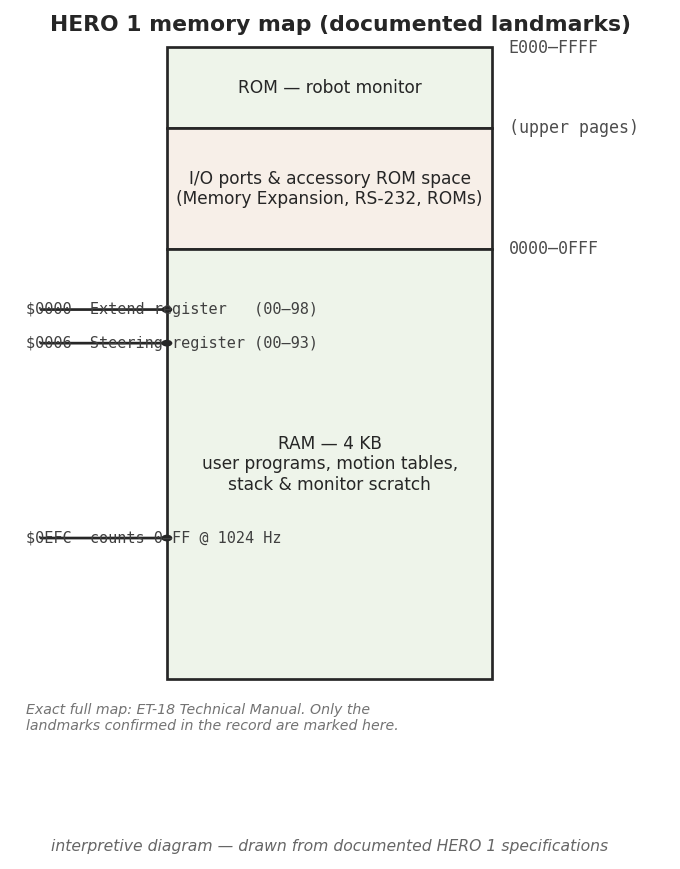
| ROM | 8 KB robot monitor, E000–FFFF (Wikipedia’s “2 KB” is contradicted) | catalogue, Fall 1983; HERO FAQ |
| I/O | Memory-mapped ports to motors, sensors, speech | HERO FAQ |
Documented monitor landmarks (the rest of the map lives in the ET-18 Technical Manual; not reconstructed here):
Table 3 — Manual; not reconstructed here)
| Address | Role | Source |
|---|---|---|
$0000 | ”Extend” register (range 00–98) | HERO FAQ |
$0006 | ”Steering” register (range 00–93) | HERO FAQ |
$0EFC | Counter, 0–FF @ 1024 Hz | HERO FAQ |
9.3 Drive & steering
Table 4 — Drive & steering
| Item | Value | Source |
|---|---|---|
| Wheels | Three — two fixed rear, one steerable front drive | HERO FAQ |
| Propulsion + steering | DC motors at the front wheel | HERO FAQ; theoldrobots |
| Stepper motors | Seven “control all movements” (DC drive is separate) | HERO FAQ |
| Stepper allocation | Head + steering + the five arm axes — interpretive; not itemized in the record | (interpretive, see Vol. 3) |
| Head rotation | 350° | HERO FAQ; Wikipedia; theoldrobots |
| Power | Four gel-cell batteries; 120/240 VAC, 50/60 Hz charger | HERO FAQ; theoldrobots |
9.4 Arm (optional, ET-18-1)
Table 5 — Arm (optional, ET-18-1)
| Item | Value | Source |
|---|---|---|
| Axes | 5 axes + gripper | HERO FAQ |
| Lift | ≈16 oz (1 lb) maximum | HERO FAQ |
| Drive | Stepper-driven joints, potentiometer position feedback | HERO FAQ |
| Joint naming | shoulder / extension / wrist pivot / wrist rotate / gripper — interpretive reading | (interpretive, see Vol. 4) |
9.5 Sensors
Table 6 — Sensors
| Sensor | Documented range / spec | Source |
|---|---|---|
| Sonar (ultrasonic ranging) | 4 inches – 8 feet | Wikipedia; HERO FAQ |
| Light | Visible spectrum into the infrared | Wikipedia; HERO FAQ |
| Sound | 300 – 5000 Hz (200 Hz lower limit per Wikipedia and the HERO FAQ) | catalogue, Fall 1983 |
| Motion | Up to 15 feet | Wikipedia; HERO FAQ |
| Also | Limit switches, real-time clock, experimental breadboard | theoldrobots |
9.6 Speech (optional, ET-18-2)
Table 7 — Speech (optional, ET-18-2)
| Item | Value | Source |
|---|---|---|
| Synthesizer | Votrax SC-01 phoneme speech chip | Wikipedia; HERO FAQ |
| Method | Phoneme-code stream → continuous formant speech | Votrax SC-01 documentation |
| Kit option price | $149.95 at launch; $99.95 from Spring 1984 | catalogue, Fall 1983; catalogue, Fall 1984 |
9.7 Control & programming
Table 8 — Control & programming
| Route | Notes | Source |
|---|---|---|
| Hex keypad + 6-digit LED | On the head; enter/verify/modify 6808 machine code, select modes | Wikipedia; HERO FAQ |
| Teaching pendant | Manual control; record / play motions | HERO FAQ |
| Cassette port | Rear-panel serial port for saving and reloading programs | catalogue, Fall 1983 |
| RF remote | Optional transmitter, three frequency versions (ET-18-35/-36/-37; manual ET-18-3), up to 100 ft | catalogue, Fall 1984 |
| RS-232 host link | ET-18-10 interface, requires the ET-18-6 memory board | catalogue, Fall 1985 |
| Default language | 6808 machine code | HERO FAQ |
| BASIC | HERO-1 BASIC (ET-18-9), requires ET-18-6 + ETA-18-6 RAM + ET-18-10 RS-232 and a terminal | catalogue, Fall 1985 |
9.8 Accessory & ROM part numbers
Table 9 — Accessory & ROM part numbers
| Part # | Accessory / ROM | Source |
|---|---|---|
| ET-18-1 | Robot arm (5 axis) | HERO FAQ; ET-18 manual set |
| ET-18-2 | Speech (Votrax SC-01) | HERO FAQ; ET-18 manual set |
| ET-18-35 / -36 / -37 | RF remote control, 75.43 / 75.67 / 75.87 MHz (manual numbered ET-18-3) | catalogue, Fall 1984; ET-18 manual set |
| ET-18-4 | Demo ROM (Utility ROM in the manuals) | catalogue, Fall 1983; ET-18 manual set |
| ET-18-5 | Monitor ROM listing | catalogue, Fall 1983 |
| ET-18-6 | Memory expansion board (up to six extra memory devices) | catalogue, Fall 1985; ET-18 manual set |
| ETA-18-6 | 8K × 8 RAM chip for ET-18-6 | catalogue, Fall 1985 |
| ET-18-7 | Automatic Mode ROM | ET-18 manual set |
| ET-18-9 | HERO-1 BASIC ROM (needs ET-18-6, ETA-18-6, ET-18-10) | catalogue, Fall 1985; ET-18 manual set |
| ET-18-10 | RS-232 interface (needs ET-18-6) | catalogue, Fall 1985 |
| ET-18-11 | Demo cassette | catalogue, Fall 1984 |
9.9 The HERO line, in one row each
Table 10 — The HERO line, in one row each
| Model | Distinguishing spec | Source |
|---|---|---|
| HERO 1 (ET-18) | 6808 @ 1 MHz, 4 KB RAM, 8 KB ROM, optional arm + speech | catalogue; HERO FAQ |
| HERO Jr (RT-1) | Smaller home version, 2 KB RAM | catalogue; Wikipedia |
| HERO 2000 (ET-19) | Intel 8088 main CPU, multi-processor, RAM to 576 KB | catalogue; Wikipedia |
Sources
- ET-18 manual set — factory manuals, Internet Archive
(
archive.org/details/heathkit-hero-1-ET-18): Assembly, Technical, Arm (ET-18-1), Voice (ET-18-2), Remote Operation (ET-18-3), BASIC (ET-18-9), the ROM and Memory Expansion accessory manuals, and the schematic sheets. Authoritative primary. - HERO FAQ —
hero.dsavage.net(deepest technical secondary; the monitor memory landmarks). - Wikipedia — “HERO (robot)”.
- theoldrobots.com, historyofinformation.com, makezine.com, robotsandcomputers.com, vintagecomputer.ca — supporting secondaries.
- Votrax SC-01 documentation — general phoneme-synthesizer facts in Vol. 6.
- Heathkit catalogues, World Radio History: No. 862, Fall 1983; No. 865, Spring 1984; Fall 1984; Christmas 1984; Fall 1985. Primary for model numbers, prices, memory sizes and accessories.
The HERO line’s catalogue history, prices and courses are in the Robots History; the battery and mains-charger cautions are in Vol. 8.
Comments (0)