HERO 2000 (ET-19) · Volume 6
The Optional Arm
6.1 What the arm is
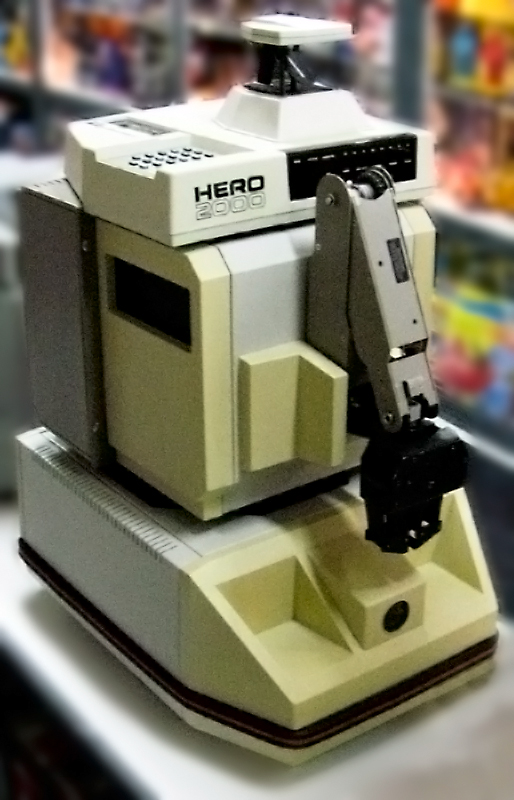
The HERO 2000 could be ordered, or upgraded, with a multi-jointed manipulator arm
ending in a gripper — an option rather than a fixed part of the machine. When fitted,
the arm extends from the robot’s torso and gives the otherwise mobile-but-handless base
the ability to reach, grasp, and place light objects. The factory spec sheet rates the
arm to a payload of about 1 pound (hero.dsavage.net HERO 2000 spec sheet;
theoldrobots.com), and Heath’s catalogue agrees: the arm “has five axis of motion and
can manipulate objects up to a pound in weight” (Heathkit catalogue, Spring–Summer 1986, p. 2). It is sold as the
ETS-19-1 arm with its controller card ($699.95 as a kit), and it came standard on
the assembled robot. It is the same general idea as the optional 5-axis arm on the
HERO 1, but it is a heavier, more
capable mechanism on a far larger robot, and — crucially for the HERO 2000’s design — fitting it changes the
robot’s electronics, not just its mechanics.
This volume covers what the record documents about the arm: its payload, the joint ranges given on the spec sheet, the extra processor and controller card the arm brings with it, and the firsthand restoration detail on how the arm is actually driven (cables and pulleys) from the Selectric writeup. Where the record is silent — reach, gripper force, joint speeds — this volume says so rather than guessing.
6.2 The documented joints
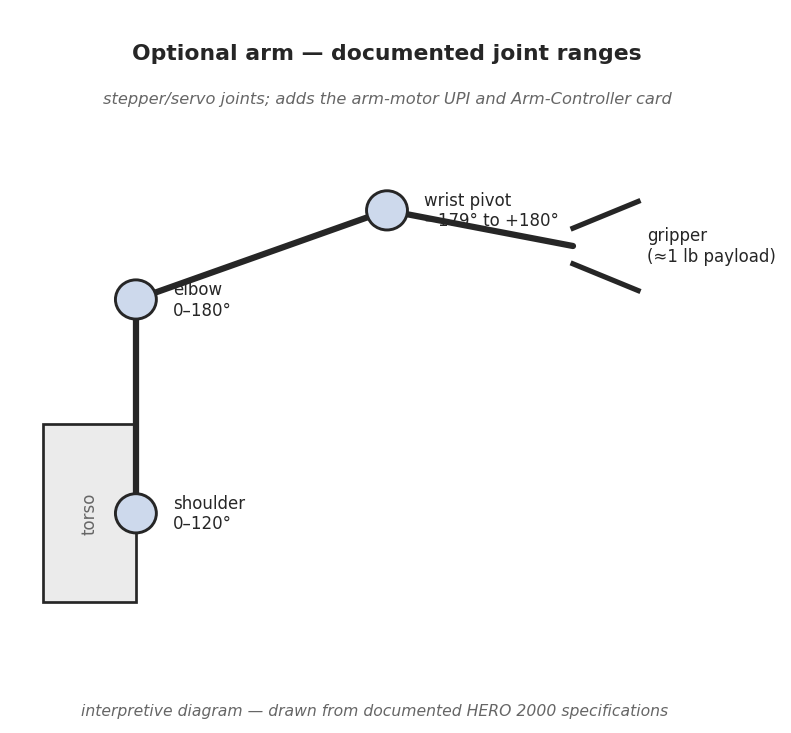
The single most specific thing the record gives about the arm is a set of joint angle
ranges, transcribed on the HERO 2000 spec sheet (hero.dsavage.net):
Table 1 — ranges, transcribed on the HERO 2000 spec sheet (hero.dsavage.net)
| Joint | Documented range | Source |
|---|---|---|
| Shoulder / arm | 0° to 120° | HERO 2000 spec sheet |
| Elbow | 0° to 180° | HERO 2000 spec sheet |
| Wrist pivot | −179° to +180° | HERO 2000 spec sheet |
These three figures are the load-bearing facts of this volume, and they should be read exactly as what they are: the angular travel of three named joints. The shoulder/arm joint raises and lowers the upper arm through a quarter-turn-plus (120°). The elbow opens and closes through a full half-circle (180°). The wrist pivots through very nearly a complete revolution (−179° to +180°, i.e. essentially the full 360° of rotation about the wrist axis).
The spec sheet gives no total axis count, but Heath’s catalogue does. The arm is “a multi-jointed, fully articulated arm with a gripper that has a sense of touch”, with “five axis of motion”, driven by “DC servo motors” in “a closed loop system” so that “HERO always knows the position of the motors and its arm”; and because “the Robot’s torso rotates on its base”, the torso “gives a sixth axis of motion to an installed arm”. The gripper, which the catalogue calls “the Heath Company patented gripper”, can “determine the size of a grasped object” and “adjust the gripping pressure over a nine-level range” (Heathkit catalogue, Spring–Summer 1986, p. 2). What neither source states is the arm’s reach or extended length, the opening span of the gripper, or the speed at which any joint moves. A reader who needs the complete kinematic specification should consult the factory ET-19 Technical Manual, the authoritative primary for the arm’s full geometry; the manual is not confirmed to be freely downloadable, so the numbers above are attributed to the transcribed spec sheet rather than reconstructed.
6.3 The arm changes the electronics: its own controller
The defining fact about the HERO 2000’s arm is not mechanical at all — it is that the arm comes with its own control electronics. The HERO 2000 is a multiprocessor machine (Vol. 2): an Intel 8088 master delegates real-time work to a set of 8-bit slave processors, which the spec sheet identifies as Intel 8042 UPIs (Universal Peripheral Interface), one for each subsystem — motor control, sonar, the keypad/display/real-time clock, and communications (HERO 2000 spec sheet).
The arm is sold with its own controller card — Heath’s catalogue lists it as “Kit ETS-19-1, HERO 2000 Arm with Controller Card” (Heathkit catalogue, Spring–Summer 1986, p. 2) — which plugs into the passive backplane’s card cage (Vol. 3; selectric.org). The spec sheet documents an arm-motor 8042 UPI slave for it. The arm’s processor takes charge of moving the joints, just as the motor-control processor takes charge of the drive wheels: the master 8088 issues high-level commands and the arm processor handles the moment-to-moment joint control.
How many processors the arm adds is where the sources differ. The spec sheet, as read in this dive, gives about six processors in the base robot and eleven with the arm, which would make the arm the difference between the two. Heath’s catalogue gives “a 16-bit 8088 master microprocessor … controlling eleven 8-bit peripheral microprocessors” without mentioning the arm (Heathkit catalogue, Spring–Summer 1986, p. 2), and states it on the same page that offers the arm-less ET-19 kit. Wikipedia gives the same figure of eleven. On the catalogue’s account the eleven belong to the robot as a whole, not to the arm-equipped configuration; on the spec sheet’s, the arm supplies the upper end of the range. The arm certainly adds its controller card and at least one processor; the total count is set out in Vol. 2 and is not resolved further here.
The architectural consequence is worth stating plainly, because it is what makes the HERO 2000’s arm different in kind from the HERO 1’s. On the HERO 1, the arm is driven by the robot’s single 6808 processor like everything else (HERO 1 dive). On the HERO 2000, the arm brings its own dedicated controller, so the master 8088 is never tied up sequencing joint motions — it hands the job to the arm’s UPI and moves on. The cross-references for the multiprocessor scheme are Vol. 2 (the 8088-master / 8042-slave architecture) and Vol. 3 (the card cage and the documented card set: CPU, Memory, Motor Controller, Arm Controller, Floppy Controller, and the head Interface card).
6.4 How the arm is driven: cables and pulleys
The richest description of the arm’s actual mechanism comes not from the factory spec sheet but from the firsthand restoration writeup at selectric.org (selectric.org/ hero2000). That account documents the arm as a cable-and-pulley mechanism rather than a set of motors mounted directly at each joint: the wrist is moved by wrist cables, and the upper arm is driven through a torso cable-and-pulley system (Selectric). In other words, motors located in or near the torso transmit their motion out to the distant joints through cables routed over pulleys — a tendon-drive arrangement that keeps the heavy actuators close to the body and the moving links light.
That detail is attributed to Selectric specifically, because it comes from a restorer working on a physical machine rather than from the spec sheet. The same writeup records a concrete failure mode of the mechanism: during the restoration, one of the wrist cables broke (Selectric). For anyone restoring a HERO 2000 today this is the salient warning — the cables are the wear point of the arm, and a broken wrist cable is a real and documented hazard of bringing an old unit back to life. Vol. 9 (acquisition and restoration) carries the broader restoration picture; this volume notes the cable fragility because it is specific to the arm.
Beyond “cables and pulleys driven from the torso, with a documented wrist-cable break,” the record does not give the gear ratios, cable routing or motor sizes of the arm; the catalogue says only that it uses DC servo motors in a closed loop.
6.5 Where the arm sits in the HERO line
The arm is also the clearest single axis on which to compare the three HEROs as manipulating machines:
Table 2 — manipulating machines
| HERO 1 (ET-18) | HERO Jr (RT-1) | HERO 2000 (ET-19) | |
|---|---|---|---|
| Arm | Optional 5-axis arm + gripper (ET-18-1) | None | Optional 5-axis arm + touch-sensing gripper (ETS-19-1); torso rotation adds a sixth axis |
| Driven by | Five stepper motors under the robot’s single 6808 | — | DC servo motors; dedicated arm controller card and processor |
| Payload | About 1 lb when fully retracted | — | Up to 1 lb |
| Documented joints | Arm joint map per ET-18 manual | — | Shoulder 0–120°, elbow 0–180°, wrist −179°/+180° |
Three points stand out. First, the HERO Jr has no arm at all — it is a fixed-head, rear-driven consumer robot built around personality programs, not manipulation (HERO Jr dive). The arm is what separates the two educational HEROs from the consumer one. Second, both educational arms are five-axis mechanisms by Heath’s own count; the HERO 2000’s spec sheet adds joint ranges for three of the joints, and its rotating torso adds a sixth axis (Heathkit catalogue, Spring–Summer 1986, p. 2). Third, the HERO 2000 arm is the only one of the three that brings its own processor and controller card; how far it raises the robot’s processor count depends on which source is followed (Vol. 2).
6.6 What remains unclaimed
To keep the record honest, the following arm specifics are not documented in the sources gathered for this deep dive and are left explicitly unclaimed:
- The arm’s reach, extended length, or working envelope.
- The gripper’s opening span, jaw geometry, or clamping/grip force.
- Joint speeds, acceleration, or cycle times.
- The arm’s gear ratios, cable routing, or motor specifications (the catalogue gives DC servo motors in a closed loop; Selectric documents the cable-and-pulley drive from the torso).
The figures that are documented — five axes plus the torso’s sixth, a payload of up
to 1 lb, a nine-level touch-sensing gripper, shoulder/arm 0–120°, elbow 0–180°, wrist
pivot −179° to +180°, and the arm controller card — are attributed above to Heath’s
catalogue, the HERO 2000 spec sheet (hero.dsavage.net), and the Selectric
restoration writeup. The factory ET-19 Technical Manual remains the primary a
restorer or builder should consult for the arm’s complete and definitive
specification.
Comments (0)