HERO 2000 (ET-19) · Volume 9
Acquisition, Restoration & Interfacing Today
9.1 Buying an ET-19 today
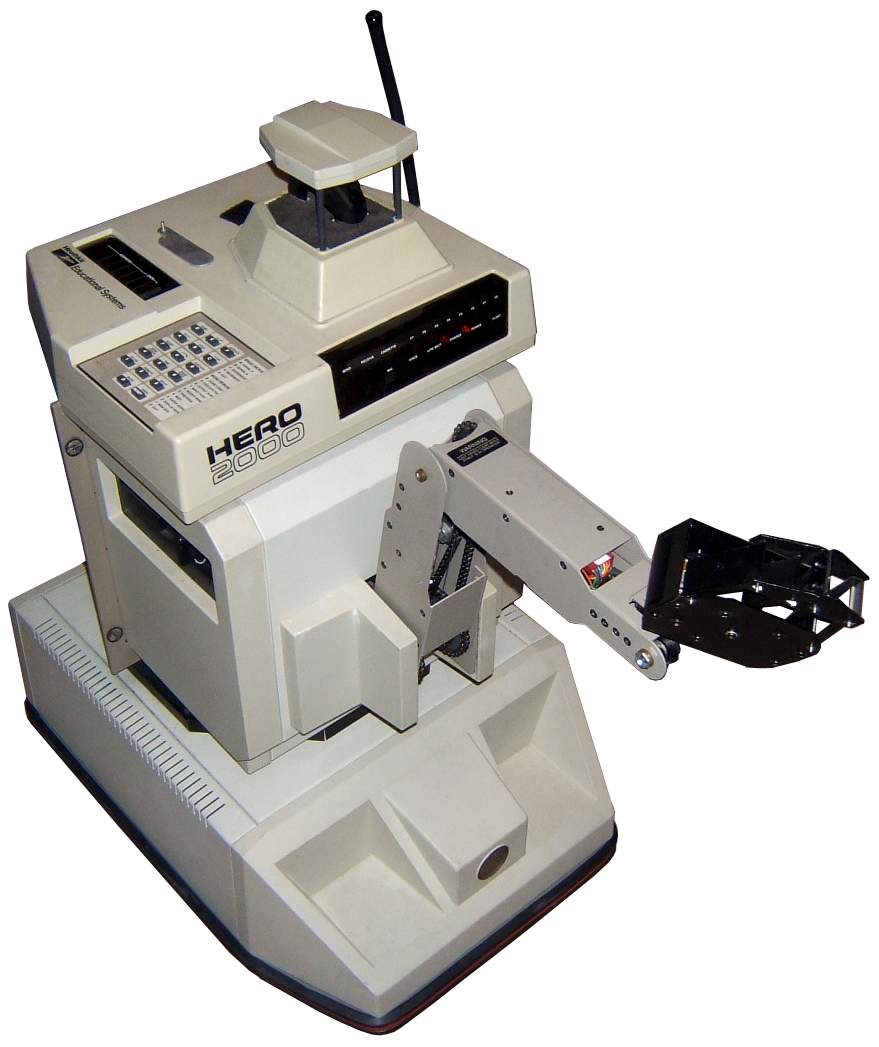
The HERO 2000 reaches the collector market either kit-built or factory-assembled. The kit was the ET-19 (without arm) or ETS-19 (with arm); the assembled robot, always with arm and remote console, was the EWS-19-35/-36 in 1986, the EWS-19-45/-46 in Fall 1987, and the ETW-19-A from Christmas 1987 (Heathkit catalogue, Spring–Summer 1986, p. 2; Heathkit catalogue, Christmas 1987, p. 80; Vol. 1). The “ET-19W” found in some listings is not a catalogue number. Both are the same machine once finished, but the distinction matters to a buyer for two reasons. A kit-built unit reflects the care of whoever assembled it three or four decades ago — workmanship varies — while an assembled robot left the factory to a uniform standard. And because the HERO 2000 was the most expensive HERO at $1,999.95 as a kit and $4,499.95 assembled (Heathkit catalogue, Spring–Summer 1986, p. 2) and sold in comparatively small numbers — about 3,000 units by Wikipedia’s unverified count, over a line discontinued in 1995 (Wikipedia) — surviving examples are scarce relative to the cheaper, more numerous HERO 1 and HERO Jr.
What separates a parts-grade shell from a complete, valuable machine is the optional equipment. Three items in particular drive completeness and therefore value:
- The optional arm. The multi-jointed arm and gripper are an add-on, not part of the base kit, and they carry their own controller card and processor with them (Vol. 6). A HERO 2000 with its arm present and intact is a materially more complete machine than a torso-only unit.
- The remote console keyboard. The detachable console/keyboard over which the robot was programmed (Vol. 8) is easily separated from the robot and easily lost.
- The docking charger. The mains charger and its docking cradle (Vol. 8; Selectric) are the means of keeping the machine alive, and a missing charger is a missing subsystem.
A representative reference point for a complete unit is the Bonhams listing of a c.1986 HERO 2000 offered with its arm, remote keyboard, and charger together (Bonhams) — the configuration a collector would treat as whole. The presence or absence of those three items is the first thing to establish about any unit on offer. No reliable price series exists in the sources gathered here, so price guidance is left unclaimed; condition and completeness, not a published figure, govern value.
9.2 Documentation — the restorer’s primaries
The authoritative references for a restoration are the factory ET-19 Technical
Manual and the ET-19 Programming Manual. The Computer History Museum catalogs
the manual set, and copies circulate on the collector market (CHM). Unlike the HERO 1
and HERO Jr — whose factory manuals are freely downloadable from archive.org — a free
scan of the ET-19 Assembly and Technical Manuals has not been found. Three
related documents are on the Internet Archive: the
HERO 2000 Illustration Booklet, 595-3414,
the Schematic Diagrams, 595-3416,
and the ET-19 Service IC Data
(Robots History, Reference). Without
the full manual, the deeper technical details in this dive rest on Heath’s catalogues
and on the transcribed factory spec sheet at hero.dsavage.net, the most
chip-level source available (Vol. 1).
The practical consequence for a restorer is that the Technical Manual is the document to acquire alongside the robot. The ROM helps: the HERO 2000’s 64 KB ROM carries demo, diagnostic, and sensor-adjustment routines in addition to the monitor and HERO 2000 BASIC (spec sheet; Vol. 3), so a working machine can be exercised and its sensors checked from on-board firmware before any external documentation is consulted.
9.3 Aging concerns
The specifics of how any individual unit has aged cannot be asserted from the record, and nothing below should be read as a measured failure rate or a quoted part. The notes here are qualitative and attributed: they identify the subsystems most worth inspecting and cite the one firsthand restoration in the sources — the Selectric writeup (selectric.org/hero2000) — for the failures it actually encountered.
9.3.1 The 12 V sealed-lead-acid battery
The battery is the single subsystem most likely to need replacement. The HERO 2000 runs from a 12 V sealed-lead-acid (SLA) battery of 24 amp-hours: “A single 24 amp-hour battery provides HERO with up to four full hours of operating power under normal use”, six hours with only the electronics running, and “up to six days” in sleep mode (Heathkit catalogue, Spring–Summer 1986, p. 2). The transcribed spec sheet’s 14 Ah is contradicted by the catalogue and is not followed here. Either way, a sealed-lead-acid cell that has sat for decades will almost certainly have lost capacity or failed outright, and replacement is the expected restoration step.
SLA replacement is also the most hazardous routine task on the machine. Old SLA cells can leak acid and can deliver very high short-circuit current — a dead short across the pack can weld tools and start fires — so the pack must be fused, never shorted at the terminals, and leaking cells disposed of properly, and charging should be done on a non-flammable surface, ventilated, and attended.
9.3.2 The arm’s cable-and-pulley mechanics
The optional arm is driven through a system of cables and pulleys, and it is the mechanism the firsthand restoration found most fragile. During the Selectric restoration a wrist cable broke and a dislodged torso cable had to be re-seated (Selectric). Those two failures are attributed to that single account and should not be generalized into a pattern, but they flag where to look first on an arm-equipped unit: the cable runs and their pulleys, particularly at the wrist and through the torso. The arm’s documented joint ranges (shoulder 0–120°, elbow 0–180°, wrist pivot −179° to +180°) are covered in Vol. 6; any cable, tension, or pulley specifics beyond what Selectric reports are left unclaimed. The usual mechanical cautions apply during any arm work — the Heathkit arms move with real force, joints and the gripper are pinch and crush points, and the machine should be powered down before reaching into the mechanism.
9.3.3 The card-cage connectors
The HERO 2000 is built around a passive backplane carrying up to 12 plug-in cards — CPU, memory, motor controller, arm controller, floppy controller, and the head interface among them (Selectric; Vol. 2, Vol. 3). A multi-card cage of this age is worth inspecting at its edge-connector contacts, where decades of oxidation can produce intermittent faults that present as subsystem failures rather than connector problems. The general practice of photographing and labelling connector orientation and wire colors before disassembly applies directly to a card cage, where reseating a card in the wrong slot or orientation is a real risk. Specific slot assignments are not reconstructed here and are deferred to the ET-19 Technical Manual (Vol. 3).
9.3.4 The docking charger
The robot is kept charged through a 120 VAC charger and a docking cradle with angled rails that guide the machine into contact (spec sheet; Selectric). Heath’s catalogue lists an ET-19-5 Auto-Docking Accessory ($149.95), first in Fall 1987 (Heathkit catalogue, Fall 1987). The charger is mains-powered, so the usual electrical cautions apply: treat any opened line-voltage wiring as live, unplug before working inside and verify with a meter, and replace cracked line cords and failed strain reliefs. Aging filter capacitors in a decades-old supply can dry out or short and should be inspected for bulging or leakage and reformed or replaced before full power is applied. The internal charger circuit is not documented in the sources here and is not described in detail.
9.4 Safety — before any battery or charger work
Because two of the most likely restoration tasks — the SLA pack and the mains charger — are also the two most hazardous, the cautions above bear repeating as a set: for the SLA pack, the leak and short-circuit hazard (fuse the pack, charge ventilated and attended); for the charger, treat mains wiring as live, meter before touching, and inspect aging electrolytics; and for the arm and drive, pinch and crush points (power down before reaching in). Any restoration or interfacing work on a HERO 2000 should begin with them.
9.5 Modern interfacing
The HERO 2000 is straightforward to connect to a modern computer because its programming interface is ordinary serial. The machine carries two RS-232C serial ports, wired as DCE — one intended for a terminal, one for a printer — running at baud rates up to 38,400 (spec sheet; Vol. 8). That is the same interface a period terminal used to program the robot, and it bridges trivially to a present-day PC through a USB-to-serial adapter: the adapter presents a virtual COM port to the host, and a terminal program at a matching baud rate talks to the robot’s monitor and HERO 2000 BASIC over the terminal port exactly as a 1986 terminal would have. The DCE wiring of the robot’s ports (Vol. 8) determines whether a straight or crossover cable is needed against a given adapter, and the exact pinout is the detail to confirm against the ET-19 Technical Manual before wiring a cable; it is not reconstructed here.
This serial path is the supported, documented route to driving a HERO 2000 from modern equipment, and for most restorers it is sufficient — a working machine, a USB-serial adapter, and a terminal emulator are enough to reach the on-board BASIC and the diagnostic routines. Deeper or undocumented modifications — replacing the battery chemistry, substituting modern storage for the floppy controller, adapting the radio link, or any reverse-engineering of the card bus — are beyond what the sources here document, and this volume makes no claim about how such changes behave or whether they are advisable. They are left explicitly unclaimed.
9.6 What remains unclaimed
Several acquisition-relevant specifics are left open rather than invented: current market prices and any failure-rate figures (no reliable series exists in the sources); the internal design of the charger; the card-cage slot assignments (deferred to the ET-19 Technical Manual); and the behavior of any undocumented modification. Where this volume cites the Selectric restoration, the failures described are that single account’s and are attributed accordingly, not generalized into a pattern.
Comments (0)