HERO Jr (RT-1) · Volume 1
Overview — The Heathkit Personal Robot
1.1 What it is
The HERO Jr is a self-contained mobile robot Heathkit introduced in 1984 as a home product — a “personal robot” for the living room rather than a teaching machine for the classroom. Where the earlier HERO 1 (covered in its own deep dive) was an educational kit that demanded its owner learn to program it before it would do anything interesting, the HERO Jr was built by Heathkit’s consumer division to do something the moment it was switched on: roam a room, sense its surroundings, talk, sing, stand guard, and react — all selected with a single press of a labelled key (Wikipedia, “HERO (robot)”; partofthething.com, “The Hero Jr. personal robot from HeathKit”; theoldrobots.com).
It borrows heavily from the HERO 1 — the same Motorola 6808 processor, the same
family of sonar and light and sound sensors, the same Heathkit kit-build tradition
— but every choice bends toward being cheaper and simpler to live with. There is no
manipulator arm. The head does not rotate. The bare hexadecimal monitor of the
HERO 1 is wrapped in a set of one-touch “personality” programs burned into ROM, and
speech, which was an extra-cost option on the HERO 1, is built in (HERO FAQ,
hero.dsavage.net; theoldrobots.com).
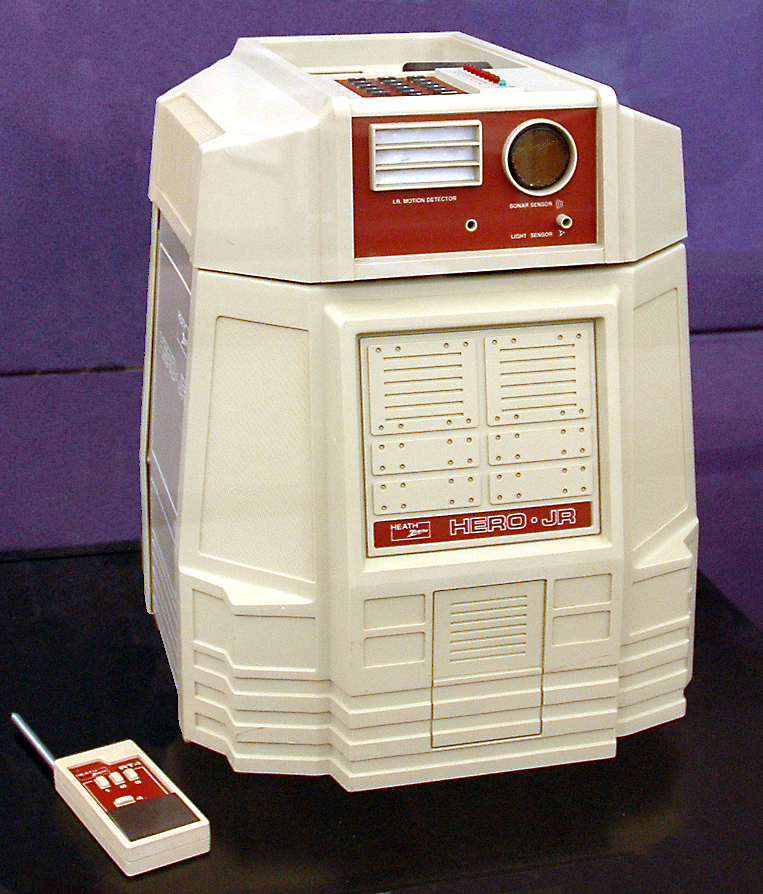
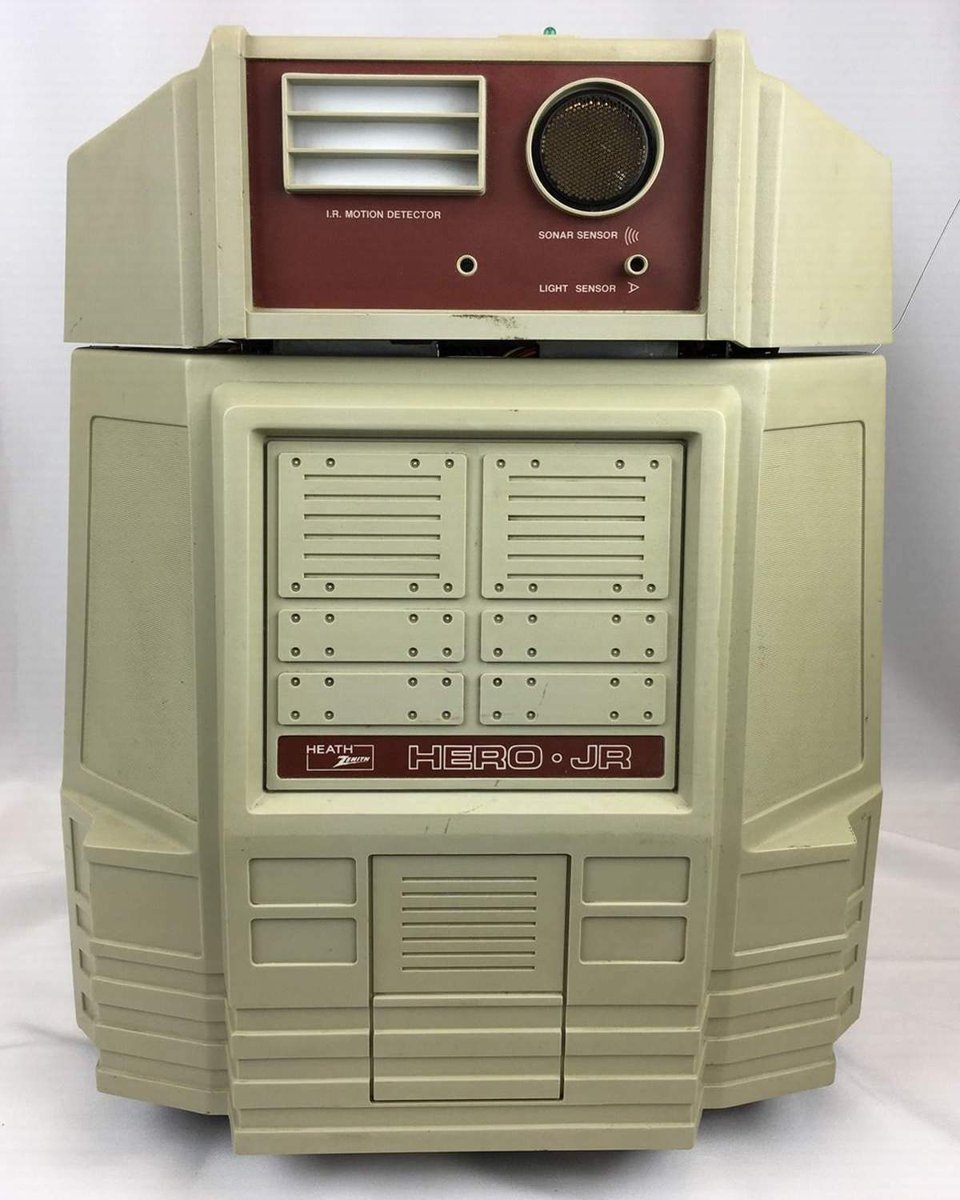
The result stands 19 inches tall and, like most Heathkit products, arrived as a box of parts: the kit, model RT-1, was “easily assembled in approximately twenty hours” and cost $599.95 at launch (Heathkit catalogue, Christmas 1984, p. 2). An assembled robot, RTW-1, sold with all four accessories, appears in the mail-order catalogue only in 1986 (Heathkit catalogue, Spring–Summer 1986, p. 16). Some secondary sources give the two numbers the other way round; the catalogue numbering is used throughout this dive.
The robot’s place in Heath’s robot line — the catalogues, the falling prices, and the sister robots — is told in the Robots History. It rolls on three wheels, runs from a pair of internal rechargeable batteries, and — in one of the demonstrations Heathkit leaned on — can carry a drink across a room in a small compartment in its body.
1.2 Headline facts
Table 1 — Headline facts
| Attribute | Value | Source |
|---|---|---|
| Name | HERO Jr — Heathkit’s home “personal robot” | Wikipedia; theoldrobots.com |
| Model numbers | RT-1 (kit); RTW-1 (assembled with all four accessories) and RTW-1-C (assembled with RS-232 and cartridge adapter), both 1986 only | Heathkit catalogue, Christmas 1984, p. 2; Heathkit catalogue, Spring–Summer 1986, p. 16 |
| Year | 1984 (shown at CES in June; first catalogued Christmas 1984) | Robots History |
| Price (new) | Kit $599.95 at launch; $399.95 by Fall 1985; $299.95 in 1986 (a $1,000 retail price was reported at CES) | Heathkit catalogue, Christmas 1984, p. 2; Heathkit catalogue, Fall 1985, p. 2; Heathkit catalogue, Spring–Summer 1986, p. 16 |
| Units produced | ~4,000 (unverified; no Heath figure found) | Wikipedia; Dilettante |
| Assembly time (kit) | ~20 hours | Heathkit catalogue, Christmas 1984, p. 2 |
| CPU | Motorola 6808, 8-bit, 1 MHz | HERO FAQ; Dilettante |
| RAM | 2 KB (6116), expandable to 24 KB | HERO FAQ; theoldrobots.com |
| ROM | 32 KB (robot monitor + personality programs) | HERO FAQ; theoldrobots.com |
| Speech | Built-in Votrax SC-01 / SC-01A | HERO FAQ; Dilettante |
| Display | Eight data LEDs that flash in time with speech (secondary sources say nine) | Heathkit catalogue, Christmas 1984, p. 2 |
| Input | 17-key hexadecimal keypad (rubber keys) on the head | theoldrobots.com; HERO FAQ |
| Sensors | Polaroid sonar (also used for motion detection), light, sound; optional IR motion detector (RTA-1-1) | Heathkit catalogue, Christmas 1984, p. 2 |
| Head | Fixed — does not rotate | HERO FAQ |
| Drive | Three wheels; one steerable drive wheel at the rear | HERO FAQ; theoldrobots.com |
| Payload | Up to 10 lb in a 94-cubic-inch compartment | theoldrobots.com; HERO FAQ |
| Power | Two 6 V rechargeable batteries (4.0 Ah per theoldrobots.com); 4–6 h per the 1984 catalogue, “about 4 hours” from 1985 | Heathkit catalogue, Christmas 1984, p. 2; Heathkit catalogue, Fall 1985, p. 2; theoldrobots.com |
| Height | 19 inches | theoldrobots.com; HERO FAQ |
| Expansion | RTC program cartridges + RTA accessories | theoldrobots.com |
| Programming | Personality keys; HERO JR. Program Language (RTC-1-10 cartridge); BASIC (RTC-1-8) over RS-232 (RTA-1-3); RF remote (RTA-1-2) | Heathkit catalogue, Fall 1985, p. 2; Dilettante |
1.3 The one-touch idea
The single design decision that defines the HERO Jr is that an owner should not have to program it. The 17-key keypad on its head is not, in the first instance, a machine-code monitor at all — it is a row of labelled behaviour keys: Sing, Play, Poet, Gab, Alarm, Guard, Help, Plan, plus Setup and Enter (theoldrobots.com; HERO FAQ; Dilettante). Press Guard and the robot watches the room and reacts to intrusion; press Sing and it sings; press Poet and it recites. Each of these behaviours is a program already living in the robot’s unusually large 32 KB ROM, and the key simply starts it. This is the consumer inversion of the HERO 1: the capability is built in, and the owner selects rather than writes it.
For owners who wanted more, the depth was there — HERO Jr could be driven by a remote control, programmed in its own keypad language (HJPL, sold on a cartridge), or run BASIC from a plug-in cartridge (Vols 5–7) — but none of that was required to get a talking, roaming robot out of the box. That balance, capable-by-default with a path deeper, is what the partofthething.com retrospective calls “a 1984 product way ahead of its time.”
1.4 Where it sat — and how it differs from the HERO 1
The HERO Jr arrived two years after the HERO 1 and aimed at a different buyer. The HERO 1 was a $999.95-to-$2,499.95 educational platform sold to schools and serious hobbyists; the HERO Jr was a $599.95 kit sold to households, and the roughly 4,000 units Wikipedia reports (against the HERO 1’s ~14,000, also unverified) reflect the narrower consumer-robot market of the mid-1980s (Wikipedia; Dilettante; Heathkit catalogue, Christmas 1984, p. 2). Heathkit’s consumer division built it by taking the HERO 1’s architecture and removing cost and complexity wherever a home user would not miss it.
The differences are worth stating up front, because they shape the volumes that follow:
Table 2 — follow
| HERO 1 (ET-18) | HERO Jr (RT-1) | |
|---|---|---|
| Market | Educational | Consumer / home |
| Year | 1982 | 1984 |
| RAM / ROM | 4 KB / 8 KB | 2 KB → 24 KB / 32 KB ROM |
| Head | Rotates 350° | Fixed |
| Drive wheel | Steerable, at the front | Steerable, at the rear |
| Arm | Optional 5-axis | None |
| Speech | Optional (Votrax SC-01) | Built-in (Votrax SC-01/SC-01A) |
| Out-of-box use | Program it first | One-touch personality keys |
| Expansion | Accessory ROMs, memory board + RS-232 interface | RTC cartridges + RTA accessories |
The HERO 1 and HERO 2000 have dives of their own. The HERO Jr is not a cut-down HERO 1 so much as a re-aimed one: the same silicon serving a different goal. Its larger ROM, its built-in voice, its cartridge slot, and its labelled keys all exist to make a robot that does something the moment a non-programmer switches it on.
The volumes that follow open each layer of that machine. Vol. 2 covers the 6808 hardware, the 2 KB-to-24 KB memory, and power; Vol. 3 the rear-driven three-wheel base and the fixed head; Vol. 4 the Polaroid sonar and the light, sound, and optional infrared sensing; Vol. 5 the built-in Votrax speech and the personality programs; Vol. 6 the deeper programming paths — HJPL, cartridge BASIC, and the remote; Vol. 7 the RTC cartridge and RTA accessory ecosystem; and Vol. 8 acquiring and restoring one today. Vol. 9 is the cheatsheet.
Comments (0)