HERO Jr (RT-1) · Volume 7
Cartridges & Accessories — The RTC / RTA Ecosystem
7.1 Why a cartridge at all
The HERO Jr was sold to a buyer who was not expected to own a soldering iron, an EPROM programmer, or a logic probe. That single assumption — the consumer, not the classroom (Vol 1) — shapes the whole expansion model. On the HERO 1, growing the robot’s repertoire meant working at the level of the silicon: programs lived in ROM, and an owner who wanted new behaviour either typed machine code into the hexadecimal monitor or physically swapped accessory ROM chips into the board. That is a fine model for a teaching machine whose owner is supposed to learn the hardware. It is a poor one for someone who bought a robot to have it sing, guard a room, and carry a drink across the living room.
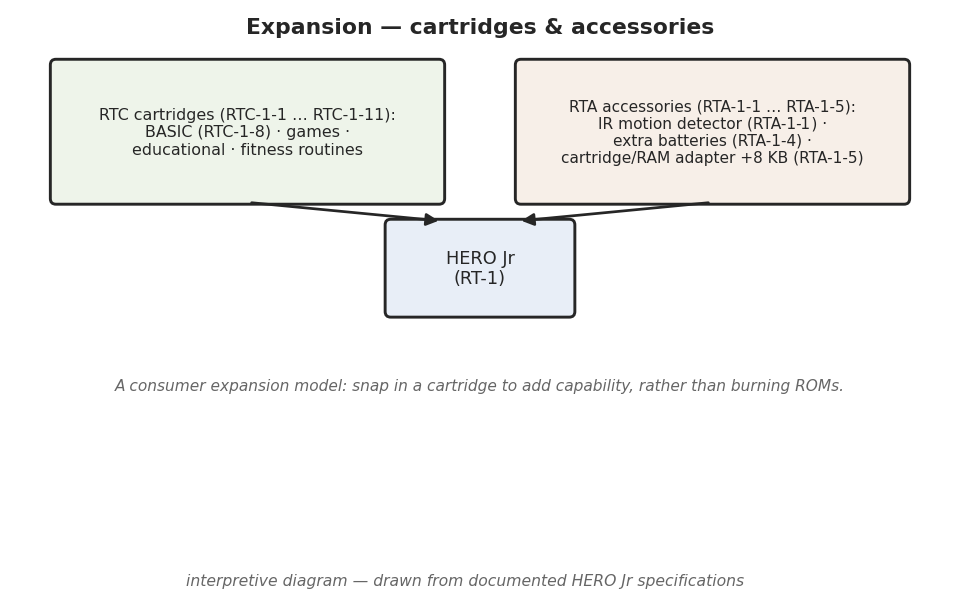
The HERO Jr answers that with the RTC program cartridge: a snap-in module the owner inserts to give the robot a new body of programs, with no chips to handle and no code to enter (theoldrobots.com). The robot already carries an unusually large 32 KB ROM holding the monitor and the built-in personality programs (Vol 2); a cartridge extends that library outward through the same memory-mapped path the built-in firmware uses, so a “Games” cartridge or the BASIC cartridge becomes, from the owner’s side, just another thing the robot now knows how to do. The act of expansion is reduced to inserting a card — the consumer inversion of the HERO 1’s chip-and-monitor approach (Vol 6 covers what the BASIC cartridge in particular unlocks for those who did want to program).
Alongside the program cartridges sits a second, parallel line: the RTA accessory catalogue — hardware add-ons (a motion detector, extra batteries, a memory adapter) rather than program modules. Together the RTC and RTA numbers form the documented expansion ecosystem of the machine.
7.2 The RTC program cartridges
The program cartridges are catalogued under the prefix RTC, numbered RTC-1-1 through RTC-1-11, and every one of them requires the RTA-1-5 cartridge adapter (“all require the installation of the RTA-1-5 Cartridge Adapter Accessory”, Heathkit catalogue, Christmas 1984, p. 2). Heath’s catalogues name every title. They arrived in three waves: six at launch at Christmas 1984, three more by Fall 1985, and the last two in 1986.
Table 1 — The RTC program cartridges
| Part # | Title | First found | Price | Source |
|---|---|---|---|---|
| RTC-1-1 | Trivia Quotes (“plays like a popular trivia game”; the player guesses which of four people made a statement) | Spring–Summer 1986 (“NEW!”) | $39.95 | Heathkit catalogue, Spring–Summer 1986, p. 16 |
| RTC-1-2 | Songs, Phrases and Rhymes #1 | Christmas 1984 | $19.95 | Heathkit catalogue, Christmas 1984, p. 2 |
| RTC-1-3 | Animals, Blackjack and Tic Tac Toe | Christmas 1984 | $39.95 | Heathkit catalogue, Christmas 1984, p. 2 |
| RTC-1-4 | Special Occasions (two versions of Happy Birthday, one using the owner’s name; Jingle Bells; Auld Lang Syne) | Christmas 1984 | $19.95 | Heathkit catalogue, Christmas 1984, p. 2 |
| RTC-1-5 | Math Master, “a timed math game” | Christmas 1984 | $24.95 | Heathkit catalogue, Christmas 1984, p. 2 |
| RTC-1-6 | Riddle Robot / Tongue Twister | Christmas 1984 | $24.95 | Heathkit catalogue, Christmas 1984, p. 2 |
| RTC-1-7 | Philosopher: lets the robot “randomly say philosophical phrases” | Spring–Summer 1986 (“NEW!”) | $39.95 | Heathkit catalogue, Spring–Summer 1986, p. 16 |
| RTC-1-8 | HERO JR. BASIC, with “special enhancements for speech, movement, sensors and integer math”; requires the RTA-1-3 RS-232 port | Christmas 1984 | $49.95 | Heathkit catalogue, Christmas 1984, p. 2 |
| RTC-1-9 | HEROBICS exercise cartridge, four levels of difficulty and ten exercises | Fall 1985 (“NEW!”) | $29.95 | Heathkit catalogue, Fall 1985, p. 2 |
| RTC-1-10 | HERO JR. Program Language, “allows you to program the Robot through its keyboard” (HJPL, Vol 6) | by Fall 1985 | $39.95 | Heathkit catalogue, Fall 1985, p. 2; Heathkit catalogue, Spring–Summer 1986, p. 16 |
| RTC-1-11 | Musical Chairs, with Acey-Ducey and Robot Mind Reader | by Fall 1985 | $34.95 | Heathkit catalogue, Fall 1985, p. 2; Heathkit catalogue, Spring–Summer 1986, p. 16 |
Most secondary accounts, including theoldrobots.com, give the range RTC-1-1 to RTC-1-11 and a set of categories (games, educational, fitness, BASIC) without tying most numbers to titles; the catalogue fills every slot. The catalogue OCR sometimes renders the prefix “RIA” or “RI”; the catalogue’s own cross-references and later issues use RTA and RT.
7.2.1 What a cartridge does for the owner
Functionally, an RTC cartridge is the consumer-facing equivalent of the HERO 1’s accessory ROMs, but it is handled like a console game cartridge: insert it, and the robot gains the programs it carries. The titles give a clear sense of the intended use:
- Games — Animals, Blackjack and Tic Tac Toe (RTC-1-3), Musical Chairs (RTC-1-11) and Trivia Quotes (RTC-1-1): interactive play, the cartridge supplying the program the robot runs while the owner interacts through the keypad and the robot’s speech and sensors.
- Educational and verbal — Math Master (RTC-1-5), Riddle Robot / Tongue Twister (RTC-1-6), Philosopher (RTC-1-7) and the songs-and-rhymes cartridges (RTC-1-2, RTC-1-4), consistent with HERO Jr’s marketing as a family product.
- Fitness — HEROBICS (RTC-1-9), the robot leading exercise, an unusual use that fits a machine designed to be a presence in the home rather than a lab instrument.
- Programming (RTC-1-8 and RTC-1-10) — the outliers: not packaged behaviours but toolchains. RTC-1-8 makes the robot programmable in BASIC over the RS-232 serial link, and RTC-1-10 carries the keypad programming language (Vol 6); the BASIC cartridge has its own factory manual.
The crucial point for this volume is the delivery mechanism, not the catalogue: in every case the owner expands the robot by inserting a card, and the robot’s existing firmware and memory map (Vol 2) absorb the new code. The cartridge is the bridge between a sealed consumer appliance and a genuinely extensible computer.
7.3 The RTA accessories
The hardware add-ons are catalogued under the prefix RTA, numbered RTA-1-1 through RTA-1-5, and all five were offered from the robot’s launch (Heathkit catalogue, Christmas 1984, p. 2):
Table 2 — ([Heathkit catalogue, Christmas 1984, p. 2](https://www.worldradiohistory.com/Archive-Catalogs/Heathkit-Catalogs/Heathkit-1984-Christmas.pdf))
| Part # | Accessory | Launch price | Source |
|---|---|---|---|
| RTA-1-1 | Infrared motion detector, “approximately 35’ long x 20’ wide”, with two “Protected By A Security Robot” window stickers | $119.95 | Heathkit catalogue, Christmas 1984, p. 2 |
| RTA-1-2 | Remote control, 75 MHz, “up to 150 feet” (100 feet from 1985) | $179.95 | Heathkit catalogue, Christmas 1984, p. 2; Heathkit catalogue, Fall 1985, p. 2 |
| RTA-1-3 | RS-232 accessory, for BASIC programming (RTC-1-8) from a terminal or computer | $49.95 | Heathkit catalogue, Christmas 1984, p. 2 |
| RTA-1-4 | Two extra batteries, to “double HERO JR.’s operating time” | $59.95 | Heathkit catalogue, Christmas 1984, p. 2 |
| RTA-1-5 | Cartridge adapter, “includes additional 8K RAM”; needed for every RTC cartridge | $49.95 | Heathkit catalogue, Christmas 1984, p. 2 |
Heath also sold the accessories in “saver” bundles with the kit: RTR-1-1 (RS-232 and cartridge adapter, $649.95) and RTR-1-2 (all four main accessories, $849.95) at launch, and in 1986 the assembled RTW-1 (with RTA-1-1, -2, -3 and -5, $499.95) and RTW-1-C (with RTA-1-3 and -5) (Heathkit catalogue, Christmas 1984, p. 2; Heathkit catalogue, Spring–Summer 1986, p. 16). Some secondary sources, including theoldrobots.com, give the infrared detector as RTA-1-2 and leave RTA-1-1 and RTA-1-3 unidentified; the catalogue numbering is used here.
7.3.1 RTA-1-1 — the infrared motion detector
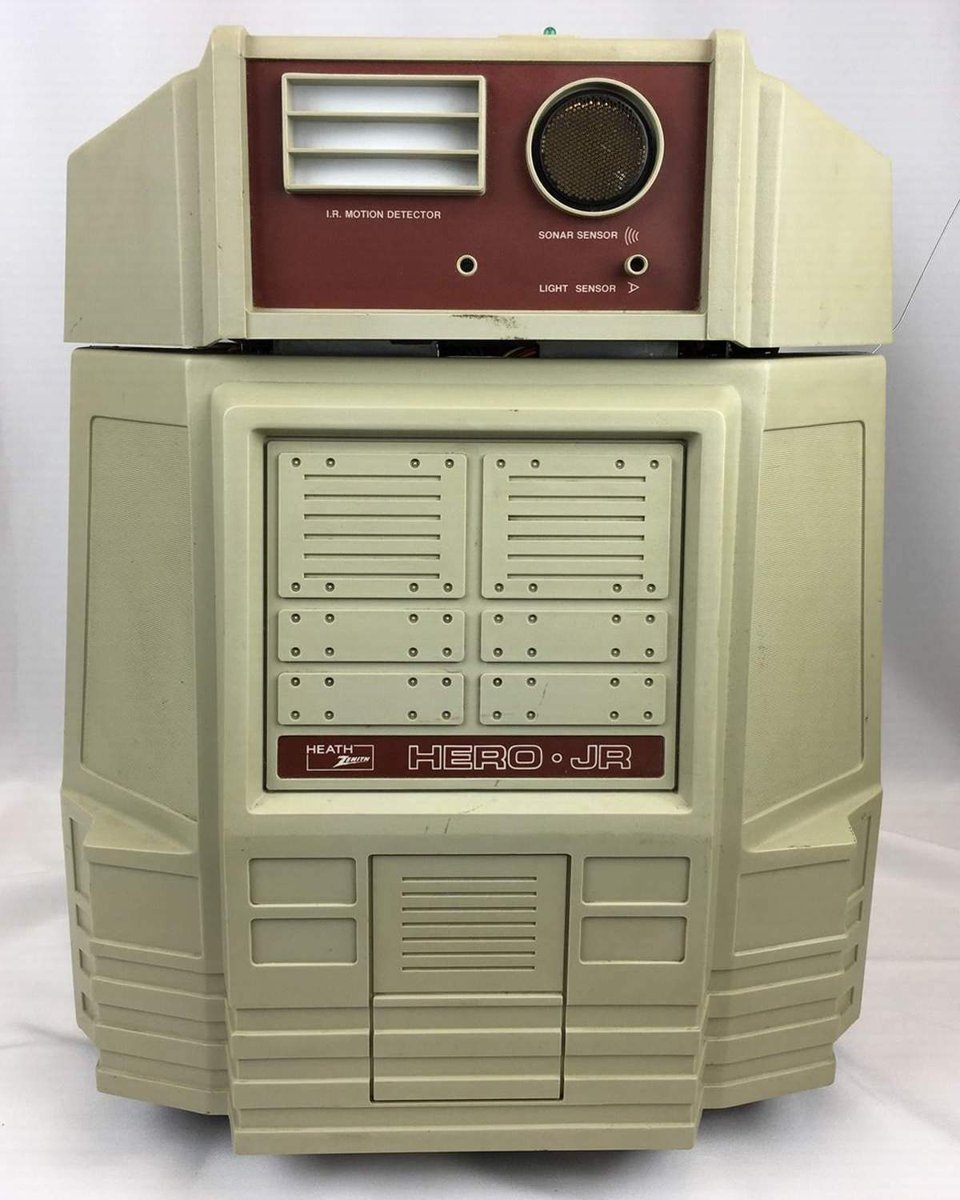
The RTA-1-1 is the optional infrared motion detector, the one HERO Jr sensor that is an add-on rather than a built-in (the sonar, light, and sound sensors are standard — Vol 4). Its documented coverage is a field roughly 35 feet long by 20 feet wide (catalogue; theoldrobots.com), a detection zone sized for a room rather than a benchtop. With the head fixed (Vol 3), the robot cannot sweep the detector by turning its head, so the field is aimed by the body — the detector watches the wedge of room the robot is pointed at. This is the accessory that most directly upgrades the robot’s signature Guard behaviour (Vol 5): a HERO Jr standing watch with an RTA-1-1 fitted has a far larger and more sensitive zone of awareness than one relying on sonar and sound alone. Note that the robot’s front panel carries an “I.R. MOTION DETECTOR” label regardless (visible in the unit photos, Vol 1/Vol 4), reflecting that the function is a designed-in option rather than a third-party hack.
7.3.2 RTA-1-4 — the extra battery pack
The RTA-1-4 adds two extra batteries to “double HERO JR.’s operating time” (Heathkit catalogue, Christmas 1984, p. 2). The HERO Jr ships with two 6 V rechargeable batteries (4.0 Ah per theoldrobots.com) and runs about four hours on a charge during normal exploring (Vol 2); the RTA-1-4 adds a second pair, extending endurance toward roughly twice that figure. For a robot whose whole appeal is being switched on and left to roam, react, and guard, doubled runtime is a meaningful upgrade rather than a niche one — and it is purely additive hardware, requiring no change to the firmware or the program model. (The robot’s sealed-lead- acid batteries and their charging cautions are taken up in Vol 8.)
7.3.3 RTA-1-5 — the cartridge / RAM adapter (+8 KB)
The RTA-1-5 is the most architecturally interesting accessory: a cartridge / RAM adapter that adds 8 KB of memory; the catalogue describes it as permitting “use of optional plug-in cartridges” and “includes additional 8K RAM” (Heathkit catalogue, Christmas 1984, p. 2). It sits at the junction of the two expansion lines — it is itself a hardware accessory (RTA), but what it does is extend the robot’s cartridge and memory capability. The base HERO Jr carries 2 KB of RAM (a 6116), and the architecture is documented as expandable to 24 KB (Vol 2); the RTA-1-5’s +8 KB is one documented step along that expansion path. The added RAM is what gives larger cartridge programs — and BASIC programs entered over the serial link (Vol 6) — room to run, since a BASIC interpreter and a user’s program both need working memory beyond the 2 KB the robot ships with. In effect, RTA-1-5 is the accessory that makes the deeper, programmable side of the HERO Jr (Vol 6) practical, which is why it pairs naturally with the RTC-1-8 BASIC cartridge.
7.4 How the two lines fit together
Read together, the RTC and RTA catalogues describe a deliberately layered upgrade path for a non-technical owner:
- Out of the box, the robot already does a great deal — the one-touch personality keys driven from the 32 KB ROM (Vols 1, 5).
- RTC program cartridges add software behaviour with nothing more than an insertion — games, educational and fitness content, the keypad programming language (RTC-1-10) and BASIC (RTC-1-8).
- RTA accessories add hardware capability — wider sensing (RTA-1-1), remote driving (RTA-1-2), a serial port (RTA-1-3), longer endurance (RTA-1-4), and more memory (RTA-1-5) for the programs the cartridges and the serial link bring.
The design intent is consistent across both lines: every documented step is something the owner installs or inserts, never something they have to engineer. That is the through-line from Vol 1’s “capable by default, with a path deeper.” The cartridge slot and the accessory catalogue are how that path is paved — and the RTA-1-5 adapter, by adding both cartridge/RAM capacity and the 8 KB those larger programs need, is the single accessory that ties the software path (cartridges, BASIC) back to the hardware it runs on.
7.5 What the record does and does not fix
Because part numbers are exactly the kind of hard fact this series checks strictly, it is worth stating the boundary plainly:
- Documented as fact, from Heath’s catalogues: every RTC title from RTC-1-1 to RTC-1-11 with its first catalogue appearance and price; every RTA accessory from RTA-1-1 (IR motion detector) to RTA-1-5 (cartridge adapter with 8 KB RAM); and the dependencies — every cartridge needs RTA-1-5, and BASIC (RTC-1-8) also needs the RTA-1-3 RS-232 port.
- Not documented, and therefore left unclaimed here: the internal contents, ROM sizes and in-use details of the individual cartridges, and the prices of the 1986 cartridges in later catalogues.
A collector or restorer reconstructing the ecosystem can take the tables above as the catalogue record and confirm any individual cartridge against its label. Vol 8 covers acquisition, where the completeness of a unit’s cartridges and accessories is one of the things that most affects its value.
Comments (0)