HW-101 Transceiver · Volume 1
Overview
For most of the 1970s the cheapest way to get a competent, full-legal-limit-capable single-sideband station on the air was to buy a cardboard box of parts from Benton Harbor and spend a few dozen evenings at the kitchen table. The box held the Heathkit HW-101: five circuit boards, four switch boards, a pre-wound wiring harness, twenty tubes and a 245-page manual. It transmitted and received upper sideband, lower sideband and CW on 80 through 10 metres, ran 180 watts peak envelope power input to a pair of 6146 beam tetrodes, and cost $249.95 when it first appeared in a Heath catalogue — about a quarter of what a Collins station cost and roughly a third the price of Heath’s own SB-102, from which it was directly derived.
It stayed in the catalogue for thirteen years, longer than any other Heath transceiver, and it was the last tube transceiver the company ever designed. Two generations of American amateurs learned to solder on one.
1.1 What it is
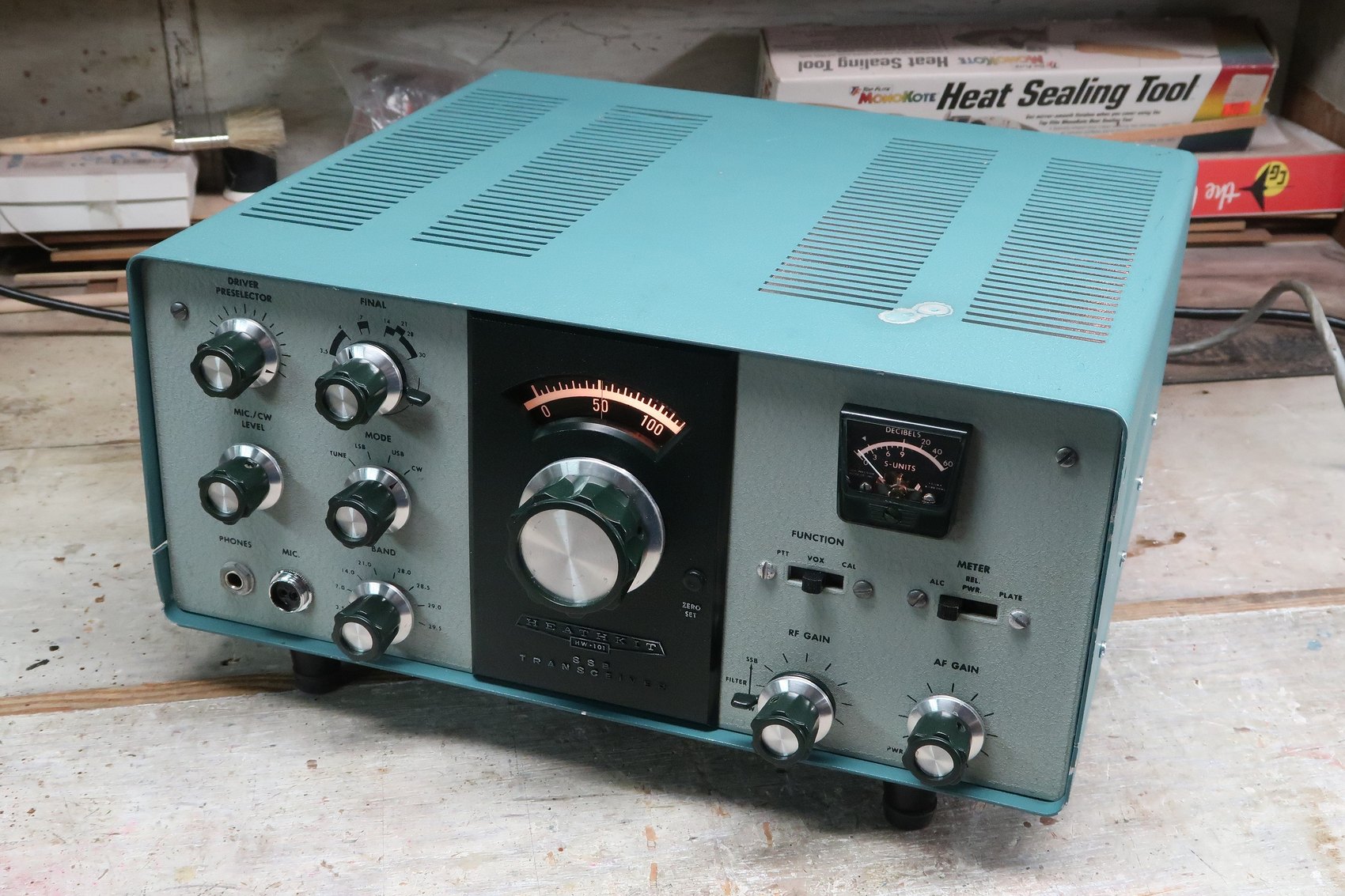
The HW-101 is a double-conversion SSB and CW transceiver for the five HF amateur bands available in 1970: 80, 40, 20, 15 and 10 metres, with 10 metres split into four 500 kHz segments so that the whole band is covered. The receiver and the transmitter share one variable-frequency oscillator, one heterodyne crystal per band, one crystal filter and one intermediate-frequency amplifier, which is what makes transmit and receive frequencies track exactly and what makes the set a transceiver rather than a transmitter and receiver in the same box.
Heath’s own specification for the model is reproduced in full in the Reference volume. The Heath Company’s own story — Benton Harbor, Daystrom, Schlumberger, Zenith and the end of the kits — is told in the site history dive and is not repeated here. The headline figures, taken from the assembly manual’s specification pages, are these.
Table 1 — What it is
| Bands | 3.5–4.0, 7.0–7.3, 14.0–14.5, 21.0–21.5 MHz; 28.0–28.5, 28.5–29.0, 29.0–29.5, 29.5–30.0 MHz |
| Modes | USB, LSB, CW (and a TUNE position) |
| DC power input | 180 W PEP on SSB; 170 W on CW at 50 per cent duty cycle |
| RF power output | 100 W, 80 through 15 metres; 80 W on 10 metres, into 50 Ω |
| Finals | Two 6146 in parallel, class AB1 |
| Receiver sensitivity | Better than 0.35 µV for 10 dB signal-plus-noise to noise (Heath’s figure from 1971 on; the manual’s own specification page says 0.3 µV) |
| Selectivity | 2.1 kHz at −6 dB, 7 kHz at −60 dB (3.395 MHz crystal filter); 400 Hz at −6 dB with the optional SBA-301-2 CW filter |
| Stability | Less than 100 Hz per hour after 45 minutes’ warm-up |
| Dial | 5 kHz divisions; 35⅓ knob revolutions per 500 kHz band segment |
| Tubes | 20, including the pair of 6146 and an OA2 regulator |
| Semiconductors | One MPF-105 FET (the VFO), one 2N3393 used as a zener, 16 diodes |
| Size and weight | 14-13/16 × 6-5/16 × 13-3/8 inches; 17½ lb net |
| Power required | 700–850 V at 250 mA, 300 V at 150 mA, −115 V at 10 mA, 12 V at 4.76 A — from a separate supply |
Three of those lines define the rig’s character. The power supply is external, which is why an HW-101 without an HP-23 or PS-23 beside it is an ornament. The finals are 6146s, a communications tube rather than a television sweep tube, so replacements are still cheap and plentiful. And the receiver’s selectivity comes from a real crystal lattice filter at 3.395 MHz rather than from a cascade of IF transformers, which is why the set still sounds respectable on a crowded band half a century later.
1.2 Where it came from
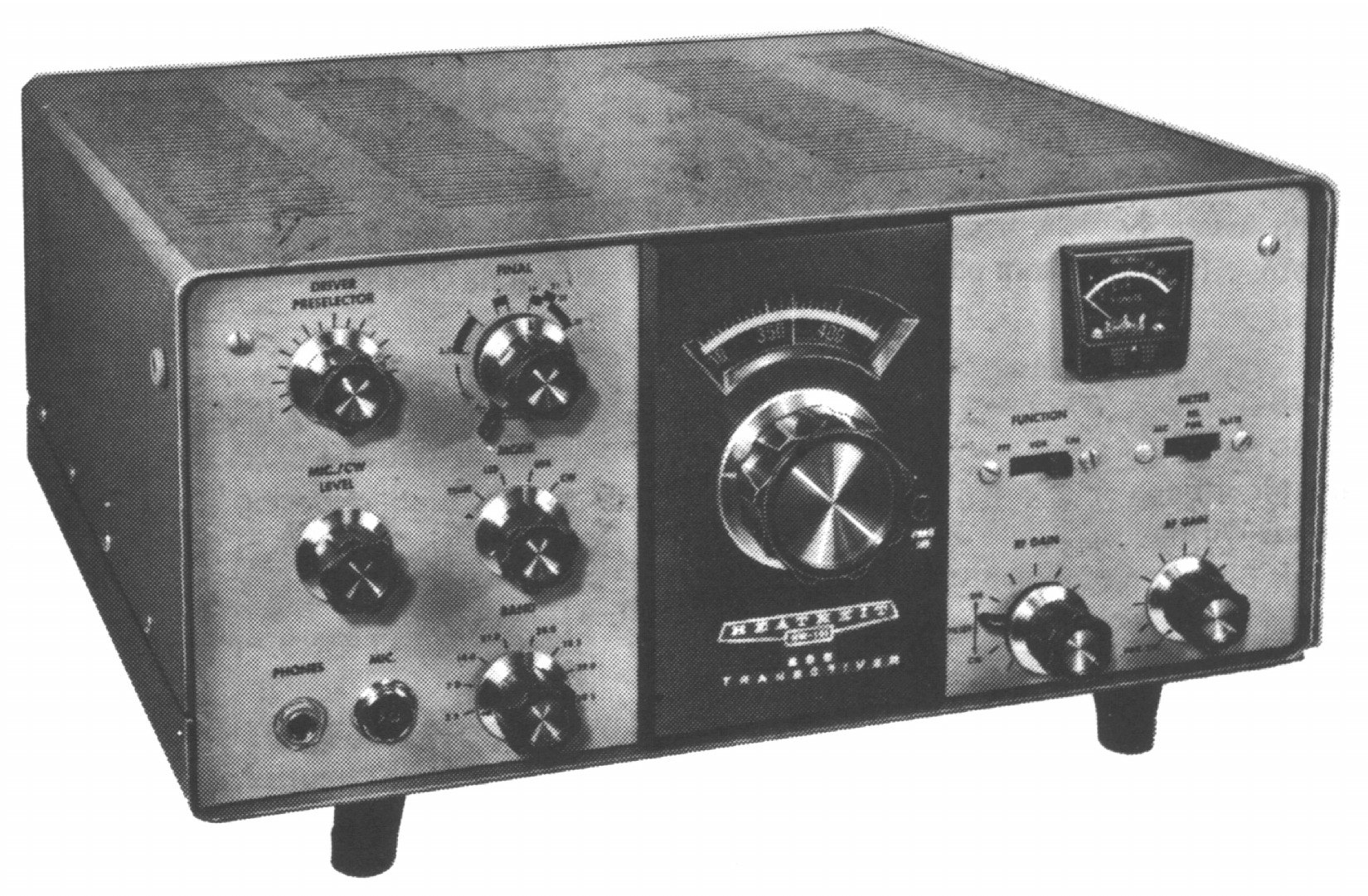
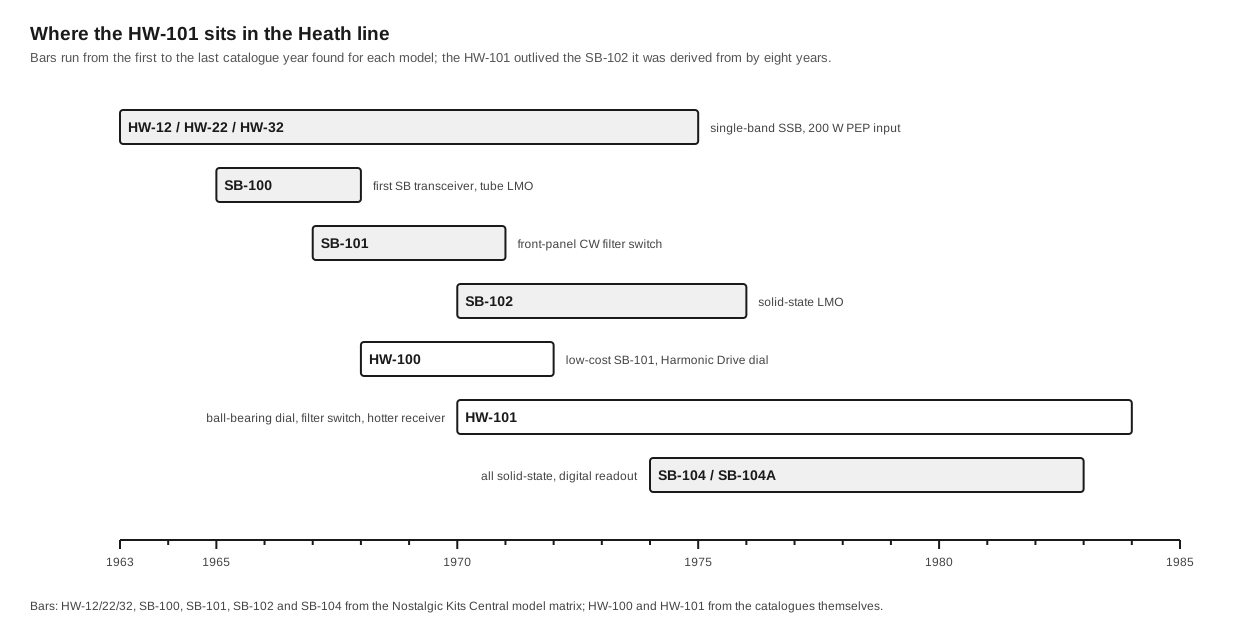
The HW-101 sits at the bottom of a family that begins with Heath’s decision, in the early 1960s, to build a station that could stand comparison with the Collins S-Line. The SB series that resulted — SB-300 receiver, SB-400 transmitter, then the SB-100 transceiver of 1965 — took its stability from a pre-built, pre-calibrated Linear Master Oscillator tuning 5.5 down to 5.0 MHz, with every other oscillator crystal-controlled (Eckweiler, Heathkit of the Month #30). The SB-100 became the SB-101 in 1967 and the SB-102 in 1970; the SB-102 replaced the tube LMO with a solid-state one and was the last of the tube SB transceivers.
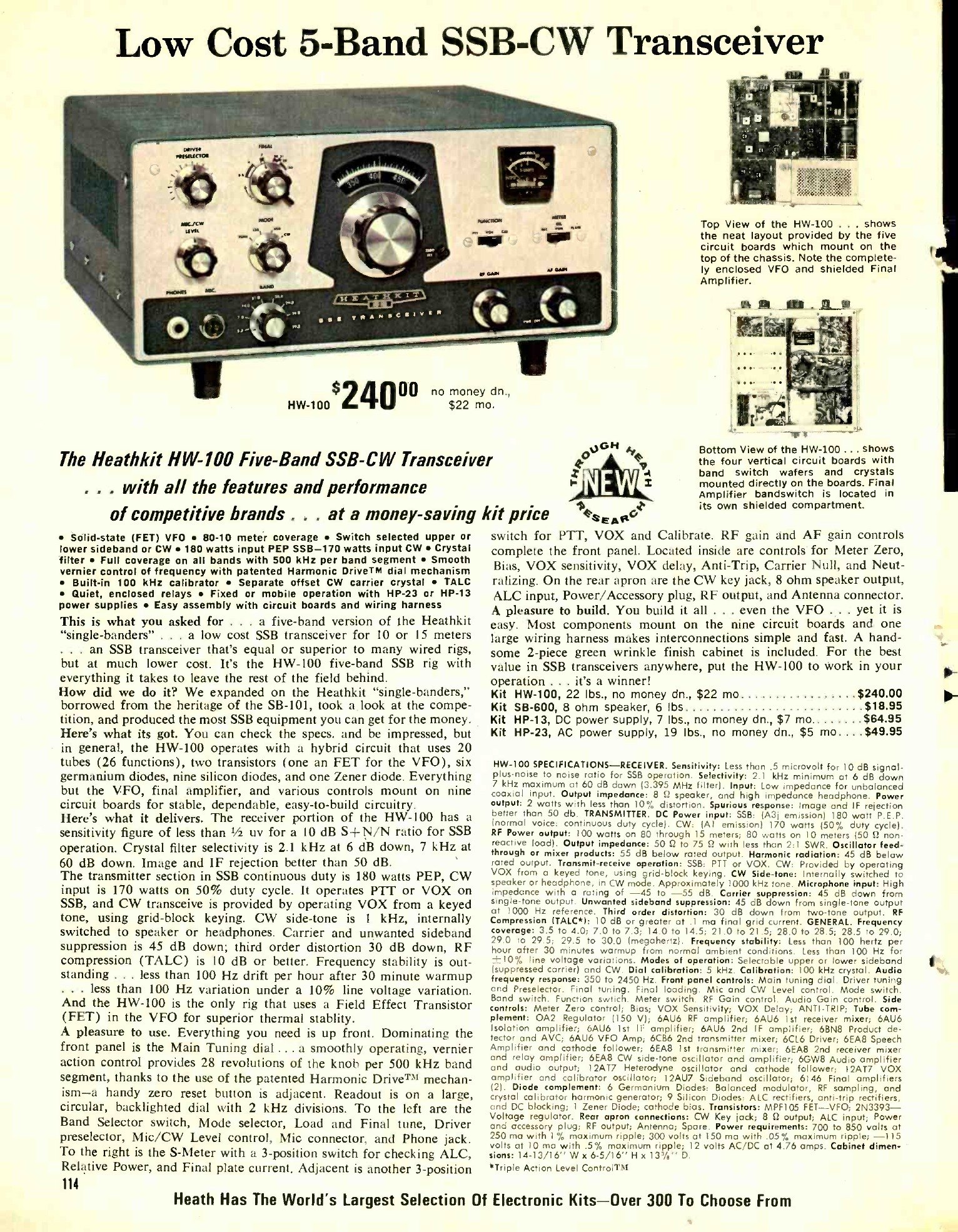
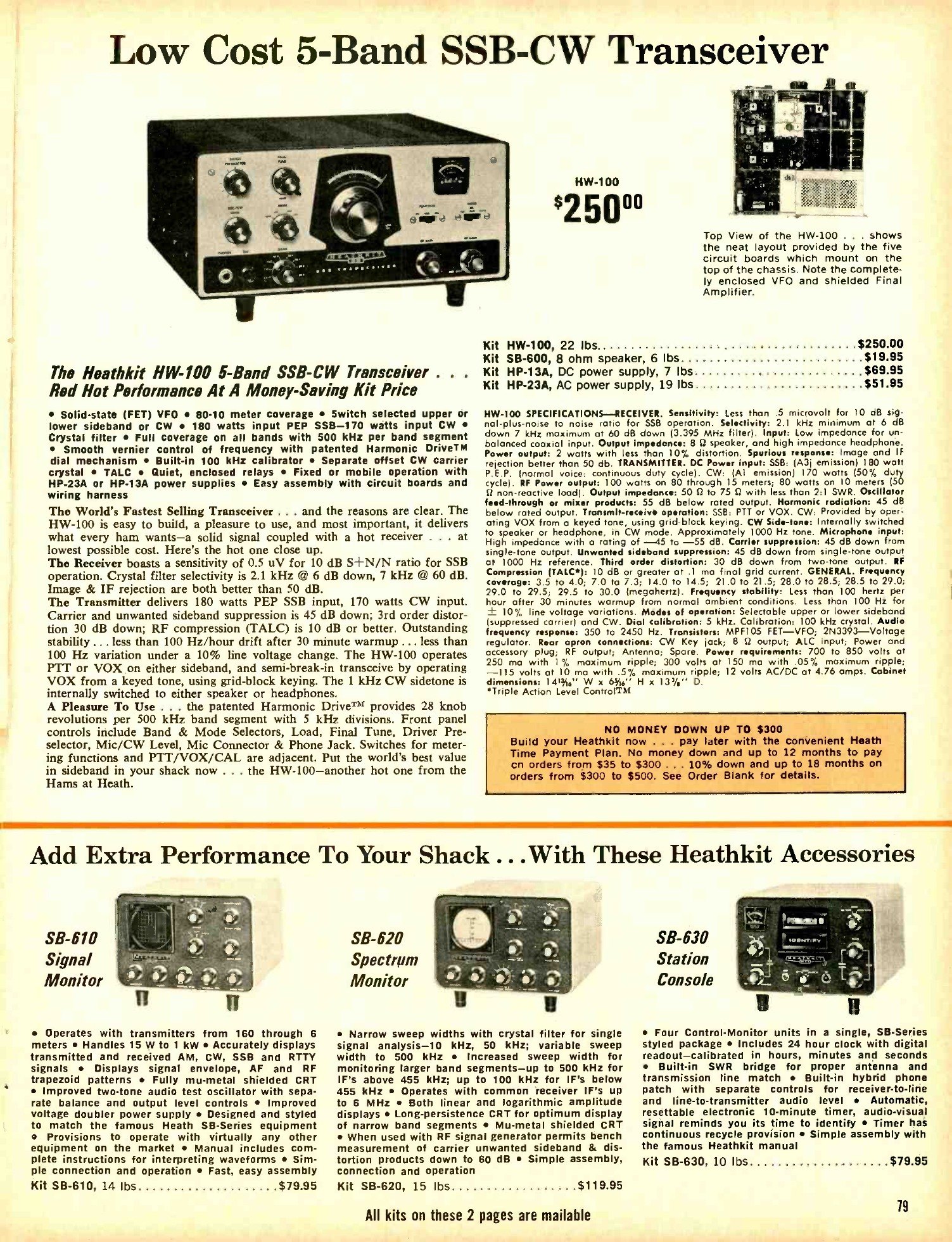
The HW prefix meant something different. In Heath’s numbering it marked the economy line — the “Hard Working” single-band transceivers HW-12, HW-22 and HW-32 of 1963, which put 200 watts PEP input on one band for about $100. In March 1968 Heath applied the same logic to the five-band rig: the HW-100 was an SB-101 with a cheaper dial mechanism, a cheaper VFO, plainer styling and no provision for switching filters. The saving was severe. The 1969 catalogue lists the SB-101 at $370 and the HW-100 at $240 (1969 Heathkit catalogue, HW-100 on p. 114).
Heath advertised the HW-100 as “the world’s fastest selling transceiver”, and the claim survives in the catalogue copy for years afterwards. It also had two faults that owners complained about. The tuning used Heath’s patented Harmonic Drive mechanism, which gave 28 knob revolutions per 500 kHz segment and, in the words of Practical Wireless’s retrospective, was thought by some operators to be “full of wobble and backlash” (Cadman, Practical Wireless, November 2007). And there was only one crystal filter position, so CW operators could not switch in a narrow filter from the front panel the way SB-101 owners could.
1.3 The HW-101 arrives
The HW-101 is the HW-100 with those two complaints answered and the receiver improved. Heath’s own summary, in the first catalogue to carry the model, is unusually direct about the parentage:
Setting the industry standard as the HW-100, the HW-101 is a further refinement of that widely acclaimed transceiver.
The changes Heath listed were a new ball-bearing dial drive with a 36-to-1 knob-to-dial ratio, front-panel selection between the SSB filter and an optional 400 Hz CW filter, new preselector circuitry, a thermally stabilised FET VFO, and receiver sensitivity improved from 0.5 to better than 0.35 µV (catalogue 800/13, “Vacation style ‘71”, p. 53). The tube line-up otherwise matches the SB-102 closely enough that the two share most service bulletins.
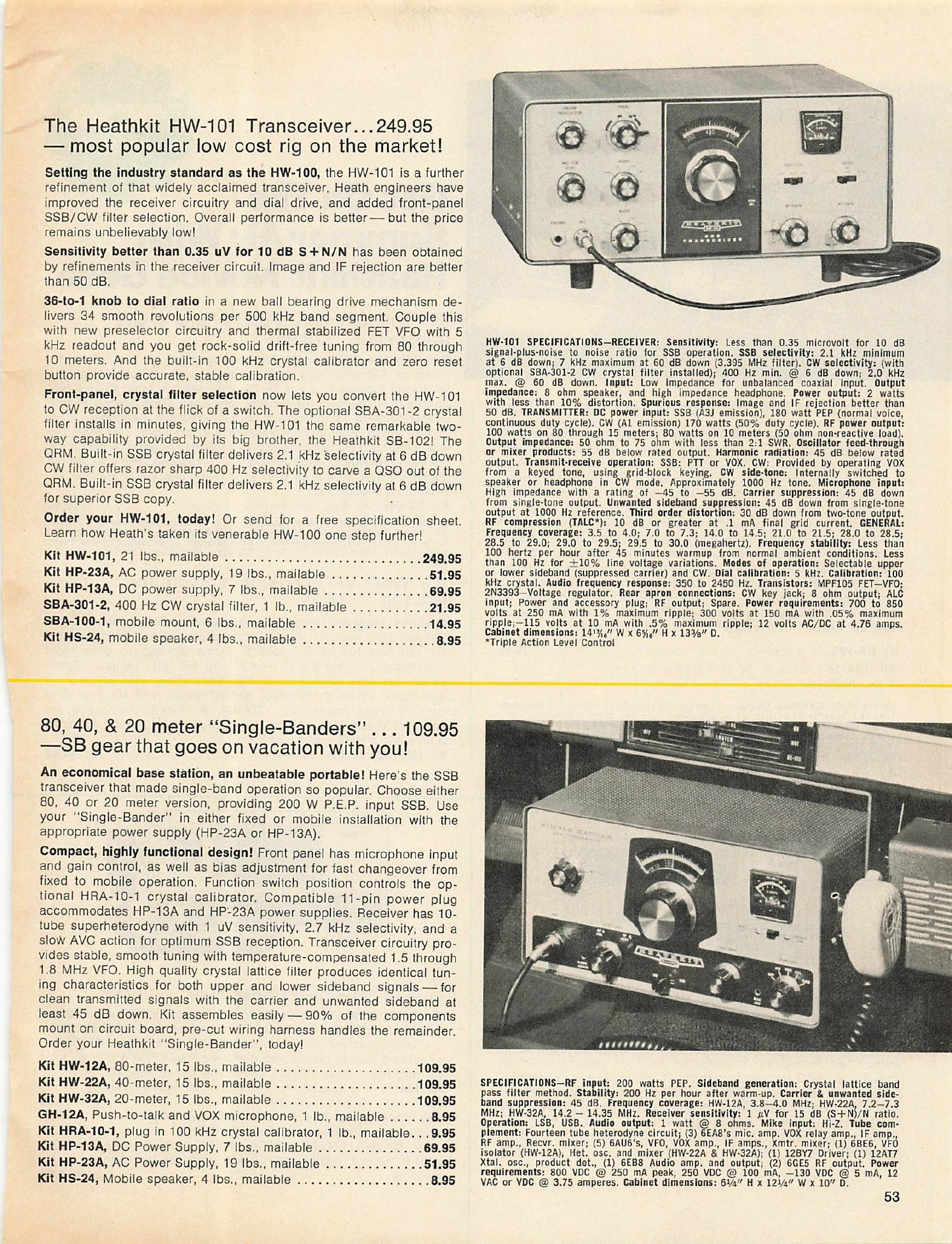
Dating the introduction precisely is harder than it looks, and the sources disagree by a few months. The assembly manual carries a 1970 copyright and the Nostalgic Kits Central model matrix gives 1970. Practical Wireless says the rig “was released just before Christmas 1970”. The general 1971 Heath catalogue, printed for the start of that year, still lists the HW-100 at $250 and does not mention the HW-101 at all; the first catalogue found here that carries the HW-101 is the summer 1971 catalogue 800/13. Against that, the first factory service bulletin for the model — HW-101-1, on VFO drift — is dated 11 February 1971, which implies units in customers’ hands well before that summer (HW-101 service bulletins). A late-1970 announcement with catalogue coverage catching up in 1971 fits all the evidence; that is how the date is treated throughout this dive.
1.4 Who it was for
Heath aimed the HW-101 at the newly licensed and the frugal, and said so. The Winter 1981 copy is typical: the rig is “the Transceiver to start with and stay with”, suitable for CW with a Novice licence and phone after the upgrade to General (Winter 1981 catalogue). The economics were straightforward: the rig alone bought a full-power station, and the same power supply, speaker, microphone and mobile mount worked across the whole HW and SB range, so an owner who later moved up kept the accessories.
It was also a deliberately mobile-capable design. The heavy supply is outside the box, so the transceiver is 17½ pounds; the HP-13 series inverter runs it from a car battery, and the SBA-100-1 bracket drops the whole rig under a dashboard and lifts it out again. Mobile SSB in 1971 was still enough of a novelty for Heath to devote catalogue space to it.
1.5 Thirteen years in the catalogue
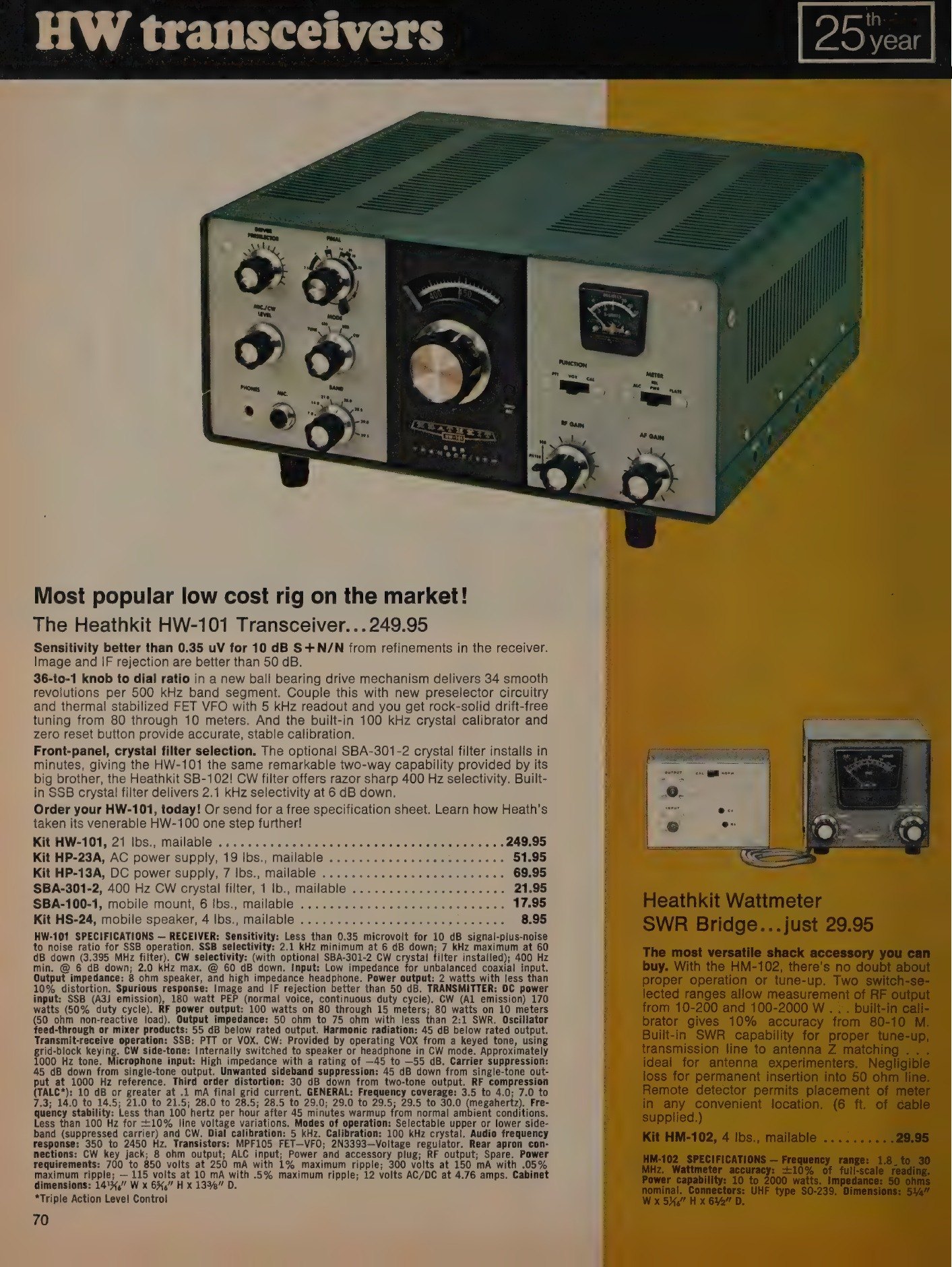
The price history is a small economic history of the 1970s. The rig cost $249.95 in 1971 and $435.95 ten years later, an increase of about three-quarters — which, against consumer prices that roughly doubled over the same decade, means Heath was quietly cutting the real price of a design whose tooling had long since paid for itself.
Table 2 — Thirteen years in the catalogue
| Catalogue | Kit price |
|---|---|
| 800/13, summer 1971 | $249.95 |
| 810/72, prices effective 1 August 1971 | $249.95 |
| March 1974 | $259.95 |
| Christmas 1975 | $299.95 |
| Spring 1976 | $339.95 |
| Fall 1977 (No. 817) | $339.95 |
| Winter 1978 | $349.95 |
| Fall 1979 | $399.95 |
| No. 848, 1980 | $389.95 |
| Winter 1981 | $399.95 |
| Winter 1981–82 | $435.95 |
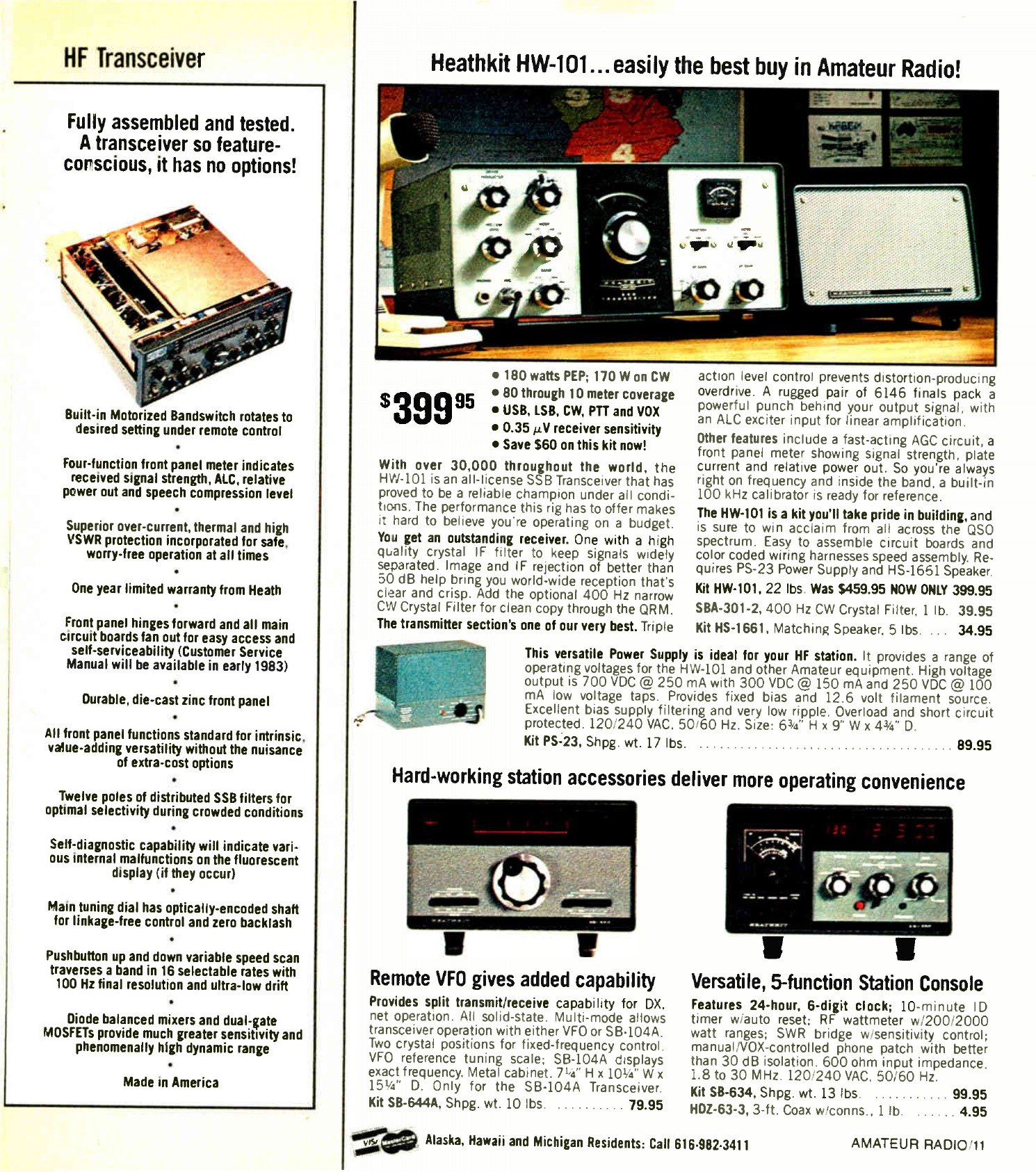
| Winter 1983 | $459.95, cleared at $399.95 |
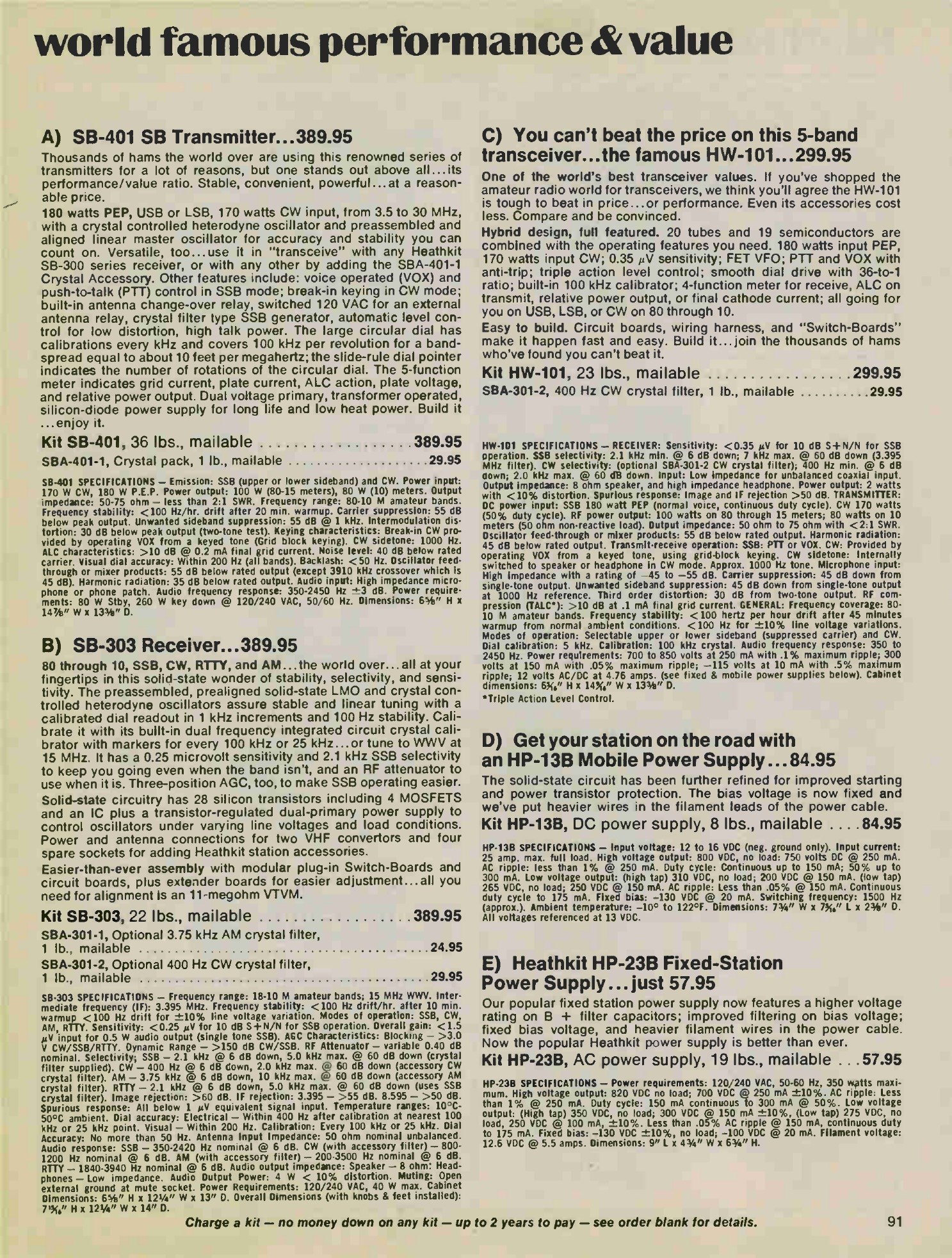
By the Winter 1983 catalogue the rig is on its way out, offered at $399.95 with “Save $60 on this kit now!” beside it; by the Fall 1983 catalogue only the power supply remains, sold as a general-purpose bench supply. The transceiver that replaced it in the line, the synthesised HW-5400, is a different kind of machine entirely.
1.6 How many were built
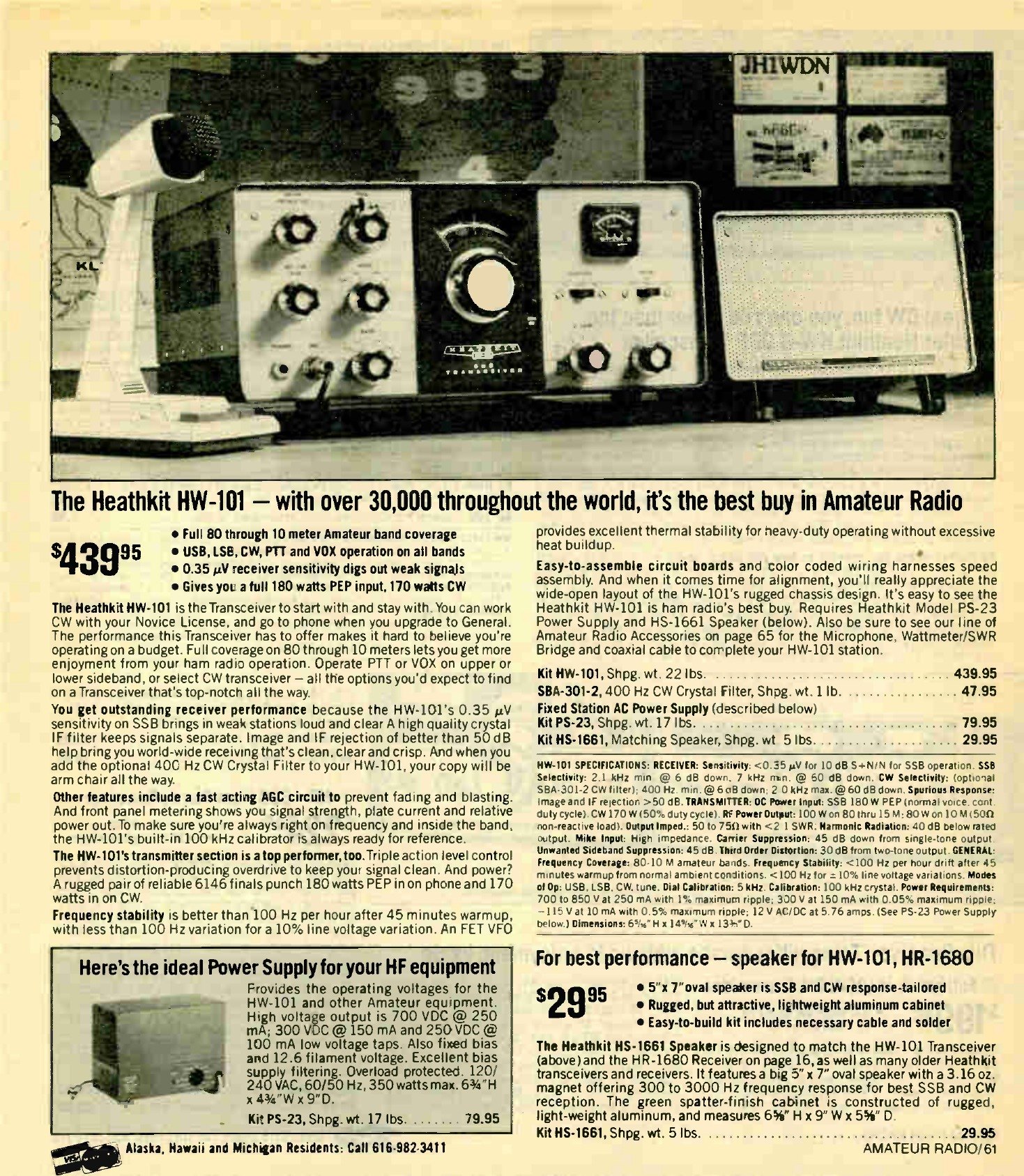
Heath’s own claim, printed on the catalogue page above, is “over 30,000 throughout the world” as of late 1981. That is a marketing figure, but it is the company’s figure and it is dated.
The number usually quoted instead — “nearly 40,000” — is not a Heath figure at all. It comes from Chuck Penson’s fiftieth-anniversary article of 1997, which states that Heath sold nearly 40,000 HW-101 transceivers, “more of a single product than anyone before or since, even more than Collins” (Penson, Electric Radio, January 1997, and QST, April 1997). No production record supporting it has been found, and Penson gives no source for it; the sites and forum posts that quote “30,000 to 40,000” are generally combining Heath’s catalogue claim with his estimate. Practical Wireless went further in 2007 and suggested the figure was “actually closer to 40,000” for the HW-100 and HW-101 combined, which is a guess about two models rather than a count of one. The defensible statement is that Heath claimed more than 30,000 by late 1981, that production ran two more years, and that 40,000 is one author’s estimate rather than a documented total.
1.7 The HW-101 as a machine to own
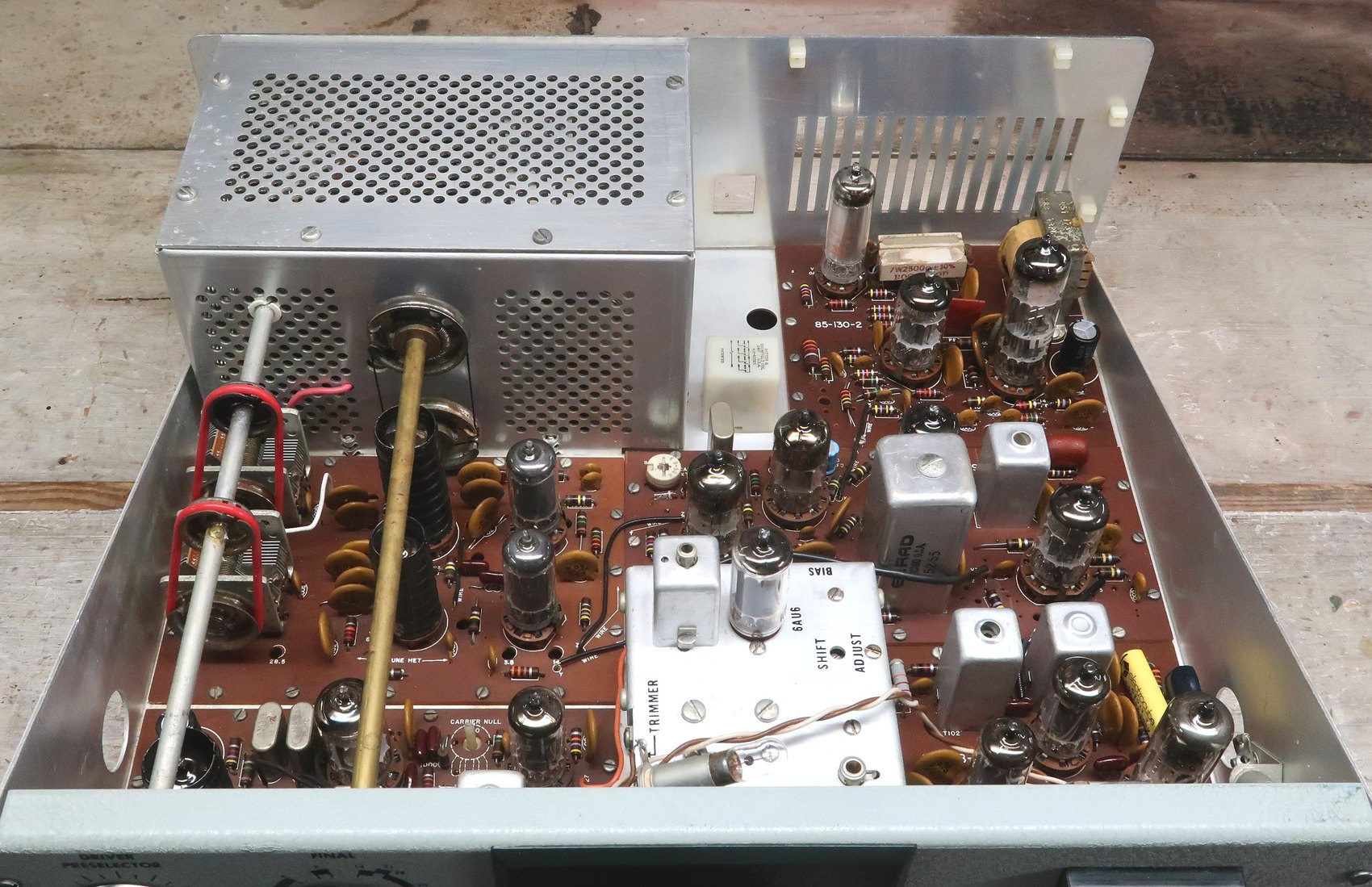
Two things about the design outlast its era. The first is that everything in it is accessible: five boards that lift out, a chassis with room between components, tubes that can be pulled and tested, and a manual that explains every stage. Heath’s own catalogue copy leaned on this — “when it comes time for alignment, you’ll really appreciate the wide-open layout” — and it is the reason the rig remains a practical restoration project rather than a display piece.
The second is that it is an honest performer rather than a compromised one. The transmitter is clean by the standards of its day, third-order products 30 dB down and carrier and unwanted sideband both 45 dB down. The receiver’s crystal filter and product detector produce the kind of audio that listeners still describe as easy on the ear, and the audio output stage is a class-A pentode driving a real 2 watts. What it lacks is convenience: no receiver incremental tuning, no digital readout, no internal supply, no internal speaker, and a dial that must be zeroed against a 100 kHz calibrator rather than read off a display.
Those are the omissions Heath charged extra to fill, and the accessories are part of the story: the HP-23 or PS-23 AC supply, the HP-13 mobile inverter, the SB-600 or HS-1661 speaker, the SBA-301-2 CW filter, the SBA-100-1 mobile mount, and — for the operator who wanted to know exactly where the dial was pointing — the SB-650 digital frequency display, whose 1973 catalogue copy singles the HW-101 out by name. Each of them is covered in the Reference volume.
Sources
- Heathkit Assembly Manual for the HW-101 SSB Transceiver, part 595-1277-18 (Heath Company, copyright 1970). Internet Archive · OCR copy
- Heathkit catalogues, World Radio History: 1969 · 1971 · 800/13, 1971 · 810/72 · March 1974 · Christmas 1975 · Spring 1976 · Fall 1977 · Winter 1978 · Fall 1979 · 1980, No. 848 · Winter 1981 · Winter 1981–82 · Winter 1983 · Fall 1983
- Heath Company, HW-101 service bulletins, 11 February 1971 to 19 November 1979. Transcript
- Cadman, Phil (G4JCP). “It’s a Classic! The Heathkit HW101.” Practical Wireless, November 2007, pp. 22 and 26–27. Scan
- Eckweiler, Bob (AF6C). “Heathkit of the Month #30: The Amateur Radio SB-Line Overview.” PDF
- Harris, Bill. “The Heathkit HW-101” (restoration notes and photographs, 2010–2022). Link
- Penson, Chuck (WA7ZZE). “Heathkit’s 50th: The Green Turns to Gold.” Electric Radio, January 1997; QST, April 1997. Reprint at the Heathkit Virtual Museum
- Nostalgic Kits Central, Heathkit alphabetic equipment matrix. Link
Comments (0)