Education · Volume 2
Heathkit Continuing Education, 1975–1979
Between Christmas 1975 and the Zenith purchase of October 1979, Heath turned its scattered educational kits into a curriculum. It had a name (Heathkit Continuing Education), a method (the Individual Learning Program), a numbering scheme (EE-31xx for analog electronics, EE-3201 for digital, EE-3401 for microprocessors), a family of bench trainers (ET-3100, ET-3200, ET-3300, ET-3400) and, from 1978, a classroom edition for schools and industry. This volume follows those four years. The two trainers of the launch have their own dives, the ET-3100 and the ET-3200. Their launch, their prices and the detail of their courses are summarised here only as far as the whole line needs them.
2.1 The founder: Lou Frenzel
The educational business had one founder, and he came from publishing. Louis E. Frenzel wrote in 2013 that he “left MH in 1973 to go to the Heath Company. I went there to start Heath’s education and publishing business”, and that he launched “a line of self-study courses in electronics with kit trainers”, which became “a great success with individuals and technical colleges” (Frenzel, Electronic Design, 30 December 2013). “MH” is McGraw-Hill. Brueschke and Mack date the founding of Heathkit Educational Systems, “offering educational materials for schools”, to 1974. The company’s own account of 2008 dates the start of its educational sales to the same year (history dive, volume 4; volume 7). No catalogue evidence of courses before Christmas 1975 was found. The March 1974 and 1974 (No. 810-74) catalogues show no ET-series trainers, and their only educational items are the EK and EF kits described in volume 1.
Frenzel also shaped the computer line. He was responsible from 1975 for “defining a product line” of computers, working with Chas Gilmore, and the first product defined was a trainer and course rather than a computer (see below). After the computer business went to Zenith he became vice-president of the educational business (Frenzel, 2013). That part of his career belongs to volume 3.
2.2 Christmas 1975: the launch
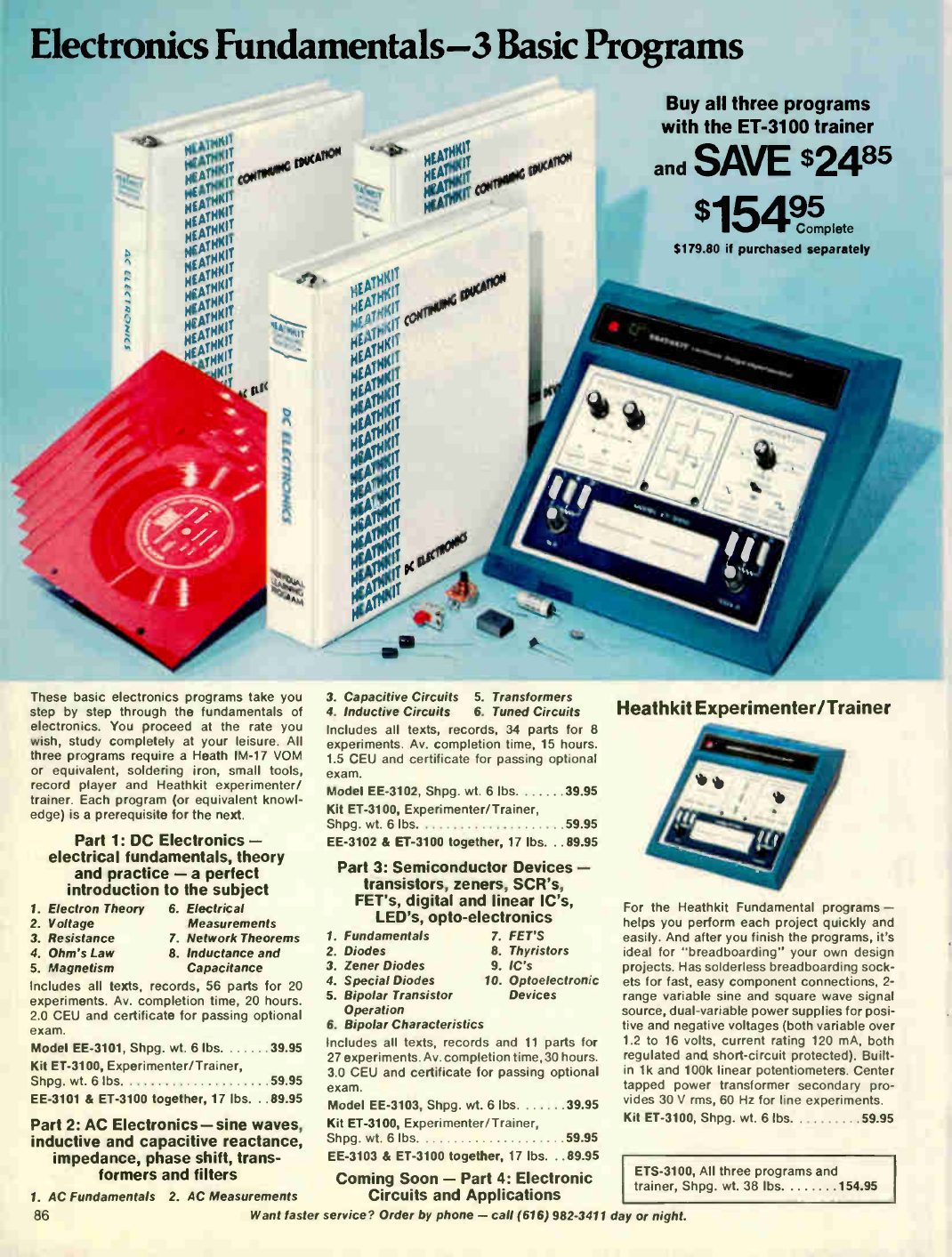
The launch was the four-page “Learn electronics” section of the Christmas 1975 catalogue, introduced by David W. Nurse’s President’s Letter as “the Heathkit Continuing Education series” of “individual learning programs and self-instructional products” (Christmas 1975 catalogue, pp. 51 and 62–65). It offered four courses and two trainers:
Table 1 — The launch was the four-page "Learn electronics" section of the Christmas 1975 catalogue, introduced by David W. Nurse's President's Letter as "the Heathkit Continuing Education series" of "individual learning programs and self-instructional products" ([Christmas 1975 catalogue, pp. 51 and 62–65](https://www.worldradiohistory.com/Archive-Catalogs/Heathkit-Catalogs/Heathkit-Christmas-1975.pdf)). It offered four courses and two trainers
| Course | Title | Price | Trainer | Price |
|---|---|---|---|---|
| EE-3101 | DC Electronics | $39.95 | ET-3100 Electronic Design Experimenter | $59.95 |
| EE-3102 | AC Electronics (“available mid-January”) | $39.95 | ET-3100 | |
| EE-3103 | Semiconductor Devices | $39.95 | ET-3100 | |
| EE-3201 | Digital Techniques | $49.95 | ET-3200 Digital Design Experimenter | $69.95 |
The kit dives give the launch pages in full: the ET-3100 dive, volume 1 for the analog courses and the ET-3200 dive, volume 1 for the digital one. What matters for the category is the format, which stayed almost unchanged for thirty years:
- A programmed text in ring binders, in short frames that each end in a question whose answer opens the next.
- Audio records (flexible discs punched to fit the binder) for spoken overviews and reviews, later duplicated on optional cassettes.
- A bag of every part the experiments needed, and a trainer on which to build them.
- Unit examinations marked by the student, and an optional final examination marked by Heath. A score of 70 per cent earned a Certificate of Achievement and Continuing Education Units (CEUs), “a nationally recognized means of acknowledging your participation in formal adult education”.
No admission requirement applied and there was no instructor, but Heath’s technical consultants would answer questions. The course manuals, unlike kit manuals, were “not available separately”.
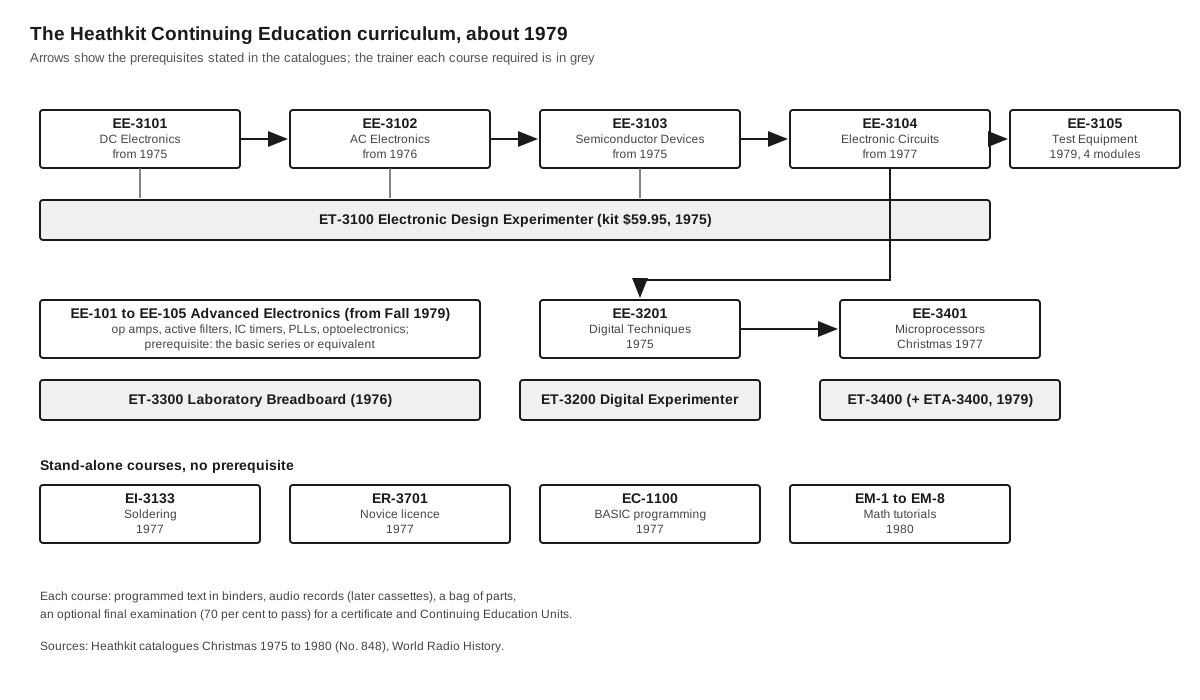
The numbers were planned. EE-31xx courses used the ET-3100, EE-3201 used the ET-3200, and from Christmas 1977 EE-3401 used the ET-3400. Number 3300 went to a general laboratory breadboard (below). The same pattern held for later lines, which is why a Heath course number usually says which trainer it needs.
2.3 1976: the president takes the course
The Spring 1976 catalogue opened its courses with a full-page picture of the binders and trainer, “Heathkit Continuing Education Series — Knowledge is at hand!” (reproduced at the head of volume 1), and a caption that set the range: “from beginners to experienced engineers”. The three fundamentals courses and the ET-3100 were now sold as a package, the ETS-3100, at $154.95, “SAVE $24.85” (Spring 1976, pp. 85–86).
The same issue carried the most personal endorsement a Heath product ever had. In “The President’s Corner”, Nurse told customers that he was himself working through the Digital Techniques course: “Forty years have slipped by since college, so I find it a challenge.” He asked readers which subjects they wanted next, naming automotive tune-up, amateur licensing, television servicing, computers and microprocessors (history dive, volume 4). Heath went on to build courses on every one of the five.
Schlumberger’s annual reports tracked the line from the parent company’s side. The 1975 report noted that Heath was “now selling home study courses for kit builders and hobbyists”, and that the courses built interest in more complex kits. In 1976 the educational products were one of the three lines with the largest sales gains. In 1977 they were “a successful and growing business since their introduction two years ago” (history dive, volume 4). No sales figure for the education line alone was found for the 1970s. Frenzel’s figure of about $15 million a year belongs to 1979 or shortly after (see volume 3).
2.4 The ET-3300 breadboard (1976)
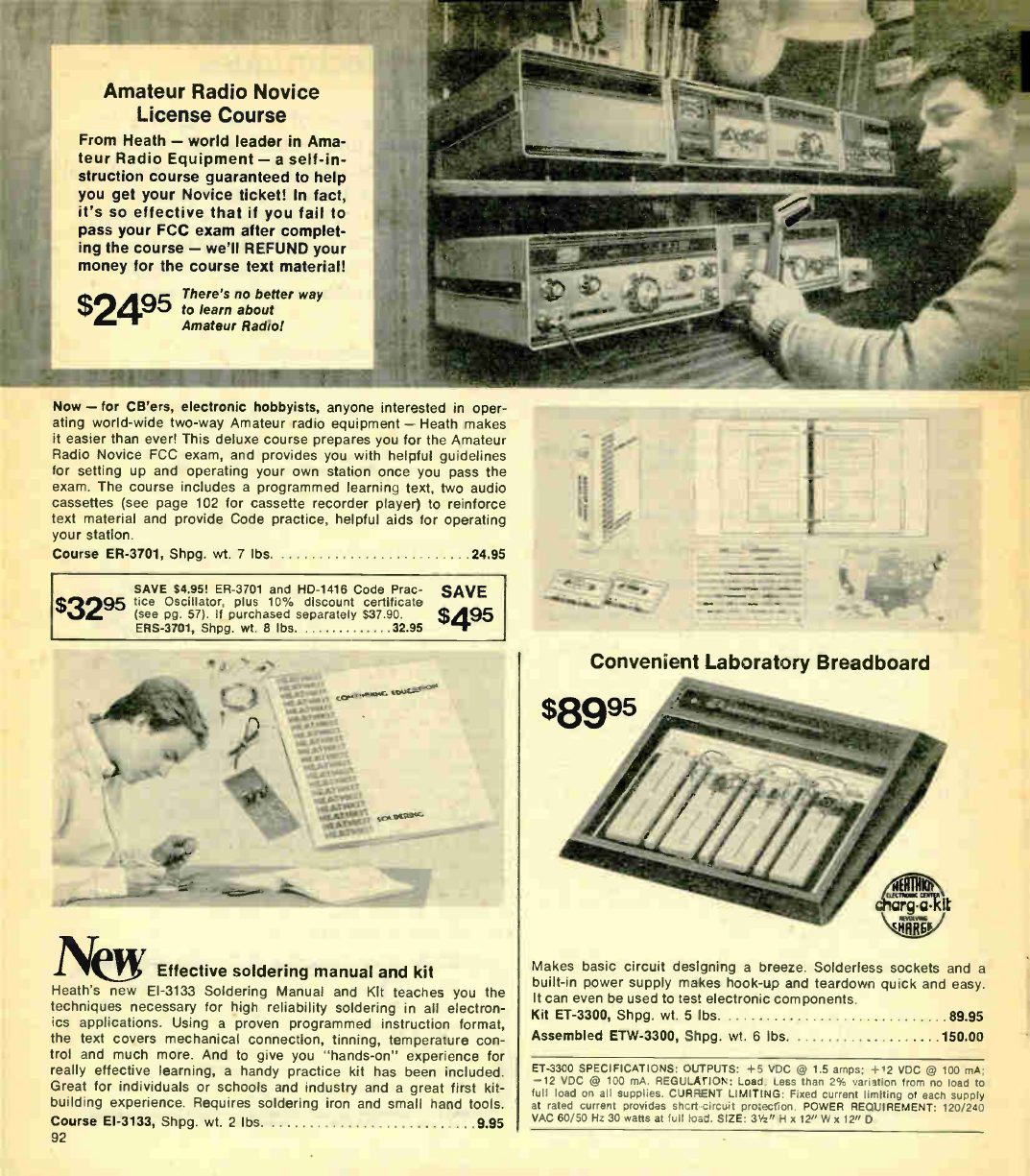
The first addition to the trainer family was not tied to a course. The ET-3300 Laboratory Breadboard, new in Spring 1976 at $79.95, was “everything you could want for basic solid-state circuit design and development … in one neat package”: solderless sockets with “three dual ground and power bus strips”, and built-in +5 V (1.5 A), +12 V and −12 V supplies. Heath aimed it at “hobbyists and technicians in laboratory experiments” and at designers “building up a prototype of a new circuit design” (Spring 1976). It cost $89.95 in Winter 1978, with an assembled ETW-3300 at $150.00 (Winter 1978, p. 92).
In 1979 the ET-3300 found its course. The Advanced Electronics series (below) was written around it, and the classroom catalogue called it the “required” trainer for all five advanced courses (volume 3). Of all the ET trainers it was the most general: it had no signal source, no switches and no indicators, only power and breadboard space.
2.5 1977: circuits, radio, soldering and BASIC
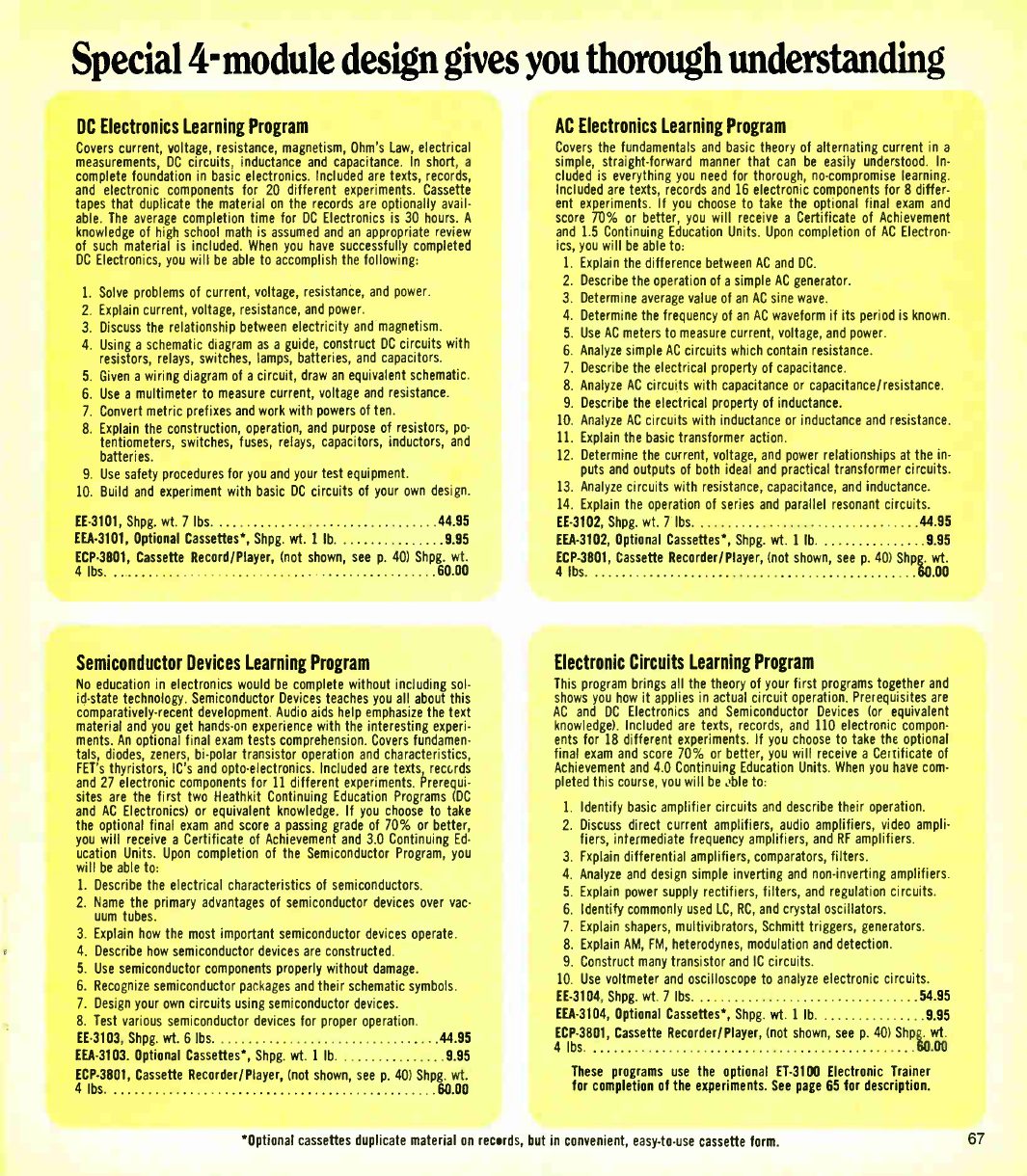
In 1977 the line doubled. The Fall 1977 catalogue (No. 817) shows the full analog sequence for the first time. EE-3104 Electronic Circuits ($49.95) completed the “four basic courses”: amplifiers, operational amplifiers, power supplies, oscillators, pulse circuits and modulation, with “over 110 parts for 18 different experiments”, an average completion time of 40 hours and 4.0 CEUs. All four courses with the trainer were sold as the ETS-3114 at $199.95. For the first time both trainers were offered factory-wired: the ETW-3100 at $89.95 and the ETW-3200 at $99.95. A new note told readers that the courses “may qualify for a Federal Tax Deduction” under Treasury Regulation 162-5, as education undertaken “to maintain or improve skills required in one’s employment”, and that “your employer may re-imburse you” (Fall 1977, pp. 100–103).
Three smaller courses were new in the same issue, each answering one of Nurse’s 1976 questions or one of the kit business’s own needs:
- ER-3701 Amateur Radio Novice License Course, $24.95: a programmed text and two cassettes “designed by the Hams at Heath” to prepare CB operators and hobbyists for the FCC Novice examination. Heath promised: “if you fail to pass your FCC exam after completing the course — we’ll REFUND your money.” With an HD-1416 code practice oscillator it was the ERS-3701 at $29.95.
- EI-3133 Self-Instructional Soldering Manual and Practice Kit, $9.95: a programmed text, a final examination and a practice kit, pitched both at kit builders and at “schools or industrial training”. It was the first Heath course that taught the kit-building skill itself.
- ECP-3800, a $49.95 battery cassette player and recorder sold as “the ideal cassette player for the Heathkit Continuing Education Series cassettes”.
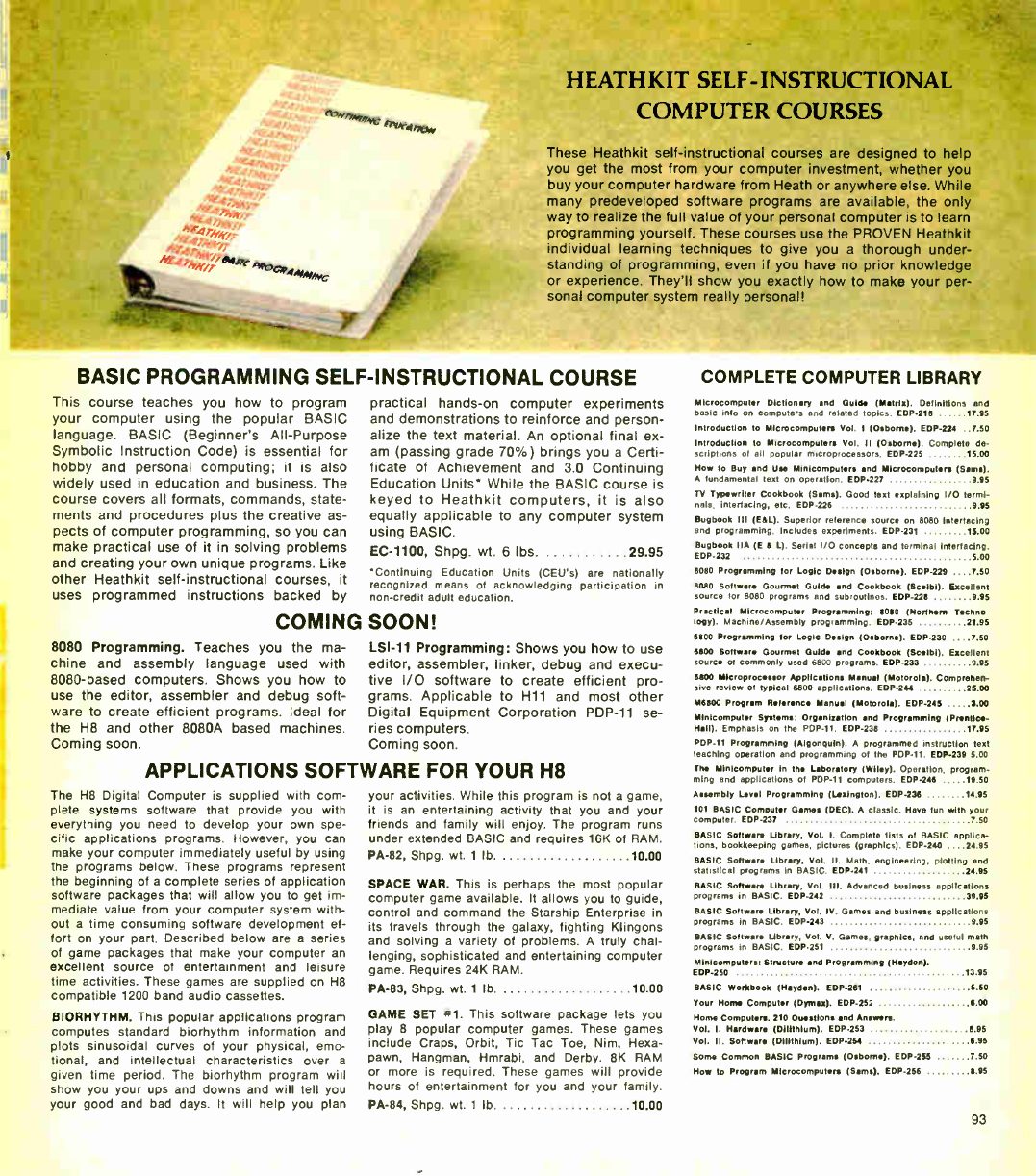
The fourth was the first software course. EC-1100 BASIC Programming, $29.95 and “available after Oct. 20th, 1977”, taught “all formats, commands, statements and procedures” of BASIC by programmed instruction backed by “hands-on computer experiments”, for 3.0 CEUs. It was “keyed to Heathkit computers” (the H8 and H11 were new in the same issue) but “equally applicable to any computer system using BASIC” (Fall 1977, p. 2 and computer section). The Winter 1978 catalogue placed it at the head of a page of “Heathkit Self-Instructional Computer Courses”, beside a “Complete Computer Library” of third-party books (Osborne, Sams, E&L and others) sold under EDP- numbers (Winter 1978, p. 93).
2.6 Christmas 1977: the microprocessor course and the ET-3400
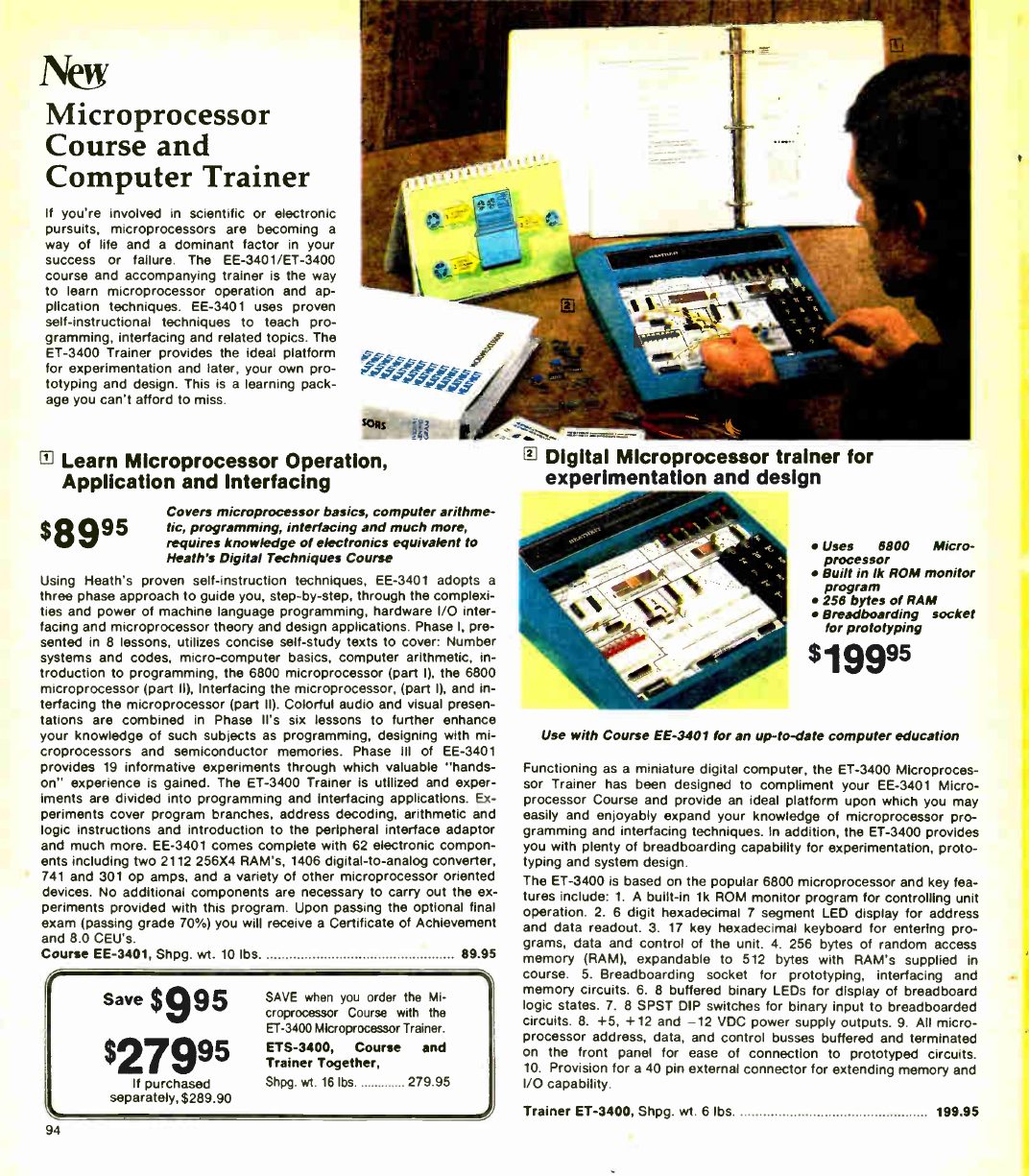
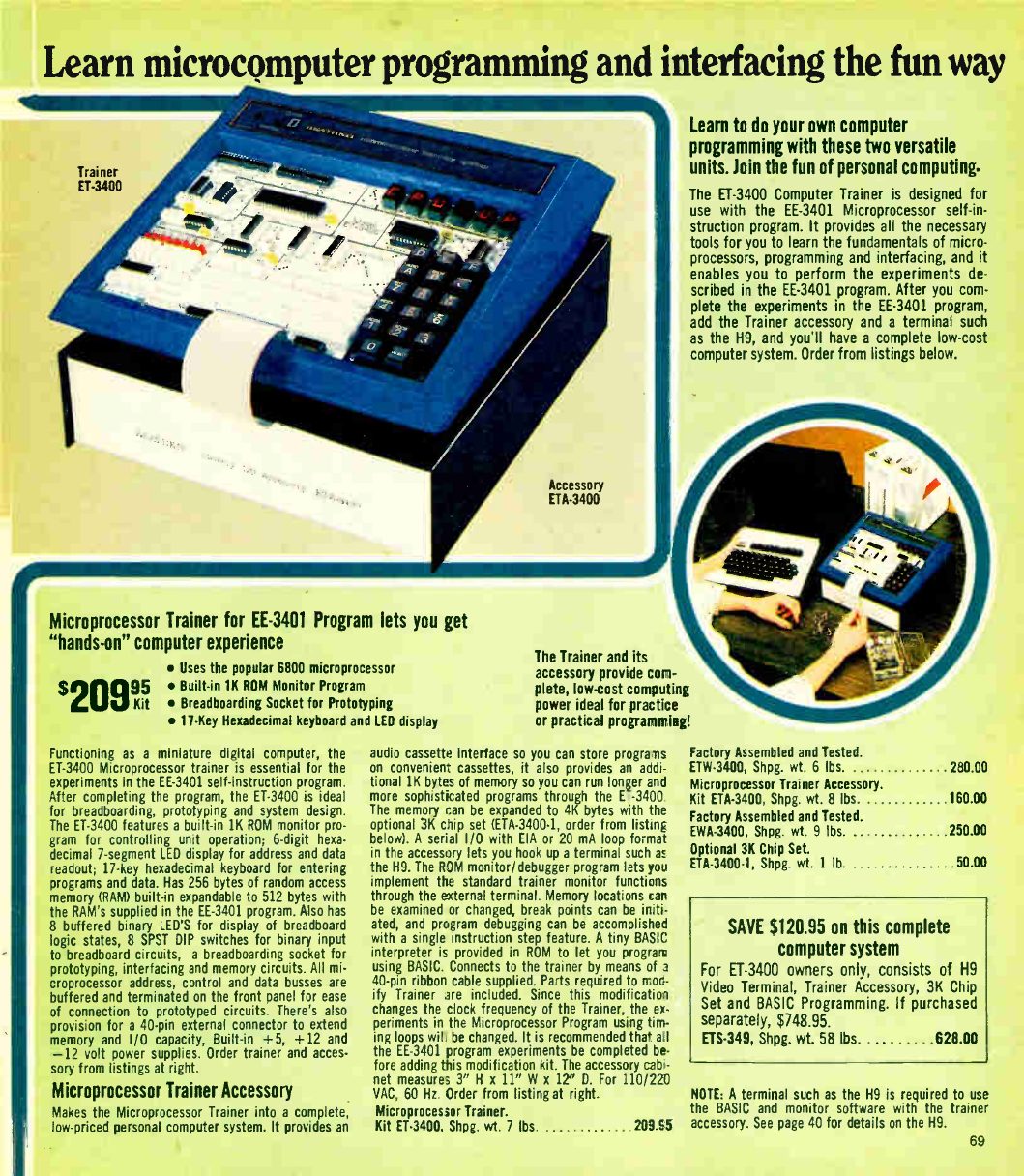
The most important educational product of the decade came at the end of 1977. The ET-3400 Microprocessor Trainer, a Motorola 6800 with a hexadecimal keypad, six-digit display, 256 bytes of RAM, a 1K monitor ROM and the ET-3200’s switches, LEDs and breadboard, was new in the Christmas 1977 catalogue at $189.95. Its course, EE-3401 Microprocessors, cost $89.95, and the pair $269.95 (Christmas 1977, cover and p. 100). Frenzel wrote that it was the first product defined in Heath’s computer effort: “a microprocessor trainer and course based on the Motorola 6800”, which “was a huge success” because “microprocessors being new to electronics there was an overwhelming need for education in this new field” (Frenzel, 2013).
The trainer and its course are covered in detail in the ET-3200 dive, volume 5, and its place in Heath’s computer history in the history dive, volume 5. Four points matter for the category. The course was built in three phases: eight lessons of programmed text, six audio-visual lessons, and 19 experiments on the trainer. It made the 6800 family Heath’s house teaching processor, which it remained through the HERO 1 robot (6808) to the ETW-3800’s 68HC11 module of 1991. It won an award from the Society for Technical Communication. And the trainer outlived the course’s era by decades: the 1993 education catalogue still called the ETW-3400-A the “World’s Most Popular Microprocessor Trainer!” (volume 4).
2.7 1978: into the classroom
In 1978 Heath repackaged its courses for teachers. The Spring 1978 catalogue announced “Famous Heath Electronics Courses, now designed for Classroom Use”, “completely repackaged for the classroom” so that the instructor could “combine an expertly formulated learning package with his own wealth of personal knowledge”. Each course was split into a student textbook, a student workbook “keyed to text and laboratory experiments”, an instructor’s guide and a parts pack. The classroom numbers were EB- plus a four-digit code that mirrored the home course: EB-6101 for DC Electronics, EB-6102 for AC, EB-6103 for semiconductors, EB-6104 for circuits and EB-6201 for Digital Techniques. The suffixes were -40 for the workbook, -50 for the instructor’s guide and -30 for the parts (Spring 1978, pp. 99–101). In Spring 1978 the DC set cost $15.95 for the text, $6.95 for the workbook, $8.95 for the guide and $13.95 for the parts. The Microprocessor set, EB-6401, followed by 1979.
By Fall 1979 a full page headed “Classroom versions of our Educational Programs — Ideal for schools and industrial training” listed every classroom part in a price table, with the cassettes as an extra column (Fall 1979, p. 71). The classroom versions made schools, not home students, the main customers of the educational line within five years. The separate catalogue in which Heath sold them is described in volume 3. The kit dives show what the classroom trainer looked like in practice: schools bought the factory-wired ETW- trainers, so that building the trainer did not use up laboratory time (ET-3200 dive, volume 4).
The home price structure also changed in 1978. The Fall 1978 catalogue raised the fundamentals courses to $44.95 each and sold each with its kit trainer as an EES- package that saved $9.95 (EES-3101, DC with the ET-3100, $99.95). The four basic courses with the trainer, ETS-3114, cost $224.95 (Fall 1978).
2.8 1979: test equipment, advanced electronics and the “Personal Learning” newsletter
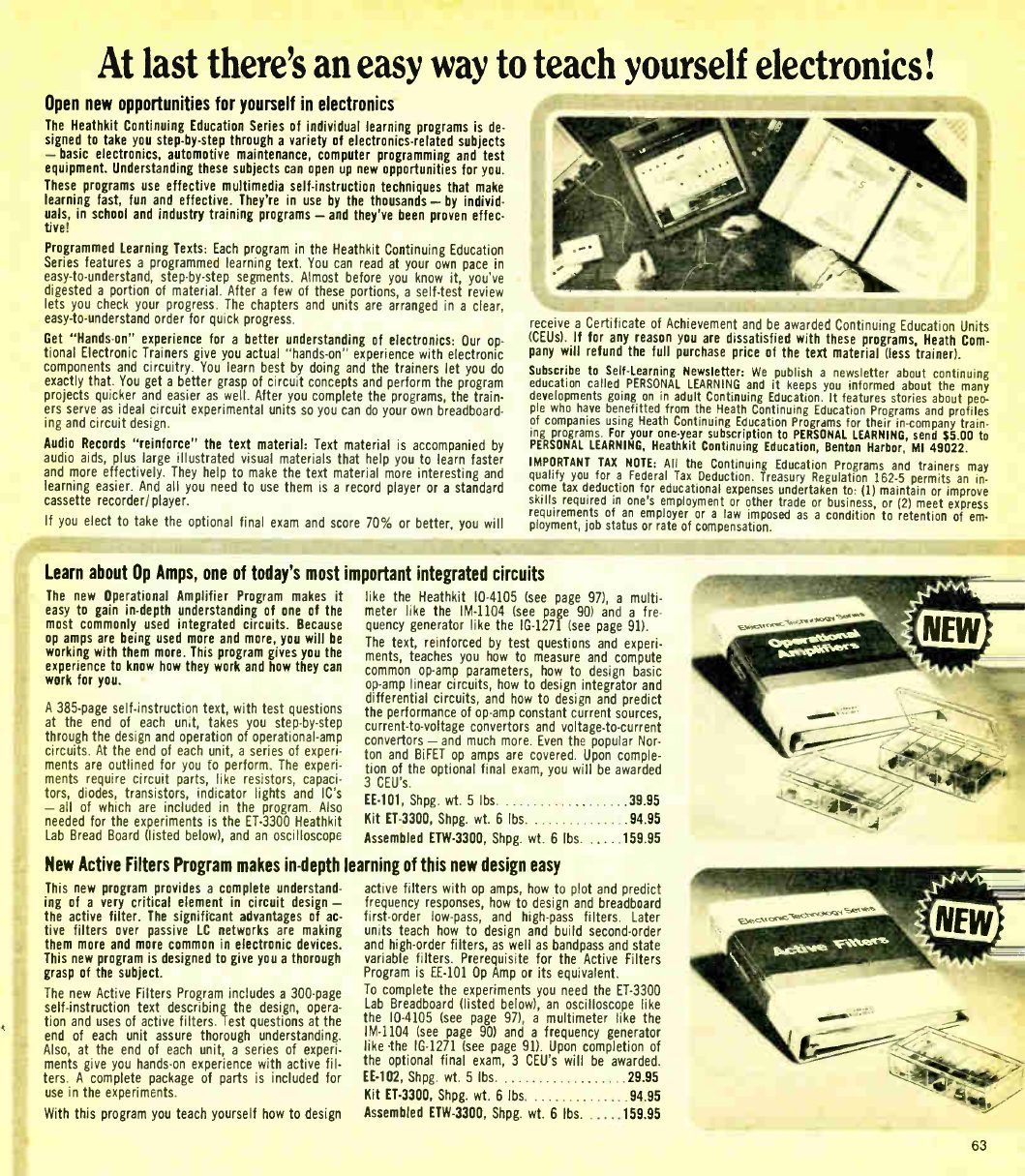
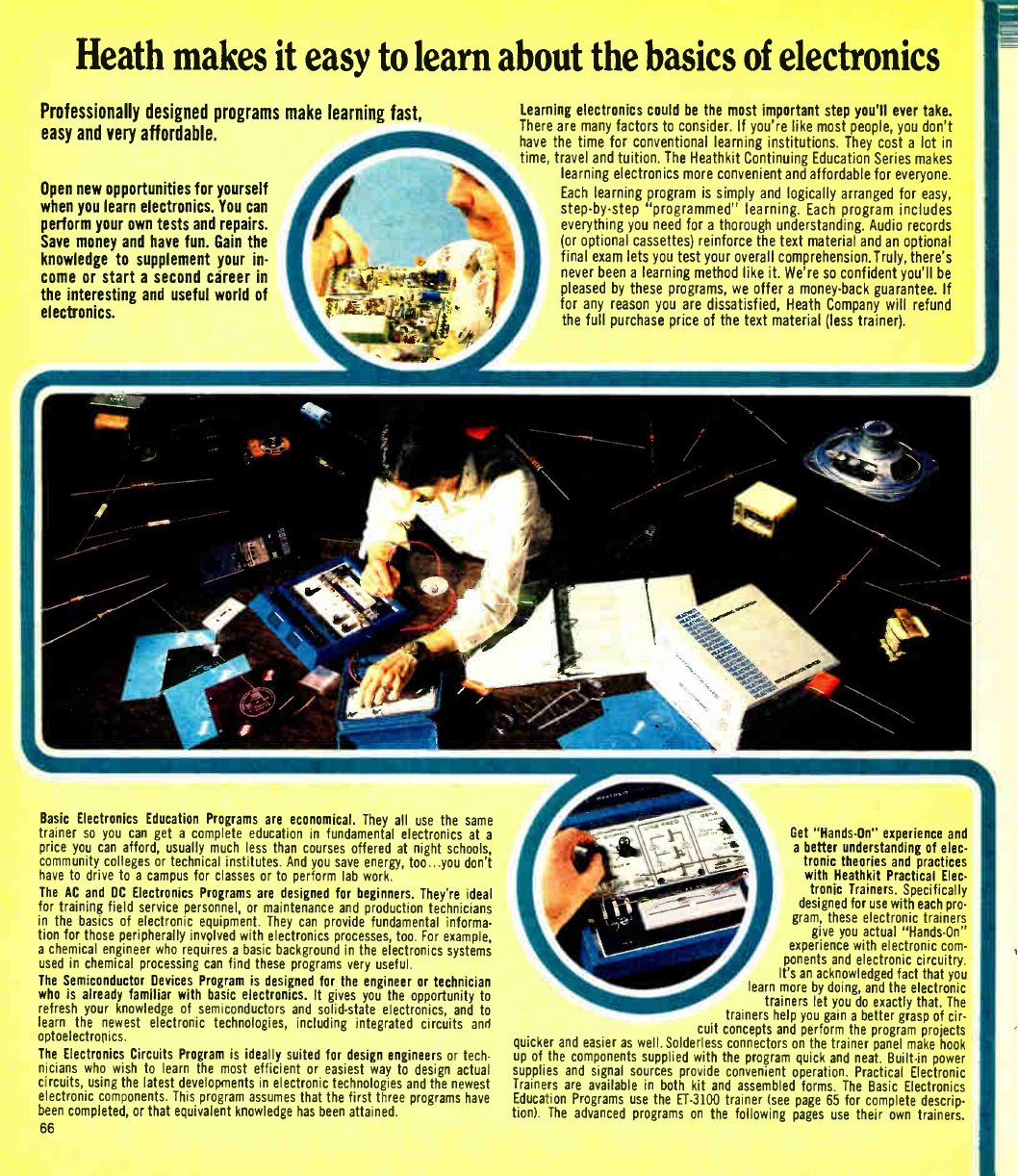
By Fall 1979 the educational pages had become a section of nine pages, printed on yellow stock. Their opening page is a summary of the programme at its height (Fall 1979, pp. 63–71):
- The series now covered “basic electronics, automotive maintenance, computer programming and test equipment” and was “in use by the thousands — by individuals, in school and industry training programs”.
- The money-back guarantee now covered all course material: Heath “will refund the full purchase price of the text material (less trainer)”.
- Heath published a newsletter about adult education called PERSONAL LEARNING, $5.00 a year, with “stories about people who have benefitted from the Heath Continuing Education Programs and profiles of companies using Heath Continuing Education Programs for their in-company training programs”. No copy of it was found.
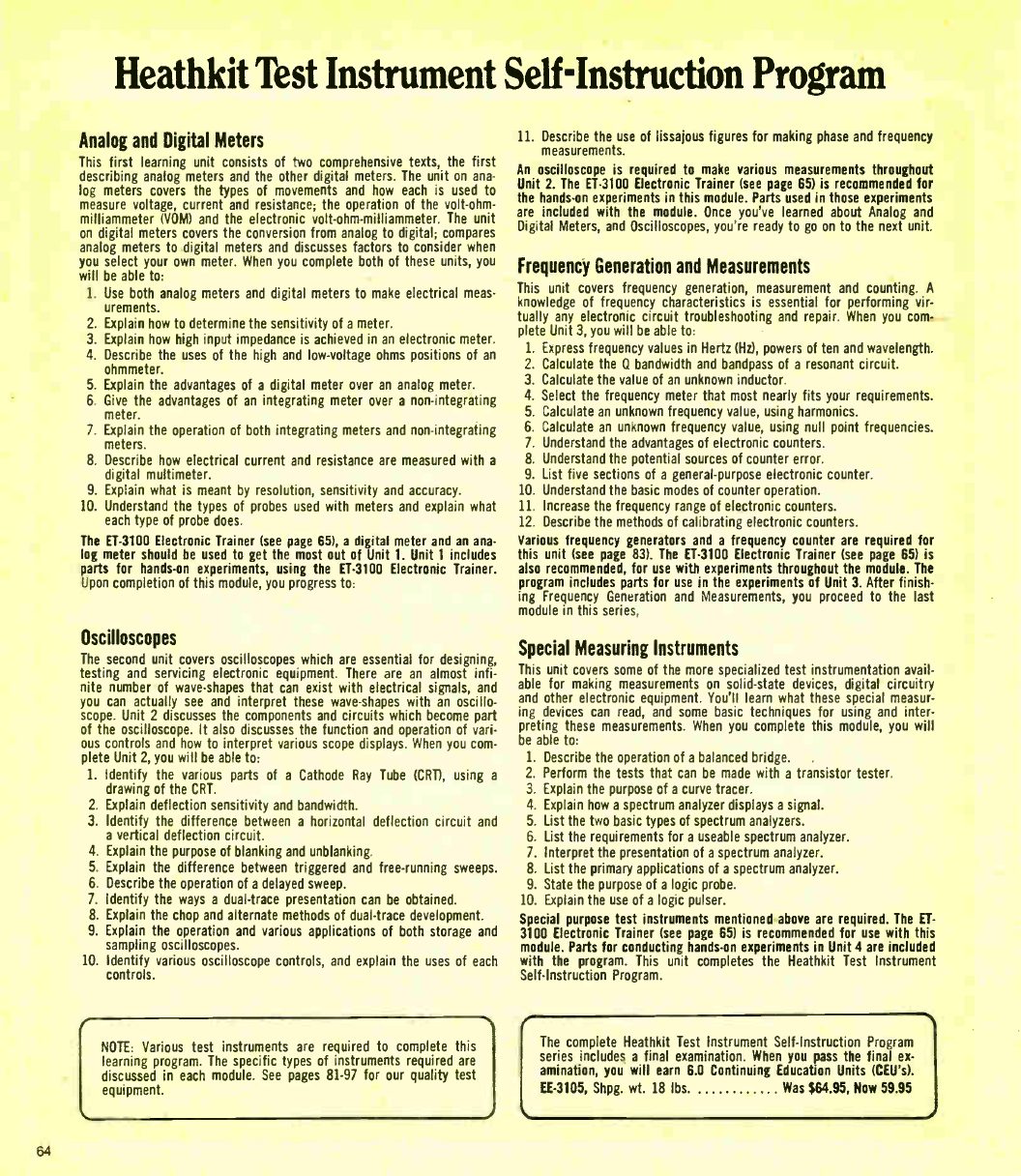
Two new families appeared. The Electronic Test Equipment course, EE-3105 (introduced in Winter 1979 according to Bob Eckweiler’s survey), came in four separately bound modules: analog and digital meters, oscilloscopes, frequency generation and measurement, and special instruments (bridges, transistor testers, curve tracers, spectrum analysers, logic probes). It cost $64.95, reduced to $59.95 in Fall 1979, and earned 6.0 CEUs for the whole programme. It required the instruments it taught, and Heath sold all of them (Fall 1979, p. 64; Eckweiler, Heathkit of the Month #129).
The Advanced Electronics series began with EE-101 Operational Amplifiers ($39.95; “a 385-page self-instruction text”, with parts, for the ET-3300) and EE-102 Active Filters ($29.95). The 1980 catalogue (No. 848) added EE-103 IC Timers ($39.95) and EE-104 Phase-Locked Loops ($49.95), and EE-105 Optoelectronics ($59.95) followed by Winter 1981 (No. 848; Winter 1981). The IC Timers text was 348 pages on the 555, 556, 322, 3905 and programmable timer-counters (Heathkit/Zenith Educational Systems catalogue 811-29R, p. 13). The three-digit EE-10x numbers suggest that the series was bought in or adapted rather than written in the EE-3xxx house style. That is an inference from the numbering, and no source for the texts’ authorship was found.
The microprocessor course grew its first accessory. The ETA-3400 Microprocessor Trainer Accessory ($160 in Fall 1979) added memory, a cassette interface, a serial port for an H9 terminal, a monitor and Tiny BASIC in ROM, and turned the ET-3400 into a small computer. The catalogue asked students to finish the course first, because the accessory changed the trainer’s clock and so the timing-loop experiments (Fall 1979, p. 69; ET-3200 dive, volume 5).
2.9 Prices and the shape of the line in 1979
Table 2 — Prices and the shape of the line in 1979
| Christmas 1975 | Fall 1977 | Fall 1979 | |
|---|---|---|---|
| EE-3101 DC Electronics | $39.95 | $39.95 | $44.95 |
| EE-3104 Electronic Circuits | promised | $49.95 | $54.95 |
| EE-3201 Digital Techniques | $49.95 | $49.95 | $59.95 |
| EE-3401 Microprocessors | — | Christmas 1977, $89.95 | $89.95 |
| ET-3100 kit | $59.95 | $59.95 | $69.95 |
| ET-3200 kit | $69.95 | $69.95 | $84.95 |
| ET-3300 kit | — (Spring 1976, $79.95) | — | $94.95 |
| ET-3400 kit | — | Christmas 1977, $189.95 | $209.95 |
Sources: the catalogues named, World Radio History. The full model table is in volume 6.
By the autumn of 1979, four years after launch, the line had more than a dozen courses, four trainers, a classroom edition and a newsletter. Its market was changing from the kit builder to the employer and the school. In October 1979 Zenith bought Heath for its computers, and the educational line gained a new name and a new catalogue (volume 3).
Sources
- Frenzel, Lou. “The History of Personal Computers, Part 2: The Heathkit Story.” Electronic Design, 30 December 2013. https://www.electronicdesign.com/technologies/communications/article/21799215/the-history-of-personal-computers-part-2-the-heathkit-story
- Heathkit catalogues, World Radio History (https://www.worldradiohistory.com/Archive-Catalogs/Heathkit_Catalogs.htm): March 1974; 1974 (810-74); Christmas 1975; Spring 1976; Fall 1977 (817); Christmas 1977 (818); Winter 1978; Spring 1978; Fall 1978; Fall 1979; 1980 (848); Winter 1981.
- Heathkit/Zenith Educational Systems & Instruments catalogue 811-29R (filed as 1975; about 1980–81). https://www.worldradiohistory.com/Archive-Catalogs/Heathkit-Catalogs/Heathkit-1975-Zenith%20Educational%20Systems-811-29R.pdf
- Eckweiler, Bob (AF6C). Heathkit of the Month #129: ET-3100/A/B and associated Heath courses. https://www.w6ze.org/Heathkit/Heathkit_129_ET3100B.pdf
- ET-3100 dive: https://heathkit.fubsypoly.com/et-3100-analog-trainer/vol-1/ ; ET-3200 dive: https://heathkit.fubsypoly.com/et-3200-digital-trainer/vol-1/ (volumes 4 and 5 for the courses and the ET-3400).
- Heathkit history dive, volumes 4, 5 and 7. https://heathkit.fubsypoly.com/heathkit/vol-4/
Comments (0)