Education · Volume 4
Heathkit Educational Systems, 1992–2012
The Heath Company stopped selling hobby kits in 1992, but its educational business carried on for another twenty years. For most of that time, anyone who bought something new with the Heathkit name on it was buying a course or a trainer. This volume follows the educational line from the end of the kits to the bankruptcy of Heathkit Educational Systems (HES) in 2012, and notes what has carried the name in education since. The ownership changes of those years (Groupe Bull, H.I.G. Capital, the DESA sale of the lighting business, Don Desrochers’ purchase in 2005, the 2008 move and sale of the manual archive, the 2011 return to kits) are set out in detail in the history dive, volume 7, and only their effect on the courses and trainers is summarised here.
4.1 What survived in 1992
When the kit line ended, the building on Riverview Drive in Benton Harbor housed two businesses. One was Heathkit Educational Systems, which sold training courses and trainers to schools. The other was the Heath/Zenith lighting and security group. Randy Kaeding, a long-serving employee, described HES as having “begun as Heath Scientific Instruments”, the group that had once made the Malmstadt-Enke laboratory line (history dive, volume 7). Chas Gilmore, general manager at the end, summed up the result in one line: “kits were phased out, leaving Reflex lighting and Heathkit Educational Systems”. He told an interviewer that the educational business stayed reasonably profitable (history dive, volume 6).
The education line needed less change than the rest of the company. Its customers were vocational schools, community colleges, the military and industrial trainers, and none of them had bought through the kit catalogue. Its trainers were already sold mainly factory-assembled. The one market it did lose was the kit catalogue’s home student, and Heath had already prepared a separate home-study catalogue for that reader.
4.2 HomeWorks by Heathkit
The Winter 1991 catalogue, the last general kit catalogue in the World Radio History archive, carried a reply card for “your free copy of HomeWorks by Heathkit”, “the new home-study catalog” (Winter 1991). HomeWorks by Heathkit: An Educational Catalog of Learn-at-Home Electronics survives as a 38-page scan (World Radio History; Internet Archive). It is undated. Its contents (the ET-3600 and ET-3700, the B editions of the analog courses, the ETW-3400-A, courses for Heath/Zenith and IBM-compatible PCs) place it with the Winter 1991 catalogue, about 1990–92.
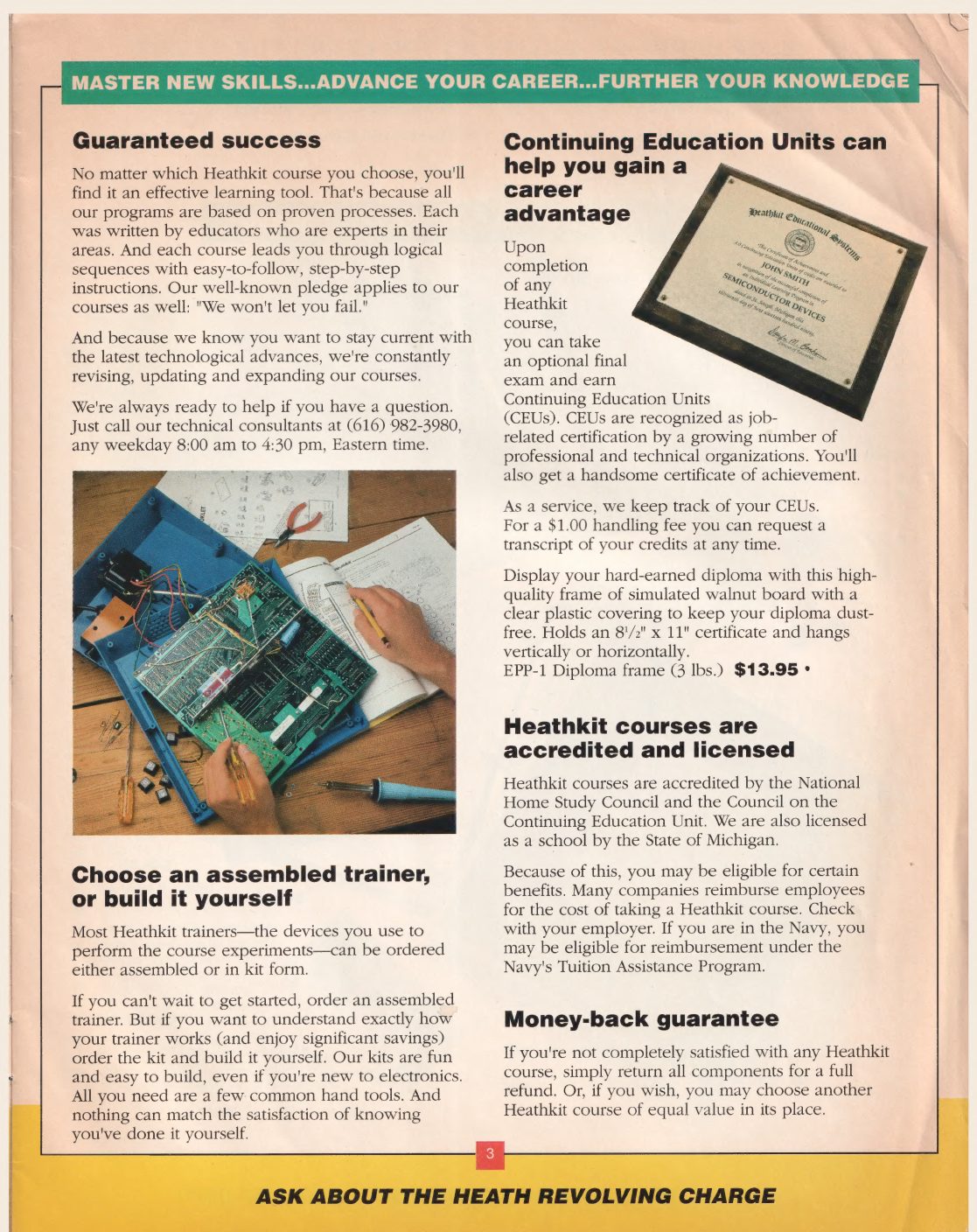
HomeWorks sold the Individual Learning Programs to adults at home, in language close to the kit catalogues’. Its pitch was “Master new skills … advance your career … further your knowledge”. It promised “Guaranteed success” and a “Money-back guarantee”, and it offered a framed-diploma service. It repeated the credentials: “Heathkit courses are accredited by the National Home Study Council and the Council on the Continuing Education Unit”, and the business was “licensed as a school by the State of Michigan”. It also noted that Navy personnel “may be eligible for reimbursement under the Navy’s Tuition Assistance Program” (HomeWorks, PDF page 3). A buyer could still “choose an assembled trainer, or build it yourself”. After 1992 these trainers were the only Heathkits still sold as kits.
4.3 The 1993 catalogue: “Electronics and Computer Education”
The fullest record of HES after the kits is its catalogue No. 279, Electronics and Computer Education, subtitled “Vocational Education · Individual Learning · School-To-Work · Tech-Prep”. World Radio History files it as 1993. Its back matter carries “©1994 Heath Company”, and one model “will be available in the spring of 1994”, so it is best dated to the winter of 1993–94 (catalogue No. 279). Its 64 pages show the business at the point where it stopped being a kit company’s side-line:
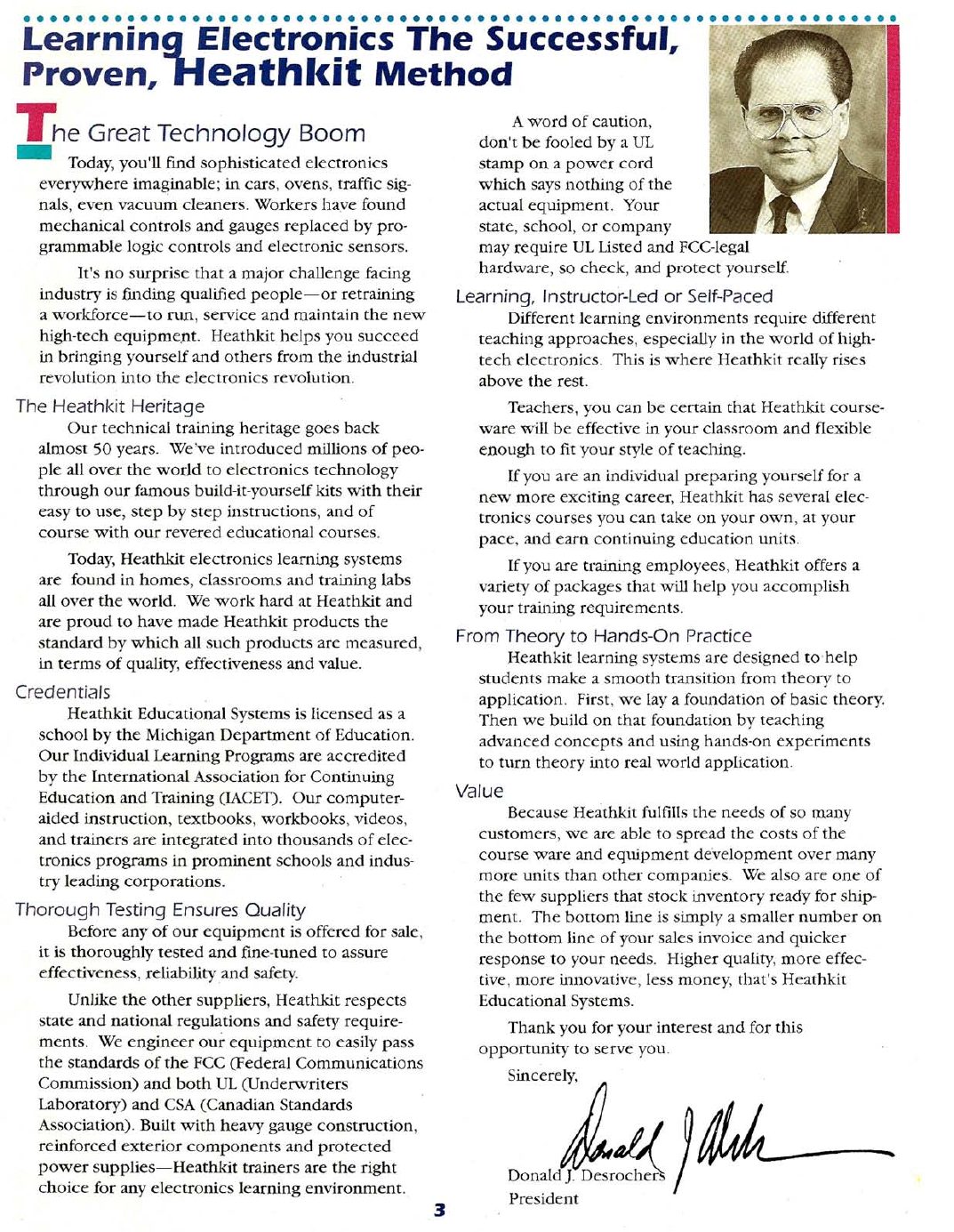
- The letter. The opening page, “Learning Electronics The Successful, Proven, Heathkit Method”, is signed by Donald J. Desrochers, President. The Herald-Palladium dates his presidency from 1995; this letter shows that he already held the title in the educational company by 1993–94. He later bought the business, in 2005 (history dive, volume 7).
- The credentials. The business was now “licensed as a school by the Michigan Department of Education”, and “our Individual Learning Programs are accredited by the International Association for Continuing Education and Training (IACET)”. The IACET was the successor to the Council on the Continuing Education Unit named in HomeWorks.
- The origin story. The catalogue claimed that Heathkit had been “literally asked to enter the electronics education business by electronics instructors” who had learned from its kit manuals, and that it had spent “nearly 20 years refining” its methods (p. 4). Elsewhere it said that HES “grew out of Heath Company (famous for fool-proof documentation)”.
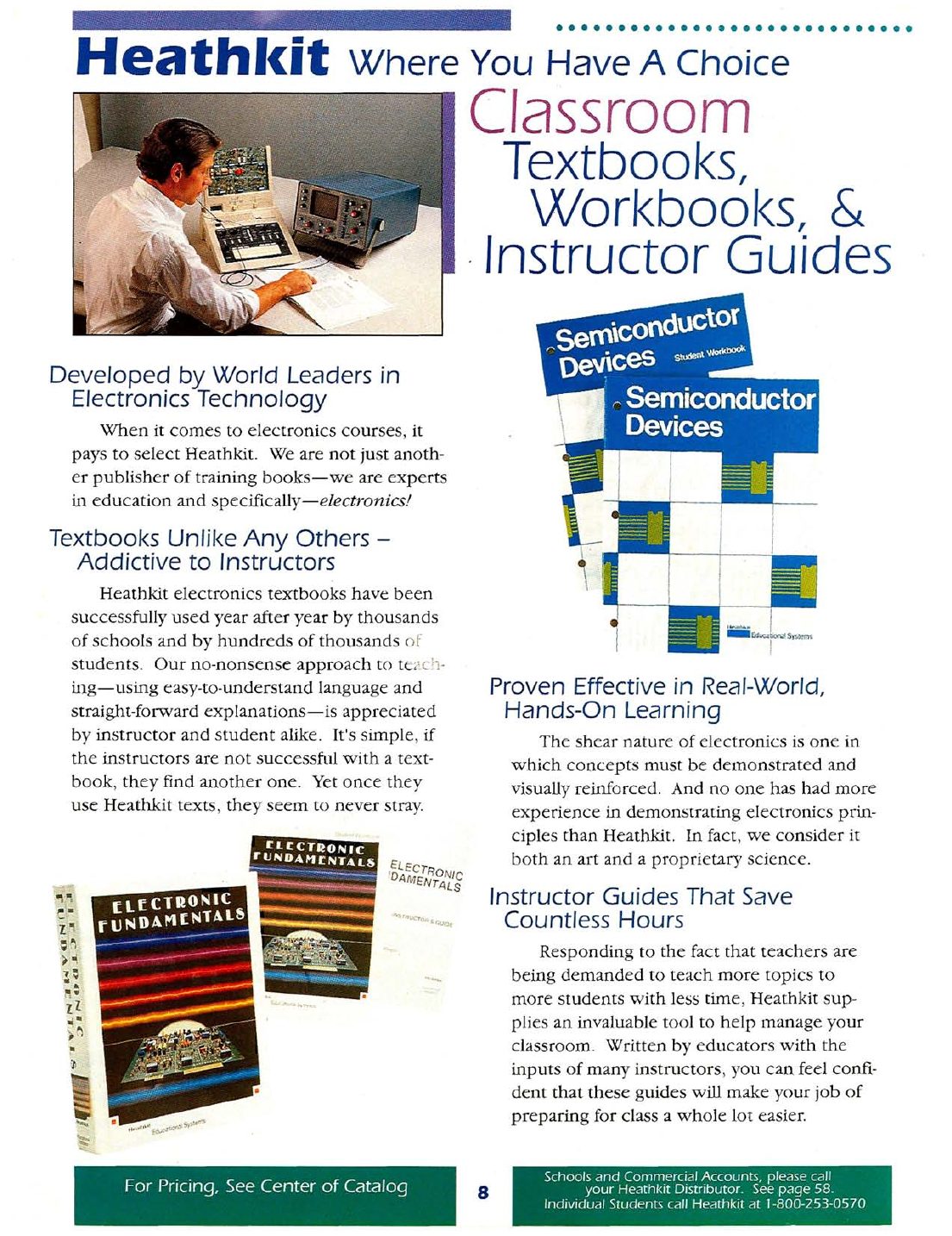
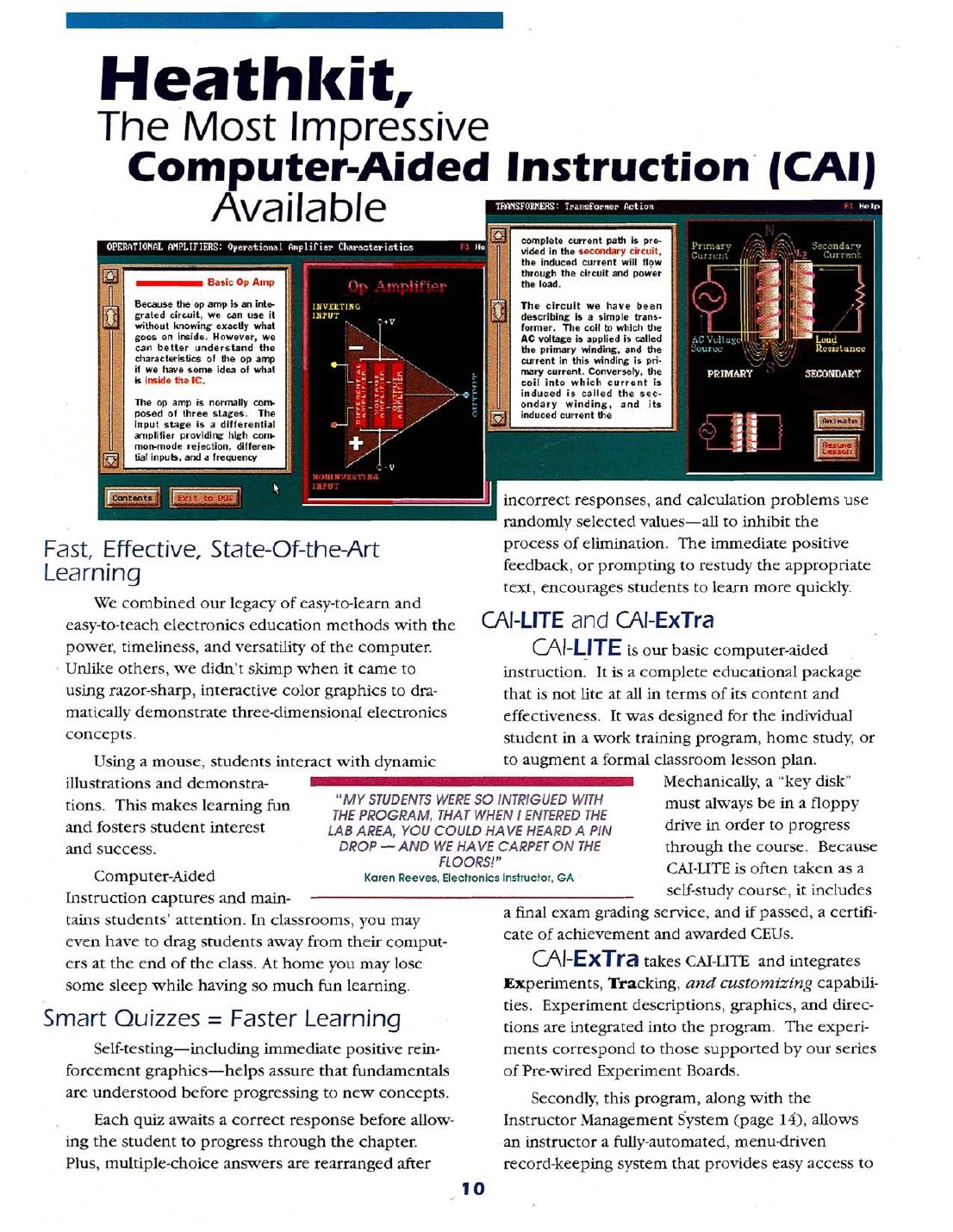
- The media. Every course came in several forms: classroom textbooks, workbooks and instructor’s guides; Individual Learning Programs (ILPs) of “400 to 1000 pages”, with parts, a course-review disk, a grading service and “private one-on-one instructor assistance” by telephone; videos; and computer-aided instruction (CAI). The CAI came in two grades, CAI-LITE and CAI-ExTra, with colour graphics and “randomly selected values” in calculation problems, “to inhibit the process of elimination”. An Instructor Management System kept the class records.
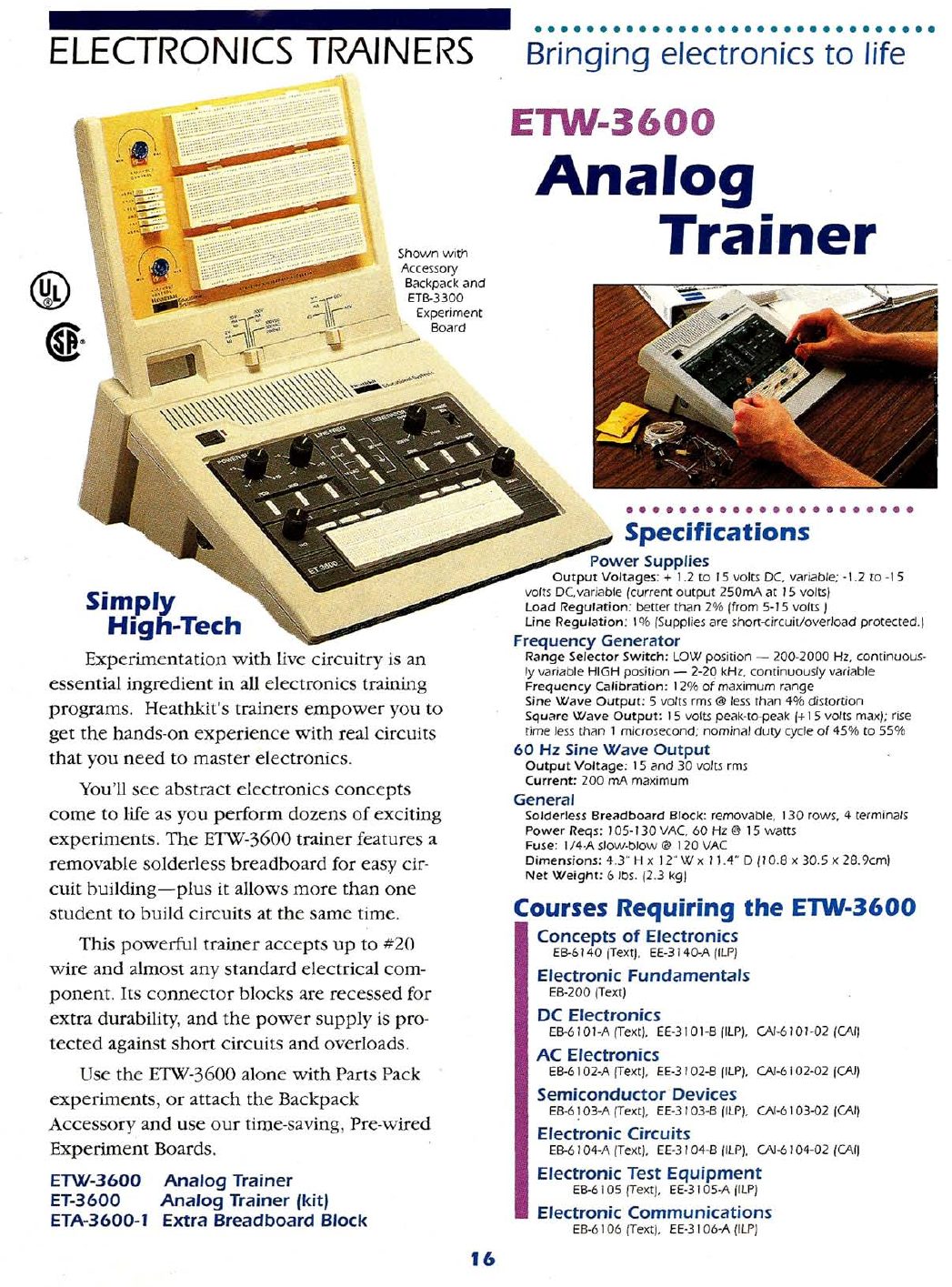
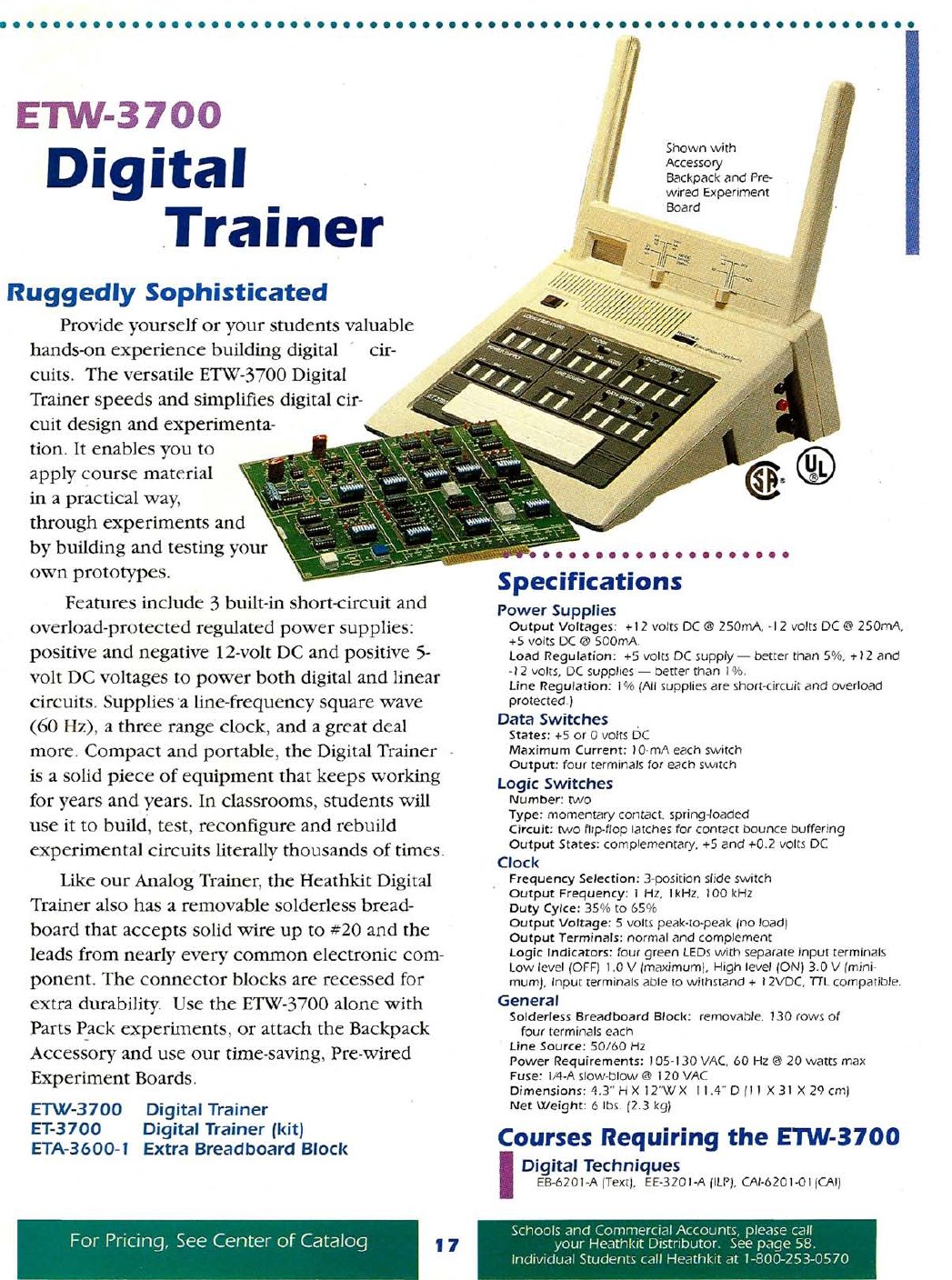
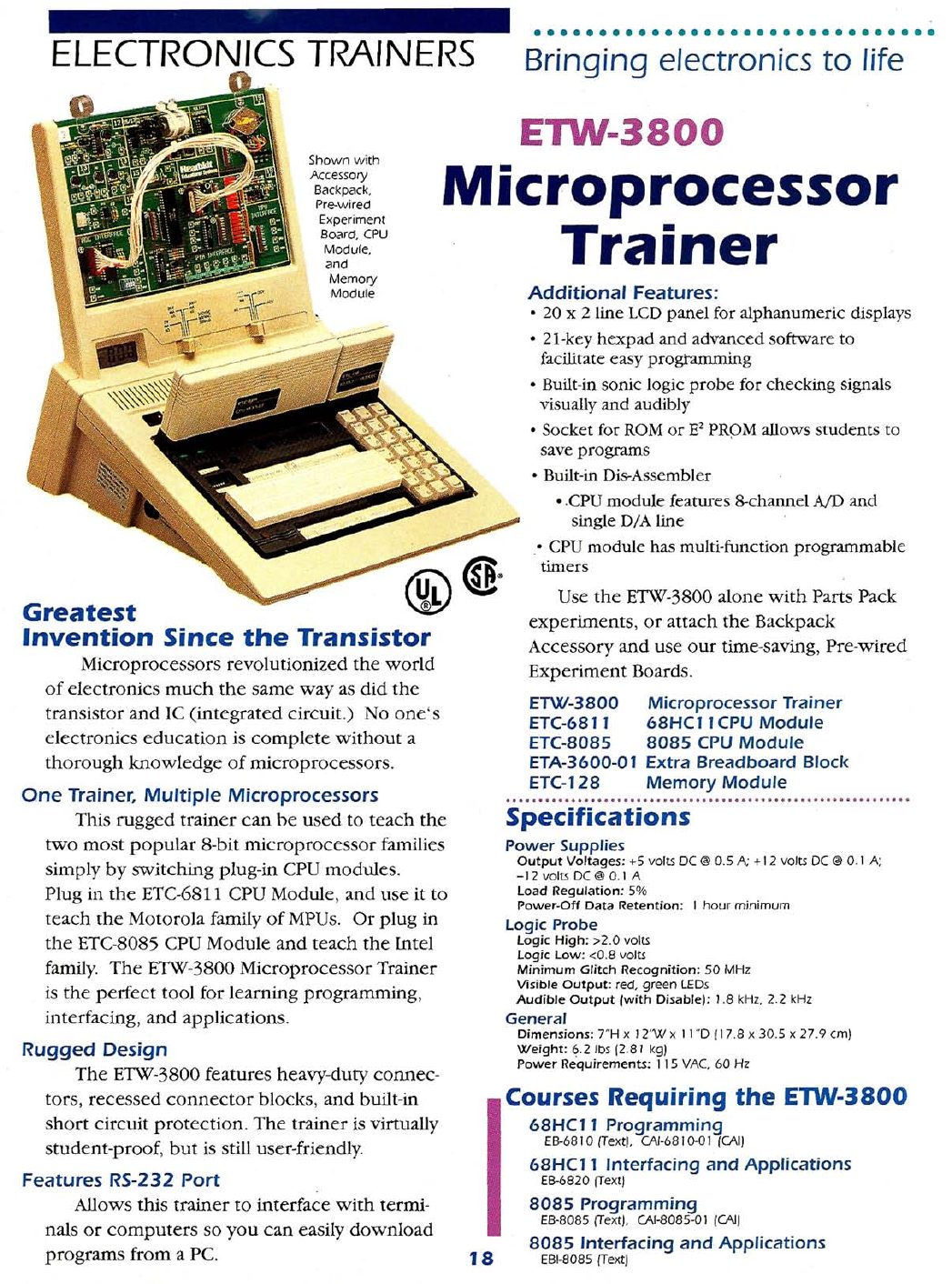
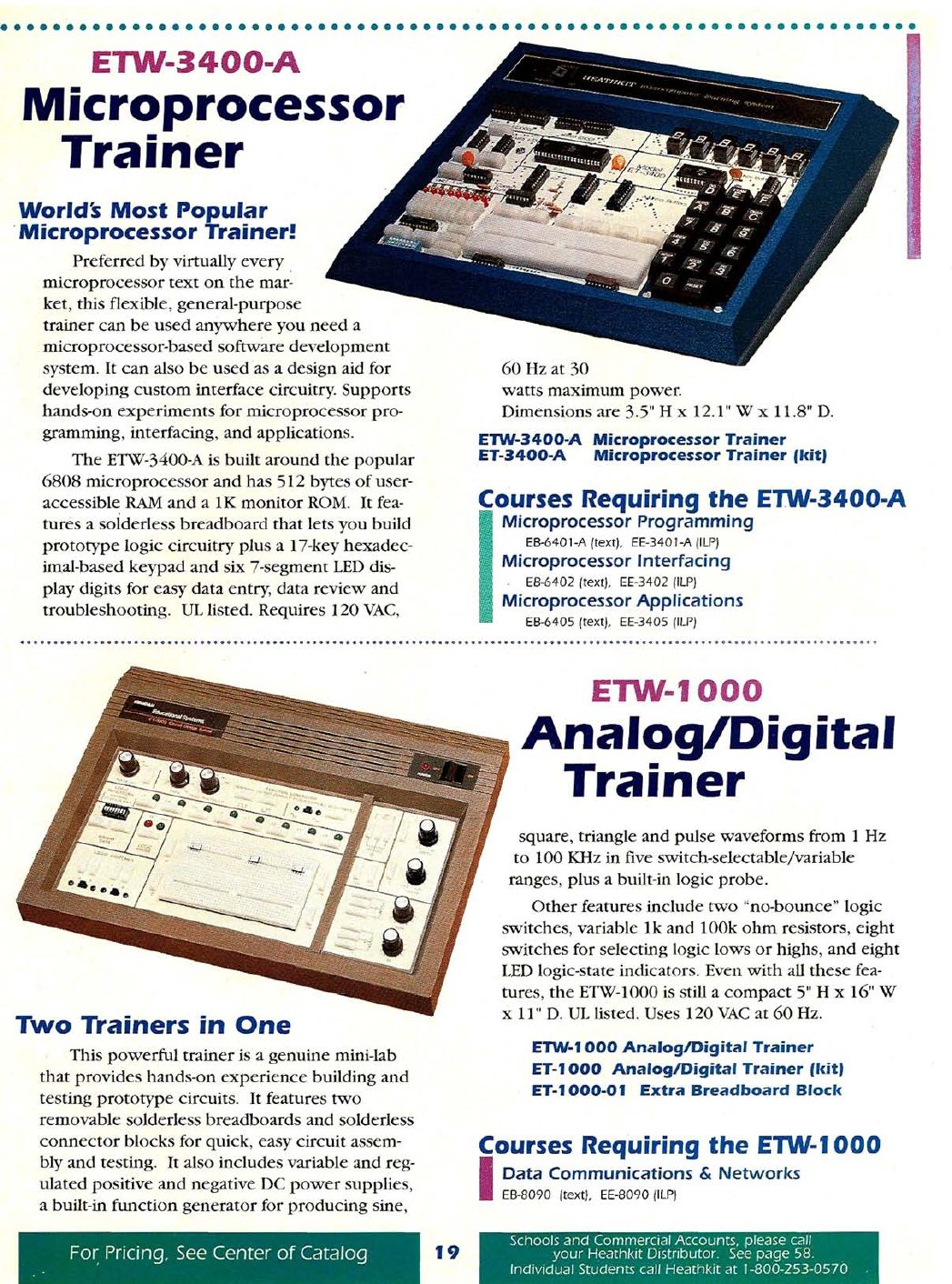
The trainer pages are a summary of the whole ET line as it stood after the kits:
Table 1 — The trainer pages are a summary of the whole ET line as it stood after the kits
| Trainer | 1993–94 kit | 1993–94 assembled | Courses |
|---|---|---|---|
| ET-3600 Analog Trainer | $149.95 | $249.95 | Concepts of Electronics; Electronic Fundamentals; DC, AC, Semiconductor Devices, Electronic Circuits, Test Equipment, Communications |
| ET-3700 Digital Trainer | $149.95 | $249.95 | Digital Techniques |
| ETW-3800 Microprocessor Trainer (68HC11 or 8085 module) | — | $599.95 | 68HC11 and 8085 programming, interfacing and applications |
| ET-3400-A Microprocessor Trainer | $349.95 | $499.95 | Microprocessor Programming, Interfacing and Applications (6800 family, individual learning) |
| ET-1000 Analog/Digital Trainer | $299.95 | $399.95 | Data Communications and Networks |
| ET-3567 Accessory Backpack | — | $249.95 | pre-wired experiment boards for the courses above |
Source: catalogue No. 279, pp. 16–19 and the price list in the centre of the catalogue (World Radio History). The prices were read from OCR text of the price list.
The copy had become a classroom specification. The ETW-3600 had a “removable solderless breadboard for easy circuit building” that “allows more than one student to build circuits at the same time”, “recessed” connector blocks “for extra durability”, and supplies “protected against short circuits and overloads”. The ETW-3800 was “virtually student-proof, but is still user-friendly”. The ET-3400-A, sixteen years after the ET-3400’s launch, was billed as the “World’s Most Popular Microprocessor Trainer!”, “preferred by virtually every microprocessor text on the market”. Every trainer page gave the courses that required it, and each course page gave its trainer, experiment board and parts pack.
The course list had moved towards jobs. Beside the core electronics series (DC, AC, semiconductors, circuits, digital techniques, microprocessors) the catalogue offered a Master Course in Electronics Technology. That was the four basic ILPs, the soldering course, videos and CAI in one package, $1,399 to $1,749 depending on the oscilloscope included. There was a Master Course in Personal Computers at $2,495. A PC Servicing, Troubleshooting and Networking package (EZS-400) included a Novell networking course. There were also courses on VCR, camcorder and television servicing, communications, lasers and electro-optics. The last pages were “Heathkit Favorites”: the ID-5001 Advanced Weather Computer, the Most Accurate Clock II (GCW-1001, $349.95), a GC-1108 digital clock and an AM radio kit (catalogue No. 279, contents and pp. 42–61). A few consumer products were thus still sold through the education catalogue after the kit catalogue had closed.
4.4 “Tech^Knowledge”: the 1990s and 2000s
The business put itself online early. The earliest capture of heathkit.com, from December 1996, is headed “Heathkit Educational Systems — Dedicated to Provide Tomorrow’s Training Tools … Today”. It lists History, A+ Certification Preparation, PC Tech^Knowledge, TelCom Tech^Knowledge Fundamentals and Core Electronics, “copyright © 1996 Heathkit Educational Systems” (heathkit.com, archived 24 December 1996).
By 1998 the site’s “About HES” page gave the company as Heathkit Company, Inc., 455 Riverview Drive, Benton Harbor. It explained that “at first, we pioneered the kit building approach, but many years in the business has shown that the real impact for our services is in passing on our technical expertise through training”. It named its customers as “corporations, schools, correctional facilities, and independent study situations”, and it still offered final examinations, grading, certificates and CEUs (heathkit.com, “About HES”, archived 1 July 1998). The 2000 version dated the business “since 1974”. It described it as “a full service curriculum provider” in “Computers, Telecommunications, and Electronics”, and it listed memberships in CompTIA, the Information Technology Training Association, the American Society for Training and Development, the Association for Career and Technical Education, IACET and SkillsUSA (heathkit.com, “About”, archived 11 July 2000).
The course list of January 2005 shows how far the line had moved from its 1975 base while keeping it. At the top were PC System Servicing and Troubleshooting, A+, Network+ and Server+ certification preparation, laser-printer repair, networking, cabling and fibre optics, telephone and wireless communication, and a new HTI Academy (home technology integration) mapped to CompTIA’s HTI+ certification, with low- and high-voltage training modules for its HTS-100 and HTS-200 courses. At the bottom, under the same headings as in 1975, were DC Electronics, AC Electronics, Semiconductor Devices, Electronic Circuits, Digital Techniques, Microprocessor Programming and Microprocessor Interfacing (heathkit.com, archived 7 January 2005). The course texts show the same continuity from the inside. The 1998 printing of Digital Techniques (EE-3201A) still told students they would need “either the ET-3200 or the ET-3700”, and the 1998–99 editions of the DC, AC and circuits courses still carried copyright dates going back to 1975 (ET-3200 dive, volume 4; ET-3100 dive, volume 4).
4.5 The end, 2012
The HES website of January 2012 still showed the full range: PC technology and certification, networking and fibre optics, RFID, residential automation, robotics with the HE-RObot mobile robot, biomedical instrumentation, wind and renewable energy, and the core electronics series with its trainers under “The Heathkit Approach to Learning” (history dive, volume 7). By then the business had moved to St. Joseph Township (2008), had sold much of its manual archive to Data Professionals (2008), and had tried a return to kits (2011).
The owner gave the reason for the collapse in the local paper: HES “was primarily dependent upon federal and state funding for schools. Spending in education continued to drop down, and it was economically unfeasible to continue operating.” Most staff were laid off in December 2011. Operations stopped in the spring of 2012 and a bank auctioned the assets that summer (history dive, volume 7). That volume ends its account with John Oliphant, a Heath/Zenith technical writer of almost 28 years, who after the layoff repaired computers for a living: “I’m actually doing what I used to write training courses about.”
4.6 The name in education since 2013
The Heathkit name returned in 2013 under a new, privately held Heath Company, which in 2023 became a subsidiary of Kirkwall of Fargo, North Dakota (history dive, volume 7). The notice that announced the return listed “Heathkit® Educational Systems” among the trademarks the new company held. The educational products of the new company have been few and small: an EX-1001 microcontroller experimenter kit branded “Heathkit Educational Systems®”, a surface-mount soldering lesson built into a code-practice oscillator (the ER-1001 “HeathRules”), and in 2025 the AMSAT CubeSatSim Kit, Heathkit Edition Educator Pack ($995), a satellite simulator with books and teaching material (history dive, volume 7). No reissue of the ET trainers or the EE courses was found. The courses of 1975 and their successors survive through the scans and collectors described in volume 5.
Sources
- Heathkit catalogue No. 223, Winter 1991. https://www.worldradiohistory.com/Archive-Catalogs/Heathkit-Catalogs/Heathkit-1991-Winter-223.pdf
- HomeWorks by Heathkit: An Educational Catalog of Learn-at-Home Electronics, about 1990–92. World Radio History: https://www.worldradiohistory.com/Archive-Catalogs/Heathkit-Catalogs/HomeWorksByHeathkit.pdf ; Internet Archive: https://archive.org/details/hwbhk
- Heathkit Educational Systems. Electronics and Computer Education, catalogue No. 279 (filed as 1993; © 1994). https://www.worldradiohistory.com/Archive-Catalogs/Heathkit-Catalogs/Heathkit-1993_279-Education.pdf
- heathkit.com, archived by the Internet Archive: 24 December 1996 (https://web.archive.org/web/19961224163704/http://www.heathkit.com:80/); “About HES”, 1 July 1998 (https://web.archive.org/web/19980701111824/http://www.heathkit.com:80/about.html); “About”, 11 July 2000 (https://web.archive.org/web/20000711061310/http://www.heathkit.com:80/About/about.html); 7 January 2005 (https://web.archive.org/web/20050107012537/http://www.heathkit.com:80/).
- ET-3100 dive, volume 4: https://heathkit.fubsypoly.com/et-3100-analog-trainer/vol-4/ ; ET-3200 dive, volume 4: https://heathkit.fubsypoly.com/et-3200-digital-trainer/vol-4/
- Heathkit history dive, volumes 6 and 7. https://heathkit.fubsypoly.com/heathkit/vol-7/
Comments (0)