Education · Volume 5
The Trainers and Courses Today
The educational line left more behind than any other Heath category. The kits were built one at a time by hobbyists. The trainers were bought a laboratory at a time by schools, colleges, industry and the armed forces, and they were built to survive students. The course texts were printed and reprinted for up to twenty-five years. When the schools replaced them, many passed into surplus sales, and from there into home workshops, museums and online archives. This volume describes what survives, where the documents can be found, how the trainers are used and restored now, and the communities that keep them in use. Restoration of individual trainers is covered in detail in the kit dives: the ET-3100 dive, volume 5 and the ET-3200 dive, volume 6.
5.1 What survives, and why so much
Three things explain how many trainers survive.
The first is numbers. No production figures for any ET trainer have been found. The catalogues, however, sold the same few designs for many years: the ET-3100 family from 1975 to 1987, the ET-3400 family from 1977 into the 1990s, and the ET-3600 and ET-3700 from 1987 to at least 1994 (volume 6). They sold them to institutions that bought by the laboratory. The classroom text of Electronic Circuits, first copyrighted in 1978, was in its nineteenth printing by 1983 (Internet Archive, Electronic Circuits, Heathkit/Zenith Educational Systems). That is five years and nineteen print runs for the fourth course of the series.
The second is construction. The trainers were small, cool-running and simple, and after 1981 they were built to UL and CSA requirements for classroom use. By 1993 Heath was advertising them as “virtually student-proof”, with recessed connector blocks and protected supplies (volume 4). Their commonest faults are mechanical: missing or spread connector blocks, cracked cases, worn breadboards. The kit dives list these faults in detail.
The third is institutional disposal. School and college trainers were retired in batches and sold as surplus, often with a laboratory’s bench number still written on them. The ET-3200A photographed in the ET-3200 dive carries “DIGITAL #6” on its bottom label (ET-3200 dive, volume 1). The ET-3400 manual scanned for the Internet Archive carries the stamp of a university electronics maintenance laboratory (ET-3200 dive, volume 5). Such markings are a useful record of where a trainer was used, and they are best left in place.
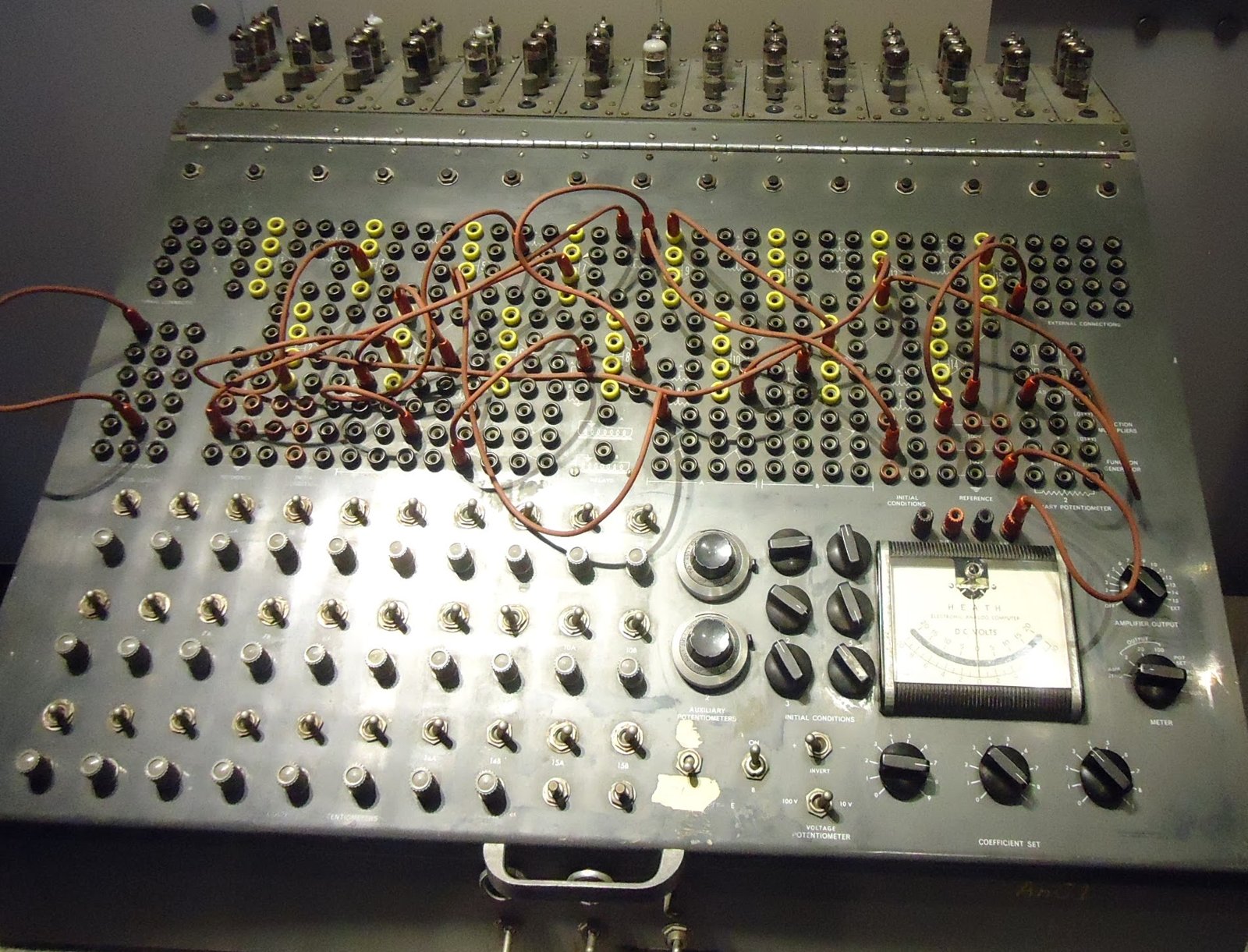
The rarer survivors are the ones that were never sold in quantity: the 1960s EK and EF kits (which were built, and so rarely survive complete with their text-workbooks), the cardboard-cased ET-6800 of 1981, the ET-100 16-bit trainer, the laser trainer, and the Malmstadt-Enke and Berkeley laboratory instruments. The analog computers have reached museums. The Computer History Museum in Mountain View has shown both the EC-1 educational analog computer (pictured in volume 1) and the larger Heath Electronic Analog Computer.
5.2 Using a trainer today
The trainers remain useful benches, which is what the catalogues always promised they would be after the course. Each family has its own strengths:
- ET-3100 / ET-3600 (analog). Two protected variable supplies and an audio oscillator in one box, suited to op-amp, transistor and filter work. The originals are limited to 100 mA per supply, and the ET-3100B and ET-3600 to 250 mA. The square wave of the early models is unipolar (ET-3100 dive, volume 4).
- ET-3200 / ET-3700 (digital). Fixed 5 V and ±12 V rails, debounced logic switches, a three-speed clock, a line-frequency reference and four indicators. They remain a quick way to try out TTL and CMOS logic (ET-3200 dive, volume 4).
- ET-3300 (breadboard). Power and space only, and still a useful general prototyping board.
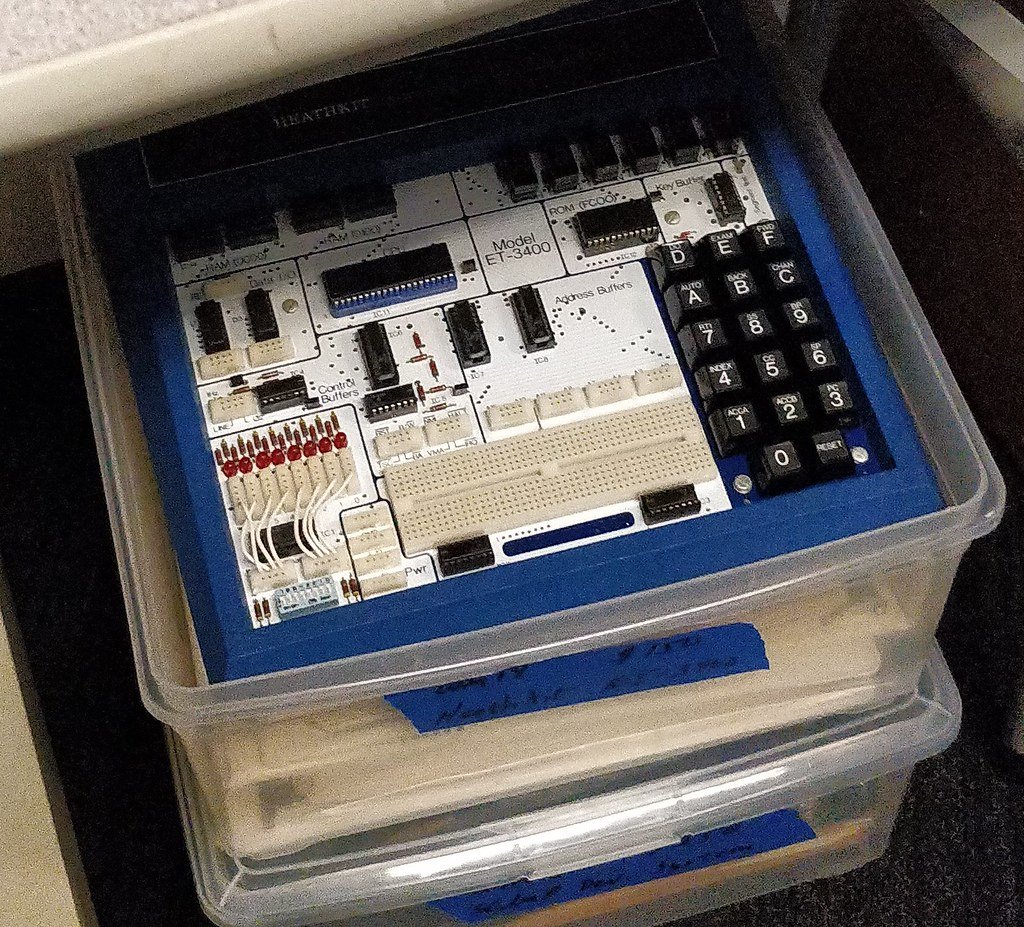
- ET-3400 / ET-3400A (microprocessor). A complete 6800-family computer with the processor’s buses brought out to a breadboard. It is used today to learn assembly language on a machine small enough to understand completely, and it is the one Heath trainer with a large following of its own (below).
Two practical cautions apply to all of them. First, every trainer is a mains-powered device. The pre-1981 models have two-wire cords and fuses inside the case, so they should be checked (cord, fuse, filter capacitors) before long use, and preferably fitted with a three-wire cord. The kit dives describe the safety revisions that produced the A models for exactly this reason (ET-3100 dive, volume 1). Second, the spring-contact connector blocks and breadboard strips wear. They accept solid wire of #22 to #24 gauge, and stranded wire or thick component leads spread them. Replacement blocks are the part most often sought.
5.3 The ET-3400 community
The ET-3400 has become a small retrocomputing platform. An ET-3400 group on groups.io serves owners (ET-3400@groups.io). Several independent emulators reproduce the trainer in software. RupertAvery’s emulator, written in C++ for Windows and Linux after an earlier C# version, emulates the 6800, the RAM, the monitor ROM, the display and the keypad. It adds a debugger with single-stepping, breakpoints and a memory heat map, and its author credits the ET-3400 group for documentation (RupertAvery/et3400; RupertAvery/et3400-emu). The sharp6800 project by cpswan is another emulator (cpswan/sharp6800). The CalPlug repository collects ROM images, cassette (Kansas City Standard) encoding and decoding tools and example code. It states that “these resources are provided to help students independently gain a deeper understanding of embedded systems”, which is the trainer’s original purpose restated forty years on (CalPlug/Heathkit_ET-3400).
The emulators matter for the course material too. The EE-3401 experiments were timed by software loops and written for the trainer’s monitor. An accurate emulator lets a reader work through a scanned course text without owning the hardware, which is how many people now first meet the Heath microprocessor course.
5.4 The documents and where to find them
The course texts and trainer manuals are the best-documented part of the whole Heath output, because they were reprinted for so long and because schools kept them. The table lists the principal scans found. The hosting position is set out in volume 6.
Table 1 — The documents and where to find them
| Title | Edition found | Where |
|---|---|---|
| EK-1 Basic Electricity text-workbook | © 1959, printing of 1965 | Internet Archive (heathkitmanuals) |
| EK-2A Basic Radio, Part I | © 1960, printing of 1966 | Internet Archive (heathkitmanuals) |
| EE-3101 DC Electronics (binder) | 1983 | Internet Archive |
| EE-3101-C DC Electronics | 1998–99 | Internet Archive |
| EE-3102-C AC Electronics | 1999 | Internet Archive |
| EE-3103-B Semiconductor Devices | 1998–99 | Internet Archive |
| EE-3104-B Electronic Circuits | 1998 | Internet Archive |
| Electronic Circuits (classroom text) | © 1978, 19th printing 1983 | Internet Archive |
| EE-3201A Digital Techniques | © 1983, 1993, 1998 | Internet Archive |
| EB-6201-71 Digital Techniques Lab Book | HES, undated | Internet Archive |
| EB-6103-71 Semiconductor Devices Lab Book | HES, 2001 | Internet Archive |
| EE-3401 Unit 1, Number Systems and Codes (with ET-3400 manual) | © 1977 | Internet Archive |
| EE-1800 Robotics & Industrial Electronics | Heathkit/Zenith, 1980s | Internet Archive |
| HomeWorks by Heathkit (catalogue) | about 1990–92 | Internet Archive |
Trainer manuals (ET-3100, ET-3100B, ET-3200, ET-3200B, ET-3300B, ET-3400) are listed with their part numbers in the kit dives’ reference volumes: ET-3100 and ET-3200. The catalogues that record the line year by year, from the 1948 schools flyer to the 1993–94 education catalogue, are all at World Radio History. The Heathkit/Zenith schools catalogue 811-29R is filed there under 1975, although it dates from about 1980–81 (volume 3).
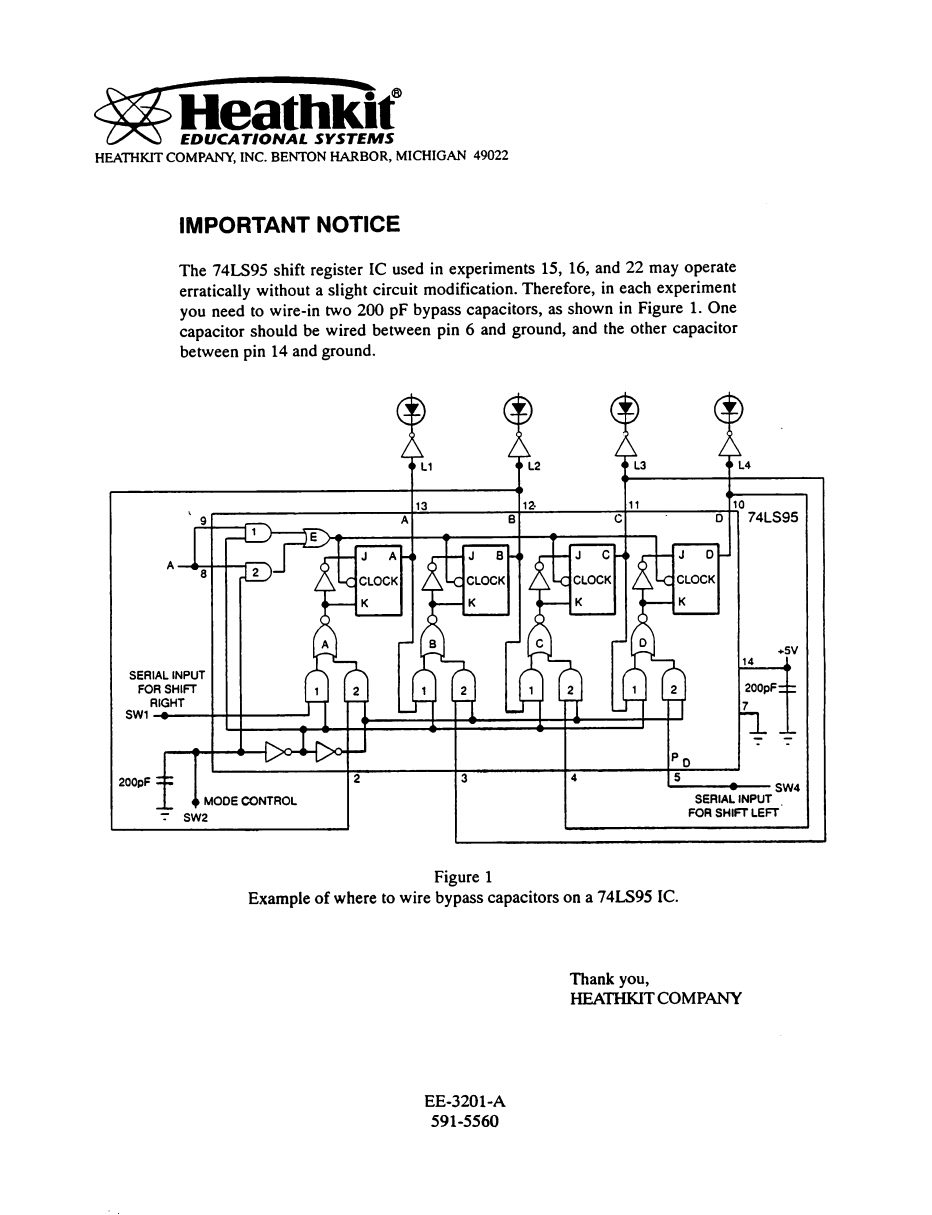
The late printings are worth reading for their errata as well as their content. The 1998 printing of EE-3201A carries a loose “Important Notice” from “Heathkit Company, Inc.” correcting three experiments that had been in print since 1983. It shows that the courses were still being supported, experiment by experiment, twenty years after they were written.
Several gaps remain. No scan was found of the original 1975 texts of EE-3101 to EE-3103 or EE-3201 (the earliest scans are the 1983 binder and later editions). None was found of the EF-series “How to Understand and Use” books, of the PERSONAL LEARNING newsletter of 1979, or of the 1970s Heath/Schlumberger scientific-instrument catalogues’ educational pages. The Malmstadt-Enke laboratory manual (EUA-11) and the Heath edition of the Berkeley Physics Laboratory instructions were not located either.
5.5 Collecting notes
- Model letters. The A and B suffixes usually appear only on the identification label underneath, not on the front panel (ET-3200 dive, volume 1). The label and the line cord (two-wire or three-wire) are the quickest way to identify a version.
- Liveries. The blue case with white panel (1975 to the early 1980s), the light-grey case with brown panel lettered “Heathkit/Zenith Educational Systems” (1980s), and the light cases of the ET-3600 generation mark the era more reliably than the model number.
- Completeness. A course is complete with its binder or binders, its audio (records before late 1982, cassettes or audio-visual packs after), its parts bag and its final-examination envelope. Complete courses are much rarer than trainers, because the parts were used and the examinations were mailed back.
- OEM and export versions. Some trainers were made for other educational publishers, such as the Swedish Esselte units documented in the ET-3100 dive, volume 5. Spanish-manual kits (ET-3100S) were sold with Spanish course editions.
- Robots. The HERO robots, the most sought-after items of the whole educational line, are covered in the Robots category (HERO 1).
Sources
- Internet Archive items as listed in the table above.
- leighklotz. “Heathkit ET-3400 Trainer.” Flickr, CC BY 2.0. https://www.flickr.com/photos/7417392@N05/42943231735
- Tomwsulcer. “Heath Electronic Analog Computer at CHM.” Wikimedia Commons, CC0. https://commons.wikimedia.org/wiki/File:Heath_Electronic_Analog_Computer_at_CHM.jpg
- ET-3400 group, groups.io. https://groups.io/g/ET-3400
- RupertAvery. ET-3400 emulator (C++), https://github.com/RupertAvery/et3400 ; earlier C# version, https://github.com/RupertAvery/et3400-emu
- cpswan. sharp6800, Heathkit ET-3400 emulator. https://github.com/cpswan/sharp6800
- CalPlug. Heathkit_ET-3400 resources. https://github.com/CalPlug/Heathkit_ET-3400
- ET-3100 dive: https://heathkit.fubsypoly.com/et-3100-analog-trainer/vol-1/ ; ET-3200 dive: https://heathkit.fubsypoly.com/et-3200-digital-trainer/vol-1/
- World Radio History, Heathkit catalogue index. https://www.worldradiohistory.com/Archive-Catalogs/Heathkit_Catalogs.htm

Comments (0)