ET-3100 Analog Trainer · Volume 1
The Bench That Came With the Course
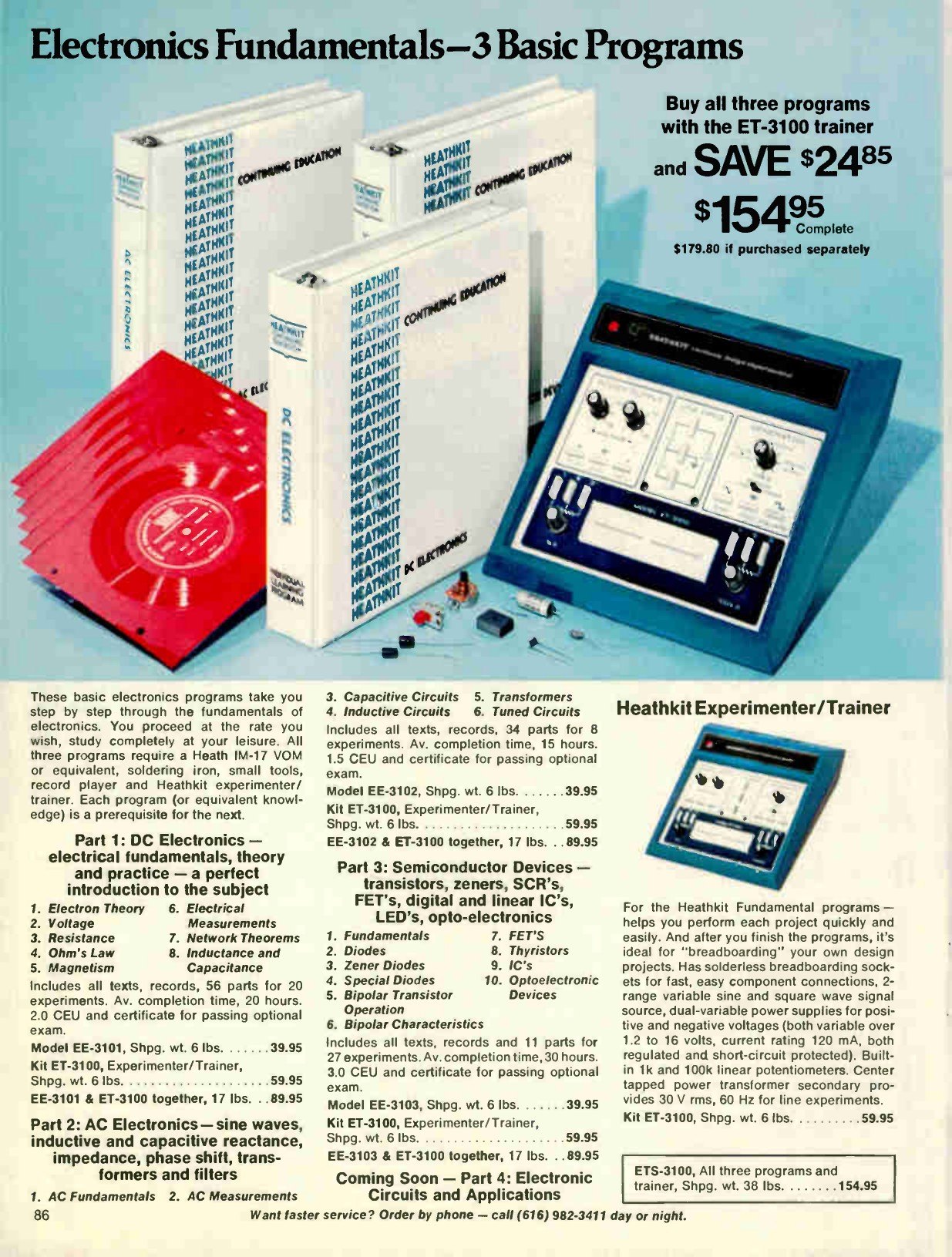
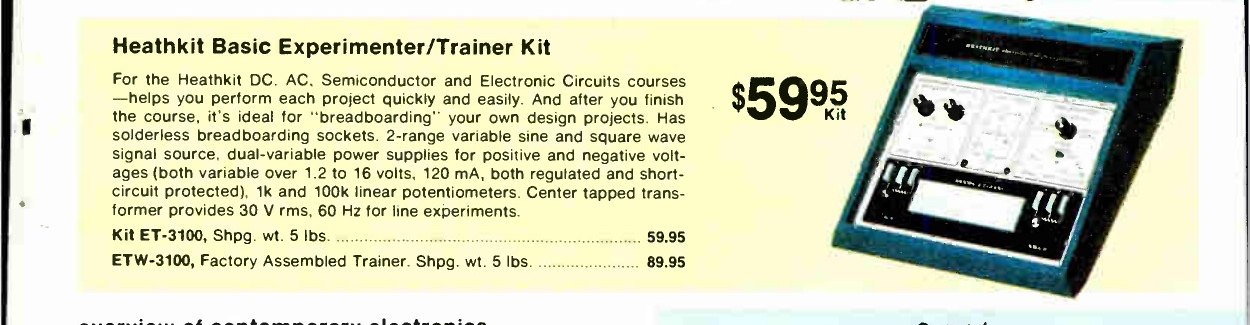
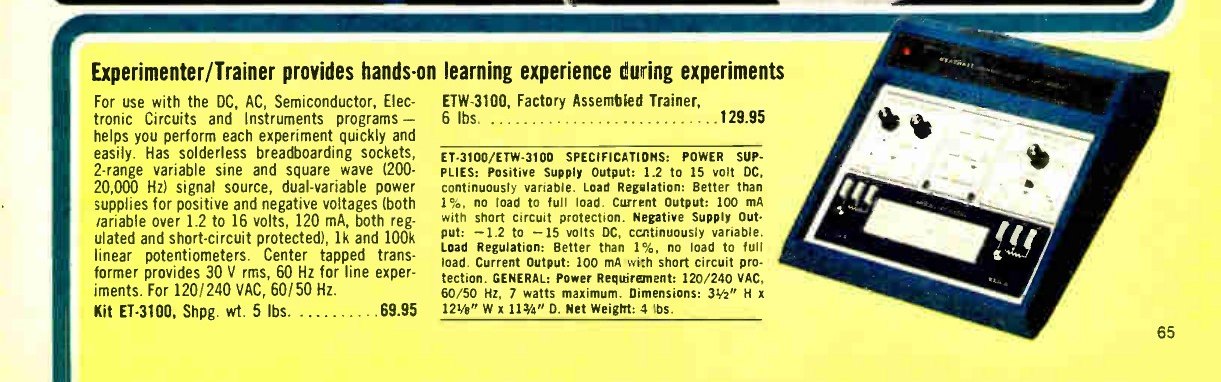
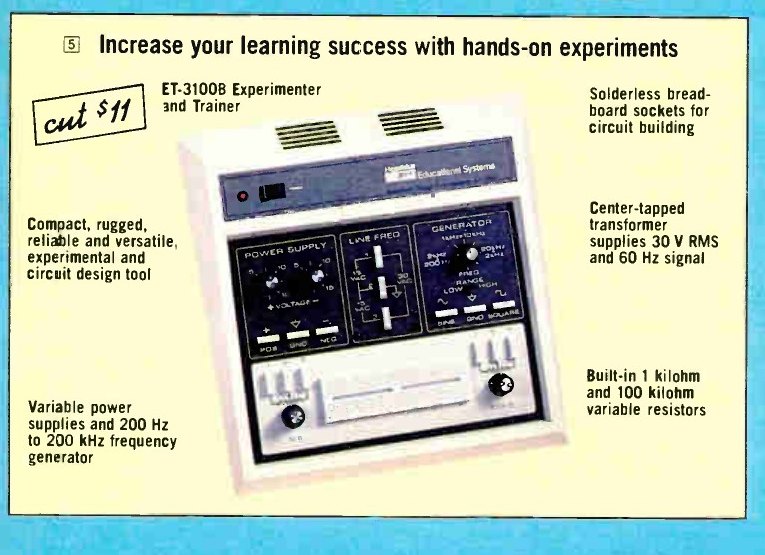
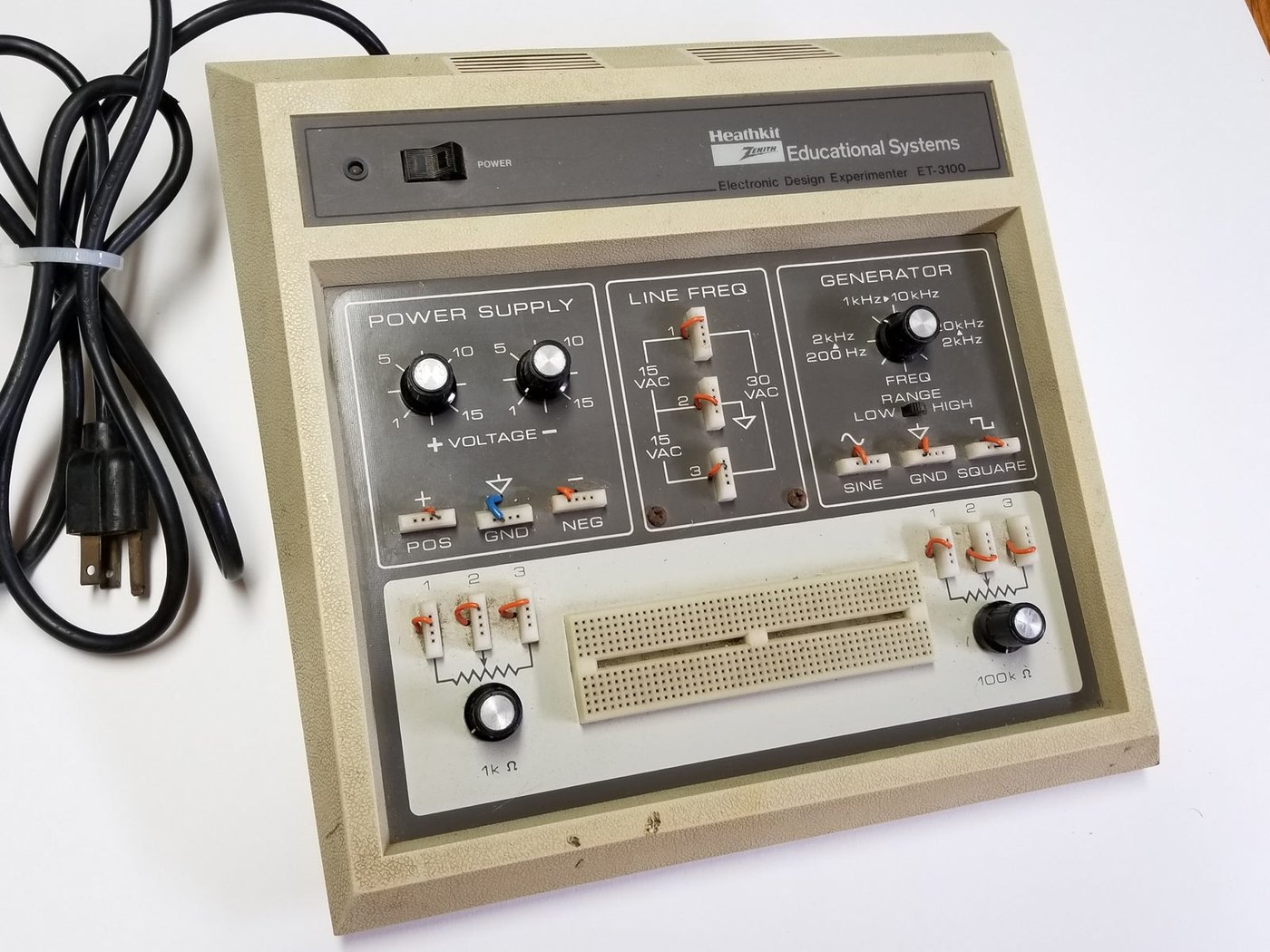
The Heathkit ET-3100 Electronic Design Experimenter is a flat, blue, sloping-fronted box about a foot square that holds four small instruments and a place to build circuits. It has two regulated power supplies adjustable from about 1.2 to 15 volts, one positive and one negative; a sine- and square-wave generator covering 200 Hz to 20 kHz; a 15- and 30-volt tap on the mains transformer for experiments at line frequency; two uncommitted potentiometers; and a solderless breadboarding socket in the middle of the panel. Heath introduced it in the Christmas 1975 catalogue as the laboratory for its new home-study electronics courses, and in one form or another it stayed in the catalogue for twelve years, until the ET-3600 replaced it in the autumn of 1987.
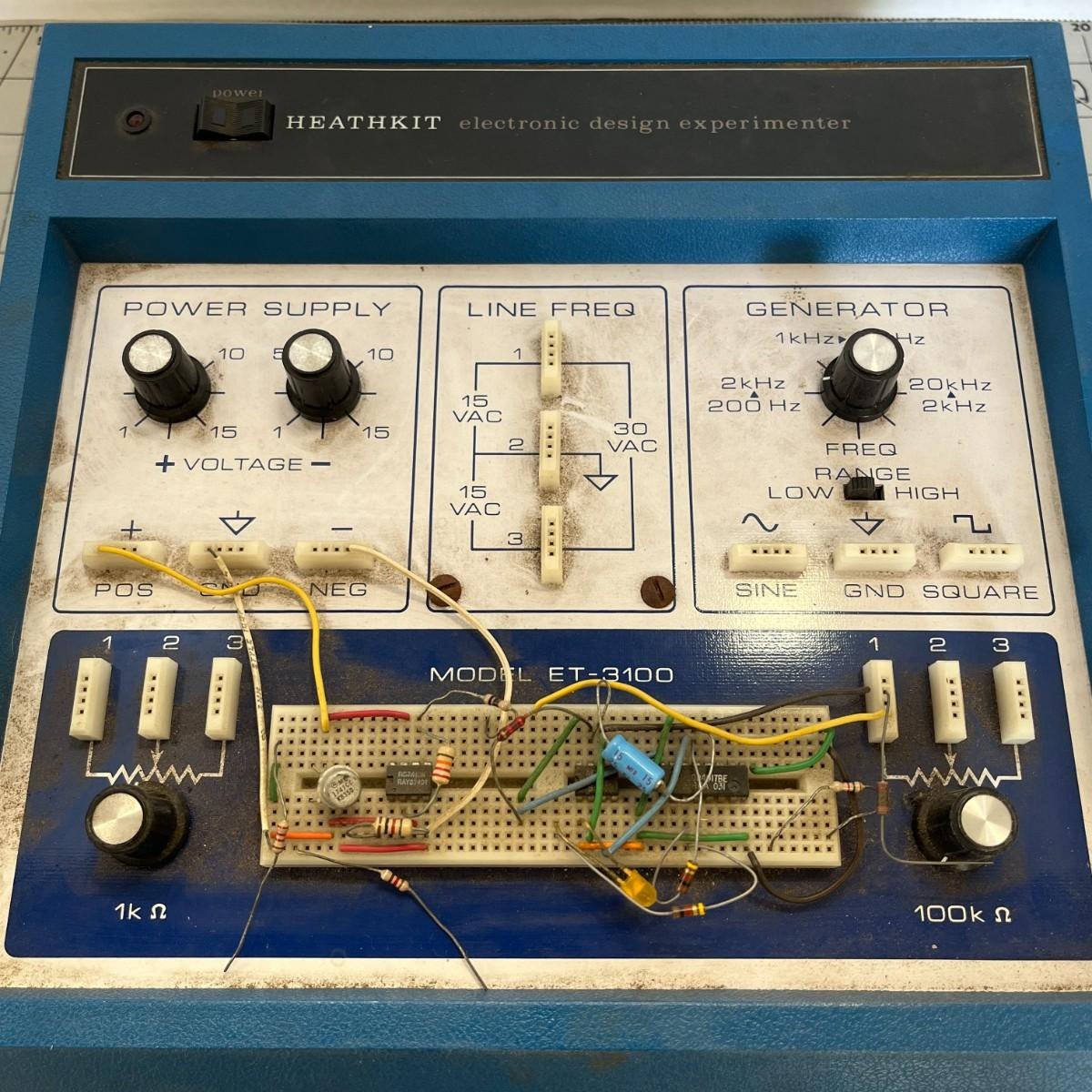
This dive treats the ET-3100 as a family: the original kit of 1975, the factory-wired ETW-3100, the safety-revised ET-3100A of 1981, and the heavier ET-3100B of 1982, together with the Individual Learning Program courses that the trainer existed to serve. The story of Heath’s move into education, and of the Heathkit/Zenith Educational Systems business that grew out of it, is told in the site history dive and is not repeated here. The digital counterpart, the ET-3200, has its own dive.
1.1 What it was for
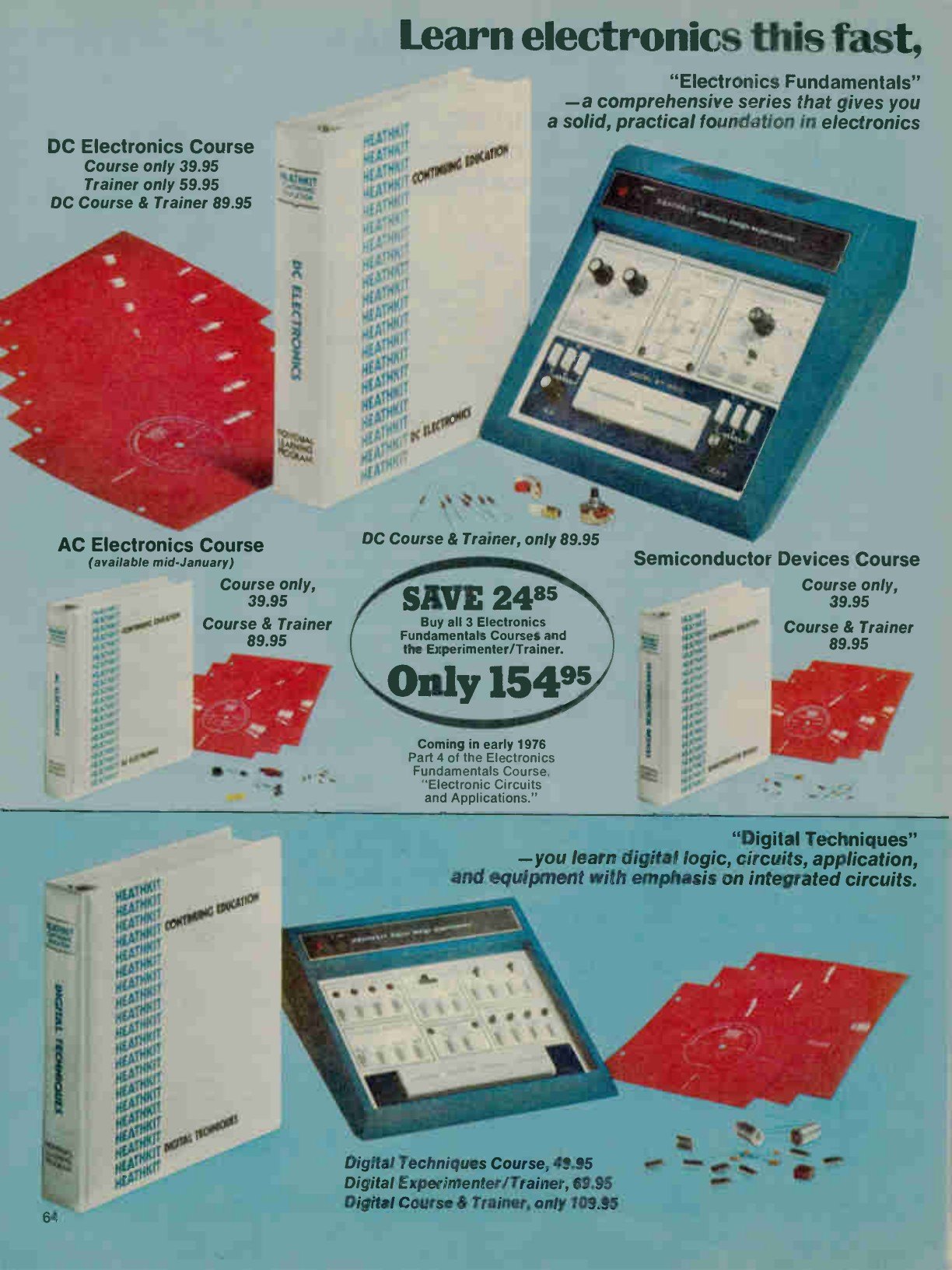
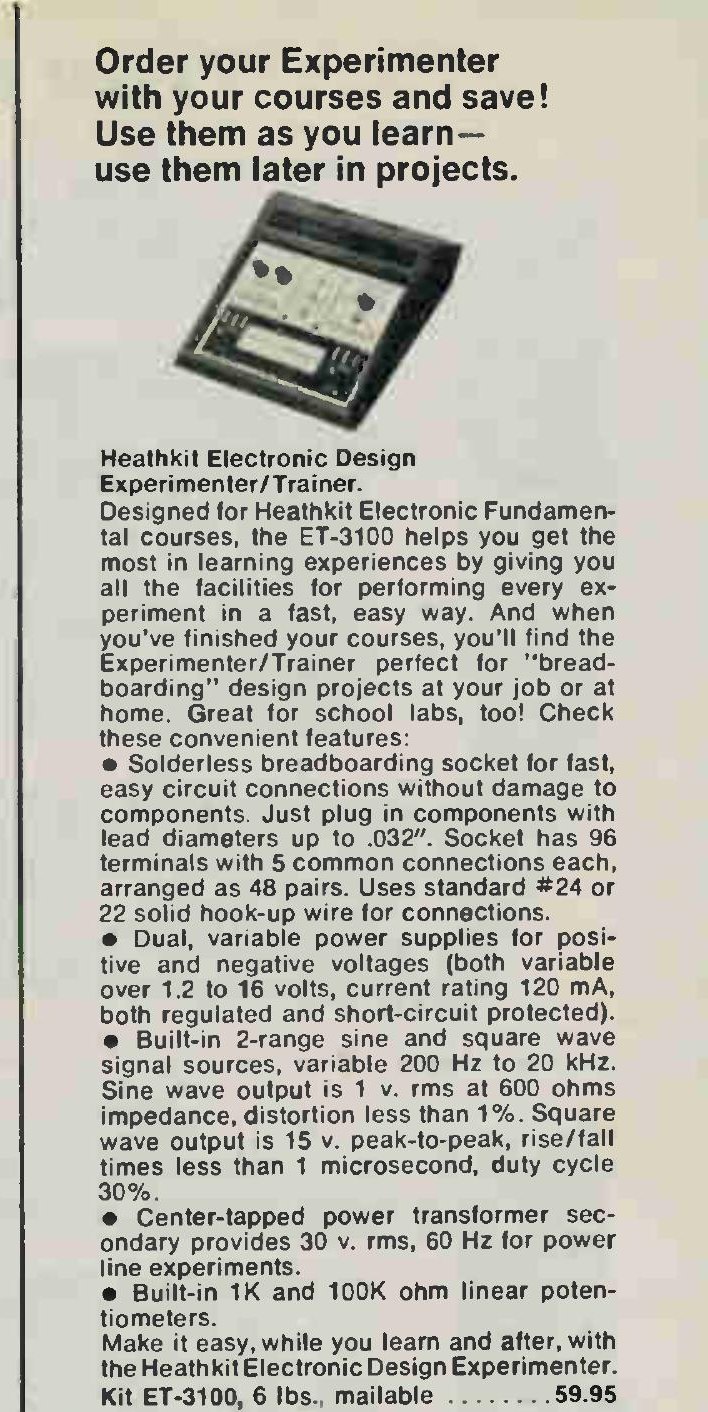
Heath sold the ET-3100 as a component of a course, not as a piece of test equipment. The Christmas 1975 catalogue introduced it on a four-page spread headed “Learn electronics this fast,” alongside three self-study programmes: EE-3101 DC Electronics, EE-3102 AC Electronics and EE-3103 Semiconductor Devices (Heathkit catalogue, Christmas 1975, pp. 64–65). Each course was a white looseleaf binder, a bag of parts for the experiments and a set of coloured flexible records that talked the student through the text. The trainer supplied everything else the experiments needed: the voltages, the signals and the place to plug the parts in. The catalogue copy says so directly: “Designed for Heathkit Electronic Fundamental courses, the ET-3100 helps you get the most in learning experiences by giving you all the facilities for performing every experiment in a fast, easy way.”
The same copy makes a second promise, which explains the name on the front panel. When the courses were finished, the trainer would be “perfect for ‘breadboarding’ design projects at your job or at home.” Heath never called it an “analog trainer” in the 1970s. It was the Electronic Design Experimenter on the nameplate and the “Experimenter/Trainer” in the catalogue, a phrase that covers both jobs. The ET-3100 manual opens the same way: it is “a compact, rugged, reliable, and versitile design instrument” [sic], and “also an excellent learning tool and is a recommended supplement to the individual learning programs of Heathkit Continuing Education” (ET-3100 assembly manual, 595-1734-06, p. 2).
The buyer Heath had in mind was an adult learning at home. The Christmas 1975 page says anyone who had finished high school should be able to complete the first programme, and pitches the series at “hobbyists and experimenters who want to know more about electronics … who want to really understand how their kits work.” Continuing Education Units and a certificate were available to anyone who passed the optional final examination. Schools were an afterthought in 1975 (“Great for school labs, too!”). By 1980 they had become the main market, served by a separate classroom version of each course and a separate catalogue; that side of the story is in the courses volume.
1.2 Where it sat in Heath’s line
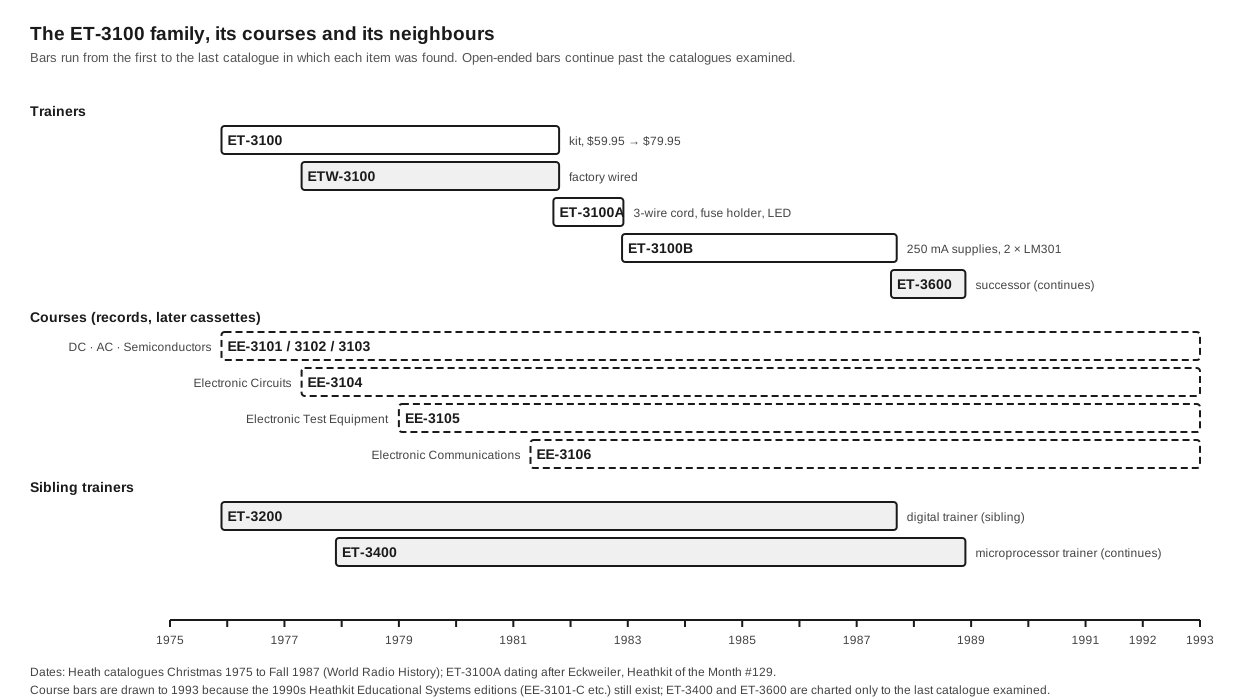
The ET-3100 arrived as one of a pair. On the same spread Heath introduced the ET-3200 Digital Design Experimenter/Trainer ($69.95) for its Digital Techniques course, EE-3201. Both trainers used the same idea and the same kind of cabinet: a sloping panel with dedicated sources along the top and a solderless socket along the bottom. The ET-3200’s sources were digital: three regulated supplies, four data switches, two debounced pulsers, a three-frequency clock and four LED logic indicators. Two years later a third member joined them. The ET-3400 Microprocessor Trainer, built around the Motorola 6800, was new in the Christmas 1977 catalogue at $189.95 with its course, EE-3401 (history dive, vol. 5). The three shared a numbering scheme, ET-3x00 for the trainer and EE-3x0n for its courses, and together they made up the practical side of the Individual Learning Program: analog, digital and microprocessor.
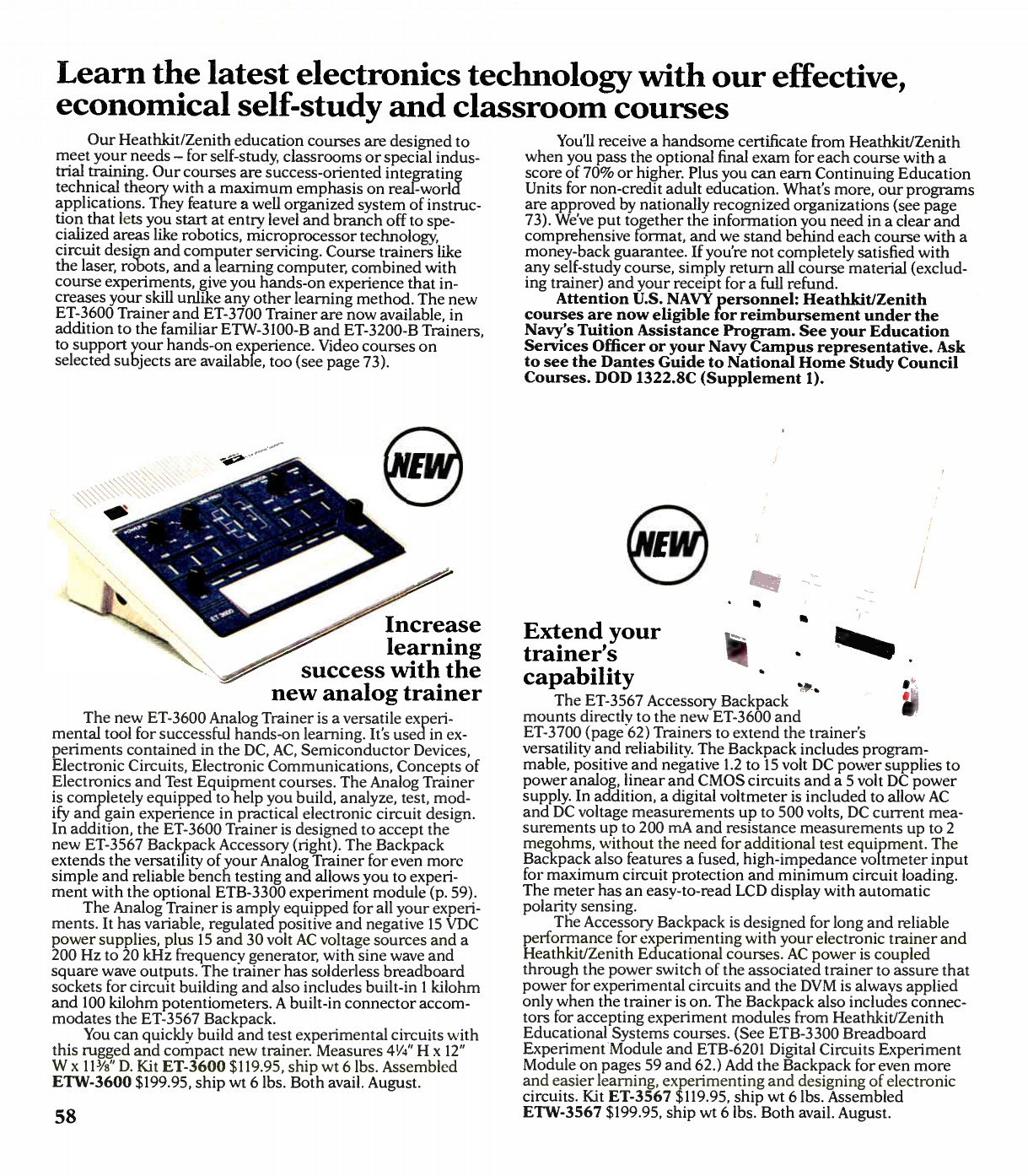
The ET-3100 had no direct predecessor in the kit line. Heath had sold educational instruments before, including the assembled Heath/Malmstadt-Enke laboratory series for universities and the EC-1 analog computer, but nothing earlier combined supplies, a generator and a solderless socket for a correspondence student. Its successor was the ET-3600 Analog Trainer, new in the Fall 1987 catalogue at $119.95 as a kit and $199.95 assembled. The ET-3600 kept the ET-3100’s functions (variable ±15 V supplies, 15 and 30 V AC, a 200 Hz to 20 kHz sine and square generator, 1 kΩ and 100 kΩ potentiometers) and added a connector for the ET-3567 Accessory Backpack, which brought a digital voltmeter and extra supplies (Heathkit catalogue, Fall 1987, p. 58). The same page still refers to “the familiar ETW-3100-B”, so the assembled ET-3100B overlapped its replacement for at least one season.
1.3 Launch, prices and the four versions
The table below traces the family through the general Heath catalogues scanned by World Radio History. Prices are for the kit unless marked. Heath’s own school price lists, which carried different prices, are not included.
Table 1 — Launch, prices and the four versions
| Catalogue | Kit | Factory wired | Notes |
|---|---|---|---|
| Christmas 1975 | ET-3100 $59.95 | — | Launch. Each course $39.95; course + trainer $89.95; three courses + trainer $154.95 |
| Spring 1976 | ET-3100 $59.95 | — | Package now numbered ETS-3100, $154.95 |
| Fall 1977 | ET-3100 $59.95 | ETW-3100 $89.95 | EE-3104 Electronic Circuits added; ETS-3114, all four courses + trainer, $199.95 |
| Christmas 1977 | ET-3100 $59.95 | ETW-3100 $99.95 | |
| Spring 1978 | ET-3100 $64.95 | ETW-3100 $109.95 | |
| Fall 1978 | ET-3100 $64.95 | — | “SAVE $9.95” course-plus-kit packages, e.g. EES-3101 at $99.95 |
| Fall 1979 | ET-3100 $69.95 | ETW-3100 $129.95 | Now also recommended for the EE-3105 Test Equipment course |
| 1980 (No. 848) | ET-3100 $69.95 | ETW-3100 $129.95 | ET-3100-S, kit with Spanish manual, listed |
| Winter 1981 | ET-3100 $79.95 | ETW-3100 $139.95 | ET-3100S Spanish kit |
| Winter 1981–82 | ET-3100A $79.95 | ETW-3100A $139.95 | ET-3100AS Spanish kit $99.95 |
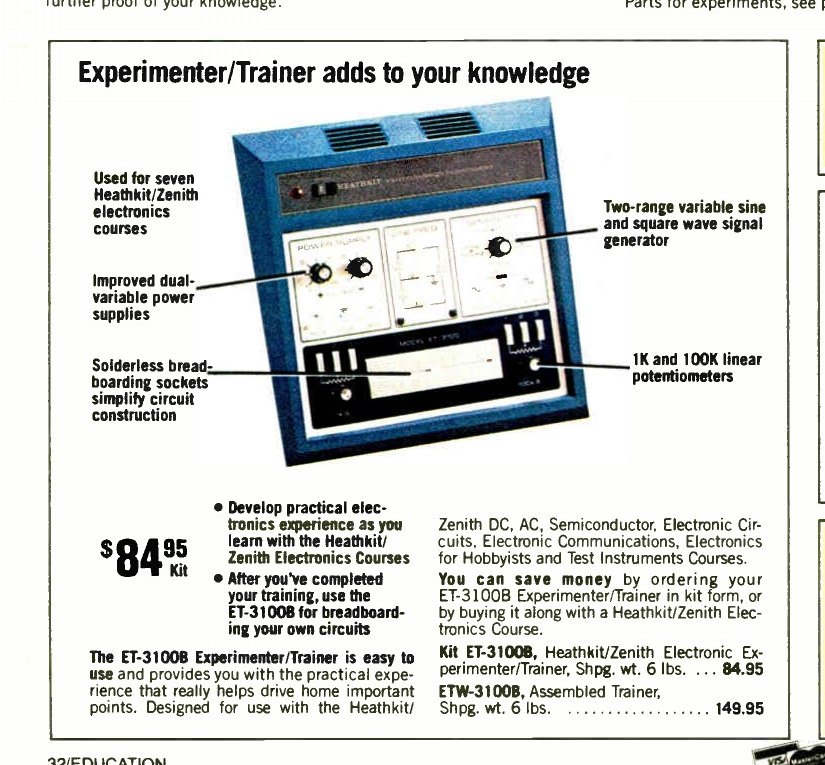
| Christmas 1982 | ET-3100B $84.95 | ETW-3100B $149.95 | ”Improved dual-variable power supplies” |
| Fall 1983 | ET-3100B $99.95 | ETW-3100B (price not legible in the scan) | EES-3101B, DC course + trainer, $129.90 |
| Fall 1985 | ET-3100B $109.95 ($98.95 sale) | ETW-3100B $179.95 ($161.95 sale) | |
| Fall 1987 | ET-3600 $119.95 | ETW-3600 $199.95 | ETW-3100-B still mentioned as available |
Sources: the catalogues named, all at World Radio History; the Christmas 1975 and Spring 1976 figures are read from the page images, the rest from the text layer and checked against the page image where a figure appears in this dive.
Four points in that table need a word.
The factory-wired ETW-3100. Bob Eckweiler dates the first ETW-3100 to the Spring 1977 catalogue, which World Radio History does not hold; it is present by Fall 1977 at $89.95, exactly $30 above the kit (Eckweiler, Heathkit of the Month #129). The Heathkit/Zenith Educational Systems school catalogue describes only the ETW-3100 and calls it “required for all the Fundamental Electronics Courses”, which suggests that schools usually bought them assembled.
The ET-3100A. The A arrived without announcement. Eckweiler traces it to the Fall 1981 catalogue (No. 854), at the same $79.95 the original had reached, and it is on sale in Winter 1981–82 under the heading “Heathkit/Zenith ET-3100A Experimenter/Trainer”. The catalogue copy did not change at all, and still quoted “1.2 to 16 volts, 120 mA”. The changes were to mains safety: a three-wire cord, a fuse holder reachable from outside the cabinet, insulation around the power switch and an LED pilot in place of the neon lamp. The circuit board was described in Heath’s master parts list as “UL/CSA Screened”, and Eckweiler, following Jeff Tranter, reads the whole revision as a response to Canadian CSA requirements (HotM #129).
The ET-3100B. Christmas 1982 brought the last and largest revision, sold as having “improved dual-variable power supplies” (Heathkit catalogue, Christmas 1982, p. 32). It had a new transformer with a second secondary, pass transistors on heat sinks rated for 250 mA instead of 100 mA, and a completely different signal generator built from two LM301 op-amps. Its manual (595-2860) carries the FCC Part 15 Subpart J notice for a “computing device”, a sign of how every Heath product sold after 1981 was being written up. The B cost $84.95 at launch and $109.95 by 1985.
The name on the panel. The first kits say “HEATHKIT electronic design experimenter” on a black strip above a white and blue panel, in a blue case. Later production carries the “Heathkit/Zenith Educational Systems” logotype and “Electronic Design Experimenter ET-3100” on the strip, in a beige case with a grey or brown panel. The ET-3100B’s panel is the silkscreen on its circuit board, and Heath made that board in at least two colour schemes, brown (85-2730-1) and white (85-2730-3) (HotM #129). Units also exist in colours and with names Heath never catalogued. A Swedish example, badged “Heath Laborationsenhet Elektronik”, was made for the educational publisher Esselte and used in Swedish schools (heathkit.nu). Those OEM units are shown in the restoration volume.
1.4 The courses it served
Seven Heath courses were written around the trainer. The ET-3100A copy of 1981 lists them: “DC, AC, Semiconductor, Electronic circuits, Electronic Communications, Electronics for Hobbyists and Test Instruments Self-Instruction Courses” (Heathkit catalogue, Winter 1981–82, p. 72). In course numbers these are:
Table 2 — Seven Heath courses were written around the trainer. The ET-3100A copy of 1981 lists them: "DC, AC, Semiconductor, Electronic circuits, Electronic Communications, Electronics for Hobbyists and Test Instruments Self-Instruction Courses" ([Heathkit catalogue, Winter 1981–82, p. 72](https://www.worldradiohistory.com/Archive-Catalogs/Heathkit-Catalogs/Heathkit-1981-82-Winter.pdf)). In course numbers these are
| Course | Title | First found | Price then |
|---|---|---|---|
| EE-3101 | DC Electronics | Christmas 1975 | $39.95 |
| EE-3102 | AC Electronics | Christmas 1975 (“available mid-January”) | $39.95 |
| EE-3103 | Semiconductor Devices | Christmas 1975 | $39.95 |
| EE-3104 | Electronic Circuits | Spring 1977 (promised from Christmas 1975) | $49.95 |
| EE-3105 | Electronic Test Equipment, four modules | Winter 1979 | $64.95 for all four |
| EE-3106 | Electronic Communications | Spring–Summer 1981 | $59.95 |
| EE-3140 | Electronics for the Hobbyist | Fall 1980 | $59.95 |
The first-appearance dates for EE-3104, EE-3105, EE-3106 and EE-3140 come from Eckweiler’s survey of catalogues that World Radio History does not hold; the rest are from the scans themselves (HotM #129). The task statement for this dive mentioned “the EE-3101-series”; the actual first numbers are EE-3101 to EE-3103, and the family ran to EE-3106, with A, B and C editions of the core four later on. A lower-level course, EE-3100 Concepts of Electricity, was added in 1981 but did not use the trainer. How the courses and the trainer worked together is the subject of the courses volume.
1.5 Headline specification
The figures are from the assembly manuals. The catalogues’ conflicting numbers are discussed above; full specifications for each version, with the manual pages reproduced, are in the reference volume.
Table 3 — Headline specification
| ET-3100 and ET-3100A | ET-3100B | |
|---|---|---|
| Positive supply | +1.2 to +15 V DC, continuously variable | same |
| Negative supply | −1.2 to −15 V DC, continuously variable | same |
| Supply current | 100 mA each, short-circuit protected | 250 mA each, short-circuit protected |
| Load regulation | better than 1%, no load to full load | 2% |
| Generator ranges | LO 200–2000 Hz, HI 2000–20,000 Hz | same (nominal) |
| Sine output | 1 V rms from 600 Ω, under 4% distortion | same |
| Square output | 15 V p-p, rise time under 1 µs, 30% duty | same |
| Line-frequency outputs | 15 and 30 V rms, 200 mA total from all supplies | 15 and 30 V rms, 200 mA (separate winding) |
| Generator circuit | one 741 op-amp, Wien bridge, lamp AGC | two LM301 op-amps, zener-limited loop |
| Pilot | neon lamp (ET-3100); LED (ET-3100A) | LED from the raw DC |
| Power | 105–130 or 210–260 V, 50/60 Hz, 7 W | same voltages, 25 W |
| Size | 12⅛ in wide × 11¾ in deep × 3½ in high | same |
| Weight | 4 lb | 4.2 lb |
Sources: ET-3100 manual, 595-1734-06, p. 28; ET-3100B manual, 595-2860-03, p. 34; ET-3100A figures after HotM #129, Table I.
1.6 Variants at a glance
Table 4 — Variants at a glance
| Model | Years | What changed |
|---|---|---|
| ET-3100 | 1975–1981 | The original. 741 Wien-bridge generator stabilised by an incandescent lamp; 100 mA supplies; neon pilot; two-wire line cord with a knot for strain relief; fuse in clips inside a moulded box. Manual 595-1734 |
| ETW-3100 | 1977– | Factory-assembled ET-3100 |
| ET-3100-S / ET-3100S | by 1980 | Kit with a Spanish-language manual, sold with the Spanish editions of the DC, AC and Semiconductor courses |
| ET-3100A | Fall 1981–1982 | Three-wire cord, external fuse holder, switch insulation, LED pilot (R101 27 kΩ → 1 kΩ; R104 220 Ω ½ W → 150 Ω 1 W). Circuit otherwise as the ET-3100 |
| ETW-3100A, ET-3100AS | 1981–1982 | Assembled and Spanish-manual versions of the A |
| ET-3100B | Christmas 1982–1987 | New transformer (54-1005) with a separate winding for the AC outputs; MJE5979/MJE5976 pass transistors on heat sinks; 250 mA; two-LM301 generator; LED fed from the raw supply. Manual 595-2860 |
| ETW-3100B | 1982–1987+ | Factory-assembled ET-3100B |
| ET-3600 / ETW-3600 | Fall 1987 on | Successor with the same functions and a connector for the ET-3567 Backpack |
The ET-3100 in its three versions was the trainer that almost every Heath analog-course student used from 1975 to 1987. Its circuit is simple enough that a student who had reached the fourth course could read its schematic as an exercise, and Heath used it for exactly that purpose, as the next volume shows.
Sources
- Heath Company, Heathkit Manual for the Electronic Design Experimenter Model ET-3100, 595-1734-06, © 1975. Internet Archive: https://archive.org/details/manualsplus_11837
- Heath Company, Heathkit Manual for the Electronic Design Experimenter Model ET-3100B, 595-2860-03, © 1982. Internet Archive (DLARC): https://archive.org/details/heathkitmanualfo00unse_0
- Heathkit catalogues, Christmas 1975 to Fall 1987, World Radio History: https://www.worldradiohistory.com/Archive-Catalogs/Heathkit_Catalogs.htm
- Bob Eckweiler, AF6C, “Heathkit ET-3100/A/B Electronic Design Experimenter/Trainer (and Associated Heath Offered Courses)”, Heathkit of the Month #129, rev. 1, OCARC, 2026: https://www.w6ze.org/Heathkit/Heathkit_129_ET3100B.pdf; support page with schematics and parts lists for all three versions: https://www.w6ze.org/Heathkit/ET-3100/index.html
- heathkit.nu, “ET-3100 The Breadboard Circuit Design Trainer”: http://heathkit.nu/heathkit_nu_ET-3100.html
- The Heath Company history on this site: https://heathkit.fubsypoly.com/heathkit/vol-4/ and https://heathkit.fubsypoly.com/heathkit/vol-5/
Comments (0)