GR-2000 Color Television · Volume 1
Overview
In January 1974 the Heath Company began shipping a 25-inch colour television that a customer assembled at his own kitchen table, and that then put the channel number on its own screen in inch-high white digits. Nothing else sold in the United States did that. The set was the GR-2000 “Digital Design” colour television, the most complex consumer product Heath ever packed into cartons, and the last great flourish of a television line that had started eleven years earlier with a 21-inch round-screen kit. It cost $649.95 for the chassis, the picture tube and one speaker, weighed 112 pounds assembled, and arrived as twenty glass-epoxy circuit boards, a sub-chassis, a picture tube in a steel shield, twelve factory-made cable harnesses and four books of instructions.
This volume sets out what the GR-2000 was, where it came from, what it cost and who bought it. The circuitry that made the numbers appear is the subject of the next volume; the site-level company history is told separately in the Heath Company deep dive.
1.1 What the GR-2000 was
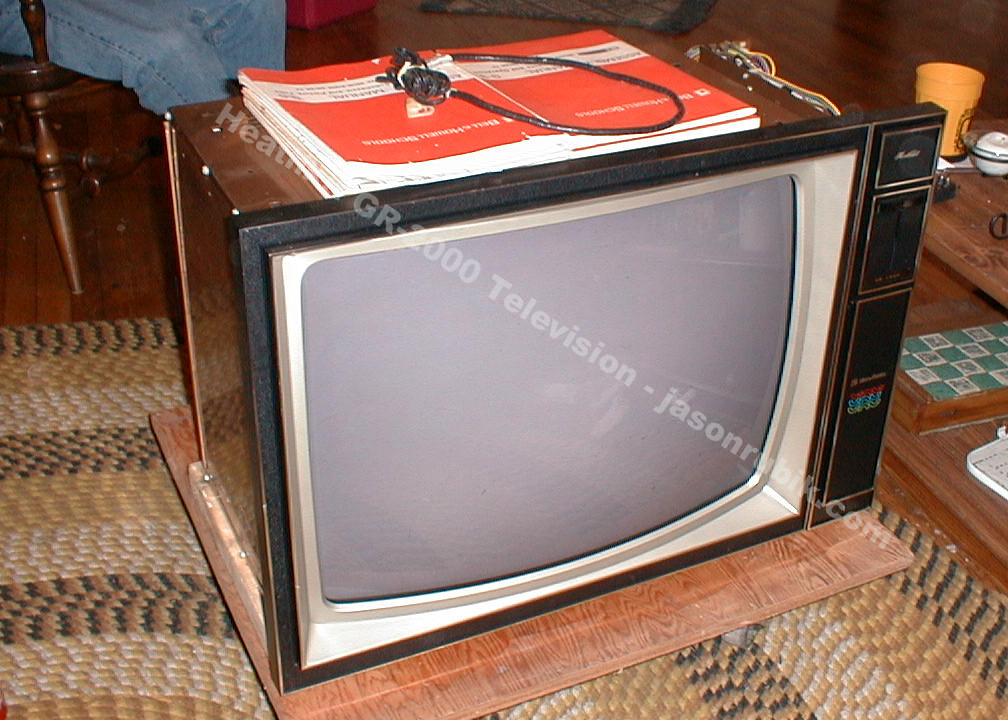
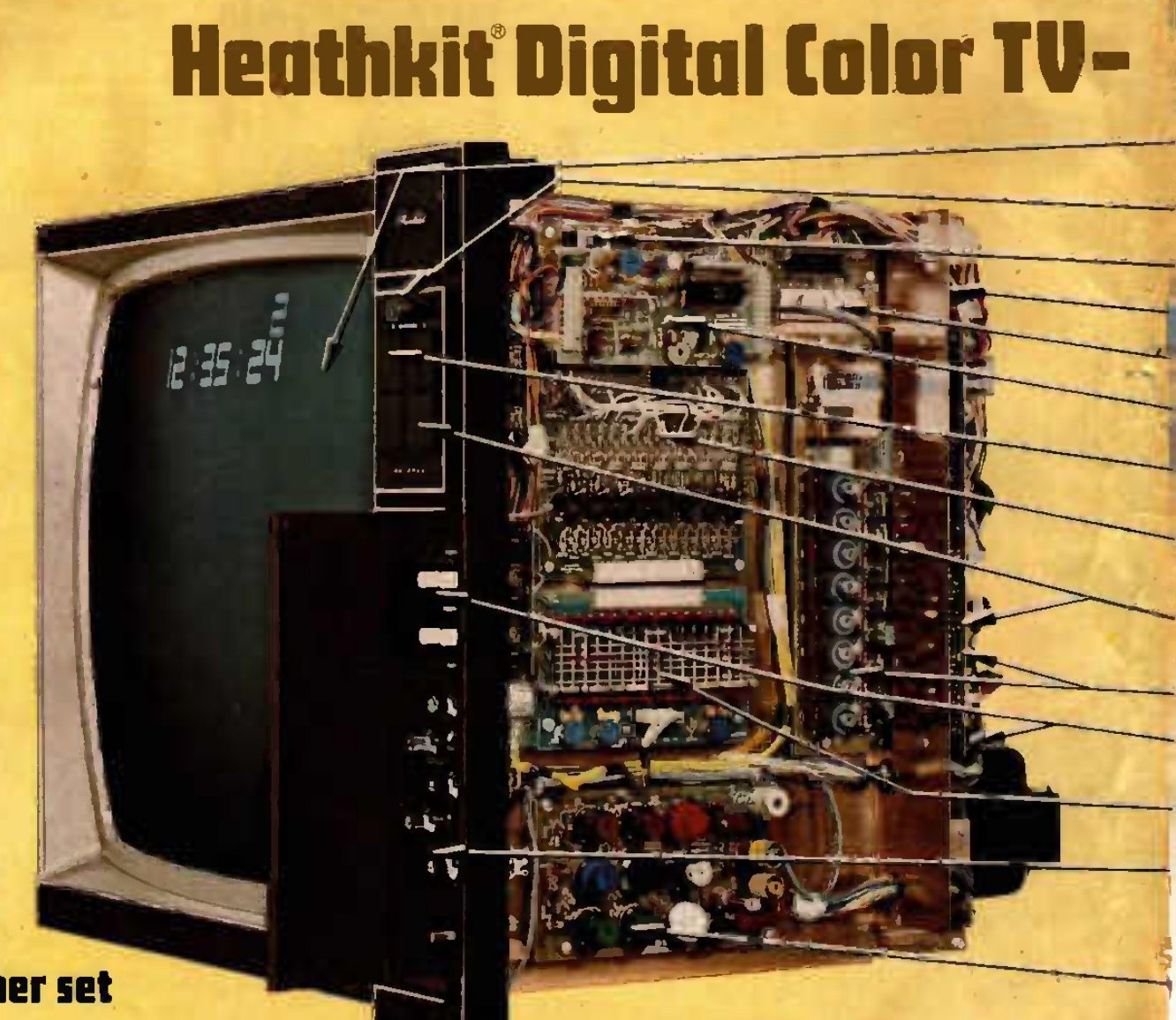
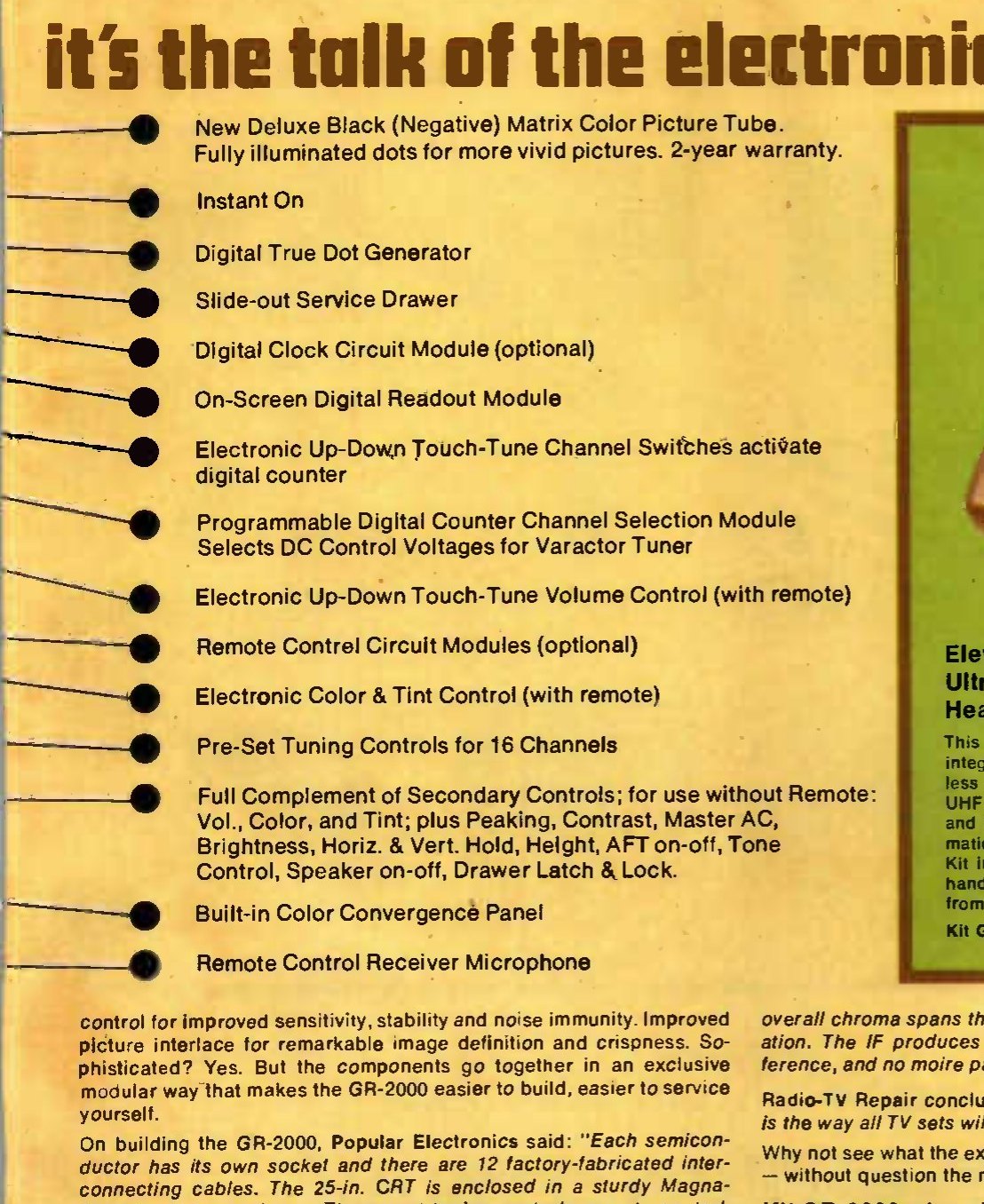
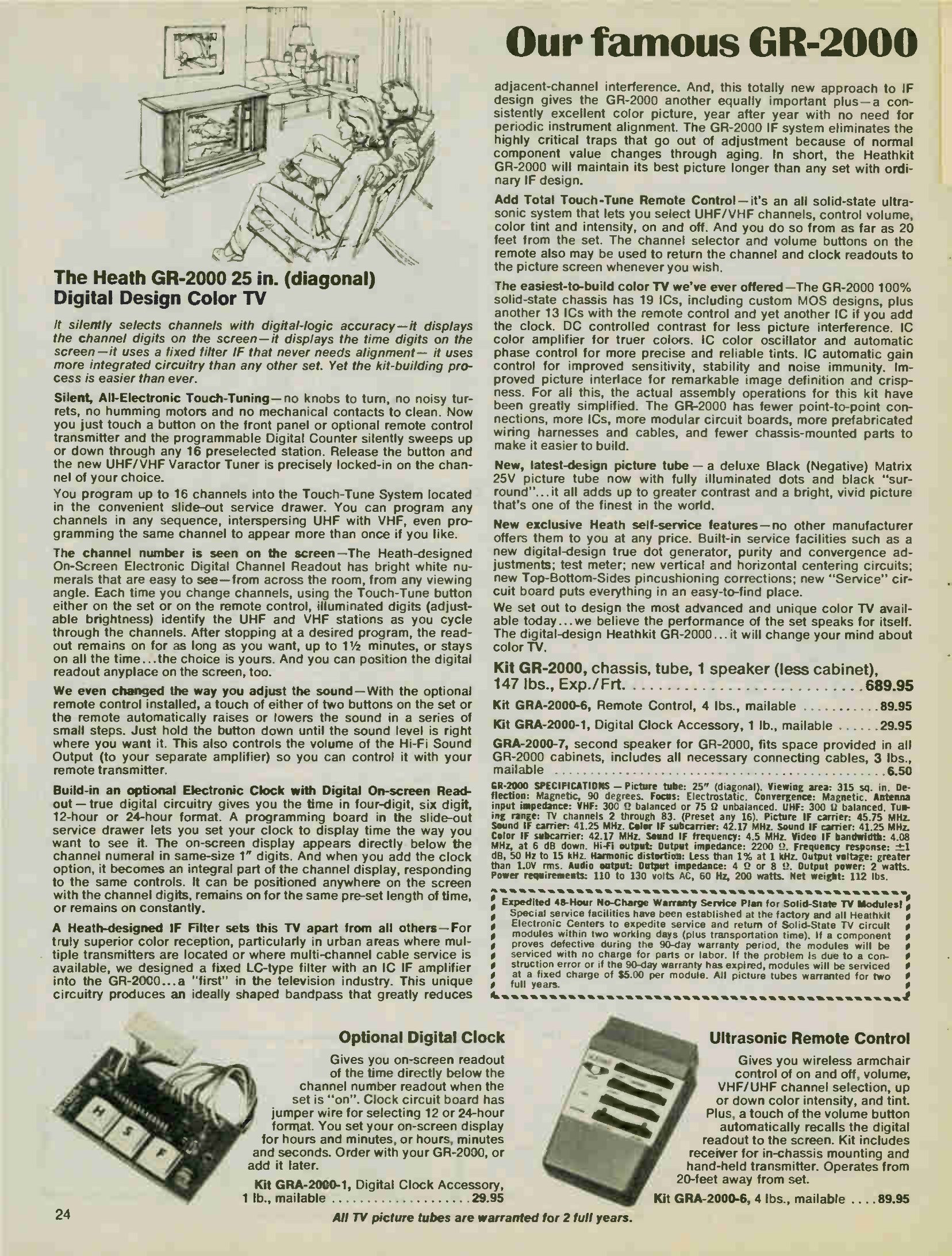
The GR-2000 was a 25-inch (315 square inch) colour receiver sold as a kit, without a cabinet. Its chassis was entirely solid-state apart from the picture tube and the high-voltage rectifier, and it used nineteen integrated circuits, including custom MOS devices, and seventy-one transistors, every one of them in a socket. Four features set it apart from anything else on an American showroom floor in 1974:
- Silent, all-electronic tuning. There was no turret tuner and no knob. VHF and UHF varactor-diode tuners were tuned by a d.c. voltage, and the viewer changed channels by touching an up or down switch on the front panel.
- Touch-to-tune, reprogrammable channel selection. Any sixteen channels, VHF or UHF, in any order the owner chose, programmed by pushing jumpers into a pin field on a board in the service drawer. Unused channels never appeared.
- An on-screen digital channel readout. The channel number appeared in large white numerals at every channel change, or at a touch of the RECALL or volume button, and could be set to stay for anything up to about a minute and a half, or permanently. Its brightness and its position on the screen were adjustable.
- A fixed, pre-aligned intermediate-frequency filter. A ten-section LC bandpass filter in a double-shielded can replaced the adjustable traps of a conventional set, so the i.f. strip never needed alignment — a point Popular Science called an industry first.
To these the buyer could add the GRA-2000-1 digital clock module at $29.95, which put the time in 1-inch digits directly below the channel number in a 12- or 24-hour format, and the GRA-2000-6 ultrasonic remote control at $79.95, which worked the set from twenty feet away and controlled volume, tint and colour as well as channel and power.
Radio-Electronics tested the set for its February 1974 issue and opened its review by saying that the set used so much digital design and so many integrated circuits that it “sets new standards for state-of-the-art in color TV”. It listed six features it could find in no other production colour set then sold in the United States (Radio-Electronics, February 1974, p. 33).
1.2 Eleven years of Heathkit colour
Heath came late to television and stayed out of the black-and-white market almost entirely. Colour was different. Schlumberger’s annual report for 1963 — Heath was by then a Daystrom division under Schlumberger — recorded that “the most important addition in 1963 was a color television” (Schlumberger annual reports, Internet Archive). That first set was the GR-53, a 21-inch round-screen receiver, and the design decision that shaped every Heathkit colour set afterwards was taken with it: the servicing instruments were built into the television. A dot generator, a convergence control panel and a mobile degaussing coil came in the carton, so that the owner could converge and maintain the set himself without buying test gear.
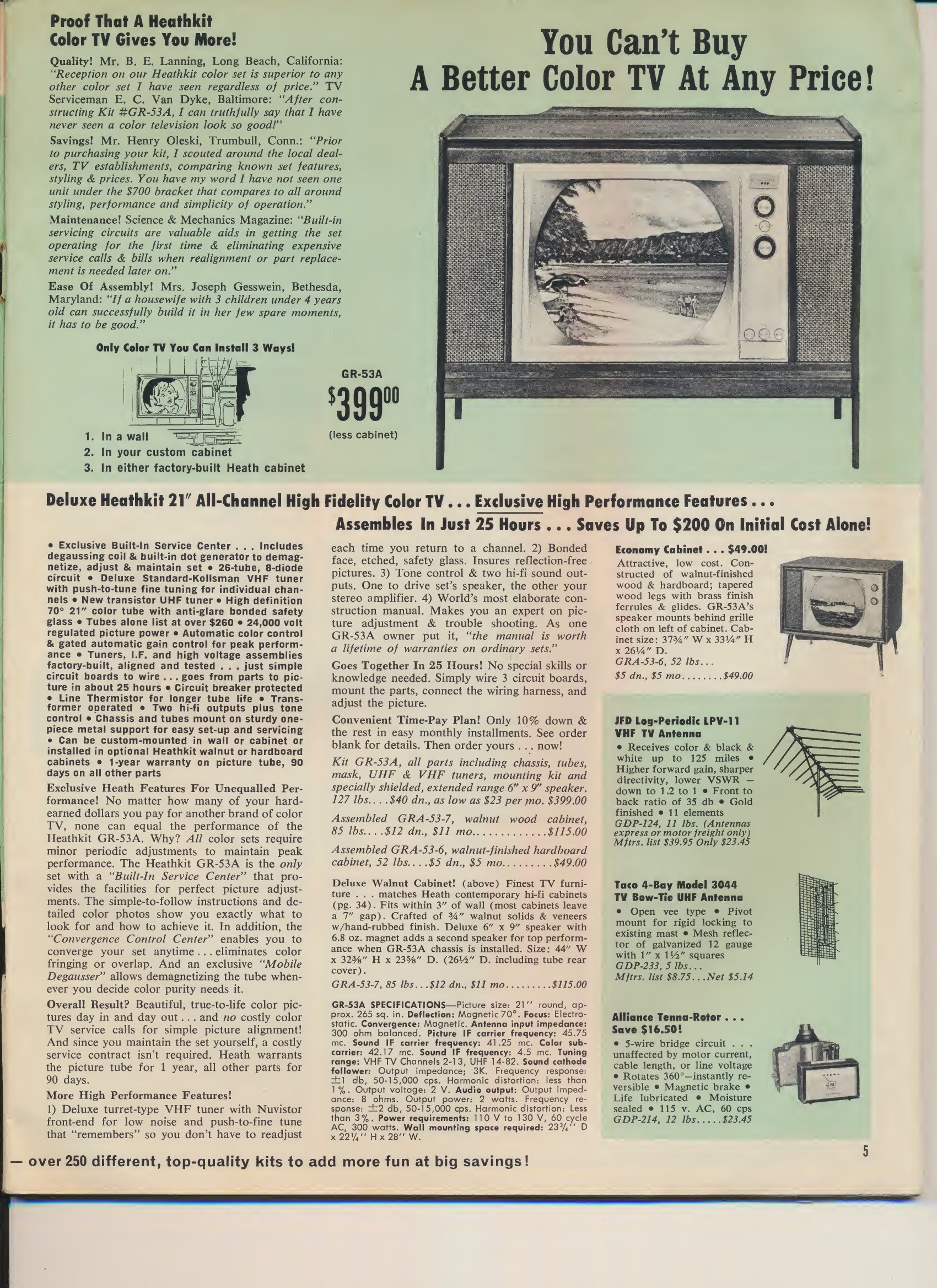
The March 1965 catalogue sold the revised GR-53A at $399.00 for a 26-tube, 8-diode chassis with a 24,000-volt supply, a Standard-Kollsman VHF tuner and a transistor UHF tuner; the tuners, i.f. strip and high-voltage assembly came factory-built and aligned, so the builder wired three circuit boards and mounted parts. Heath claimed assembly “in 25 hours” and made the built-in service centre the centre of its advertising, telling buyers that every colour set needs periodic adjustment and that the GR-53A alone had a “Built-In Service Center” (Heathkit catalogue 800/53, March 1965, p. 5).
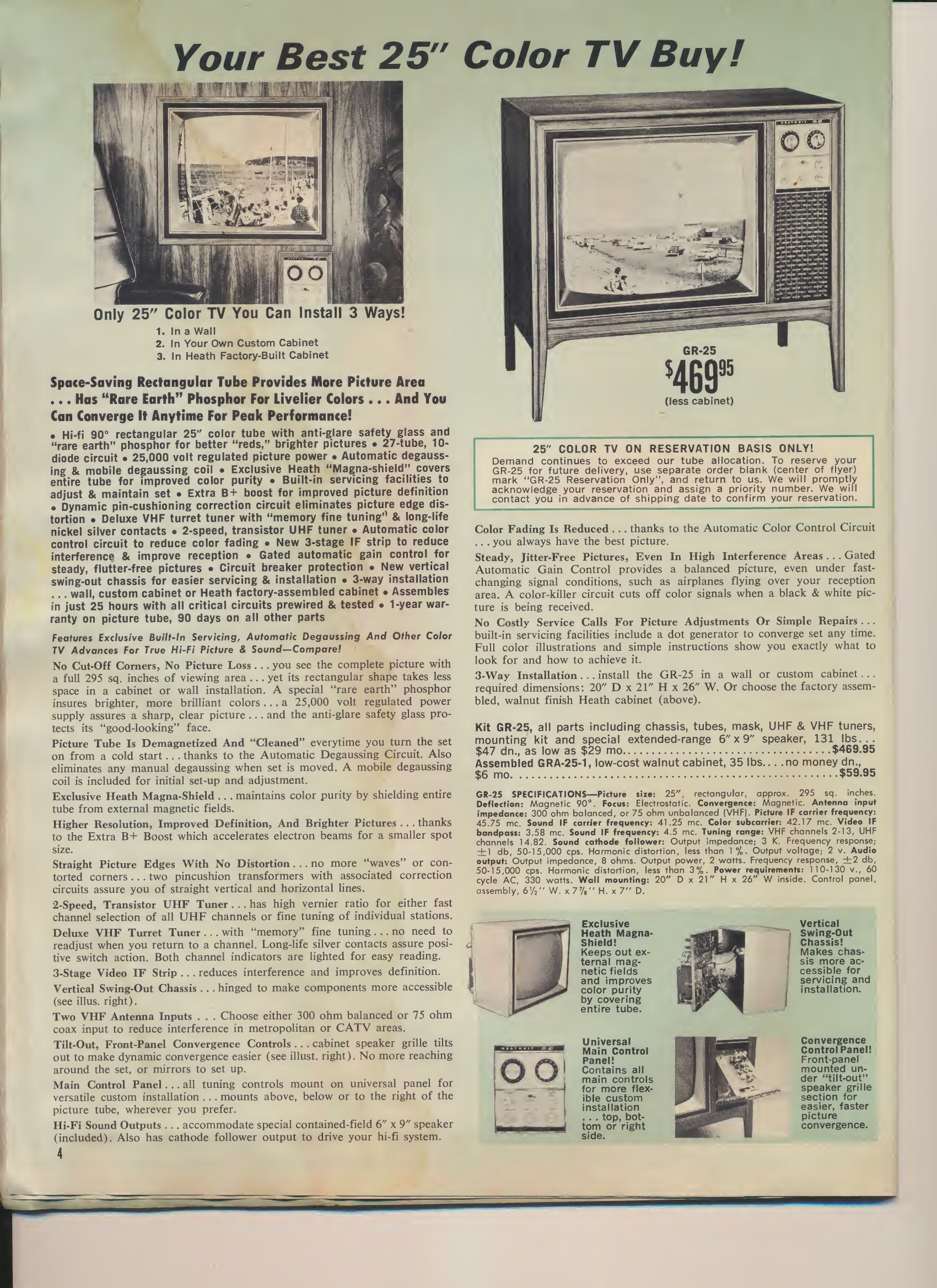
A 25-inch rectangular set, the GR-25, followed in late 1965 at $469.95: 295 square inches of picture, 27 tubes, a 25,000-volt supply, automatic degaussing, a “Magna-Shield” around the tube, pincushion correction and a vertical swing-out chassis. Demand outran the supply of picture tubes and Heath sold it on a reservation basis, telling customers that “demand continues to exceed our tube allocation” (Heathkit flyer, late 1965).
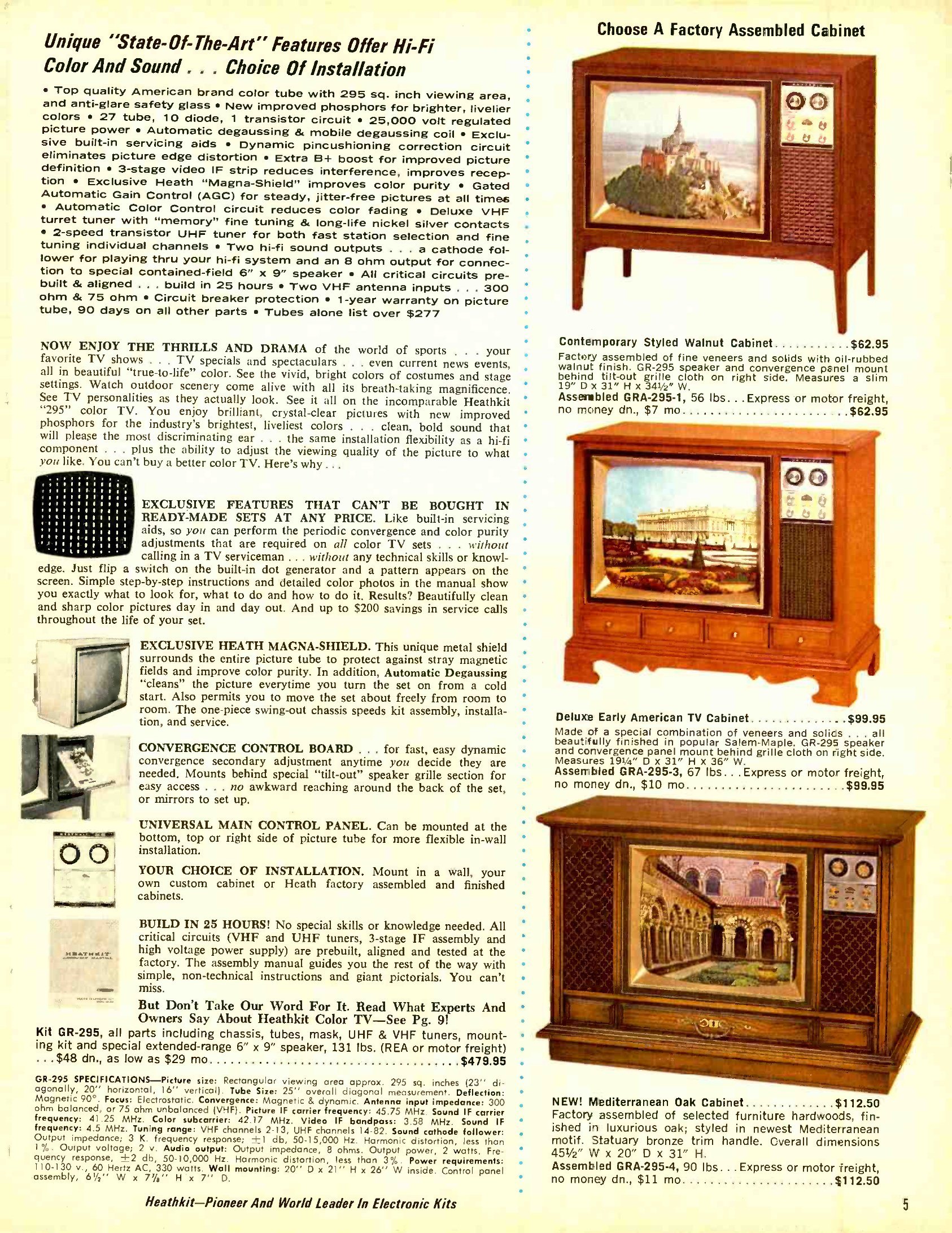
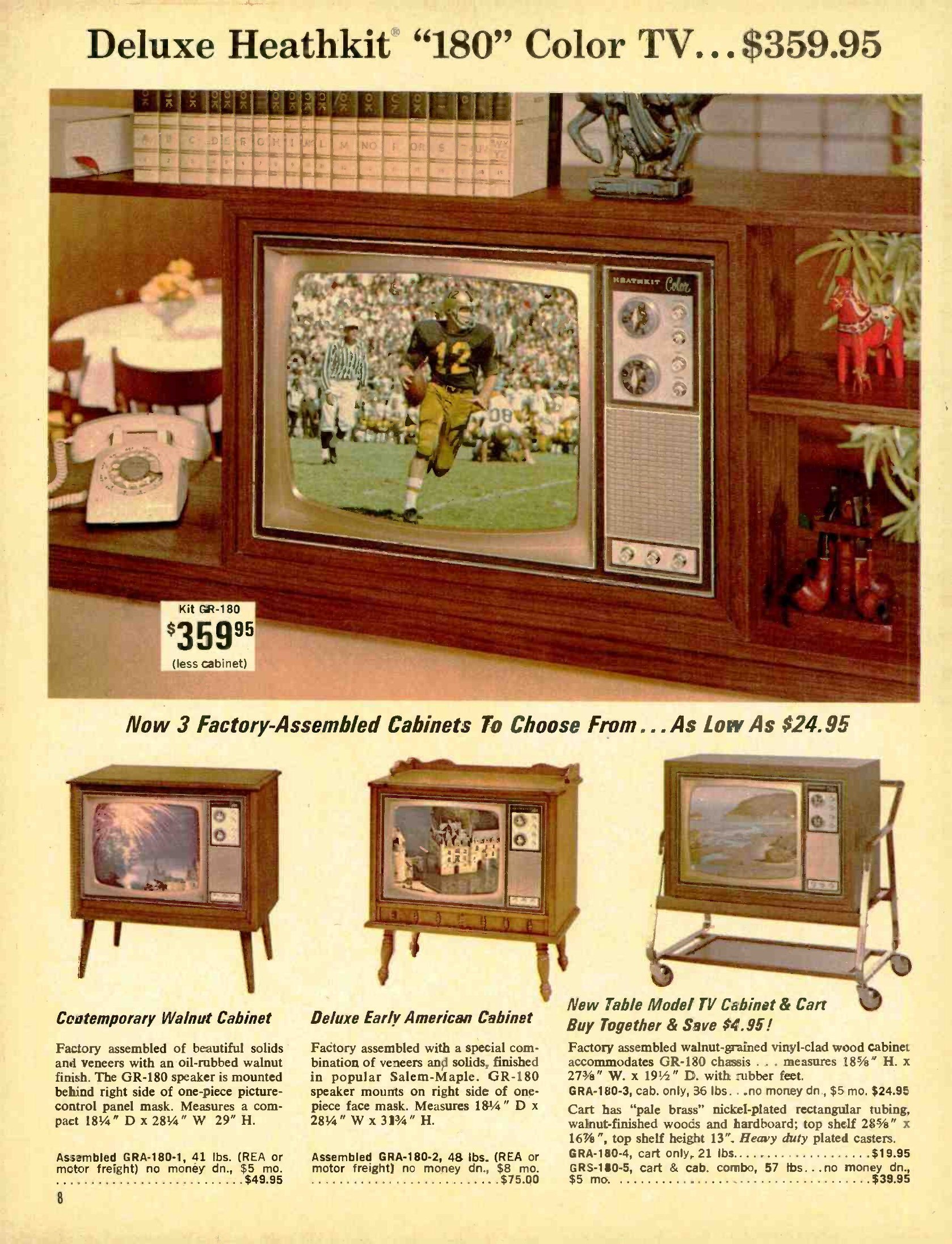
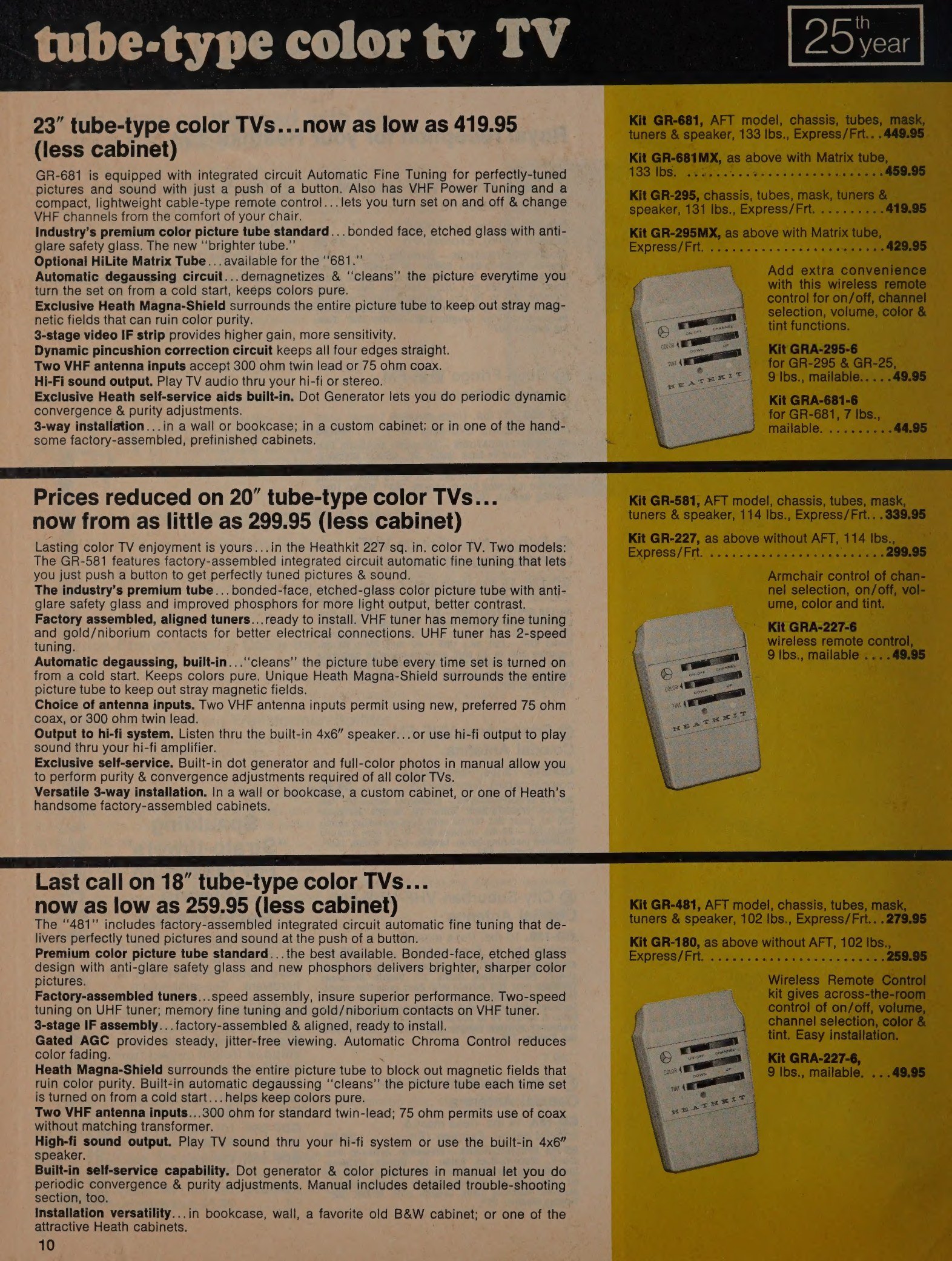
From 1967 Heath named its sets after the viewing area rather than the tube diagonal, and the GR-25 became the GR-295. By 1968 the catalogue offered three sizes — the “295” at $479.95, the “227” at $419.95 and the “180” at $359.95 — all of them tube sets with the same self-service philosophy, and all of them able to take a wireless remote control at $69.95. Prices fell the following year.
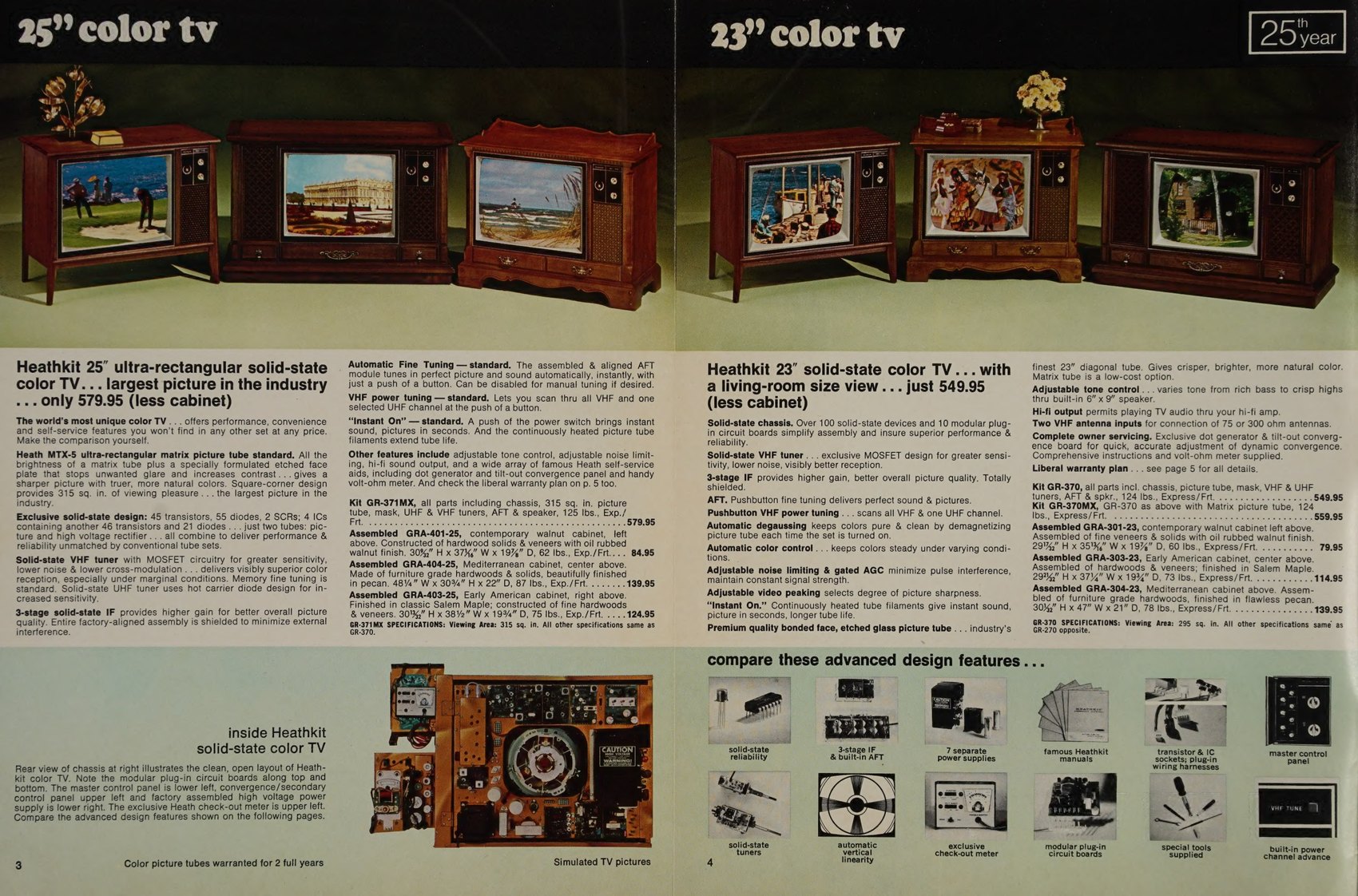
Solid-state colour arrived in 1970, and with it the modular construction that the GR-2000 inherited. The 1972 catalogue’s GR-270 used “over 100 devices and only two tubes (picture and high voltage rectifier)” on ten plug-in glass-epoxy boards that “snap in or out in seconds”, a MOSFET VHF tuner, automatic fine tuning as standard, a tilt-out convergence panel and a volt-ohm meter in the carton. The 25-inch GR-371MX at $579.95 carried Heath’s MTX-5 “ultra-rectangular” matrix tube with 315 square inches of picture — the tube size the GR-2000 would use — and counted 45 transistors, 55 diodes, 2 SCRs and 4 integrated circuits containing another 46 transistors and 21 diodes (Heathkit catalogue 810/72, 1972, pp. 3-5). Heath backed the modules with an expedited 48-hour exchange service at the factory and its own stores, and after the warranty a failed module could be exchanged for a flat $5.00.
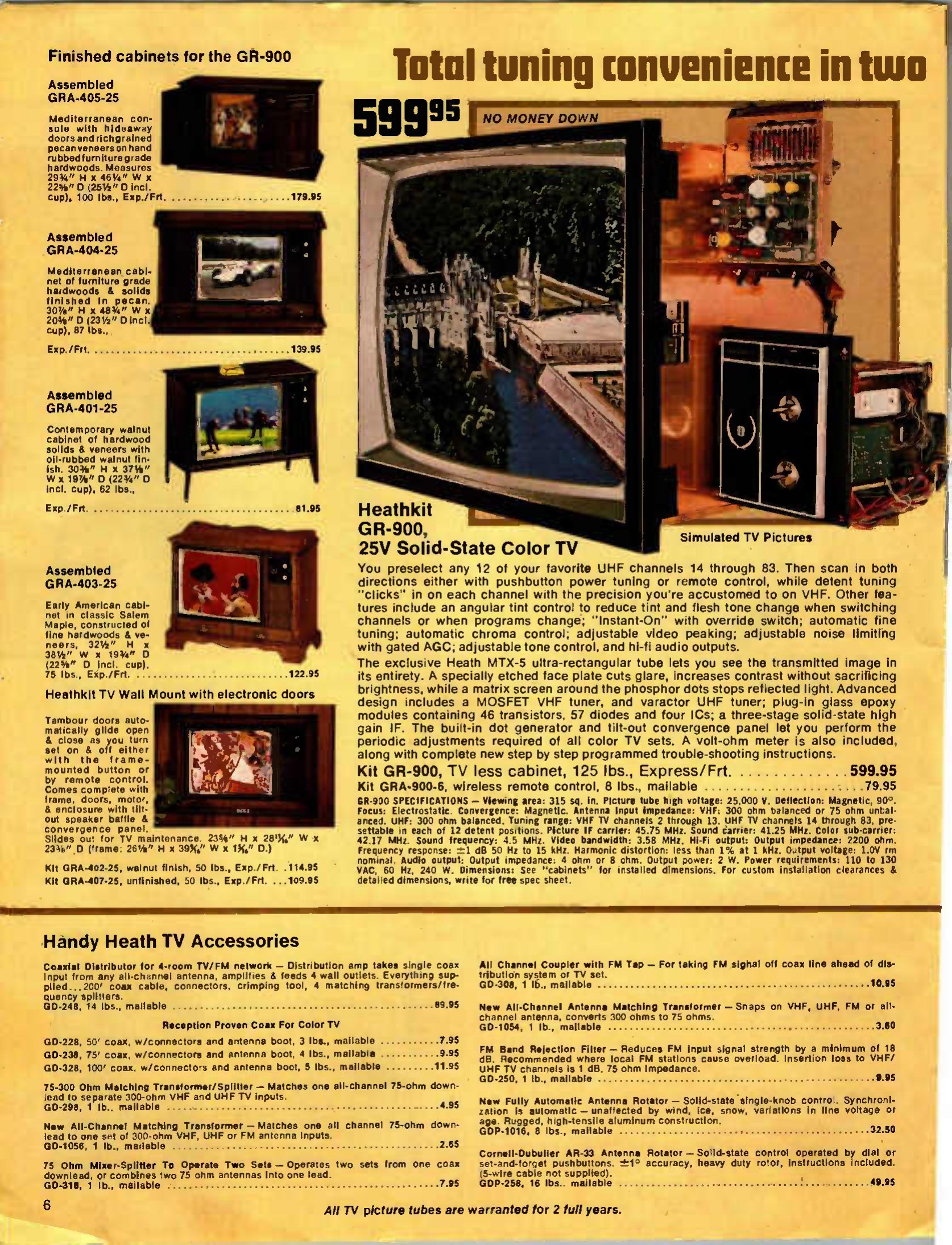
The immediate predecessor of the GR-2000 in the catalogue was the GR-900, a 25-inch solid-state set with pushbutton “detent” tuning of twelve preselected UHF channels, sold at $599.95 in March 1974. It is the yardstick for what the digital set added: the GR-900 buyer got the same picture tube, the same self-service philosophy and the same modular chassis, but tuned his set with a knob and read the channel from a dial.
1.3 Launch, price and the press
Schlumberger’s annual report for 1973 dates the set exactly, recording a new digital colour model introduced in January 1974 with all-electronic control of tuning and sound level and the channel number shown on screen, and calling initial acceptance “unusually good”. The 1974 report added the clock and the touch-controlled sound (Schlumberger annual reports).
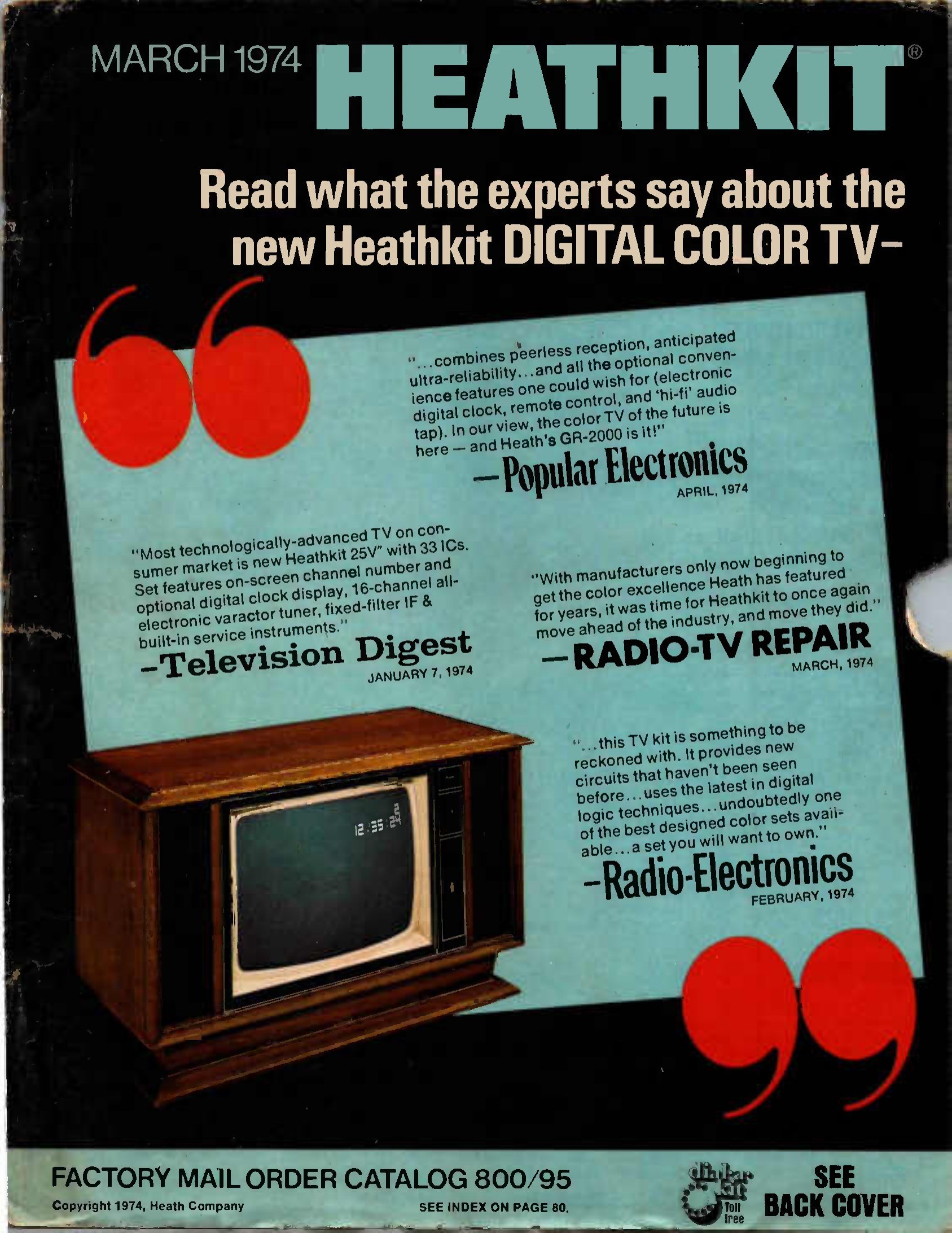
Heath put the trade press on the cover of the March 1974 catalogue rather than a photograph of the set. Television Digest of 7 January 1974 called it the “most technologically-advanced TV on consumer market”; Radio-TV Repair wrote in March that the rest of the industry was only now reaching the colour quality Heath had offered for years, and that Heath had moved ahead again; and Popular Electronics concluded in April that “in our view, the color TV of the future is here — and Heath’s GR-2000 is it!” (Heathkit catalogue 800/95, March 1974, cover and pp. 2-3).
The catalogue price history is worth following, because it shows the set outliving three rounds of competition:
Table 1 — The catalogue price history is worth following, because it shows the set outliving three rounds of competition
| Catalogue | GR-2000 kit | Remote | Clock |
|---|---|---|---|
| March 1974 (800/95) | $649.95 | $79.95 (GRA-2000-6) | $29.95 (GRA-2000-1) |
| Christmas 1975 | $689.95 | $89.95 | $29.95 |
| Fall 1977 (817) | $599.95 | $89.95 | $29.95 (renumbered GRA-601) |
| Fall 1979 | $659.95 | $99.95 | $35.95 |
| Winter 1981 | $599.95 (from $669.95) | $99.95 | $29.95 |
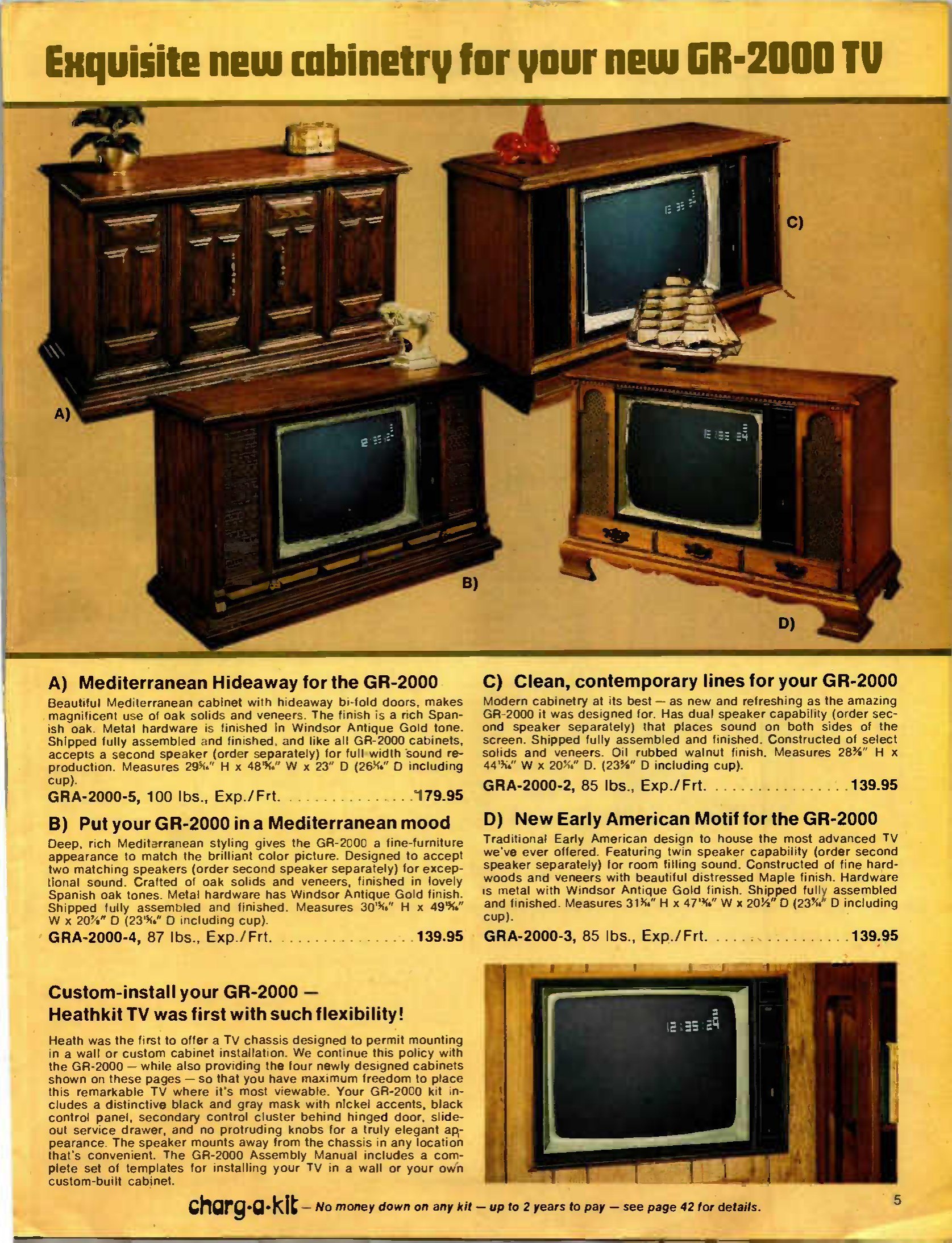
Cabinets were extra and were sold fully assembled and finished: in March 1974 the contemporary, Early American and Mediterranean floor cabinets were $139.95 each and the Mediterranean “hideaway” with fold-away doors was $179.95. A second speaker, GRA-2000-7, cost $6.50 and dropped into a space provided in every cabinet.
1.4 The family the GR-2000 founded
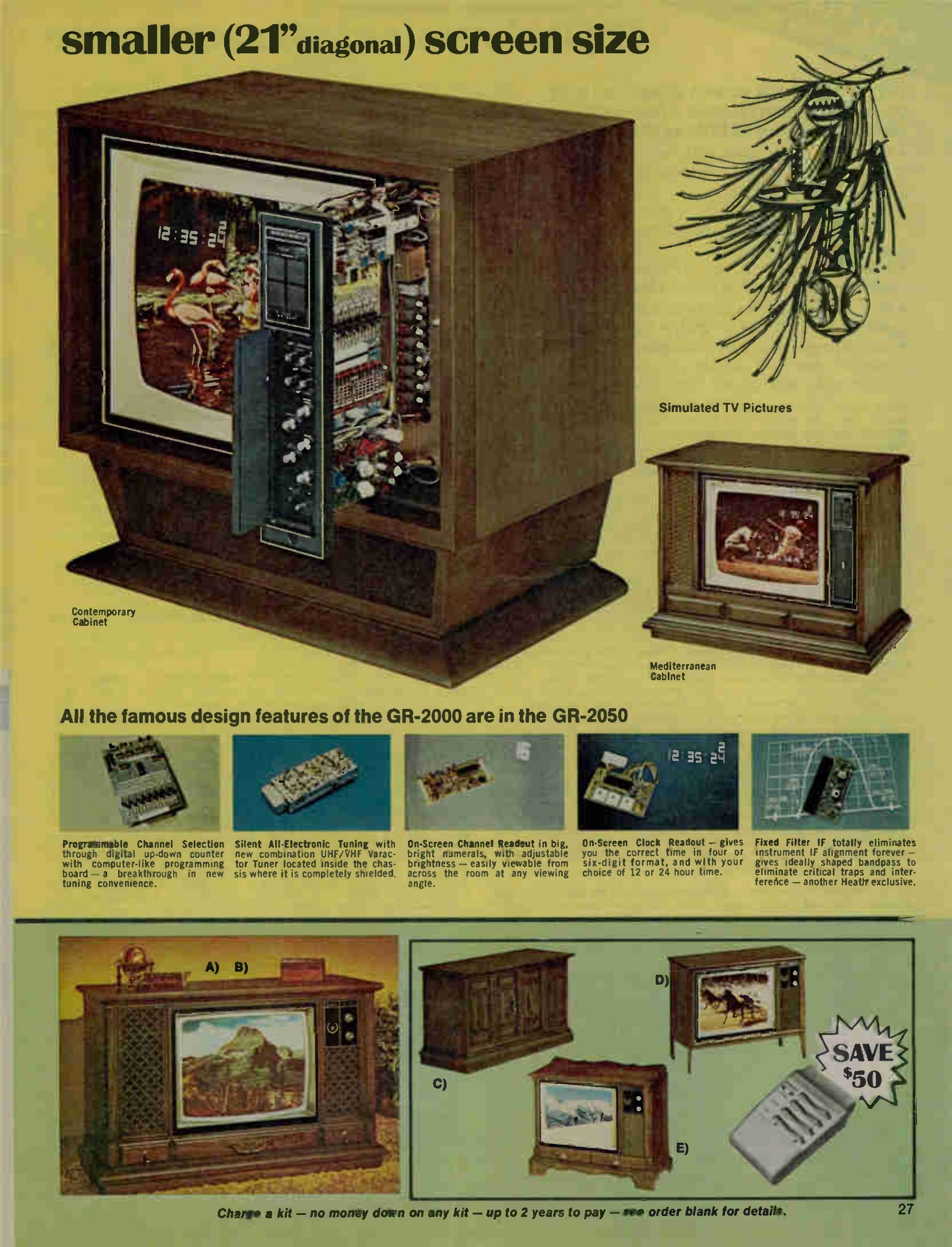
The digital chassis quickly became a family. The 21-inch GR-2050 of 1975 carried “all the famous design features of the GR-2000” in a smaller cabinet at $599.95. The small-screen GR-500, GR-400 and GR-300 (19, 17 and 15 inches) took the on-screen channel readout down to $399.95, Heath noting that the feature “originated in the famed Heathkit GR-2000”.
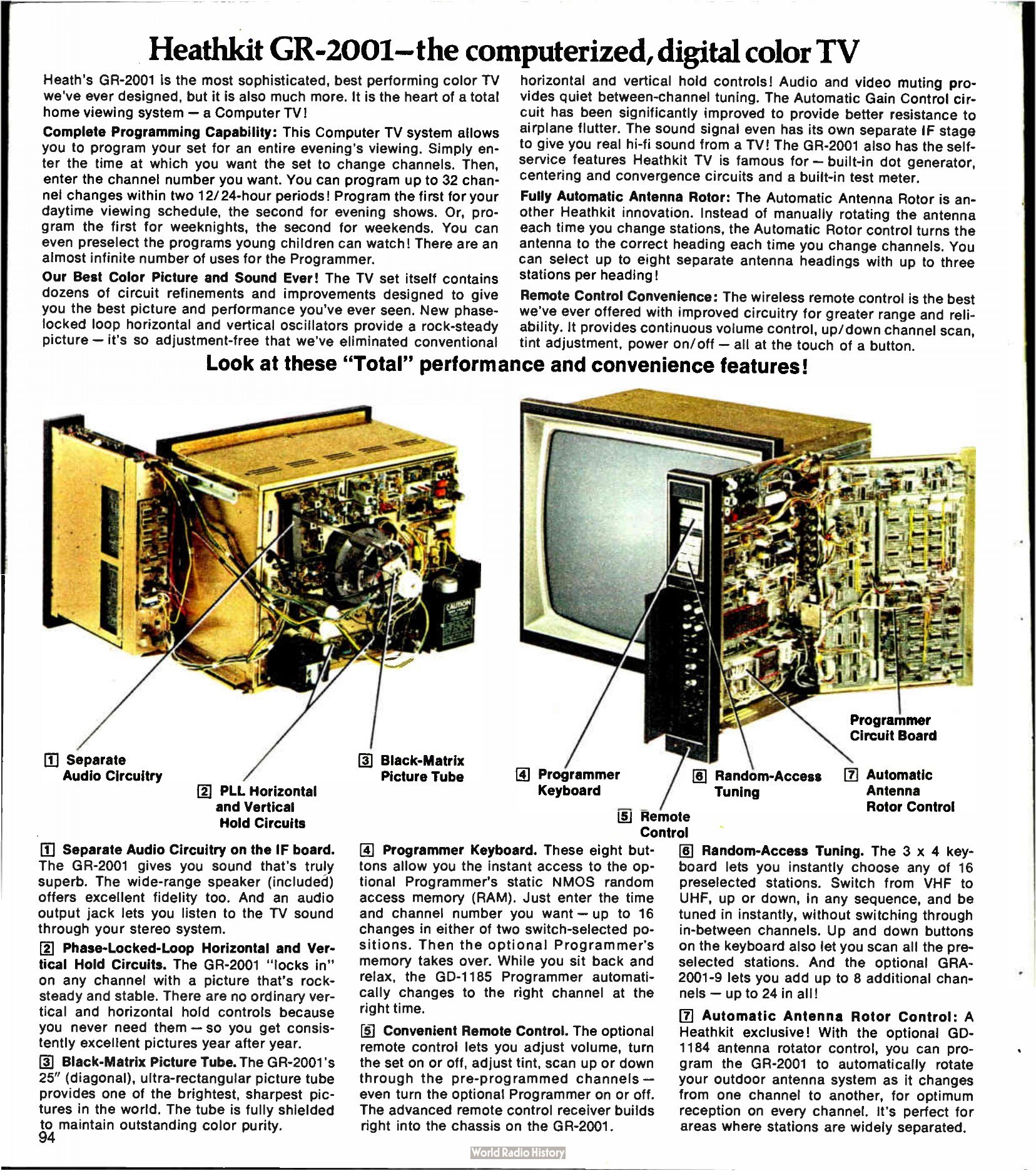
In 1976 came the GR-2001, which Heath called “the computerized, digital color TV”. It added phase-locked-loop horizontal and vertical oscillators (doing away with hold controls), random-access tuning from a 3×4 keyboard, audio and video muting between channels, a separate sound i.f. stage, and two accessories that went well beyond television practice of the day: the GD-1185 programmer, which switched the set to a chosen channel at a chosen time — up to 32 channel changes across two 12- or 24-hour periods — and the GD-1184 automatic antenna rotor control, which turned the aerial to the right heading each time the channel changed (Heathkit Fall 1977 catalogue, No. 817, pp. 94-95).
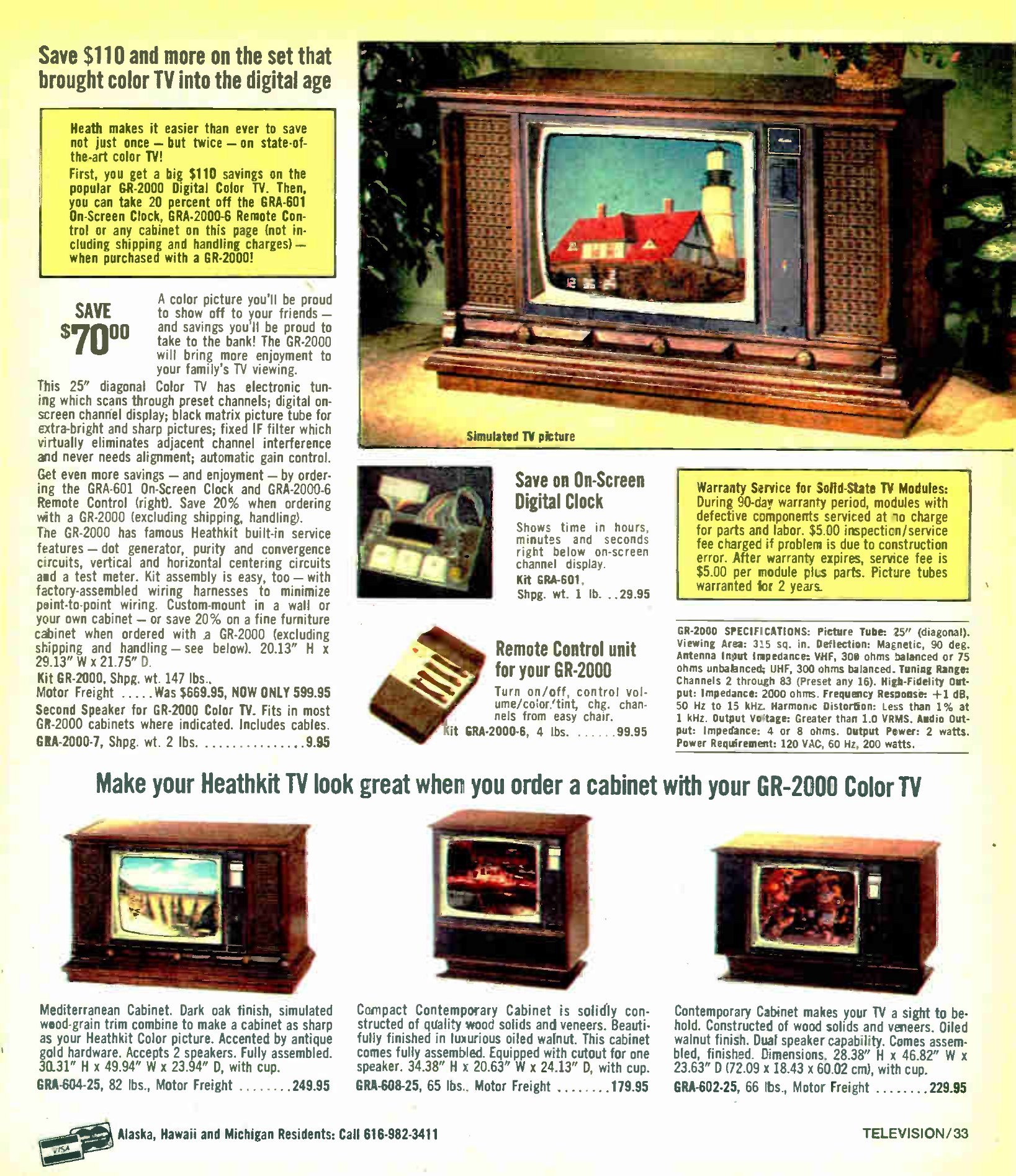
The GR-2000 itself stayed in the catalogue alongside its successor for seven years. It was still listed in the Winter 1981 catalogue, cut from $669.95 to $599.95 under the headline “Save $110 and more on the set that brought color TV into the digital age”. It had gone by the Christmas 1981 catalogue, and in Christmas 1982 the only trace left was a notice to GR-2000 and GR-2001 owners that Heath would place a final order for the GRA-602-25 contemporary cabinet on 1 December 1982 (Heathkit Christmas 1982 catalogue, p. 86).
1.5 Headline specification
Table 2 — Headline specification
| Model | GR-2000, “Digital Design” colour television |
| Introduced | January 1974 (Schlumberger annual report, 1973) |
| Picture tube | 25-inch diagonal, black (negative) matrix, 315 square inches of viewing area; two-year warranty |
| Deflection / focus / convergence | Magnetic, 90 degrees / electrostatic / magnetic |
| Tuning | VHF and UHF varactor diode tuners, d.c. voltage controlled; any 16 preset channels from VHF 2-13 and UHF 14-83 |
| Semiconductors | 19 integrated circuits (33 with remote control and clock); 71 transistors, all socketed |
| Construction | 20 plug-in glass-epoxy circuit boards, 12 factory-fabricated cables, slide-out service drawer |
| Picture i.f. carrier | 45.75 MHz |
| Sound i.f. carrier | 41.25 MHz |
| Colour i.f. subcarrier | 42.17 MHz |
| Intercarrier sound | 4.5 MHz |
| Video i.f. bandwidth | 4.08 MHz at 6 dB down |
| Aerial input | VHF 300 Ω balanced or 75 Ω unbalanced; UHF 300 Ω balanced |
| Audio output | 2 watts into 4 or 8 Ω; hi-fi output 2200 Ω, ±1 dB from 50 Hz to 15 kHz |
| Power | 110-130 V a.c., 60 Hz, 200 watts |
| Weight | 112 lb net; 147 lb shipping |
| Price at launch | $649.95 (chassis, picture tube, one speaker; cabinet extra) |
Specification from the catalogue spec blocks of March 1974 and Christmas 1975; semiconductor counts from Radio-Electronics, February 1974 and Popular Electronics, April 1974.
1.6 Variants and accessories
Table 3 — Variants and accessories
| Model | Year first seen in a catalogue | Notes |
|---|---|---|
| GR-53 / GR-53A | 1963 / 1965 | 21-inch round tube, 26 tubes, first Heathkit colour set; $349 at launch, $399.00 in March 1965 |
| GR-25 → GR-295 | late 1965 → 1967 | 25-inch rectangular, 295 square inches, 27 tubes; renamed for its viewing area |
| GR-227, GR-180 | 1967-1968 | 20-inch and 18-inch tube sets; AFT versions GR-581 and GR-481 from about 1970 |
| GR-681 | 1970-1972 | 23-inch tube set with integrated-circuit automatic fine tuning |
| GR-269, GR-169 | 1972 | 18-inch compact and 14-inch portable solid-state colour |
| GR-270, GR-370, GR-371MX | 1972 | Solid-state, modular; the GR-371MX introduced the 25-inch MTX-5 matrix tube |
| GR-900 | by 1974 | 25-inch solid-state with pushbutton detent tuning, $599.95 |
| GR-2000 | January 1974 | Digital channel selection and on-screen readout; in the catalogue until Winter 1981 |
| GR-2050 | 1975 | 21-inch version of the GR-2000 design, $599.95 |
| GR-500 / GR-400 / GR-300 | 1975 | 19, 17 and 15-inch sets with on-screen readout, from $399.95 |
| GR-2001 | 1976 | Successor: PLL sweep, keyboard tuning, programmer and antenna-rotor options |
| GRA-2000-1 / GRA-601 | 1974 / renumbered by 1977 | On-screen digital clock module, $29.95 |
| GRA-2000-6 | 1974 | Ultrasonic remote control, 11 functions, $79.95 at launch |
| GRA-2000-7 | 1974 | Second speaker for the cabinets, $6.50 |
| GRA-2000-2/-3/-4/-5 | 1974 | Contemporary, Early American, Mediterranean and hideaway cabinets, $139.95-$179.95 |
| GD-1999 | 1976 | Universal colour TV game, connected to any set, $69.95 (cut to $49.95 in 1977) |
1.7 Who bought one
Three kinds of buyer. The first was the established Heathkit customer — the man who had already built test equipment and a receiver, who read the assembly manual as a technical education, and for whom a television that could be aligned and converged without instruments was an argument rather than a compromise. Heath aimed its copy squarely at him: “Because you build the set, you can service it. All the circuitry you need is built in.”
The second was the buyer who wanted the features and accepted the labour as the price of getting them. In 1974 digital tuning and an on-screen readout were not available from any American manufacturer at any price, and the chassis and tube at $649.95 undercut a comparable factory console.
The third barely appears in the advertising but mattered commercially: the correspondence schools. Schlumberger’s reports show electronics schools buying Heathkit colour sets in quantity as course material, a business the company accounted for separately as “contract sales” and whose loss in 1977-1978 explains most of Heath’s revenue decline in those years (Schlumberger annual reports).
1.8 Three claims worth handling carefully
The GR-2000 attracts three specific claims, all traceable to one 2024 interview with Chas Gilmore, Heath’s former vice-president of engineering, and all examined in detail in the company history dive. In short:
- “The first television anywhere with on-screen channel and time.” Defensible for the United States, not proven for the world. The Radio-Electronics editors, writing in February 1974, could find the feature in no other production colour set sold in the U.S. They also noted that “Sharp offers one set with this feature. Hitachi is talking about it. And Blaupunkt sells one in Europe” — which is itself the best evidence that the worldwide claim does not hold. The time display was in any case an optional module.
- “47,000 sold in a year.” Unverified. It rests on a recollection hedged with “I think”, and no Heath or Schlumberger document gives unit counts.
- “27 patents.” Unverified, and about Heath’s colour-television work generally at the time of the 1979 Zenith acquisition rather than about this model.
None of the three is needed. What can be documented — a kit-built television that tuned by counter and decoder, wrote its own channel number on the screen, and carried its own dot generator and test meter so that its owner could converge it on a Sunday afternoon — is remarkable enough.
Sources
- Heathkit catalogue 800/95, March 1974 (cover, pp. 2-3, 5, 6, 8), World Radio History.
- Heathkit Christmas 1975 catalogue, pp. 24-28.
- Heathkit Fall 1977 catalogue No. 817, pp. 93-98.
- Heathkit Fall 1979 catalogue, pp. 98-101.
- Heathkit Winter 1981 catalogue, pp. 30-32.
- Heathkit Christmas 1982 catalogue, p. 86 (final cabinet order notice).
- Heathkit catalogue 800/53, March 1965, p. 5 (GR-53A).
- Heathkit flyer 80-33, late 1965 (GR-25).
- Heathkit catalogue, 1968, pp. 5-8 (GR-295, GR-227, GR-180).
- Heathkit catalogue 810/72, 1972, pp. 3-10 (solid-state line).
- Larry Steckler, “Heathkit’s new digital color TV”, Radio-Electronics, February 1974, pp. 33-37, 78-80.
- “Heathkit Model GR-2000 Digital Color TV Receiver”, Popular Electronics, April 1974, pp. 77-80.
- Schlumberger Limited annual reports, 1963-1976, Internet Archive.
- Heath Company deep dive, volume 4 (company history, and the examination of the three claims).
Comments (0)