Robots · Volume 1
Origins
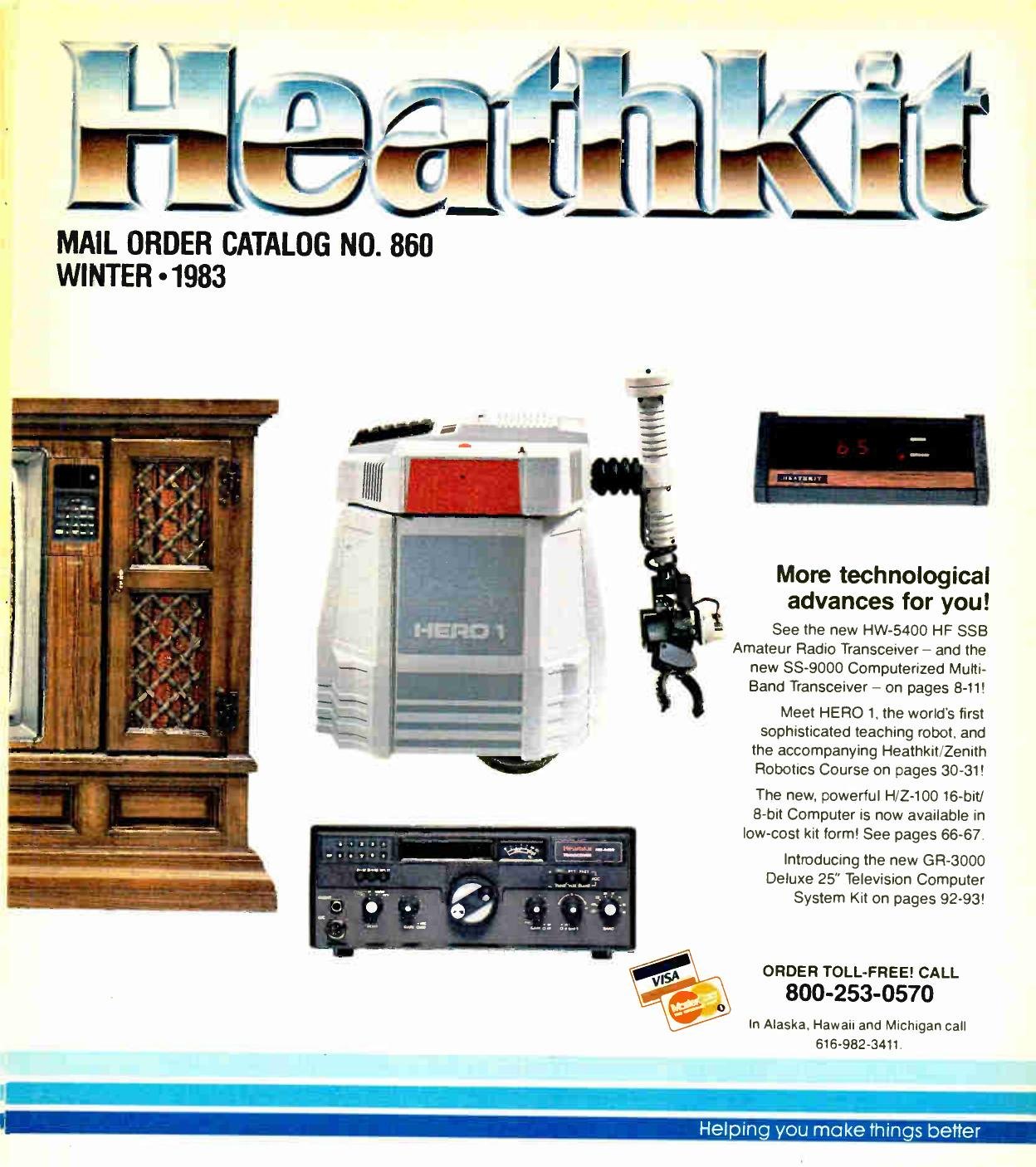
In the Heath Company’s catalogues of the early 1980s, the robot arrives between the telephones and the education courses. The Winter 1983 mail-order catalogue, No. 860, put it on the cover and devoted two pages to it: “Introducing the world’s first sophisticated teaching robot, HERO 1.” The kit cost $999.95 without its arm and voice. The factory-built robot, with both, cost $2,499.95. Over the next five years Heath sold three robots under the HERO name, HERO 1, HERO Jr and HERO 2000, together with a stand-alone Robot Arm Trainer and a shelf of self-study courses built around them. Twenty years later the name came back on a very different machine, the HE-RObot of 2007.
This dive tells the story of that line as a whole. It covers why a kit company in Benton Harbor, Michigan built a robot, and who built it. It covers what the robots cost, what they competed with, how the catalogue presented them from year to year, and how the line ended. Each of the three HERO robots already has its own detailed dive on the Robots site, so their engineering is only summarised here:
The Heath Company’s own history is covered by the site history dive: the surplus years, Daystrom, Schlumberger, Zenith and the end of the kits. It is not retold here. The robots belong to the period that dive calls Heathkit goes digital and to the Zenith years that follow it in Zenith, Bull and the end of the kits.
1.1 A course that needed a machine
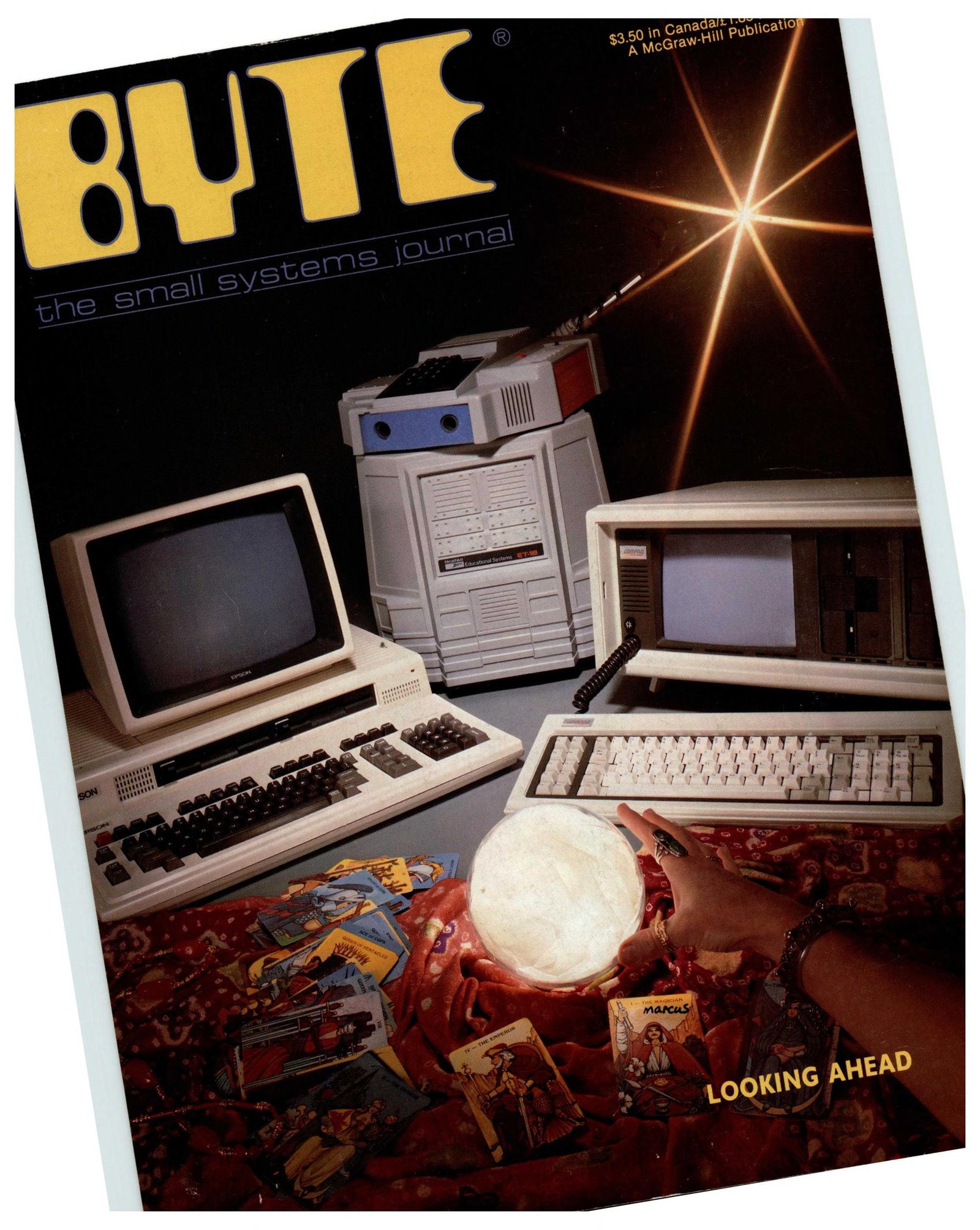
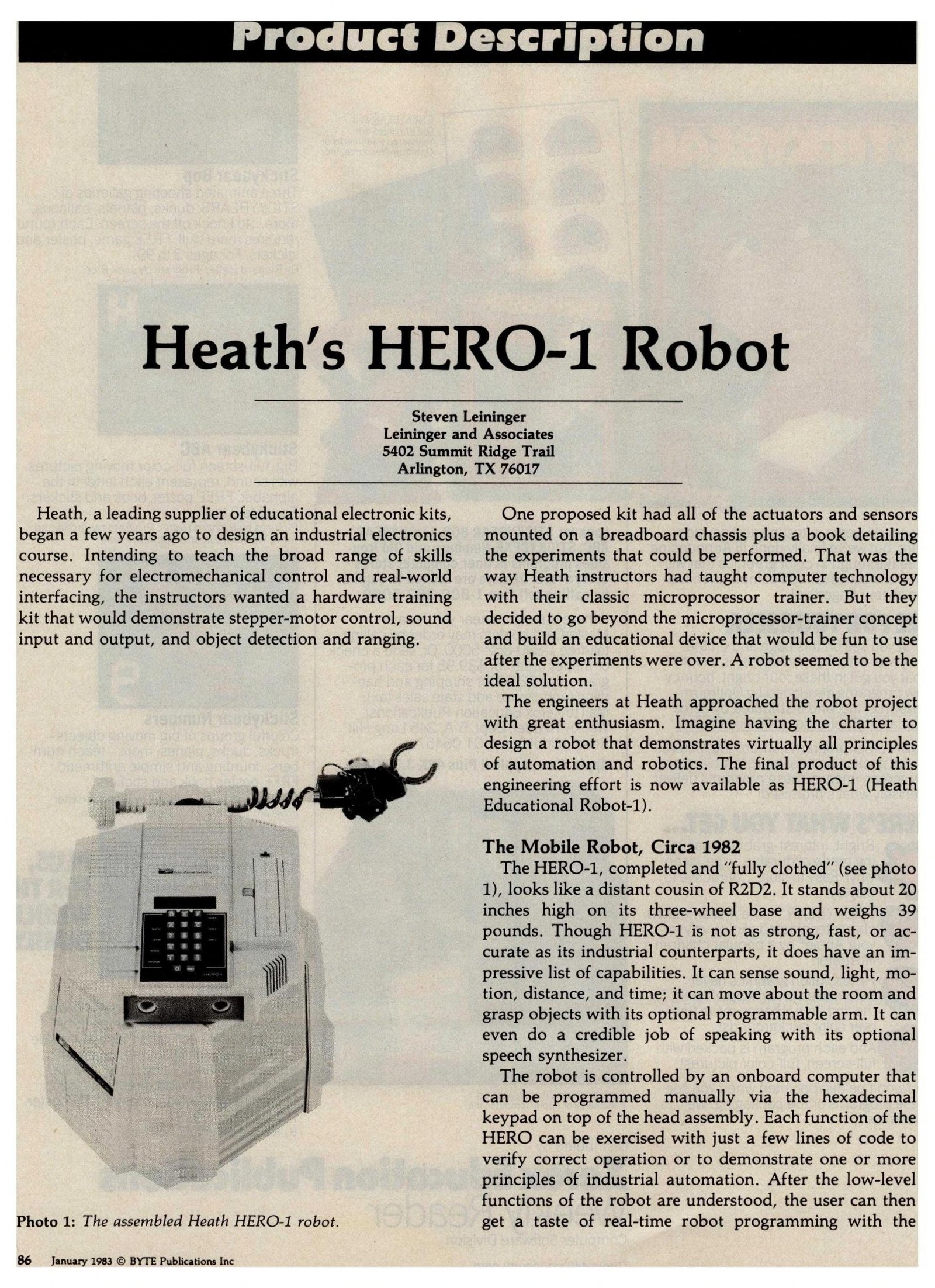
The robot began as teaching hardware. The fullest early account of its origin is the product description that Steven Leininger wrote for the January 1983 issue of BYTE, which also put the robot on its cover. Leininger, writing as an outside consultant from Arlington, Texas, says that Heath “began a few years ago to design an industrial electronics course”. Its instructors wanted “a hardware training kit that would demonstrate stepper-motor control, sound input and output, and object detection and ranging.” One proposal mounted the actuators and sensors on a breadboard chassis, with a book of experiments. That was how Heath had taught computing with its microprocessor trainer, the ET-3400. Instead, Heath decided to “go beyond the microprocessor-trainer concept and build an educational device that would be fun to use after the experiments were over. A robot seemed to be the ideal solution” (Leininger, “Heath’s HERO-1 Robot”, BYTE, January 1983, pp. 86–96).
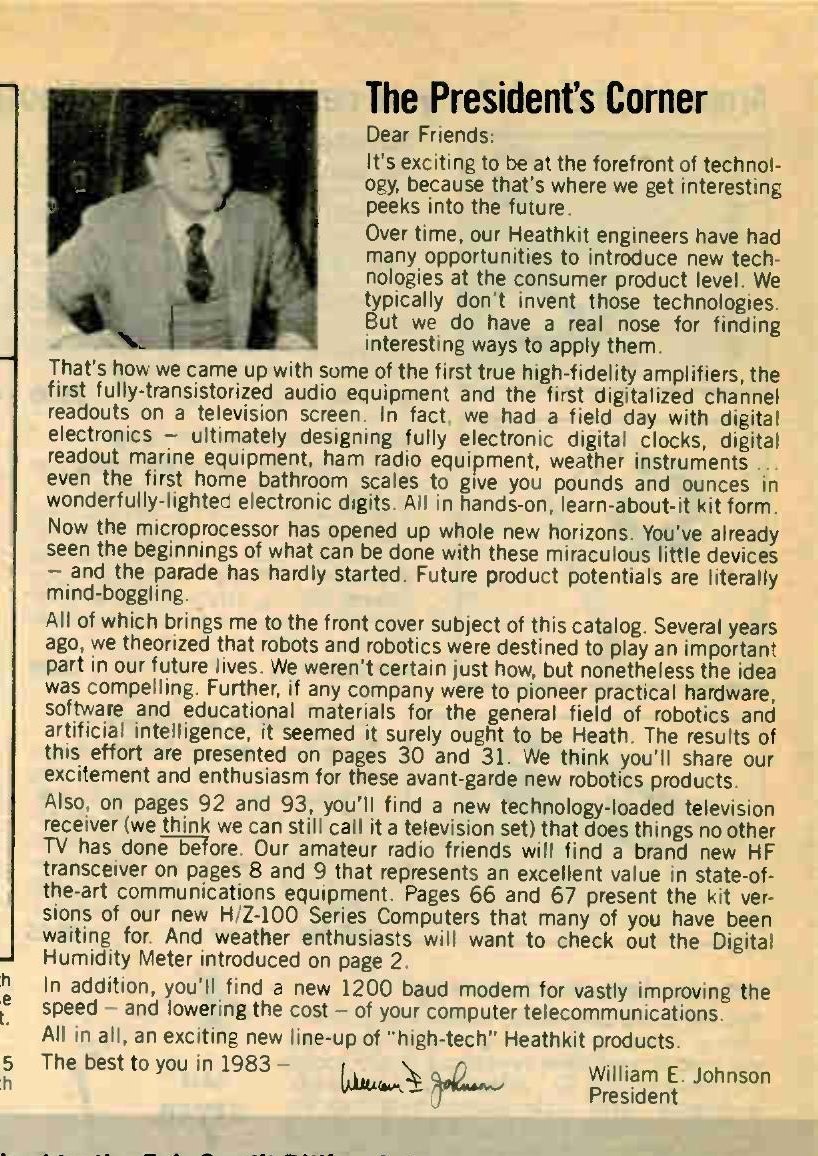
Wikipedia dates the start of the project to October 1979 (Wikipedia, “HERO (robot)”). No primary source for that month was found, but it fits Leininger’s “a few years ago” and the length of a kit development. It also fits the company’s own story as its president told it. In the Winter 1983 catalogue, William E. Johnson wrote in “The President’s Corner” that “several years ago, we theorized that robots and robotics were destined to play an important part in our future lives. We weren’t certain just how, but nonetheless the idea was compelling.” He added that if any company were to pioneer “practical hardware, software and educational materials for the general field of robotics and artificial intelligence, it seemed it surely ought to be Heath” (Heathkit catalogue No. 860, Winter 1983, “The President’s Corner”).
Two things about that origin shaped everything that followed. First, the robot was an educational product. BYTE’s “At a Glance” box gives the maker as “Heath/Zenith Educational Systems”, not the kit catalogue. The model number is in the ET series, Heath’s prefix for educational trainers, which also covered the ET-3100 and ET-3400; see the prefix table in the field guide. Second, the course and the robot were designed together. The robot came with an experimenter’s breadboard on its head, wired to an I/O port, an interrupt line and the power rails, which, in Leininger’s words, gave “the user a chance to perform experiments from Heath’s Robotics Course.”
The processor followed the same logic. HERO 1 used a Motorola 6808, a member of the 6800 family that Heath already taught with the ET-3400 trainer and its EE-3401 microprocessor course. A student coming from Heath’s microprocessor course would find the robot’s machine code familiar. The company history dive notes this continuity in its section on HERO 1.
1.2 The people
The design team has left fewer names in print than the H8 computer team did. The names that do survive come from period sources.
- Jim Lytle, described as HERO 1’s “chief engineer”, took the robot to NBC’s Today show, where it appeared on 1 December 1982 (TODAY, “Personal Robot Called HERO 1 Stops by TODAY in 1982”, YouTube).
- Douglas Bonham, Heath’s Director of Educational Marketing and Development, sat on the steering committee of the first International Personal Robot Congress in 1984 (Ron Johnson, “Part of the Beginning”, Robotics Age, August 1984, p. 35).
- Ron Johnson, a Senior Educational Media Designer at Heath, wrote Robotics Age’s report on that congress. The magazine notes that he had “written several books and articles on robotics” (same source, p. 36).
- Myron Kukla of Heath appears in the same report, photographed “instructing HERO 1 in the finer points of show demonstrations.”
- Howard Boyet wrote Heath’s HERO 1 Advanced Programming Experiments, and Mark J. Robillard wrote the independent Sams book HERO 1: Advanced Programming and Interfacing (1983) (Wikipedia, “HERO (robot)”, bibliography).
- John D. Hubbard and Lawrence P. Larsen are credited with the HERO 2000 programming and interfacing course book of 1986 (same source).
Steven Leininger needs a note of his own. The company history dive introduces him as the designer of the Radio Shack TRS-80 Model I, which he was, and quotes his article’s line about “the charter to design a robot.” The article does not claim that Leininger designed HERO 1, though. It is signed from “Leininger and Associates” in Texas. It describes “the engineers at Heath” as the ones who held that charter. It reports a visit to “the Heath facilities in Benton Harbor” where the author evaluated “one of the preproduction prototypes,” one of “only three HERO-1s” then in existence. Leininger is best read as an expert outside reviewer given early access, not as a member of the design team.
1.3 The launch, December 1982
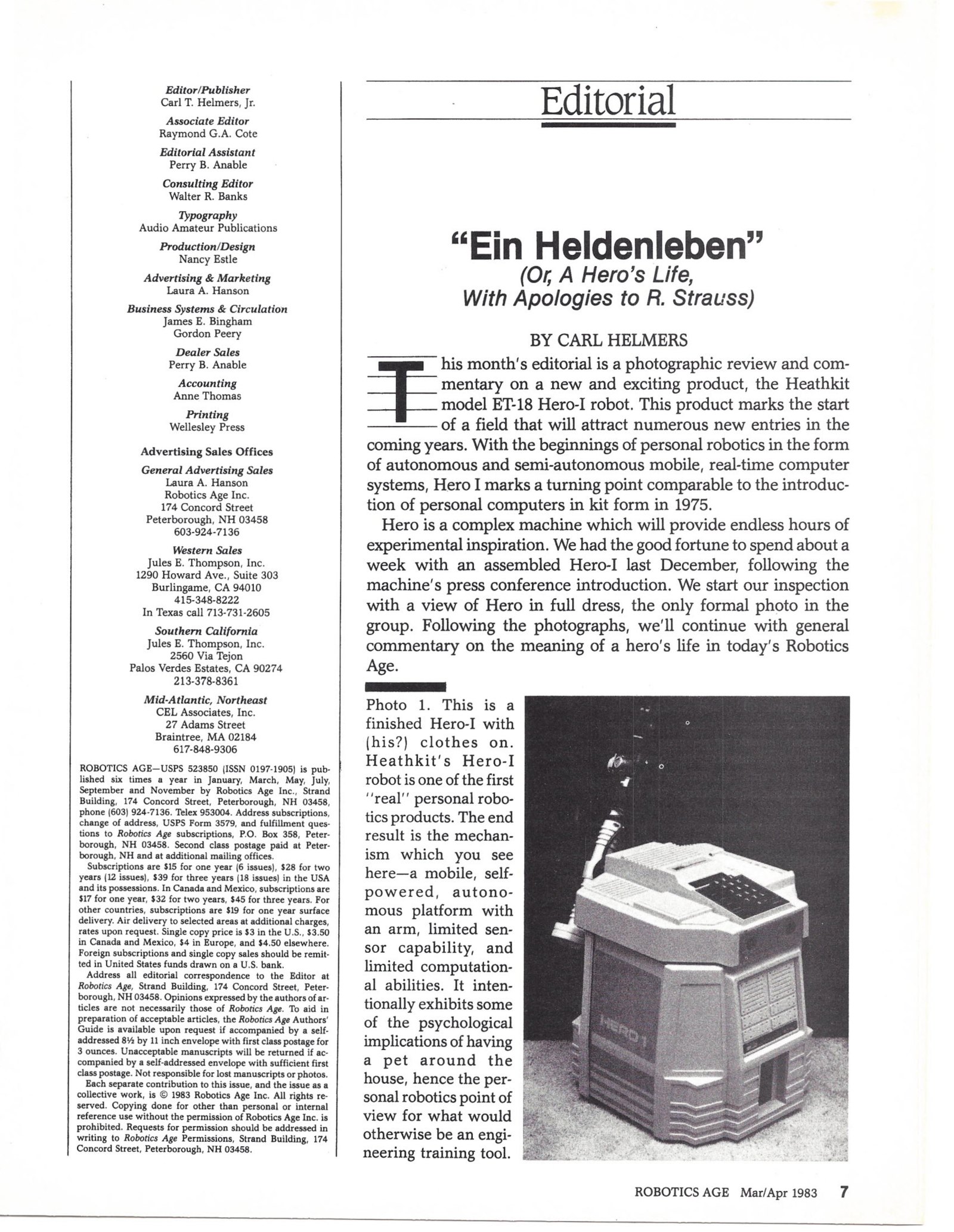
Heath had shown a robot in some form at the West Coast Computer Faire earlier in 1982, according to the Brueschke and Mack history of the company (Brueschke & Mack, AWA Review 32, note 36). The formal launch came at a press conference on 1 December 1982. The date is fixed by two independent sources. Carl Helmers, publisher of Robotics Age, wrote that he had seen “a photocopy of the proofs at the press introduction on December 1” and then “spent about a week with an assembled Hero-I last December, following the machine’s press conference introduction” (Helmers, “Ein Heldenleben”, Robotics Age, March/April 1983, pp. 7–12). The Today appearance aired the same day.
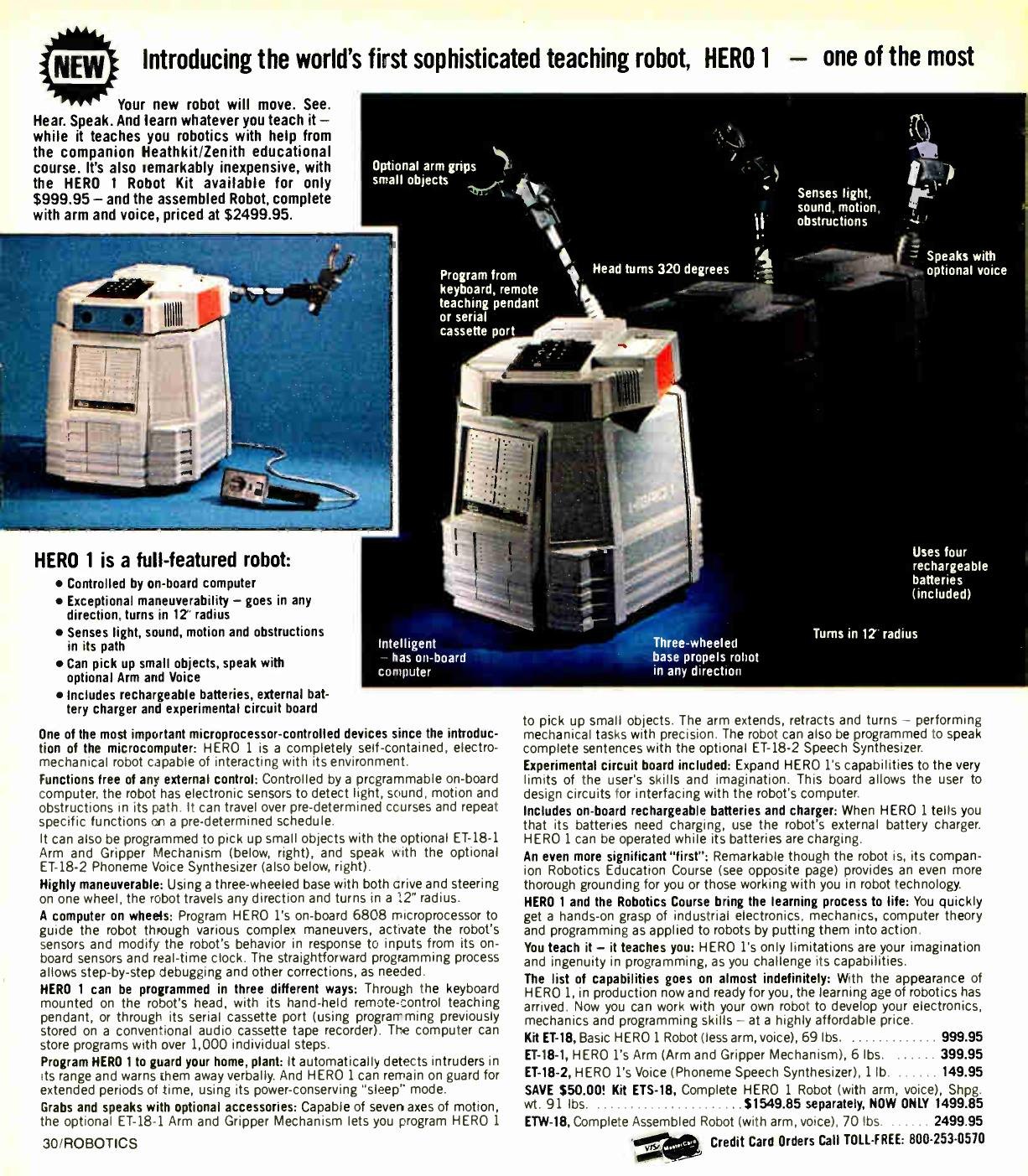
The Christmas 1982 catalogue (No. 859), mailed before the launch, has no robot in it. The first catalogue to list HERO 1 is Winter 1983, No. 860, which Heath dated to the new year (“The best to you in 1983”). Its two pages give the full price list:
Table 1 — The Christmas 1982 catalogue (No. 859), mailed before the launch, has no robot in it. The first catalogue to list HERO 1 is Winter 1983, No. 860, which Heath dated to the new year ("The best to you in 1983"). Its two pages give the full price list
| Model | Description | Winter 1983 price |
|---|---|---|
| ET-18 | Kit, basic HERO 1 robot (less arm, voice), 69 lb | $999.95 |
| ET-18-1 | HERO 1’s Arm (arm and gripper mechanism) | $399.95 |
| ET-18-2 | HERO 1’s Voice (phoneme speech synthesizer) | $149.95 |
| ETS-18 | Kit, complete robot with arm and voice (“$1,549.85 separately”) | $1,499.85 |
| ETW-18 | Complete assembled robot, with arm and voice, 70 lb | $2,499.95 |
| EE-1800 | Robotics Course, 1,200 pages in two binders | $99.95 |
Source: Heathkit catalogue No. 860, Winter 1983, pp. 30–31.
The model numbers follow Heath’s usual convention: the plain number is the kit and the W marks the factory-wired version. The HERO 1 dive on the Robots site has these two reversed (it gives ET-18 as assembled and ETW-18 as the kit); the catalogue, BYTE’s price box (“Basic HERO-1 kit (ET-18) … assembled HERO-1 (ETW-18)”) and the company history all agree on the order used here.
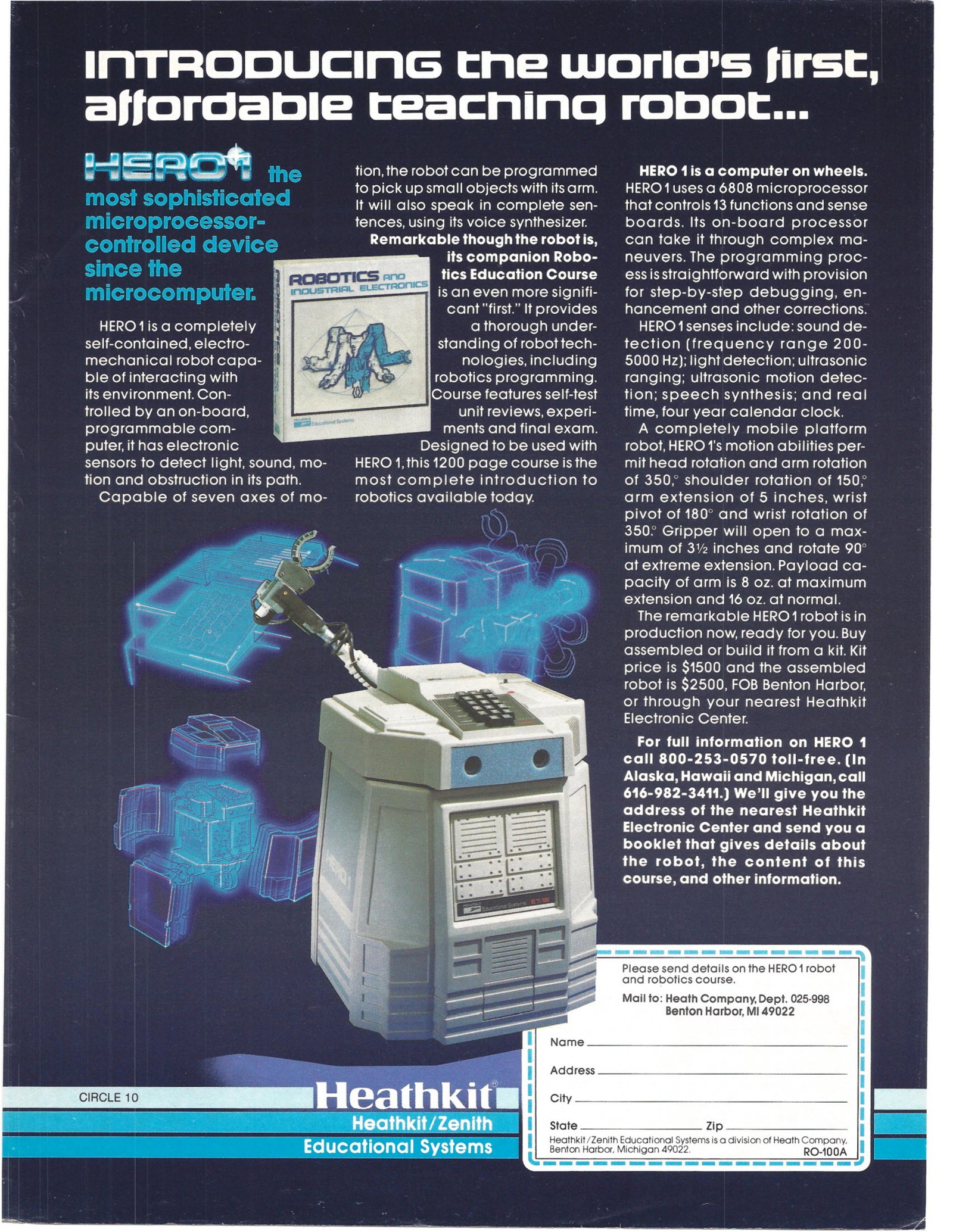
The figure repeated in most online histories, “$1,500 as a kit, $2,500 assembled”, is the price of the complete kit and of the assembled robot. It also matches the rounded prices Heath used in its own magazine advertising that spring, “Kit price is $1500 and the assembled robot is $2500, FOB Benton Harbor” (Heathkit advertisement, Robotics Age, March/April 1983, p. 5). A buyer could, however, start with the bare robot for about a thousand dollars.
1.4 What the robot was
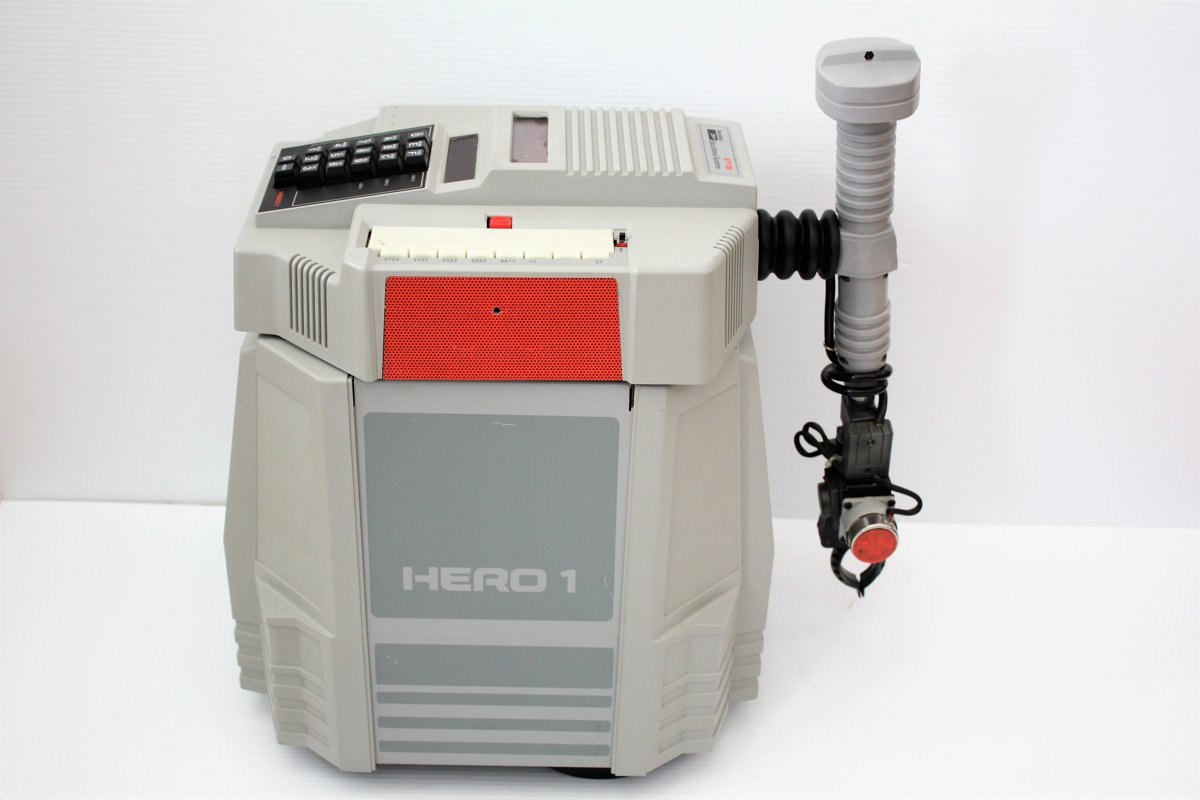
HERO 1 is documented in nine volumes in its own dive, and only its outline is needed here. It was a self-contained mobile robot about 20 inches tall and 39 pounds, on three wheels, the front one both driving and steering. The head rotated and carried a 17-key hex keypad and a six-digit LED display, a sonar ranger good to about 8 feet, an ultrasonic motion detector, a light sensor and a sound sensor. It had a real-time clock, an optional five-axis arm, and an optional Votrax SC-01 phoneme speech synthesizer. The catalogue credited it with 4K of RAM and “an 8K ROM” holding its built-in commands and speeches. BYTE’s review confirms 4K bytes of programmable memory and 8K bytes of ROM. The main processor board came from Heath assembled and tested, “so that the student of robot technology does not have to be a computer-troubleshooting technician as well.” (The HERO 1 dive gives the ROM as 2 KB, following Wikipedia; both period sources say 8K.)
It could be programmed from the keypad in machine code or through a built-in “Robot Interpreter” language. The wired teaching pendant supported a “learn” mode, in which the robot recorded manual movements and then played them back. Programs could be stored on an ordinary cassette recorder. On power-up it said “ready.” Among its canned phrases BYTE lists “Your wish is my command” and “Oh no! I do not do windows!”
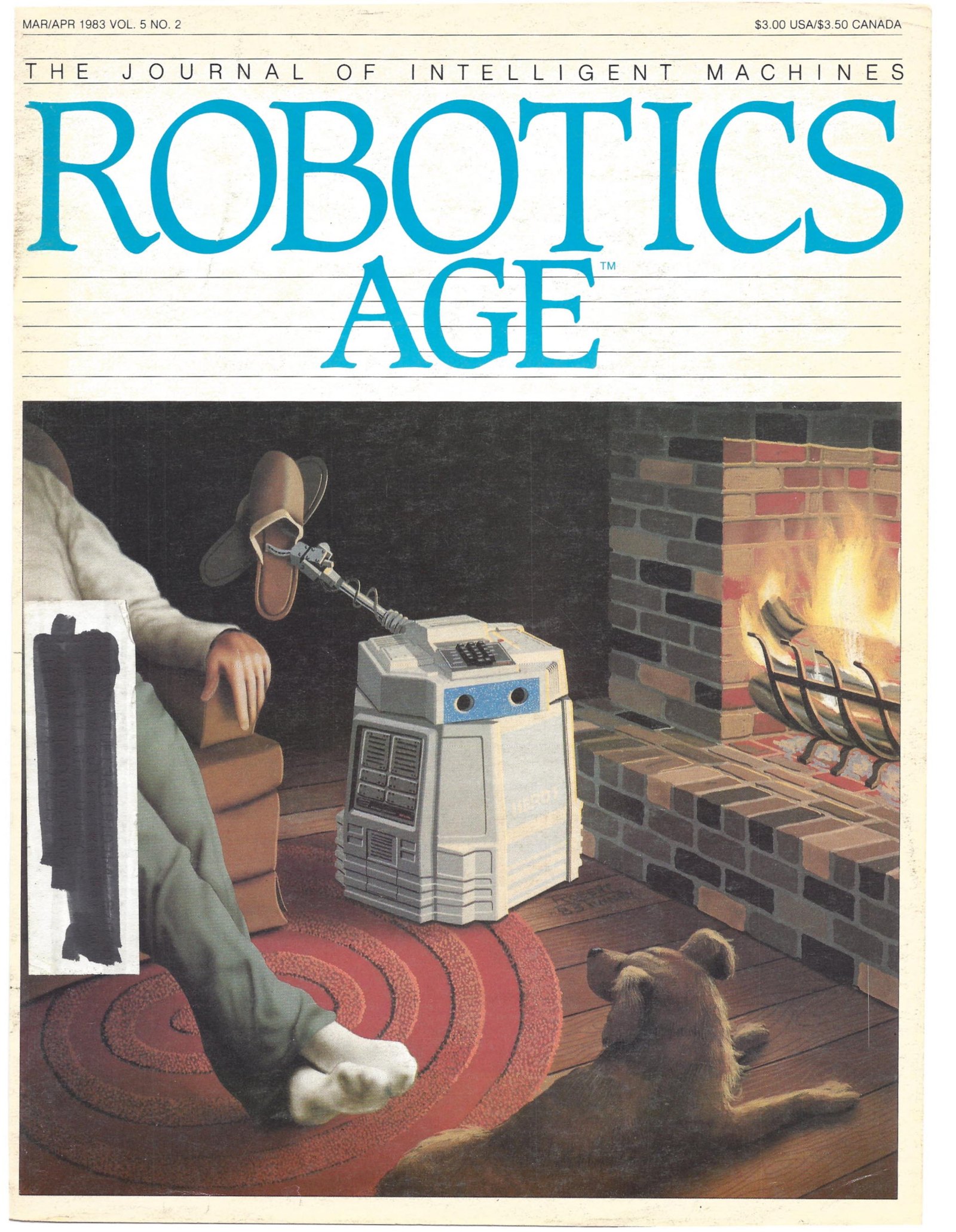
Leininger ended his hour with the prototype, a session that nearly drove one of the three prototypes off a conference-room table, with the sentence that Wikipedia still quotes: HERO 1 was “a product of extraordinary flexibility and function.” Robotics Age went further. Helmers called it “a turning point comparable to the introduction of personal computers in kit form in 1975”, the year of the Altair.
1.5 The personal-robot moment
HERO 1 was not alone for long. Between 1982 and 1985 a small industry tried to sell robots to homes and schools. It borrowed the vocabulary of the personal computer: “personal robot”, “the Apple of robots”. Its trade press was Robotics Age in Peterborough, New Hampshire. Its trade show was the International Personal Robot Congress (IPRC), held for the first time in Albuquerque, New Mexico, on 13–15 April 1984. Heath advertised the show in its Spring 1984 catalogue: “Come to the first International Personal Robot Congress and Exposition in Albuquerque, New Mexico and see HERO 1 star with other personal robots” (Heathkit catalogue No. 865, Spring 1984, p. 68).
Ron Johnson’s report on the congress calls Androbot, Heath and RB Robot “the ‘Big Three’” of the field. It records about 1,500 registrations for the exhibition and 200 for the technical sessions, with about 25 exhibitors. Isaac Asimov gave the keynote by satellite from New York. Joseph Engelberger, the industrial-robot pioneer, and Nolan Bushnell of Atari and Androbot gave the featured talks: Bushnell argued that personal robots had to be cheap and entertaining, Engelberger that they could be expensive if they did useful work (Robotics Age, August 1984, pp. 35–37). HERO 1 sat between those two positions. It was neither cheap nor useful. It was sold as something that taught.
The competitors, with the prices found in the period press:
Table 2 — The competitors, with the prices found in the period press
| Robot | Maker | First seen | Price | Character |
|---|---|---|---|---|
| HERO 1 | Heath Company, Benton Harbor, Michigan | December 1982 | $999.95 basic kit; $2,499.95 assembled | Self-contained, keypad-programmed, optional arm and voice; sold with a course |
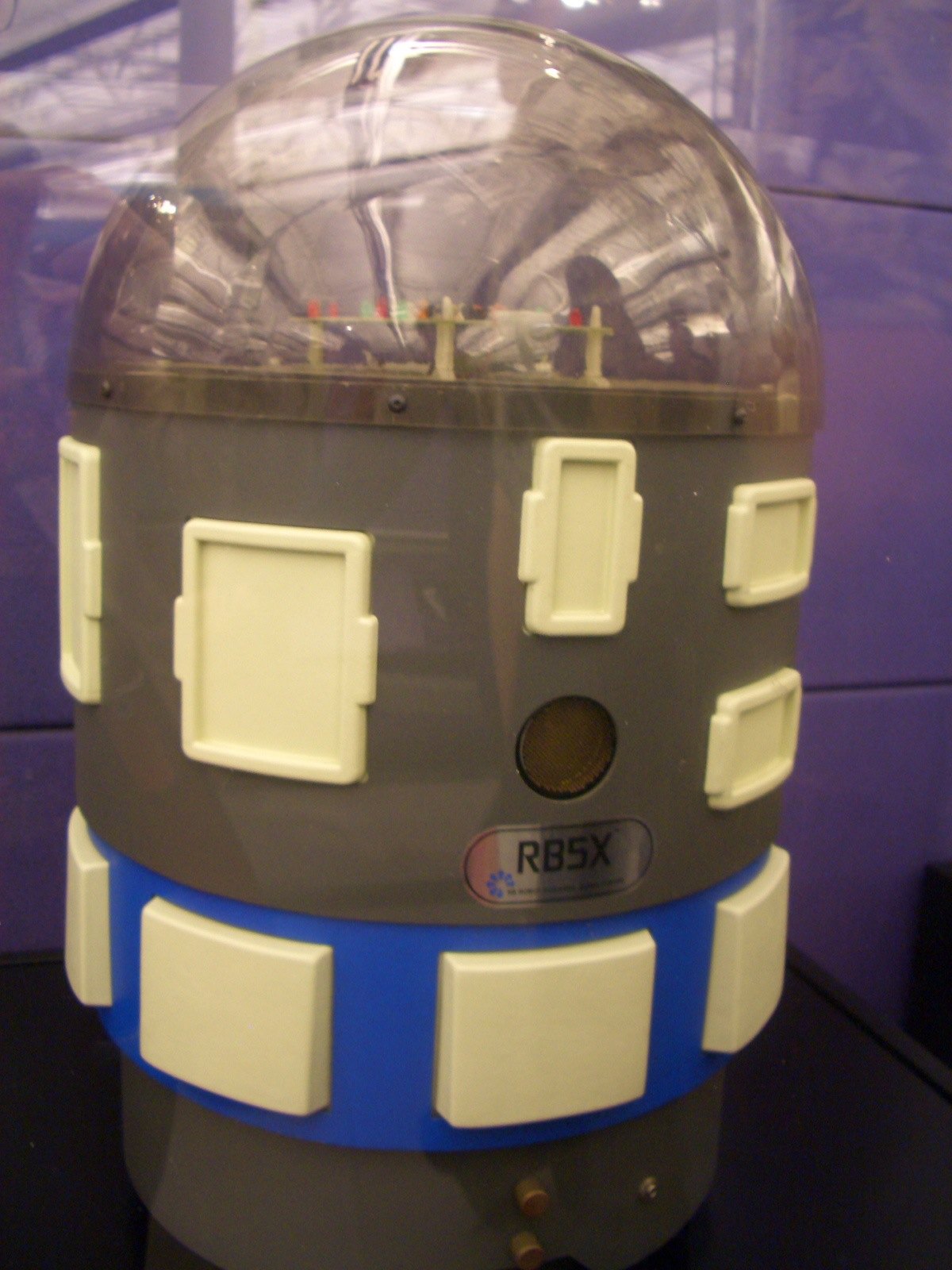
| RB5X | RB Robot Corp., Golden, Colorado | c. 1983 | $1,795 (January 1984); $2,295 list (May 1985) | Assembled, domed cylinder with bumpers and Polaroid sonar; Tiny BASIC; self-charging; optional arm and voice |
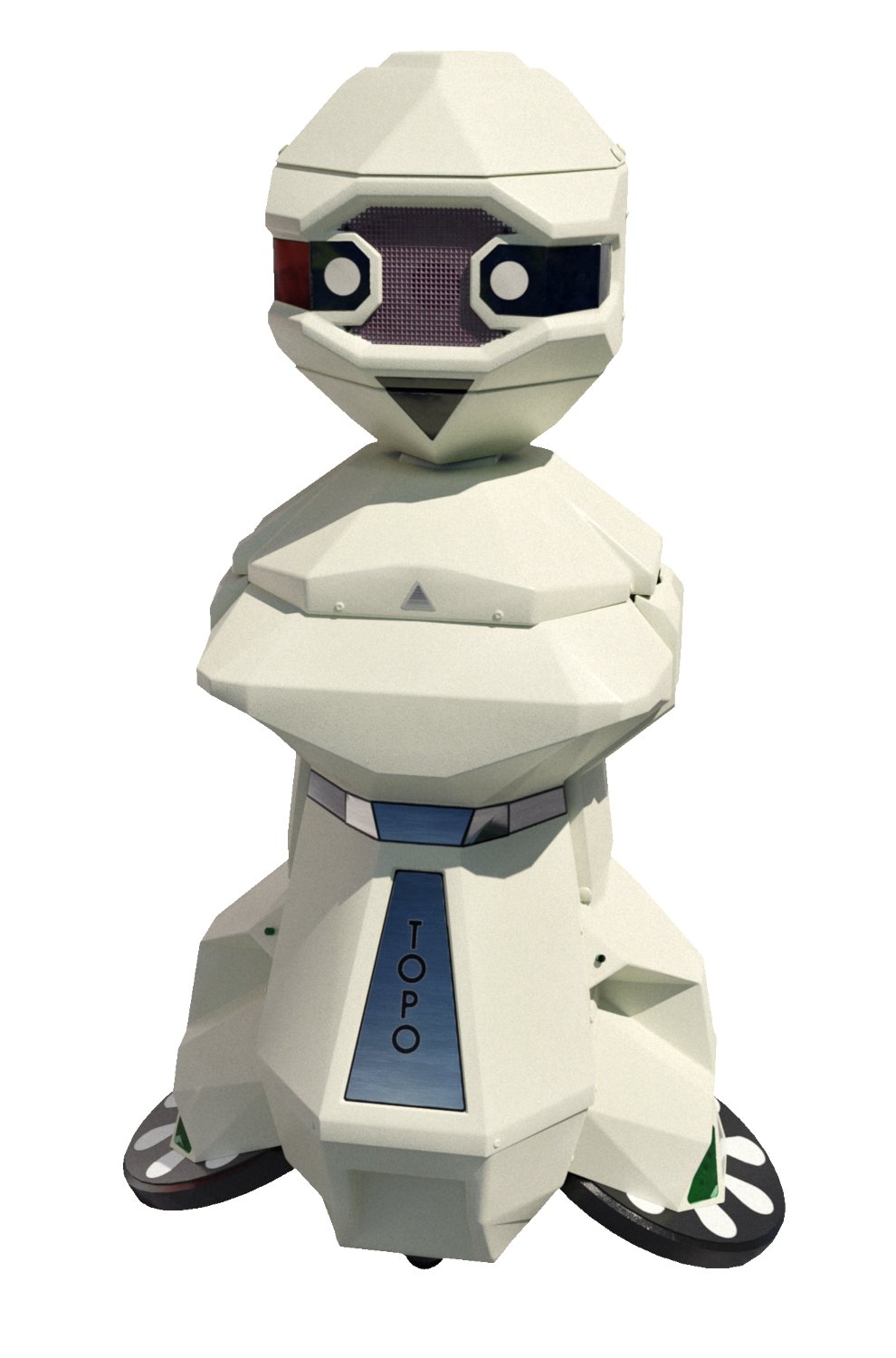
| Topo | Androbot Inc., San Jose (Nolan Bushnell) | 1983 | $1,595 | Host-driven by an Apple II over an infrared link; little autonomy of its own; a Topo III was listed in 1985 |
| Hubot | Hubotics, Carlsbad, California | 1984 | $3,495 | A mobile home workstation with built-in computer and monitor, to be sold through department stores |
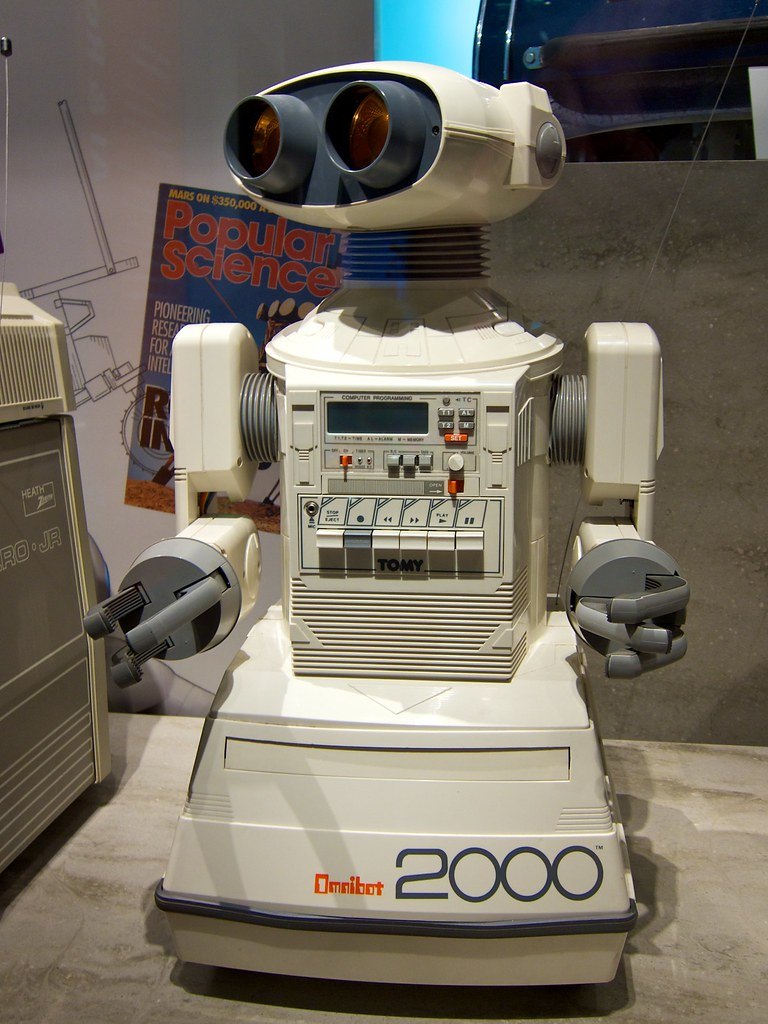
| Omnibot | Tomy | 1984 | about $250 | Toy: remote control and cassette-recorded sequences, no sensors |
| Gemini | Arctec Systems | 1985 | not given | Kit or assembled; built-in text-to-speech |
Sources: RB5X, Robotics Age, January 1984, “RB5X Enhancements” and the dealer list in Robotics Age, May 1985; Topo, Androbot advertisement, Robotics Age, January 1984, pp. 26–27; Hubot, Robotics Age, April 1984; Omnibot, Cote, editorial, Robotics Age, August 1984, pp. 6–7; Gemini, Robotics Age, May 1985.
Three things set Heath apart from this field. First, Heath already had a national retail chain of Heathkit Electronic Centers, a mail-order list of long standing, and a school business that sold courses and trainers to community colleges and the military. Second, the robot was documented to Heath’s standard. Helmers wrote that Heath’s “well deserved reputation for exhaustive and complete documentation” made him confident about the manuals he had only seen in proof. Third, HERO 1 did not depend on a host computer. Topo, the best-known rival, was essentially a motorised peripheral for an Apple II. HERO 1 carried its own computer, sensors and power, which made it the more serious machine for teaching and the more interesting one for hobbyists.
The boom was short. In Robotics Age, the trade magazine of the movement, the personal robots fill the news and advertising pages of 1984, and then thin out. In a count of the scanned text, its 1984 issues name HERO between about seven and seventy times each; its 1986 issues name it once to three times. Heath’s line nonetheless stayed in the catalogues until 1988 and was supported into the mid-1990s. The difference was the classroom: schools and colleges went on buying robots that came with a curriculum.
1.6 The line at a glance
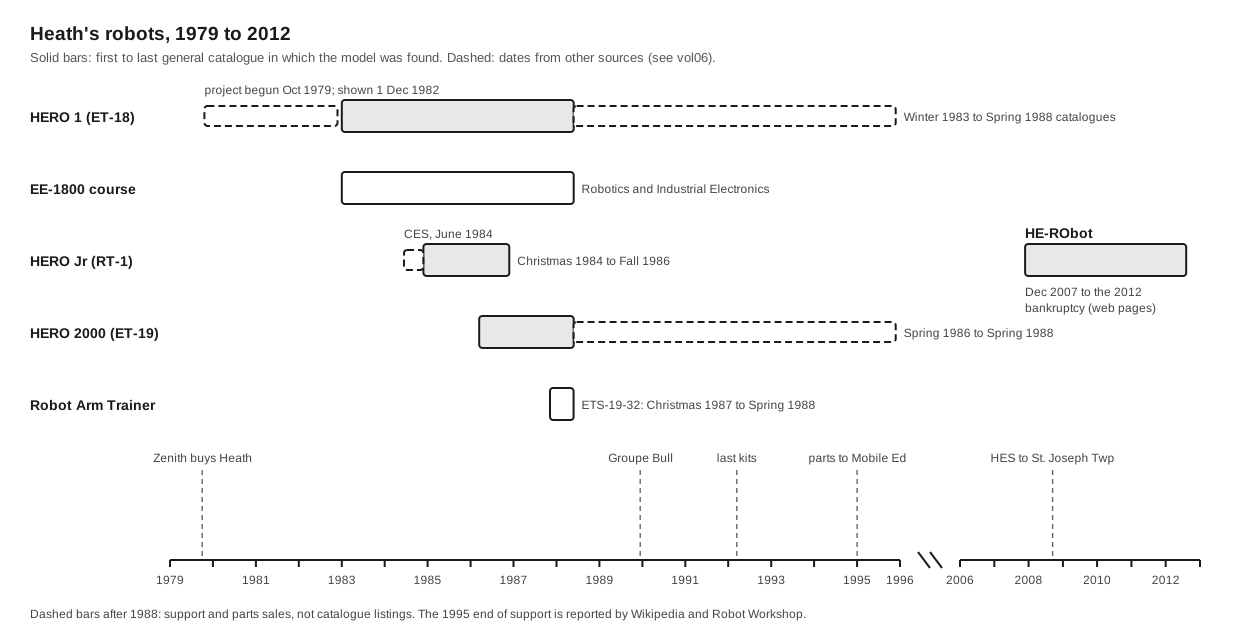
The timeline below summarises the whole story that the following volumes tell. HERO 1 appeared in the Winter 1983 catalogue and HERO Jr at Christmas 1984. HERO 2000 appeared in Spring 1986 and the Robot Arm Trainer at Christmas 1987. The last scanned general catalogue with any of them is Spring 1988. Parts and support passed to a dealer in 1995. The name returned in December 2007 on the HE-RObot, a badge-engineered PC robot sold by Heathkit Educational Systems until the company’s 2012 bankruptcy.
The remaining volumes follow the line in order:
- HERO 1 in the catalogue and the classroom: the prices, the accessories and the robotics courses, 1983–1988.
- HERO Jr and HERO 2000: the consumer robot and the automation trainer.
- The end of the line: how the robots left the catalogue, and the HE-RObot revival.
- Collecting and community: the robots today.
- Reference: the complete model table, manuals and sources.
Sources
- Heathkit catalogues, World Radio History: No. 860, Winter 1983; No. 859, Christmas 1982; No. 865, Spring 1984.
- Leininger, Steven. “Heath’s HERO-1 Robot.” BYTE vol. 8 no. 1, January 1983, pp. 86–96. Internet Archive
- Helmers, Carl. “Ein Heldenleben (Or, A Hero’s Life).” Editorial, Robotics Age, March/April 1983, pp. 7–12; Heathkit advertisement, p. 5. Internet Archive
- Johnson, Ron. “Part of the Beginning” (IPRC ‘84 report), and Cote, Raymond G. A., “June Travelogue” (editorial). Robotics Age, August 1984. Internet Archive
- Robotics Age, January 1984, April 1984, May 1985, for competitors’ prices.
- TODAY. “Personal Robot Called HERO 1 Stops by TODAY in 1982” (aired 1 December 1982). YouTube
- Brueschke, Erich E., and Michael Mack. “The History of the Heath Companies and Heathkits: 1909 to 2019.” AWA Review 32 (2019). Internet Archive
- Wikipedia, “HERO (robot)”, for the project start date and bibliography only.
- VintageComputer.ca, “Heathkit Hero 1 (ET-18) Robot”.
Comments (0)