Robots · Volume 4
The End of the Line
No Heath catalogue announced the end of the robots. They were not withdrawn in a single season. The consumer robot went first, the price cuts came next, and then the robots were simply absent from the next catalogue that survives. This volume traces that ending through the catalogues, which is where it can be dated, and sets it against what was happening to Heath at the time. It then follows the parts, the rights and the name into the 1990s and 2000s. The story ends with the HE-RObot of 2007, a robot that carried the HERO name and had nothing else in common with the originals.
The company’s own ending is told in the history dive: Zenith, Bull and the end of the kits and After the kits. It is summarised here only where it bears on the robots.
4.1 Robots as trainers, 1987
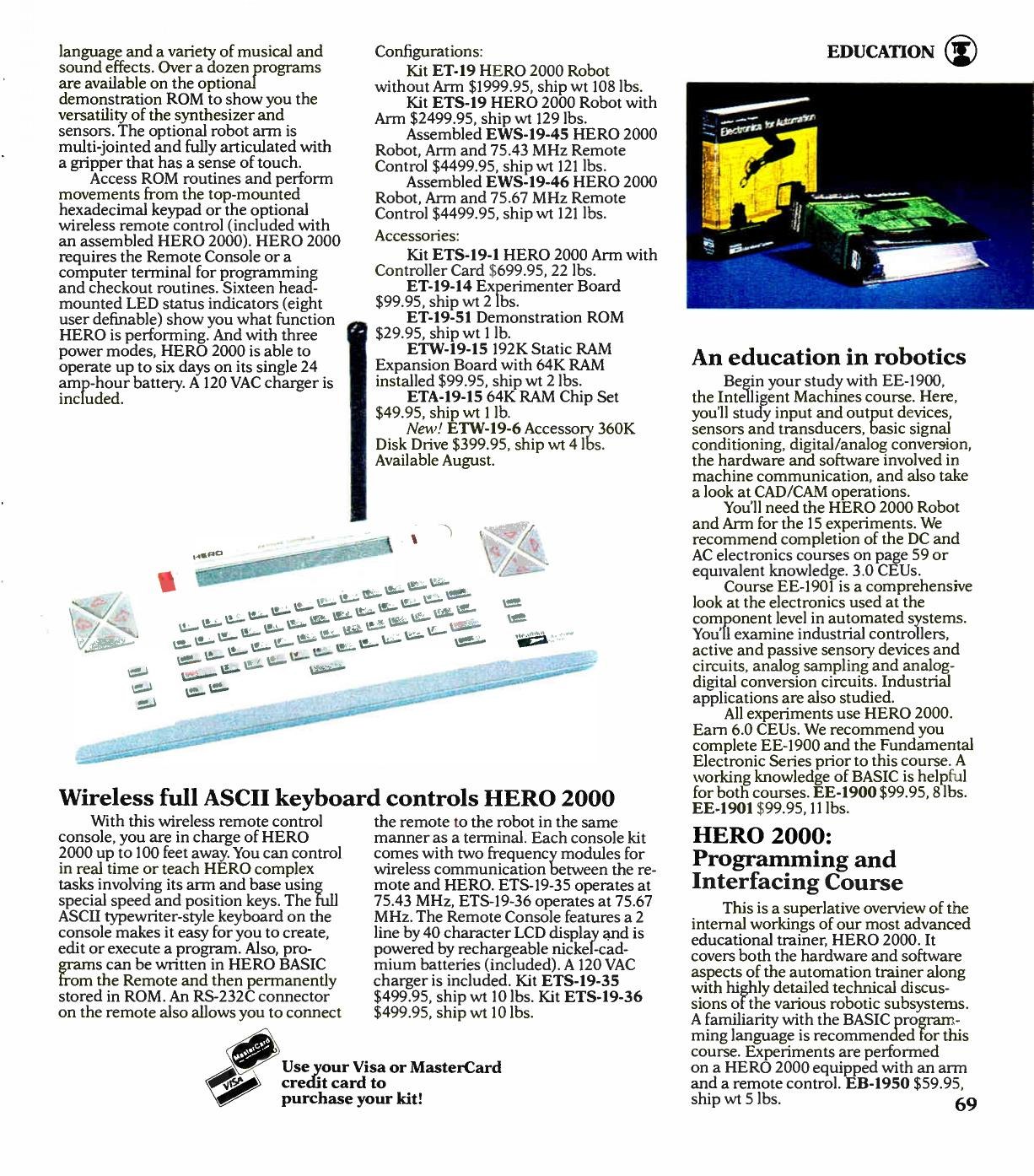
By Fall 1987 the robots had been moved. HERO Jr was gone. HERO 1 and HERO 2000 appeared only in the Education section, under a heading that described them purely as training equipment: “Prepare for the advanced world of robotics with Heath’s HERO 2000 and HERO 1.” The copy no longer mentioned guarding the house or entertaining the family. The robots were “robotic trainers” that would give the student “practical knowledge of the robotic systems used in modern manufacturing,” and a way to understand “the mechanical operation and electronic control systems that give today’s industrial and domestic robots their capabilities — and their limitations” (Heathkit catalogue, Fall 1987, p. 68).
The phrase “and their limitations” is revealing. It had first appeared in the Robot Applications course description of 1984. By 1987 the whole field had learned it. The personal-robot boom described in Origins was over. Its trade magazine had already signalled the turn in May 1985. Answering a reader who feared that personal robots were being “phased out,” Robotics Age replied that it “will indeed be giving more attention to industrial robotics than it has in the past,” while insisting that this was “an expansion of interest and not a turning away from personal robotics” (Robotics Age, May 1985, p. 21). By 1986 the magazine named HERO only once or twice an issue. In education, however, the robots still had a place. The Christmas 1987 catalogue added the Robot Arm Trainer and a HERO 2000 system price. It still carried the full HERO 1 accessory list and the $1,374.70 EES-1800 training bundle (Christmas 1987, pp. 80–83).
4.2 The last catalogue, Spring 1988
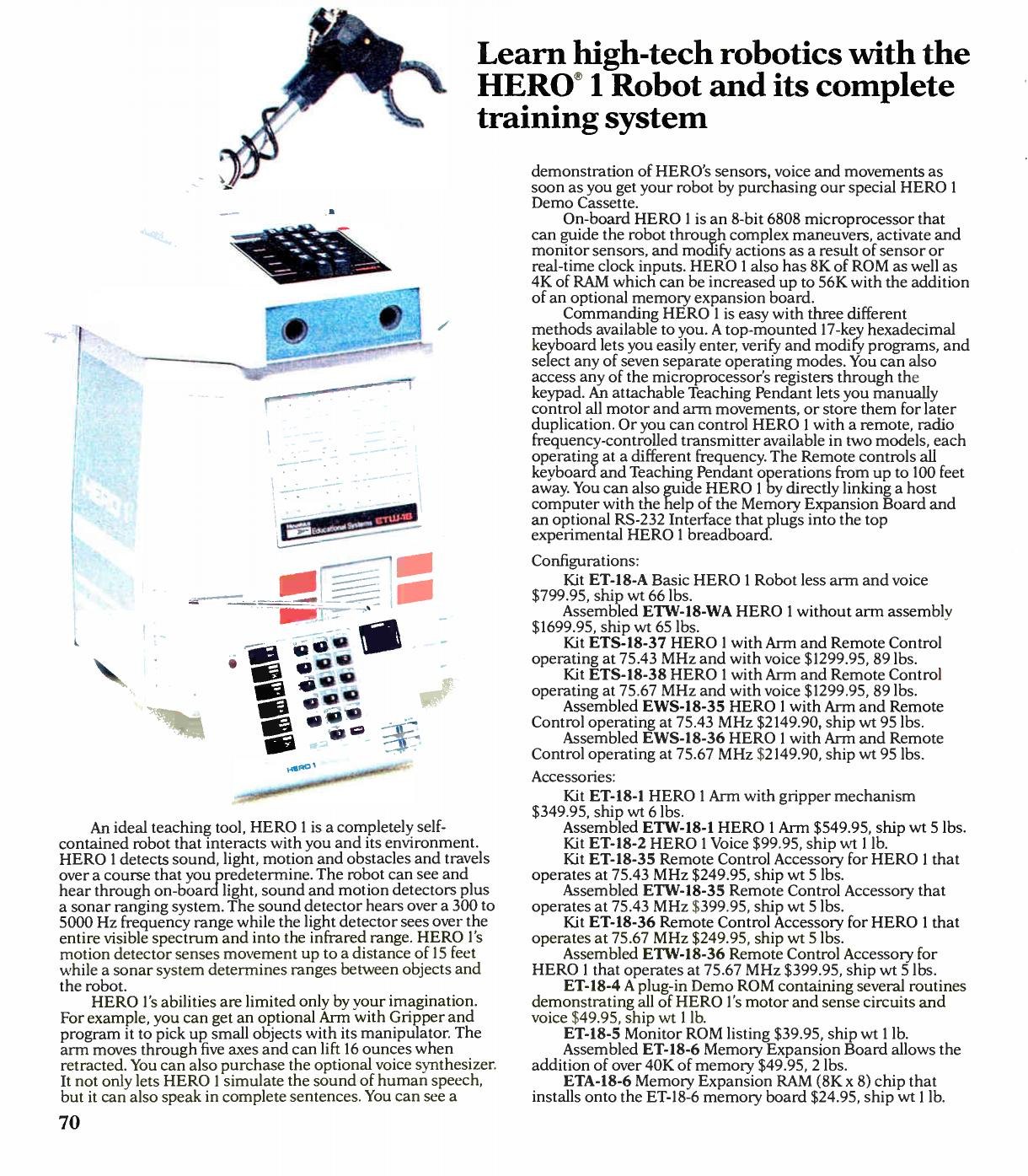
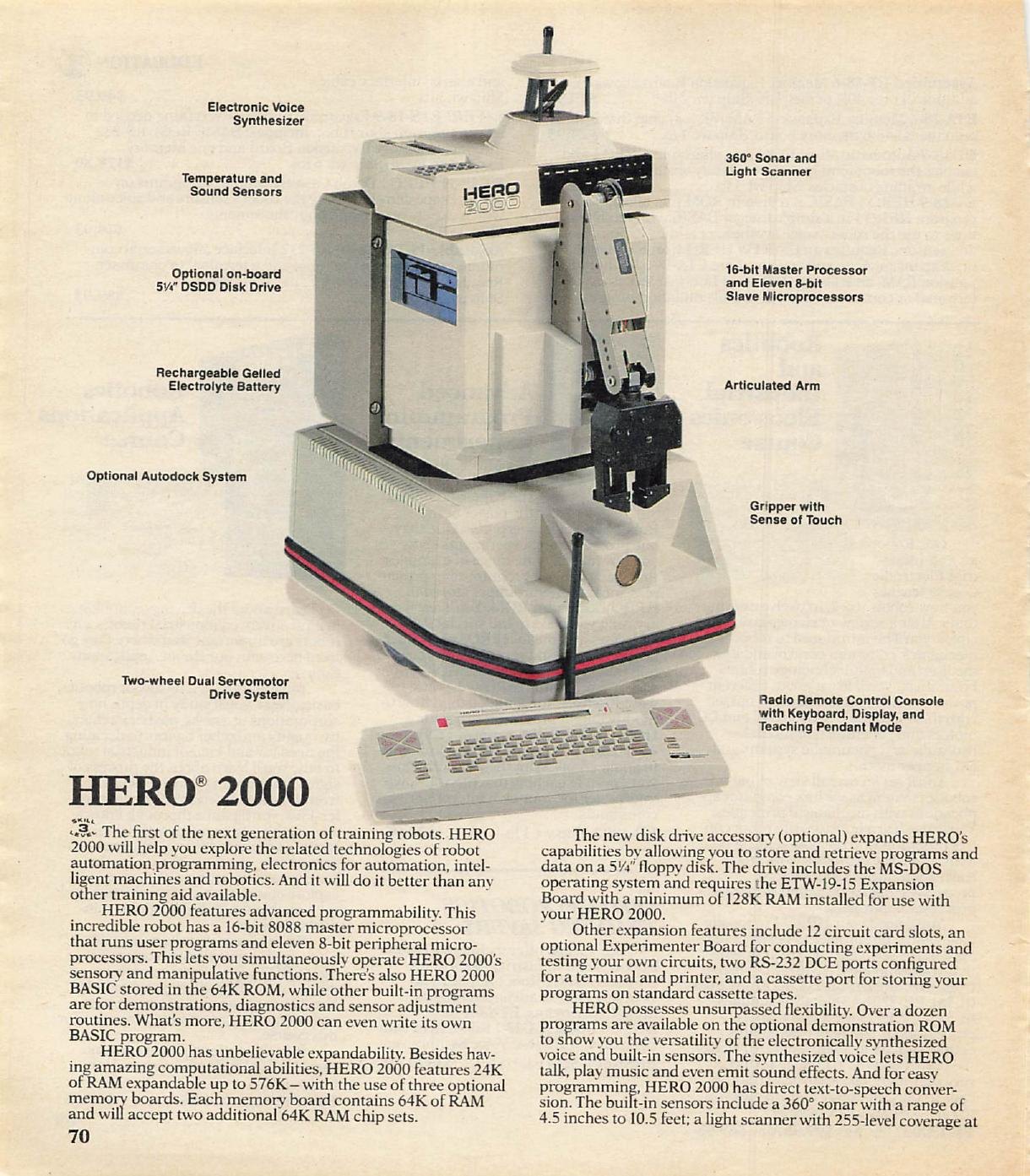
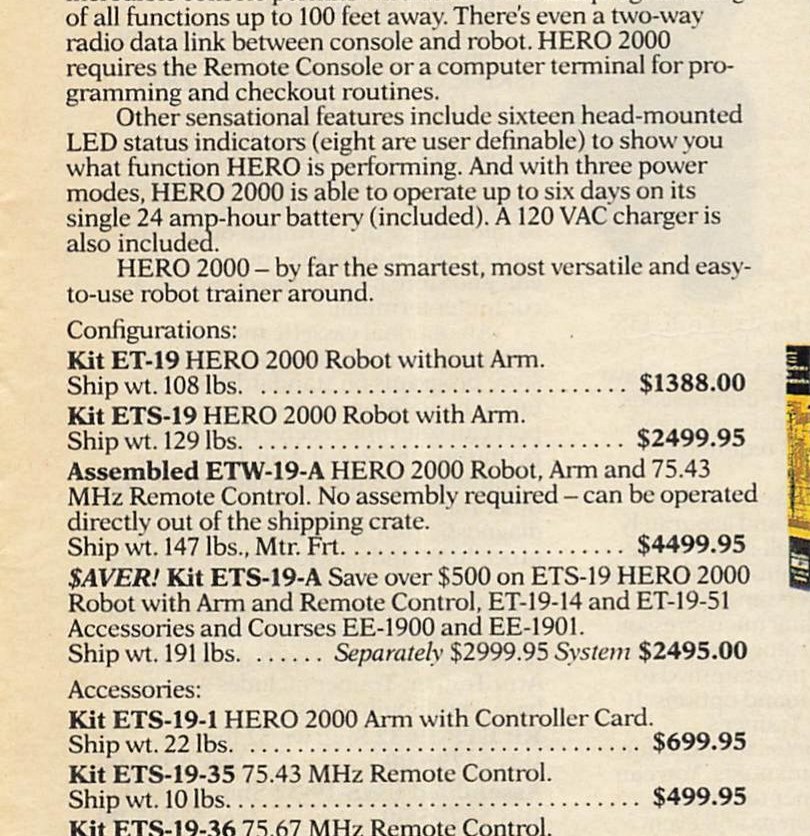
The last general Heathkit catalogue found with the robots is Spring 1988, No. 211. Its scan has no text layer, and the robot pages (pp. 68–72) were read by OCR for this dive. The pages look like a line being cleared:
- The HERO 2000 kit without arm was cut from $1,999.95 to $1,388.00. A new system package with arm, remote, accessories and both courses was “Separately $2999.95 System $2495.00”, and a $99.95 robot carrying cart appeared.
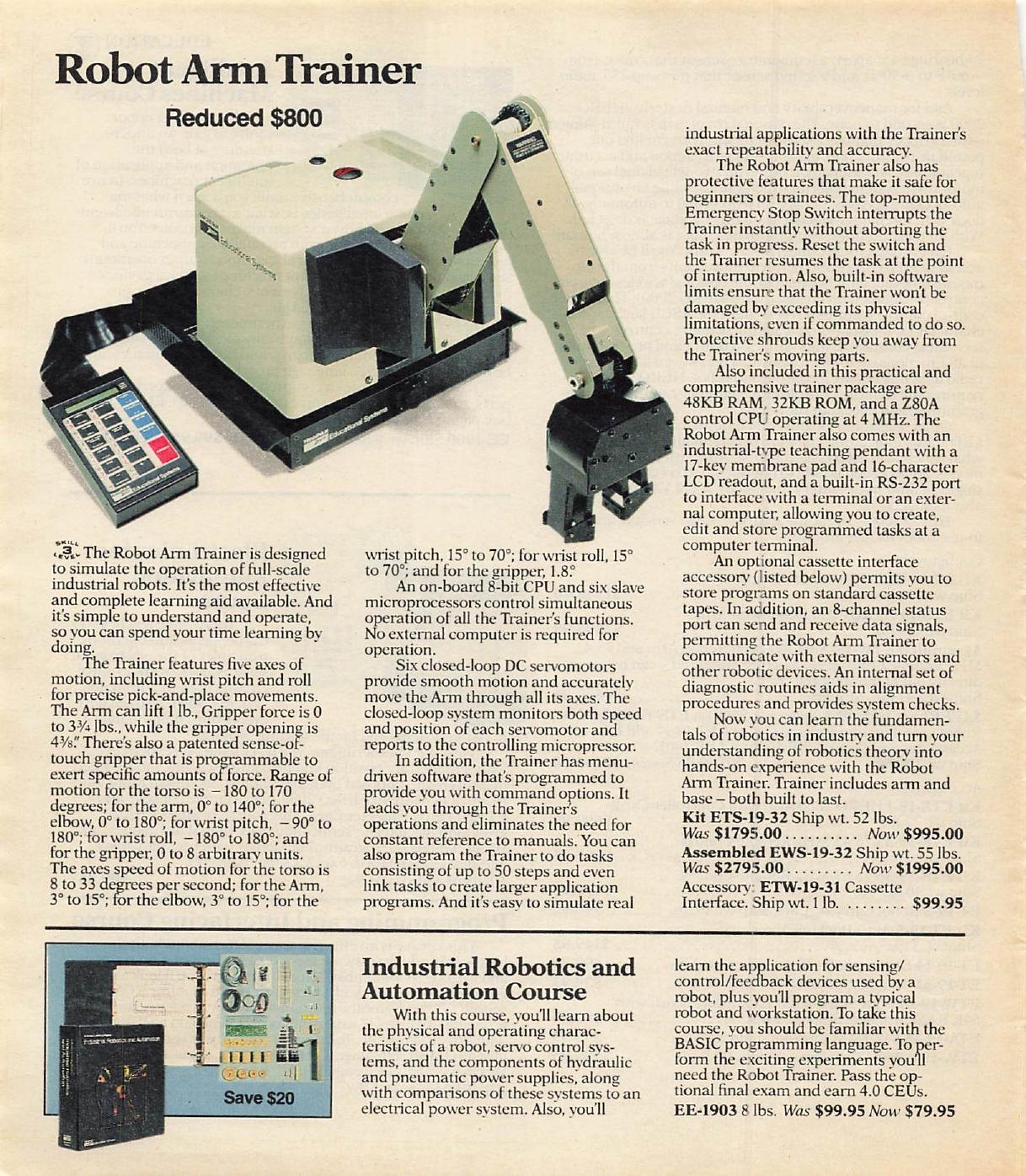
- The Robot Arm Trainer, introduced only the previous Christmas, was “Reduced $800”: $995.00 for the kit (was $1,795.00) and $1,995.00 assembled (was $2,795.00). Its EE-1903 course was cut from $99.95 to $79.95.
- The HERO 1 assembled without arm was “Was $1699.95 Now $1499.95”, and the assembled robot with arm and remote dropped to $1,995.00.
Source: Heathkit catalogue No. 211, Spring 1988, pp. 68–72.
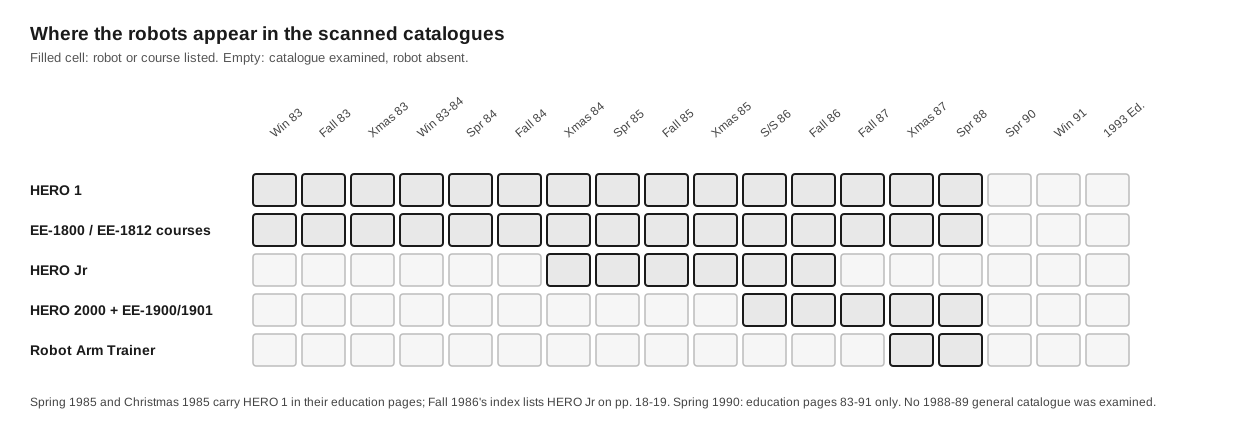
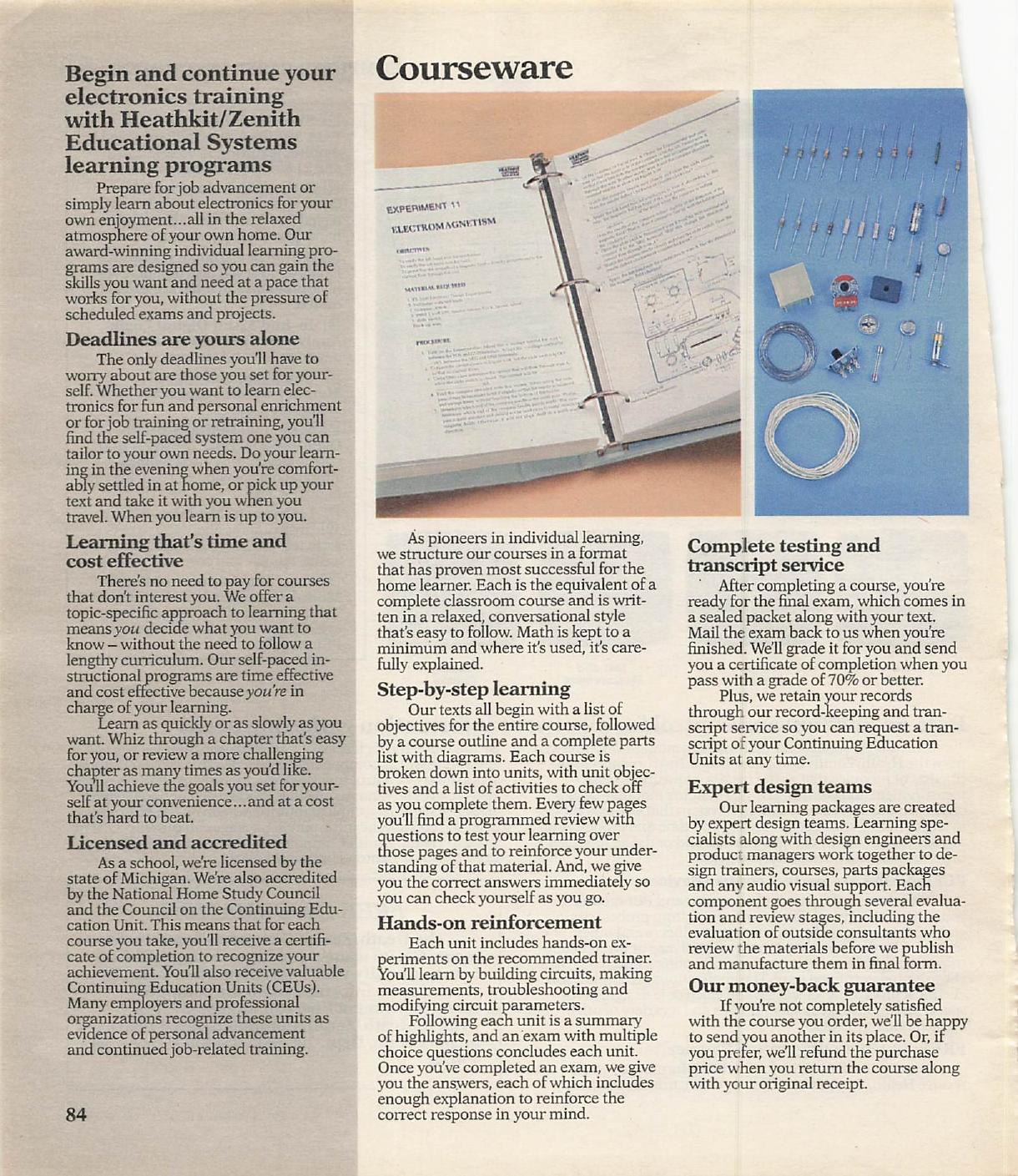
No general catalogue from later in 1988 or from 1989 was examined for this dive; World Radio History’s index lists none. The next one checked, Spring 1990, has an education section beginning on p. 84. It offers Heathkit/Zenith Educational Systems’ self-study courses, “licensed by the state of Michigan” and accredited by the National Home Study Council, but no robots (Heathkit catalogue, Spring 1990, pp. 84–91). Winter 1991 has no HERO at all. Its only robotics is the subject matter of a CAD/CAM course and an artificial-intelligence course (Winter 1991, No. 223). The separate 1993 Heathkit/Zenith Educational Systems catalogue, No. 279, was also checked, by OCR of all 64 pages. It has no robot trainer either. Robots appear only as a course objective in its microprocessor-applications course: “List the three major sections of an intelligent robot” (1993 Education catalogue).
So the robots leave the catalogues found here between Spring 1988 and Spring 1990. Heath may have gone on selling them to schools through its educational sales force after they left the consumer catalogue; no educational price list from 1988–1990 was found to show it.
4.3 Why the line ended
No Heath statement explaining the decision has been found: no press release, no president’s letter, and no interview with a robot engineer. The explanation has to be put together from the circumstances, and it should be read as such.
The market had moved. The personal-robot boom of 1983–84 was short. HERO Jr, the attempt to sell a robot to households, lasted two years in the catalogue and ended at half its launch price. The educational market was steadier, but it was changing. The HERO 2000 courses already speak of “intelligent machines,” CAD/CAM and flexible manufacturing. By 1990 Heath was teaching those subjects from textbooks and software, and by 1991 from AutoCAD exercises on floppy disks, not from a robot on the classroom floor.
The robots were expensive to make and support. An assembled HERO 2000 at $4,499.95, a 147-pound motor-freight shipment, was a costly item for a mail-order company to stock and service. So was the HERO 1, whose basic kit had not changed price since 1984. The 1988 reductions look like an attempt to clear stock rather than a new pricing strategy.
Heath itself was changing hands. Zenith had bought Heath in 1979 for its computers. By the late 1980s the Heath Company was a small part of Zenith Data Systems. In late 1989 Groupe Bull bought ZDS, and with it Heath and Heathkit/Zenith Educational Systems. The kit business ended in 1992; the history dive dates the last kits to March 1992 (Zenith, Bull and the end of the kits). A robot line that had been developed under Schlumberger and launched under Zenith had no obvious sponsor under Bull.
The education business survived by changing form. Heathkit/Zenith Educational Systems outlived the kits. It became Heathkit Educational Systems and, after several changes of owner, was still selling courses in 2012 (After the kits). Its product was courseware with small trainers, the direct descendant of EE-1800 without the robot.
4.4 Parts, rights and support, 1988–2002
Two sources give the end date of support. Wikipedia states that Heathkit supported the HERO robots until 1995 (Wikipedia, “HERO (robot)”). Robot Workshop, the business that holds the remaining stock today, gives the sequence behind that date: in 1995 Heathkit sold its remaining HERO inventory to Mobile Ed Productions, and in 2002 Robot Workshop “purchased all remaining parts and rights” from Mobile Ed. It describes original parts, prototype parts, test fixtures and circuit boards with date codes among the stock (Robot Workshop, “HERO Robots”). Neither account says what “support” meant in the early 1990s. It probably meant parts and technical assistance for schools that still used the trainers. What happened to the tooling after 1995 is not documented, beyond Robot Workshop’s remark that it is making reproduction parts because the original tooling was destroyed.
4.5 The HE-RObot, 2007–2012
The name came back two decades later, on a robot from a different world. In December 2007 Heathkit Company Inc. added a new page to heathkit.com under the heading “HE-ROBOT™.” Heathkit Company Inc. was then the educational business, trading as Heathkit Educational Systems. The page promised a robot for students and teachers who “want to write custom algorithms for artifical [sic] intelligence or just want an entertaining learning tool.” It said that the robot “utilizes industry standard PC hardware and software” and “can talk, see, hear, transmit, receive and process data, or if you like, just play a CD” (heathkit.com, archived 21 December 2007).
The site’s HTML demonstration pages of 2008 list the components: “industry standard PC hardware and software components, 80GB hard drive, Mini-ITX mainboard with Intel Core Duo Processor, Window[s] XP Professional,” host-computer or web-server capability, manual navigation by mouse, keyboard or joystick, a Logitech webcam, a CD-ROM/CD-RW drive, a “USB Machine Management Module,” LED headlights, infrared sensors and speakers (heathkit.com, “Inside”, archived 11 October 2008). The software page names the control program, “BRAIN,” with speech recognition, motion detection, remote control, navigation and a scripting language. It also offers development in Microsoft .NET languages with Microsoft Robotics Studio, “or, use Linux and Player/Stage” (heathkit.com, “Software”, archived 11 October 2008).
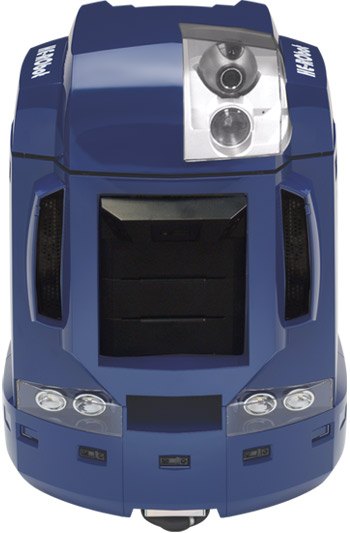
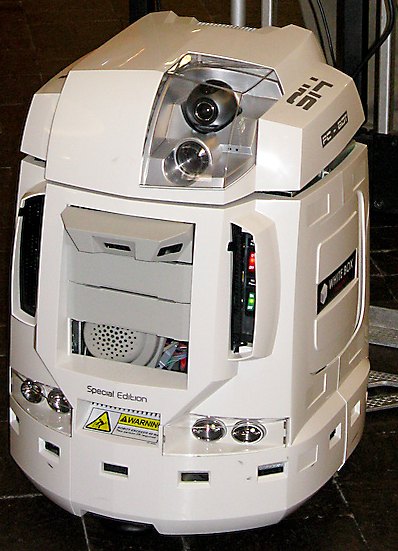
The announcement reached the technology press over Christmas 2007. Slashdot’s item, “Heathkit Reincarnates the Hero Robot,” gave the robot as 21 inches tall and 55 pounds (Slashdot, 25 December 2007). Make’s blog pointed out that it was not a Heath design. It was built on White Box Robotics’ 914 PC-BOT and “being built and priced towards the educational market,” and the PC-BOT itself sold for $5,000 to $8,000 (Collin Cunningham, “Heathkit HERO”, Make:, 28 February 2008).
White Box Robotics was founded in 2000 by Thomas Burick. Its 914 PC-BOT, released in December 2006, was a general-purpose service robot built around standard PC parts. Wikipedia describes the HE-RObot as a badge-engineered version of it, sold under a partnership between Heathkit and White Box Robotics (Wikipedia, “White Box Robotics”). The same encyclopedia says the HE-RObot cost up to $8,000 and that Heathkit sold about 50 before its bankruptcy in 2012 (Wikipedia, “HERO (robot)”). Neither figure was traced to a primary source. The 2012 bankruptcy is documented in the company history.
The HE-RObot was HERO in name and in purpose, an educational robot sold to schools by the Heath education business. In every other way it was the reverse of the original idea. HERO 1 had been a kit that a student built, with a documented 8-bit computer whose every register could be examined from a keypad on its head. The HE-RObot came assembled. It was a Windows PC on wheels, programmed through Microsoft’s robotics toolkit, and its internals were those of any small desktop computer. Readers of the Slashdot item made the same point in 2007. One recalled building a HERO Jr in 1985, and another observed that the kit and the learning had been the point.
Sources
- Heathkit catalogues, World Radio History: Fall 1987; Christmas 1987; Spring 1988, No. 211; Spring 1990; Winter 1991, No. 223; Heathkit/Zenith Educational Systems, 1993, No. 279.
- heathkit.com, archived by the Internet Archive: HE-RObot page, 21 December 2007; “Inside”, 11 October 2008; “Outside”, 11 October 2008; “Software”, 11 October 2008.
- “Heathkit Reincarnates the Hero Robot”, Slashdot, 25 December 2007.
- Cunningham, Collin. “Heathkit HERO”, Make:, 28 February 2008.
- Robot Workshop, “HERO Robots”.
- Wikipedia: “HERO (robot)”; “White Box Robotics”.
- The site history dive: vol. 6 and vol. 7.
Comments (0)