Robots · Volume 3
HERO Jr and HERO 2000
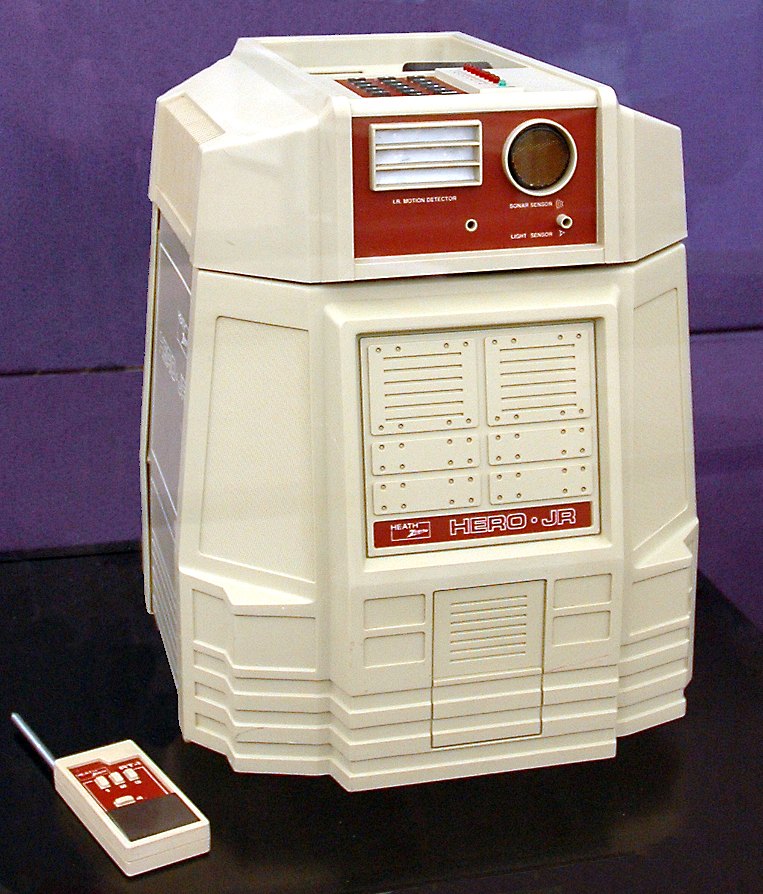
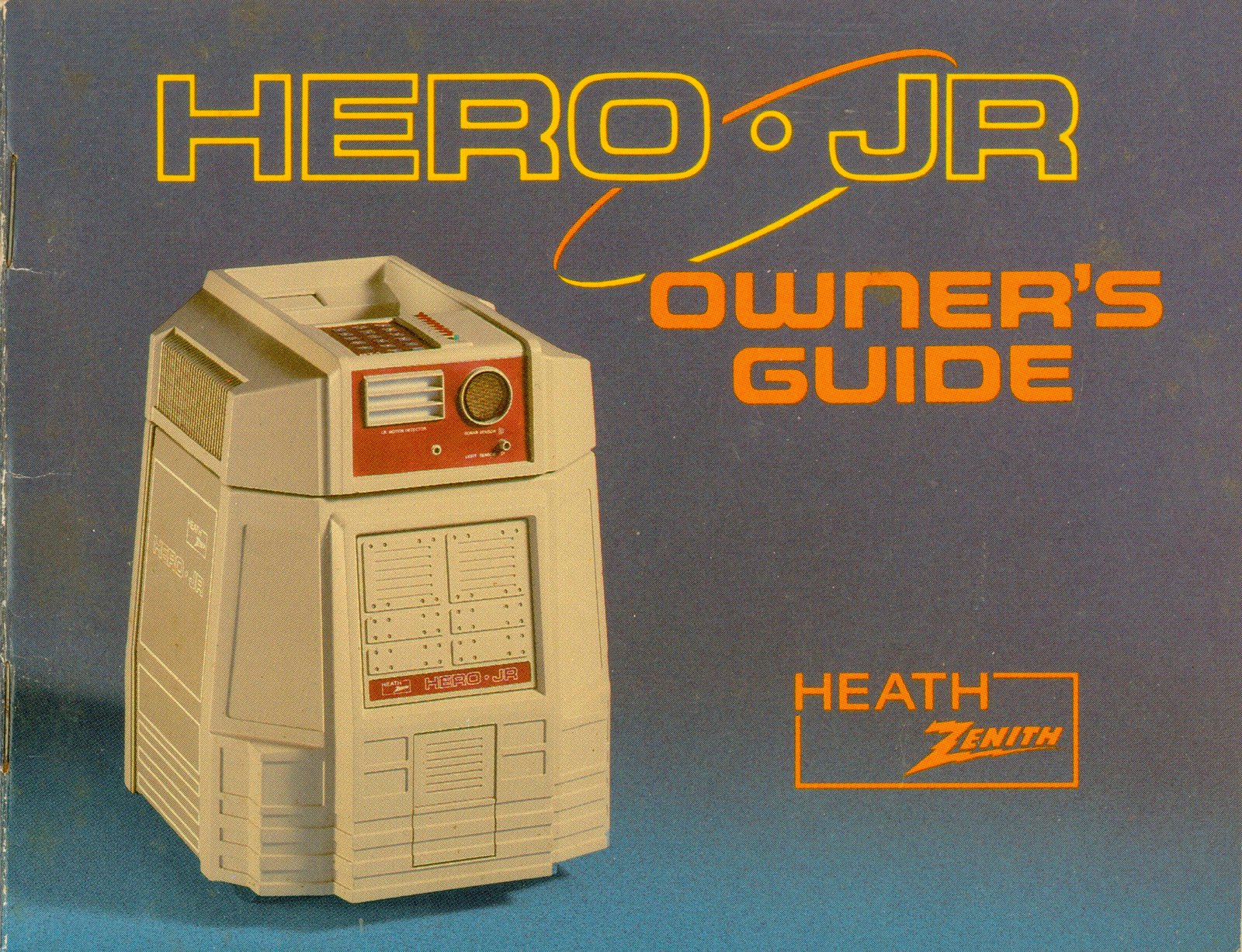
Heath followed HERO 1 with two robots that went in opposite directions. HERO Jr, shown in June 1984, was a cheaper, simpler robot for the home. It came from Heath’s consumer division, not the educational one, and it was meant to be switched on and enjoyed, not programmed. HERO 2000, launched in the spring of 1986, was a large and expensive automation trainer for schools and industry, with a 16-bit master processor and a set of slave processors. Around the second robot Heath built a new set of courses and, at the end of 1987, a stand-alone Robot Arm Trainer. This volume follows both robots through the catalogues. Their engineering is documented in the HERO Jr dive and the HERO 2000 dive on the Robots site.
3.1 HERO Jr: a robot for the living room
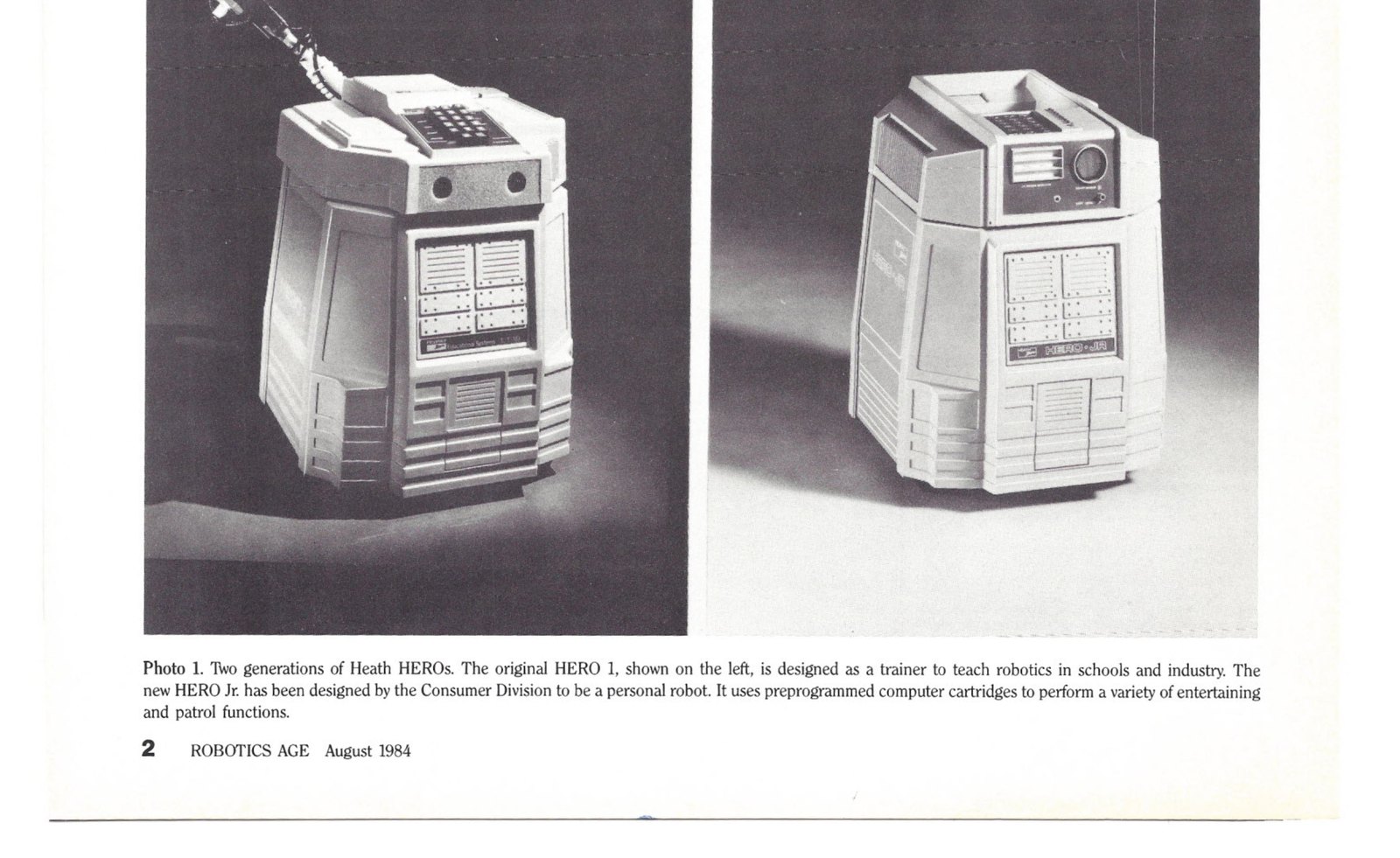
HERO Jr was introduced at the Consumer Electronics Show in the first week of June 1984. Robotics Age’s editor, Raymond Cote, covered it in his editorial for August under the heading “Hello Jr.” He reported that Heath billed it as “the first affordable, personal robot with a dynamic personality,” a companion that “requires no programming skills to operate.” More striking than the robot was the route to market. “In a break from all past Heath policies,” Cote wrote, “the HERO Jr. is being marketed through ‘high-tech department stores and retailers that sell computer games and software.’” Heath’s literature described the target buyer as “general consumers, especially electronics and computer game enthusiasts and the type of consumer who buys a satellite receiver, a VCR with Hi-Fi, and compact disk audio” (Cote, “June Travelogue”, Robotics Age, August 1984, pp. 1–7).
Cote was sceptical about the price. “As a consumer toy, the Jr.’s $1000 price tag seems expensive.” He compared the robots: “When people ask what the HERO 1 does, the answer is simple: the HERO 1 teaches. I’m not so sure about the Jr.” He also noted that the new robot had been designed by “the Heath Consumer division and not the Educational division that produced the HERO 1.”
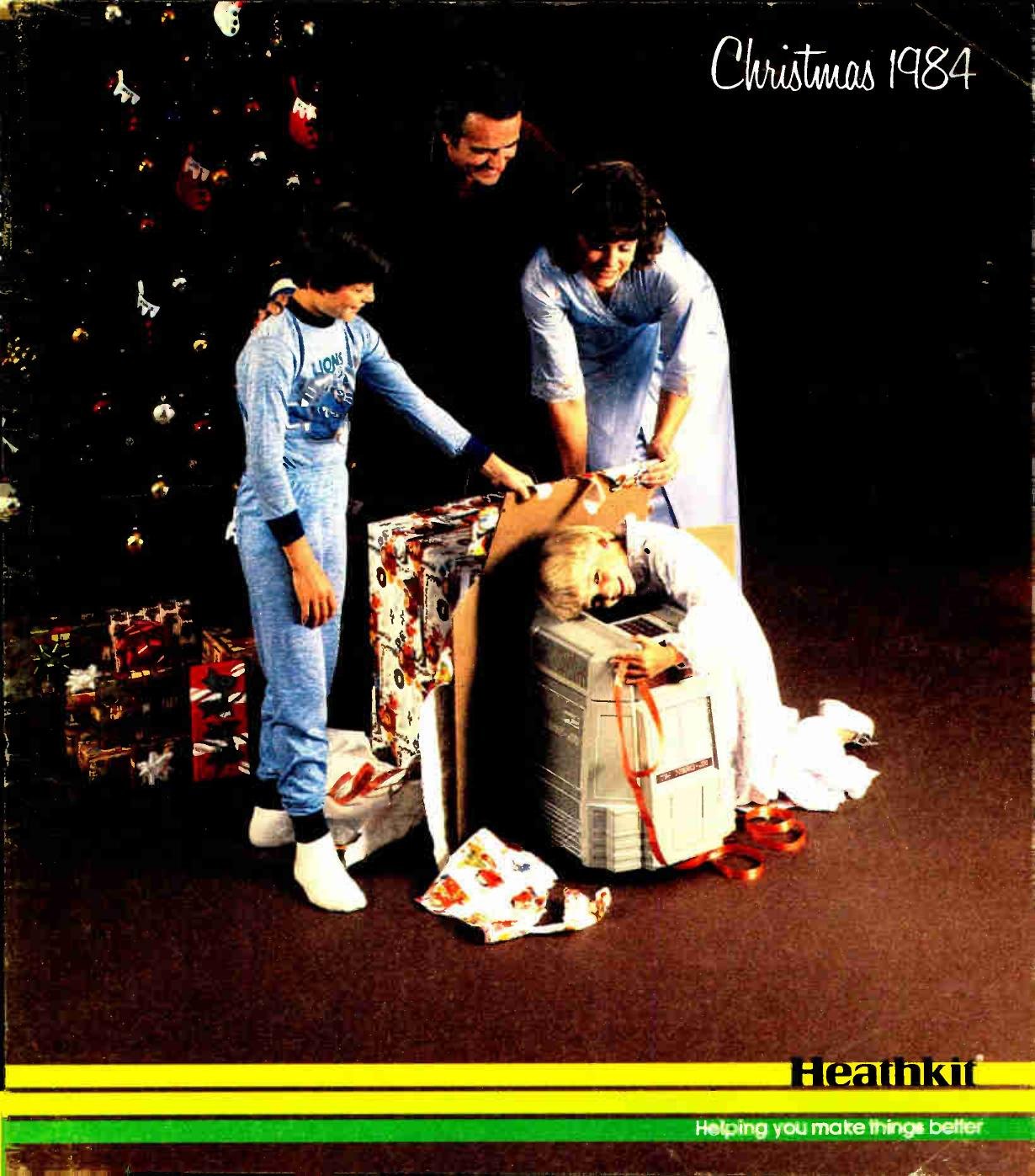
The $1,000 figure appears to be the assembled retail price discussed at the show. In Heath’s own mail-order catalogue, HERO Jr arrived at Christmas 1984 as a kit, RT-1, at $599.95, “Low kit price … with voice.” The catalogue gave it the inside front cover, a two-page lifestyle spread, and the family photograph on the cover (Heathkit catalogue, Christmas 1984, pp. 2–3).
3.1.1 What it did
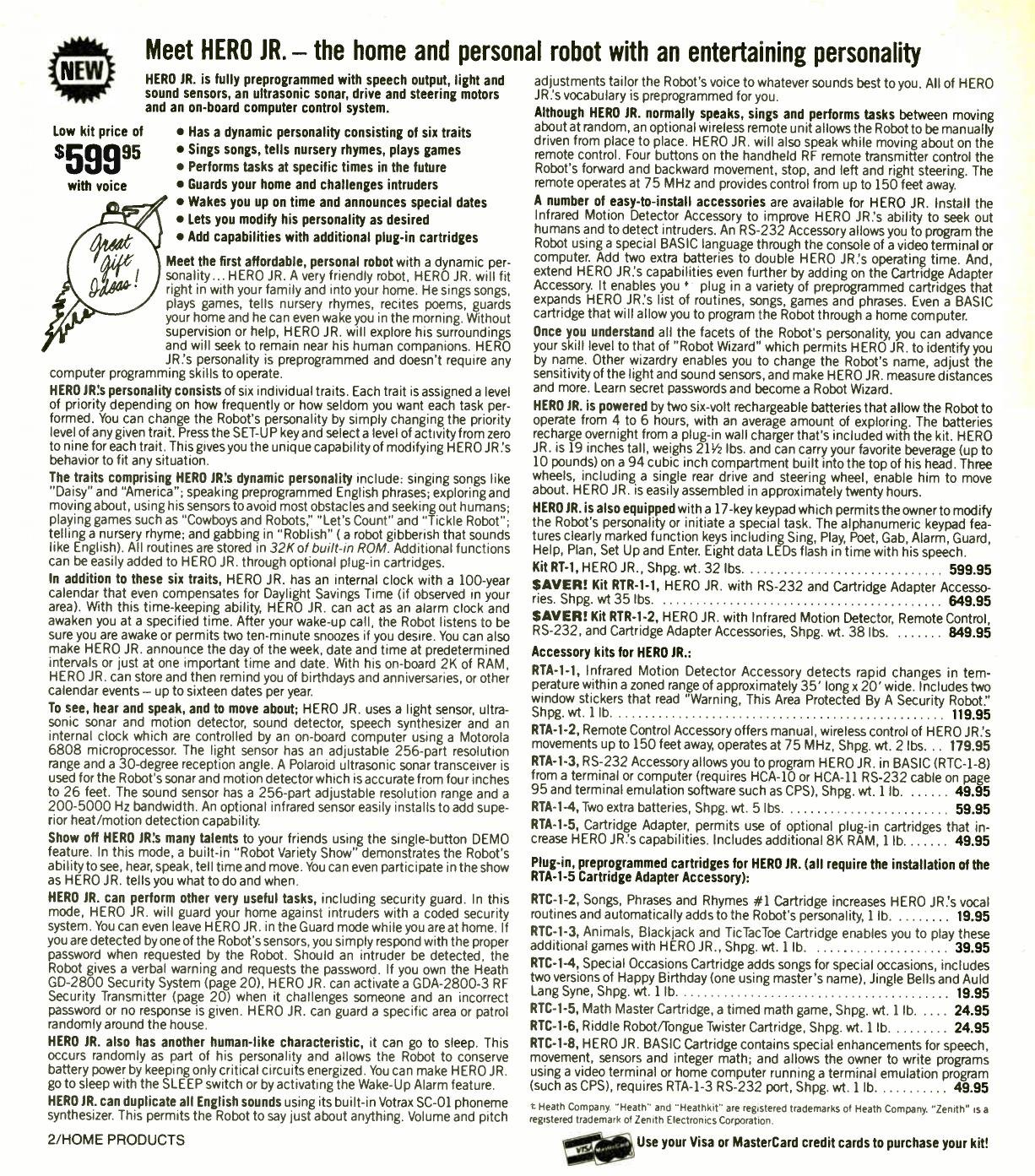
HERO Jr kept the HERO 1’s Motorola 6808, its Polaroid-style ultrasonic sonar, and its light and sound sensors. It dropped the arm, the rotating head and the machine-code keypad. In their place it had personality. The catalogue describes six traits, each with a priority the owner could set from zero to nine with the SET-UP key:
- singing songs such as “Daisy” and “America”;
- speaking preprogrammed English phrases;
- exploring, avoiding obstacles and “seeking out humans”;
- playing games such as “Cowboys and Robots”, “Let’s Count” and “Tickle Robot”;
- telling a nursery rhyme;
- “gabbing in ‘Roblish’ (a robot gibberish that sounds like English)”.
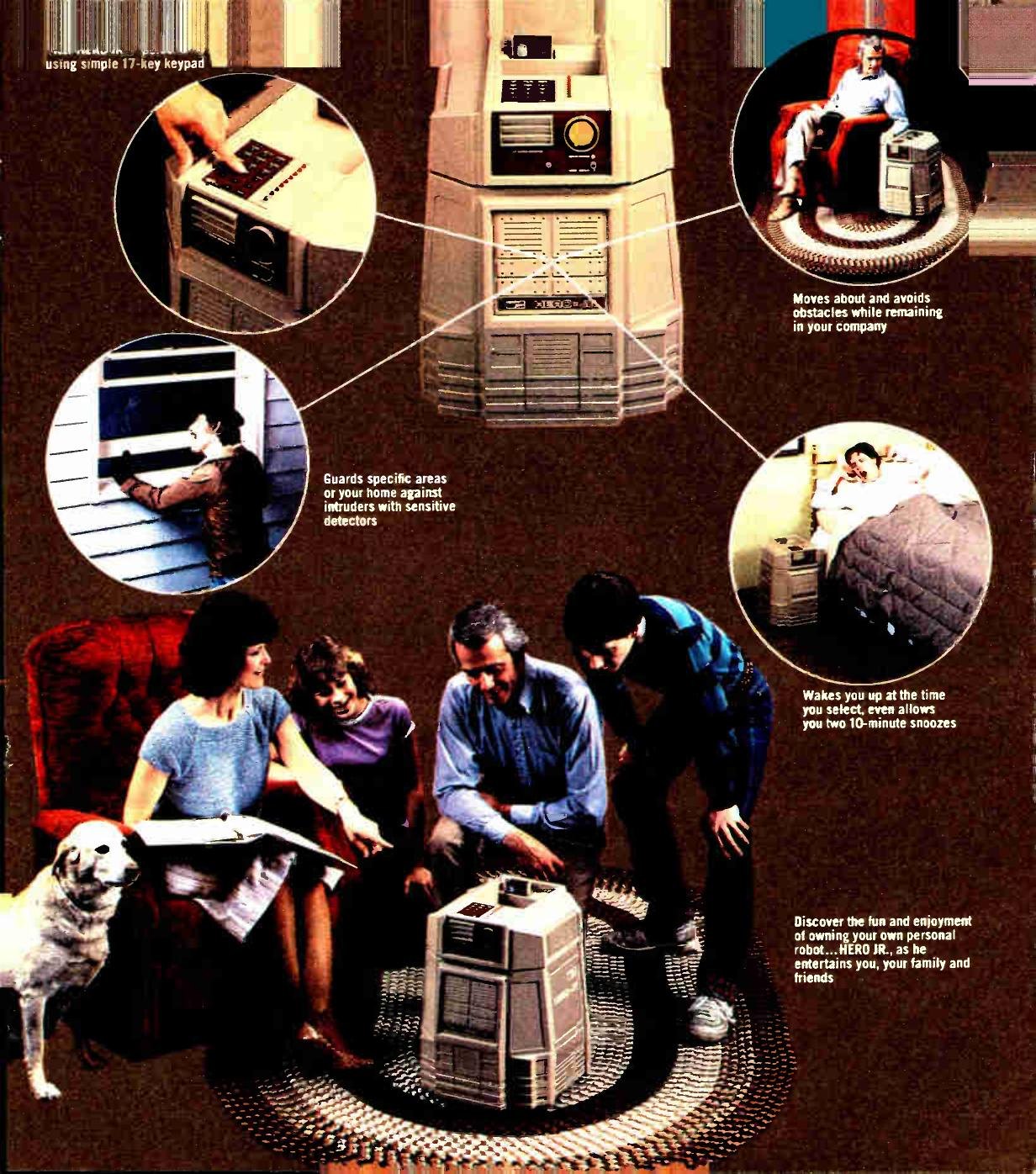
All of this lived in 32K of ROM. The robot also had a clock with a 100-year calendar that could wake its owner, allow “two ten-minute snoozes”, and remember sixteen birthdays or anniversaries a year in its 2K of RAM. A Guard mode challenged anyone its sensors detected and asked for a password. If the answer was wrong it could trigger Heath’s GD-2800 wireless security system through a GDA-2800-3 transmitter. The keypad’s labelled keys were Sing, Play, Poet, Gab, Alarm, Guard, Help, Plan, Set Up and Enter, and “eight data LEDs flash in time with his speech.” An owner who learned “secret passwords” could become a “Robot Wizard,” change the robot’s name and adjust its sensors. It stood 19 inches tall, weighed 21½ pounds, could carry a drink of up to 10 pounds in a 94-cubic-inch compartment in its head, and was “easily assembled in approximately twenty hours” (Christmas 1984, p. 2).
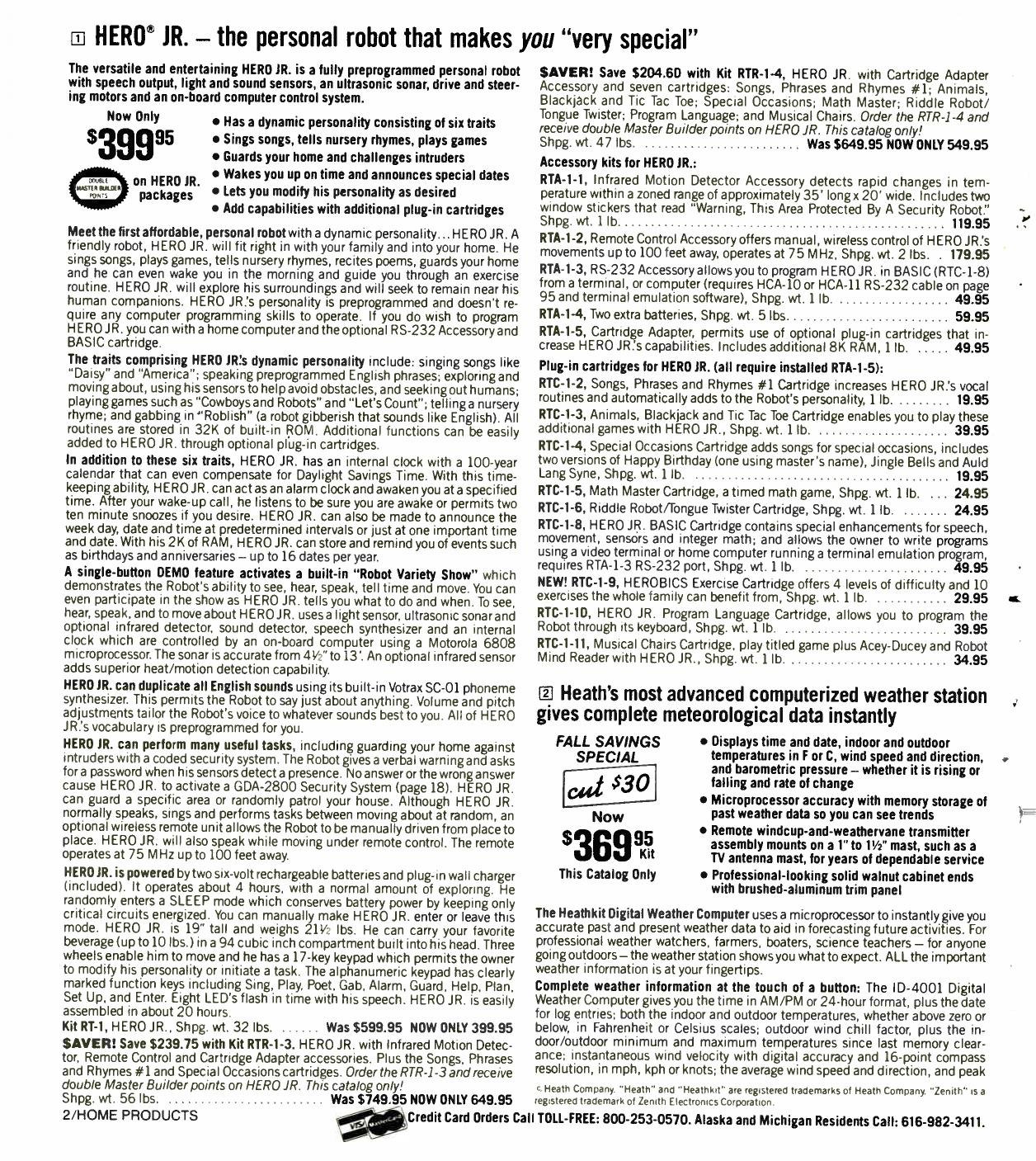
Two details of the specification changed between catalogues. The sonar range was given as “four inches to 26 feet” in Christmas 1984 and “4½” to 13’” in Fall 1985. The operating time was “from 4 to 6 hours” in 1984 and “about 4 hours” in 1985 (Fall 1985, p. 2). The later figures are the more conservative.
Robotics Age noted two engineering changes from HERO 1, both answers to known faults. The drive-and-steer wheel had moved from the front to the back, pushing two idler wheels. Anyone who had worked with HERO 1, Cote wrote, “has discovered that the front wheel is difficult to keep straight.” The wheel-rotation counter had moved from the drive wheel to an idler, so that the robot could tell when its drive wheel was spinning on a slippery floor. The electronics were on a single board, with an RS-232 port option and a ROM-pack slot for “game-type programming modules.” Cote regretted that there was no bus opening for third-party hardware of the kind that HERO 1 had attracted.
3.1.2 Accessories and cartridges
HERO Jr was designed to be extended with cartridges, the way a video-game console was. The accessories listed at launch:
Table 1 — HERO Jr was designed to be extended with cartridges, the way a video-game console was. The accessories listed at launch
| Model | Accessory | Christmas 1984 price |
|---|---|---|
| RTA-1-1 | Infrared motion detector, “approximately 35’ long x 20’ wide”, with two “Protected By A Security Robot” window stickers | $119.95 |
| RTA-1-2 | Remote control, 75 MHz, “up to 150 feet” (100 feet in 1985) | $179.95 |
| RTA-1-3 | RS-232 accessory, for BASIC programming from a terminal or computer | $49.95 |
| RTA-1-4 | Two extra batteries | $59.95 |
| RTA-1-5 | Cartridge adapter, with an extra 8K of RAM | $49.95 |
Source: Heathkit catalogue, Christmas 1984, p. 2. The catalogue OCR renders the prefix “RIA”; the catalogue’s own cross-references and later issues use RTA.
The catalogue assigns the infrared motion detector to RTA-1-1 and the remote control to RTA-1-2. The HERO Jr dive on the Robots site, following theoldrobots.com, gives the infrared detector as RTA-1-2. The catalogue numbering is used here.
The cartridges, all of which needed the RTA-1-5 adapter, grew in three waves:
Table 2 — The cartridges, all of which needed the RTA-1-5 adapter, grew in three waves
| Cartridge | Title | First found | Price |
|---|---|---|---|
| RTC-1-2 | Songs, Phrases and Rhymes #1 | Christmas 1984 | $19.95 |
| RTC-1-3 | Animals, Blackjack and Tic Tac Toe | Christmas 1984 | $39.95 |
| RTC-1-4 | Special Occasions (two versions of Happy Birthday, Jingle Bells, Auld Lang Syne) | Christmas 1984 | $19.95 |
| RTC-1-5 | Math Master, “a timed math game” | Christmas 1984 | $24.95 |
| RTC-1-6 | Riddle Robot / Tongue Twister | Christmas 1984 | $24.95 |
| RTC-1-8 | HERO JR. BASIC (needs RTA-1-3) | Christmas 1984 | $49.95 |
| RTC-1-9 | HEROBICS exercise cartridge, four levels, ten exercises | Fall 1985 (“NEW!”) | $29.95 |
| RTC-1-10 | HERO JR. Program Language, programming from the keypad | by Fall 1985 | $39.95 |
| RTC-1-11 | Musical Chairs, with Acey-Ducey and Robot Mind Reader | by Fall 1985 | $34.95 |
| RTC-1-1 | Trivia Quotes | Spring–Summer 1986 (“NEW!“) | not read |
| RTC-1-7 | Philosopher | Spring–Summer 1986 (“NEW!“) | not read |
Sources: Heathkit catalogues Christmas 1984, Fall 1985 and Spring–Summer 1986.
3.1.3 Falling prices and the end
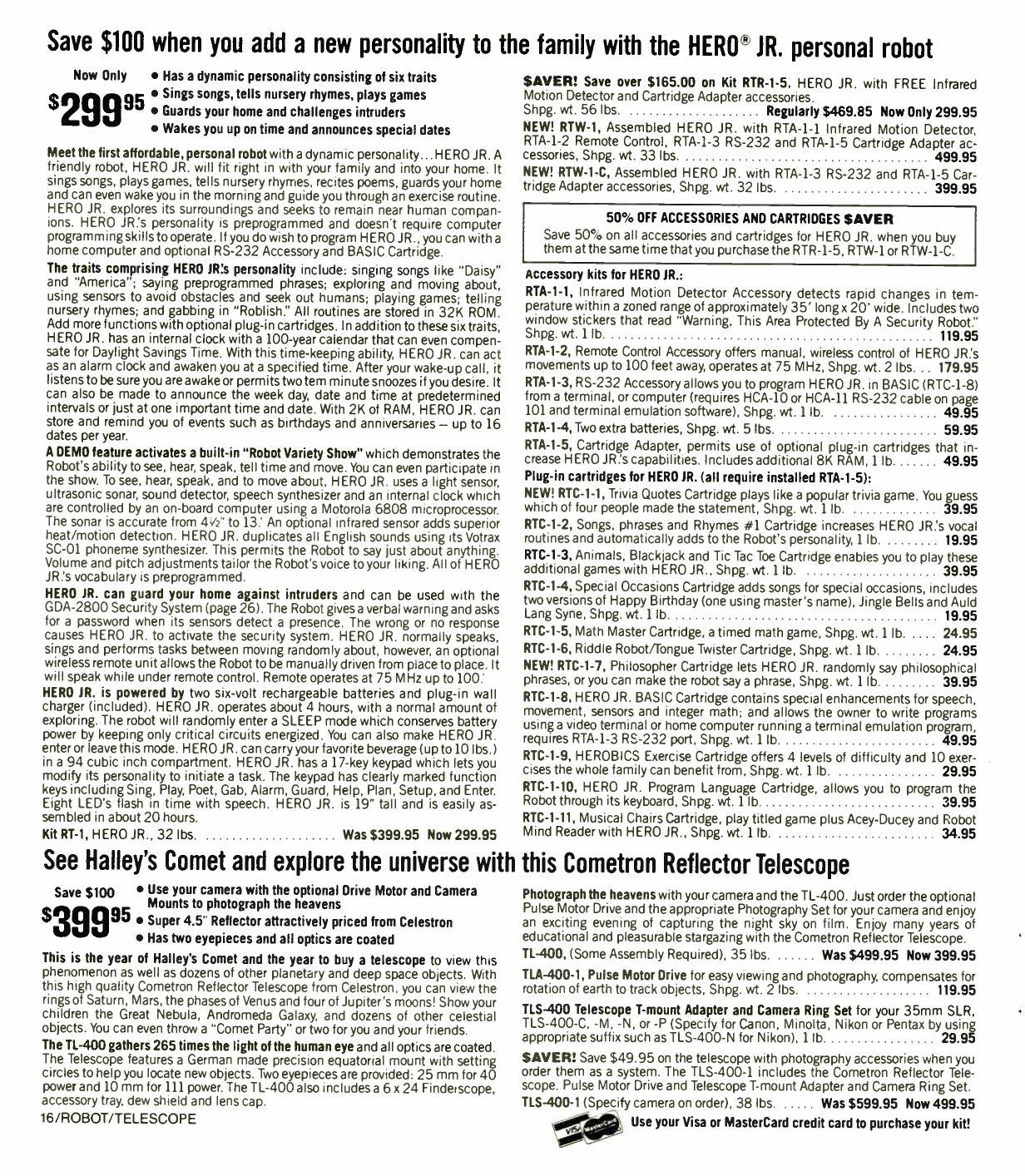
The kit price fell twice within eighteen months:
Table 3 — The kit price fell twice within eighteen months
| Catalogue | Kit RT-1 | Packages and assembled versions |
|---|---|---|
| Christmas 1984 | $599.95 | RTR-1-1 (with RS-232 and cartridge adapter) $649.95; RTR-1-2 (with all four accessories) $849.95 |
| Spring–Summer 1985 | $599.95 | RTR-1-3 and RTR-1-4 “saver” packages |
| Fall 1985 | ”Was $599.95 NOW ONLY $399.95” | RTR-1-3 $649.95 (was $749.95); RTR-1-4 with seven cartridges $549.95 (was $649.95) |
| Christmas 1985 | $399.95 | ”$200 off” RTR-1-3 and RTR-1-4 |
| Spring–Summer 1986 | ”Was $399.95 Now $299.95” | NEW RTW-1, assembled with all four accessories, $499.95; NEW RTW-1-C, assembled with RS-232 and cartridge adapter, $399.95; RTR-1-5 kit package $299.95 |
| Fall 1986 | listed (index, pp. 18–19) | not read |
| Fall 1987 | absent | absent |
Sources: the catalogues named, World Radio History; the Fall 1986 pages have no text layer and only the index entry was read.
Three things follow from that table. First, the catalogue confirms the model numbers: RT-1 is the kit. The assembled robot, RTW-1, appeared in the mail-order catalogue only in 1986, when it was sold with all its accessories for less than the original bare kit. (The HERO Jr dive gives the two numbers the other way round.) Second, a robot marketed at about $1,000 through department stores in 1984 was clearing at $299.95 by mail order two years later. Third, it was gone from the general catalogue by Fall 1987. At the same time Heath’s stores were being renamed Heath/Zenith Computers & Electronics, “to become one of the leading retail computer chains in North America,” as Joseph M. Schulte of Veritechnology wrote in the Spring–Summer 1985 catalogue. The shops that were to sell a personal robot beside personal computers were becoming computer shops.
Wikipedia gives HERO Jr’s production as about 4,000. No primary source for that number was found. The partial record that does survive, a Minnesota technical institute buying one to join its two HERO 1s in 1986 (Sextant no. 20), suggests that part of the Jr’s market ended up in schools after all.
3.2 HERO 2000: the automation trainer
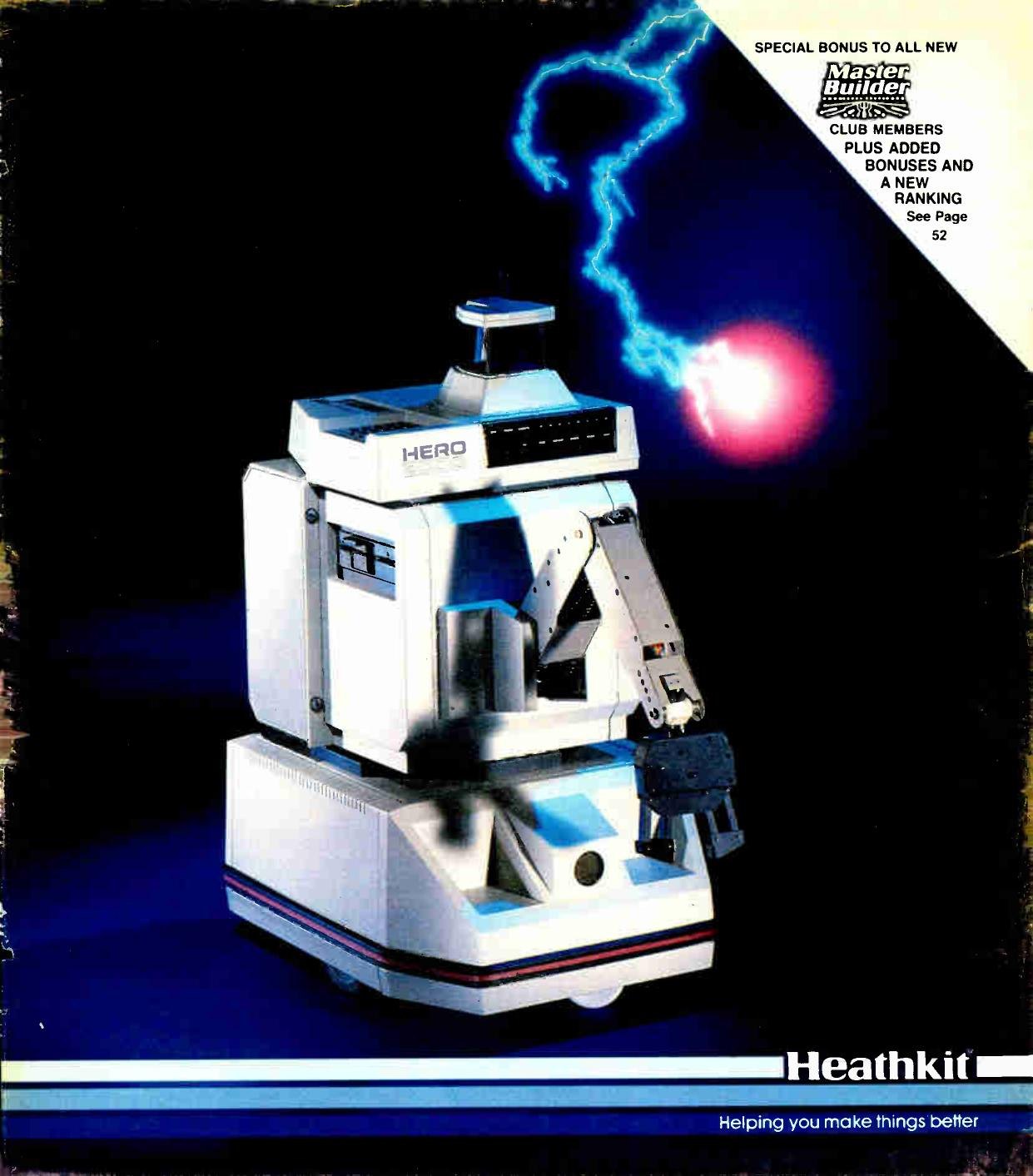
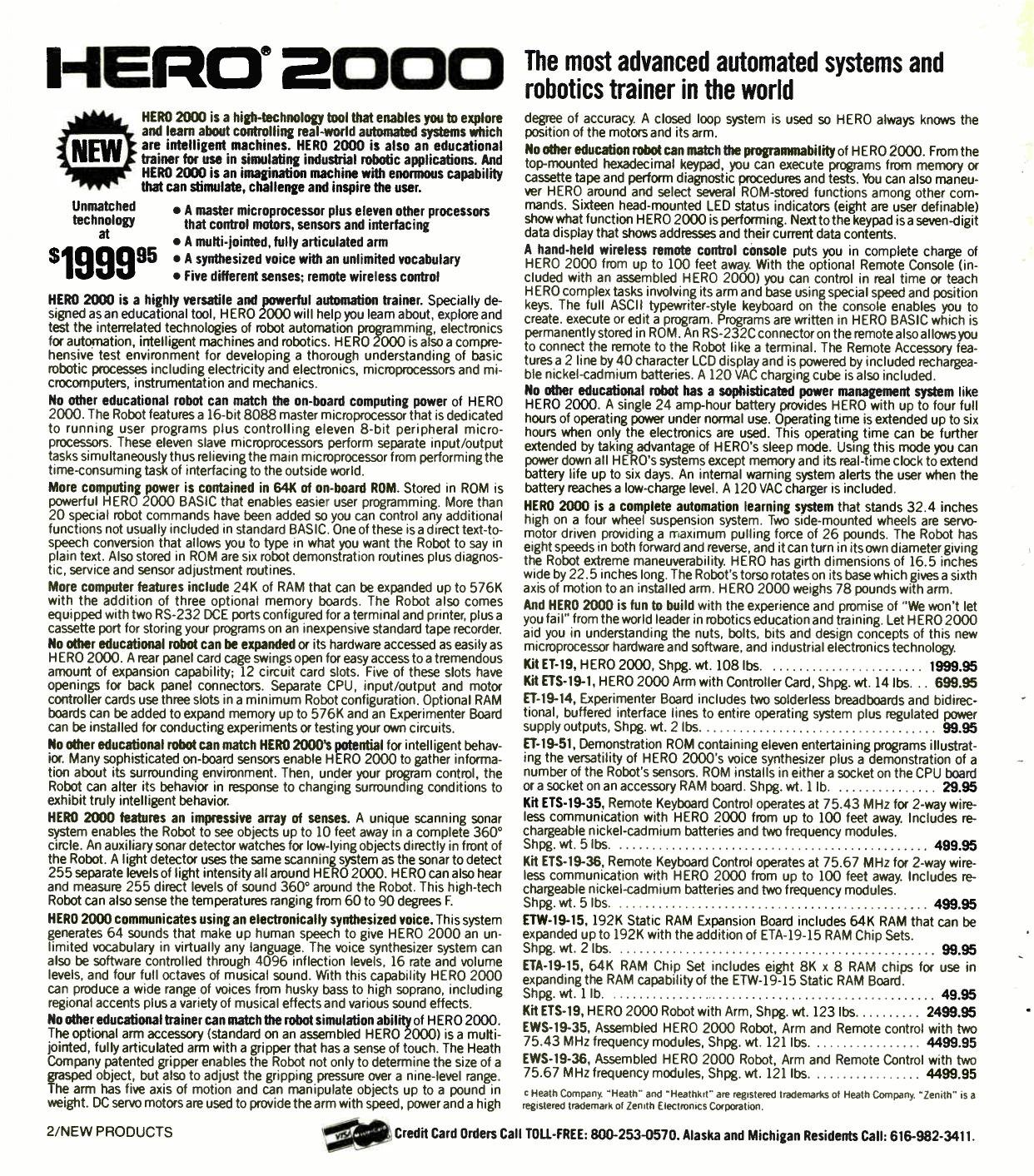
The Spring–Summer 1986 catalogue opened with a new robot on its cover and on its first inside page, headed “HERO 2000: The most advanced automated systems and robotics trainer in the world.” The copy was addressed to schools and industry, not to families. It was “a high-technology tool that enables you to explore and learn about controlling real-world automated systems which are intelligent machines,” and “an educational trainer for use in simulating industrial robotic applications.” It was also “an imagination machine” (Heathkit catalogue, Spring–Summer 1986, p. 2).
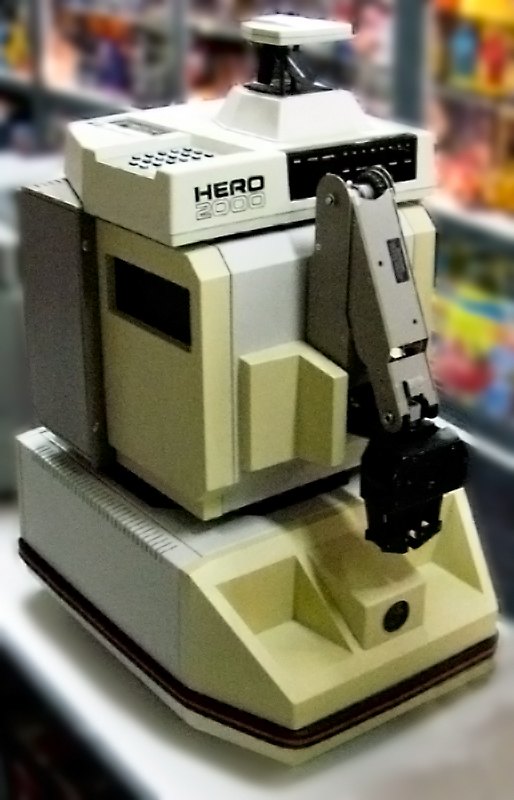
HERO 2000 was a different class of machine from its predecessors. The catalogue specification:
- a 16-bit Intel 8088 master processor running user programs and controlling “eleven 8-bit peripheral microprocessors” that handled motors, sensors and interfacing;
- 64K of ROM holding HERO 2000 BASIC, with more than 20 added robot commands, including “a direct text-to-speech conversion”, and six demonstration routines;
- 24K of RAM, expandable to 576K with three optional memory boards;
- two RS-232 DCE ports (terminal and printer), a cassette port, and a rear card cage with 12 slots;
- a scanning sonar covering “a complete 360° circle” to 10 feet, an auxiliary sonar for low objects in front, a light sensor (255 levels, all round), a sound sensor, and a temperature sensor (60 to 90 °F);
- a voice synthesizer with 64 speech sounds, “4096 inflection levels, 16 rate and volume levels, and four full octaves”;
- an optional five-axis arm with DC servo motors and a gripper “with a sense of touch,” described as “the Heath Company patented gripper,” that could sense an object’s size and grip it at nine pressure levels; the rotating torso added a sixth axis;
- a 24 amp-hour battery: four hours of normal use, six with the electronics alone, and up to six days in sleep mode;
- a height of 32.4 inches on a four-wheel suspension, with two servo-driven side wheels, a pulling force of 26 pounds, eight speeds and a turn in its own diameter; 16.5 by 22.5 inches; 78 pounds with the arm.
The copy closed with the promise that the company history dive traces through Heath’s catalogues: HERO 2000 was “fun to build with the experience and promise of ‘We won’t let you fail’ from the world leader in robotics education and training.”
Two catalogue details bear on disagreements in the secondary record. The catalogue says “eleven 8-bit peripheral microprocessors” without tying the count to the arm. The HERO 2000 dive, following a transcribed spec sheet, gives six slaves in the base robot and eleven with the arm, and identifies them as Intel 8042s where Wikipedia says Z-80s. The catalogue settles the battery question in favour of 24 amp-hours, against the 14 Ah given by the spec sheet.
3.2.1 Prices and configurations
Table 4 — Prices and configurations
| Model | Description | Spring–Summer 1986 | Christmas 1987 | Spring 1988 |
|---|---|---|---|---|
| ET-19 | Kit, robot without arm | $1,999.95 | $1,999.95 | $1,388.00 |
| ETS-19 | Kit, robot with arm | $2,499.95 | $2,499.95 | $2,499.95 |
| EWS-19-35 / -36 | Assembled robot, arm and remote console (75.43 or 75.67 MHz); renumbered EWS-19-45 / -46 in Fall 1987 | $4,499.95 | — | — |
| ETW-19-A | Assembled robot, arm and 75.43 MHz remote, “can be operated directly out of shipping crate” | — | $4,499.95 | $4,499.95 |
| ETS-19-A | Kit system: robot, arm, remote, experimenter board, demo ROM and courses EE-1900 and EE-1901 | — | $2,999.95 | $2,495.00 |
| ETS-19-1 | Arm with controller card (kit) | $699.95 | $699.95 | not read |
| ETS-19-35 / -36 | Remote keyboard console, 2 × 40 LCD, NiCd, 100 feet | $499.95 | $499.95 | $499.95 |
| ETW-19-15 | 192K static RAM board with 64K fitted | $99.95 | $99.95 | $99.95 |
| ETA-19-15 | 64K RAM chip set | $49.95 | $49.95 | not read |
| ET-19-14 | Experimenter board, two breadboards | $99.95 | $99.95 | $99.95 |
| ET-19-51 | Demonstration ROM, eleven programs | $29.95 | $29.95 | $29.95 |
| ET-19-5 | Auto-docking accessory: docking ROM and two infrared transceivers | — | $149.95 | $149.95 |
| ETW-19-6 | 360K disk drive, with an MS-DOS software package; needs 128K RAM | — | $399.95 | not read |
| ET-19-3 | Robot carrying cart | — | — | $99.95 |
Sources: Heathkit catalogues Spring–Summer 1986, p. 2, Christmas 1987, p. 80 and Spring 1988, p. 71. The auto-docking accessory and the disk drive were first found in Fall 1987, where the drive is marked “New! … Available August.”
Once again the catalogue’s model numbers differ from the Robots-site dive. There ET-19 is the kit. The assembled robot was EWS-19-35 or -36 in 1986, EWS-19-45 or -46 in Fall 1987, and ETW-19-A from Christmas 1987. The HERO 2000 dive gives the kit as “ET-19W,” a number not found in any catalogue examined.
HERO 2000 was the most expensive robot Heath sold. Assembled with its arm and remote, it cost more than three complete EES-1800 HERO 1 training systems. The Wikipedia figure of about 3,000 units, like the figures for the other two robots, could not be traced to a primary source.
3.2.2 The HERO 2000 courses
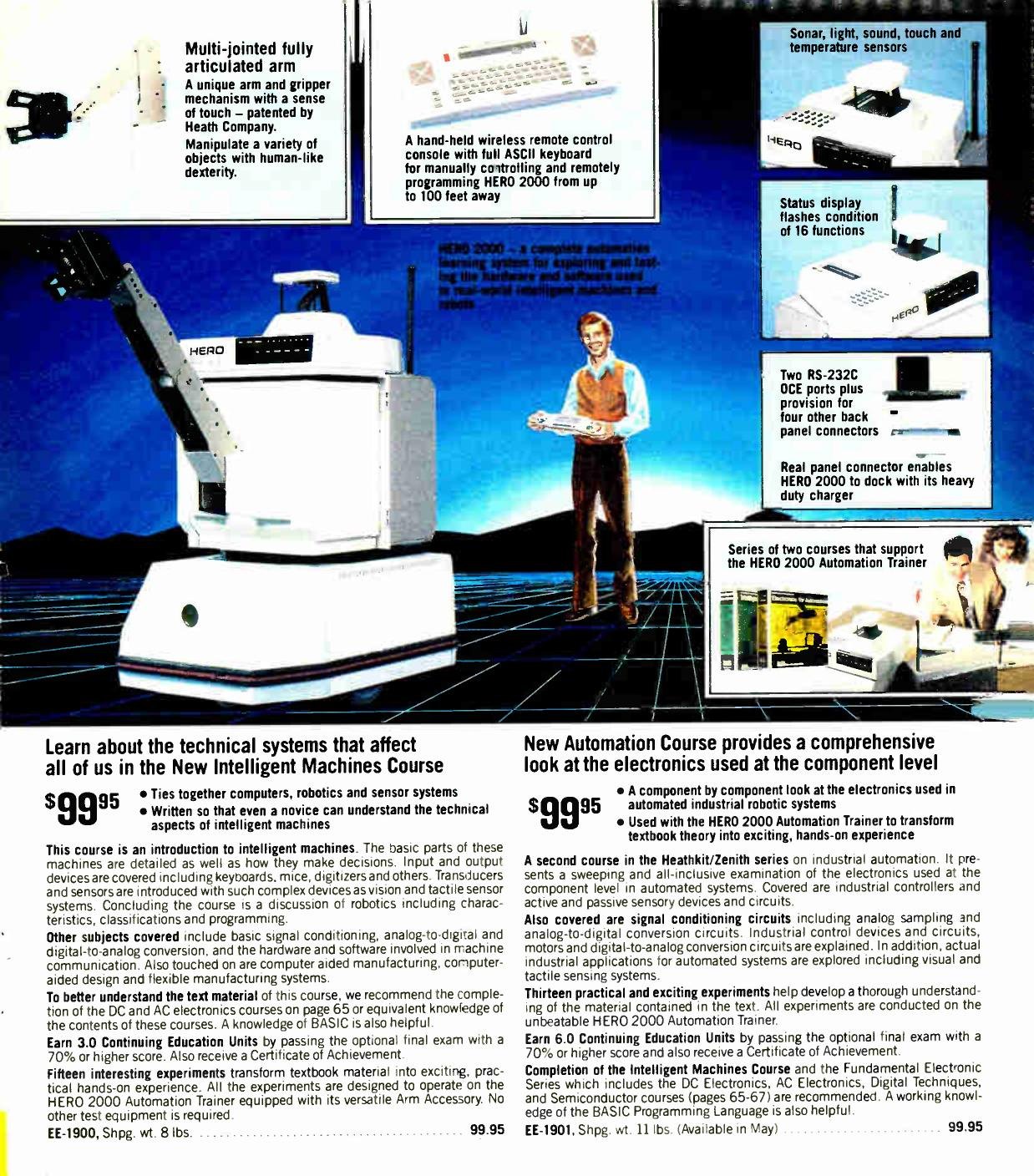
The catalogue language had shifted from “robotics” to “automation” and “intelligent machines.” The courses followed:
- EE-1900, Intelligent Machines ($99.95, 3.0 CEUs): an introduction to input and output devices, transducers and sensors, including vision and tactile systems, signal conditioning, analog-digital conversion, machine communication, CAD/CAM and flexible manufacturing. It had fifteen experiments, all on a HERO 2000 fitted with its arm.
- EE-1901, Electronics for Automation ($99.95, 6.0 CEUs, “Available in May” 1986): industrial controllers, sensory circuits, analog sampling, motors and conversion circuits, with thirteen experiments on the robot. It was recommended after EE-1900 and Heath’s Fundamental Electronic Series.
- EB-1950, HERO 2000 Programming and Interfacing ($59.95, first found Fall 1987): “a superlative overview of the internal workings of our most advanced educational trainer,” with experiments on a robot equipped with arm and remote control.
Sources: Spring–Summer 1986, p. 3; Fall 1987, p. 69.
The classroom tables list EE-1900’s classroom edition (EB-1900) with the assembled EWS-19-35 or -36 as its trainer. A school that adopted the course was committing to a $4,500 robot per station, a very different proposition from the HERO 1 courses.
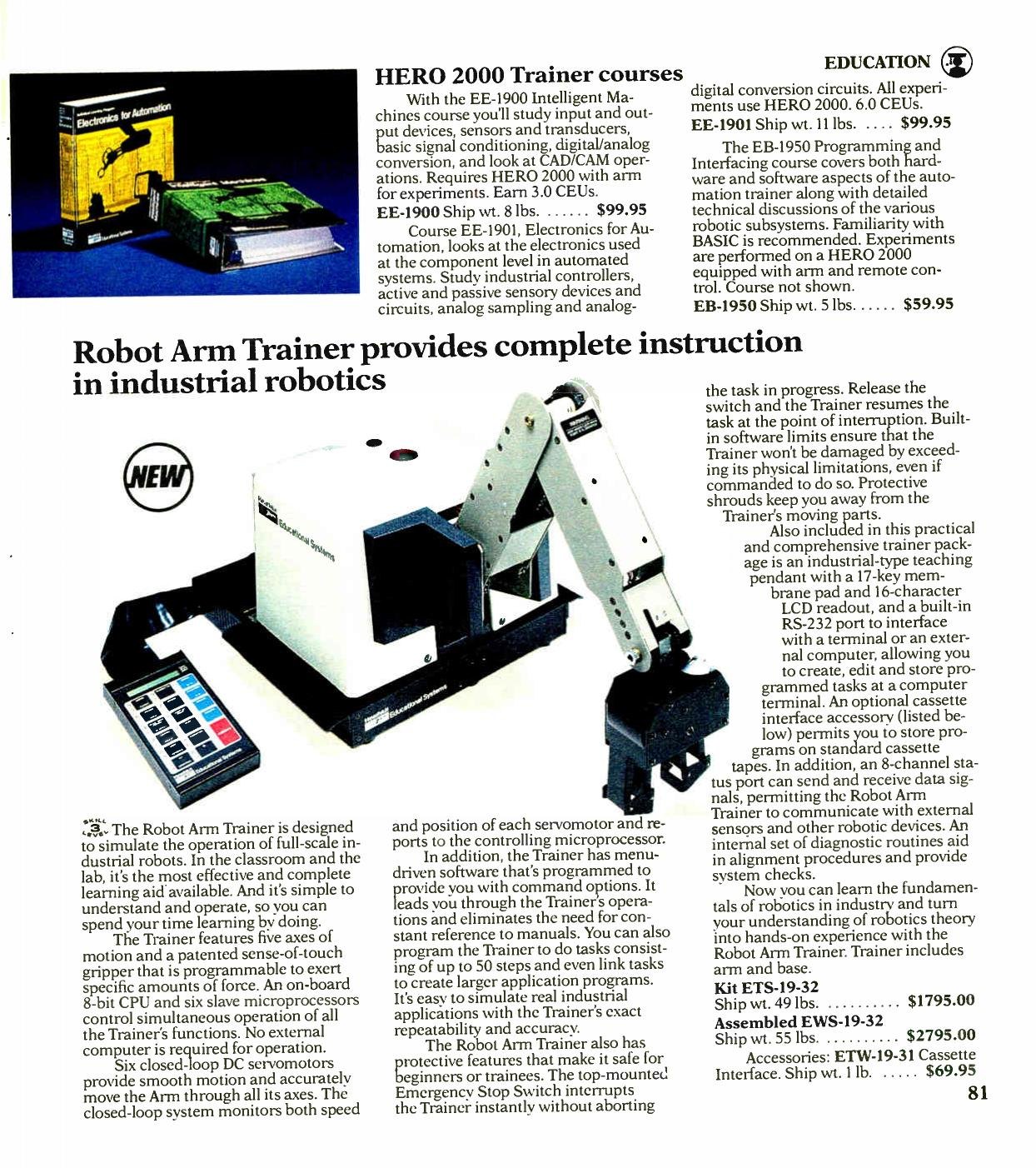
3.3 The Robot Arm Trainer
The last new robot product was not a mobile robot. The Christmas 1987 catalogue introduced the Robot Arm Trainer, ETS-19-32 as a kit at $1,795.00 or EWS-19-32 assembled at $2,795.00. It was a bench-mounted five-axis arm “designed to simulate the operation of full-scale industrial robots.” It used the HERO 2000 family’s “patented sense-of-touch gripper,” an on-board 8-bit CPU and six slave microprocessors, and six closed-loop DC servomotors. It came with an industrial-style teaching pendant (17-key membrane pad and a 16-character LCD), an RS-232 port, an emergency stop switch and protective shrouds. Tasks could be up to 50 steps long and linked into larger programs. A cassette interface, ETW-19-31, was $69.95 (Heathkit catalogue, Christmas 1987, p. 81).
The model number put it in the HERO 2000 series, and the course that went with it, EE-1903, Industrial Robotics and Automation (4.0 CEUs), was pitched at the same industrial-training market. By Spring 1988 the trainer was already “Reduced $800”: the kit was $995.00 and the assembled trainer $1,995.00, and the course was $79.95, down from $99.95 (Spring 1988, p. 72). Robot Workshop, which later bought Heath’s remaining robot stock, counts the Arm Trainer as the fourth member of the HERO family (Robot Workshop, “HERO Robots”).
Sources
- Heathkit catalogues, World Radio History: Christmas 1984; Spring–Summer 1985; Fall 1985; Christmas 1985; Spring–Summer 1986; Fall 1986; Fall 1987; Christmas 1987; Spring 1988, No. 211.
- Cote, Raymond G. A. “June Travelogue” (editorial). Robotics Age, August 1984. Internet Archive
- Sextant no. 20, January–February 1986. Internet Archive
- Heath Company. HERO Jr Owner’s Guide (1984). Internet Archive
- Robot Workshop, “HERO Robots”.
- Wikipedia, “HERO (robot)”, for production estimates only.
Comments (0)