Ham Radio · Volume 1
A Grid Dipper and a Novice Rig
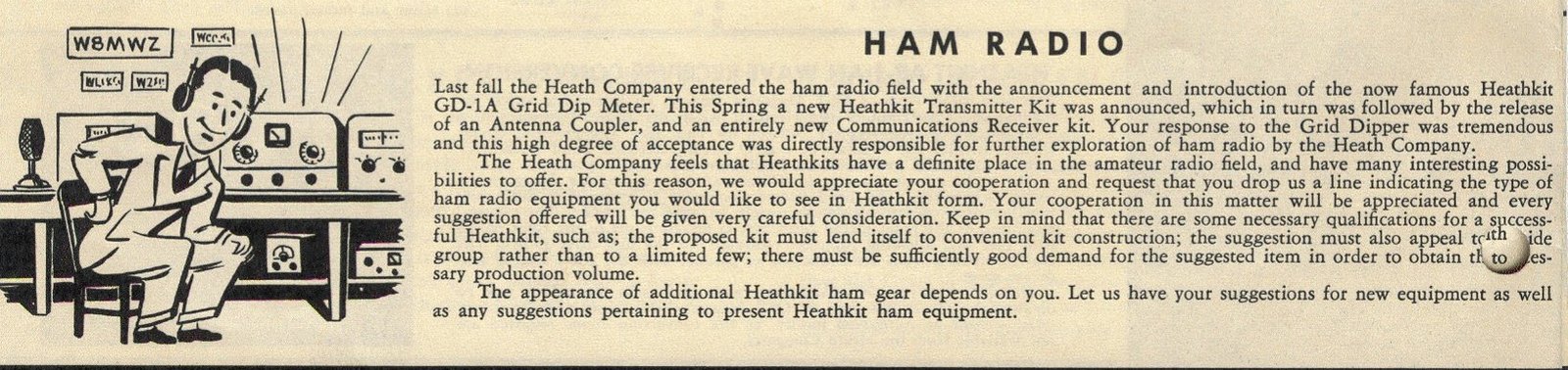
Heath’s amateur-radio line did not begin with a transmitter. It began with a grid-dip meter, a small instrument that radio amateurs used to find the resonant frequency of a coil or an antenna. The company’s own account, printed in a box headed “Ham Radio” in one of its mid-1953 flyers, is the earliest statement of the plan:
Last fall the Heath Company entered the ham radio field with the announcement and introduction of the now famous Heathkit GD-1A Grid Dip Meter.
The same note reported that a transmitter kit had followed “this Spring”, then an antenna coupler and a communications receiver, and that the response to the grid dipper “was directly responsible for further exploration of ham radio”. It closed by asking readers to write in with the kits they wanted, on three conditions: the kit had to suit kit construction, appeal to a wide group rather than a few, and sell in enough numbers to justify production (Heath Summer Flyer, p. 4). Those three conditions describe the whole forty-year line that followed.
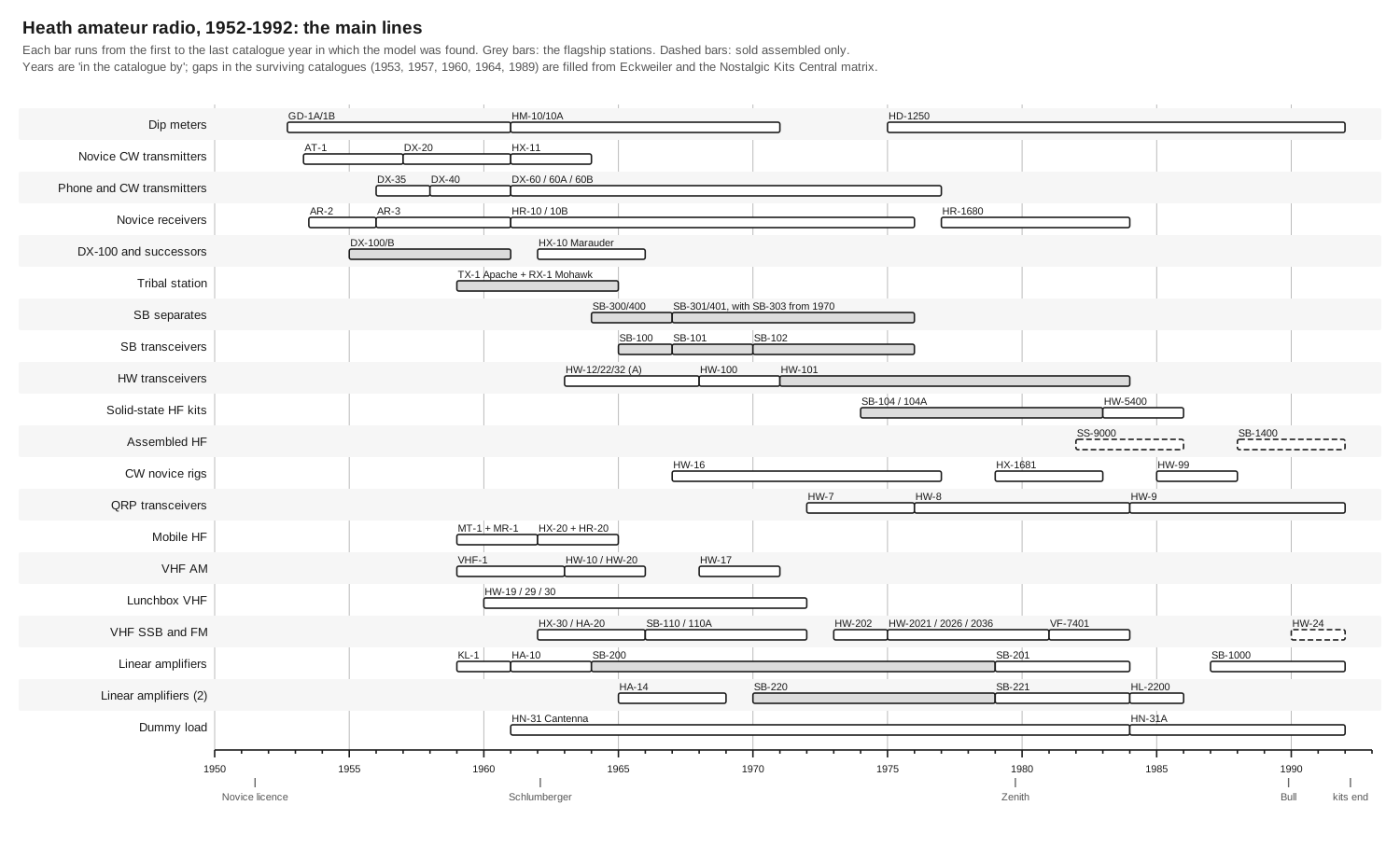
This volume covers the first six years, from the grid dipper of 1952 to the DX-40 of 1958. The Heath Company’s general story in the same years (Howard Anthony’s death in 1954 and the sale to Daystrom in 1955) is told in the company history and is not repeated here.
1.1 Dating the first kits
The flyer that carries this note is filed on World Radio History as the “Summer 1951” flyer, and it has often been read that way, which is the source of the 1951 date some accounts give the AT-1 transmitter. This site’s company history now follows the 1953 dating. The flyer itself contradicts the label. It prints a notice headed “Heathkit AR-1 All Wave Receiver Conversion” that begins “The May 1953 issue of QST Magazine features an interesting article”, and it refers to “the outstanding 1952 Model” of a Heath oscilloscope (flyer, pp. 4–5). It cannot be earlier than May 1953. Heath’s September 1951 flyer and its 1952 catalogue list no amateur equipment at all (September 1951; 1952 catalogue), and neither do the flyers of September 1950 and January 1951.
Read as a 1953 document, the flyer agrees with the collector record. Bob Eckweiler’s table of Heath’s amateur kits, compiled from the catalogues, gives the GD-1 grid dipper as fall 1952, the AT-1 as spring 1953, and the AR-2 receiver and AC-1 coupler as summer 1953 (Eckweiler, Heathkit of the Month #132). Chas Gilmore also dates the GD-1 to 1952, and says Heath sold more than 15,000 grid dippers in their first two years (Leibson, EEJournal, “‘H’ is for Heathkits and Hams”, part 1). The dates that conflict are the ones that rest on the mislabelled flyer, or on memory: Gilmore’s “Christmas 1951” for the AT-1, and Eckweiler’s own 1951 in his earlier AT-1 article, which reproduces an advertisement from the same flyer (Heathkit of the Month #25). Brueschke and Mack, who give 1952–1956 for the AT-1 and credit its design to Roger Mace, hired by Gene Fiebich in 1952 as an experienced amateur, are closer (Brueschke and Mack, AWA Review 32). A transmitter designed in 1952 and announced in the spring of 1953 fits every source except the flyer’s filename. This volume uses those dates.
1.2 The market in the early 1950s
Amateur radio in the early 1950s was a hobby of home construction and war surplus. The standard transmitters were built from magazine articles or bought from a handful of specialist makers. Collins Radio sold the best and most expensive equipment. E. F. Johnson of Waseca, Minnesota, had entered the field in 1949 with the Viking I, a 100-watt phone transmitter that was itself sold as a kit: $209.50 in 1949, and the price did not include the tubes (Post, “Johnson Viking I Transmitter”). Hallicrafters and National dominated receivers. Allied Radio sold Knight-Kits and the Electronic Instrument Company (EICO) of Brooklyn sold test-equipment kits; both later offered amateur transmitters, but neither built a line as broad as Heath’s (Nostalgic Kits Central).
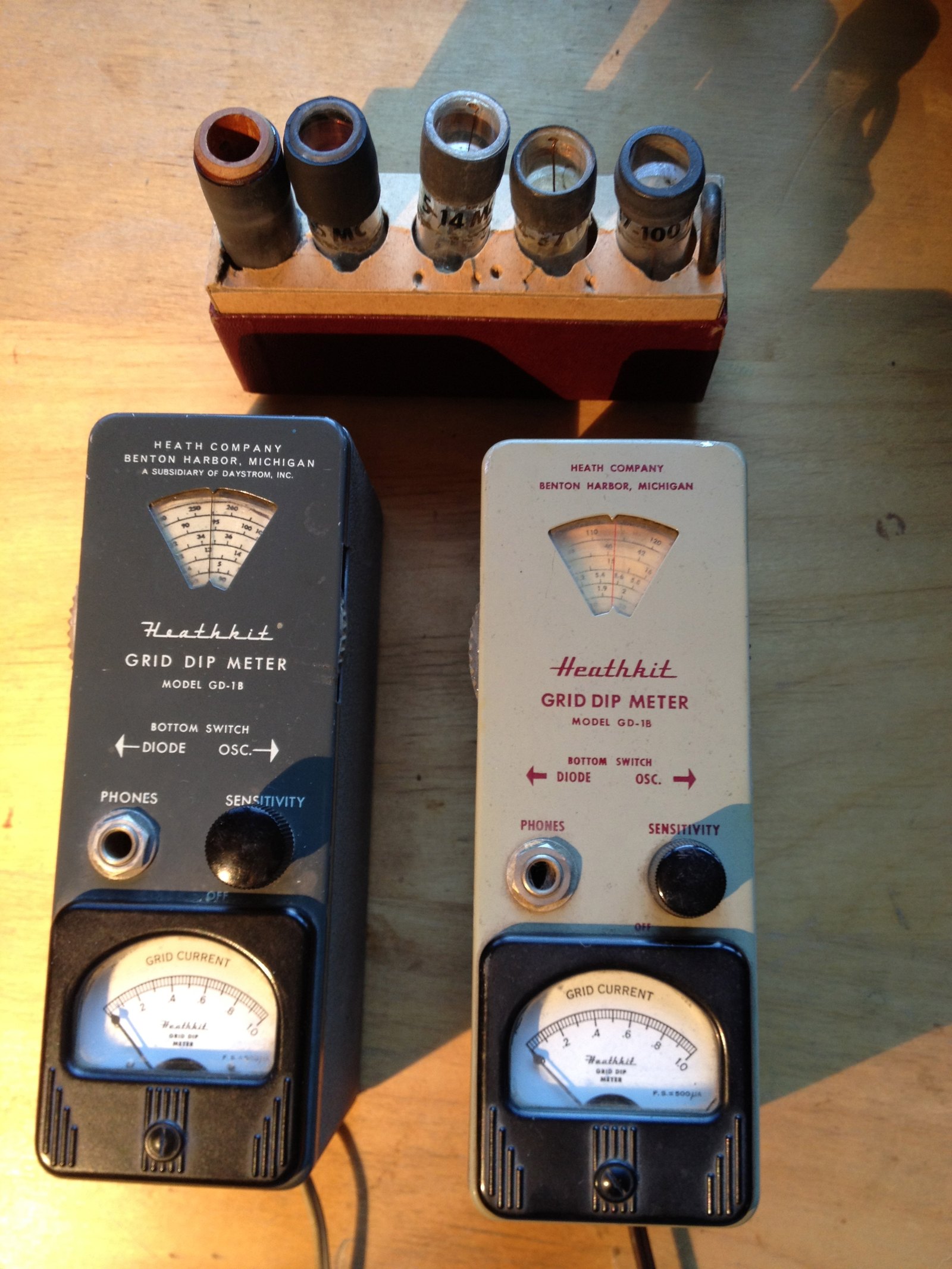
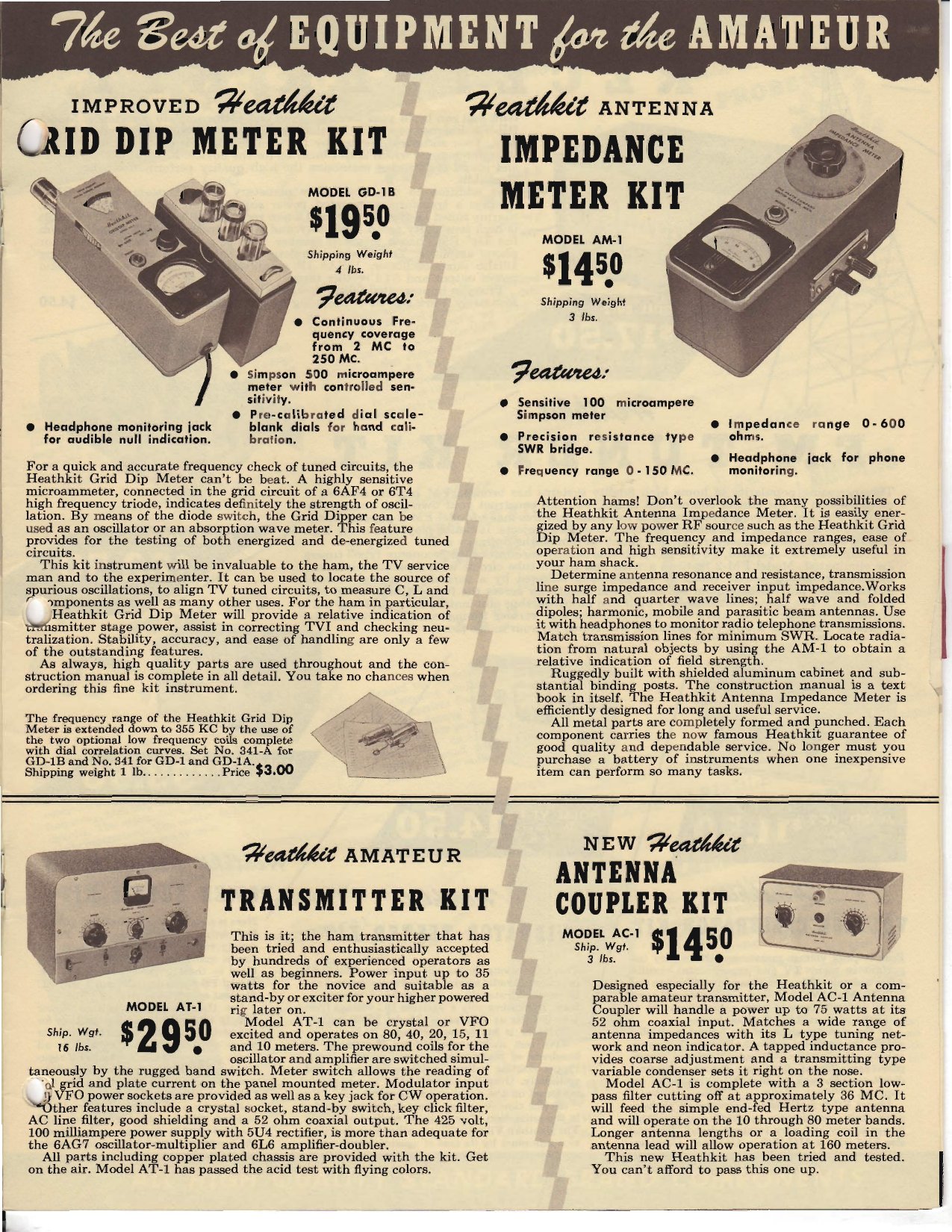
Heath came to this market as a maker of test equipment. Its kits of 1947 to 1952 were oscilloscopes, vacuum-tube voltmeters and signal generators for television servicemen, sold by mail from Benton Harbor, Michigan (company history, vol. 2). A grid-dip meter was a natural bridge: it was a test instrument, it sold to the same servicemen, and every radio amateur needed one. The 1953 flyer placed the GD-1A in its laboratory section at $19.50, alongside an audio oscillator and an intermodulation analyser. The improved GD-1B followed in the Winter 1954 flyer, still at $19.50, covering 2 to 250 MHz with plug-in coils (Winter 1954 flyer, p. 9). It stayed in the catalogue until the transistorised HM-10 “Tunnel Dipper” replaced it in 1961.
1.3 The Novice licence and the AT-1
The market Heath’s first transmitter was aimed at had been created by a change in the licence rules. In 1951 the Federal Communications Commission reorganised amateur licensing and created an entry-level Novice class. A Novice could operate only CW (Morse) on small segments of the 80- and 11-metre bands, at no more than 75 watts input, and the transmitter had to be crystal-controlled (Eckweiler, Heathkit of the Month #25). The licence created a new market of beginners who needed a small, cheap, simple transmitter, and who were exactly the customers Heath’s step-by-step manuals were written for. Heath took nearly two years to reach it.
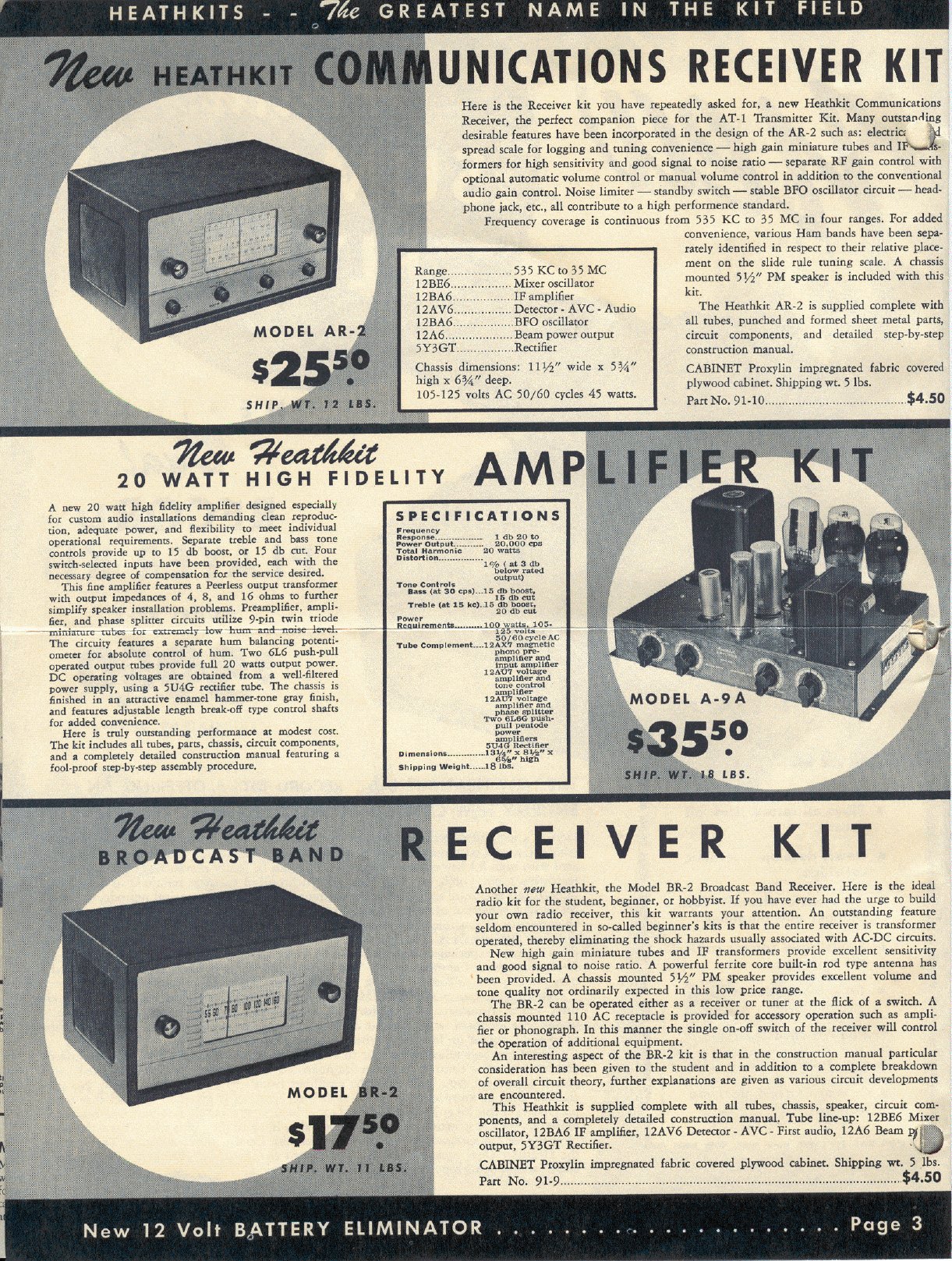
The AT-1 was that transmitter. The 1953 flyer introduced it as “the latest Heathkit addition to the ham radio field”, with a price of $29.50 and a shipping weight of 16 lb. It had three tubes: a 6AG7 crystal oscillator and multiplier, a 6L6 amplifier and doubler, and a 5U4G rectifier. It covered 80, 40, 20, 15, 11 and 10 metres, ran “up to 35 watts” input from a built-in 425-volt supply, and took its crystal in a socket on the front panel. There were sockets for an external VFO and a modulator (flyer, p. 3). The same page announced the AC-1 antenna coupler, “specifically designed for the Heathkit AT-1”, at $14.50.
The flyer’s cartoon of a ham at his station shows a QSL card for W8MWZ on the wall. The 1958 catalogue names W8MWZ as “Rog”, Heath’s “senior Ham Engineer” (1958 catalogue, p. 52). If “Rog” is Roger Mace, as the dates suggest, the designer of the AT-1 had his own call sign drawn into its launch advertisement. No source that states Mace’s call sign was found, so that identification remains an inference.
The receiver completed the station. The AR-2, announced in the same flyer at $25.50, was “the Receiver kit you have repeatedly asked for”, described as “the perfect companion piece for the AT-1 Transmitter Kit”. It was a six-tube general-coverage superheterodyne from 535 kHz to 35 MHz, with an electrical bandspread, a BFO for CW, a noise limiter and a headphone jack, and the ham bands marked on its dial (flyer, p. 2). With a transmitter, a receiver and a coupler costing about $70 together, a new Novice could put a complete station on the air for less than the cost of one commercial receiver.
1.4 A small line, 1953–1955
For the next two years the amateur line hardly grew. The Winter 1954 flyer gives it a single page, “The Best of Equipment for the Amateur”: the GD-1B grid dipper and the AM-1 antenna impedance meter, both at $14.50 to $19.50, the AT-1 at $29.50 and the AC-1 coupler, now described as “new”, at $14.50 (Winter 1954 flyer, p. 9). The AR-2 receiver was listed separately among the radios. Heath was still a test-equipment house. Gilmore counts 15 kit instruments in 1952 and 44 kits of all kinds in 1953 (EEJournal, part 1).
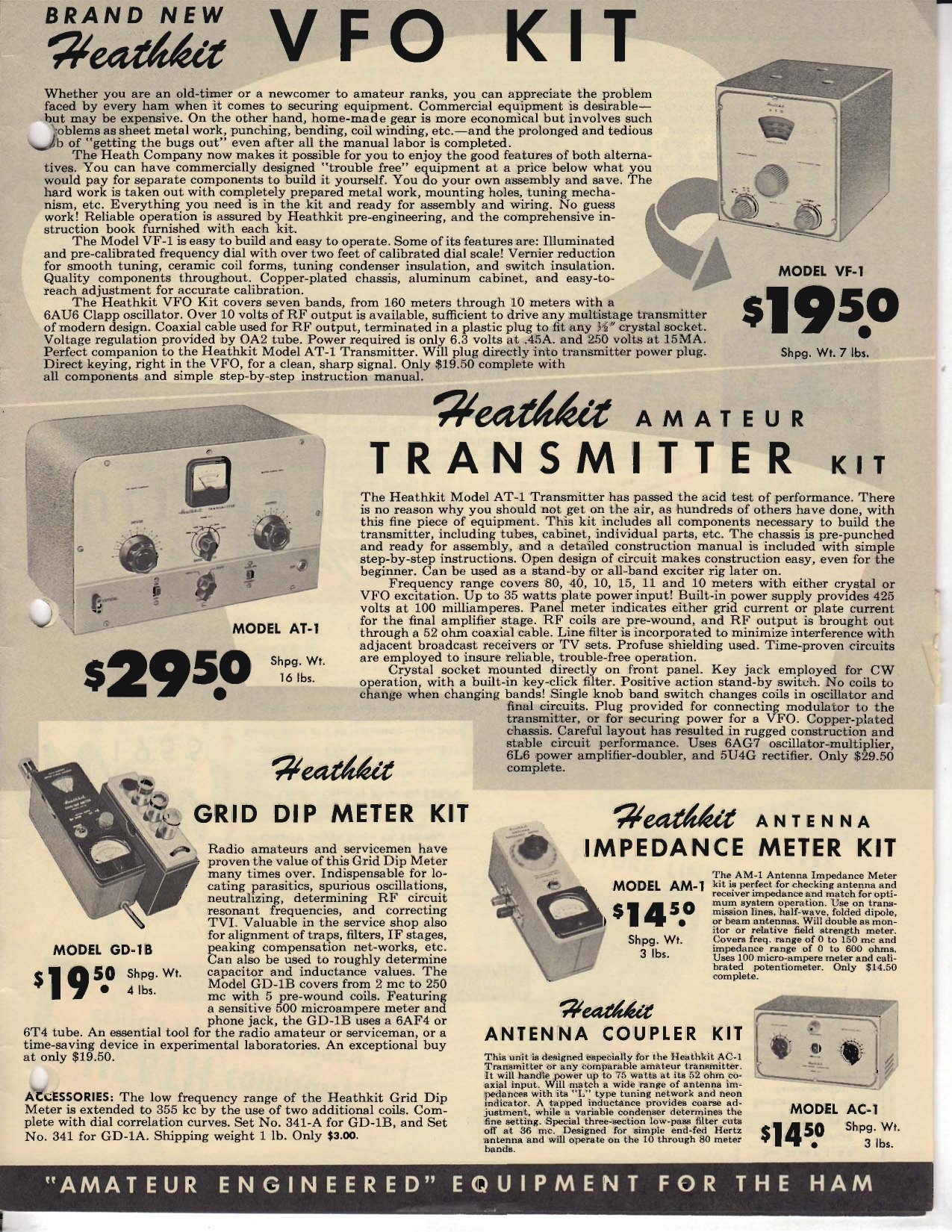
The one addition of these years was the VF-1 variable-frequency oscillator. Eckweiler’s article on it gives 1952 (Heathkit of the Month #79), which is too early for an accessory built to plug into the AT-1; his later table of Heath’s amateur kits gives fall 1954 (#132). The Fall 1955 flyer still presents it as a “Brand New Heathkit VFO Kit” at $19.50, covering 160 through 10 metres with a 6AU6 Clapp oscillator and an OA2 regulator, and “perfect companion to the Heathkit Model AT-1 Transmitter” (Fall 1955 flyer, p. 15). A VFO mattered because the Novice licence lasted only one year and could not be renewed. A Novice who passed the General examination was free to move off his crystals, and the VF-1 plugged straight into the AT-1’s power socket. The strip across the foot of that flyer page reads “‘Amateur Engineered’ Equipment for the Ham”, the first appearance found of a slogan Heath would use for years.
1.5 The DX-100 and the ladder of transmitters
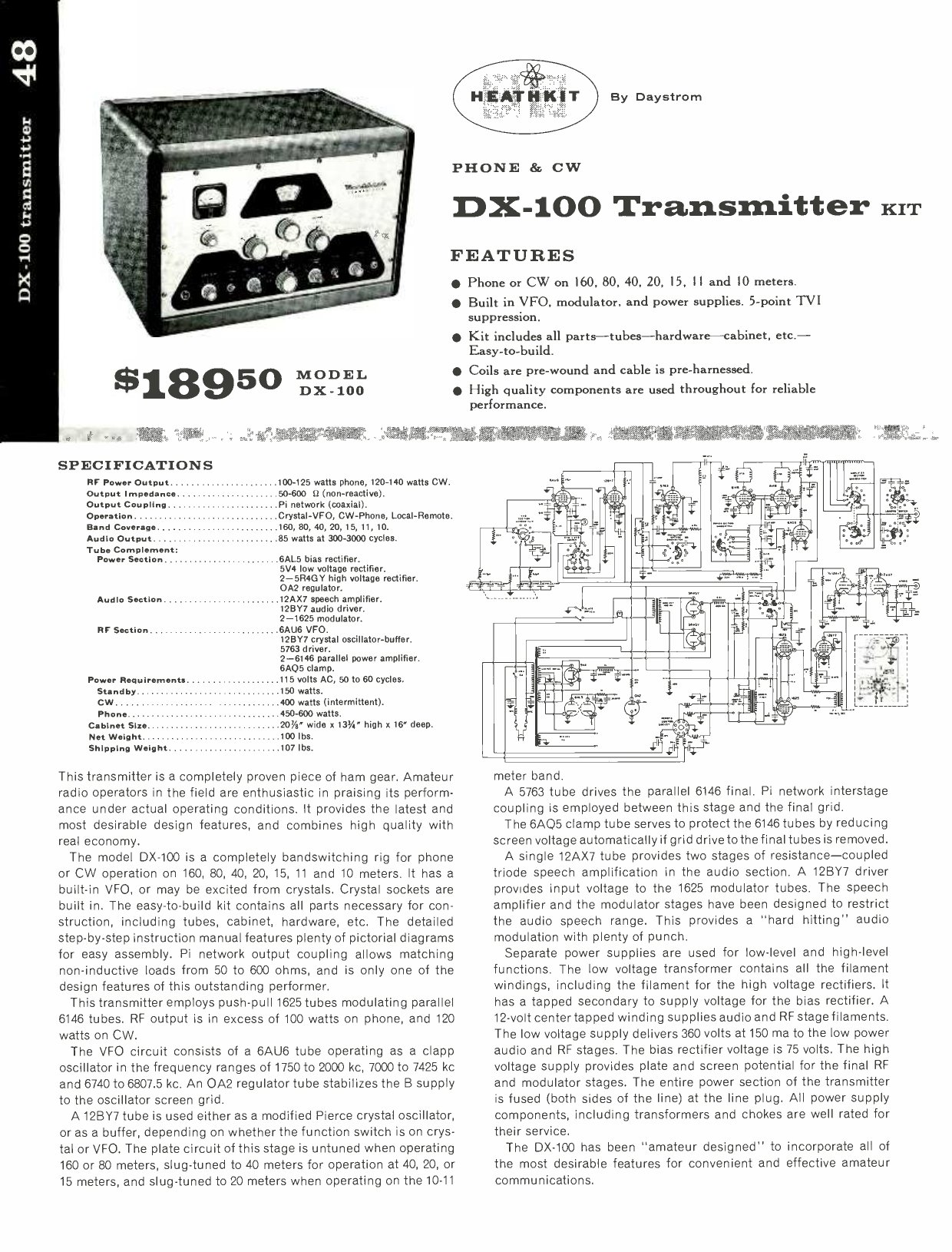
The DX-100 changed the scale of the business. It was announced in the mid-winter flyer of 1955, “available after March 15th”, at $189.50: a bandswitching AM and CW transmitter for 160 through 10 metres, with a built-in VFO, a pair of 6146 tubes in the final, a pair of 1625s as plate modulators and three power supplies, weighing 107 lb packed (1956 catalogue, p. 38). It was the largest and most expensive kit Heath had offered, and it was the first Heath rig a well-off General-class operator would buy in preference to a Johnson or a Collins. Brueschke and Mack record that Heath arrived at the design by reverse-engineering the Johnson Viking II, which cost about $100 more, and that the DX-100’s success paid for the graduate engineers who let Heath stop copying and start designing (AWA Review 32). Its circuit, construction and restoration are the subject of the DX-100 dive; its place in the company’s finances is covered in the Daystrom volume.
Below the DX-100 Heath built a ladder of smaller transmitters, each aimed at a particular licence and budget.
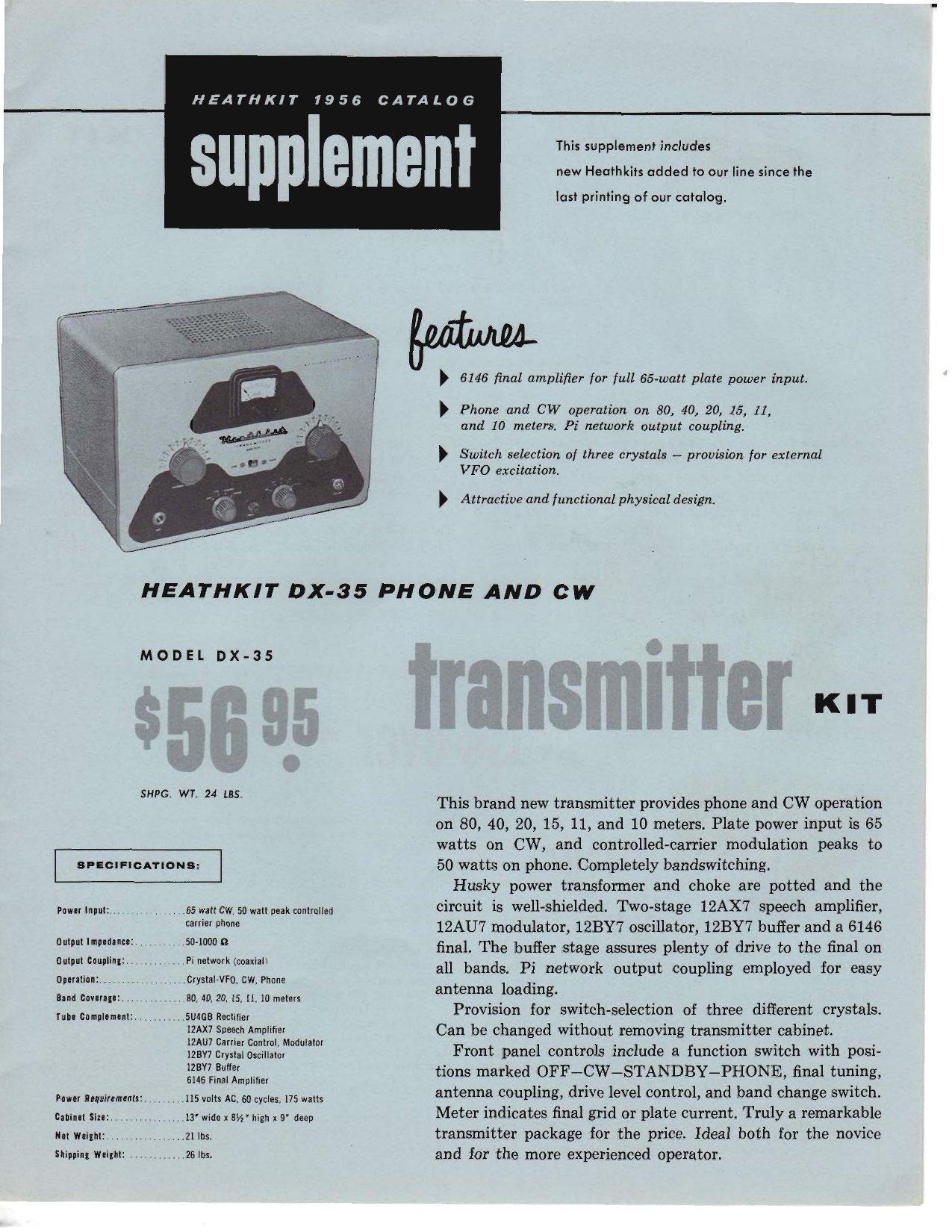
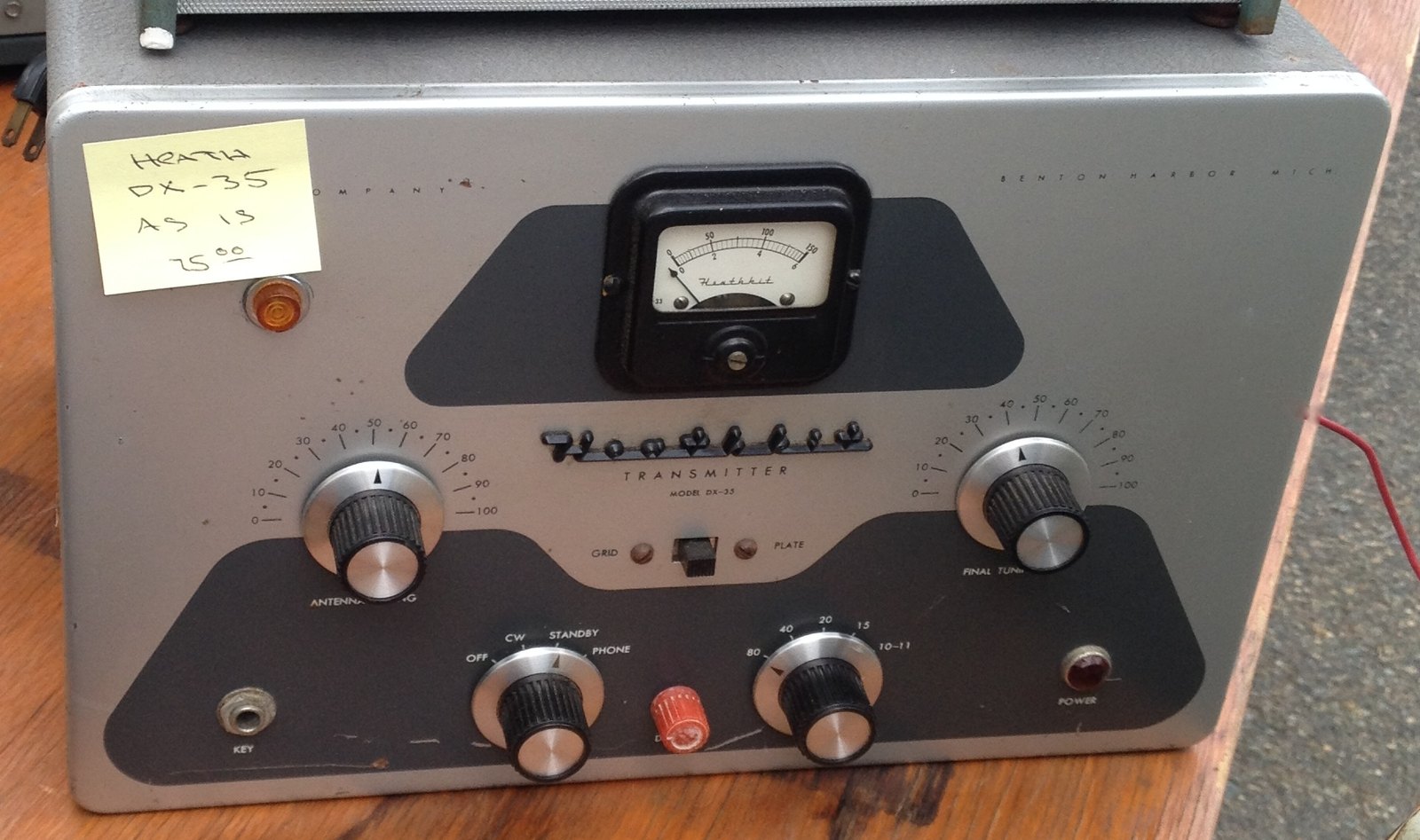
- DX-35 (1956). A phone and CW transmitter of 65 watts input on CW and 50 watts peak on phone, with a single 6146 final and three switch-selected crystals, at $56.95. The 1956 catalogue supplement introduced it as “ideal both for the novice and for the more experienced operator” (1956 catalogue supplement). Its phone mode used controlled-carrier screen modulation, far cheaper than the DX-100’s plate modulator.
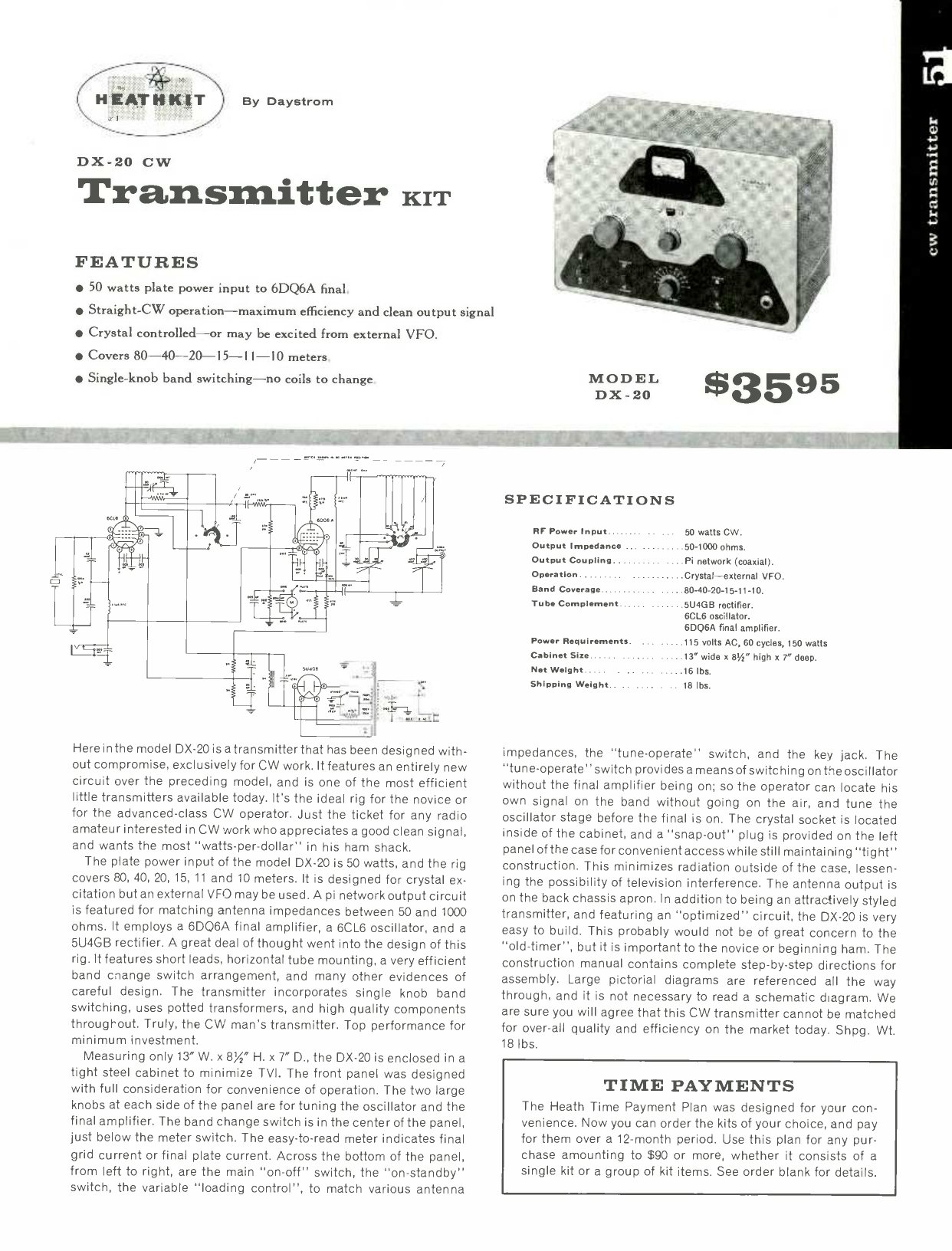
- DX-20 (1957). A three-tube CW-only transmitter of 50 watts input at $35.95, the AT-1’s successor. It used a 6DQ6A television sweep tube in the final; Eckweiler notes that Heath was one of the first makers to use a sweep tube as an RF amplifier, a practice that became common later (Heathkit of the Month #3; 1958 catalogue, p. 51). It moved the crystal socket inside the case and used a true pi-network output, both to reduce television interference.
- DX-40 (1958). The DX-35 improved and raised to 75 watts, exactly the Novice limit, with phone as well as CW, at $64.95 (1958 catalogue, p. 50). Its built-in phone capability meant that a Novice could keep the rig after upgrading to General, simply by adding a VF-1.
The receivers climbed more slowly. The AR-3 of 1956 ($27.95) was a modest improvement on the AR-2, still a general-coverage set with the ham bands marked (1956 catalogue, p. 37). Eckweiler’s judgement is that the AR series “had none of the features needed for a good ham radio receiver” (Heathkit of the Month #14). Heath filled the gap with accessories. The QF-1 Q-multiplier ($9.95) sharpened the selectivity of any receiver with a 455 kHz IF, and the CA-1 Conelrad alarm ($13.95) switched a transmitter off when civil-defence rules required broadcast stations to leave the air.
1.6 Heath hams
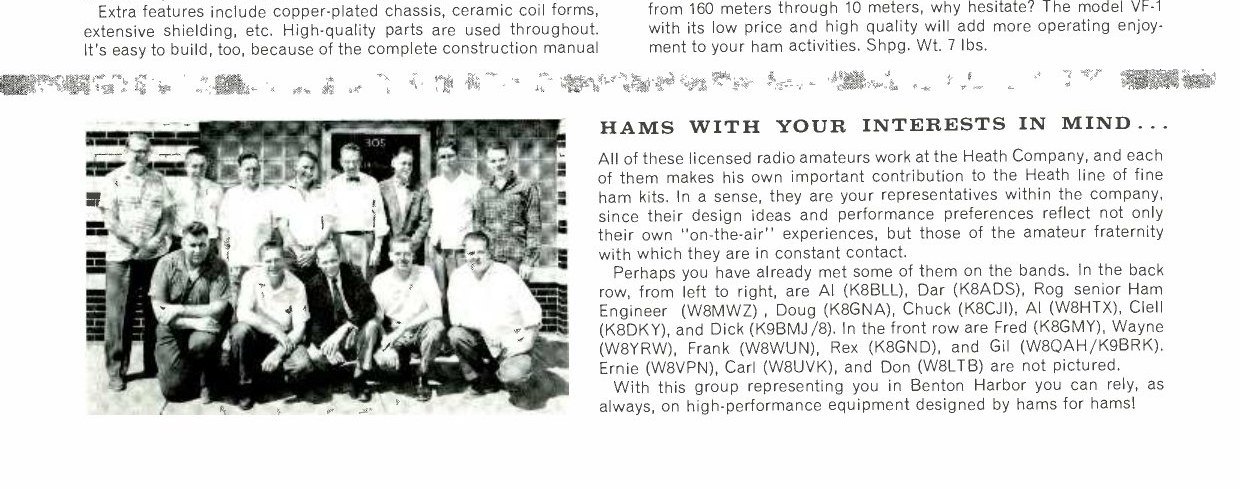
By 1958 the amateur products were designed by a group of licensed amateurs inside the company, and Heath put them in the catalogue. The 1958 catalogue printed a photograph of sixteen of them under the heading “Hams with your interests in mind”, describing them as “your representatives within the company” and naming each by first name and call sign: Al (K8BLL), Dar (K8ADS), “Rog senior Ham Engineer (W8MWZ)”, Doug, Chuck, Al, Clell, Dick, Fred, Wayne, Frank, Rex and Gil, with Ernie, Carl and Don not pictured (1958 catalogue, p. 52). The 1959 catalogue repeated the idea with a larger group, “Meet the Hams Who Serve You”, some thirty names long (1959 catalogue, p. 44). The same page reproduced by the Heathkit Virtual Museum confirms the 1958 date (Heathkit Virtual Museum, “Heath Hams”).
Two of those names reappear later. Al Robertson, K8BLL, was by 1963 “the Heathkit Amateur Radio Product Manager”, and Dar Evans, K8ADS, was project engineer on the HX-30 six-metre SSB transmitter (May 1963 catalogue, p. 4). The next volume returns to them.
1.7 What the first decade established
By the end of 1958 the pattern of the whole line was set. There was a cheap Novice transmitter, a mid-priced phone and CW rig, and a flagship. Each had a matching receiver, and a ring of inexpensive accessories surrounded them: VFO, coupler, grid dipper, impedance meter, Q-multiplier. Each model was presented as a step in a ham’s progress from Novice to General, and each was designed so that the owner could keep it after moving up. The line was small: the 1956 catalogue carried eight amateur kits among about fifty instruments, and Gilmore counts nine ham products that year against forty-two in test equipment (EEJournal, part 1). It was about to grow very quickly.
Sources
- Heath Company catalogues and flyers, World Radio History: September 1950 · January 1951 · summer 1953, filed as “Summer 1951” · September 1951 · 1952 · Winter 1954 · Fall 1955 · 1956 · 1958 · 1959 · May 1963
- Brueschke, Erich, and Michael Mack. “The History of the Heath Companies and Heathkits: 1909 to 2019.” The AWA Review 32 (2019). Internet Archive
- Eckweiler, Bob (AF6C). Heathkit of the Month #3 (DX-40), #14 (RX-1), #25 (AT-1), #79 (VF-1), #132 (HR-10). OCARC. #3 · #14 · #25 · #79 · #132
- Leibson, Steven, with Chas Gilmore, Chuck Penson and Terry Perdue. “‘H’ is for Heathkits and Hams, Part 1: Early Days through the 1950s.” EEJournal. Link
- Post, Rich. “Johnson Viking I Transmitter.” Link
- Heathkit Virtual Museum. “Heath Hams.” Link
- Nostalgic Kits Central. Link
Comments (0)