Ham Radio · Volume 2
Tribes, Lunchboxes and the Coming of Sideband
Between 1959 and 1964 Heath’s amateur line more than tripled. In 1958 the catalogue carried eight ham kits. By May 1963 it carried more than thirty: two transmitters of a kilowatt class, a matched station receiver, mobile pairs, three VHF transceivers, self-contained “lunchbox” rigs for the beginner, a dummy load in a paint can, and the first single-sideband equipment Heath designed itself. Chas Gilmore’s count for 1961 is 29 amateur products out of about 180 in the whole catalogue (Leibson, EEJournal, “‘H’ is for Heathkits and Hams”, part 2).
The period is also the one most easily recognised by its names. From 1959 Heath named its larger ham sets after Native American peoples: Apache, Mohawk, Seneca, Cheyenne, Comanche, Chippewa, Shawnee and Pawnee, with the Mohican shortwave receiver and the Warrior and Marauder alongside. Bob Eckweiler lists them in the introduction to his article on the Cheyenne and Comanche (Heathkit of the Month #10). The names disappeared from new models after 1962. Eckweiler’s guess is that Heath “had either stopped using, or ran out of, popular Indian tribe names” (Heathkit of the Month #11). No Heath statement explaining either the choice or the change was found.
The corporate background (Daystrom’s ownership to 1962, the new plant on Hilltop Road, and the Schlumberger purchase of February 1962) is told in the company history’s Daystrom and Golden Age volumes.
2.1 The Apache and the Mohawk, 1959
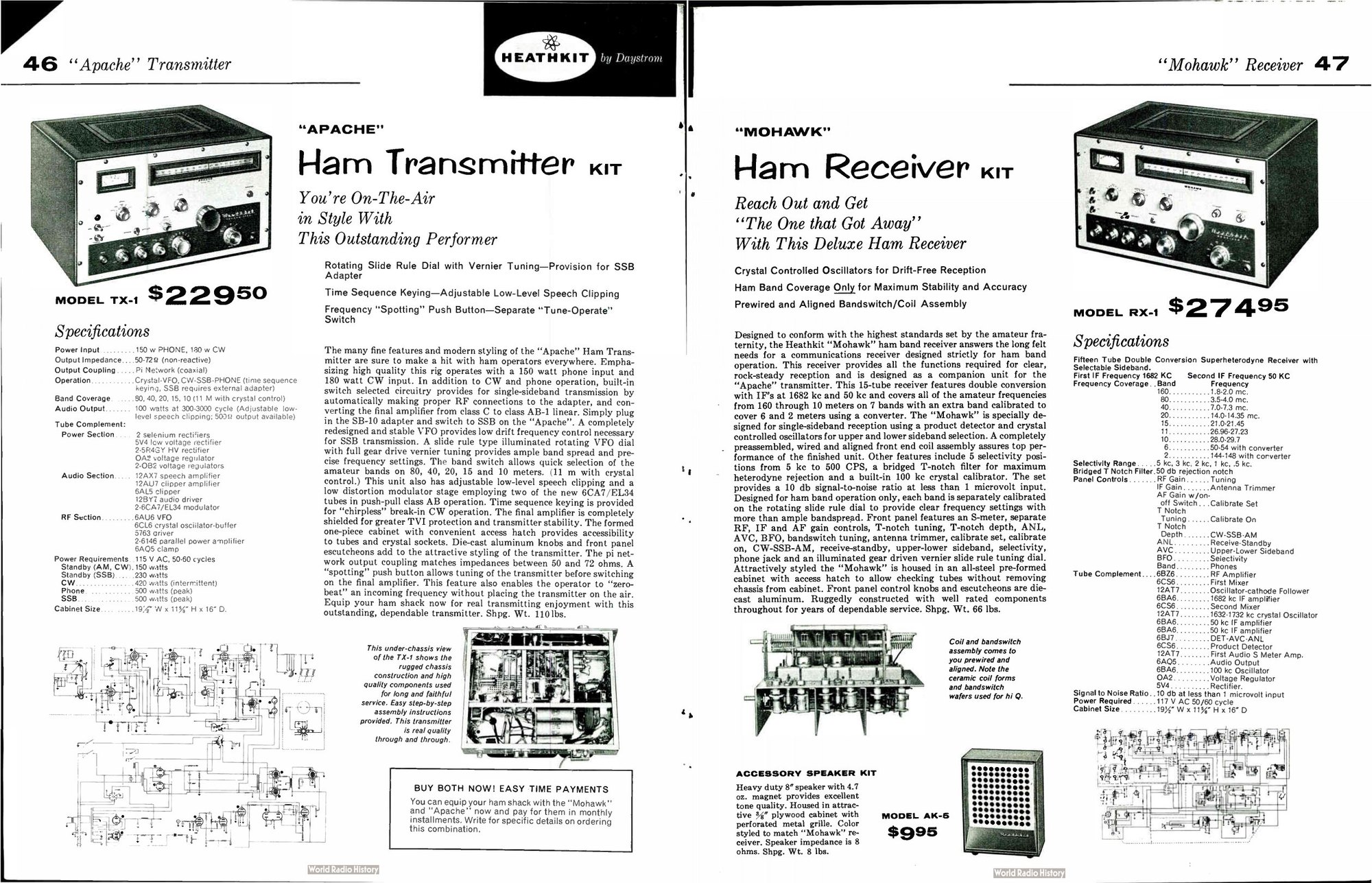
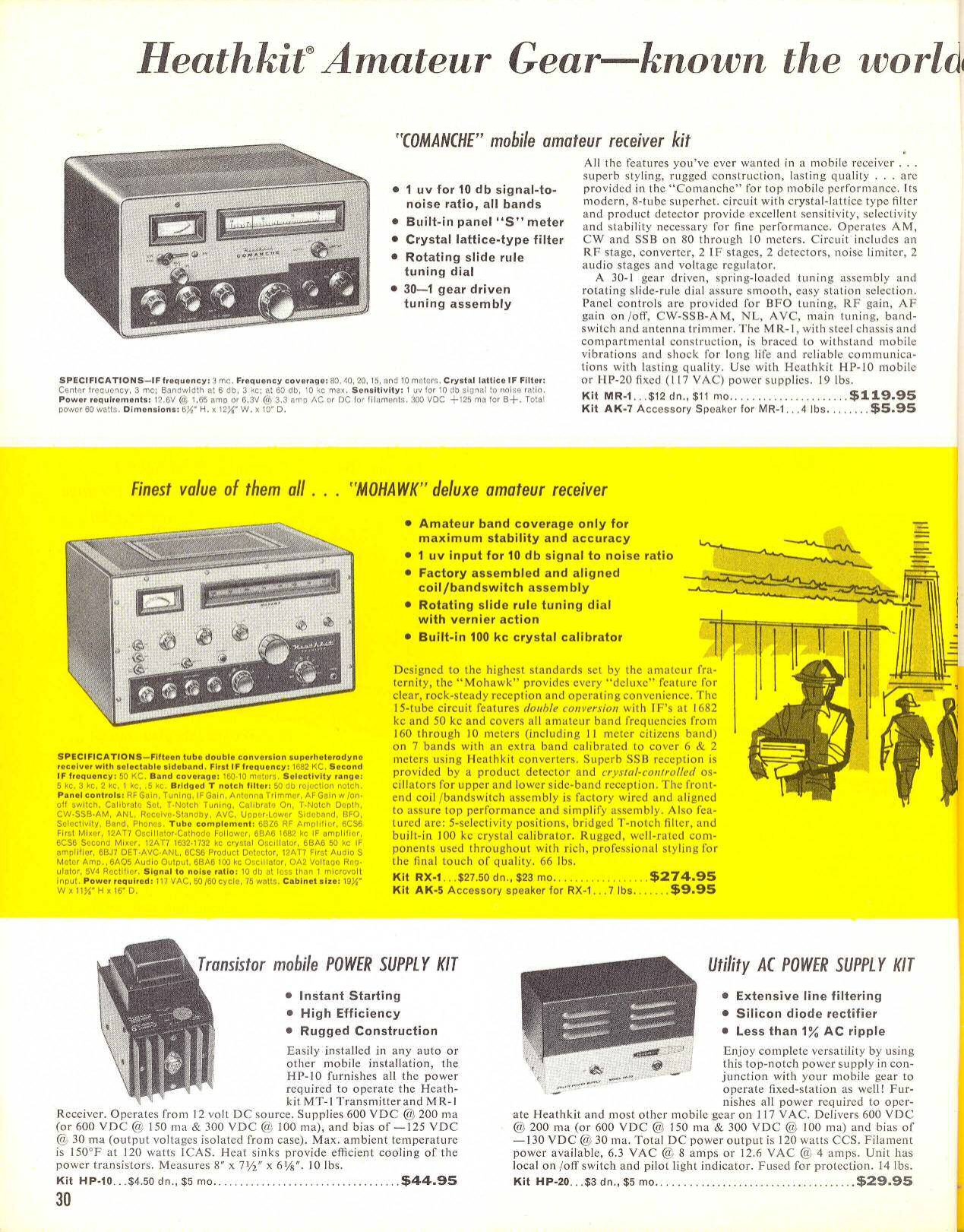
The first tribal station was a matched pair in identical 19½-inch green cabinets. The 1959 catalogue offered the TX-1 “Apache” transmitter at $229.50 and the RX-1 “Mohawk” receiver at $274.95 on facing pages (1959 catalogue, pp. 46–47). The Apache ran 150 watts on phone and 180 on CW, with a pair of 6146 finals, high-level plate modulation from a pair of EL34s, a rotating drum dial that showed only the band in use, and time-sequence keying. It weighed 107 lb, most of it in five pieces of potted iron (Eckweiler, Heathkit of the Month #17).
The Mohawk was more significant. Eckweiler calls it “their first real ham receiver”: a fifteen-tube, double-conversion, ham-bands-only set from 160 through 10 metres, with five steps of selectivity from 5 kHz down to 0.5 kHz, a notch filter, a crystal-controlled second oscillator with switched upper and lower sideband, and a product detector (Heathkit of the Month #14). The AR-series receivers had been general-coverage sets with the ham bands marked on the dial. The Mohawk was designed from the start for single sideband, which was spreading quickly on the HF bands.
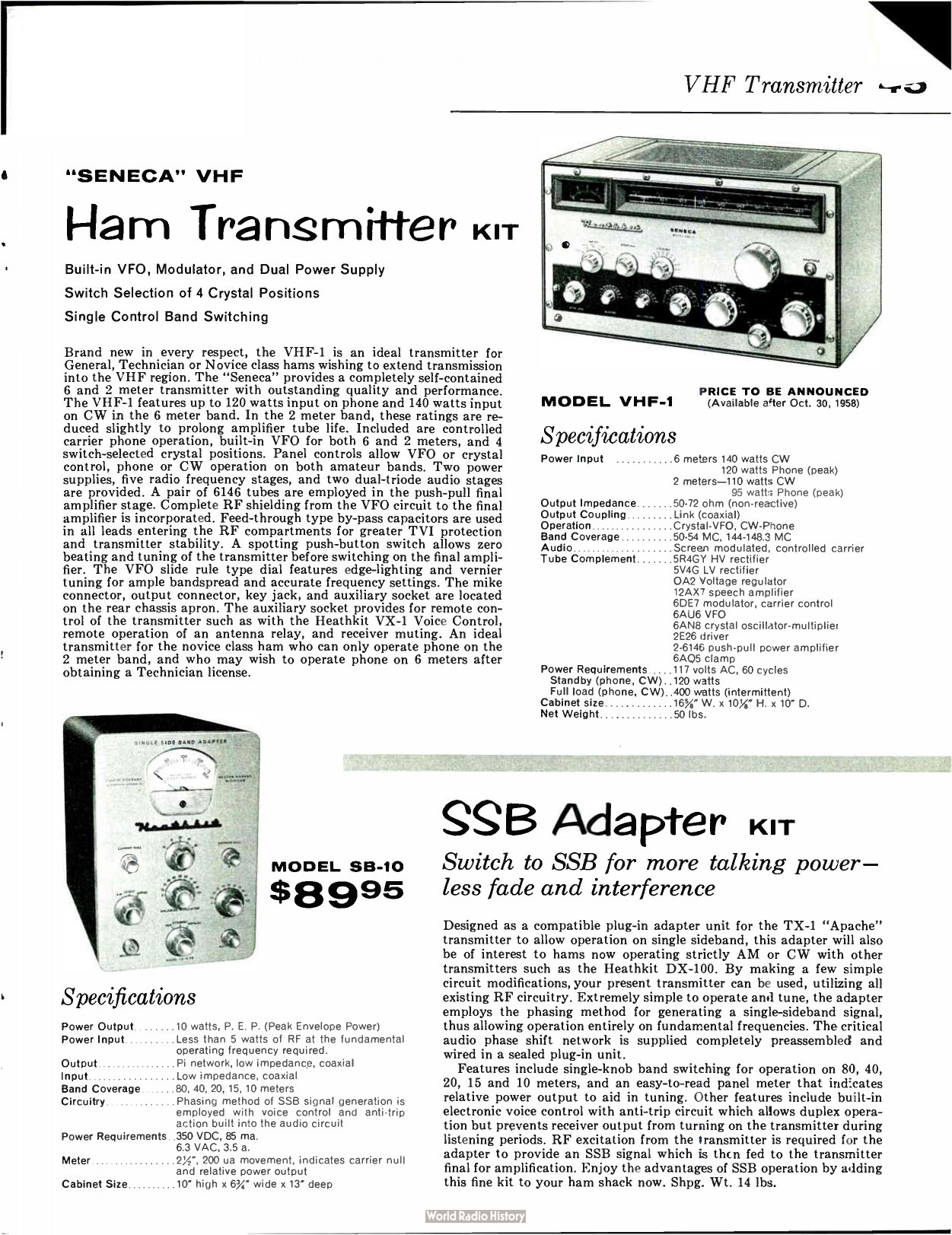
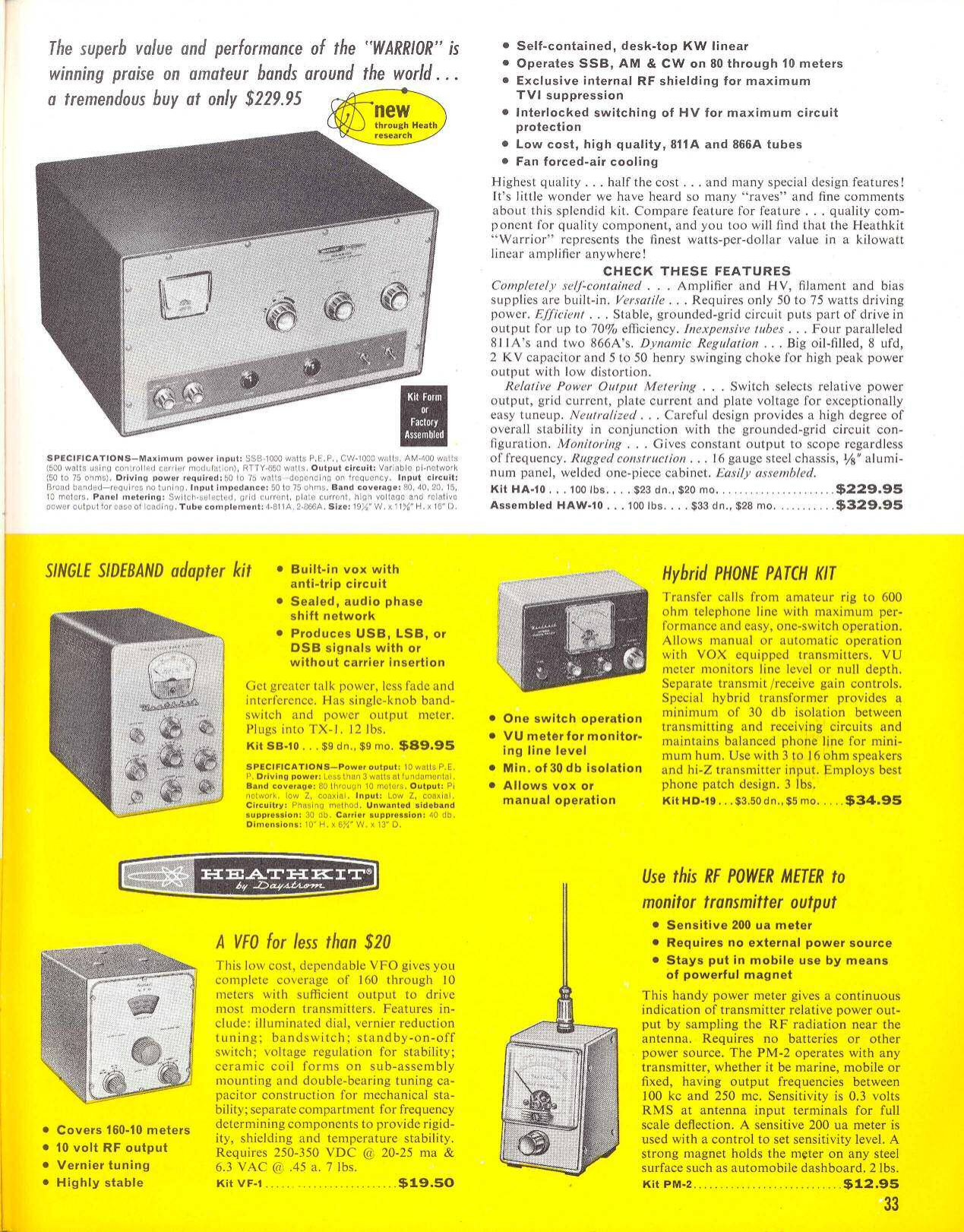
The Apache itself was an AM and CW transmitter. Heath’s answer to sideband was an adapter: the SB-10, at $89.95, “designed as a compatible plug-in adapter unit for the TX-1 ‘Apache’” that would also work with the DX-100 (1959 catalogue, p. 45). It generated SSB by the phasing method, and the Apache’s final switched from class C to class AB1 linear when the mode switch was turned to SSB. Eckweiler notes the choice of “phasing technology rather than filtering technology” (Heathkit of the Month #30). Phasing avoided the cost of a crystal filter, but it was harder to keep aligned, and every Heath SSB design after the SB-10 used filters.
The same catalogue introduced the VHF-1 “Seneca”, a six- and two-metre AM and CW transmitter with a built-in VFO and modulator, “available after Oct. 30, 1958” with its price still to be announced; by May 1961 it cost $179.95 (1959 catalogue, p. 45; May 1961 catalogue). The DX-100 was still listed, restyled as the DX-100B at the same $189.50, on a page it shared with the group photograph of Heath’s staff amateurs, “Meet the Hams Who Serve You”.
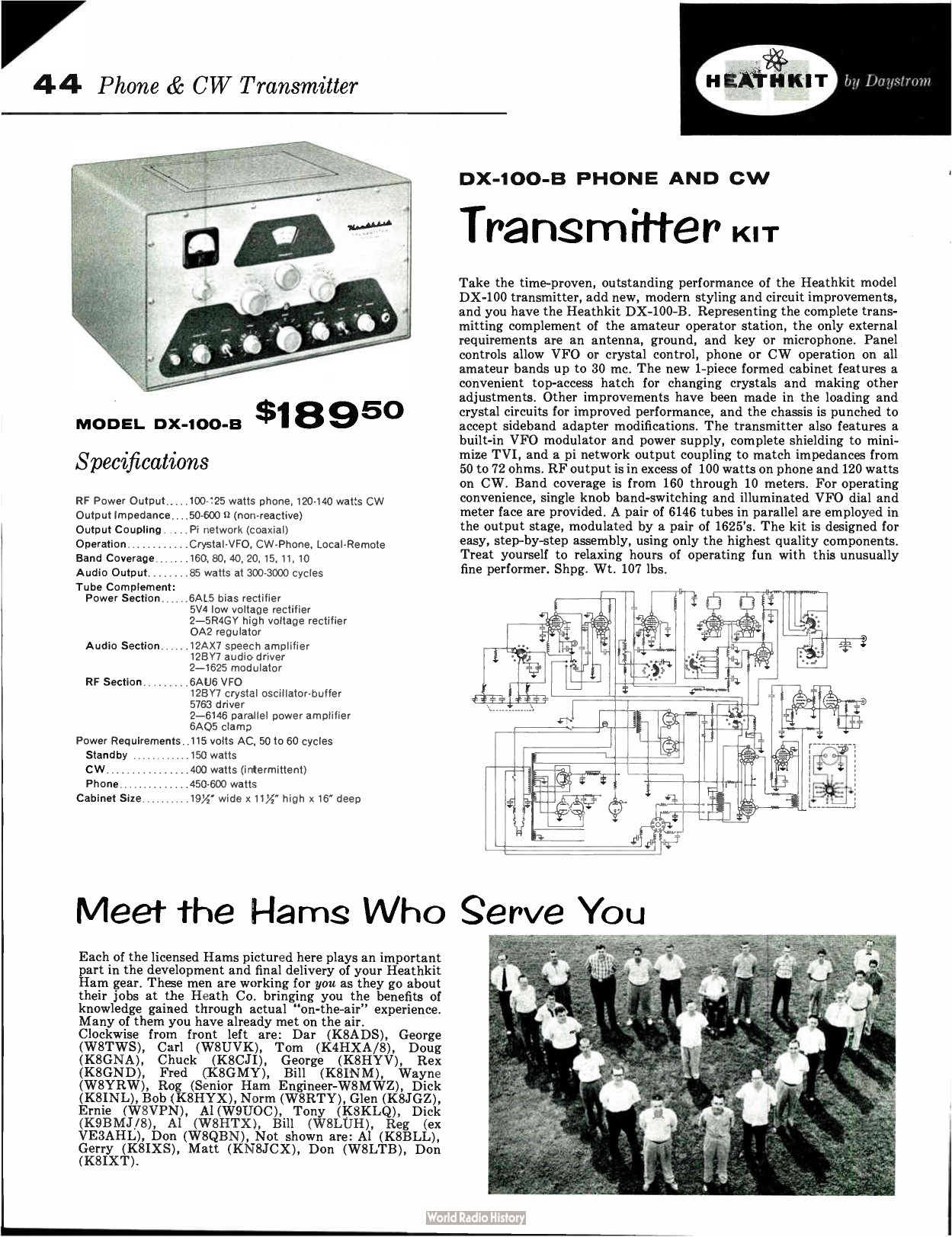
Gilmore’s recollection places the Apache and Mohawk in “the early 1960s” at $252.50 and $299.99 (EEJournal, part 2). The catalogues show both prices were later ones. The Apache rose to $239.95 by May 1961 and $252.50 by the 1962–63 catalogue, where the Mohawk was $299.95 (May 1961; 1962–63 catalogue 81-30). Eckweiler dates both to 1958 (#14), which is consistent with a late-1958 announcement for the 1959 catalogue, and gives 1964 for the end of both.
2.2 Mobile twins and kilowatts
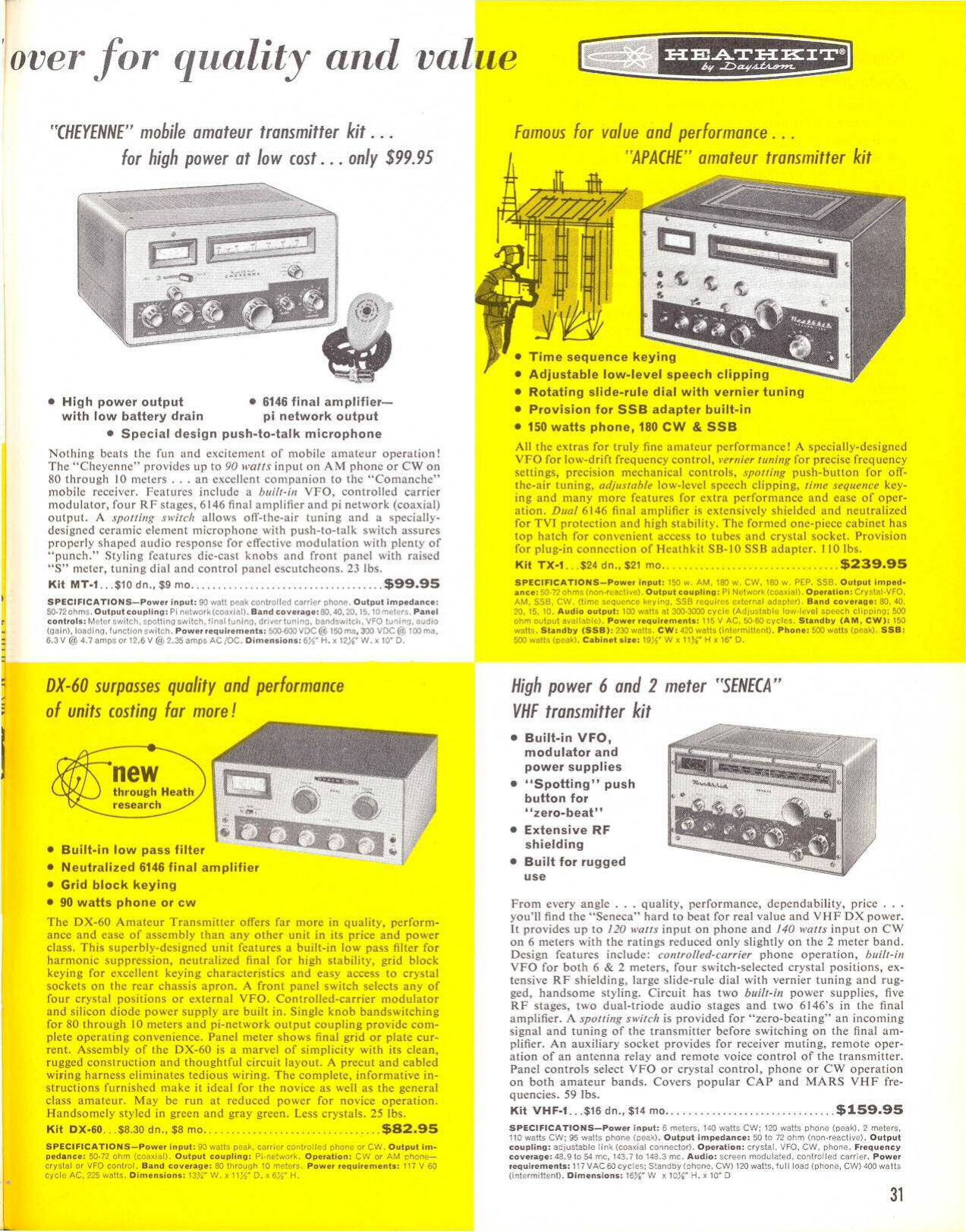
Heath’s first mobile pair followed in 1959: the MT-1 “Cheyenne” transmitter and the MR-1 “Comanche” receiver, at $99.95 and $119.95 according to Gilmore. They were small enough to mount under a dashboard, 6½ inches high. The Cheyenne was essentially a DX-40 without its power supply, with a VFO added, running 90 watts input on CW and controlled-carrier AM (Eckweiler, #10). A separate supply, the MP-1 and later the HP-10, ran them from a car battery.
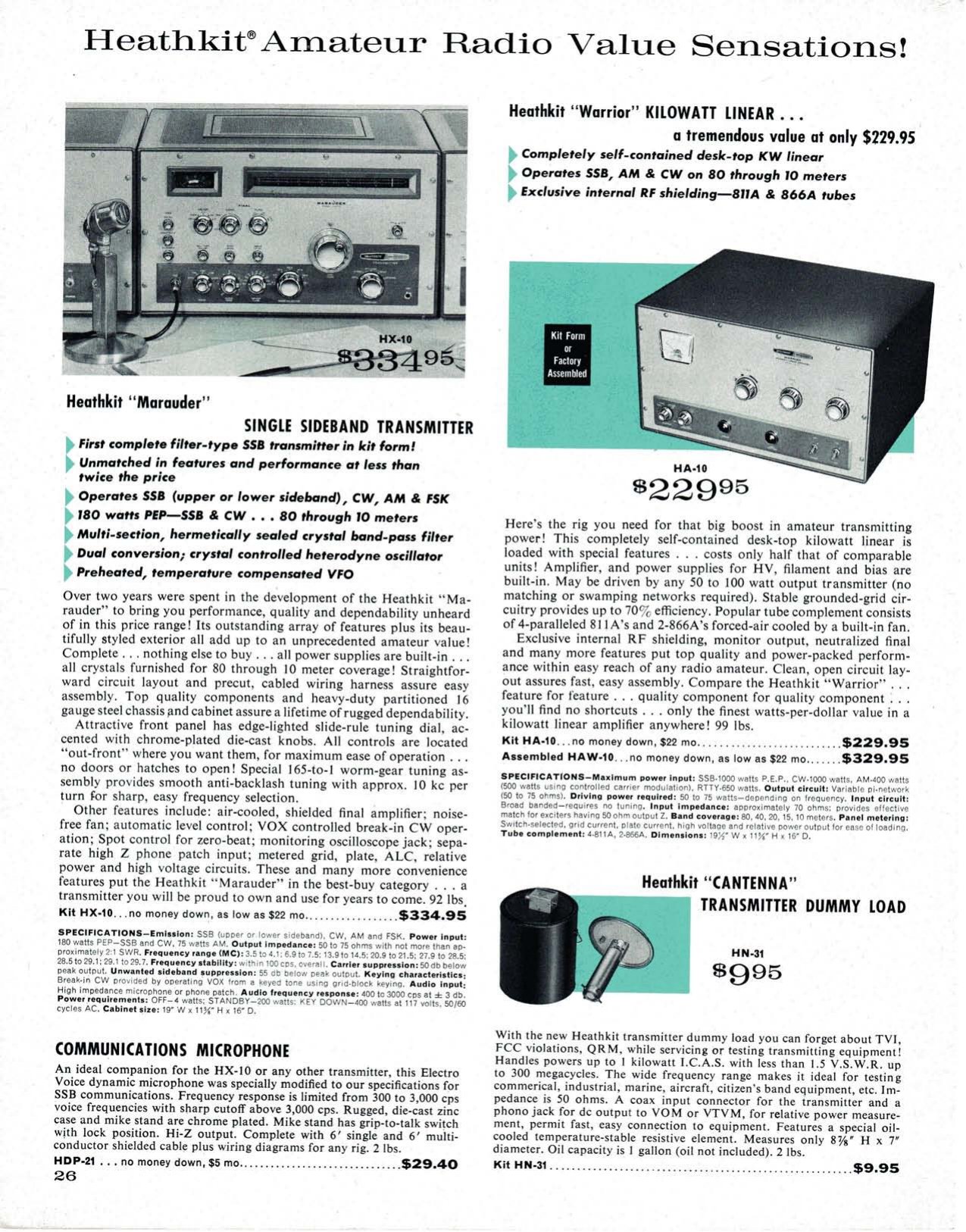
The kilowatt class came next. Eckweiler’s table of Heath’s HF amplifiers begins with the KL-1 “Chippewa” of 1959–1960, a pair of 4-400A tubes that needed the separate KS-1 power supply, and the HA-10 “Warrior” of 1961–1965, four 811A triodes with the supply built in (Heathkit of the Month #33). The Chippewa and its supply appear in the May 1961 catalogue on a page of clearance items marked “Quantities Limited”. The Warrior was “a tremendous buy at only $229.95”, and Heath described it as “the finest watts-per-dollar value in a kilowatt linear amplifier anywhere” (May 1961). Its successors are traced in the Reference volume’s amplifier chart.
2.3 Lunchboxes, Shawnee and Pawnee: VHF for everyone
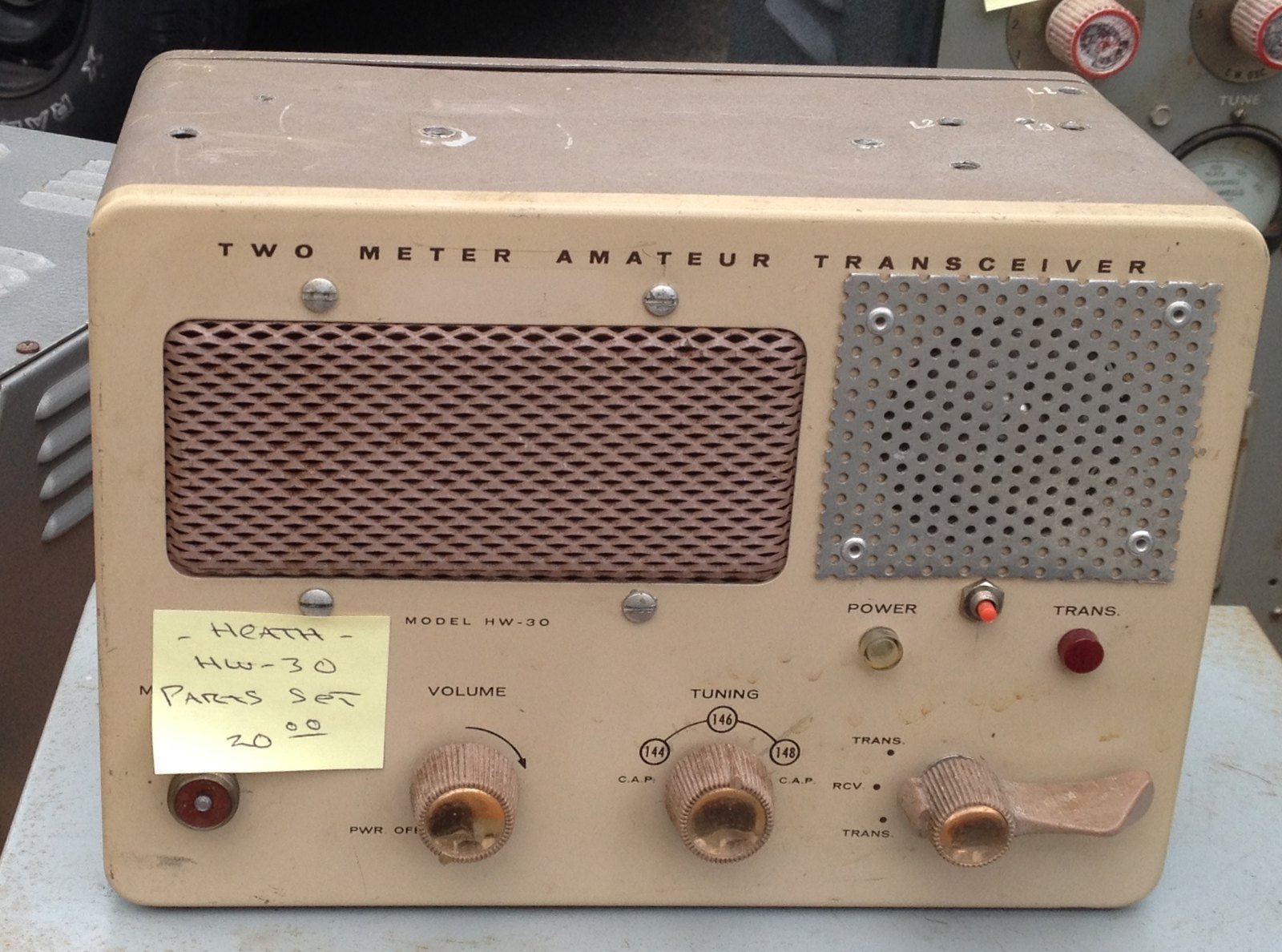
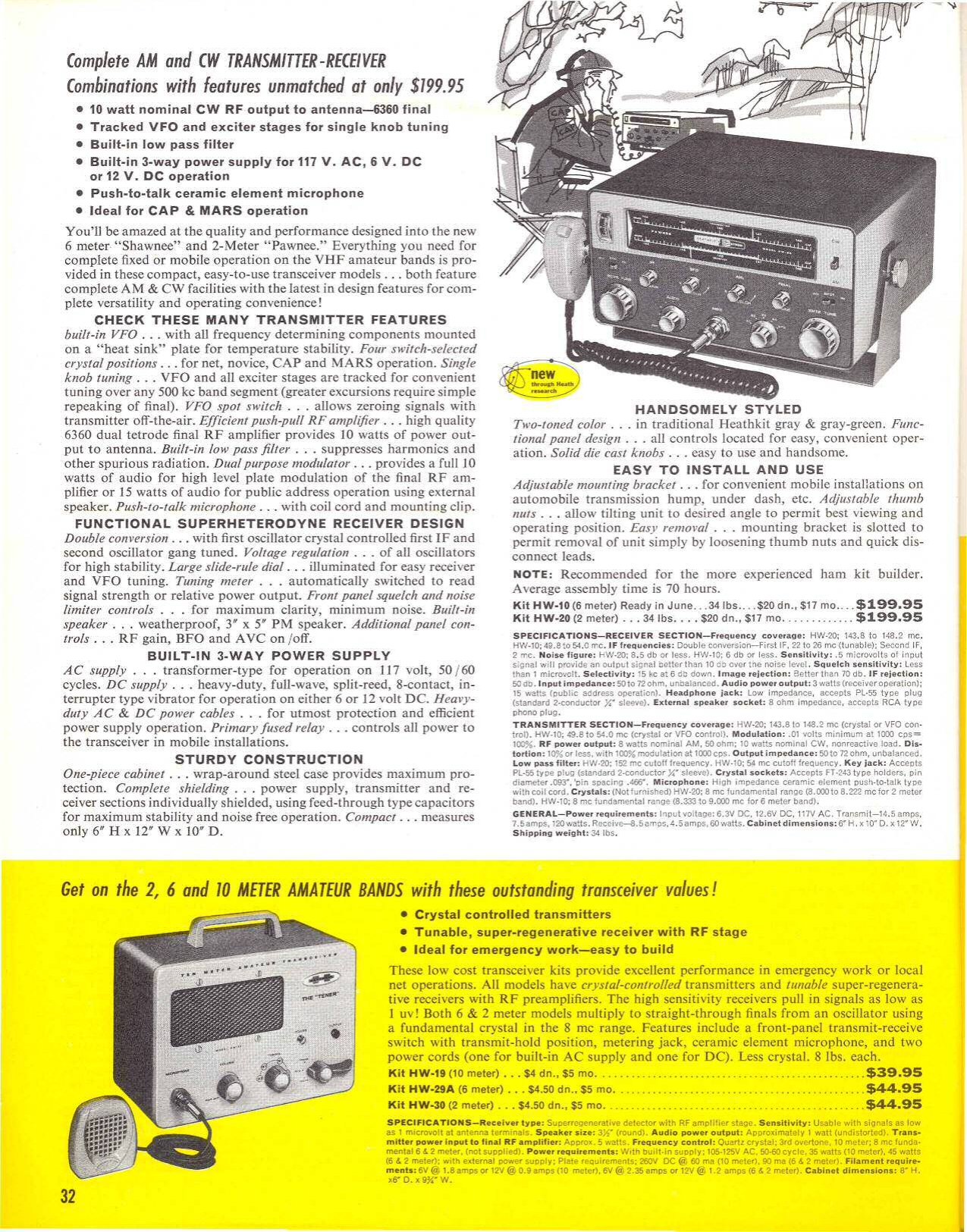
The most distinctive Heath ham products of the early 1960s were the self-contained VHF transceivers that collectors call “lunchboxes”. Gilmore describes them as the “Benton Harbor Lunchbox” series. The first was an 11-metre Citizens Band set, the CB-1, followed by the HW-19 “Tenner” for 10 metres, the HW-29 “Sixer” for 6 metres and the HW-30 “Twoer” for 2 metres. Each had a transmitter of 3.5 to 5 watts, a super-regenerative receiver, a built-in power supply and a microphone, all in one small cabinet with a carrying handle (EEJournal, part 2). The May 1961 catalogue priced the Tenner at $39.95 and the Sixer and Twoer at $44.95 (May 1961). They were cheap enough for a Technician licensee’s first station and simple enough for a first kit. Gilmore also records their weakness: the super-regenerative receiver radiated a signal of its own, which other VHF receivers could hear. The Sixer and Twoer lasted until 1971, a decade after their introduction.
At the top of the VHF line were the HW-10 “Shawnee” for six metres and the HW-20 “Pawnee” for two, each $199.95 in May 1961, when the Shawnee was marked “Ready in June”. The catalogue sold them as “everything you need for complete fixed or mobile operation on the VHF amateur bands”, with AM and CW, a VFO, a crystal-controlled position, and power supplies for both the car and the shack (May 1961). Six-metre SSB followed in 1963 with the HX-30 transmitter ($189.95) and the HA-20 linear amplifier ($99.95); Dar Evans, K8ADS, one of the 1958 “Heath hams”, was the HX-30’s project engineer (May 1963 catalogue, p. 4).
2.4 The Novice line: DX-60, HX-11, HR-10
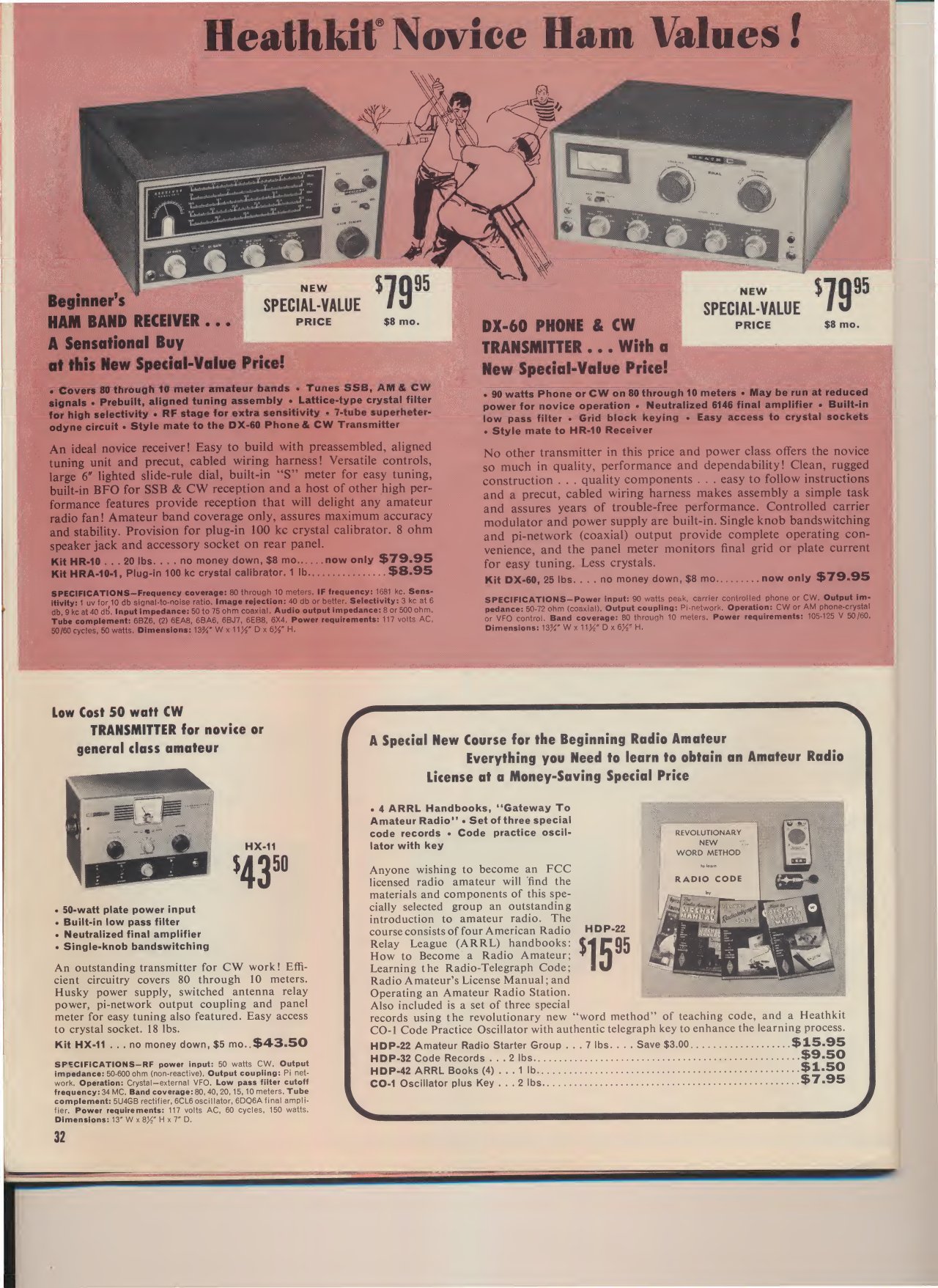
For the beginner, the DX-40 gave way in 1961 to the DX-60, 90 watts input on phone or CW with grid-block keying and a built-in low-pass filter, at $82.95 (May 1961). The CW-only HX-11 replaced the DX-20 at $43.50; Eckweiler describes it as nearly identical in circuit but with a built-in low-pass filter and a new cabinet (Heathkit of the Month #3). The HR-10, announced in the Fall–Winter 1961–62 catalogue at $82.95, the same price as the DX-60, filled what Eckweiler calls “a receiver gap”. Until then a Heath buyer could choose between the aged AR-3, the $300 Mohawk and the mobile MR-1. The HR-10 was a basic ham-bands-only receiver for 80 through 10 metres, single-conversion with a high 1,681 kHz IF and a half-lattice crystal filter, styled to match the DX-60 (Heathkit of the Month #132). Eckweiler counts 52 significant amateur products released by Heath before it. The HG-10 VFO ($34.95) completed the set. In the 1962–63 catalogue the DX-60 and HR-10 were each cut to a “new special-value price” of $79.95 (1962–63 catalogue). In their DX-60B and HR-10B forms the pair stayed in the catalogue until 1976 and 1975, which made them the longest-lived Heath station of all.
2.5 The Marauder and mobile sideband, 1962
Heath’s first filter-type SSB equipment arrived in 1962. The HX-10 “Marauder” transmitter, $334.95, appears in the March 1962 catalogue and in the 1962–63 catalogue, whose copy claims more than two years of development and calls it the “first complete filter-type SSB transmitter in kit form”. It ran 180 watts PEP on SSB and CW on 80 through 10 metres, with AM and FSK as well, a multi-section crystal band-pass filter, a crystal-controlled heterodyne oscillator and a temperature-compensated VFO (1962–63 catalogue). It was styled to match the Apache and Mohawk, but it used low-level modulation on AM and was an interim design. Eckweiler dates it to 1962–1965 (Heathkit of the Month #17).
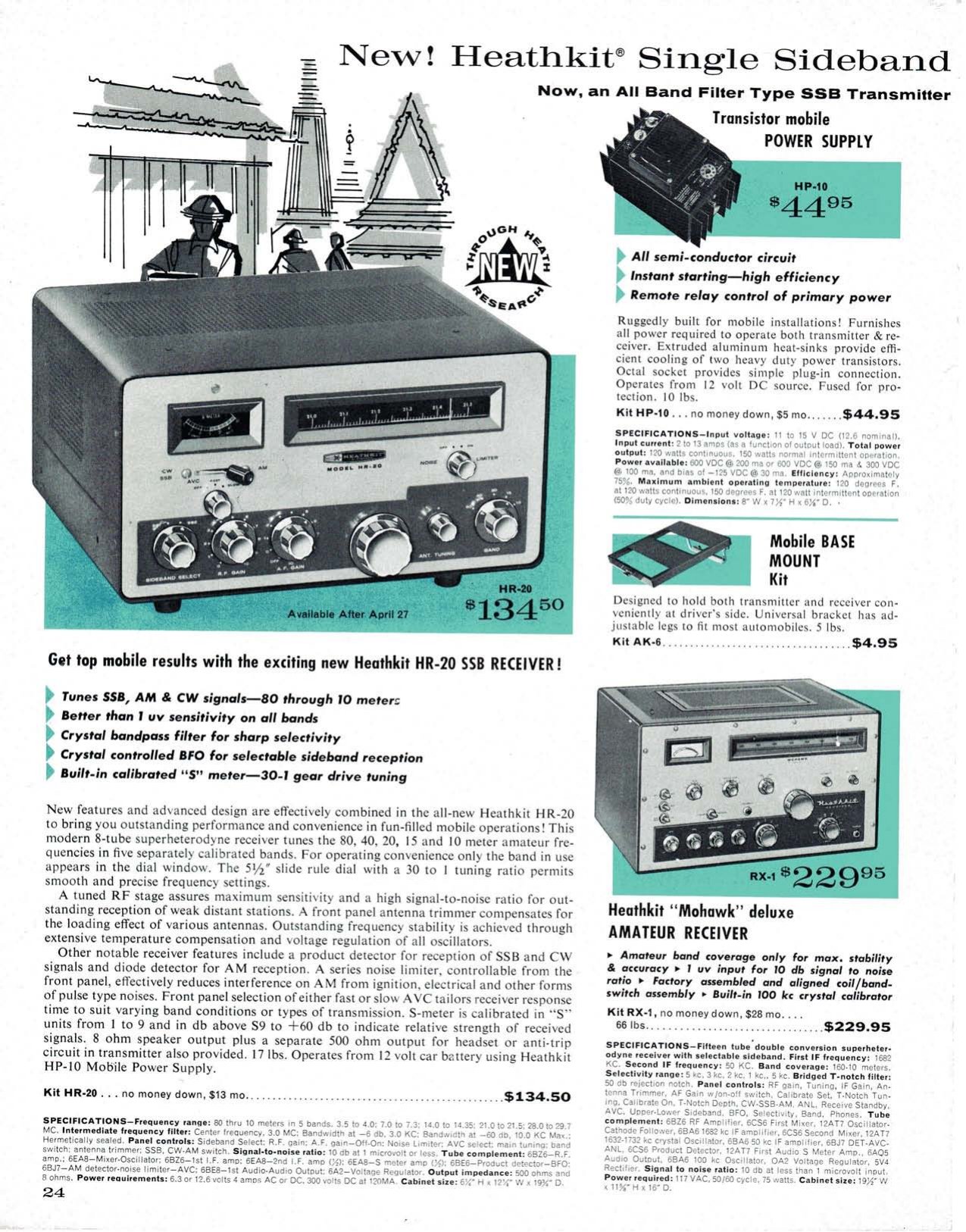
The same catalogue replaced the Cheyenne and Comanche with a sideband mobile pair, the HX-20 transmitter ($199.95) and the HR-20 receiver ($134.50). Eckweiler notes that the HX-20 was “almost totally redesigned” and shared little with the Cheyenne. It used a single VFO tuning from 5.5 MHz down to 5.0 MHz, with every other oscillator crystal-controlled and no frequency multiplication (Heathkit of the Month #11). That arrangement, a 5.0–5.5 MHz tuning oscillator heterodyned against crystals, is the frequency scheme of the SB line two years later.
2.6 The Cantenna
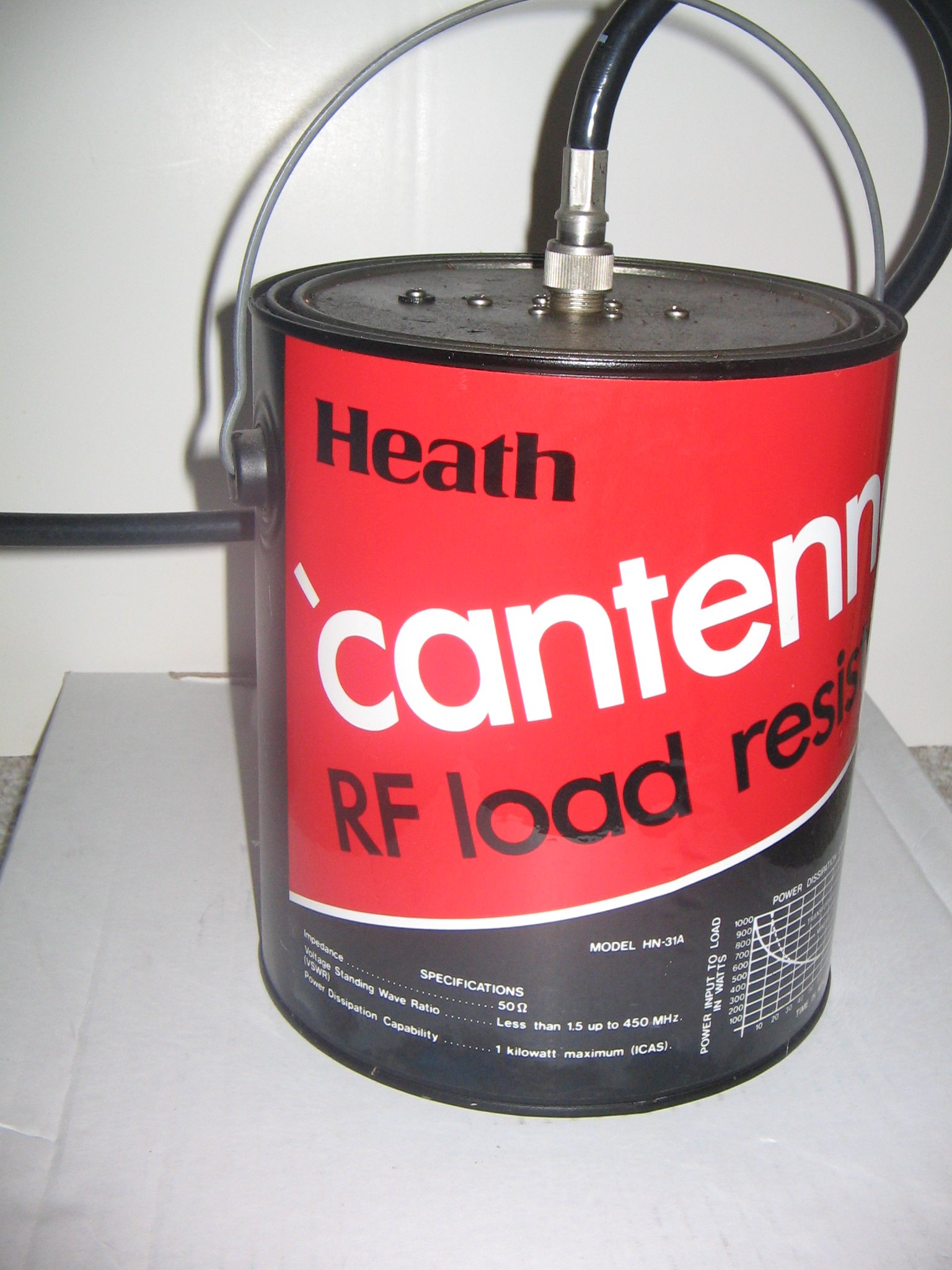
One modest accessory from these years outlived every radio. The HN-31 “Cantenna”, introduced in 1961 at $9.95, was a 50-ohm dummy load: a non-inductive resistor mounted under the lid of a one-gallon paint can filled with transformer oil. Eckweiler records that it would take a full kilowatt for nine or ten minutes and keep the SWR below 1.5:1 up to 450 MHz, and that early cans were plain black, with printed graphics added later (Heathkit of the Month #20). Gilmore adds that one of Heath’s engineers designed it “knowing nothing about amateur radio”, that it sold “more than a couple of hundred thousand” over thirty years, and that the price eventually rose to $24.95 (EEJournal, part 2). It was redesigned as the HN-31A in 1983 and was still in the Winter 1991 catalogue (Winter 1991). No other Heath amateur product was sold for as long.
2.7 The Singlebanders, 1963
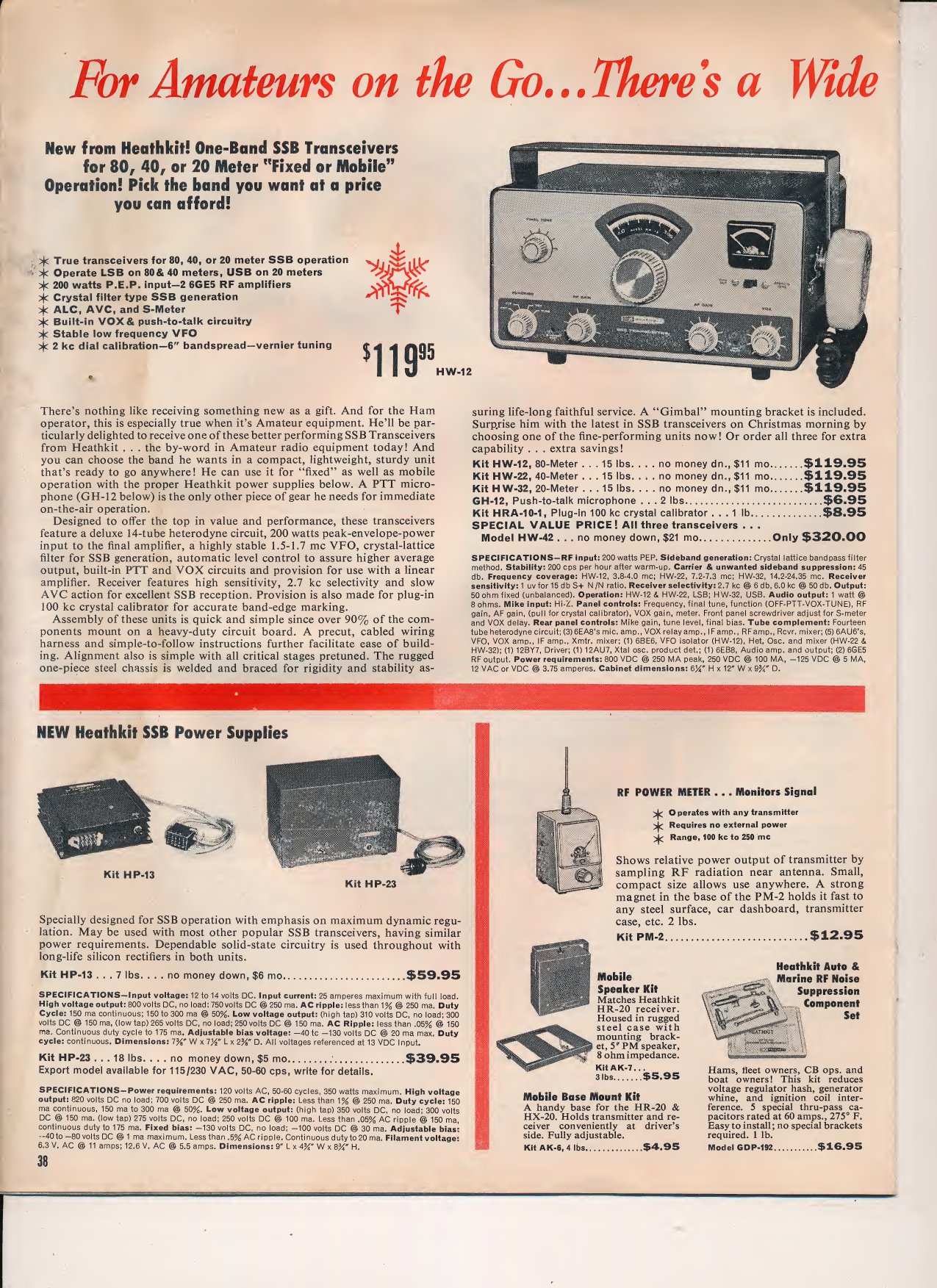
The last new line of this period was the one that pointed furthest ahead. In late 1963 Heath introduced three single-band SSB transceivers: the HW-12 for 75 metres, the HW-22 for 40 and the HW-32 for 20. Each worked on one band and one sideband, at 200 watts PEP input, from an external supply such as the HP-23 or the HP-13 mobile supply, and each cost $119.95 (Eckweiler, Heathkit of the Month #70; catalogue 80-34). Eckweiler recalls that “orders quickly exceeded Heathkit’s production rates, creating a backlog”. Gilmore’s account adds the engineering point: the whole transceiver, receiver and 100-watt transmitter together, was built on a single circuit board, which some at Heath had said could not be done (EEJournal, part 2).
The Singlebanders put a sideband transceiver within reach of a DX-60 buyer, and they established the HW (“Heathkit ham”) prefix as the name of Heath’s economy transceivers. The improved HW-12A, HW-22A and HW-32A of 1966 were cut to about $99 and lasted until 1974. The prefix itself had first appeared on the lunchboxes and on the Shawnee and Pawnee in 1960–61.
2.8 “Big things are coming”
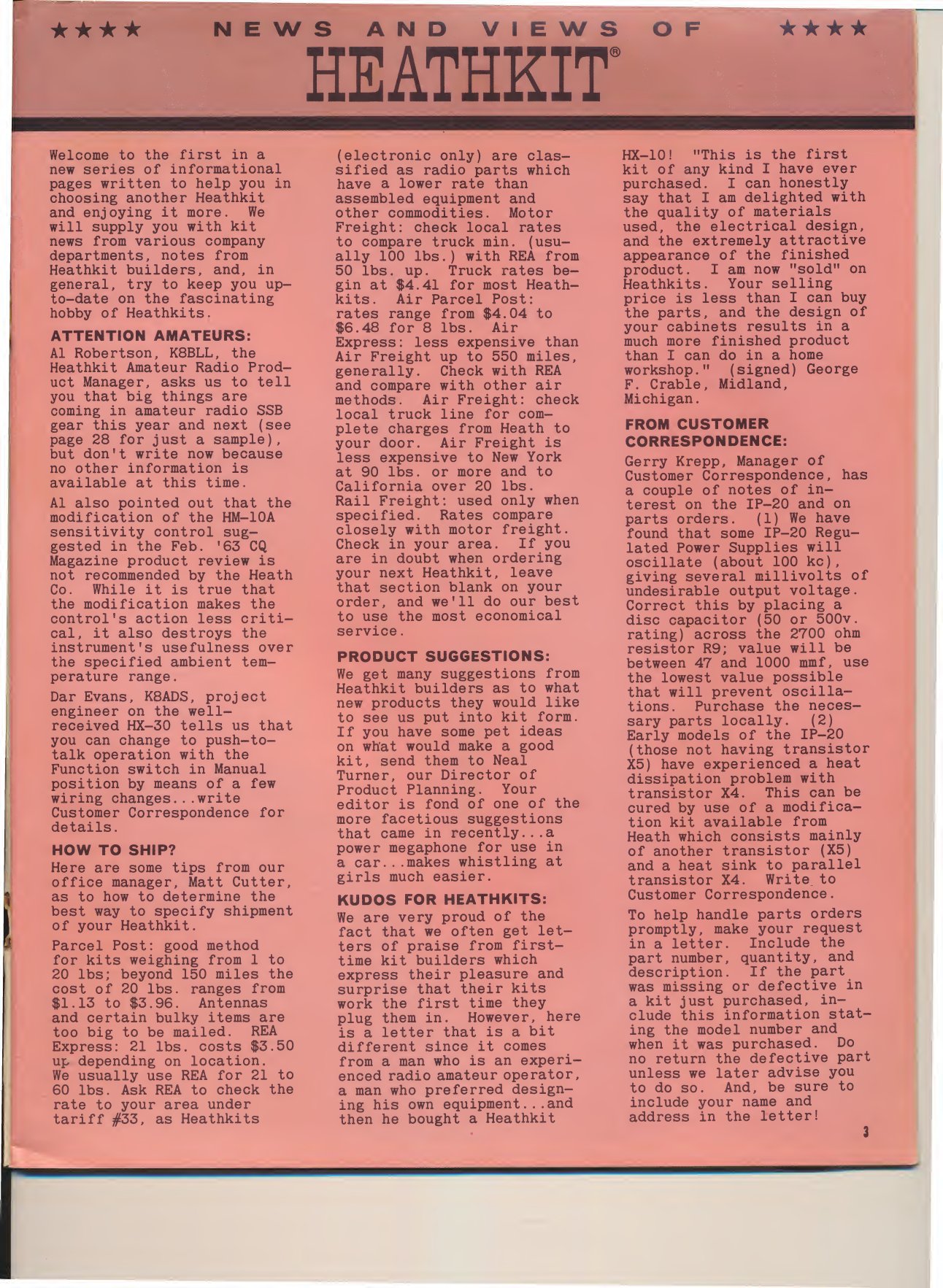
By the spring of 1963 the tribal station was ageing. The Apache still needed an adapter to transmit sideband, and the Marauder, the Mohawk and the Apache were three different designs with three different frequency schemes. A short news column in the May 1963 catalogue, the first of a series called “News and Views of Heathkit”, carried a message from Al Robertson, K8BLL, “the Heathkit Amateur Radio Product Manager”: big things were coming “in amateur radio SSB gear this year and next”, but readers should not write in yet “because no other information is available at this time” (May 1963 catalogue, p. 4). The big things were the SB-300 receiver and SB-400 transmitter, the subject of the next volume.
The period left Heath with the broadest amateur line in the United States and a customer base that reached from the Technician with a Twoer to the General-class operator with an Apache and a Warrior. It also left a lesson. The amateurs who bought the Apache and the SB-10 were being asked to accept a sideband station assembled from parts designed at different times. The SB line was built to avoid that.
Sources
- Heath Company catalogues, World Radio History: 1959 · May 1961 · Fall–Winter 1961 · March 1962 · 1962–63, 81-30 · May 1963 · 80-34, late 1963 · Winter 1991
- Eckweiler, Bob (AF6C). Heathkit of the Month, OCARC: #3 DX-40 · #10 MR-1/MT-1 · #11 HR-20/HX-20 · #14 RX-1 · #17 TX-1 · #20 HN-31 · #30 SB line · #33 SB-200 · #70 HW-12/22/32 · #132 HR-10B
- Leibson, Steven, with Chas Gilmore, Chuck Penson and Terry Perdue. “‘H’ is for Heathkits and Hams, Part 2: The 1960s.” EEJournal. Link
Comments (0)