Ham Radio · Volume 4
Solid State and the End of the Line
The last eighteen years of Heath’s amateur line began with its most ambitious kit and ended with a Japanese transceiver in Heath paint. In between, the line moved from tubes to transistors, from dials to digital readouts, and from HF phone to VHF FM, packet radio and low-power CW. It also shrank. A count of amateur model numbers in the catalogues, made for this dive, finds about forty in Christmas 1975, about thirty-five in 1980, twenty-six in Fall 1983 and just over twenty from 1985 to the last catalogue of Winter 1991. The corporate background (Schlumberger’s sale to Zenith in 1979, Zenith Data Systems, the sale to Groupe Bull in 1989 and the end of the kits in March 1992) is told in the company history’s Zenith and Bull volume.
4.1 The SB-104 and its station, 1974
Heath announced the SB-104 in a five-page spread in the amateur magazines of November 1974, at $669.95. It was an all-solid-state SSB and CW transceiver for 80 through 10 metres: a broadband final amplifier of four transistors that needed no tuning, a six-digit counter that read the operating frequency to 100 Hz, and a 13.8-volt supply requirement that suited a car as well as a station. It kept the SB line’s 3.395 MHz IF and 5.0–5.5 MHz VFO, and almost nothing else. It was also the kit that went wrong. Factory service bulletins began in January 1975 and ran to fifty by August 1976, and Heath’s historians later wrote that “virtually none of the SB-104s could meet specifications”. The revised SB-104A of Fall 1977 arrived with a factory-built receiver front end and stayed in the catalogue until the end of 1982. The SB-104A dive tells the story of the rig, its faults and its repair.
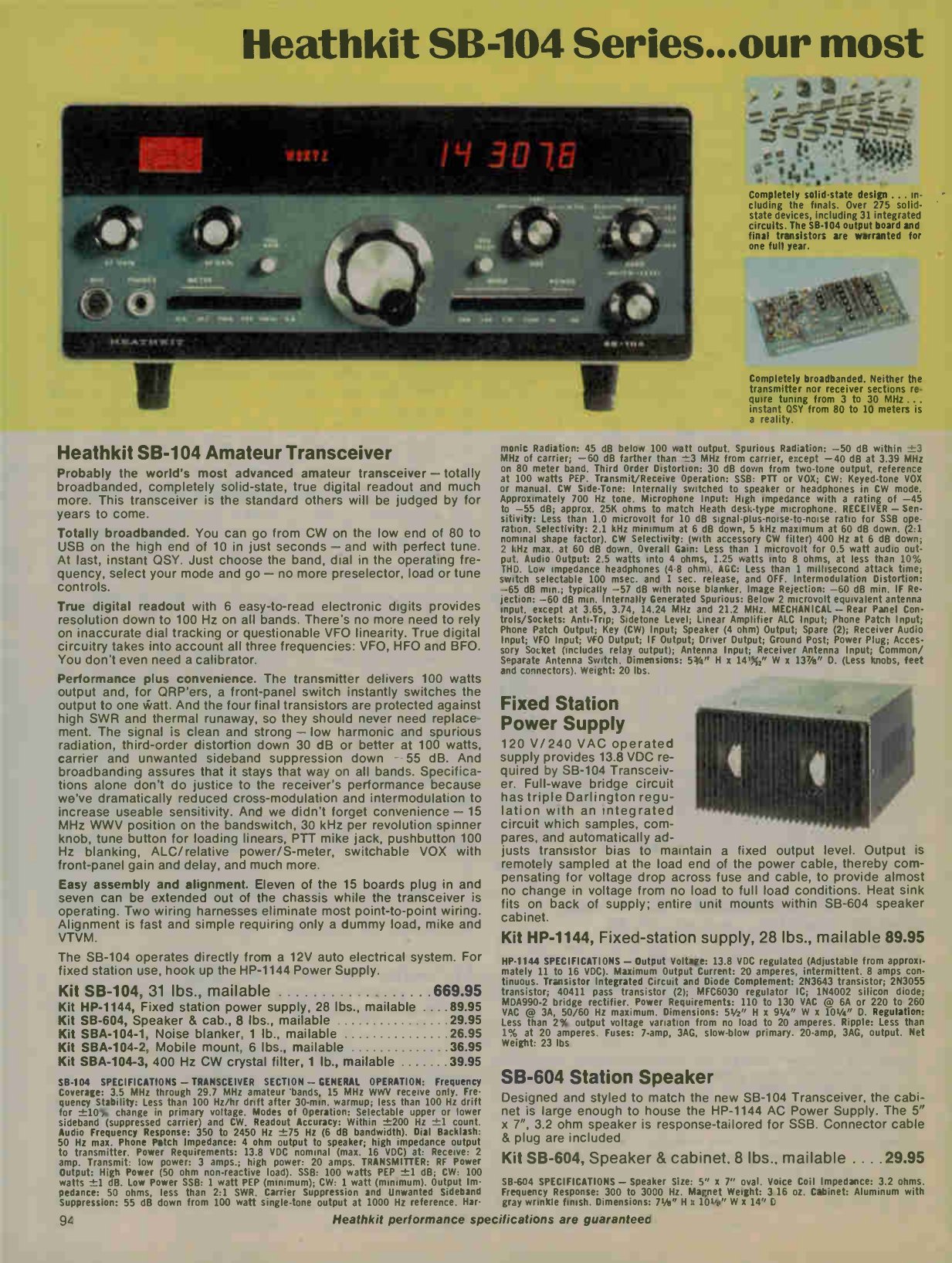
The SB-104 came with a new station in a new style: two-tone grey with a dark-green panel and black stripes. Heath sold the SB-604 speaker with room for the HP-1144 supply inside, the SB-614 station monitor ($139.95), the SB-634 console with clock, timer, wattmeter, SWR bridge and phone patch ($179.95), the SB-644 remote VFO ($119.95) and the SB-230 linear amplifier, a single Eimac 8873 ceramic tetrode cooled by conduction rather than a fan, at $319.95 at launch and $339.95 by Christmas 1975 (Christmas 1975 catalogue; Eckweiler, Heathkit of the Month #30).
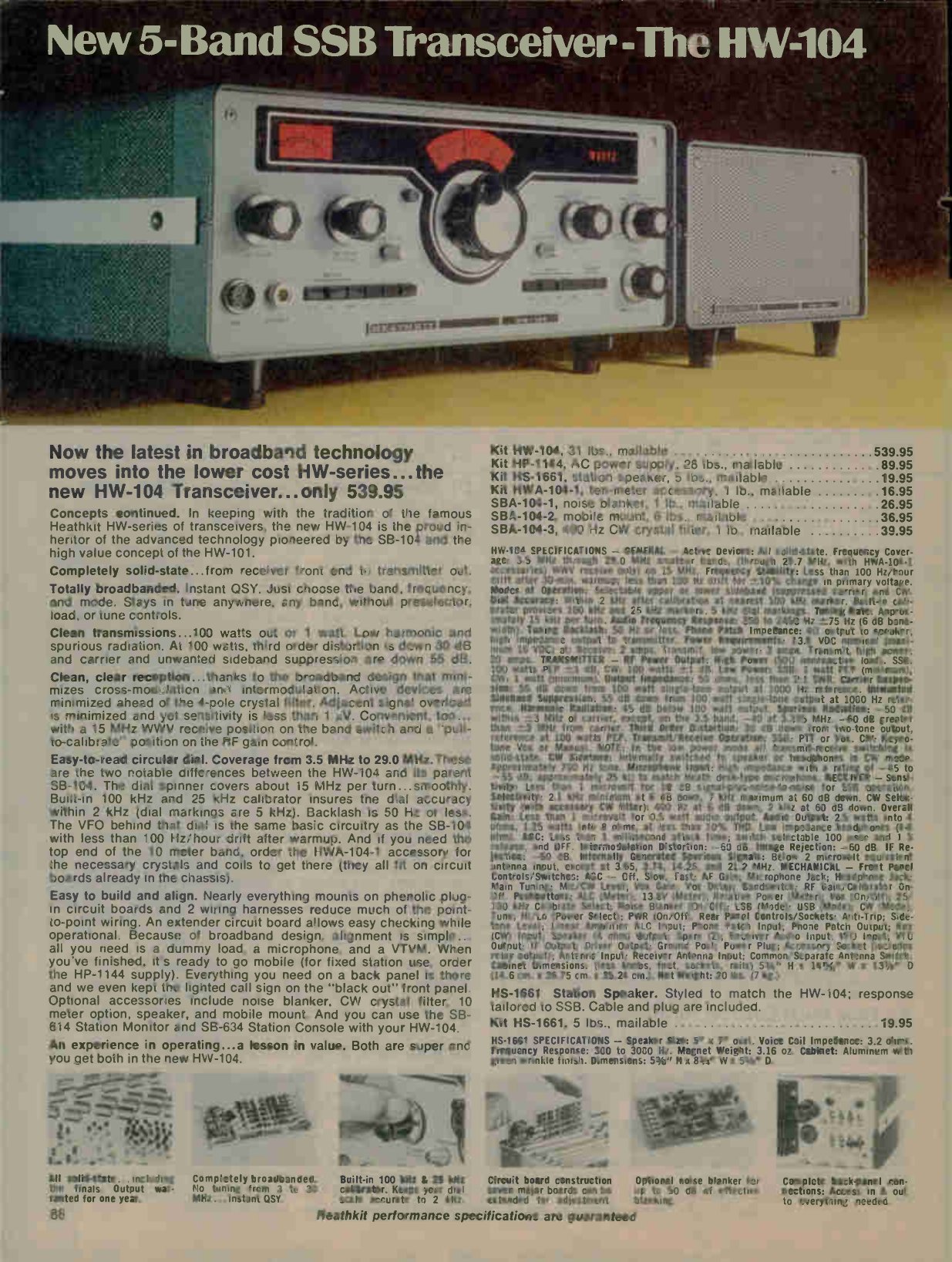
The HW line followed the same pattern as before. The HW-104 of Christmas 1975, $539.95, was the SB-104 without the counter, with a mechanical dial and a crystal calibrator, “proud inheritor of the advanced technology pioneered by the SB-104 and the high value concept of the HW-101” (Christmas 1975, p. 84). It sold for only two years. The tube HW-101, at about half the price, outlived it by six.
4.2 Two metres, FM and the recall
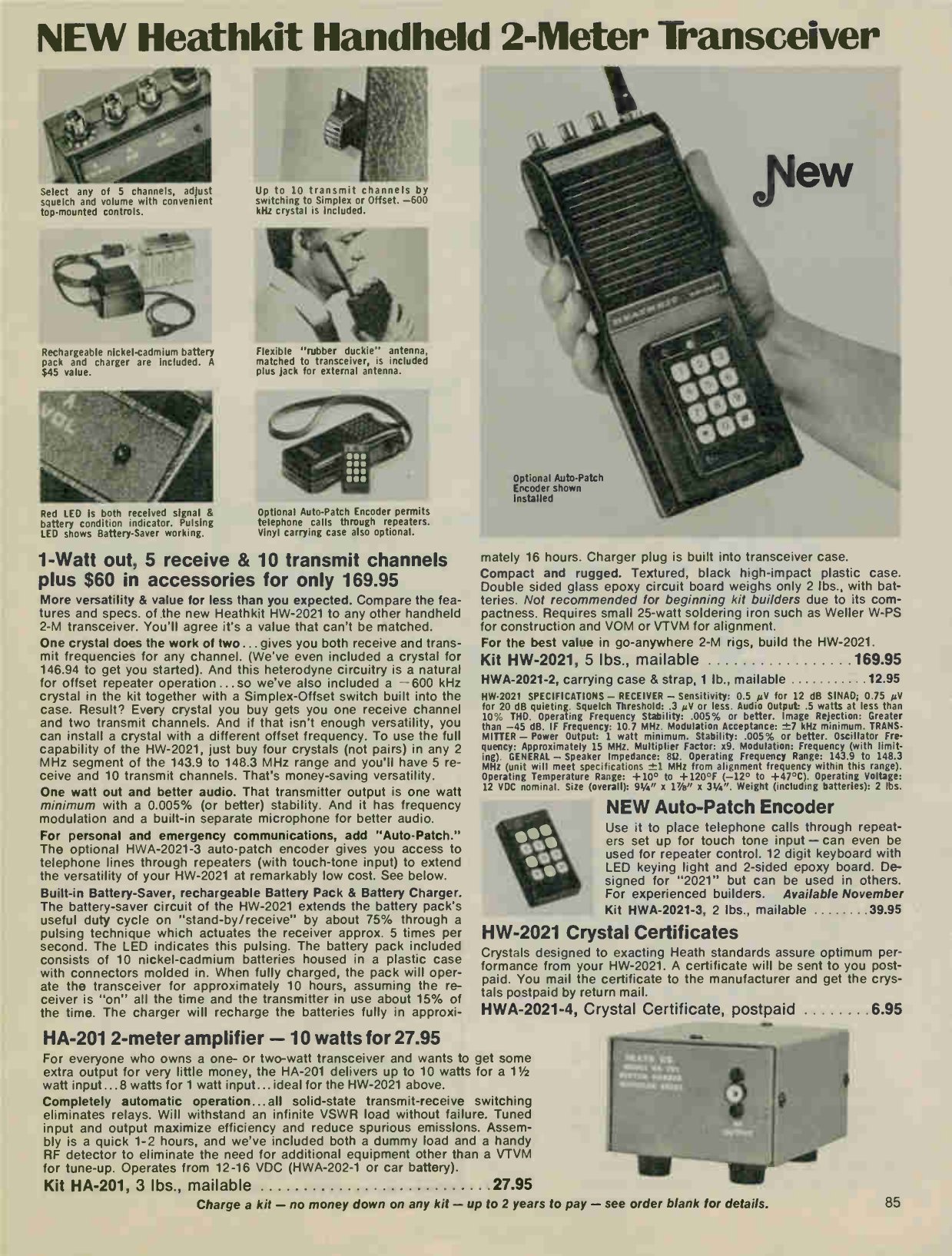
VHF FM through repeaters was the growth market of the 1970s, and Heath’s products for it are the clearest record of what the company could and could not do with digital design. The HW-202 of 1973, a crystal-controlled six-channel two-metre transceiver, was $179.95 in 1975. The HW-2021 handheld of 1975 had one watt, five crystal channels and a built-in autopatch tone encoder; Gilmore calls it “a tough kit to build” because the parts were packed so tightly (Leibson, EEJournal, “‘H’ is for Heathkits and Hams”, part 3).
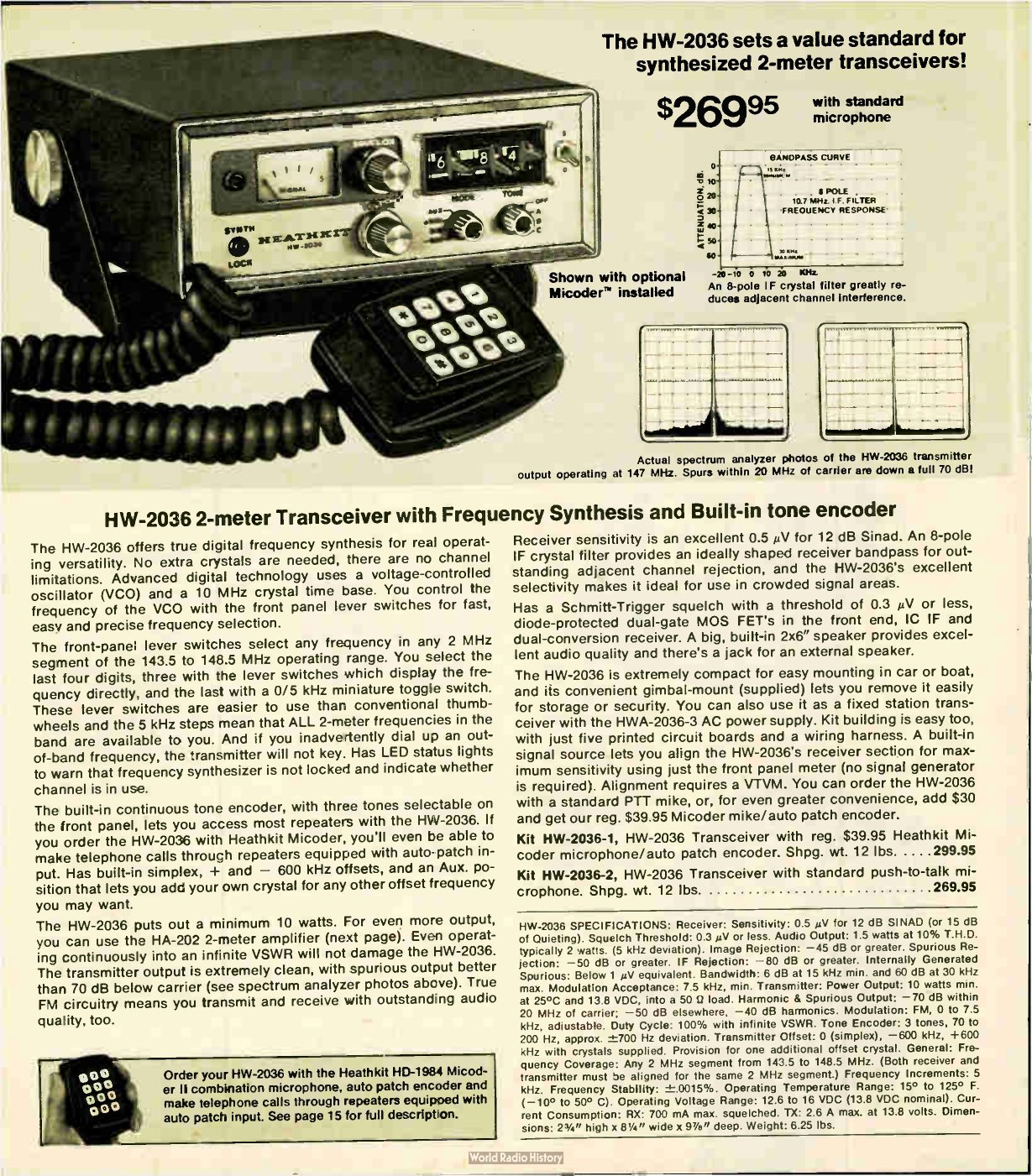
The HW-2026 of Christmas 1975 was the first synthesised Heath rig, with thumbwheel frequency selection, at $289.95. Its synthesiser produced so many spurious signals that it could key several repeaters at once. The first production run was finished on 15 November 1975; within weeks owners were reporting that they were heard where they were not transmitting, and Heath’s engineers concluded that no quick fix was possible. President David Nurse wrote to every factory buyer on 23 December 1975, offering a full refund (Eckweiler, Heathkit of the Month #111). Gilmore calls it “one of the very first, if not the only, major recall ever done for a Heathkit product”, and Eckweiler calls it probably Heath’s biggest kit disaster. The HW-2036 of 1976 replaced it (EEJournal, part 3). The replacement did well: Schlumberger’s 1976 report records that the new synthesised two-metre transceiver set a record for dollar volume for a single product in one quarter (company history, vol. 4). The Fall 1977 catalogue offered the HW-2036 at $269.95, or $299.95 with the “Micoder” touch-tone microphone (Fall 1977). It became the HW-2036A in 1978, and the VF-7401 scanning transceiver and VF-2031 synthesised handheld followed around 1979–81. The HA-201 and HA-202 amplifiers raised the handhelds and mobiles to 10 or 40 watts.
4.3 QRP: the HW-8
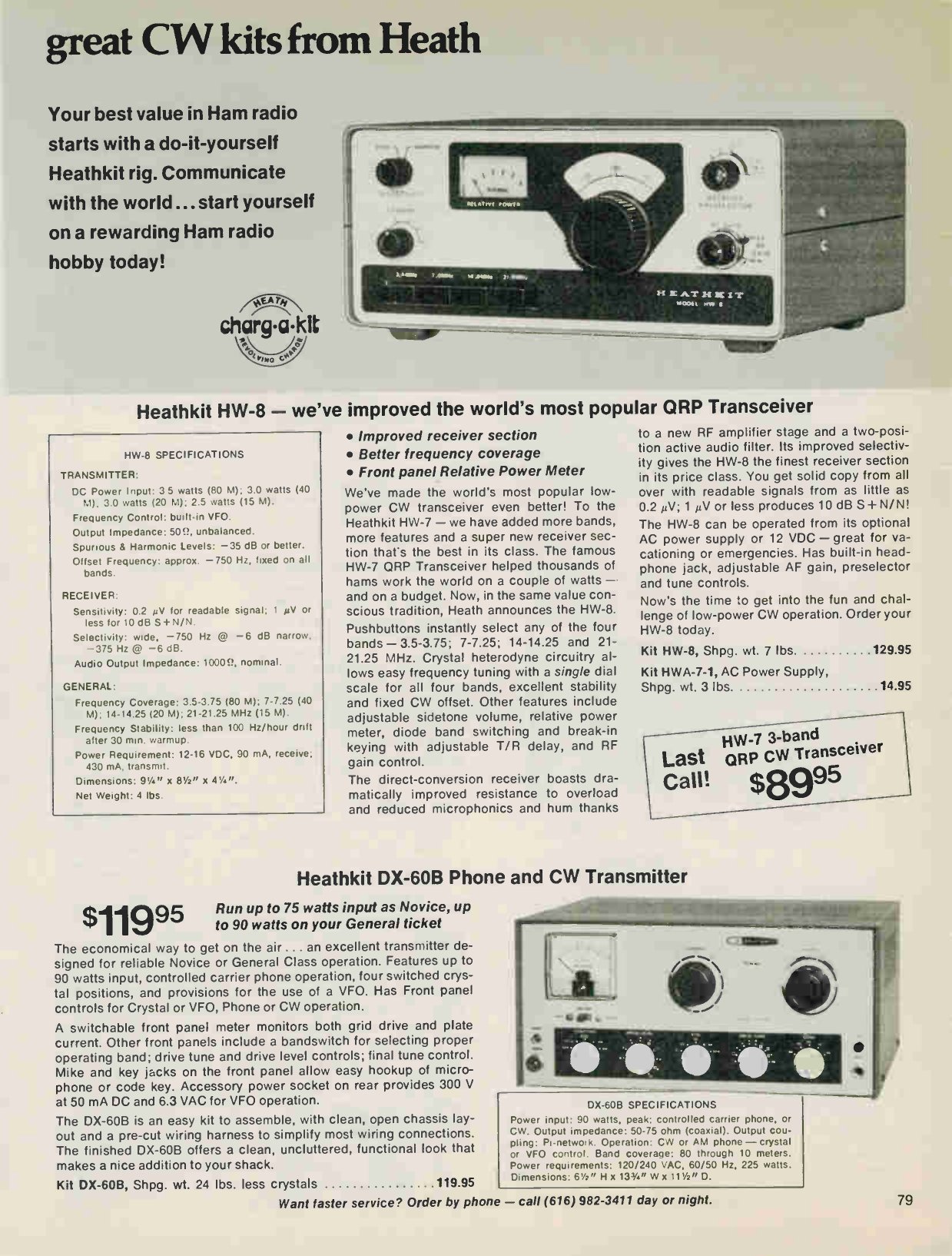
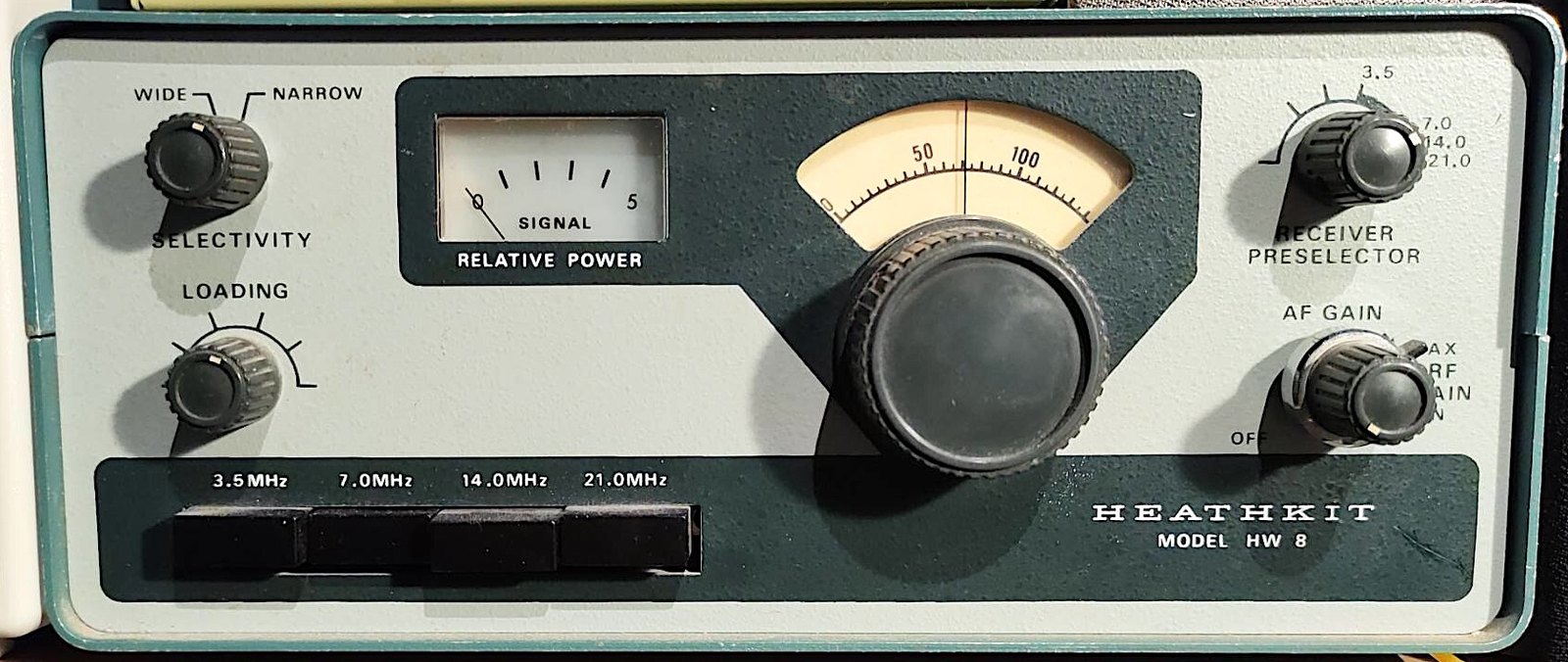
The low-power line begun by the HW-7 in 1972 found its classic form in the HW-8 of 1976. The Spring 1976 catalogue announced it as “Heathkit HW-8 — we’ve improved the world’s most popular QRP transceiver”, at $129.95, on a page headed “great CW kits from Heath” that also offered the HW-7 for the last time (Spring 1976 catalogue, p. 77). It covered the CW portions of 80, 40, 20 and 15 metres at 2.5 to 3.5 watts output, with a direct-conversion receiver built around a JFET RF amplifier, a balanced product detector and an active audio filter with wide and narrow settings (WD8RIF, “Heathkit HW-8”). It stayed in the catalogue until 1983. Among low-power operators it acquired, in one modern writer’s phrase, “a certain mystique among QRP enthusiasts” (Matt, W6CSN, “Vintage QRP with the Heathkit HW-8”, 2026).
Its successor, the HW-9 of 1984 ($249.95), was a superheterodyne with broadband circuits, receiver incremental tuning and up to 4 watts output. It covered the lowest 250 kHz of 80, 40, 20 and 15 metres, and the HWA-9 band pack added 10 metres and the new WARC bands at 30, 17 and 12 metres (Fall 1984; Summer 1990, p. 74). Matching accessories, the HFT-9 antenna tuner ($54.95) and the HM-9 QRP wattmeter ($49.95), followed. The HW-9 was still in the Winter 1991 catalogue at $249.95, one of the last Heath-designed ham kits on sale. It is on the list of titles that Tubular Electronics believes are still in copyright, which is why its manual is not among those this site will host (Tubular Electronics).
4.4 The Novice station, 1977–1987
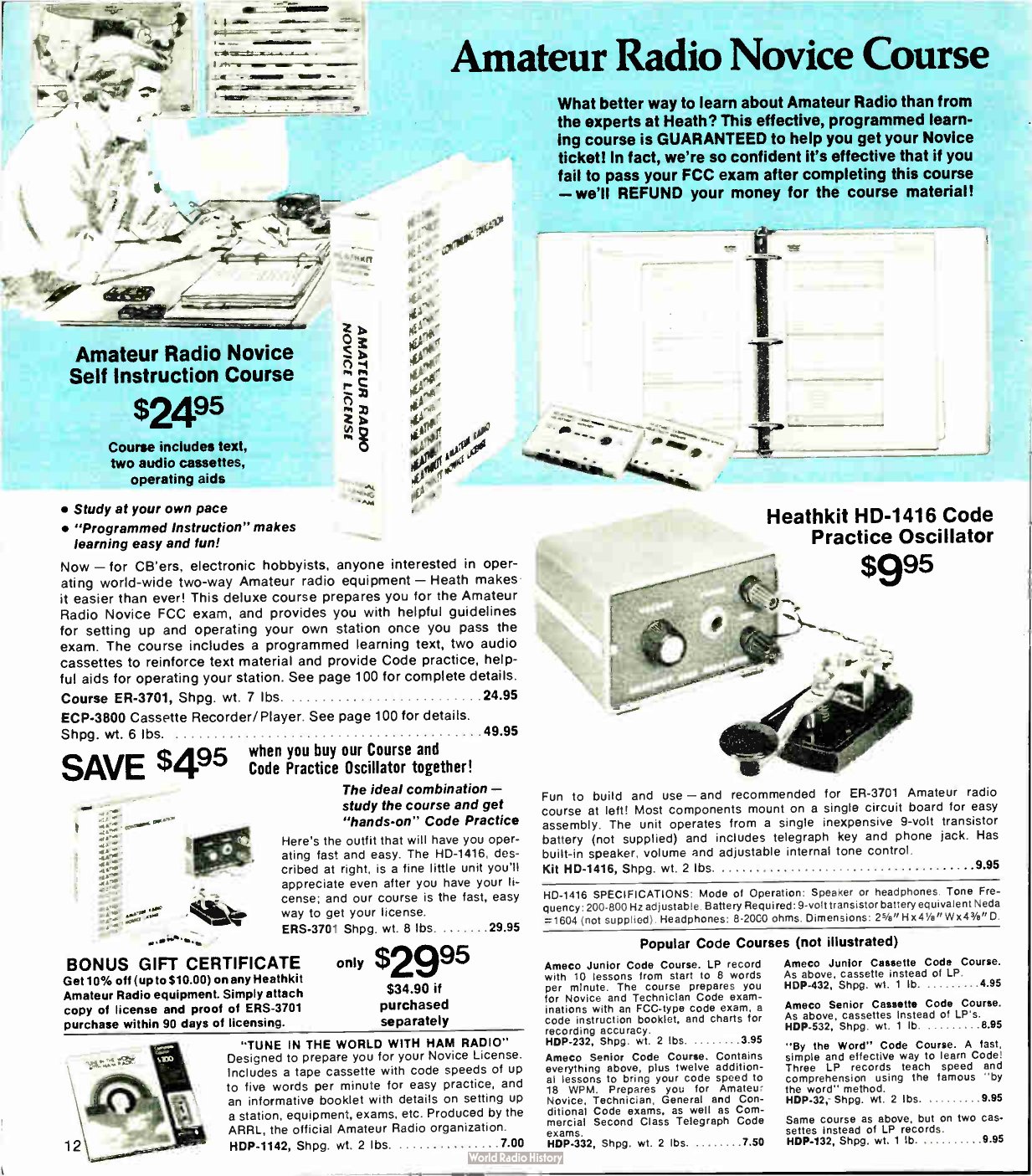
Heath kept a Novice station in the catalogue to the end, and supported it with teaching material. The Fall 1977 catalogue opened its amateur section with an “Amateur Radio Novice Course” at $24.95, guaranteed to get the buyer through the licence examination, beside the HD-1416 code-practice oscillator (Fall 1977, p. 12).
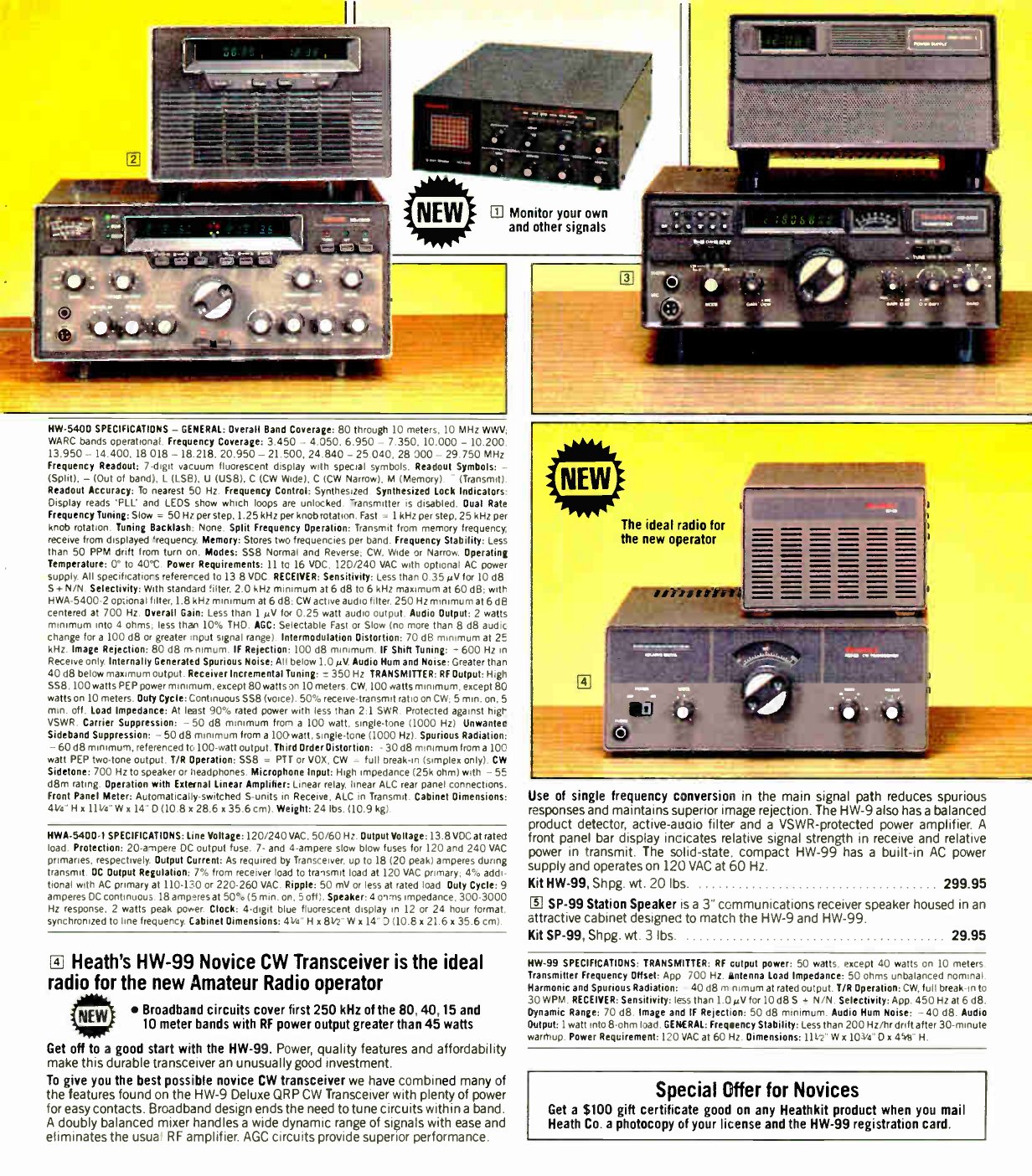
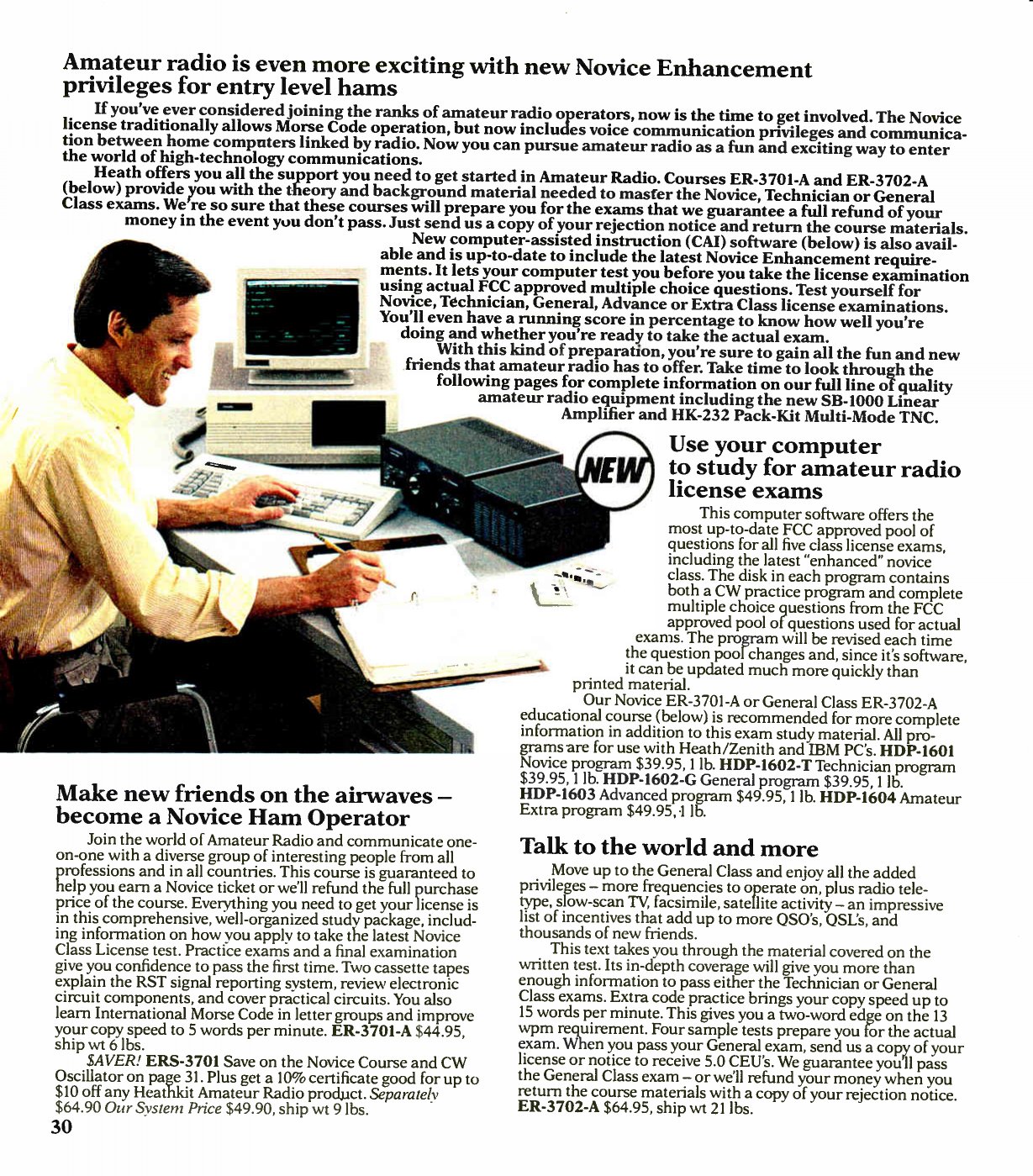
The last Novice rig was the HW-99 of Fall 1985, $299.95: a CW transceiver built on the HW-9’s broadband design but with more than 45 watts output and a built-in AC supply, covering the first 250 kHz of 80, 40, 15 and 10 metres. Heath offered a $100 gift certificate to buyers who sent in a copy of their new licence (Fall 1985, p. 27). When the FCC’s “Novice Enhancement” of 1987 gave Novices voice privileges and digital modes, Heath responded with licence courses guaranteed “or we’ll refund the full purchase price”, and with computer-assisted study software (Fall 1987, p. 32). It did not respond with a new Novice radio.
4.5 The last HF rigs: SS-9000 and HW-5400
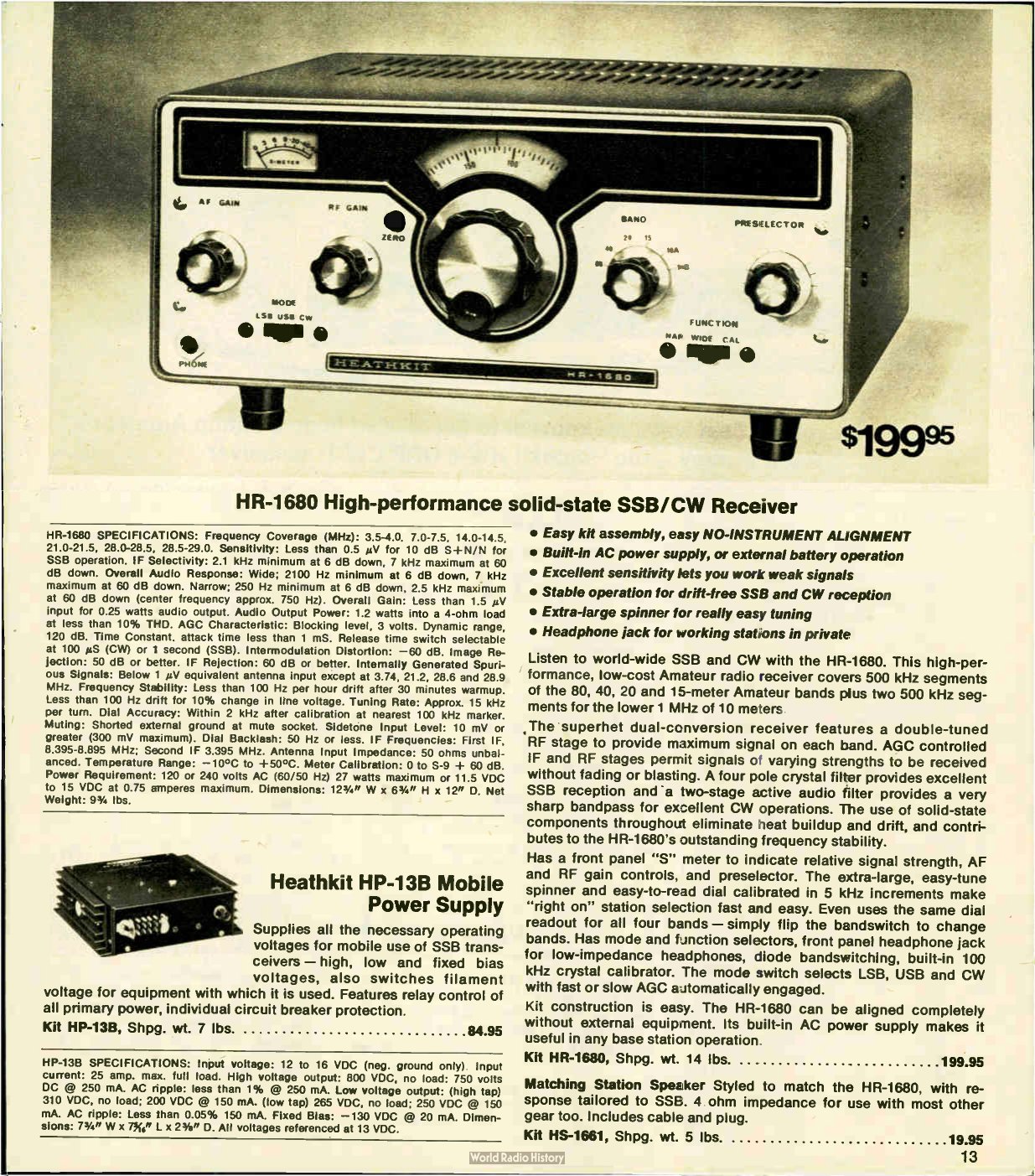
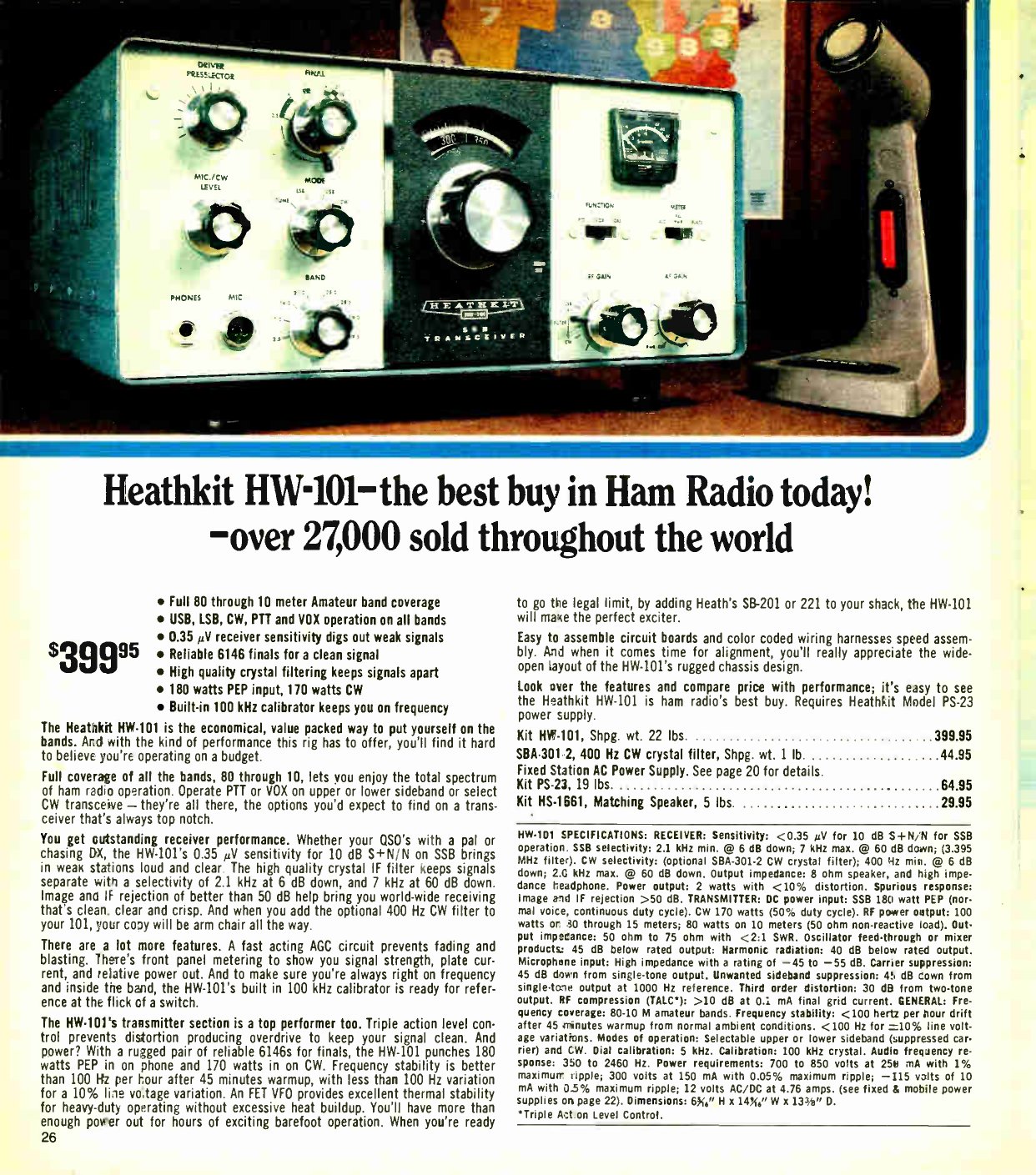
By the late 1970s the HW-101, now more than a decade old, was the best-selling transceiver in Heath’s catalogue. The Fall 1979 catalogue called it “the best buy in Ham Radio today! — over 27,000 sold throughout the world”, at $399.95 (Fall 1979, p. 26). The SB-104A had not replaced it. When Heath did produce new HF radios, it produced two very different ones.
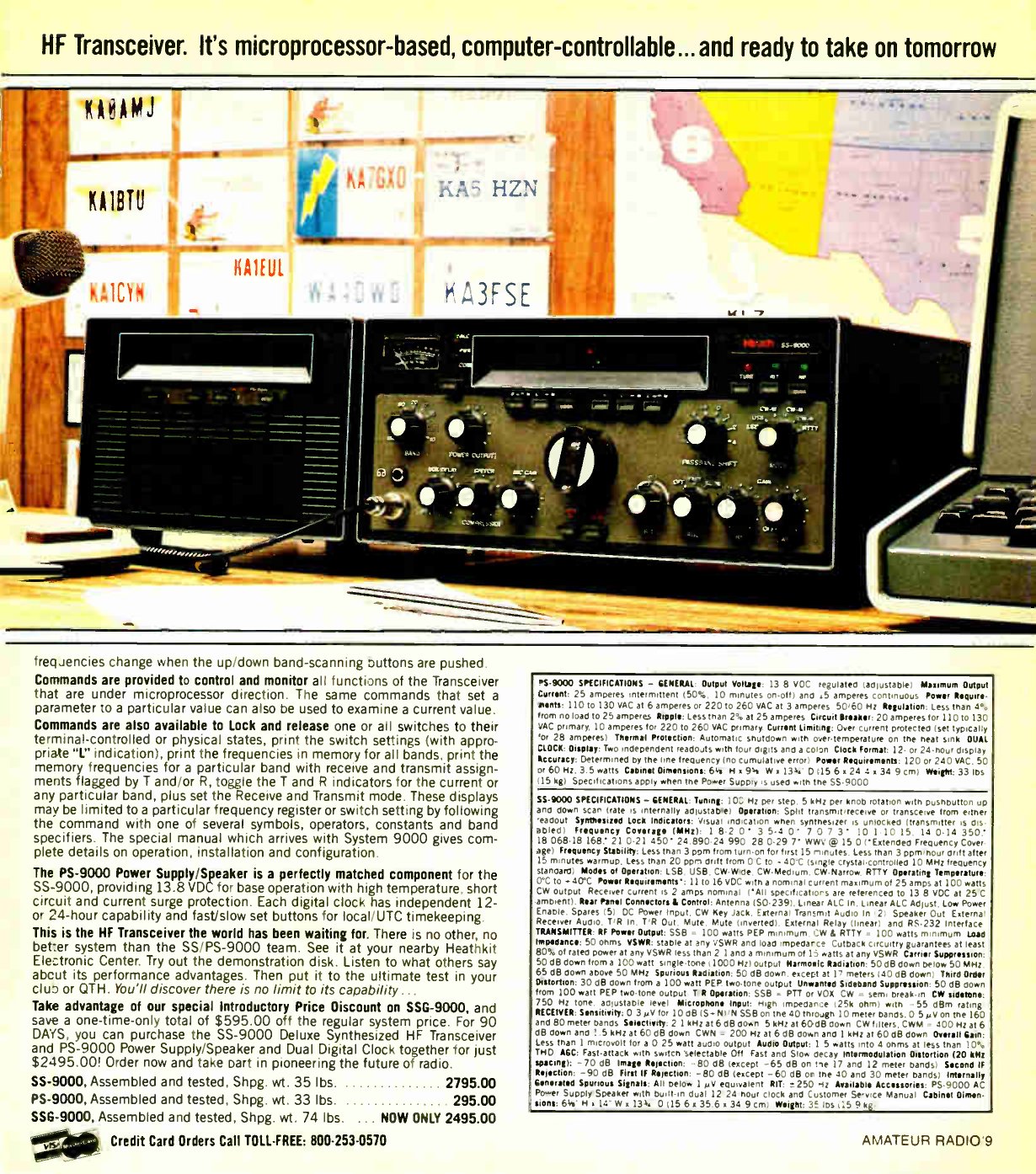
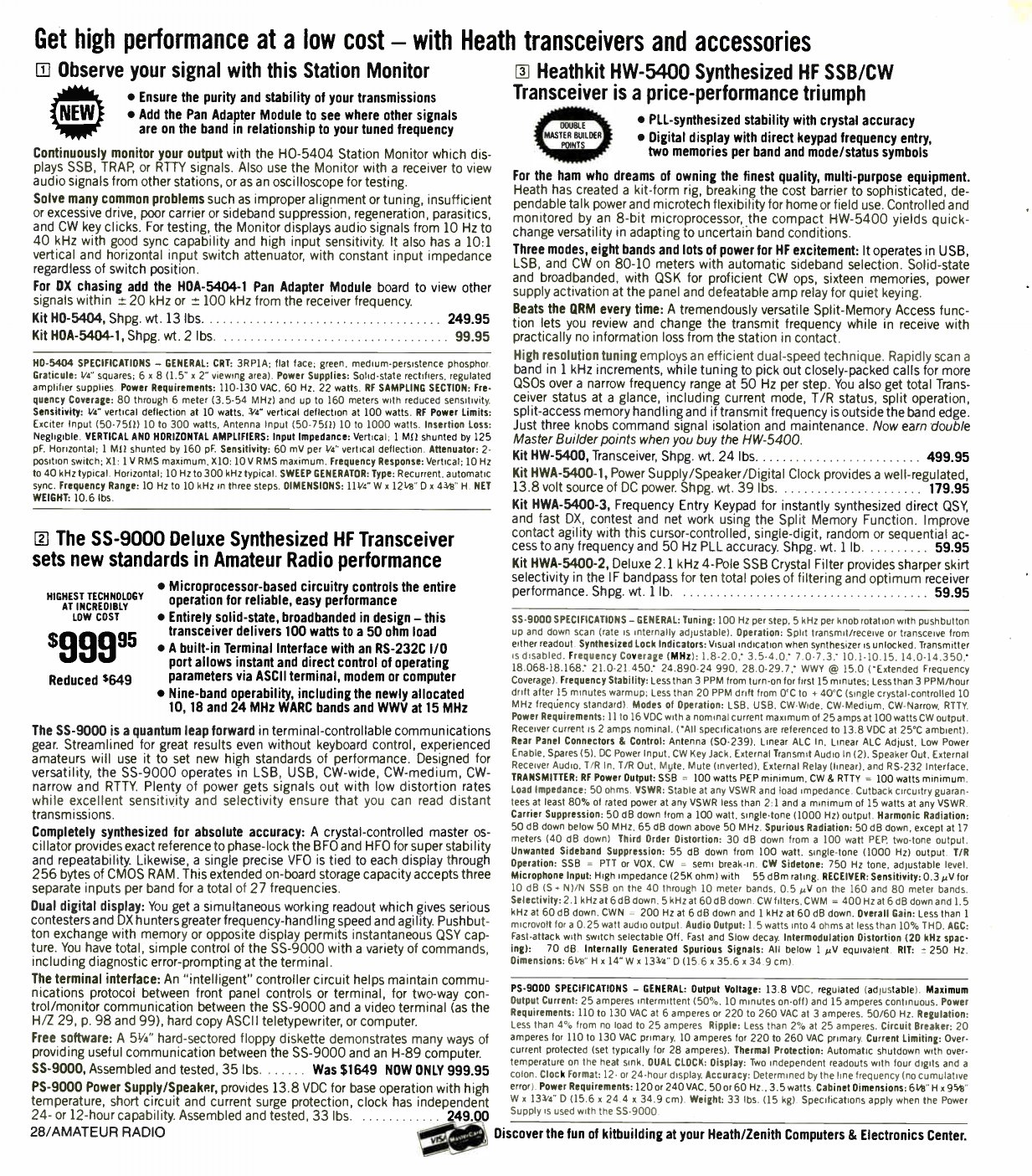
The SS-9000, introduced in the Christmas 1982 catalogue with a letter from Heath’s president William E. Johnson, was a microprocessor-controlled, synthesised HF transceiver with the WARC bands and a computer interface. It was sold only assembled, at $2,795. Brueschke and Mack say it replaced a planned kit, the SS-8000, that Heath could not make work in kit form, and that “competing transceivers cost half as much”; about 2,000 were made, and the Fall 1985 catalogue cleared the stock at $999.95 (company history, vol. 6; Fall 1985, p. 26). The HL-2200 linear amplifier, a pair of 3-500Zs at $849.95, was styled to match it.
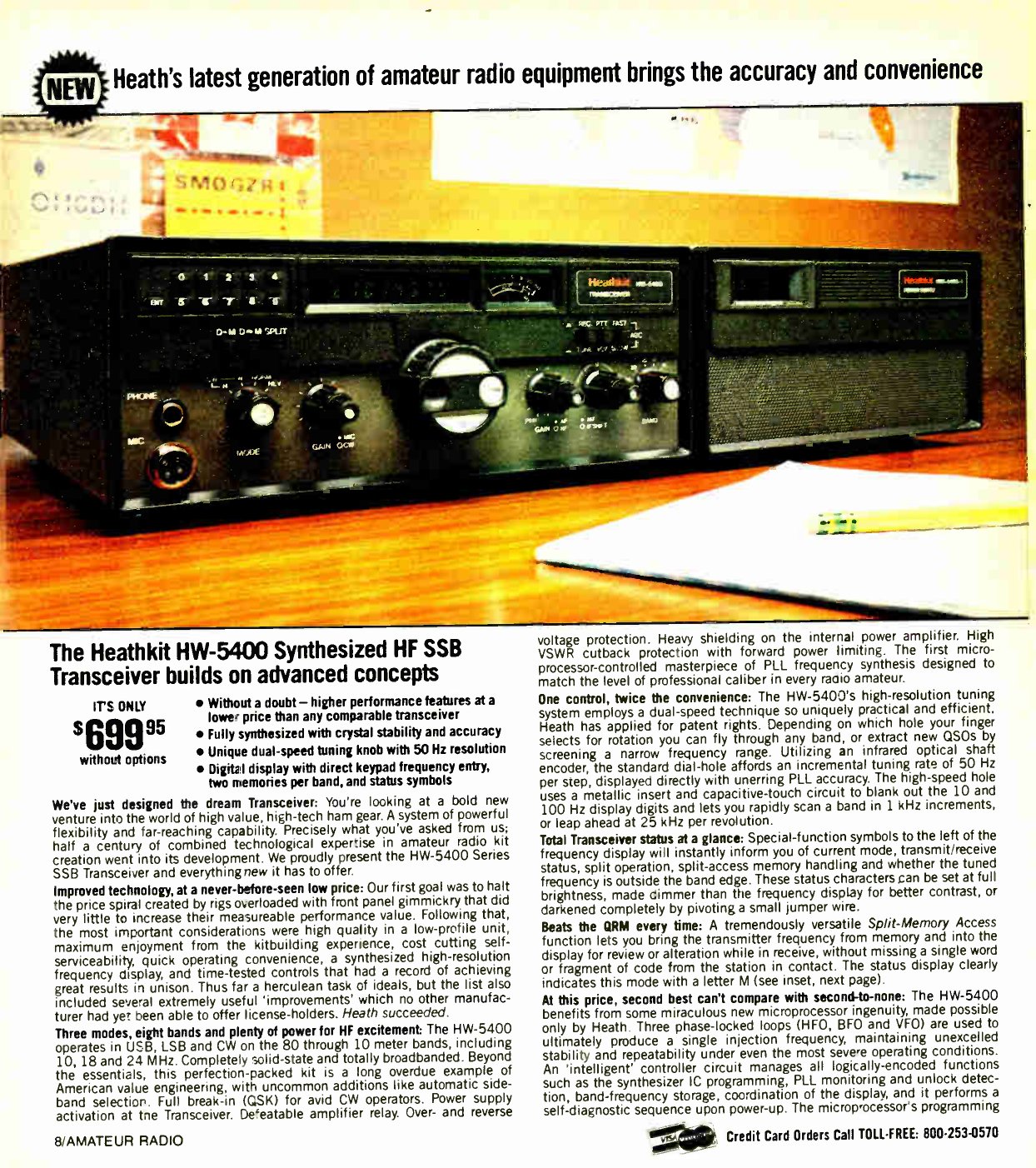
The HW-5400 of Winter 1983, $699.95, was the kit version of the same idea: a synthesised SSB and CW transceiver for 80 through 10 metres including the WARC bands, with a seven-digit fluorescent frequency display and a memory for two frequencies per band (Winter 1983, p. 8). Gilmore describes it as a kit of pre-assembled boards, “largely a mechanical assembly kit” (Leibson, EEJournal, part 4). Its price fell to $649.95 by Fall 1983 and $499.95 by Fall 1984, and it was gone by 1986. It was the last HF transceiver Heath designed. Brueschke and Mack write that by 1985 all new product development had ceased in the amateur-radio group (company history, vol. 6).
4.6 Accessories, tuners and data modes
The accessory business outlasted the radios, and in the 1980s it moved towards digital operating. The line included:
- Antenna tuners. The SA-2040 ($139.95 in 1980), the SA-2060 with its built-in wattmeter ($254.95 in Christmas 1981, later the SA-2060A), and the SA-2500 automatic tuner ($599.95 in Fall 1984) (1980 catalogue No. 848; Christmas 1981; Fall 1984). Eckweiler covers the SA-2040 in Heathkit of the Month #97.
- CW and RTTY. The SA-5010 “µMatic” keyer ($97.95 in 1981), the HD-8999 “UltraPro” CW keyboard ($249.95 in 1983) and the HD-3030 RTTY terminal unit ($249.95 in 1984).
- Packet radio. The HD-4040 terminal node controller of 1985, then the HK-232 “Pack-Kit” multi-mode TNC ($279.95, “available August” 1987) and the HK-21 pocket packet controller ($219.95 assembled in 1988) (Fall 1987; Spring 1988). Eckweiler covers the HD-4040 in Heathkit of the Month #21.
- The Intellirotor. The HD-1780 antenna-rotator controller ($279.95 in Summer 1990), which remembered antenna headings, was designed by Terry Perdue around an Intel 8052 microcontroller (Summer 1990; EEJournal, part 4). It was advertised on the cover of the Winter 1991 catalogue.
The Cantenna, redesigned as the HN-31A in 1983 at $24.95, the HD-1250 solid-state dip meter and a code-practice oscillator ran through every catalogue to the end.
4.7 Linears to the last
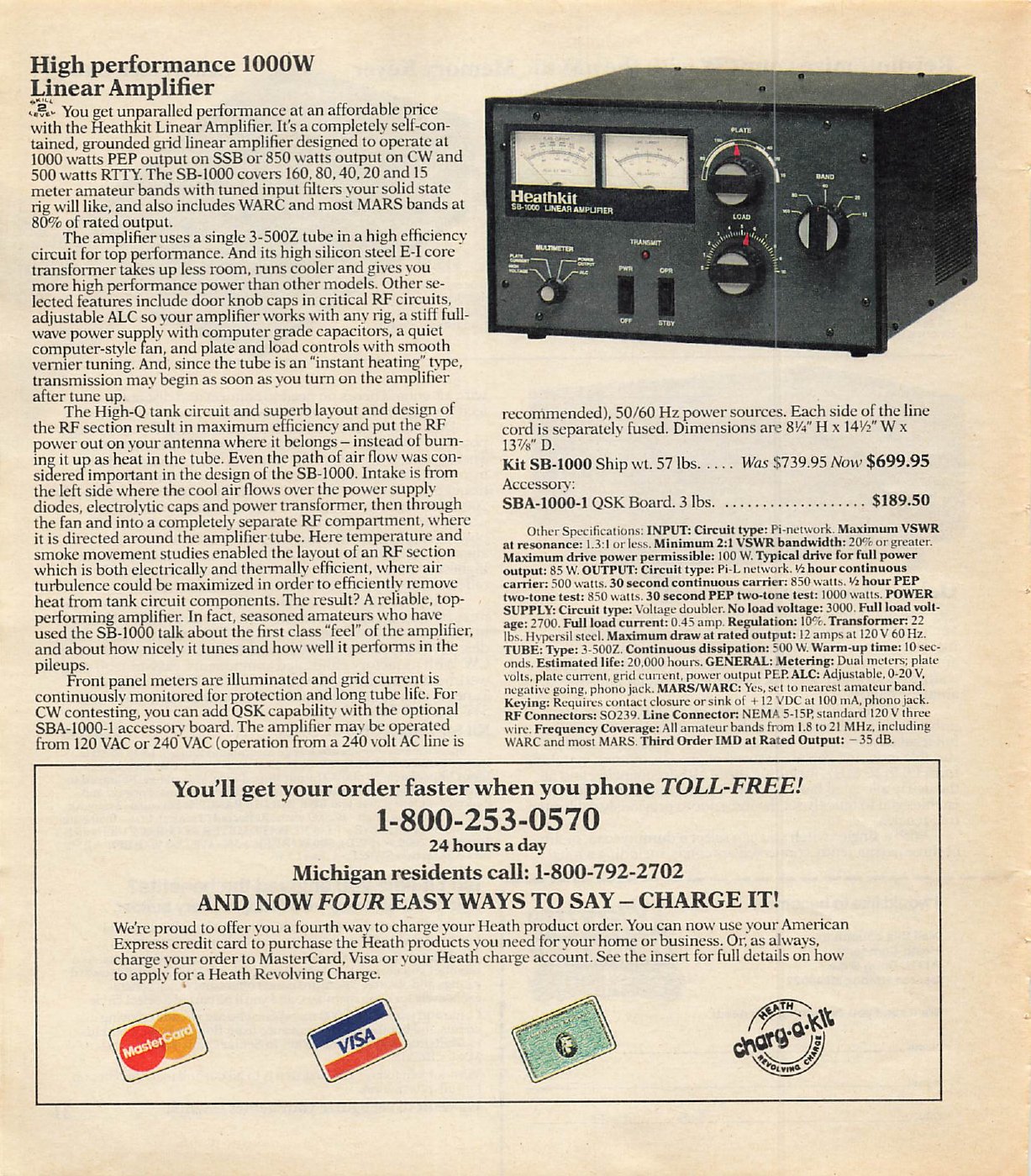
The SB-201 and SB-221, the 1978 versions of the SB-200 and SB-220 without 10 metres, were $429.95 and $579.95 in 1978–79 and were sold until 1983 (Winter 1979; Christmas 1978). After the HL-2200 of 1983–84 there was one more: the SB-1000 of 1987, a single 3-500Z running 1,000 watts output, at $739.95, “Avail. August” (Fall 1987). Eckweiler notes that it used the brown styling of the SS-9000 rather than the SB green (Heathkit of the Month #30). It was in the catalogue until the end, the last Heath amplifier and one of the last Heath-designed ham kits.
4.8 Heath paint on imported radios
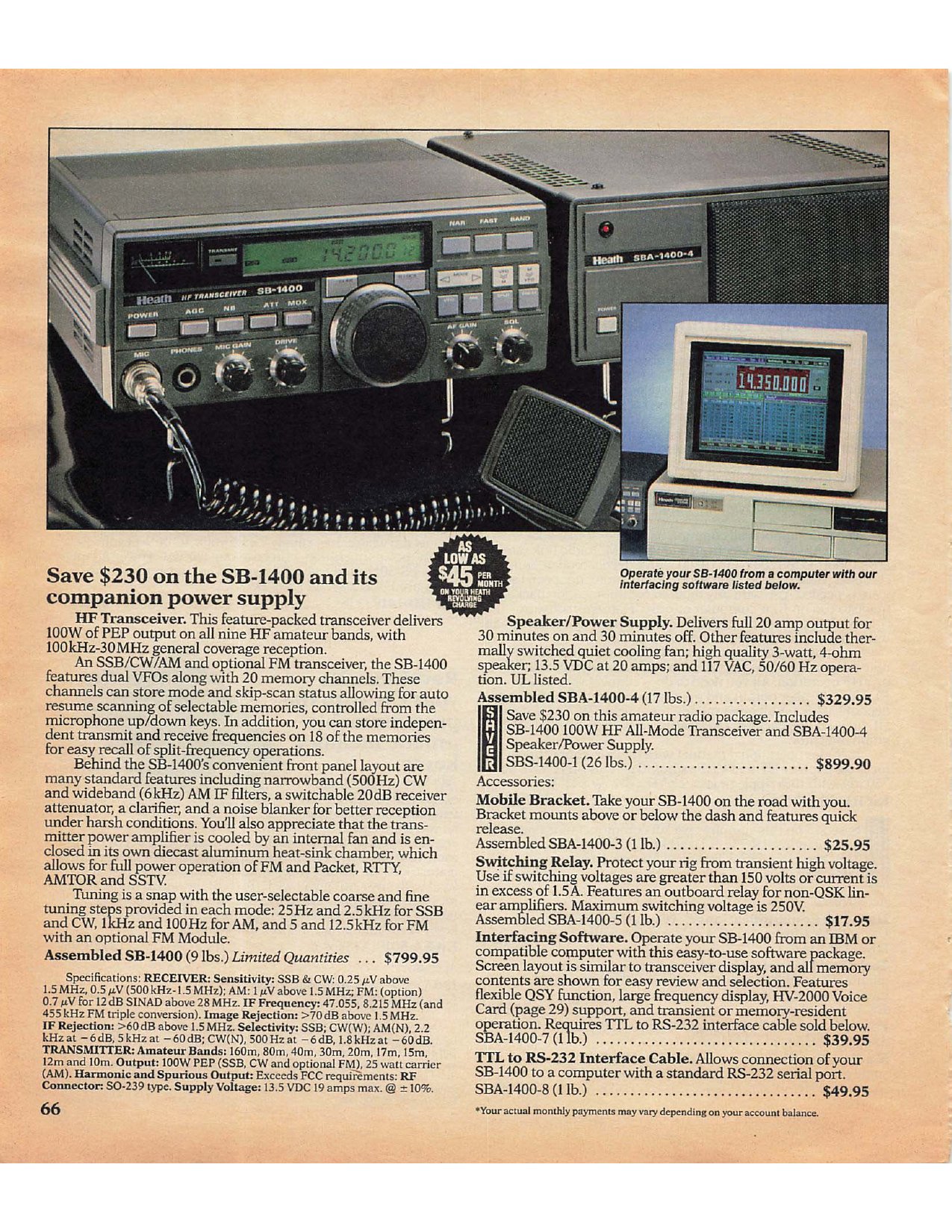
From the mid-1980s Heath’s newest amateur radios were not kits and not Heath designs. The HW-6502 two-metre handheld of 1986 was sold assembled at $199.95 (Fall 1986). The SB-1400 of 1988–91, which revived the SB prefix for an HF transceiver, was in Eckweiler’s words “not even a kit; it is a Yaesu FT-747GX in Heathkit livery” (Heathkit of the Month #30). The Summer 1990 catalogue offered it assembled at $799.95, covering all nine HF amateur bands with general-coverage reception, dual VFOs and twenty memories; the HW-24 twin-band VHF/UHF transceiver beside it was $599.95, also assembled (Summer 1990, p. 66). According to Brueschke and Mack, Heath had by about 1988 moved the sourcing and packing of its remaining kits to a small Hong Kong company, Heath Prokit (company history, vol. 6).
4.9 The end, 1991–1992
The Winter 1991 catalogue, the last general Heathkit catalogue in the World Radio History archive, still had an amateur section. It offered the HW-9 kit with a free band pack, the SB-1000 linear, the HK-232 and HK-21 packet controllers, the HFT-9 tuner and HM-9 wattmeter, the Cantenna, the HD-1780 Intellirotor, antennas and switches, and the SB-1400 marked “Last Call!” (Winter 1991). It was about twenty products, several of them sold only assembled. In March 1992 Heath announced that it was leaving the kit business. Gilmore’s explanation, looking back, was that kits “were just no longer profitable within a large corporate structure” and that interest in building them “had decayed” (EEJournal, part 4). The company history weighs that explanation against the charge of neglect by Zenith and Bull (company history, vol. 6).
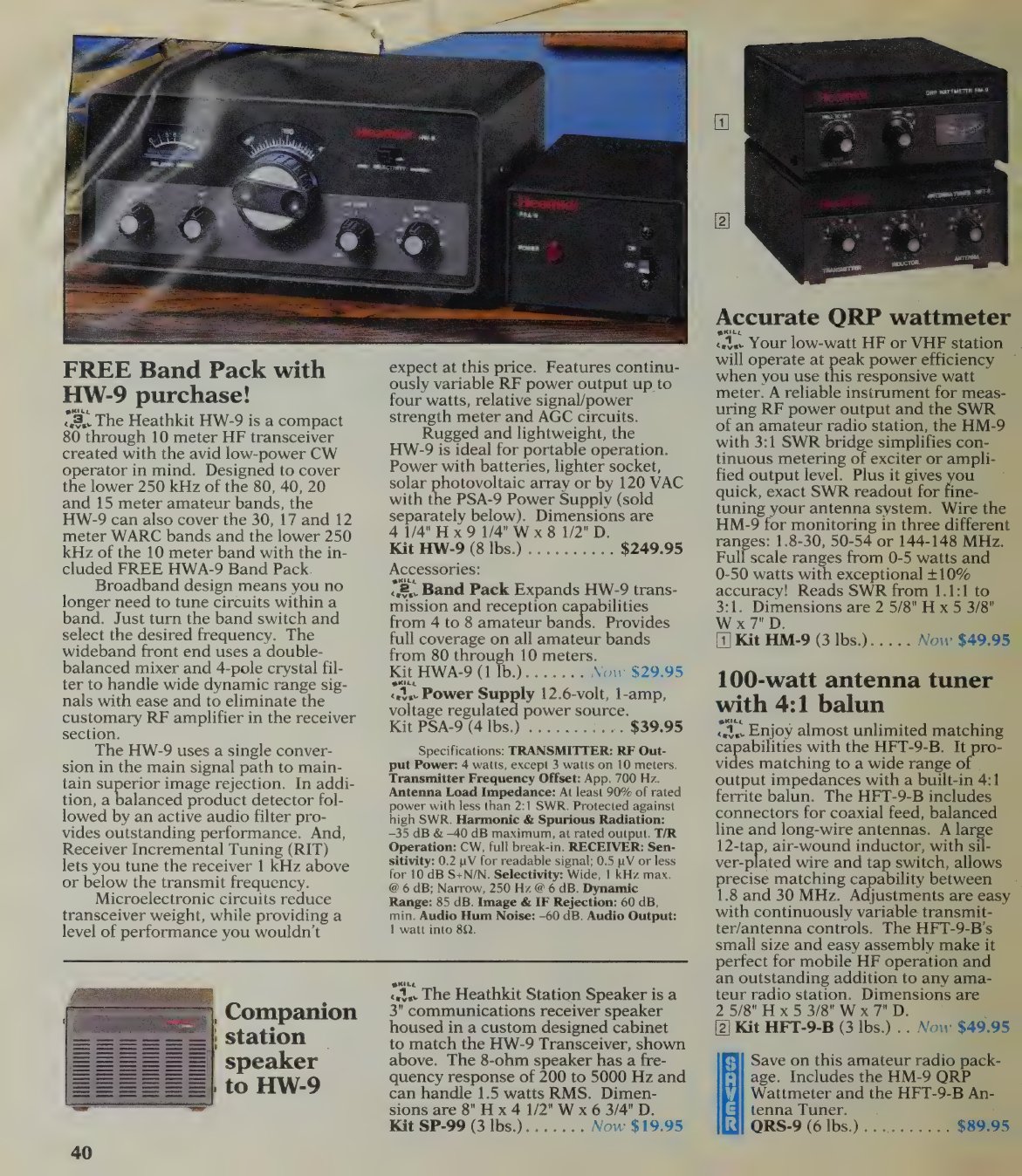
For amateur radio the end was a slow one. The last new Heath-designed HF transceiver was the HW-5400 of 1983; the last Heath-designed ham kits, the HW-9 and SB-1000, were ten and five years old in 1992. What had replaced the Heath station in American ham shacks was already clear in the catalogue itself: a Japanese transceiver, built by machine, with a Heath badge on the front.
Sources
- Heath Company catalogues, World Radio History: Christmas 1975 · Spring 1976 · Fall 1977 · Christmas 1978 · Winter 1979 · Fall 1979 · 1980, No. 848 · Christmas 1981 · Christmas 1982 · Winter 1983 · Fall 1983 · Winter 1983–84 · Fall 1984 · Fall 1985 · Fall 1986 · Fall 1987 · Spring 1988 · Summer 1990 · Winter 1991
- Eckweiler, Bob (AF6C). Heathkit of the Month, OCARC: #21 HD-4040 · #30 SB line · #97 SA-2040 · #111 HW-2026
- Leibson, Steven, with Chas Gilmore, Chuck Penson and Terry Perdue. “‘H’ is for Heathkits and Hams”, parts 3 and 4. EEJournal. Part 3 · Part 4
- WD8RIF. “Heathkit HW-8.” Link
- Matt, W6CSN. “Vintage QRP with the Heathkit HW-8.” QRPer, January 2026. Link
- Tubular Electronics, Heath manuals A–Z. Link
- Site dives: SB-104A · company history, vol. 4 · vol. 6
Comments (0)