SB-104A Transceiver · Volume 6
Reference
This volume collects the specifications, board and part numbers, manuals, accessories and further reading for the SB-104, HW-104 and SB-104A, with the evidence for each entry.
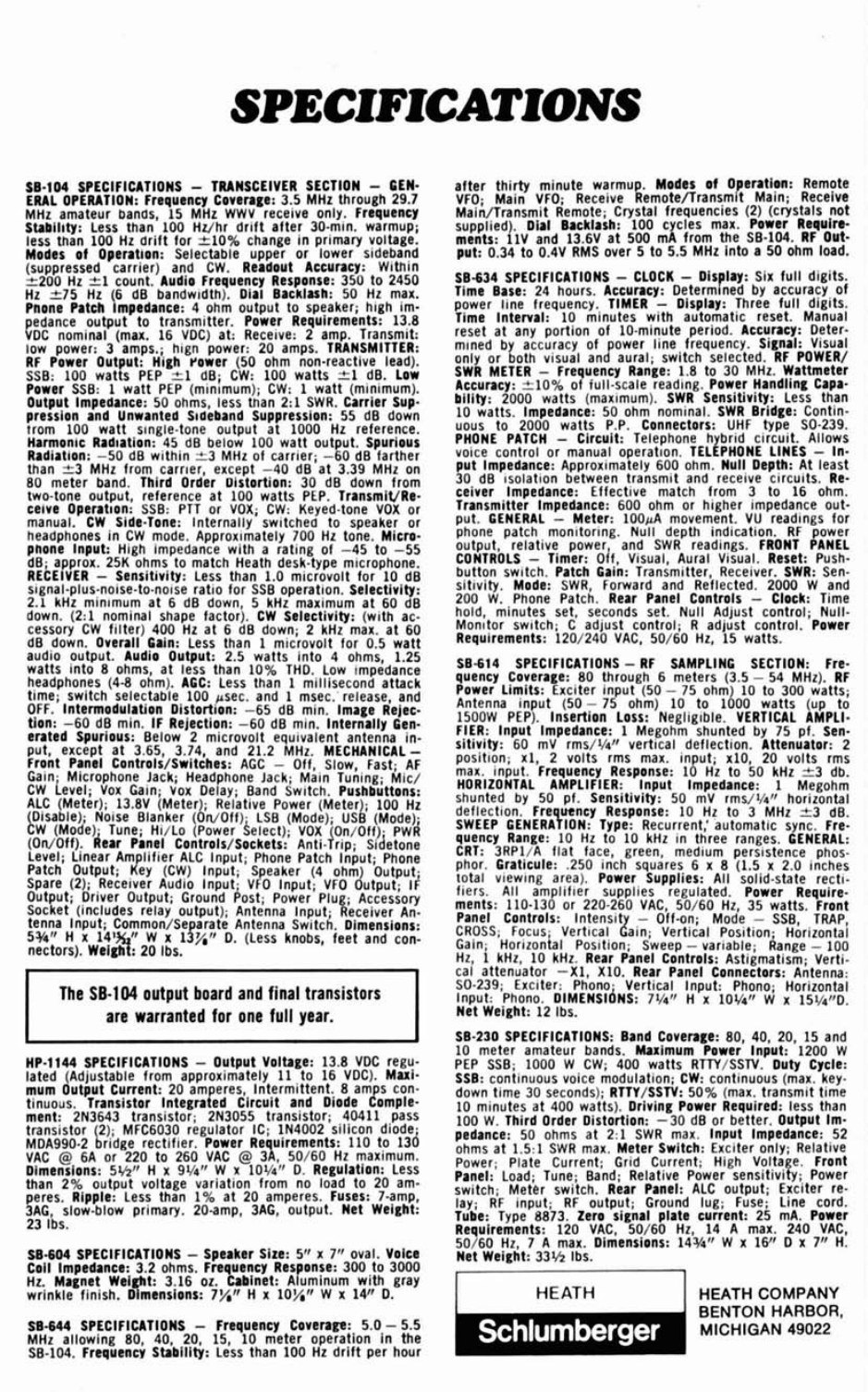
6.1 Full specification
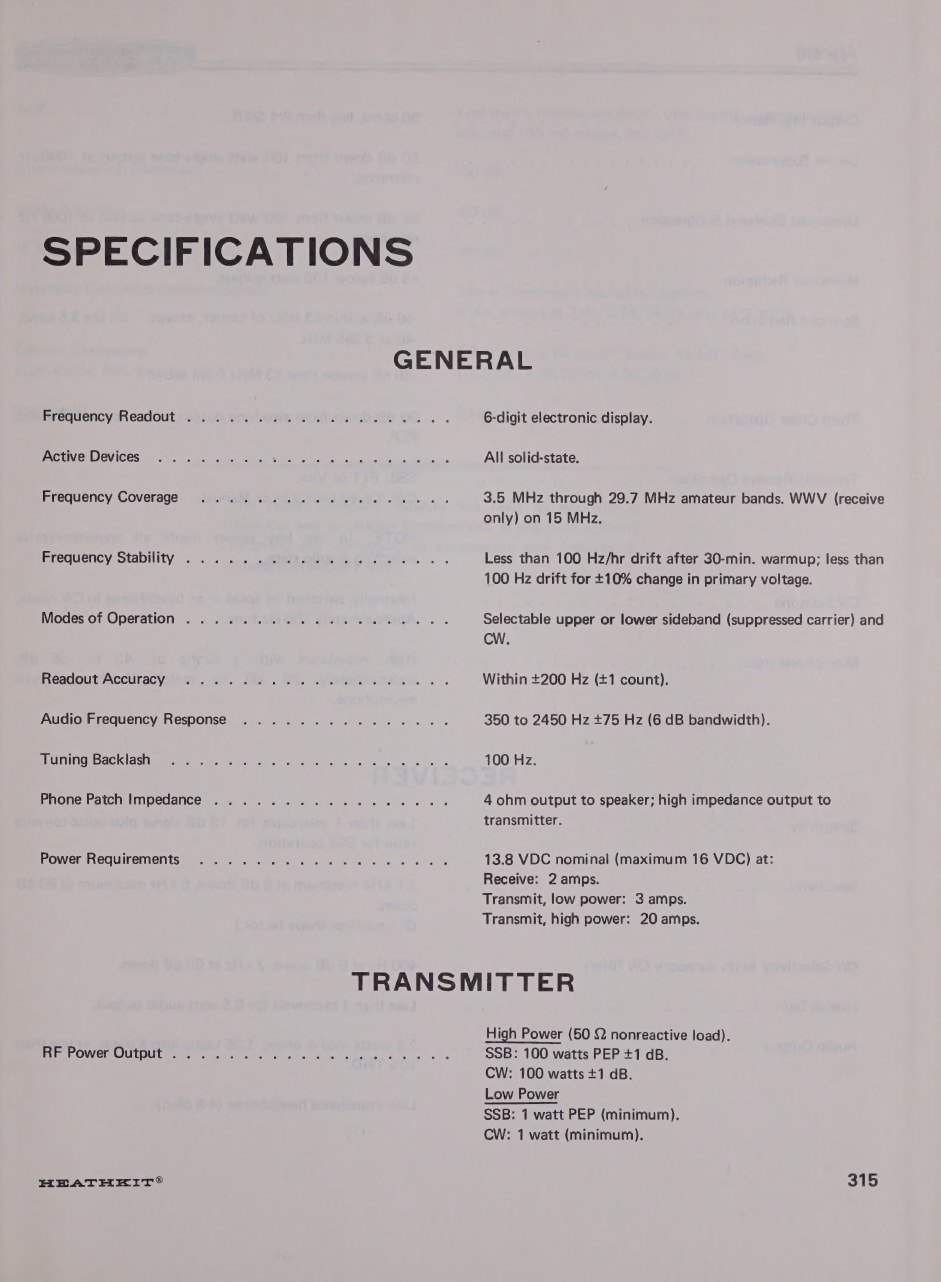
From the SB-104 Operation manual (1974, pp. 315–317) and the SB-104A Operation manual (595-1994, 1977, pp. 2-107 to 2-109). Where the two differ, both are given.
General
Table 1 — General
| SB-104 | SB-104A | |
|---|---|---|
| Frequency readout | 6-digit electronic display | same |
| Active devices | all solid-state | same |
| Frequency coverage | 3.5–29.7 MHz amateur bands; WWV receive only on 15 MHz | 3.5–4.0, 7.0–7.3, 14.0–14.5, 21.0–21.5, 28.0–29.7 MHz; 15.0–15.3 MHz receive only |
| Stability | less than 100 Hz/hr drift after 30-min warm-up; less than 100 Hz for 10 % change in primary voltage | less than 100 Hz/30 min after 30-min warm-up; same voltage figure |
| Modes | USB, LSB (suppressed carrier), CW | same |
| Readout accuracy | within ±200 Hz (±1 count) | same |
| Audio frequency response | 350–2450 Hz ±75 Hz (6 dB bandwidth) | same |
| Tuning backlash | 100 Hz | same |
| Phone-patch impedance | 4 Ω output to speaker; high impedance to transmitter | same |
| Power requirement | 13.8 V DC nominal (max 16 V): receive 2 A; transmit low power 3 A; high power 20 A | 12.6–16 V DC at 20 A; same typical currents; all specifications referred to 13.8 V |
| Cabinet | 5¾ in H × 14 15/32 in W × 13⅞ in D, less knobs, feet, sockets, rails | same |
| Net weight | 20 lb | 20 lb (9 kg) |
Transmitter
Table 2 — Transmitter
| SB-104 | SB-104A | |
|---|---|---|
| RF output, high power (50 Ω non-reactive load) | SSB 100 W PEP ±1 dB; CW 100 W ±1 dB | same |
| RF output, low power | SSB 1 W PEP minimum; CW 1 W minimum | same |
| Output impedance | 50 Ω, less than 2:1 SWR | same |
| Carrier suppression | 50 dB below 100 W single-tone output, 1000 Hz reference | same |
| Unwanted sideband suppression | 55 dB below 100 W single-tone output | same |
| Harmonic radiation | 45 dB below 100 W output | 40 dB below 100 W output |
| Spurious radiation | −50 dB within ±3 MHz of carrier, except −40 dB at 3.395 MHz on 80 m; −60 dB beyond ±3 MHz | −40 dB within ±4 MHz; −60 dB beyond ±4 MHz, except −50 dB on 10 m |
| Third-order distortion | 30 dB below two-tone output, 100 W PEP reference | same |
| T/R operation | SSB: PTT or VOX; CW: keyed-tone VOX or manual; all solid-state switching in low power | same |
| CW sidetone | internally switched to speaker or phones in CW; about 700 Hz | same |
| Microphone input | high impedance, −45 to −55 dB, about 25 kΩ | same |
Receiver
Table 3 — Receiver
| SB-104 | SB-104A | |
|---|---|---|
| Sensitivity | less than 1 µV for 10 dB S+N/N, SSB | less than 0.5 µV |
| Selectivity | 2.1 kHz minimum at −6 dB; 5 kHz maximum at −60 dB (2:1 nominal shape factor) | same |
| CW selectivity (SBA-104-3) | 400 Hz at −6 dB; 2 kHz at −60 dB | same |
| Overall gain | less than 1 µV for 0.5 W audio | same |
| Audio output | 2.5 W into 4 Ω, 1.25 W into 8 Ω, less than 10 % THD; 4–8 Ω phones | same |
| AGC | attack under 1 ms; switch-selectable release (fast, slow) and OFF | same, release given as 100 ms and 1 s |
| Intermodulation distortion | −60 dB | same |
| Image rejection | −60 dB | same |
| IF rejection | −60 dB | −60 dB at 8.395–8.895 MHz; −55 dB at 3.395 MHz |
| Internally generated spurious signals | below 2 µV equivalent, except at 3.65, 3.74, 14.24 and 21.2 MHz | same, plus 28.46, 28.9 and 29.33 MHz |
6.2 Semiconductor complement
Heath’s launch figure is “over 275 advanced solid-state devices, including 31 ICs, 75 transistors and 171 diodes” (Ham Radio, November 1974). A full list is in the Identification Charts of each Operation manual. The devices that matter most for service are these.
Table 4 — Semiconductor complement
| Position | Device | Note |
|---|---|---|
| Q951–Q954 (board H) | RF power transistors, Heath 417-831 | CTC CD-2664A or 2N6456 per the SB-104A Assembly manual; WB4KDI lists Acrian S30-12A (original), Microsemi 2N6456, CTC CD-2664A, TRW PT5757 |
| Q901, Q902 (board J) | RF drivers | TRW PT6619 or CTC CD-3342 (WB4KDI); bulletins cite Heath 417-820 and 417-830 |
| IC202, IC203 (board B) | 5 V and 11 V regulators | Motorola MFC6030, with chassis pass transistors Q1, Q2 |
| IC301 (board C) | transmit IF amplifier, ALC-controlled | Heath 442-18; WB4KDI identifies it as an MC1350 |
| Q701, Q704 (board G, SB-104) | dual-gate MOSFET mixers | 40673; changed from Heath 417-240 to 417-274 by SBM-104-1 |
| Q702 (board G, SB-104A) | first-IF amplifier | 2N5109 |
| D719–D723, D724–D727 (board G, SB-104A) | double-balanced mixer diodes | hot-carrier diodes, replaced as matched sets |
| Q501 (board F) | IF amplifier | dual-gate MOSFET, Heath 417-274 |
| IC201 (B), IC502 (F) | quad op-amps | microphone, VOX and sidetone; audio filter |
| IC101 (A) | ÷4 prescaler | counter input |
| IC102–IC111 (A) | presettable decade counters and memory latches | five of each |
| Display drivers | segment drivers for the gas-discharge digits | K5BCQ gives DM8880; K9ARF found DD700 and SN75480N (ECG2028) |
| VFO | FET oscillator, source follower, two buffers | zener-regulated drain; D1201 sideband shift switch |
6.3 Board part numbers
From the 1974 Test and Adjustments steps, bulletin SB-104-40 (May 1976), later bulletins and K5BCQ. Suffixes are revision levels; a unit may contain any mixture.
Table 5 — Board part numbers
| Board | SB-104 | Later / SB-104A |
|---|---|---|
| A, counter | 85-1417 (85-1417-1) | — |
| Display | 85-1416-1 | — |
| B, TX audio/regulator | 85-1580, 85-1580-3 | — |
| C, TX IF/predriver | 85-1420-3, 85-1420-6 | factory-built in SB-104A; “-02 level” noted 1978 |
| D, HFO/premixer | 85-1418, 85-1418-2 | — |
| E, carrier gen/crystal filter | 85-1463; 85-1581-5 | — |
| F, RX IF/audio | 85-1462, 85-1462-4 | — |
| G, RX front end | 85-1459(-1), 85-1708-2 | 85-1931-1, factory assembled and aligned |
| H, power amplifier | 85-1422-2 | 360 pF stabilising capacitors added |
| J, driver | 85-1421 | — |
| K, ALC/filter | — | 85-2056-1 (adds L815) |
| VFO filter | 85-1516-1 / -2 (bulletin SB-104-47); K5BCQ gives 85-1633-2 | 85-1930-1 |
| VFO oscillator | 85-1205-3 (bulletin SB-104-59) | — |
| Extender | 85-1465 | — |
6.4 Frequency data
Table 6 — Frequency data
| IF | 3.395 MHz (both directions); receiver first IF 8.395–8.895 MHz |
| BFO crystals | USB 3396.4 kHz, LSB 3393.6 kHz, CW 3395.7 kHz (from the counter presets 6603.6, 6606.4, 6604.3) |
| VFO | 5.0–5.5 MHz; operating frequency rises as VFO frequency falls |
| HFO | band edge + 8.895 MHz (e.g. 12.395 MHz for 80 m; 22.895 MHz for 20 m) |
| Premix | HFO − VFO; operating frequency = premix − 3.395 MHz |
| Counter time base | 1 MHz crystal, set against WWV or CHU |
| Display high voltage | 180 V DC from a 25 kHz converter |
6.5 Heath accessories
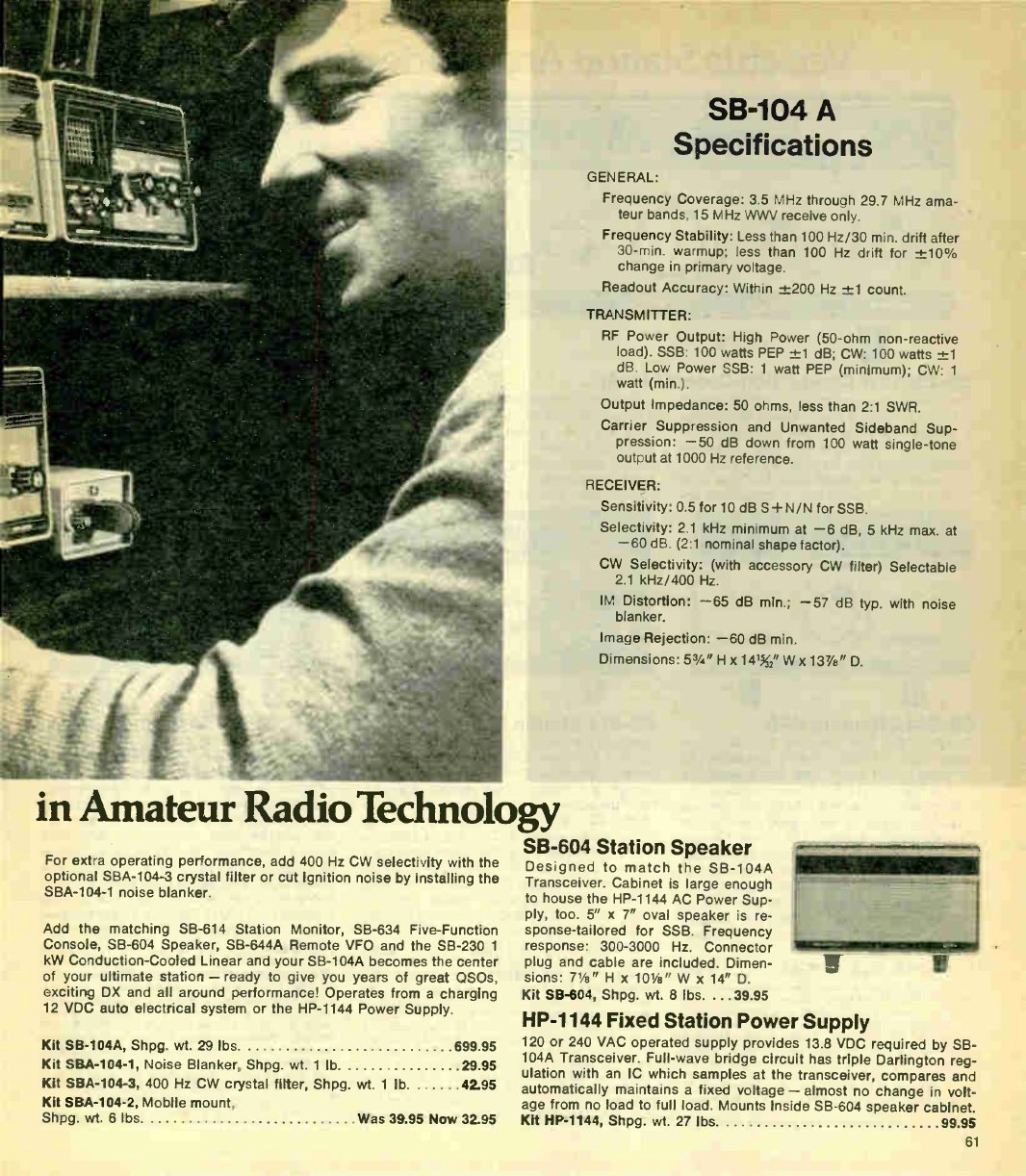
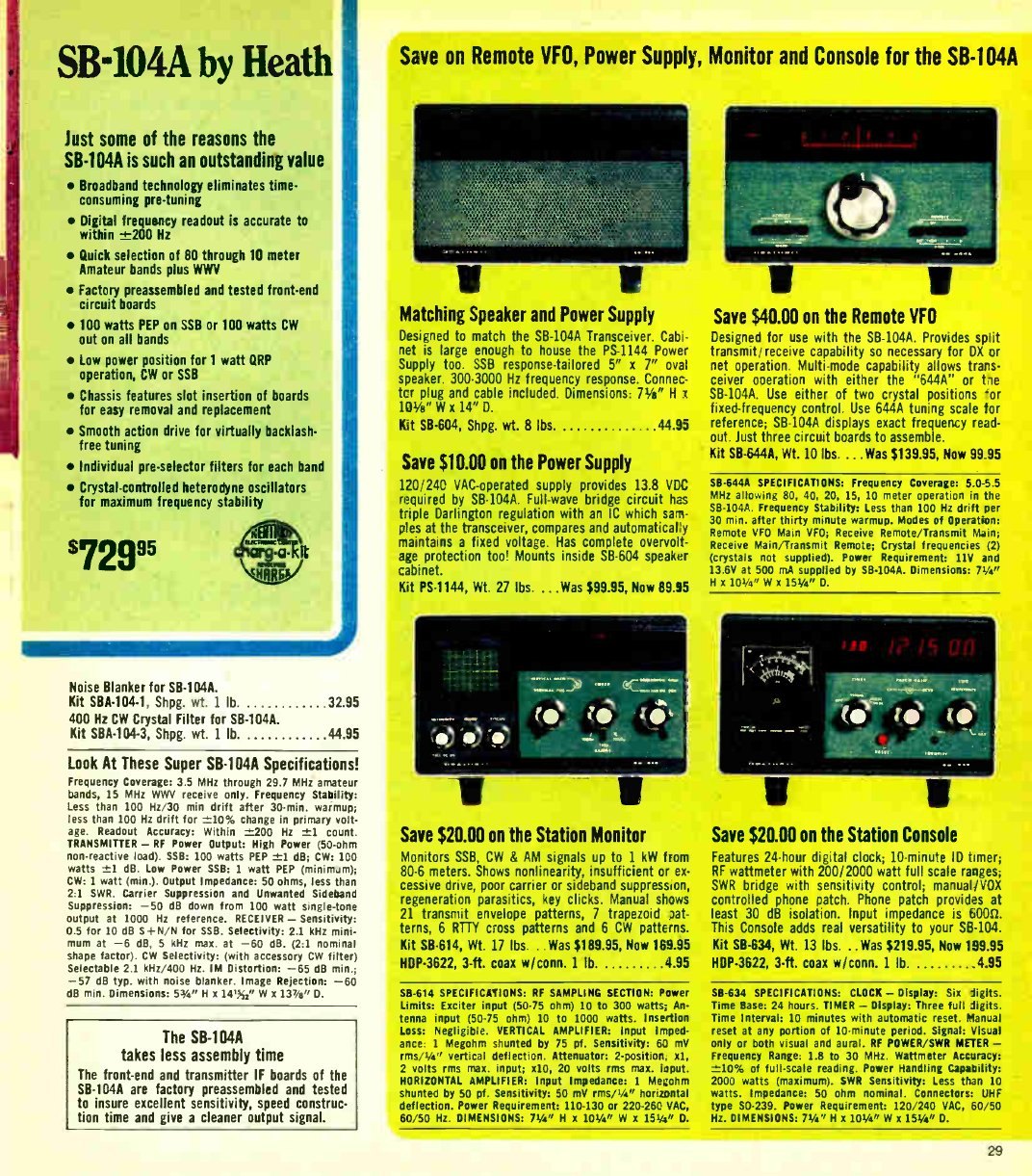
Launch prices are from the Ham Radio advertisement of November 1974; later prices from the catalogues in the Sources.
Table 7 — Heath accessories
| Accessory | What it is | Prices |
|---|---|---|
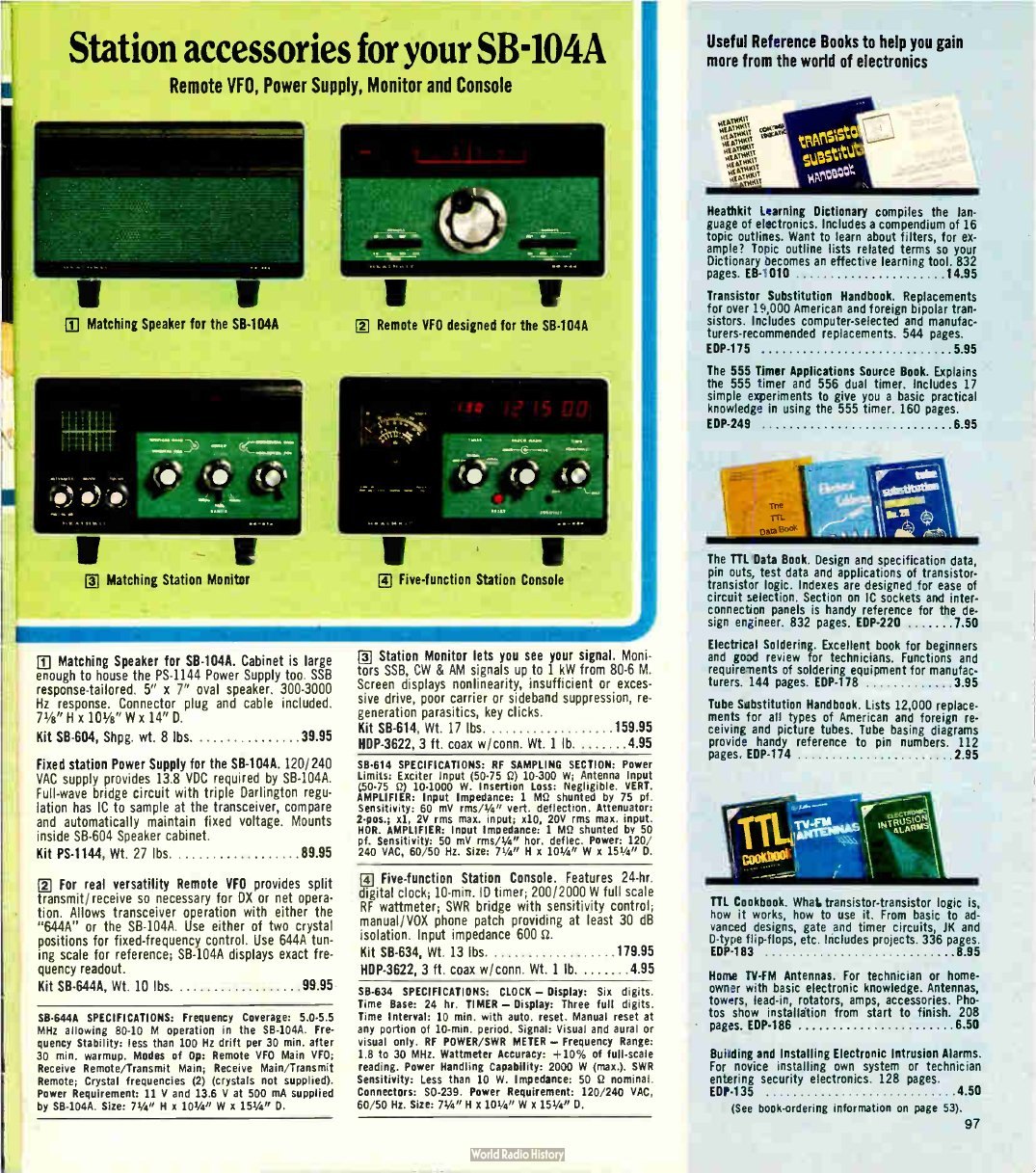
| SB-604 station speaker | 5 × 7 in oval, 3.2 Ω, 300–3000 Hz, in a cabinet large enough to hold the HP-1144 | $29.95 (1974); $34.95 (Fall 1977); $39.95 (1978); $44.95 (Fall 1979); $59.95 (1981–82) |
| HP-1144, later PS-1144, AC supply | 13.8 V regulated (adjustable about 11–16 V), 20 A intermittent, 8 A continuous; 2N3055 driver, two 40411 pass transistors, MFC6030 regulator; remote sensing at the transceiver; remote on-off from the SB-104; 120/240 V; 23 lb net. Manual 595-1599-01 (1974) | $89.95 (1974); $99.95 (1978); PS-1144 $89.95 sale (Fall 1979); $119.95 (1981); $129.95; $69.95 clearance (Christmas 1982) |
| SB-614 station monitor | 1.5 × 2 in CRT monitor for SSB, CW and AM up to 1 kW, 80–6 m; envelope, trapezoid and sweep displays; manual with “40 CRT display illustrations”. Manual 595-1686-03 (1974) | $139.95 (1974); $159.95 (1977); $189.95 (1978); $194.95 (1981–82) |
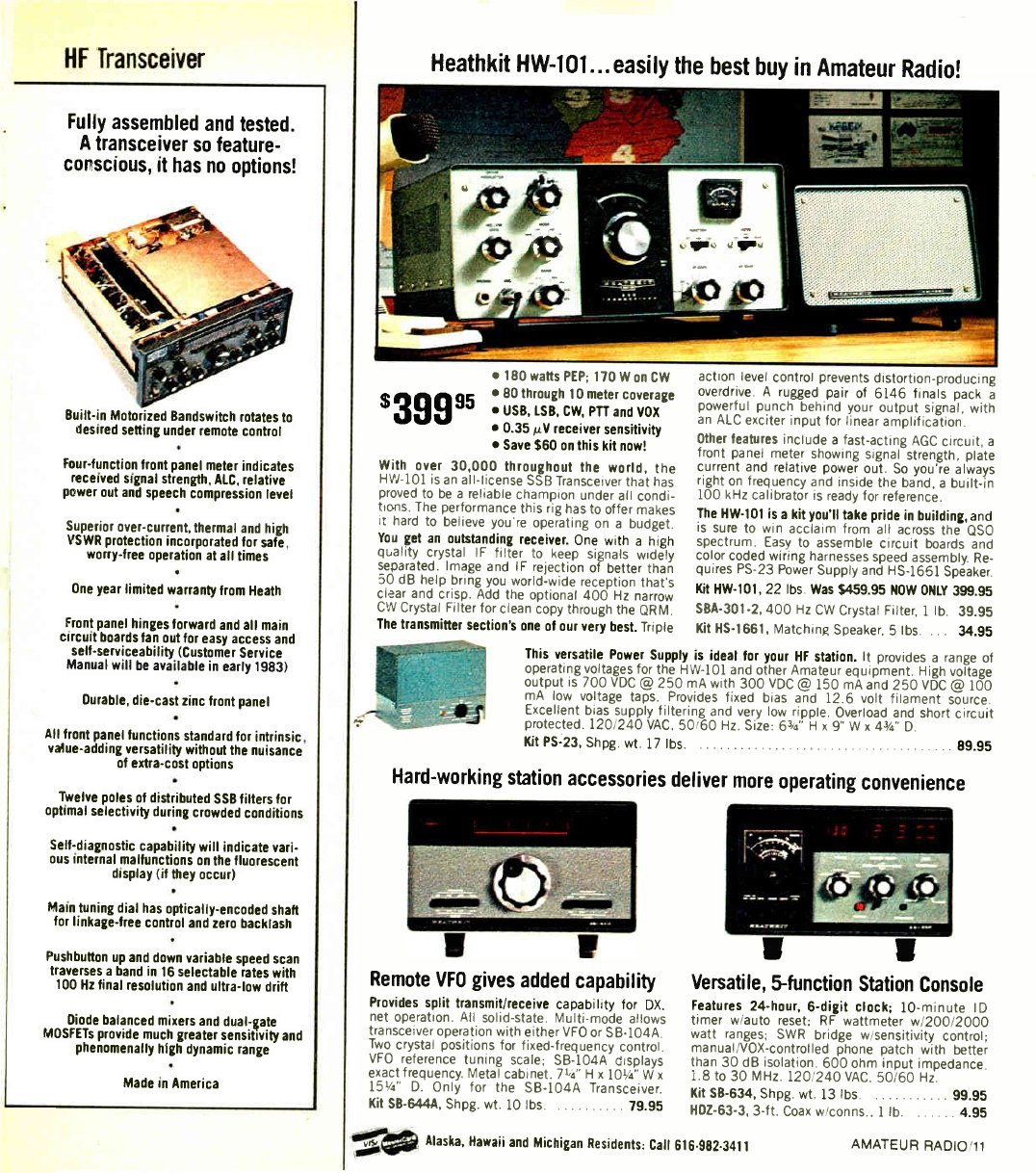
| SB-634 station console | 24-hour digital clock, 10-minute ID timer, RF wattmeter 200/2000 W, SWR bridge, hybrid phone patch; replaced the SB-630 | $179.95 (1974); $199.95–$219.95 (1978–79); $194.95 (1982); $99.95 clearance (Christmas 1982, Winter 1983) |
| SB-644, later SB-644A, remote VFO | duplicate of the SB-104 VFO with transceive/split switching and two crystal positions; readout remains on the transceiver | $119.95 (1974); SB-644A $119.95 (Christmas 1977); $134.95 (1978); $129.95–$134.95 (1981–82); $79.95 clearance |
| SB-230 linear amplifier | conduction-cooled Eimac 8873 triode, grounded grid, 1200 W PEP SSB, 1000 W CW, 400 W RTTY/SSTV input; under 100 W drive; 80–10 m; no fan; thermal breaker; “goes together in 15 to 20 hours” | $319.95 (1974); $339.95 (1975); $369.95 (1976); $429.95 (Fall 1977); $469.95 (1978) |
| SBA-104-1 noise blanker | plug-in board with front-panel switch | $24.95 (1974); $26.95; $29.95; $32.95 |
| SBA-104-2 mobile mount | hinged rear, telescoping front support, 11 ft cable, power relay and circuit breaker | $34.95 (1974); $36.95 |
| SBA-104-3 CW filter | 400 Hz crystal filter, Heath 404-548; fits board E | $34.95 (1974); $39.95; $42.95; $44.95; $52.95 |
| HWA-104-1 | 10 m coverage above 29.0 MHz for the HW-104 | listed Christmas 1975 |
The SB-634 is described in detail in Bob Eckweiler’s Heathkit of the Month #112. He dates its discontinuation to mid-1983 and notes its clock is the Mostek MK5017AA chip of Heath’s GC-1005 clock.
6.6 Manuals and documents
The project’s hosting rule (decision 5 in the Heathkit project notes) hosts a title only if it is likely public domain: published before 1964 with no renewal, or published without a copyright notice before 1 March 1989. Every Heath document for this rig dates from 1974 to 1989 and carries a notice. For works first published between 1964 and 1977, copyright renewal became automatic under the Copyright Renewal Act of 1992, so no renewal search is needed to conclude they remain in copyright. All are linked, not hosted.
Table 8 — Manuals and documents
| Title | Heath number | Year | Notice seen | Renewal search | Free copies |
|---|---|---|---|---|---|
| SB-104 Assembly manual (pp. 1–232) | not found | 1974 (inferred) | — | not needed (1964–77 work) | no scan found |
| SB-104 Operation manual (pp. 233–327) | cover reads “I-595-1270” | 1974 | yes, “Copyright ©1974 Heath Company” | not needed | Internet Archive DLARC (156 pp., text layer) |
| SB-104A Assembly manual | 595-1992-06 (bulletin SB-104-68 cites -01) | 1977 | yes | not needed | retronik.silicium.org (204 pp., image only) · RigPix |
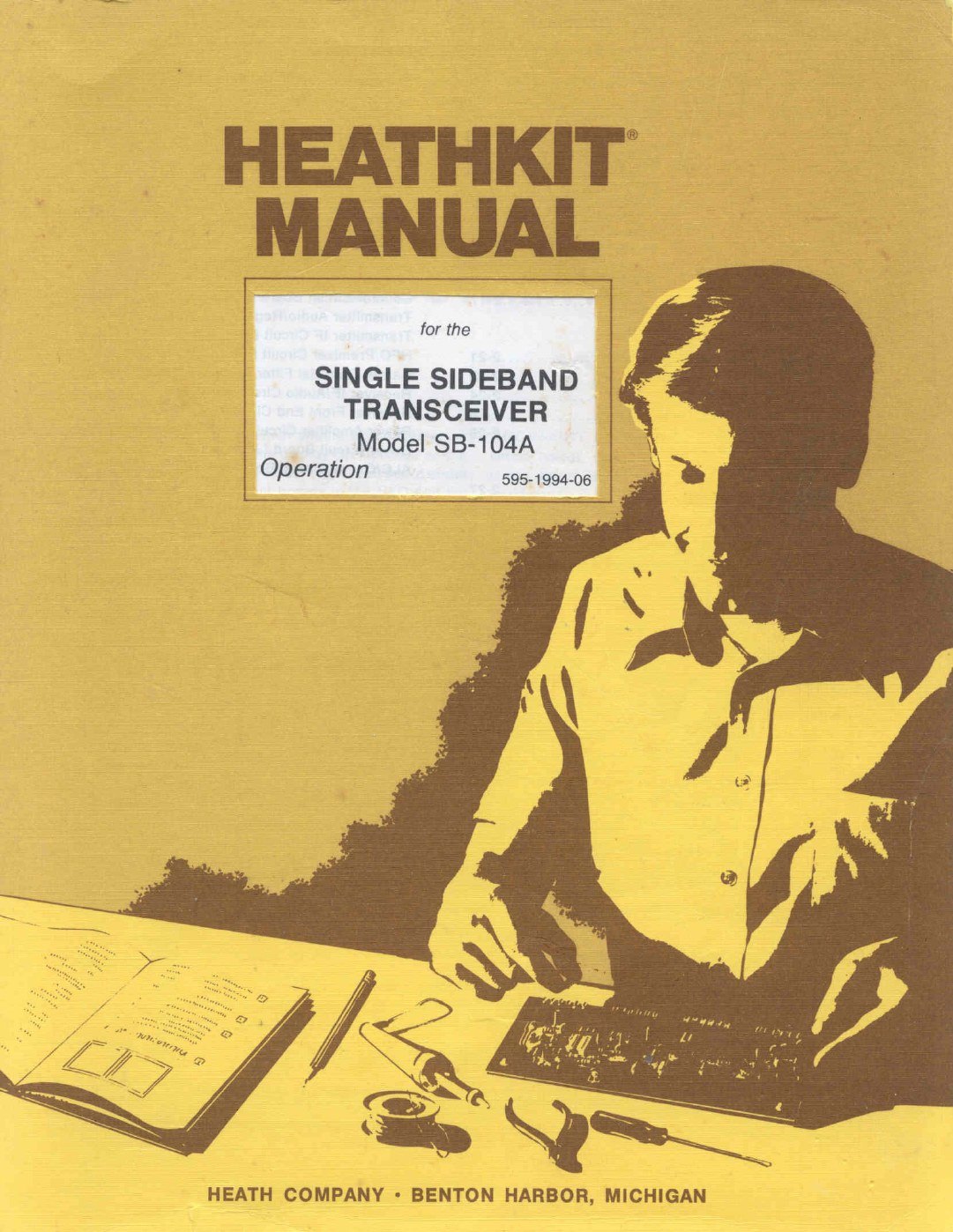
| SB-104A Operation manual | 595-1994-06 | 1977 | yes | not needed | RigPix (124 pp., image only) |
| SB-104A Illustration Booklet | not recorded | 1977 | not checked | not needed | RigPix |
| SB-104A schematic (Heath technician’s copy with voltages) | — | c. 1977 | not checked | not needed | Internet Archive · RigPix |
| SBM-104-1 sensitivity modification | 597-1576 | c. 1975 | not seen on the scan | not needed | Internet Archive |
| SBM-104-2 SB-104A update | 595-2016 (-00 to -04) | 1977–78 | not checked | not needed | none free found; K5BCQ offered copies |
| SB-104 service bulletins SB-104-1 to -103 | — | 1975–89 | internal Heath documents | not needed | W7LPF transcription |
| HW-104 service bulletins | — | 1975–89 | — | not needed | W7LPF PDF, radiomanual.info |
| HW-104 | — | 1975 | not checked | not needed | Internet Archive (fragment) |
| HP-1144 Assembly manual | 595-1599-01 | 1974 | yes | not needed | Internet Archive DLARC · schematic |
| SB-614 manual | 595-1686-03 | 1974 | yes | not needed | Internet Archive DLARC · heathkitmanuals |
| SB-644 schematic | — | 1974 | not checked | not needed | Internet Archive |
| SB-230 schematic | — | 1974 | not checked | not needed | Internet Archive |
Notes on the table:
- “I-595-1270”. This number was read from the cover of the DLARC scan at 150 dpi. It is out of sequence with the Heath manual numbers of 1974 (the HP-1144 manual is 595-1599 and the SB-614 manual 595-1686), and it has not been confirmed from a second copy.
- Paid and aggregator copies. Further copies of the SB-104 and SB-104A manuals are on ManualsLib, Scribd and manuals.plus, which are commercial aggregators. Paper reprints are sold by the current owner’s Data Professionals business (see the history dive).
- Catalogues and advertisements. All the catalogues and magazine advertisements cited here (1974–1983) are on World Radio History. They count as advertising under the project’s rule and are handled the same way as the manuals until checked.
6.7 Related Heath equipment
Table 9 — Related Heath equipment
| Model | Relation |
|---|---|
| SB-102 (1970) | the tube transceiver the SB-104 replaced; same 3.395 MHz IF and filter. SB-102 dive |
| HW-101 (1970) | the tube economy transceiver, sold alongside the SB-104 for its whole life. HW-101 dive |
| SB-301 / SB-401 | the tube separates of the SB line. SB-301/SB-401 dive |
| SB-630 | the earlier station console, replaced by the SB-634 in 1974 |
| SB-650 (1973) | the outboard digital frequency display for the tube SB and HW rigs |
| HW-104, HW-104A (1975, 1977) | the HW-line version: dial instead of counter, phenolic boards |
| HW-5400 (1983) | Heath’s next HF transceiver kit, synthesised |
| SS-9000 (Christmas 1982) | factory-built solid-state HF transceiver, sold beside the last SB-104As |
Further reading
- Penson, Chuck (WA7ZZE). Heathkit: A Guide to the Amateur Radio Products. Cited by Brueschke and Mack (pp. 33 and 226 of the 2003 edition) for the SB-104’s production problems. Not consulted for this dive.
- Bercovici, Harlan (W0MYN). “Improving the SB-104A/SB-644A.” QST, August 1979. Listed by K5BCQ; not consulted.
- Palmer, David (W6PHF). “Refining the SB-104.” QST, March 1982. Listed by K5BCQ; not consulted.
- CQ, August 1975, pp. 28–32, 68–69, 73 (SB-104 article, cited on WB4KDI’s HW-104 page). Not consulted.
- The HEATH mailing-list archive at puck.nether.net, including W7LPF’s original bulletin posts of 1997–98.
Sources
- Ham Radio, November 1974, “Presstop” and Heathkit centre spread. PDF
- Ham Radio, April 1981, Tashner, pp. 78–81. PDF
- 73 Amateur Radio Today, August 1998, Blum, pp. 10–12. PDF
- Heath Company manuals and bulletins as listed in the table above.
- Heathkit catalogues, World Radio History: Christmas 1975 · Spring 1976 · Fall 1977 · Christmas 1977 · Winter 1978 · Spring 1978 · Fall 1979 · No. 848, 1980 · Winter 1981 · Winter 1981–82 · Christmas 1982 · Winter 1983
- Eckweiler, Bob (AF6C). Heathkit of the Month #30 (SB-line overview) and #112 (SB-634). #30 · #112
- K5BCQ. “Heathkit SB-104, HW-104, SB-104A Transceiver Repair.” Link
- WB4KDI Engineering Notebook, HW-104 pages. Link
- Brueschke, Erich E., and Michael Mack. “The History of the Heath Companies.” AWA Review 32 (2019). Internet Archive
Comments (0)