Test Equipment · Volume 2
Printed Circuits and the I-Prefix, 1955–1966
For its first dozen years under corporate owners the instrument line did two things at once. It kept the cheap service instruments that had built the business, and it reached upward into instruments a school or a small laboratory could use. The printed circuit board arrived in 1954–55, the 5-inch scope split into a cheap utility model and a “professional” one, the tube tester gained a mutual-conductance version drawn from a Weston design, and in 1961 the whole line was restyled and renumbered under the I-prefix that it carried to the end. This volume covers the Daystrom years (1955–1962) and the first Schlumberger years to about 1966. The corporate side of both is in the history dive’s third and fourth volumes.
2.1 Daystrom and Weston
Daystrom bought Heath in February 1955 for about $1.8 million, according to Brueschke and Mack. Daystrom was an instrument group: it also owned the Weston Electrical Instrument Corporation of Newark, the maker of laboratory meters and of the Weston 981 mutual-conductance tube tester. Weston’s influence on the Heath line shows most clearly in the TT-1 tube tester. Heath’s catalogues carried the words “by Daystrom” under the Heathkit name into the early 1960s (history dive, volume 3).
2.2 The printed circuit, 1954–1956
The V-7 voltmeter introduced the printed circuit board to Heathkits: its manual calls it “the first kit instrument using a prewired, prefabricated printed circuit board.” Heath’s managers worried that a board would spoil the building; the worry proved unfounded, and the board, Heath claimed, halved construction time. The V-7 and its V-7A successor, and the correction to the board thickness given in the published histories, are covered in the VTVM dive.
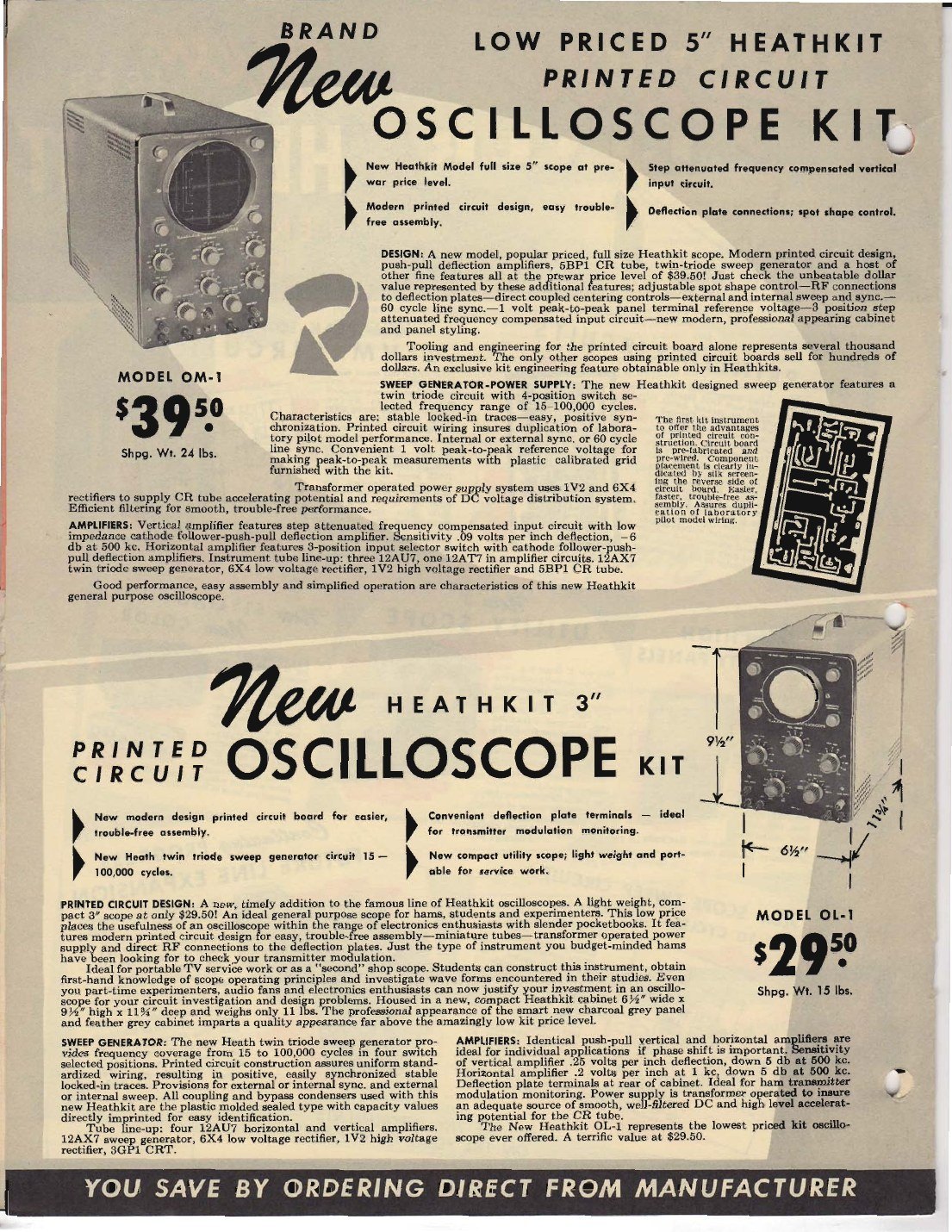
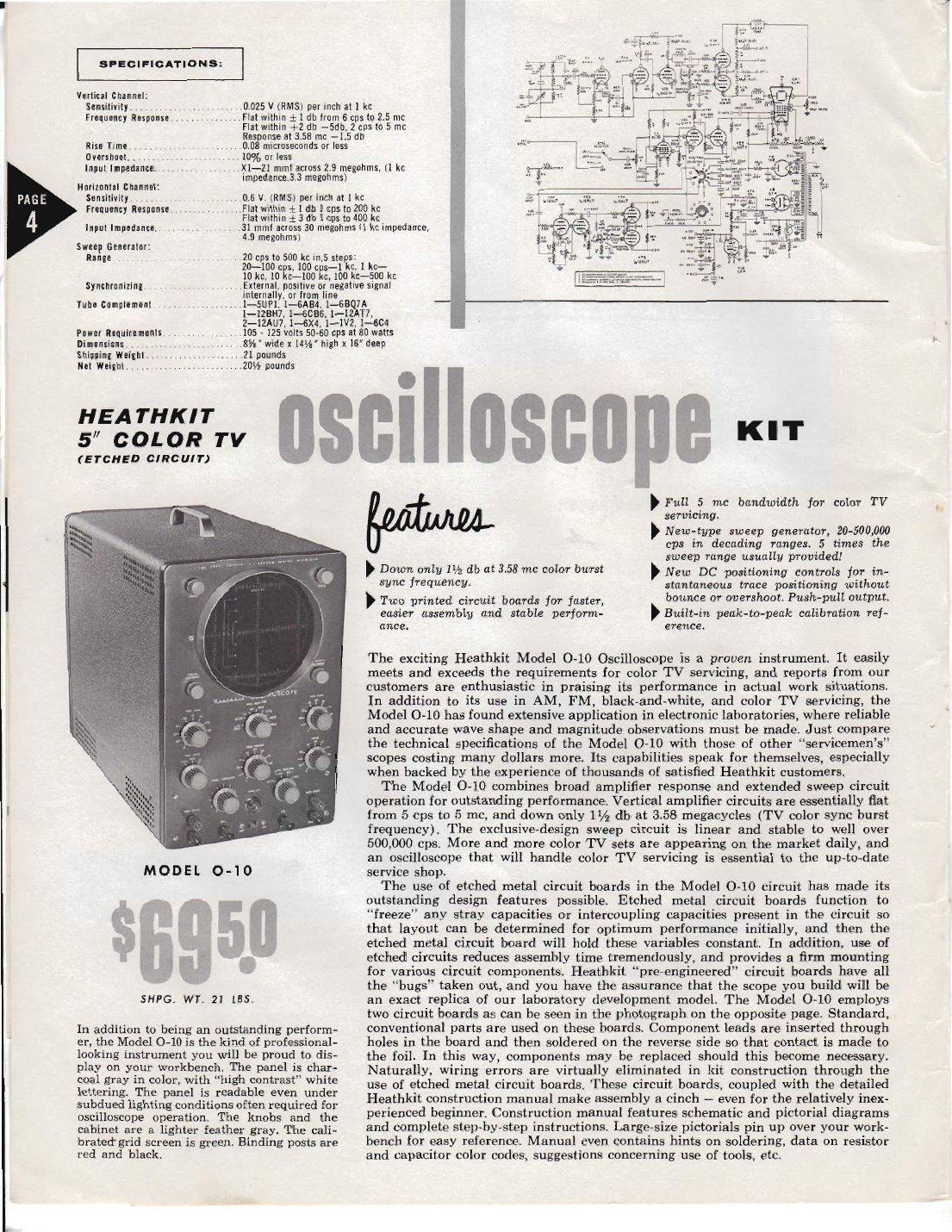
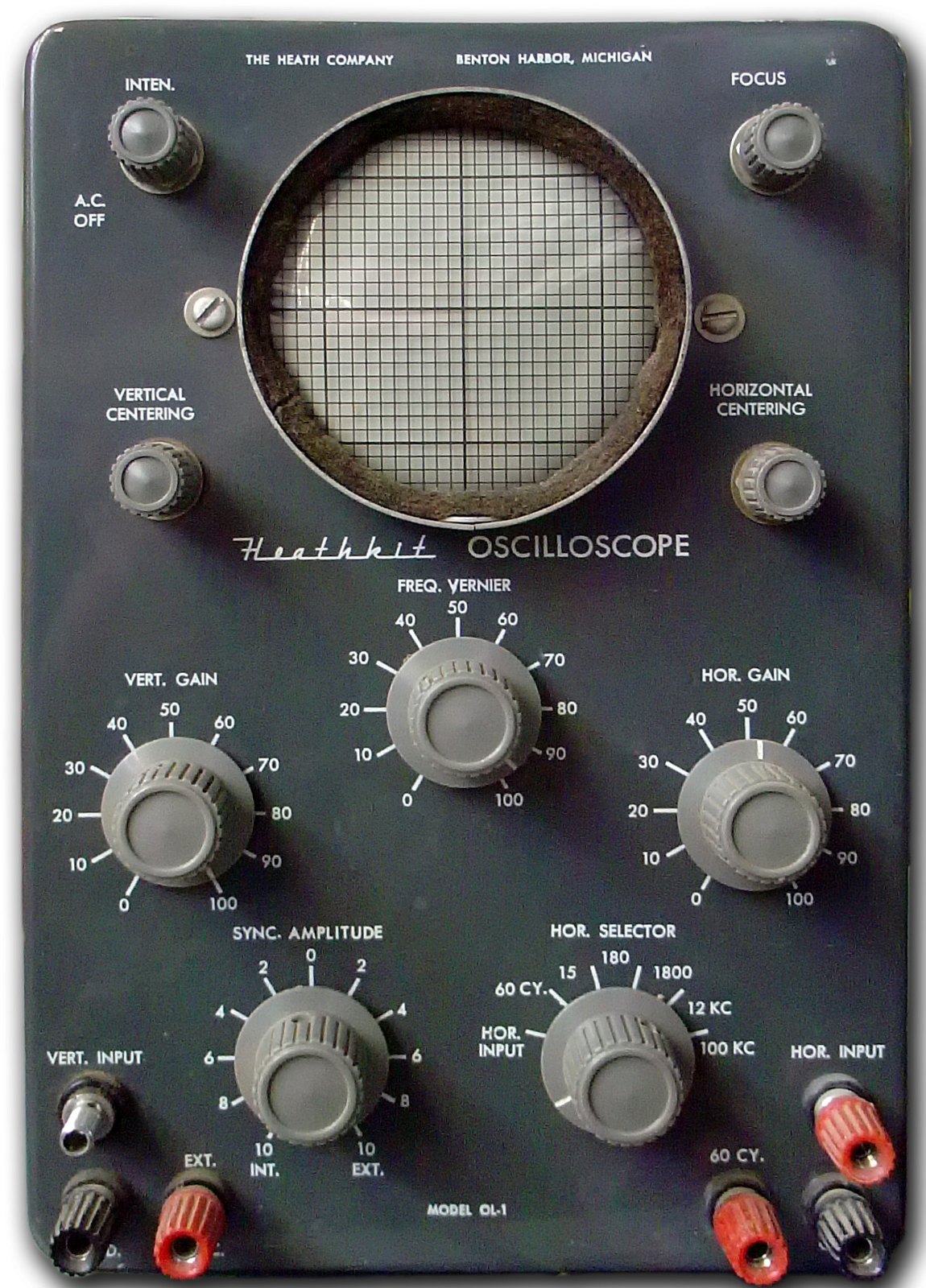
The scopes followed at once. The O-10 of September 1954 ($69.50) used two etched boards, and by 1956 Heath was selling it as a scope for colour-television servicing: its vertical response was only 1½ dB down at the 3.58 MHz colour burst frequency (1956 catalogue, p. 4). Below it Heath opened a second, cheaper line. The OL-1 of August 1954 was the first Heathkit scope with a 3-inch tube, a war-vintage 3GP1, at $29.50, ten dollars less than the O-1 had cost in 1947 (Eckweiler #41). The OM-1 was a printed-circuit 5-inch utility scope at $39.50, advertised as a “full size 5-inch scope at pre-war price level”; by the 1956 catalogue it had risen to $49.50. The OM-2 ($42.50) and OM-3 ($39.95) continued the utility line to 1960 (Eckweiler #89).
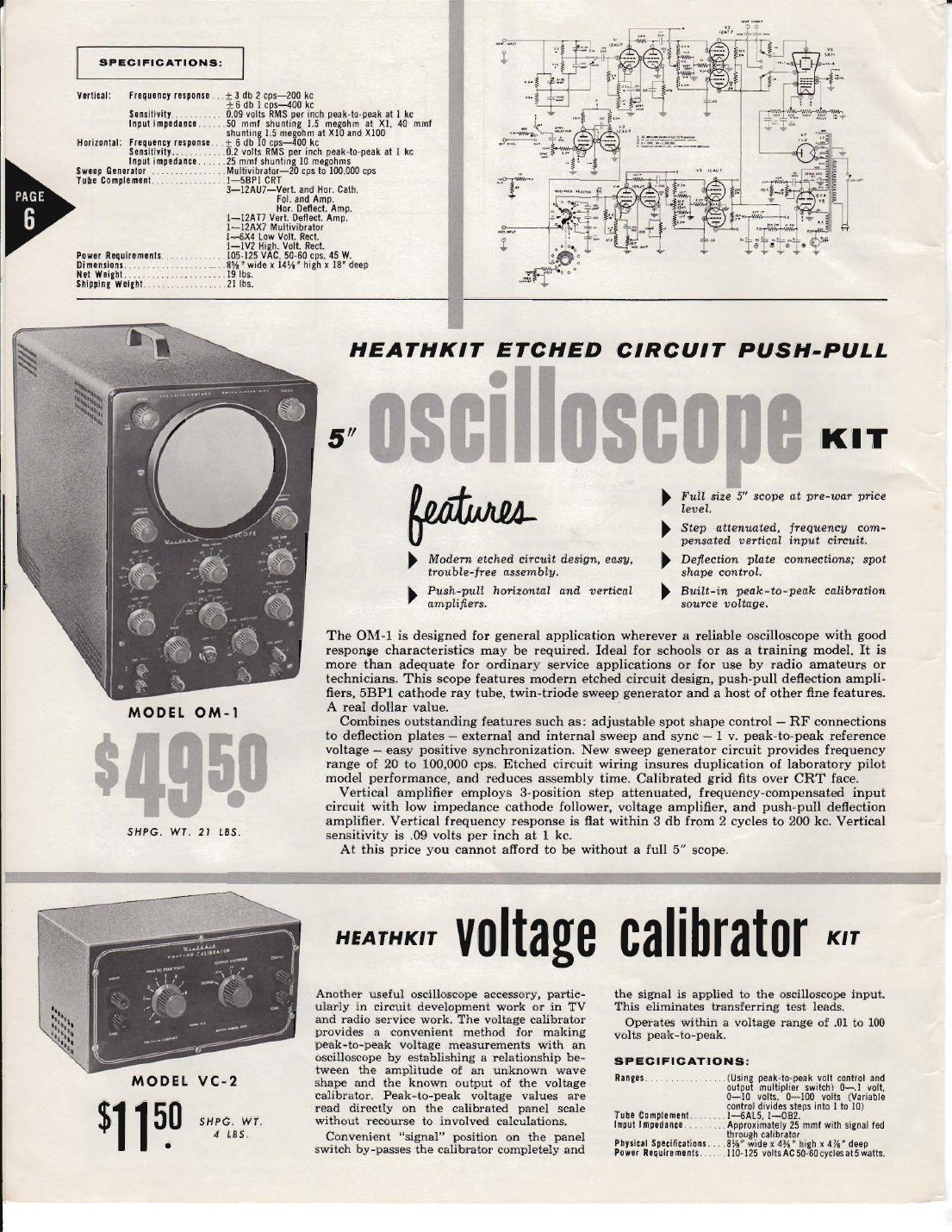
The O-series ended with two quiet changes. The O-11 of September 1956 held the $69.50 price for eighteen months; the O-12 replaced it in Radio News in May 1958 with no “New” banner, only a new model number and a price cut to $64.95. The O-12 was the last O-series scope, withdrawn in November 1960 (Eckweiler #89).
Table 1 — The printed circuit, 1954–1956
| Model | Announced | Withdrawn | Price | Note |
|---|---|---|---|---|
| OL-1 | Aug. 1954 | Aug. 1956 | $29.50 | 3-inch, 3GP1 |
| O-10 | Sep. 1954 | Aug. 1956 | $69.50 | Etched boards; colour-TV response |
| OM-1 | 1954–55 | 1956 | $39.50, then $49.50 | Printed-circuit utility 5-inch |
| O-11 | Sep. 1956 | Apr. 1958 | $69.50 | |
| OM-2 | 1957 | 1958 | $42.50 | |
| O-12 | May 1958 | Nov. 1960 | $64.95 | Last O-series scope |
| OM-3 | 1958 | 1960 | $39.95 | |
| OR-1 “Research” | by 1961 | — | $119.95 | DC-coupled, 5ADP2 CRT |
| OP-1 “Professional” | 1958–59 | 1962 | $179.95 | DC-coupled, triggered, calibrated |
Sources: Eckweiler #41, #89; 1955 flyer, 1956 and 1959 catalogues.
2.3 Reaching up: the professional scopes
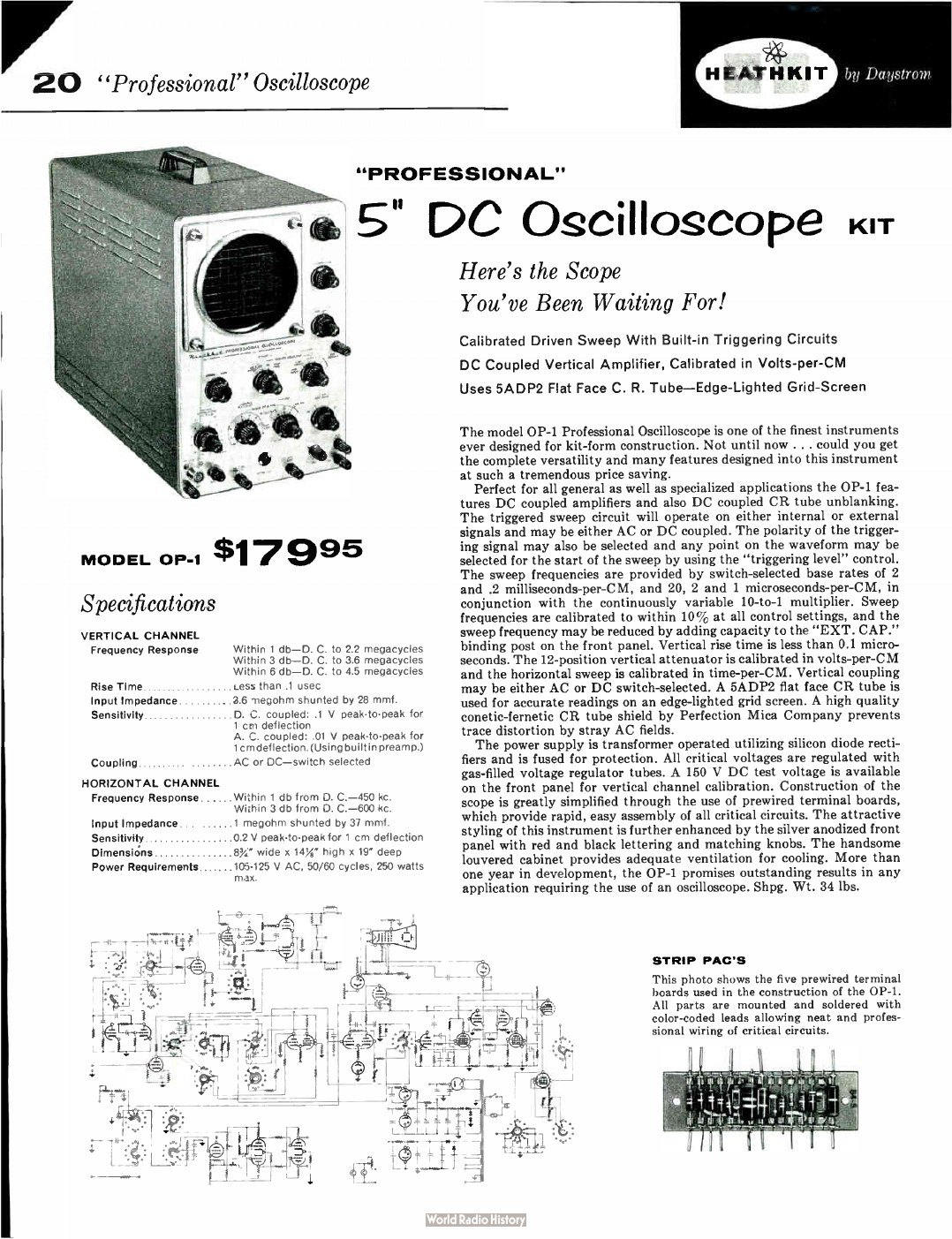
At the other end, Heath began to build scopes for laboratories. The OP-1 “Professional” 5-inch DC oscilloscope, $179.95 in the 1959 catalogue, had DC-coupled amplifiers calibrated in volts per centimetre, a triggered sweep calibrated in time per centimetre, a flat-faced 5ADP2 tube with an edge-lit graticule, and pre-wired terminal “strip pacs” for the critical wiring. The catalogue said it had been “more than one year in development” and opened: “Here’s the Scope You’ve Been Waiting For!” (1959 catalogue, p. 28). The OR-1 “Research” scope sat between it and the O-12 at $119.95 (Eckweiler #89).
The market below Heath was moving too. Eckweiler notes that by late 1960 Heath’s advertising in Electronics World had shifted to audio, amateur and home products; from January to October 1960 the only test equipment it advertised was the new RF-1 signal generator, the FMO-1 FM alignment generator and the TT-1 tube tester. In November 1960 “2 new scopes” appeared: the IO-30 at $76.95, which replaced the O-12, and the all-new IO-10, a 3-inch DC scope at $79.95 (Eckweiler #89).
2.4 Generators, bridges and the television bench
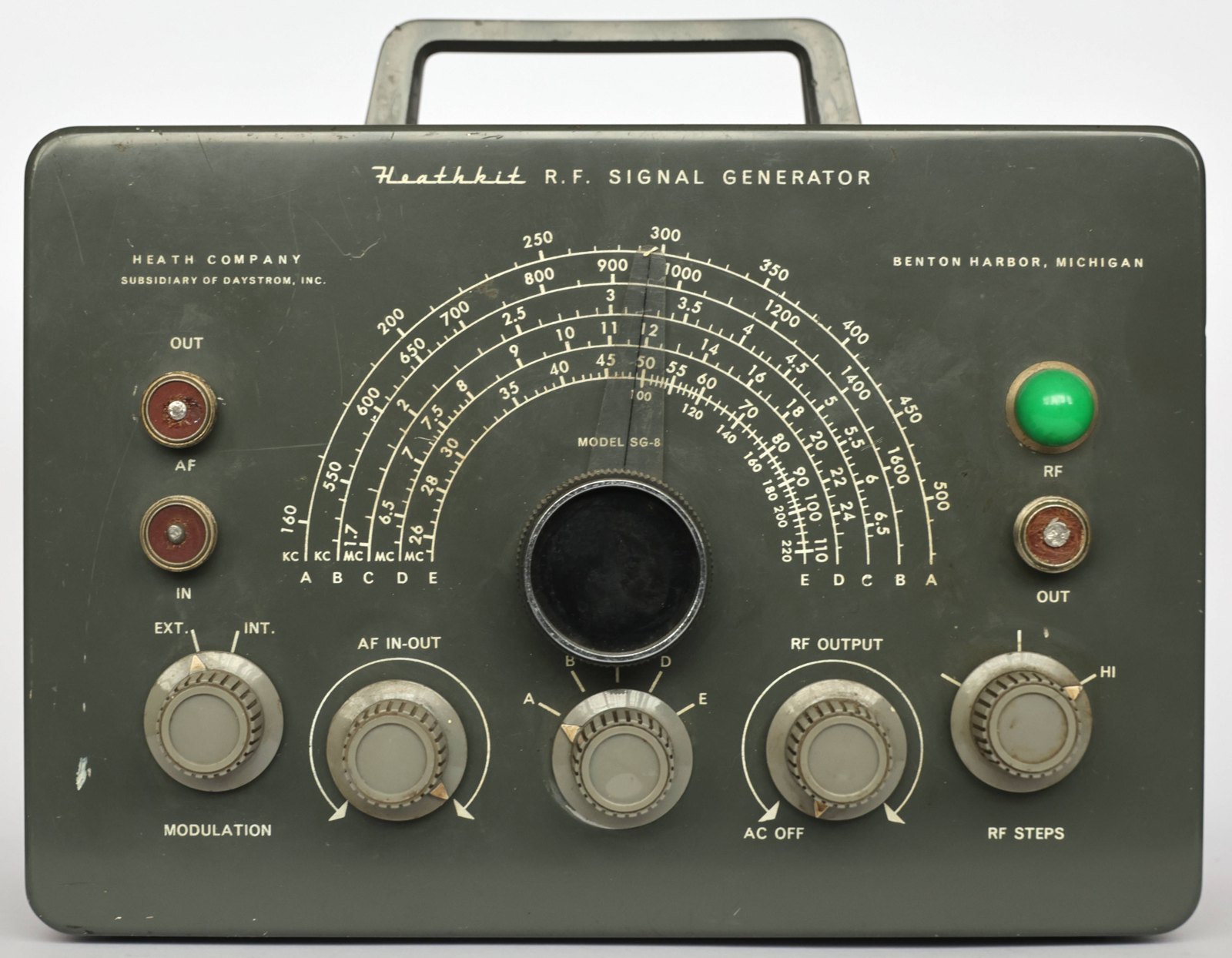
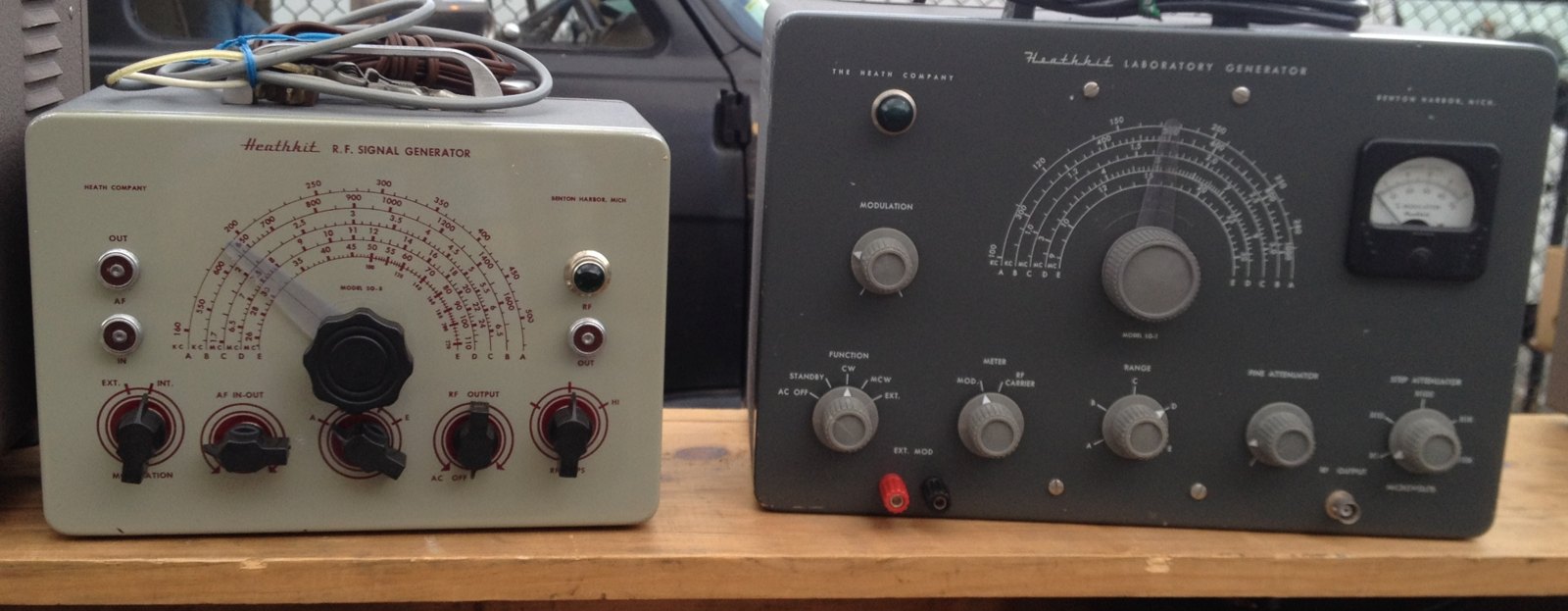
The generator line of the 1950s kept its prices while its circuits improved. The SG-6, SG-7 and SG-8 RF generators all sold at the $19.50 the G-1 had cost in 1948; the SG-8 of 1953 used a 6C4 and a 12AU7, reached 110 Mc and stayed in the catalogue until 1961. The LG-1 laboratory generator ran from 1953 to 1962 at $39.50, later $48.95 (Eckweiler #32; #61). The audio line ran through the AG-8, AG-9A and AG-10 sine and square-wave generators, the AO-1 audio oscillator, the AA-1 audio analyser ($59.50) and the HD-1 harmonic-distortion meter ($49.50), which served the hi-fi boom that Heath’s own amplifiers were feeding (1956 order form).
Television servicing drove the rest. The TS-4 and TS-4A sweep alignment generators ($49.50), the LP-1 linearity pattern generator ($22.50), the CC-1 picture-tube checker ($22.50), and in 1957 the CD-1 colour bar and dot generator ($59.95), which Heath later listed among its “firsts,” all served the colour-set repairman. For the component bench there were the CM-1 direct-reading capacity meter ($29.50), the CT-1 in-circuit “Capaci-Tester” of 1957 at $7.95, the IB-2A impedance bridge ($69.95) and the QM-1 Q meter (Eckweiler #44; 1956 and 1959 catalogues). The 1956 catalogue also offered a radiation counter kit, the RC-1, at $79.95, sold into the fallout scares of the Cold War.
2.5 The TT-1 tube tester
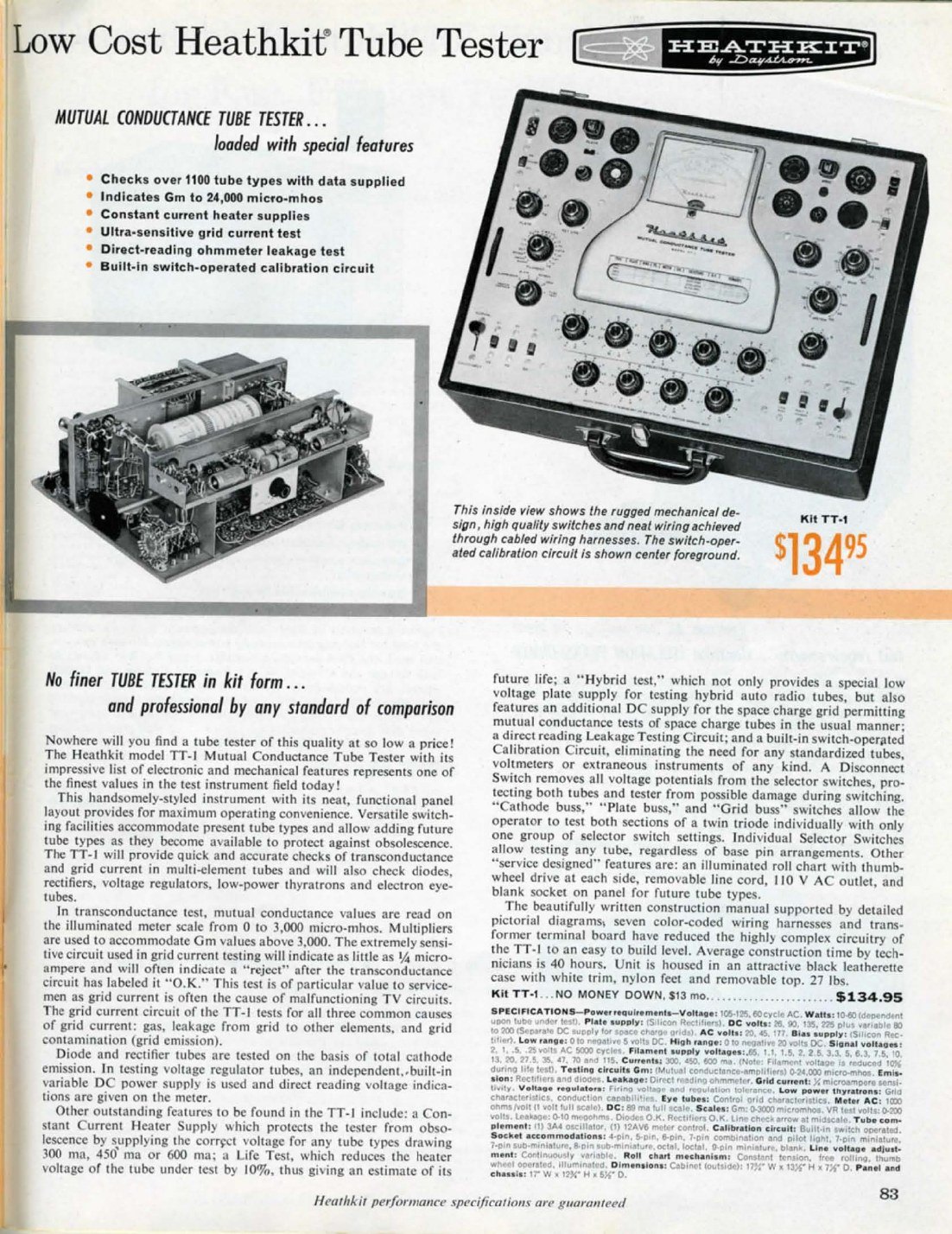
The most ambitious instrument of the Daystrom years was a tube tester. The TT-1 measured mutual conductance, the tube’s actual gain, by putting a 5 kHz signal on the grid and reading the change in plate current directly in micromhos. An emission checker like the TC-series only asked whether the cathode was still emitting. The TT-1 was a kit-form redesign of the professional Weston 981, which Daystrom also owned. It was in the Fall–Winter 1961 catalogue at $134.95, three times the $44.95 of the IT-21 emission checker that replaced the TC-3 the following year, with the frank note that “average construction time by technicians is 40 hours.” The TT-1A of 1962 ($149.95) added a socket adapter for Compactrons and Nuvistors, and the pair stayed in the catalogue until about 1974 (Heathkit Fall–Winter 1961 catalogue, p. 83). The instrument, its Weston ancestry and the emission-versus-mutual-conductance question are the subject of the TT-1 dive.
2.6 1961: the I-prefix and Classic II
In 1961 Heath restyled and renumbered its instruments. The single-letter and two-letter model numbers of the 1950s gave way to a system whose first letter, I, meant “instrument” and whose second gave the kind: IM for meters, IO for oscilloscopes, IG for generators, IT for testers, IP for power supplies, IB for bridges and later counters, IN for substitution boxes. No Heath document decoding the prefixes has been found; the meanings are inferred from the products (history dive, volume 9). The new panels were dark grey with silver lettering, the style the collector Chuck Penson calls “Classic II” (Eckweiler, review of Penson).
Most of the new models were old circuits in new cases, and the catalogue said so. The IM-11 was “now designated the IM-11,” the V-7A with a new cabinet and a single switching probe, at $29.95 in the Fall–Winter 1961 catalogue; a year later Heath cut it to $24.95 because, the copy said, “this is the world’s largest selling VTVM” (Fall–Winter 1961, p. 79; 1962–63 catalogue). The PS-4 power supply became the IP-32 without an electrical change (IP-32 dive); the LG-1 became the IG-42 ($56.95); the AG-9A became the IG-72 ($41.95); the RF-1 became the IG-102 ($27.95); the TC-3 became the IT-21 ($44.95); the C-3 condenser checker became the IT-11 capacitor checker ($29.95), and “condenser” disappeared from the catalogue.
Table 2 — 1961: the I-prefix and Classic II
| Old model | New model | Kit price in the new catalogue |
|---|---|---|
| V-7A VTVM | IM-11 | $29.95 (1961), $24.95 (1962) |
| AV-3 AC VTVM | IM-21 | $33.95 |
| BT-1 battery tester | IM-20 | $14.95 |
| C-3 condenser checker | IT-11 | $29.95 |
| TC-3 tube checker | IT-21 | $44.95 |
| PS-4 HV power supply | IP-32 | $56.95 |
| LG-1 laboratory generator | IG-42 | $56.95 |
| AG-9A audio generator | IG-72 | $41.95 |
| RF-1 RF generator | IG-102 | $27.95 |
| T-4 signal tracer | IT-12 (successor inferred) | $19.95 |
| S-3 electronic switch | ID-22 (successor inferred) | $23.95 |
| RS-1, CS-1 substitution boxes | IN-12, IN-22 | $5.95, $5.50 |
Sources: Heathkit catalogues Fall–Winter 1961 and 1962–63, World Radio History; Eckweiler #35 and #38 (substitution boxes), #47 (AV-3 to IM-21), #59 (IG-72 a restyled AG-9A), #61 (IG-42, IG-102); the Nostalgic Kits Central matrix (IM-20, IT-21, IG-42 and IG-102 as replacements). The T-4 and S-3 successors are inferred from function and date only.
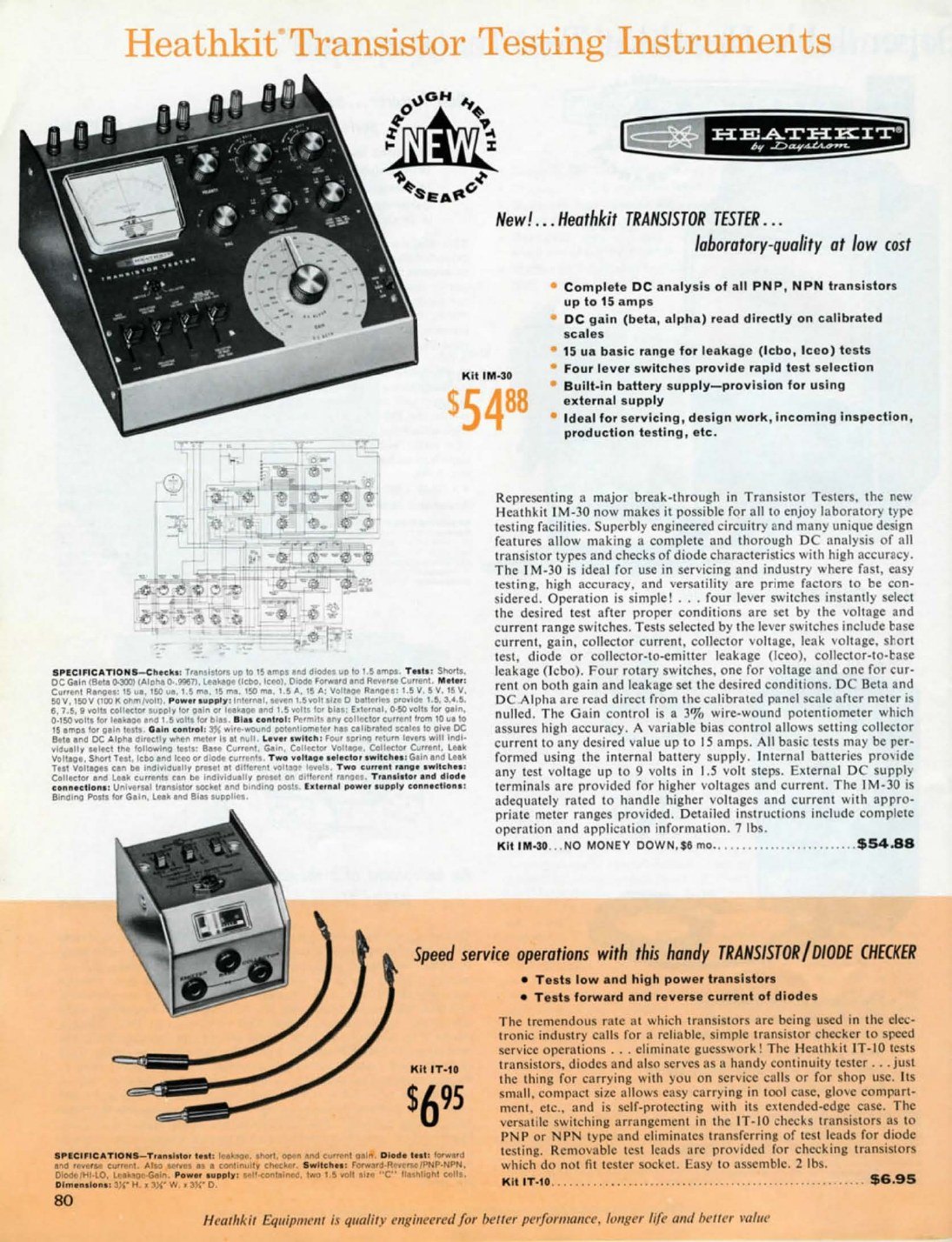
Two genuinely new families arrived with the restyle. The first was the transistor tester. Eckweiler found only one kit using transistors in the 1959 catalogue, the DF-1 direction finder, and more than a dozen two years later. The IT-10 ($6.95), a small cube that checked leakage and gain from two C cells, was “New through Heath research” in May 1961, and the IM-30 laboratory transistor tester followed at $54.88 (Eckweiler #75). The second was the service-bench VTVM with a 6-inch meter, the IM-10 of 1961, which the VTVM dive follows through the IM-13 and IM-28.
The IT-11 capacitor checker is a good example of how long the restyled instruments lasted. It measured capacitance from 10 pF to 1,000 µF on a line-frequency Wheatstone bridge with a magic-eye null indicator, checked leakage at 3 to 600 volts and power factor for electrolytics, and could also measure resistance and transformer turns ratio. Eckweiler, who bought his in August 1966 at the Heathkit store in Redondo Beach for $36.50, above the catalogue price, still used it more than any other Heath instrument decades later (Eckweiler #2).
2.7 The IO scopes of the 1960s
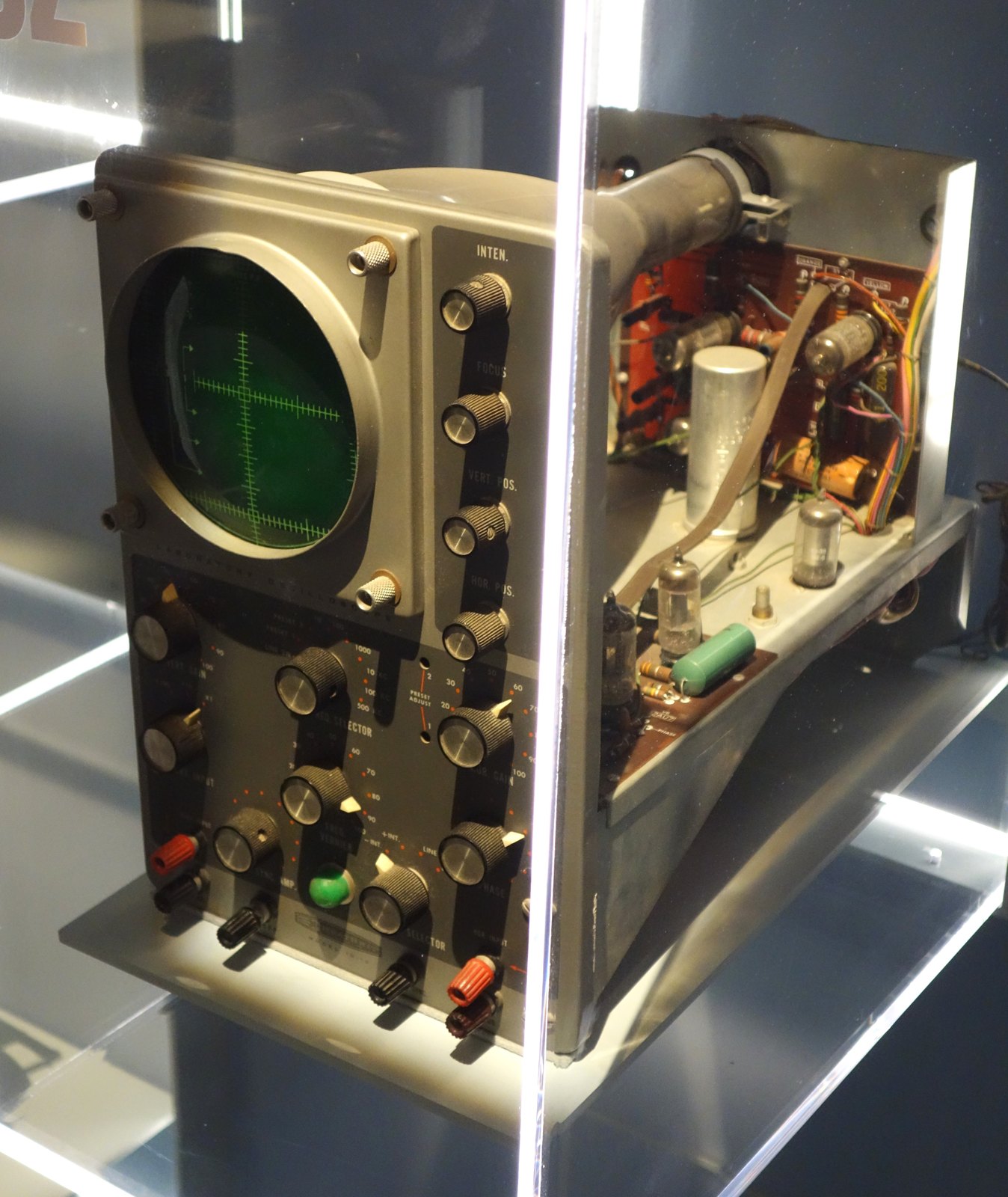
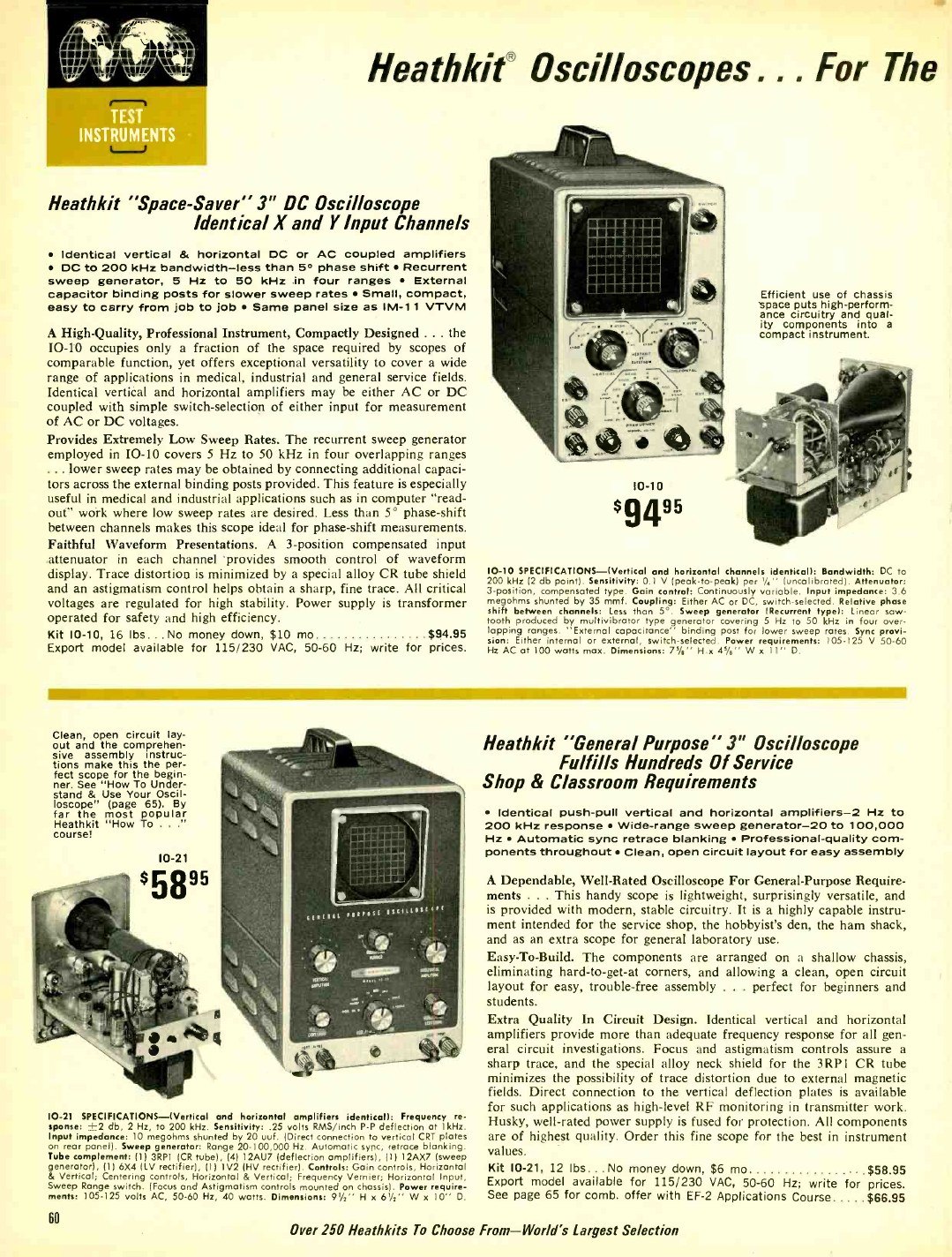
The oscilloscope line of the 1960s had three tiers. The IO-21 “General Purpose” 3-inch scope (1961, $49.95, $61.95 by 1971) was the cheap one, sold with Heath’s EF-2 “How to Understand and Use Your Oscilloscope” course and used, as Eckweiler recalls, to monitor cassette levels for early home computers. The IO-10 “Space-Saver” 3-inch DC scope ($79.95, $94.95 by 1967) had identical DC-coupled horizontal and vertical channels. The IO-12, a 5-inch laboratory scope at $76.95 in the 1962–63 catalogue, became the best-known Heath tube scope of all and remained in the catalogue until 1971 (Eckweiler #96; catalogues 1962–1971).
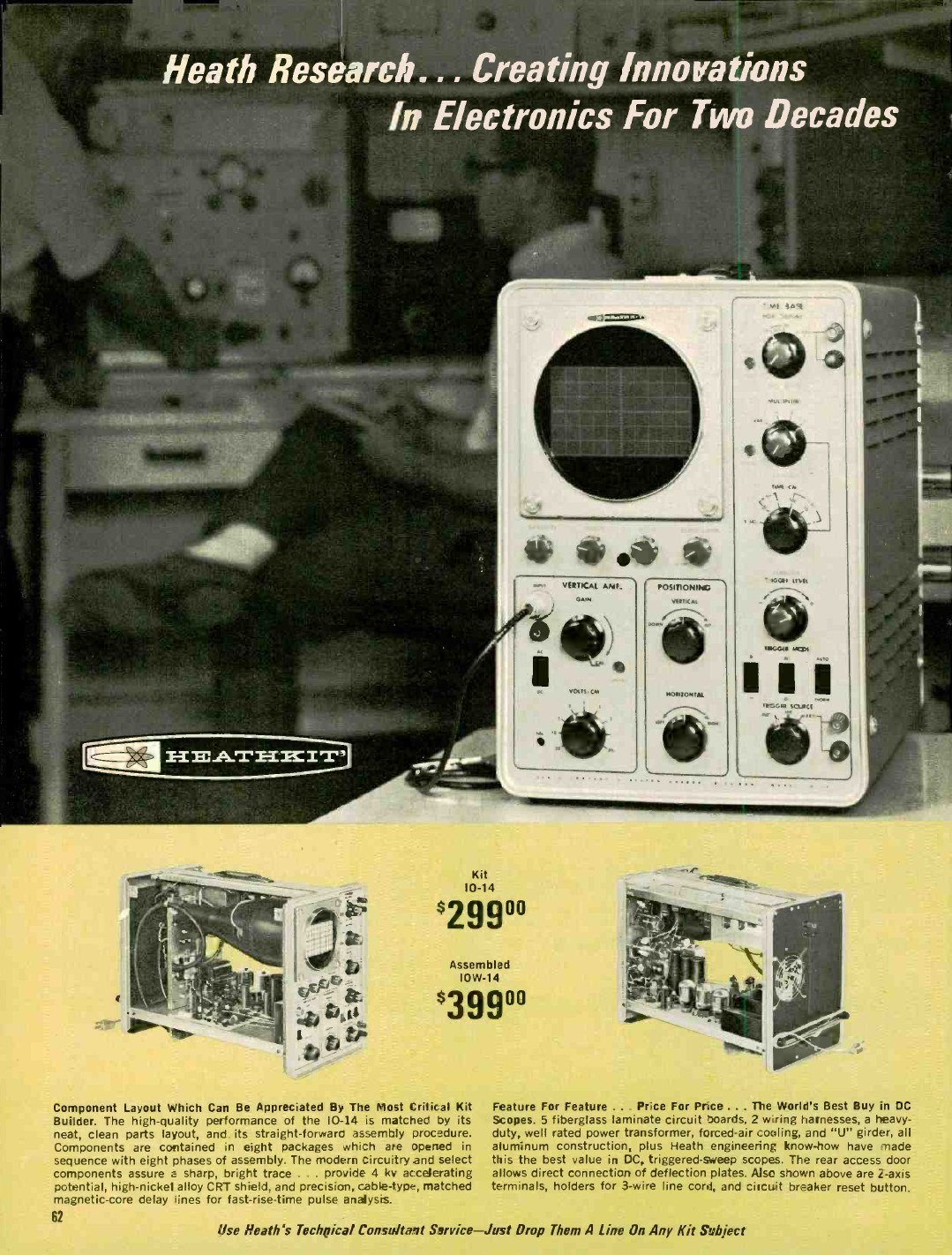
The top tier arrived in 1966–67 with the IO-14, a 5-inch DC-to-8 MHz scope with triggered sweep and magnetic-core delay lines for looking at fast pulses, at $299.00 in kit form and $399.00 assembled. Heath headed the spread “Heath Research… Creating Innovations in Electronics for Two Decades” and called it “the world’s best buy in DC scopes.” Its circuit came in eight packages opened in sequence with the manual, the technique Heath was using on its colour-television kits (1967 catalogue, pp. 62–63). It was the first Heath kit scope priced against the professional instruments of Tektronix rather than against EICO.
2.8 Schlumberger and the laboratory line
Schlumberger took over Daystrom, and with it Heath and Weston, on 1 February 1962. Its 1963 annual report described Heath as having developed “a wide range of measuring instruments for use in homes, schools, service shops, and laboratories,” from oscilloscopes and vacuum-tube voltmeters to signal generators, signal tracers and audio generators, “packaged for home assembly or sold in assembled form,” and put the catalogue at 200 Heathkits (Schlumberger Annual Report 1963).
The same years produced a new kind of instrument for Heath: assembled laboratory equipment for teaching. From 1962 Heath developed, with the chemists Howard Malmstadt of the University of Illinois and Christie Enke of Princeton, a line of factory-built instruments to teach electronics to scientists; the first, a strip-chart recorder, went on sale in August 1963. The EUW-24 VTVM ($62), EUW-25 DC oscilloscope ($168) and EUW-20A recorder ($199) of the Malmstadt-Enke line were sold only assembled, at prices taken from the Nostalgic Kits Central matrix, and the Scientific Instruments group that built them became the seed of Heath’s later assembled instrument business (Nostalgic Kits Central; Schlumberger Annual Report 1972). The group, the EU-805 universal digital instrument and the people who designed it are described in the history dive’s fourth volume. The next volume follows what that group, and the kit line beside it, did with solid-state and digital circuits.
Sources
- Eckweiler, Bob (AF6C). “Heathkit of the Month” #2 (IT-11), #9 (IT-12), #32 (LG-1), #41 (OL-1), #44 (CT-1), #59 (IG-72), #61 (SG-8), #75 (IT-121 and the transistor testers), #89 (O-9 to O-12), #96 (IO-21), and review of Penson’s Heathkit Test Equipment Products (A03). https://www.w6ze.org/Heathkit/Heathkit_Index.html
- Heath Company catalogues: flyer filed as Fall 1955; 1956; 1959; Fall–Winter 1961 (Allied-distributed); 1962–63 (filed as 1963 Fall–Winter 81-30); 1967. World Radio History. https://www.worldradiohistory.com/Archive-Catalogs/Heathkit_Catalogs.htm
- Schlumberger Limited, Annual Reports 1962, 1963 and 1972. Internet Archive. https://archive.org/details/01.-schlumberger
- Nostalgic Kits Central, Heathkit model matrix. https://www.nostalgickitscentral.com/heath/products/alphabetical.html
- Heathkit history dive, this site, volumes 3, 4 and 9. https://heathkit.fubsypoly.com/heathkit/vol-3/
- Related dives: VTVM; TT-1 tube tester; IP-32 power supply.
Comments (0)