Test Equipment · Volume 3
Solid State, Nixies and Heath/Schlumberger, 1967–1979
Between 1967 and 1979 the instrument line changed more than in the twenty years before. The tube gave way to the transistor and then to the integrated circuit. The meter needle gave way to the Nixie tube and then to the LED. The oscilloscope gained a triggered, calibrated time base as a matter of course, and the frequency counter, which Heath had never sold, became one of its best lines. Alongside the kits, the old Scientific Instruments group became a separate assembled-instrument business under the name Heath/Schlumberger. By the end of the decade the catalogue offered a kit, an assembled version or both for almost every instrument, and a four-digit numbering scheme had replaced the short numbers of 1961. The Schlumberger years as a whole are covered in the history dive’s fourth volume.
3.1 Instruments in a changing company
Schlumberger’s reports show that instruments still mattered to Heath in these years. The 1968 report said that “since the first introduction in 1947 of test instrument kits, they have become a significant part of Heath business,” and that instrument sales “showed large gains in 1968.” The 1974 report said orders “continued to increase for Heath electronic test instruments, mainly low priced oscilloscopes, counters, function generators and multimeters — many of these are sold as assembled units, as well as in kit form.” In 1976, a record year with sales of $92 million, the largest gains were in amateur radio, “laboratory/test equipment” and the new educational courses, and the new products included “a 10MHz dual-trace oscilloscope, an AC voltmeter, a portable color alignment generator, distortion analyzers, digital meters, testers and frequency counters” (Schlumberger Annual Reports 1968, 1974, 1976).
The same reports record a change in what a kit was for. In 1972 Schlumberger wrote that when Heathkits first appeared “the prime motivation to build a kit was financial savings,” but that “now frequently a better Heathkit product may cost as much as a competitor’s ordinary assembled model” (Schlumberger Annual Report 1972). For instruments that was the new position: a Heath scope or counter was no longer a cheap copy of a laboratory instrument, but a laboratory instrument sold cheaply because the customer built it.
3.2 Solid-state meters and the New Look
The first solid-state Heath voltmeter, the IM-17 “utility solid-state voltmeter,” appeared late in 1967; the 1968 catalogue lists it at $19.95, and Eckweiler gives $25.95 at introduction (1968 catalogue; Eckweiler #78). It used an FET input to give 11 megohms on DC without a tube. The IM-16 bench solid-state volt-ohm meter ($44.95) and the IM-25 laboratory meter ($80.00 as a kit, $115.00 wired) followed in the same catalogue. None of them displaced the vacuum-tube voltmeters, which Heath kept selling to 1989; that story, and the IMA-18-1 plug-in FET conversion for the old VTVMs, belongs to the VTVM dive.
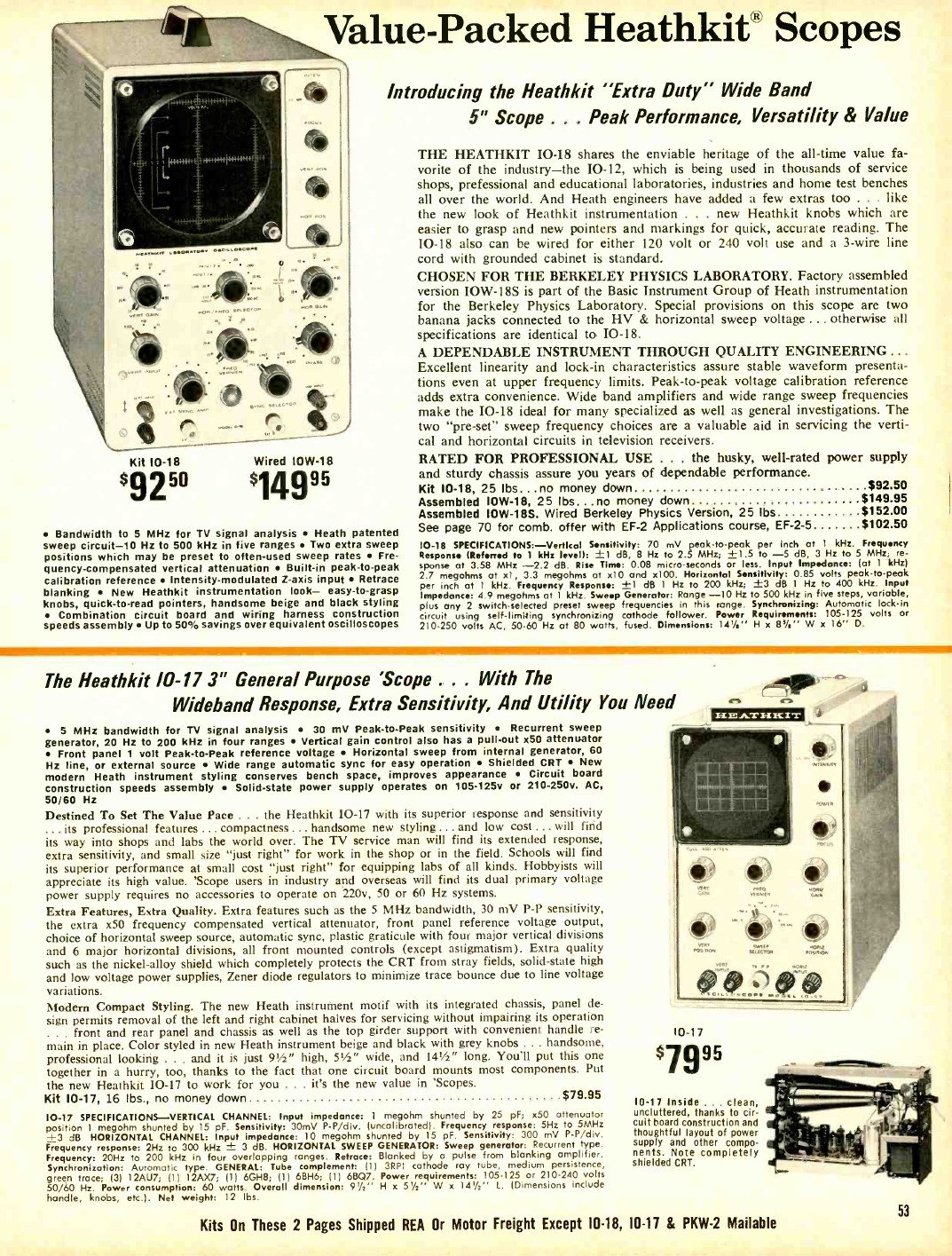
The new instruments came in new cases. From about 1968 Heath restyled its test equipment in what Chuck Penson calls the “New Look”: beige cabinets, black panels and larger, easier-to-grip knobs. The 1971 catalogue introduced the IO-18 5-inch “Extra Duty” scope, a development of the IO-12, with “the new look of Heathkit instrumentation … new Heathkit knobs,” and described the companion IO-17 3-inch scope as “Heath instrument beige and black with grey knobs.” An assembled IO-18, the IOW-18S, was “chosen for the Berkeley Physics Laboratory” (1971 catalogue, p. 53).
3.3 Oscilloscopes go solid state
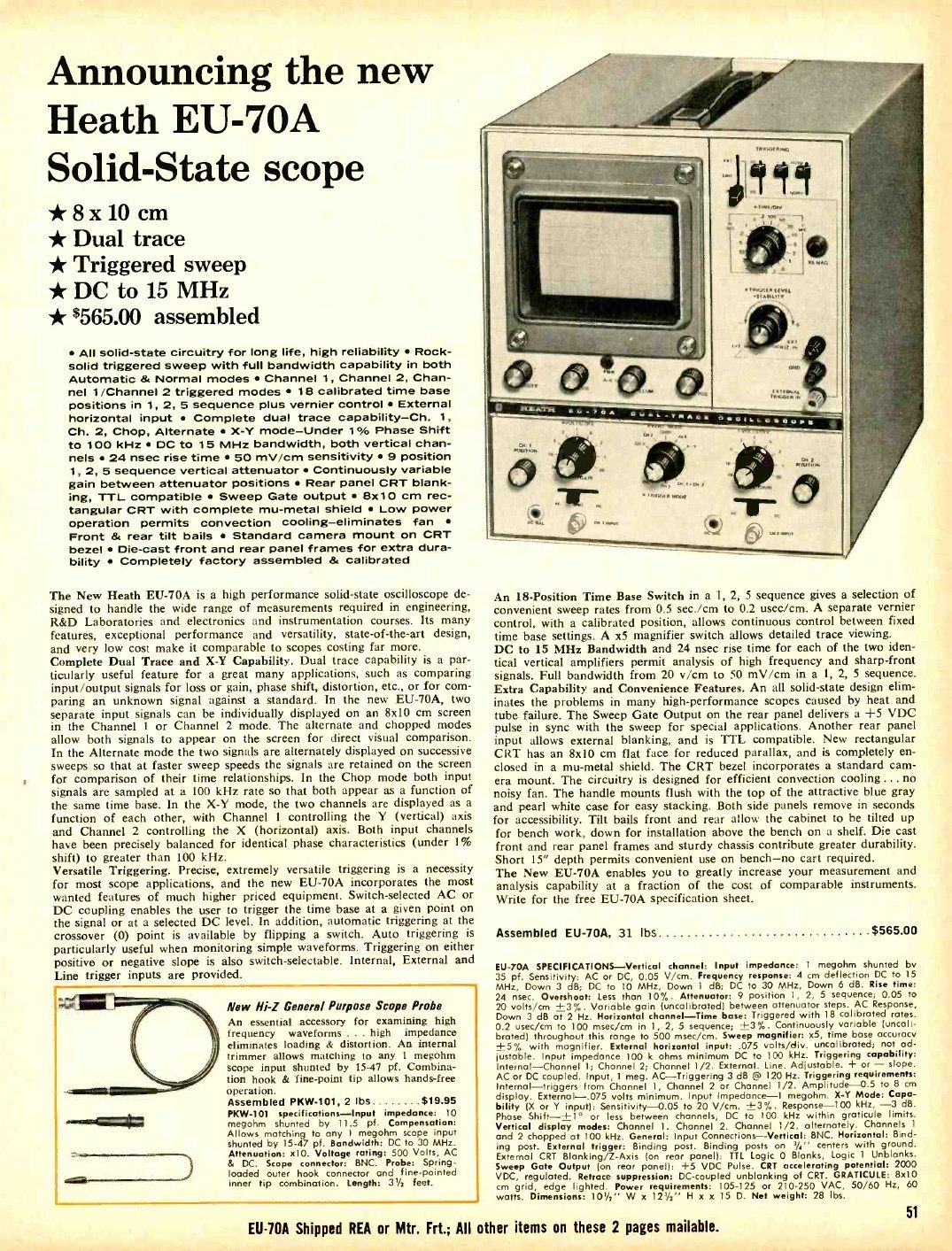
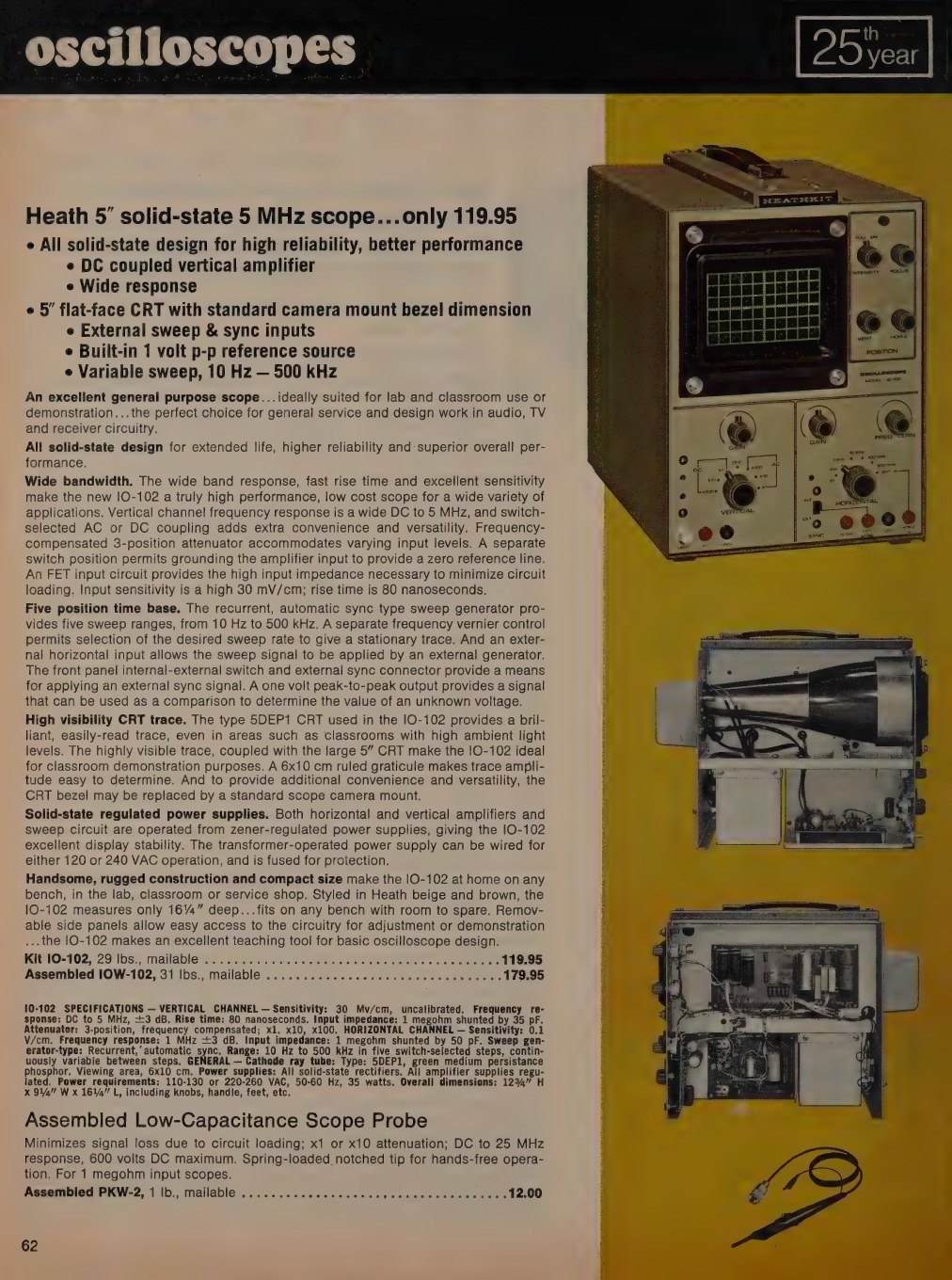
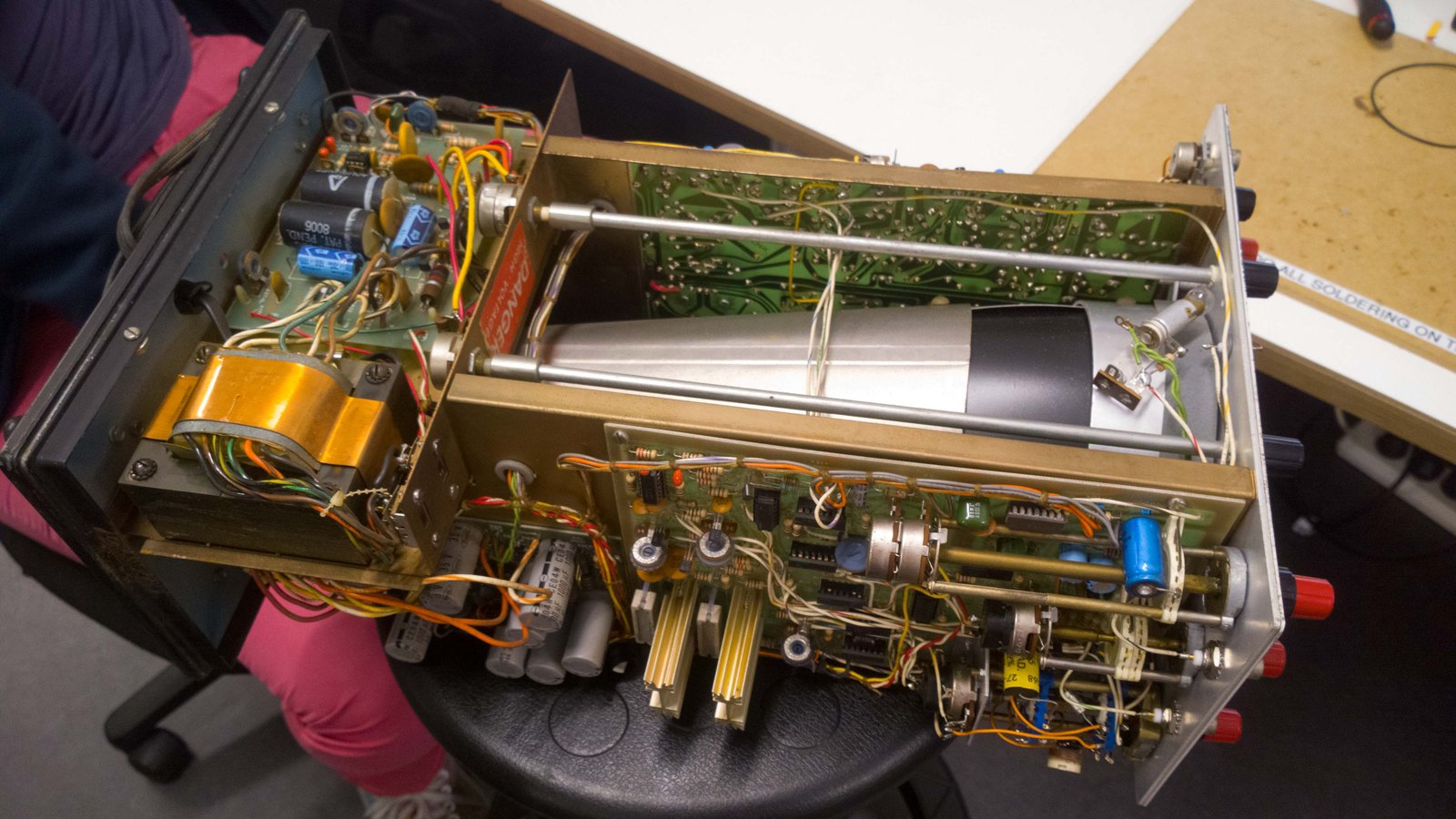
The first all-solid-state Heath scope was an assembled laboratory instrument, not a kit. The EU-70A of about 1970, from the Scientific Instruments group, was a dual-trace, triggered, DC-to-15 MHz scope with an 8 × 10 cm rectangular CRT and TTL-compatible gate output, sold assembled at $565.00 (1971 catalogue, p. 51). The kit line followed with the IO-102 of 1971, a solid-state 5 MHz 5-inch scope at $119.95, and the IO-103, IO-104 and IO-105 of 1972–74, the last a dual-trace DC-to-15 MHz design (1972 catalogue, p. 62; Nostalgic Kits Central). The IO-101 and IO-1128 were vectorscopes for colour-television alignment.
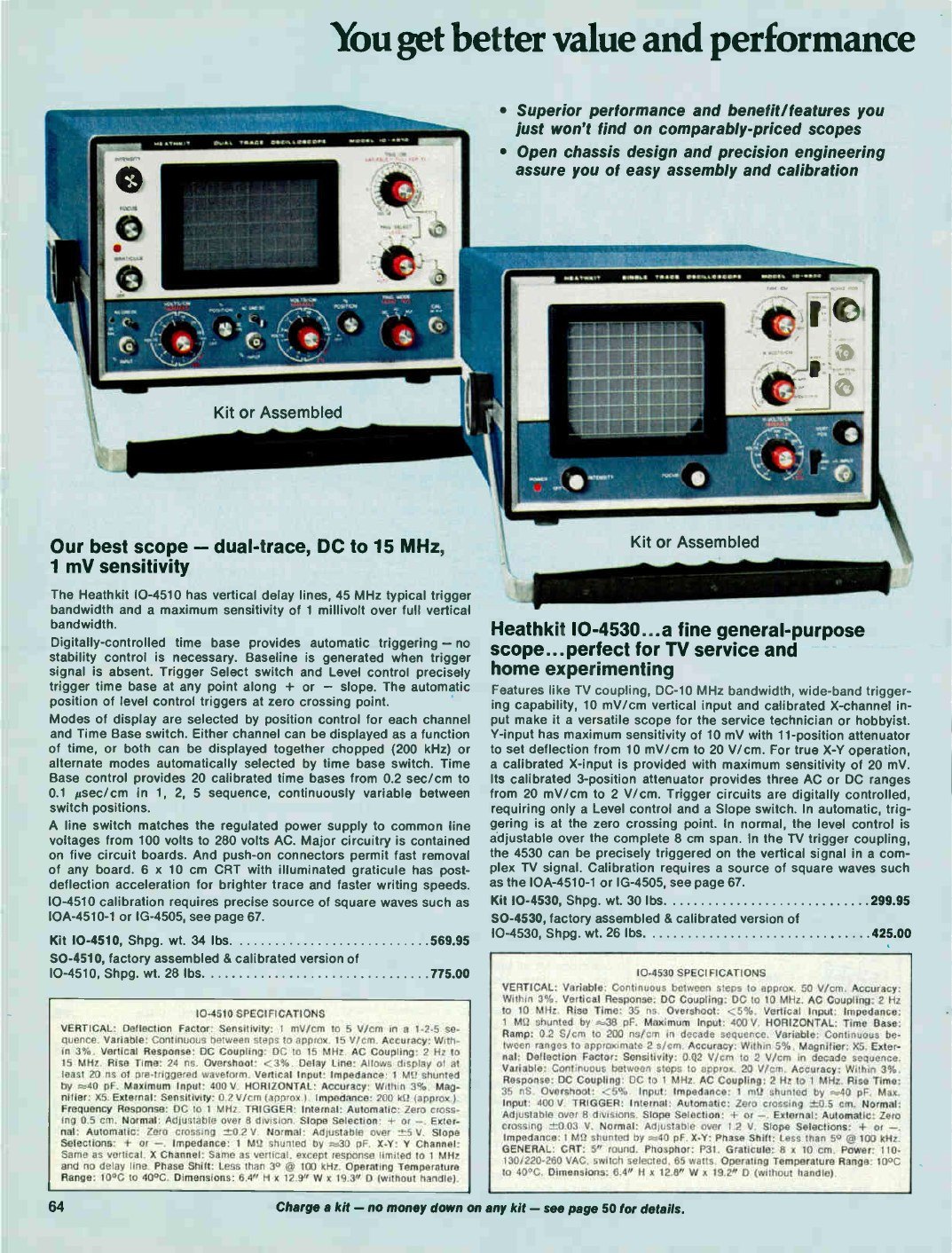
In 1974 the scopes moved to four-digit numbers, and by 1976 to blue cabinets. The IO-4510, “our best scope,” was dual-trace, DC to 15 MHz, with vertical delay lines and a 1 mV sensitivity, $569.95 as a kit and $775.00 assembled as the SO-4510 in 1976. Beneath it came the IO-4530 TV-service scope ($299.95), the IO-4540 ($179.95) and IO-4560 ($119.95) hobby and service scopes, and in 1976 the IO-4550 10 MHz dual-trace scope at $379.95 (Spring 1976 catalogue, p. 64; Christmas 1975 catalogue). The Schlumberger report for 1974 noted that “Heath engineers developed … 15MHz and 10MHz oscilloscopes at relatively low prices for quality equipment” for laboratory technicians and television servicemen.
3.4 Frequency counters
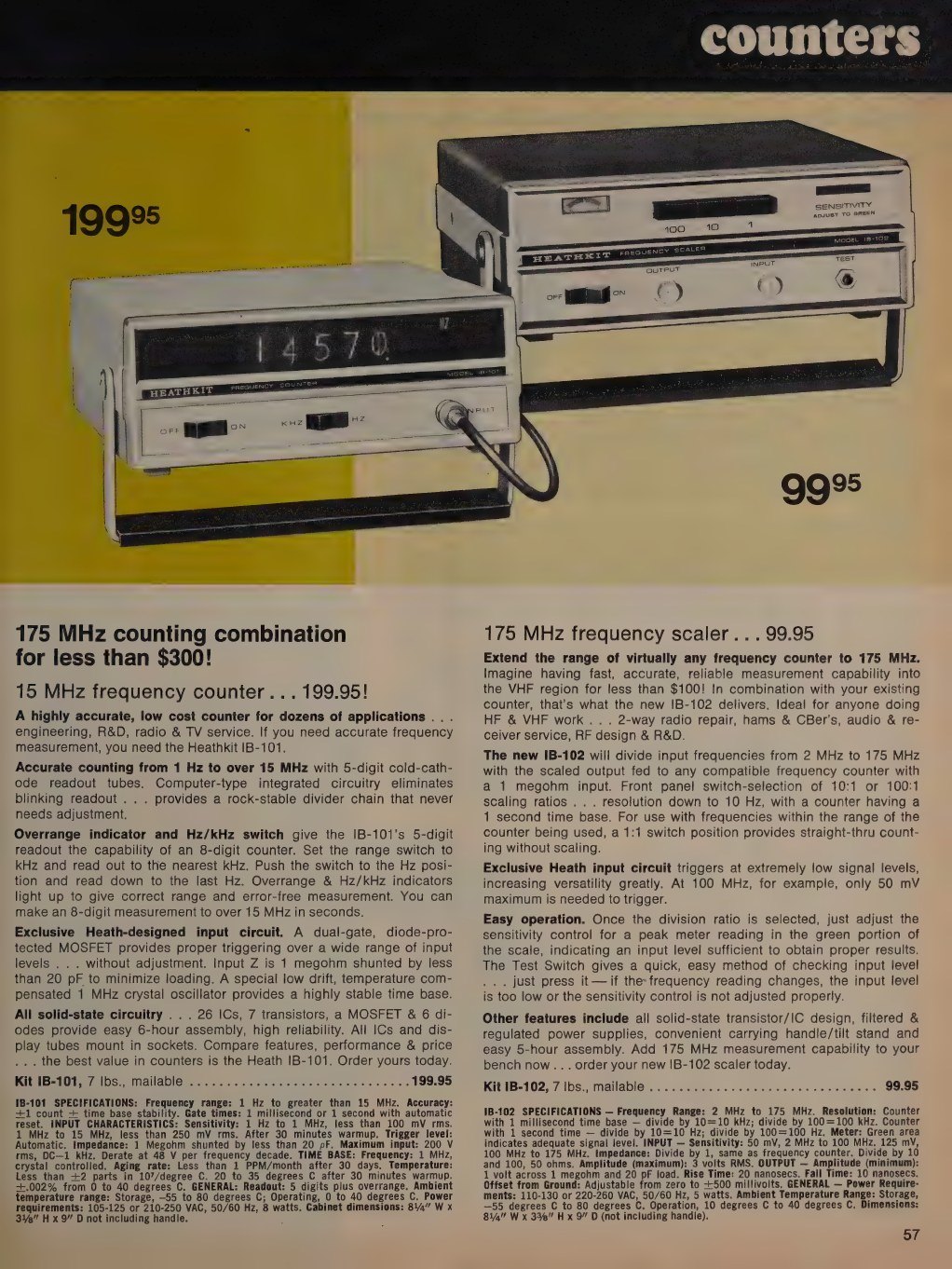
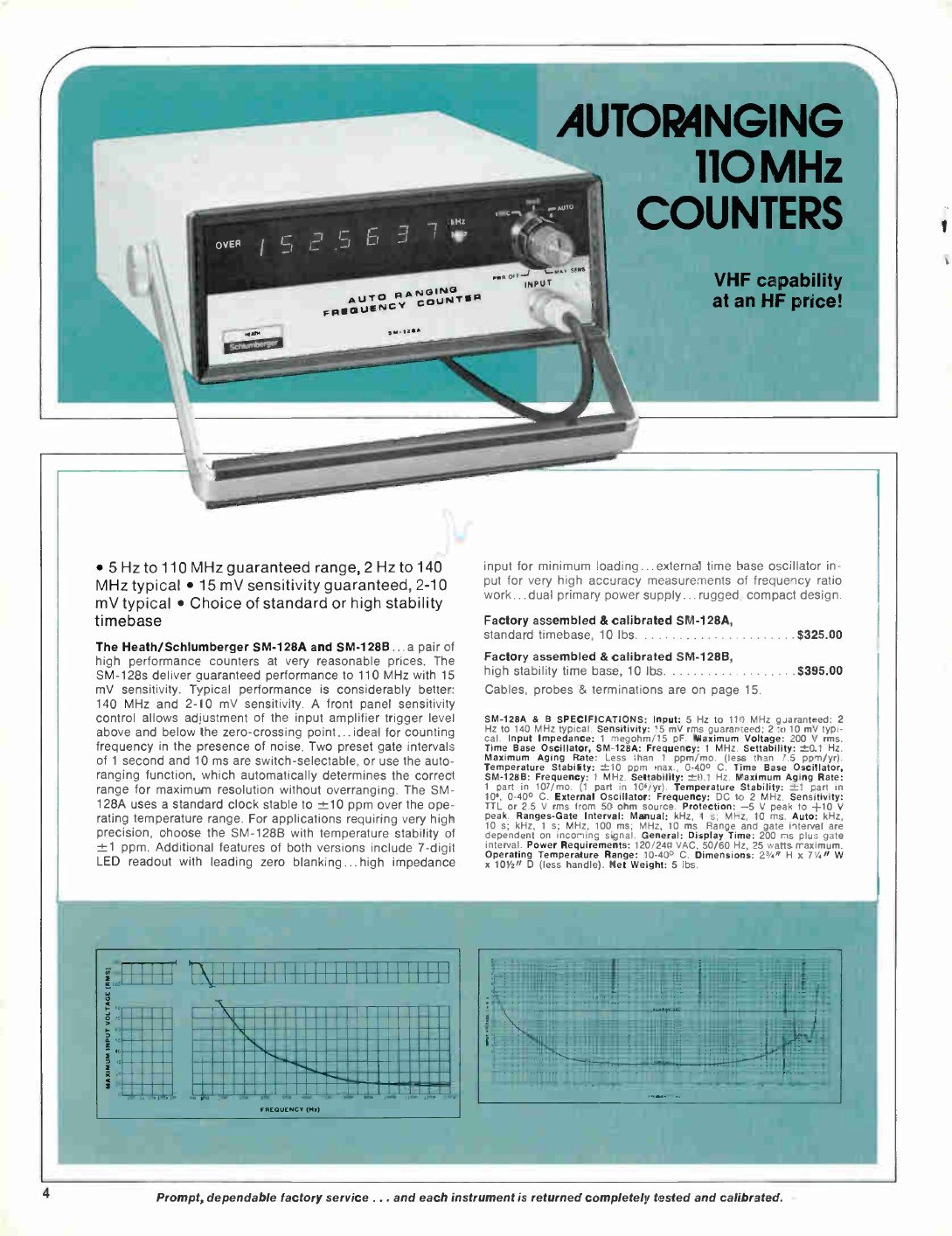
Heath had never sold a frequency counter before the IB-101 of about 1970: a 15 MHz counter with five Nixie tubes, 26 integrated circuits and a MOSFET input, $199.95 in kit form. The IB-102 scaler ($99.95) extended any counter to 175 MHz (1972 catalogue, p. 57). Its successors, the IB-1100 (30 MHz), IB-1101 (100 MHz), IB-1102 (120 MHz, eight digits, $279.95) and IB-1103 (180 MHz with a phase-locked frequency multiplier, $349.95), took the Nixie counter to 1977. Schlumberger’s report for 1973 singled out two new counters: “one is a kit measuring up to 180 MHz … through the use of a phase-locked frequency multiplier. The other is an assembled fully automatic 110 MHz autoranging counter” (Schlumberger Annual Report 1973). The kit is the IB-1103; the assembled one appears in the 1974 Heath/Schlumberger catalogue as the SM-128A and SM-128B, at $325 and $395.
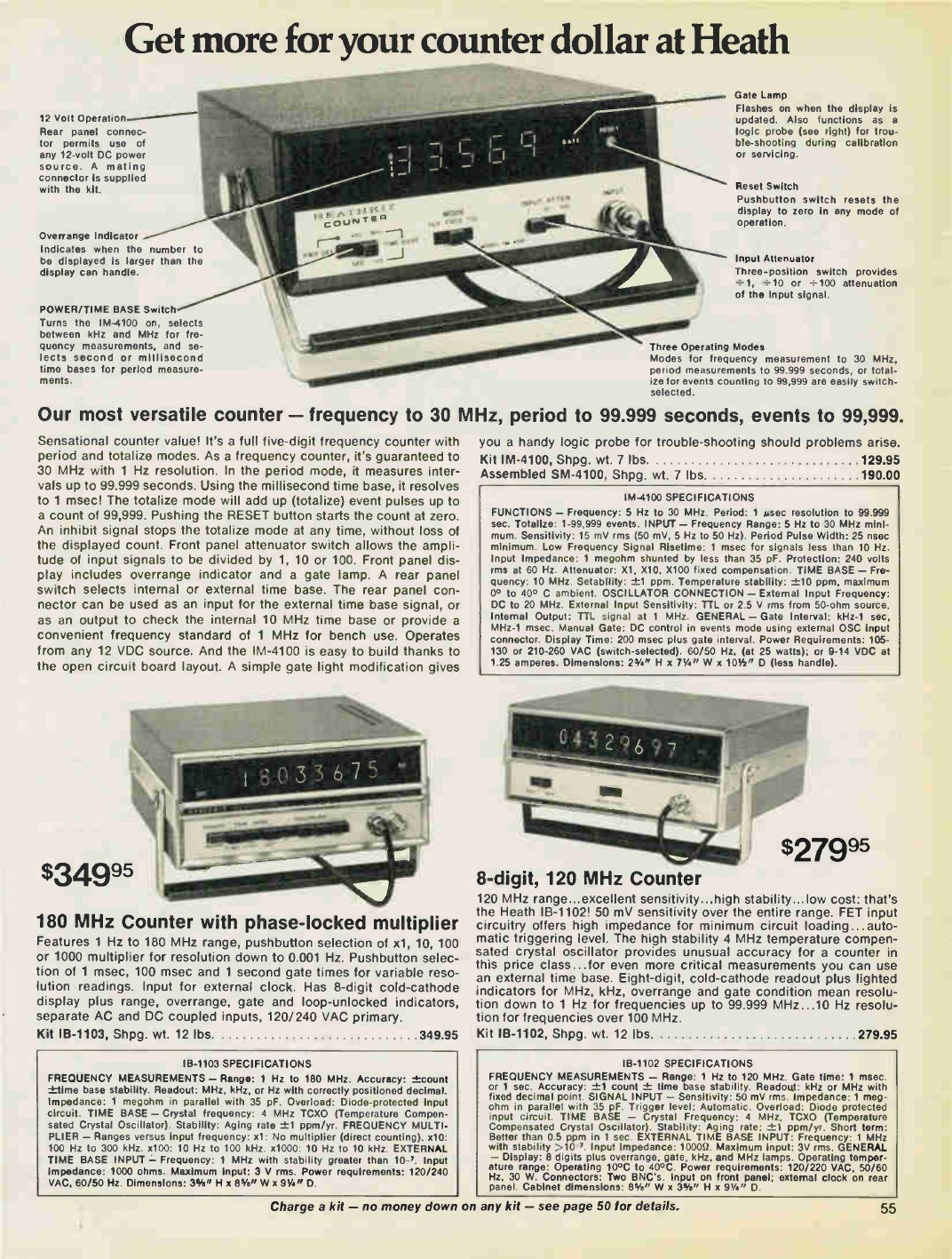
The LED counters followed. The IM-4100 of 1975 measured frequency to 30 MHz, period and totalised events at $129.95; the IM-4110 (110 MHz, $189.95), IM-4120 (250 MHz, $329.95) and IM-4130 (1 GHz, $529.95) of 1977 completed the family (Fall 1977 and Christmas 1977 catalogues). Chas Gilmore listed “the first frequency counter using 74LS TTL” among Heath’s firsts, without naming the model (Gilmore, Electronic Design). Counters became a Heath line that radio amateurs in particular bought, and they lasted, with the IM-2400 series of the 1980s, to the end of the kits.
3.5 Digital meters
The digital multimeter arrived in the same years. Schlumberger’s 1972 report noted that Heath “has also introduced a low-cost digital multimeter,” and the early models used Nixie tubes: the IM-102 3½-digit DVM ($249.95 in 1975) and the 2½-digit IM-1202 and IM-1212. The LED models followed from 1975: the IM-2202 3½-digit portable ($179.95), the IM-1210 low-cost bench DMM ($67.95 in 1977) and, in 1979, the IM-2212 3½-digit auto-ranging meter ($299.95) and the IM-2215, a handheld LCD multimeter ($99.95) (Schlumberger Annual Report 1972; catalogues 1975–1980).
3.6 Heath/Schlumberger Instruments
The Scientific Instruments group that had built the Malmstadt-Enke line changed direction in the 1970s. Gilmore, who joined it in 1966 under chief engineer Wayne Kooy, recalls that it had been “a spin-off from the old kit instruments group,” about five engineers and three or four technicians, and that a marketing executive brought in from Schlumberger’s oilfield services turned it from teaching instruments toward general-purpose ones: frequency meters, function generators, chart recorders and power supplies. In that market, sold mainly by mail, it faced Hewlett-Packard, Tektronix, Fluke, Wavetek, Keithley, Systron-Donner and Weston (EEJournal, “The Rise and Fall of Heathkit,” part 2). The “Heath/Malmstadt-Enke” name was dropped in 1974 and the line continued as Heath/Schlumberger (Brueschke and Mack).
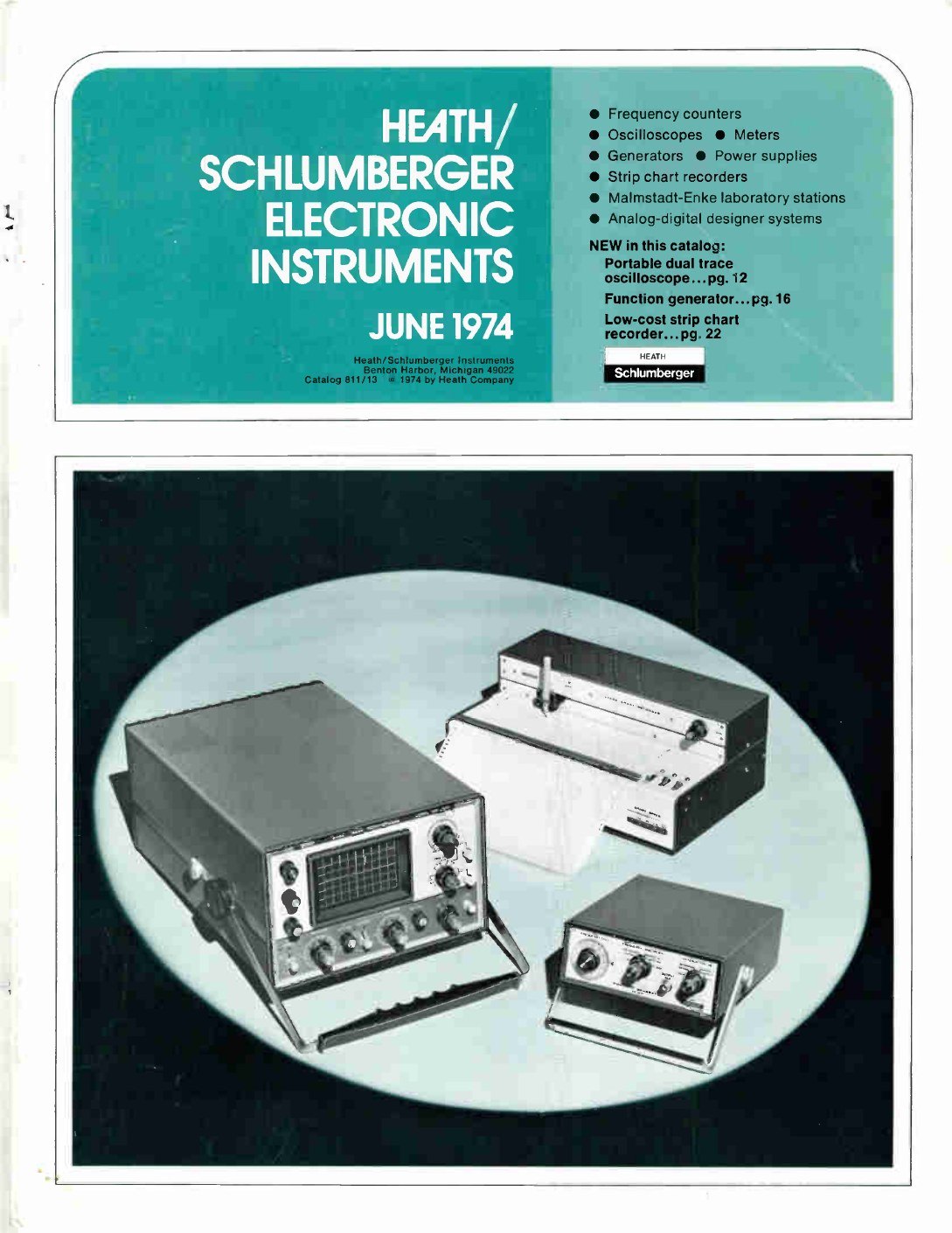
The June 1974 Heath/Schlumberger catalogue shows what the business was. It sold frequency counters, oscilloscopes, generators, meters, power supplies, strip-chart recorders, Malmstadt-Enke laboratory stations and “analog-digital designer” systems, all “assembled in a separate facility at the Heath plant in Benton Harbor,” with a thirty-day free trial, specifications guaranteed for a year, quantity discounts, a factory showroom on Hilltop Road and manuals at $2 each so that a buyer could study an instrument before ordering. Many models were assembled versions of kits under S-prefix numbers: the SM-20A and SM-21A were the IM-18 and IM-28 voltmeters, the SM-4100 the IM-4100 counter, the SP-2717 the IP-2717 power supply (Heath/Schlumberger catalogue 811/13, 1974; Spring 1976 catalogue).
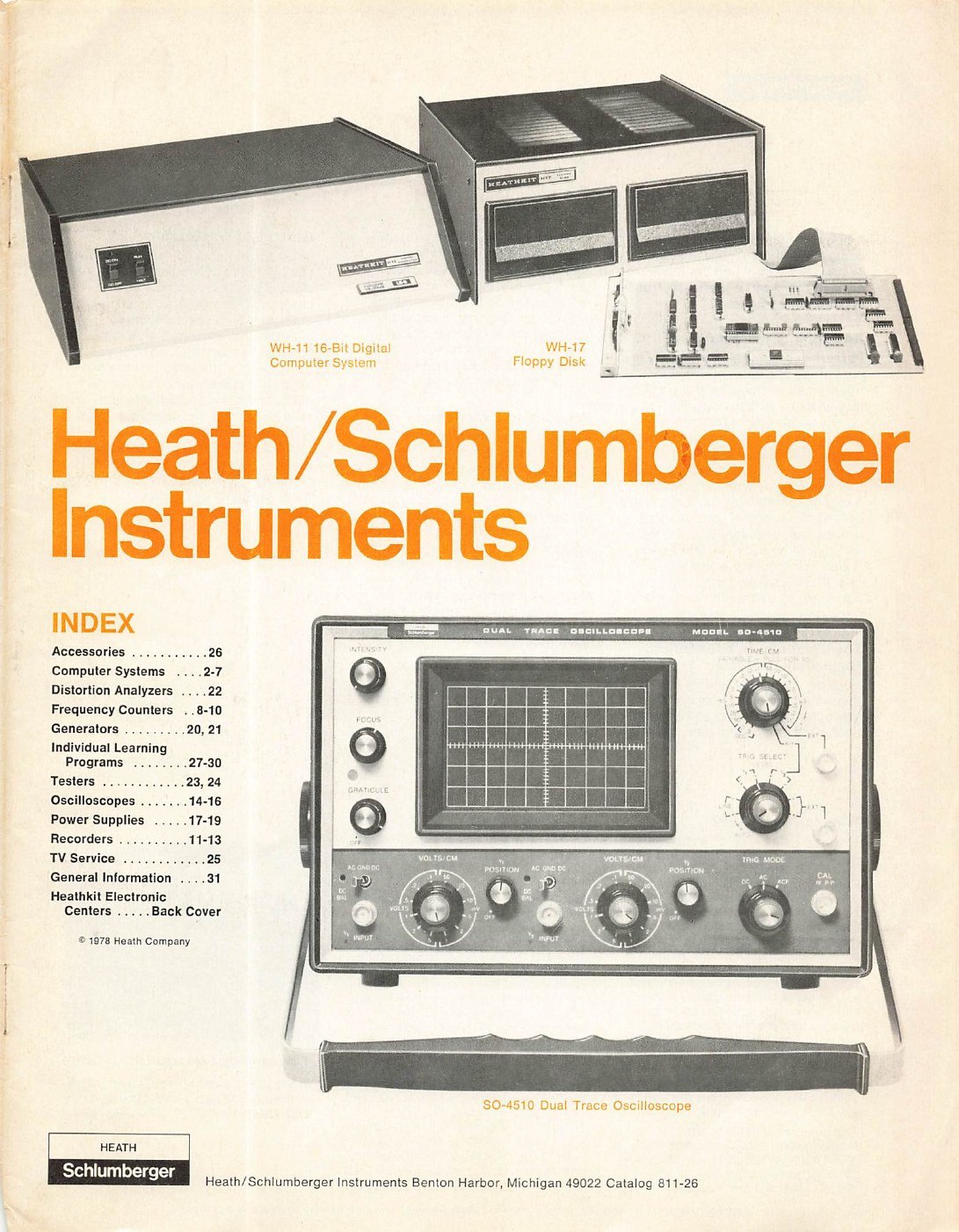
By 1978 the assembled line had become something else again. The 1978 Heath/Schlumberger catalogue (811-26) led with the WH-11 16-bit computer, the assembled version of Heath’s PDP-11 kit, and its WH-17 floppy disk, and gave the SO-4510 dual-trace scope the cover; its index began with “Computer Systems” and included “Individual Learning Programs” alongside counters and oscilloscopes (Heath/Schlumberger catalogue 811-26, 1978). The assembled-instrument business was turning into the assembled-computer business that Zenith would buy the following year (history dive, volume 5).
3.7 Testers, curve tracers and power supplies
The component-testing line moved to semiconductors. The IT-18 in-circuit transistor tester ($24.95, 1969), the IT-27 ($6.95, a restyled IT-10) and the IM-36 laboratory tester replaced the 1961 models, and the IT-121 FET and transistor tester of 1972–73 ($62.95 in 1975) followed (Eckweiler #75). The IT-7400 digital IC tester of 1976 ($74.95) was a sign of where the bench was going.
The most sophisticated tester was the curve tracer. The IT-1121, in the catalogue from about 1974 at $94.95 (Christmas 1975), swept a transistor’s collector and stepped its base, drawing the family of characteristic curves on an external oscilloscope in X-Y mode. The IT-3121 of 1977 ($99.95) was the same instrument in the new colours. Both are covered, with the dating question (one source says 1973), in the IT-3121 dive.
The tube tester survived the transistor. The IT-17 ($49.95 in 1968) replaced the IT-21, and the IT-3117 of 1977 carried it to 1982 (Eckweiler #130). The IT-5230 of 1976 ($89.95) tested and rejuvenated picture tubes for the television shop.
Power supplies multiplied. The IP-17 (1968, $59.95) continued the high-voltage tube-circuit supply of the IP-32, and the IP-2717 of 1977 ($99.95) and IP-2717A of 1982 carried the same 0–400 V, 100 mA rating to 1991; the assembled SP-2717A is the subject of its own dive. The IP-27, IP-28 and IP-18 low-voltage supplies of 1968–69 gave way in 1975 to the IP-27xx family, 60, 30, 15 and 7.5 V supplies each offered with analog or digital metering, and in 1976 to the IP-2718 triple-output supply for digital work ($79.95), which stayed in the catalogue to 1991.
3.8 Four digits and the 5280 series
In 1977 most of the instruments were renumbered with four digits and a new “Post New Look” styling. The new numbers often kept the old one: the IM-18 became the IM-5218, the IM-28 the IM-5228, the IP-17 the IP-2717, the IP-28 the IP-2728, the IT-17 the IT-3117, the IT-18 the IT-3118, the IN-17 the IN-3117, the IB-28 the IB-3128, the IG-42 the IG-5242, the IO-101 the IO-4101 and the ID-101 the ID-4101 (Nostalgic Kits Central; catalogues 1977–1978). The pattern is visible in the model matrix; no Heath document explaining the leading digits has been found.
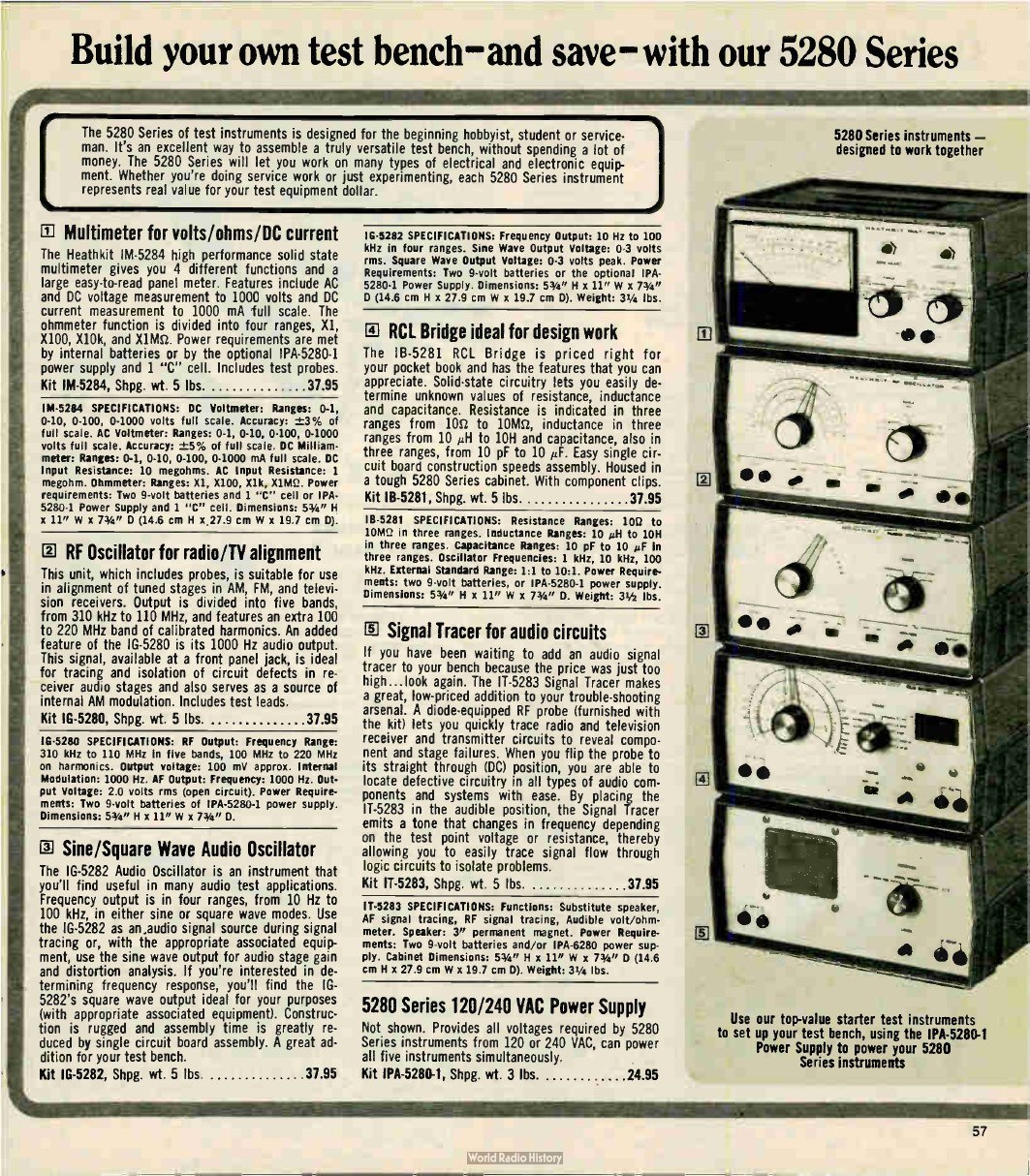
The same year brought the 5280 series, a set of matching starter instruments in identical small cases that stacked into a bench: the IM-5284 multimeter, IG-5280 RF oscillator, IG-5282 audio oscillator, IB-5281 RCL bridge and IT-5283 signal tracer, each $37.95 in 1980, with a shared power supply. Heath aimed them at “the beginning hobbyist, student or serviceman” (1980 catalogue, p. 57). They were the last new family of simple service instruments, a return to the $20-to-$40 instruments of the 1950s, and several stayed in the catalogue until 1990. At the other end, the 1979 catalogue introduced the IO-4235, a dual-trace, delayed-sweep 35 MHz scope at $899.95, the most expensive Heathkit scope yet. The next volume follows the line from there to the end.
Sources
- Schlumberger Limited, Annual Reports 1968, 1972, 1973, 1974 and 1976. Internet Archive. https://archive.org/details/01.-schlumberger
- Heathkit catalogues 1968, 1971, 810/72 (1972), Christmas 1975, Spring 1976, Fall 1977, Christmas 1977 and 848 (1980); Heath/Schlumberger Electronic Instruments catalogues 811/13 (June 1974) and 811-26 (1978). World Radio History. https://www.worldradiohistory.com/Archive-Catalogs/Heathkit_Catalogs.htm
- Eckweiler, Bob (AF6C). “Heathkit of the Month” #75 (IT-121), #78 (IM-17), #130 (IT-17). https://www.w6ze.org/Heathkit/Heathkit_Index.html
- Leibson, Steven, with Chas Gilmore. “The Rise and Fall of Heathkit,” part 2. EEJournal. https://www.eejournal.com/article/the-rise-and-fall-of-heathkit-part-2-the-1960s-through-the-mid-1970s/
- Gilmore, Charles. “Heathkit: An Employee’s Look Back.” Electronic Design, 30 November 2020. https://www.electronicdesign.com/blogs/contributed-blogs/archive/communiqu/article/21148923/electronic-design-heathkit-an-employees-look-back
- Brueschke and Mack, AWA Review 32 (2019). https://archive.org/details/thehistoryoftheheathcompanies
- Nostalgic Kits Central, Heathkit model matrix. https://www.nostalgickitscentral.com/heath/products/alphabetical.html
- Related dives: VTVM; IT-3121 curve tracer; SP-2717A power supply; history dive volumes 4 and 5.
Comments (0)