Test Equipment · Volume 4
Zenith, the Assembled Bench and the Last Kits, 1979–1992
Zenith Radio bought Heath on 1 October 1979 for $64.5 million, mainly for its computers (history dive, volume 6). The instrument line went with it, and for a few years looked much as it had under Schlumberger: new counters and scopes, a growing range of digital meters, the 5280 starter bench and a handful of specialised testers. From about 1983 the number of instrument kits fell. By 1990 the catalogue sold more assembled instruments than kits, several of them made by other companies, and the last Heathkit instruments left the catalogue with the rest of the kits in 1992. This volume follows that decline, counts it, and sets out what the catalogues do and do not show about its causes.
4.1 The line in 1980
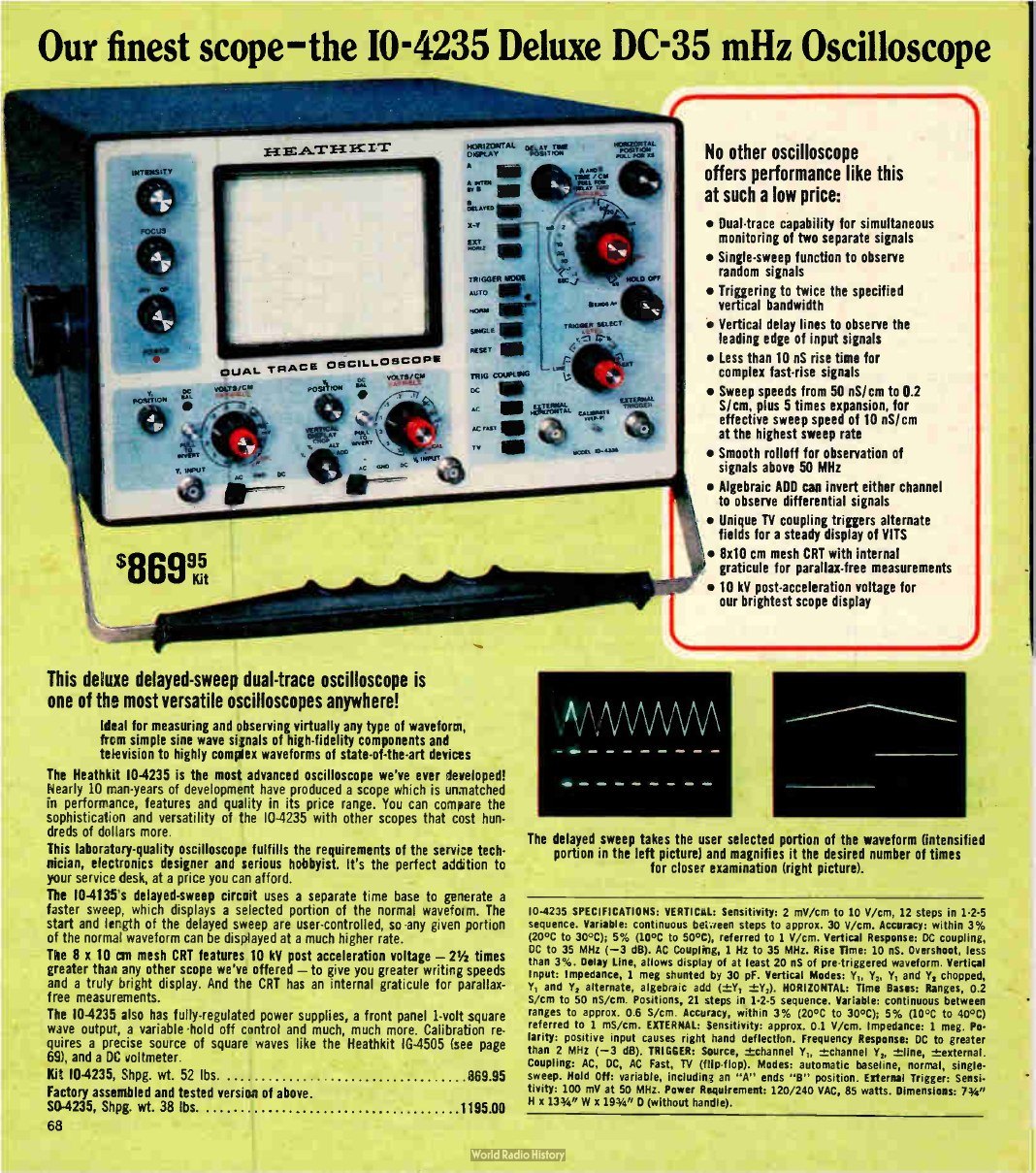
The first catalogue after the sale, No. 848 of early 1980, is the fullest instrument catalogue Heath ever printed by one measure: a script count of its text finds 58 distinct instrument kits and 13 assembled instruments. It had meters at every level, from the 5280-series starter multimeter at $37.95 to the IM-2212 3½-digit auto-ranging bench DMM at $289.95; five kit oscilloscopes up to the IO-4235 at $869.95; the IM-4100 counter family; the 5280 bench; the IT-3121 curve tracer and IT-3117 tube tester; the IP-2717 high-voltage supply; and the three surviving vacuum-tube voltmeters (1980 catalogue, pp. 56–70).
4.2 New instruments of the 1980s
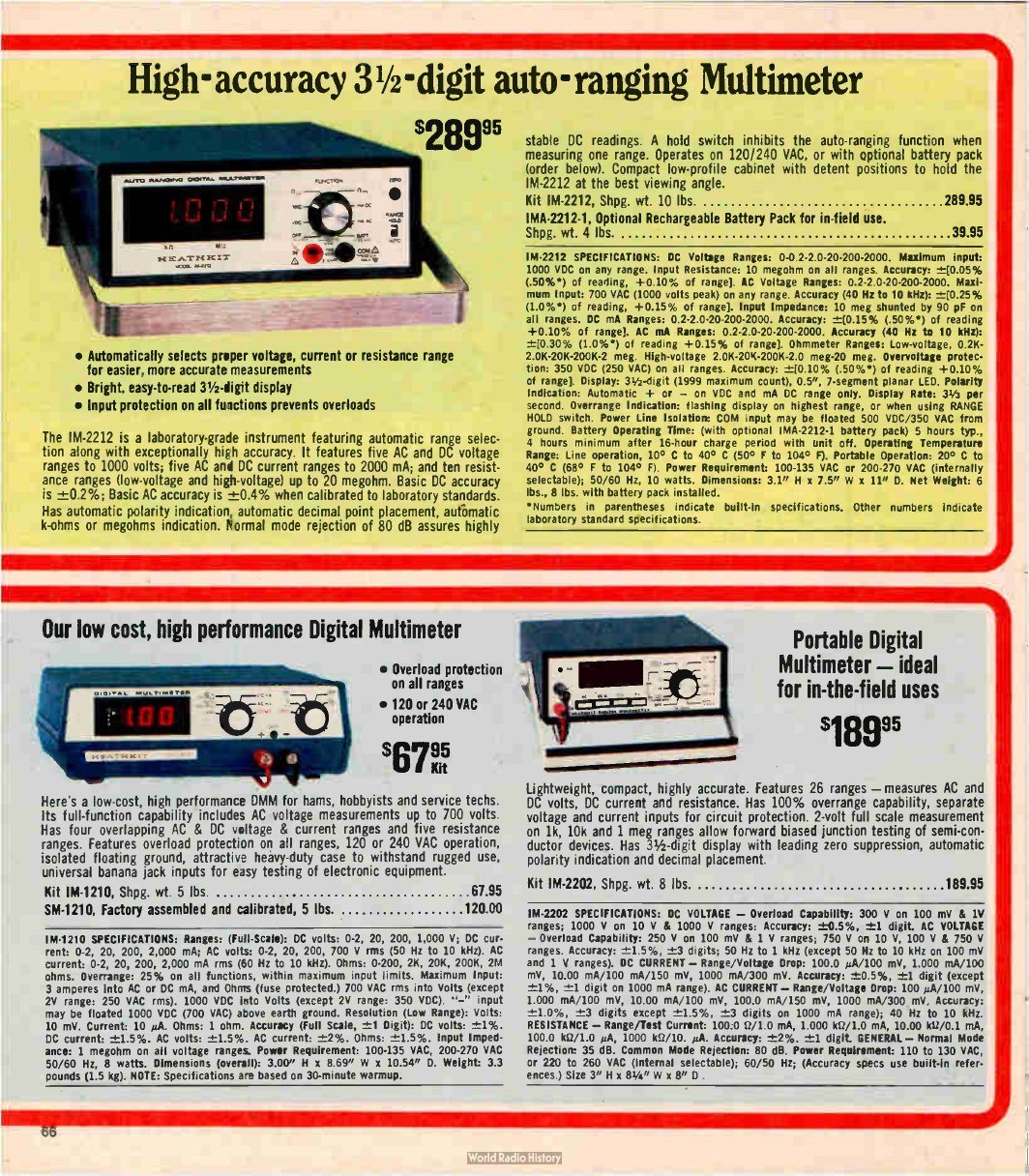
Heath still designed new instruments after 1980, and several were among its best. The IM-2400 family of LED counters replaced the IM-4100 series from about 1981: the IM-2410 (225 MHz, $139.95), the IM-2420 (512 MHz, eight digits, $269.95 as a kit, $320.00 assembled) and the handheld IM-2400 (512 MHz, $139.95 at launch). The IM-2420 page of Fall 1983 promised that it “takes as little as four evenings to build,” and all three stayed in the catalogue until 1990 or 1991 (Fall 1983 catalogue, p. 56; Winter 1981 catalogue).
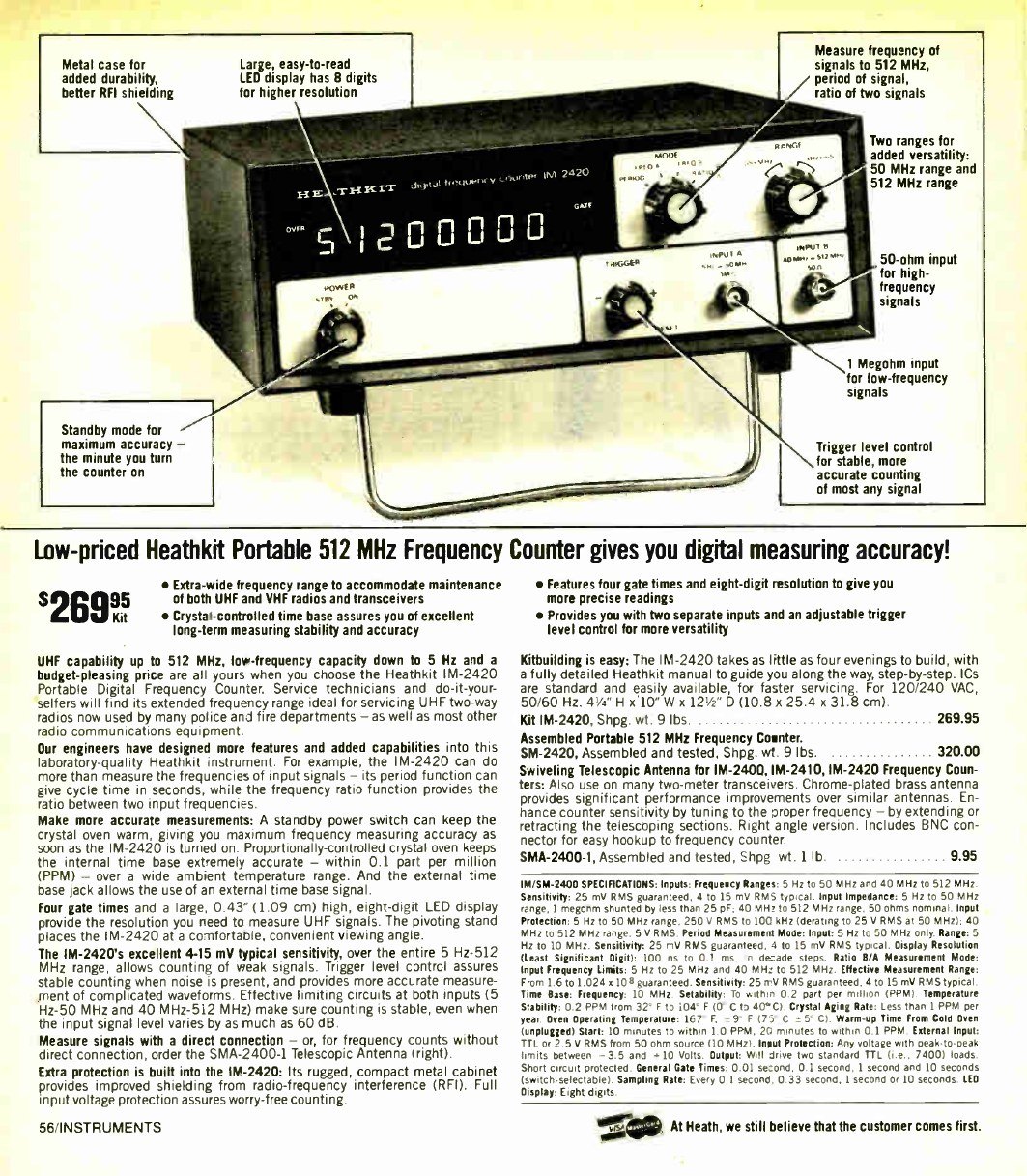
The oscilloscopes went portable and faster. The IO-3220 of 1982–83, a dual-trace 20 MHz scope that “fits under an airplane seat” and ran from an optional battery pack, was “the first portable Heathkit oscilloscope,” at $699.95 as a kit or $995.00 assembled (Fall 1983 catalogue, p. 61). The IO-4360, a 60 MHz triple-trace scope at $999.95 in 1985, is the most expensive kit oscilloscope found in the catalogues examined. The IG-4244 precision oscilloscope calibrator, “new” in the Christmas 1983 catalogue at $149.95, served owners of the faster scopes (Eckweiler #51).
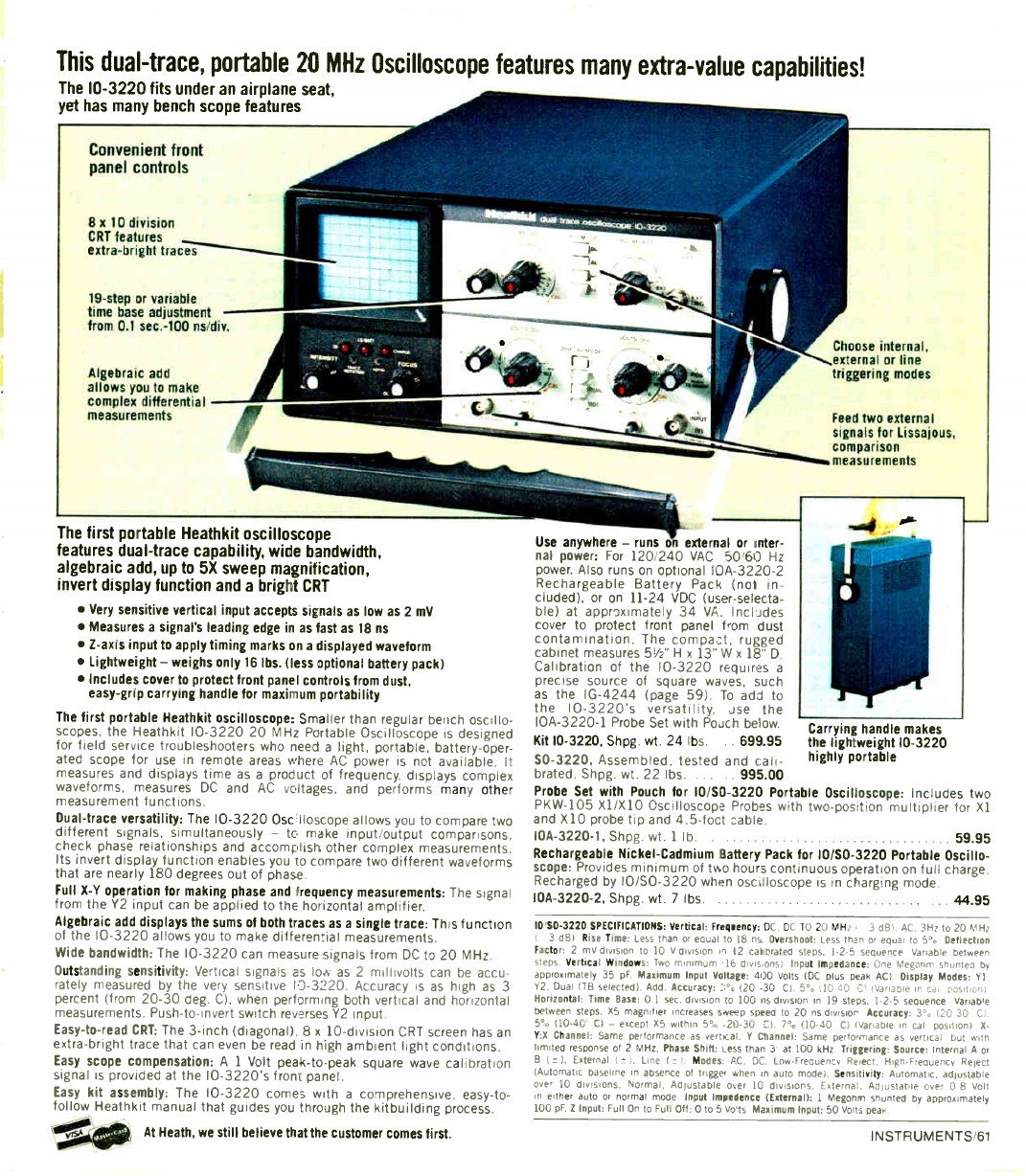
The component testers turned digital. The IT-2250 handheld digital capacitance meter ($159.95, 1981), the IT-2232 component tracer ($249.95, 1984), which displayed a component’s current-voltage signature on its own 3-inch CRT for comparing good and bad boards, and the IT-2240 digital impedance bridge ($269.95, 1986) replaced the magic-eye bridges of the 1960s. The IT-3120 FET and transistor tester carried the semiconductor tester to 1988, and the IT-5230 picture-tube tester and rejuvenator lasted almost as long.
4.3 The computer on the bench
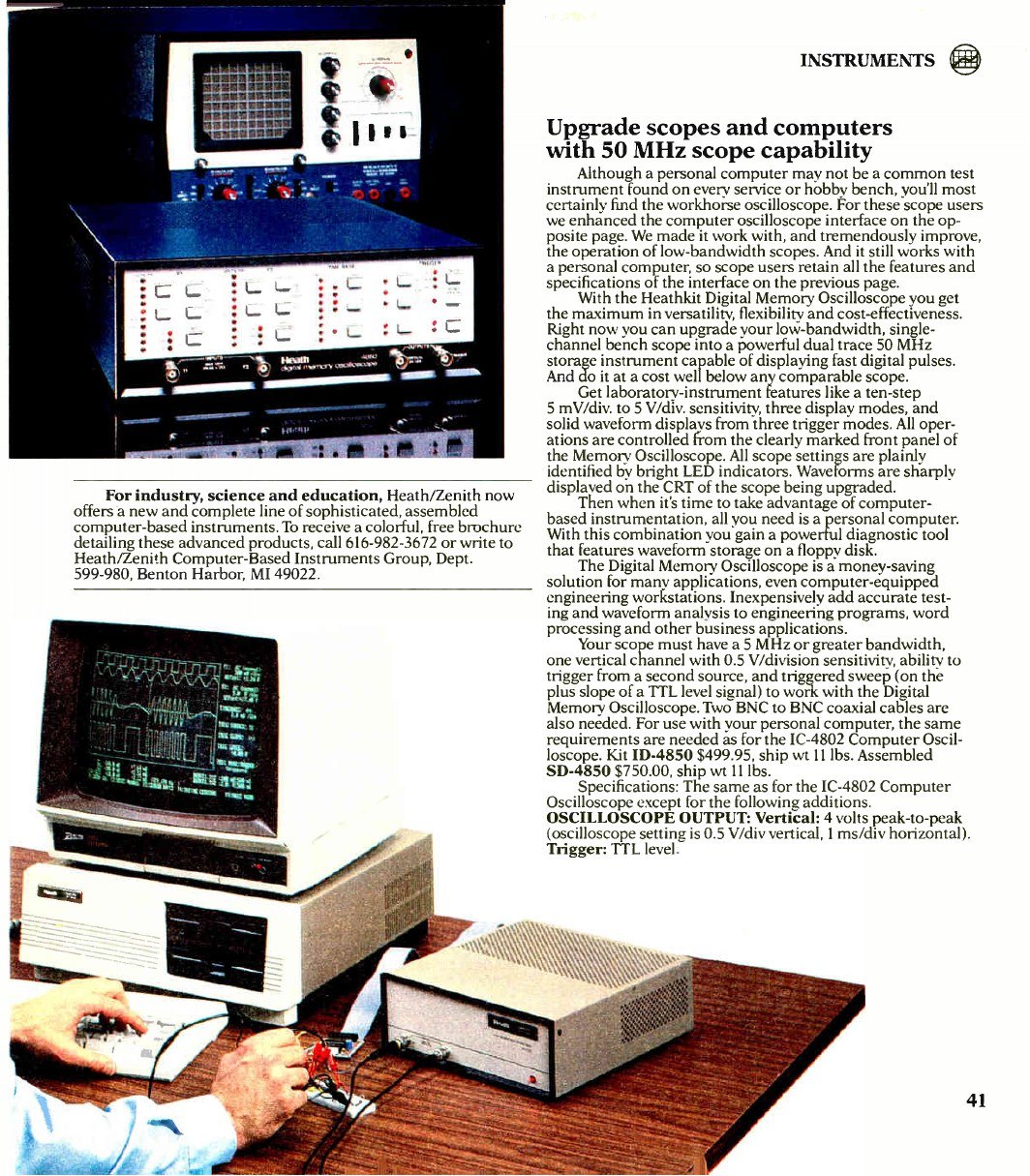
As Heath’s parent turned into a computer company, the instruments began to talk to computers. The 1987 catalogue offered the ID-4850 digital memory oscilloscope, a box that captured waveforms from an ordinary low-bandwidth scope and stored them to disk through a personal computer ($499.95 as a kit, $750.00 assembled), the IC-4802 computer oscilloscope, and from 1987 the IC-1001 logic analyser for the PC ($269.00). A notice on the same pages told industrial and educational buyers that “Heath/Zenith now offers a new and complete line of sophisticated, assembled computer-based instruments,” sold through a Heath/Zenith Computer-Based Instruments Group in Benton Harbor (Fall 1987 catalogue, p. 41). The Heath/Schlumberger assembled line of the 1970s had its successor, and it was built around the personal computer.
4.4 Assembled instruments from outside
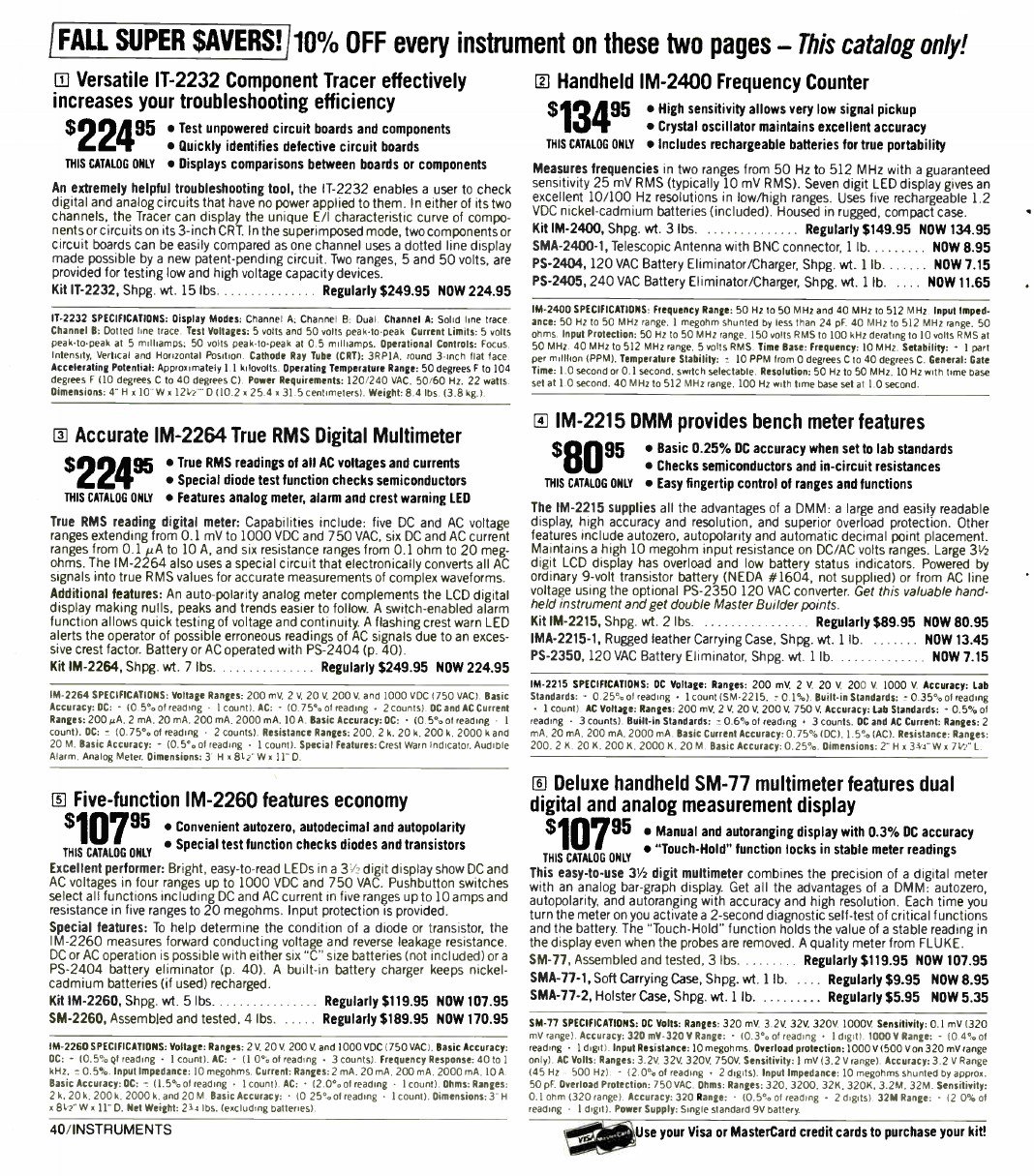
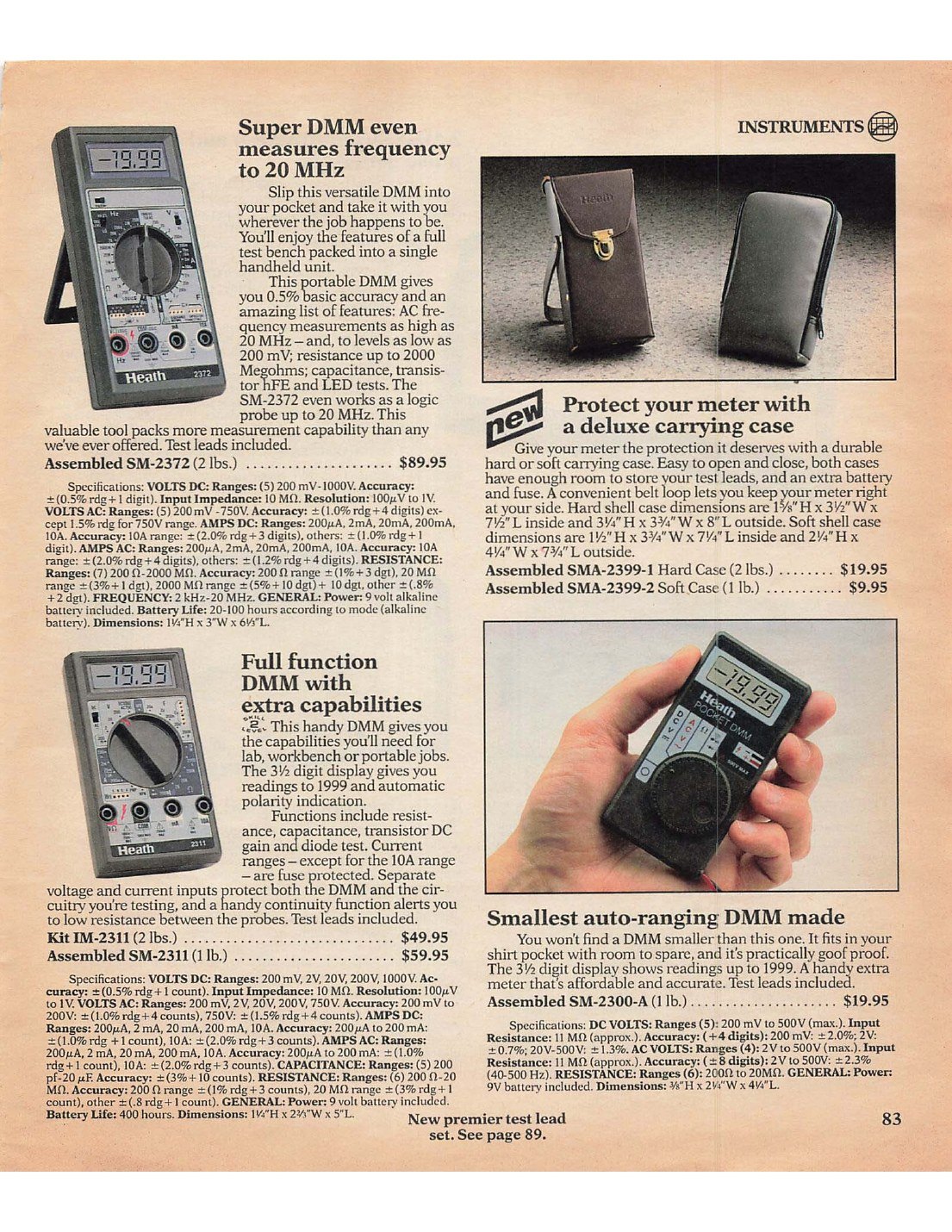
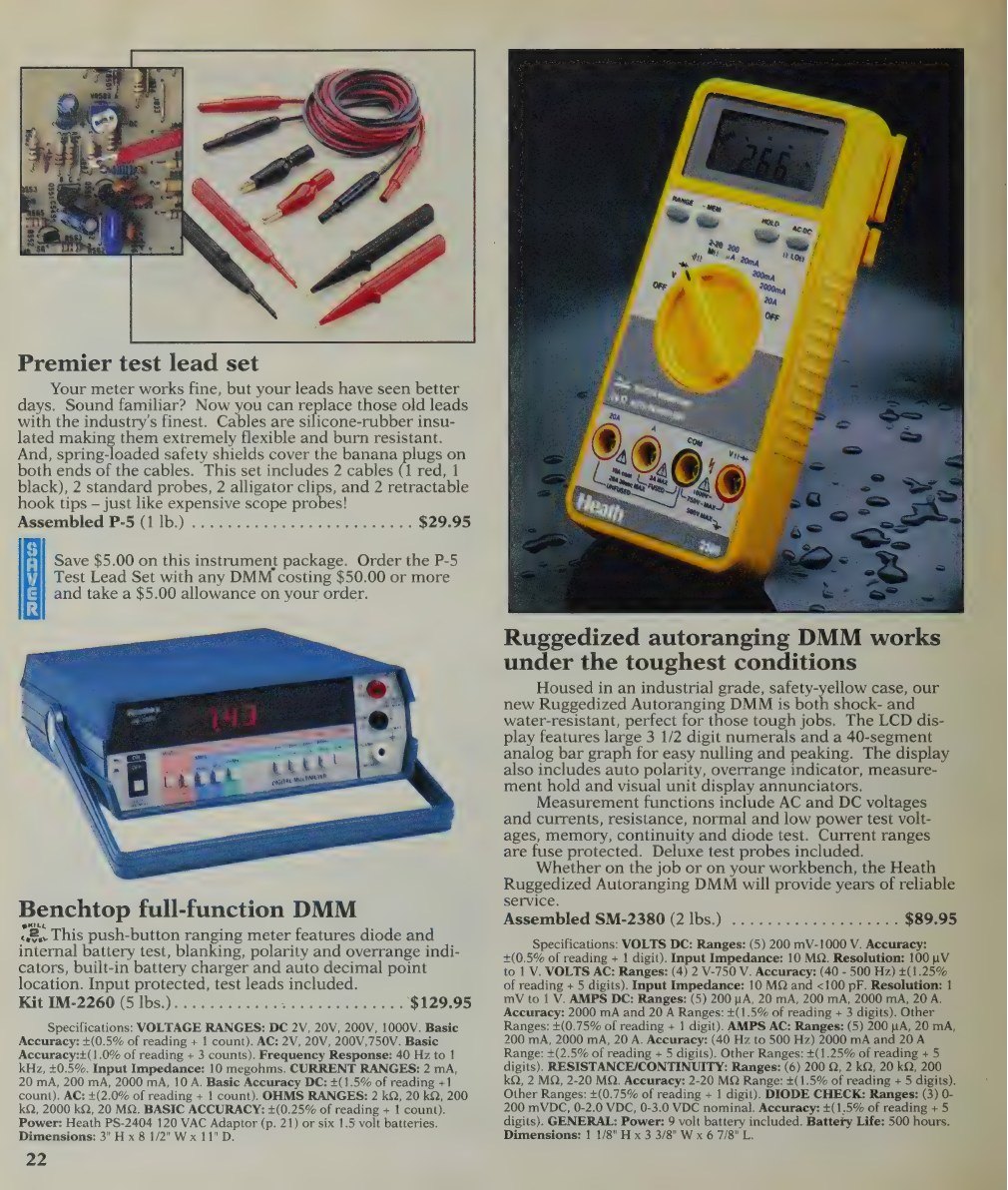
The other change of the 1980s was that some Heath instruments were no longer Heath designs. In Fall 1985 the catalogue sold the SM-77, “a quality meter from FLUKE,” assembled at $119.95; the Fall 1986 and Fall 1987 catalogues sold it again as the “Heath DMM from FLUKE” at $129.95 (Fall 1985 catalogue, p. 36; Fall 1986; Fall 1987). Its model number and its specification (3,200-count ranges, an analog bar graph and a “Touch-Hold” function) suggest that it was Fluke’s own Model 77 under a Heath number, though the catalogue says only “from FLUKE.” A growing family of SM-prefix handheld, pocket and clamp-on meters followed: the SM-2206 clamp-on meter of 1983, the SM-2300 pocket DMM of 1986, and by 1990 the SM-2372 frequency-reading DMM, the SM-2374 clamp meter and SM-2376 insulation tester, and the SM-2380 “ruggedized” autoranging meter in a yellow case. The catalogues do not say who made these instruments, and no other source for their origin was found.
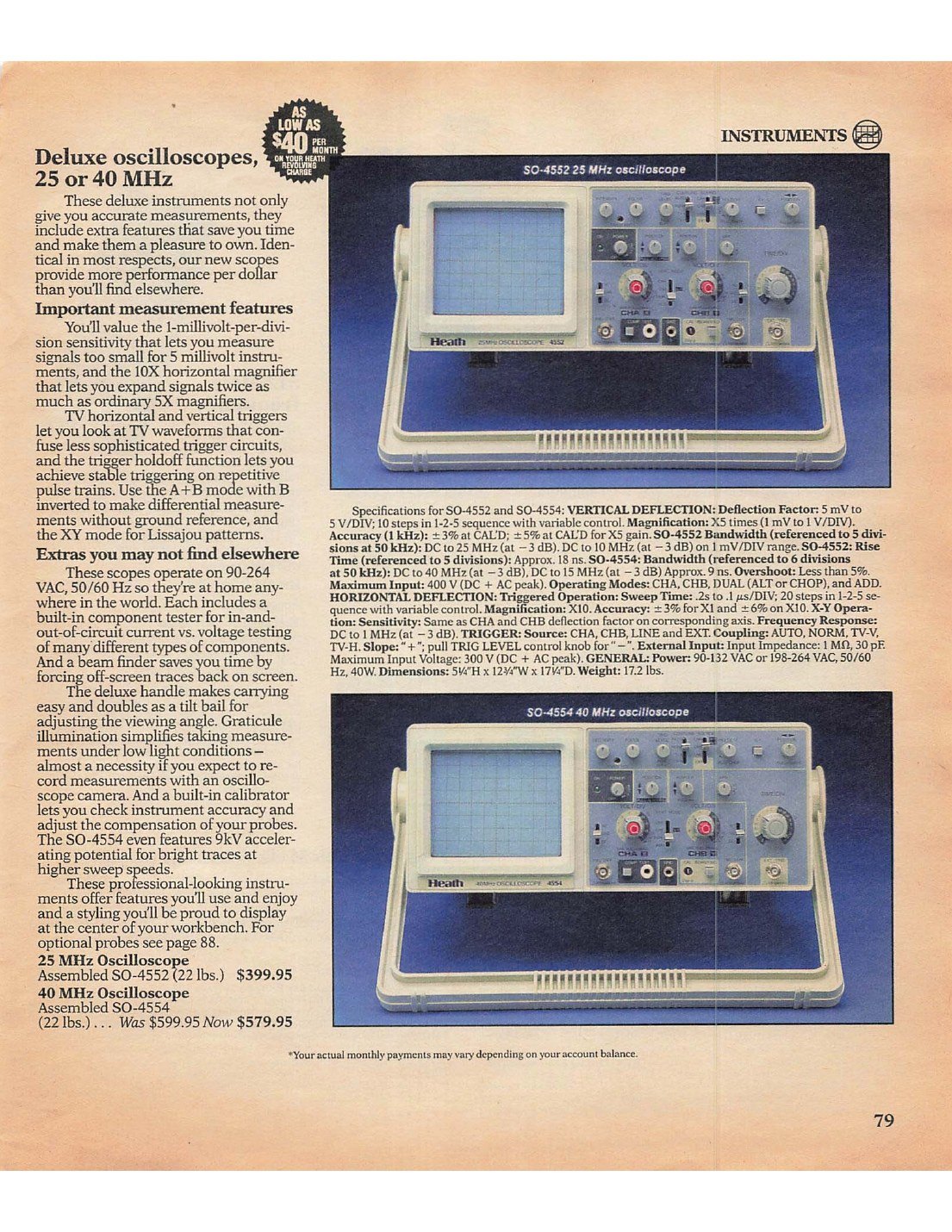
The scopes went the same way. The kit oscilloscopes of the 1970s and early 1980s (the IO-4105, IO-4205 and IO-4210) were last catalogued in 1987. Their successors, the SO-4552 (25 MHz, $399.95) and SO-4554 (40 MHz, $599.95) of 1989–90, were assembled only. With 1 mV sensitivity, worldwide 90–264 V operation, a built-in component tester, a beam finder and graticule illumination, they had the feature list of the imported bench scopes of their day (Summer 1990 catalogue, p. 79). The catalogue does not say where they were built.
4.5 Counting the decline
The shift can be measured from the catalogues themselves. The chart below counts, for nine catalogues from 1976 to 1991, the distinct instrument models offered as kits and those offered assembled, from the text of each scan.
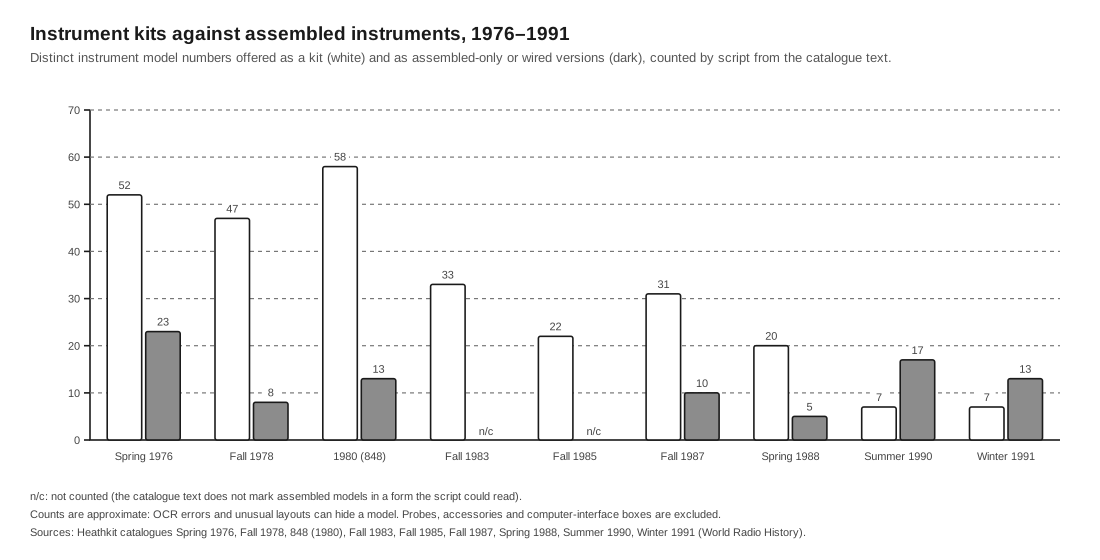
Table 1 — Counting the decline
| Catalogue | Instrument kits | Assembled instruments |
|---|---|---|
| Spring 1976 | 52 | 23 |
| Fall 1978 | 47 | 8 |
| No. 848 (early 1980) | 58 | 13 |
| Fall 1983 | 33 | not counted |
| Fall 1985 | 22 | not counted |
| Fall 1987 | 31 | 10 |
| Spring 1988 | 20 | 5 |
| Summer 1990 | 7 | 17 |
| Winter 1991 | 7 | 13 |
Method: distinct model numbers with an instrument prefix (IM, IO, IG, IT, IP, IB, IN and the ID and IC instrument models) following “Kit” in the catalogue text, and S-prefix or W-suffix models following “Assembled” or “Wired.” Probes, accessories and power adapters are excluded. The 1983 and 1985 catalogues mark assembled versions in a form the script could not read, and optical-character errors in the 1988 and 1990 scans may hide a few models, so the figures are approximate. The Fall 1978 count excludes the separate Heath/Schlumberger catalogue of the same year. Sources: the catalogues named, at World Radio History.
The pattern matches what the history dive found for the catalogue as a whole: the kit range held through 1980, fell by about a third within a few years of the Zenith purchase, and collapsed around the Bull sale of 1989 (history dive, volume 6). The vacuum-tube voltmeter, the second product Heath ever made, was last sold in 1989, according to Gilmore (Electronic Design); in the scans examined here the IM-5228 last appears in Fall 1987.
4.6 The last catalogue
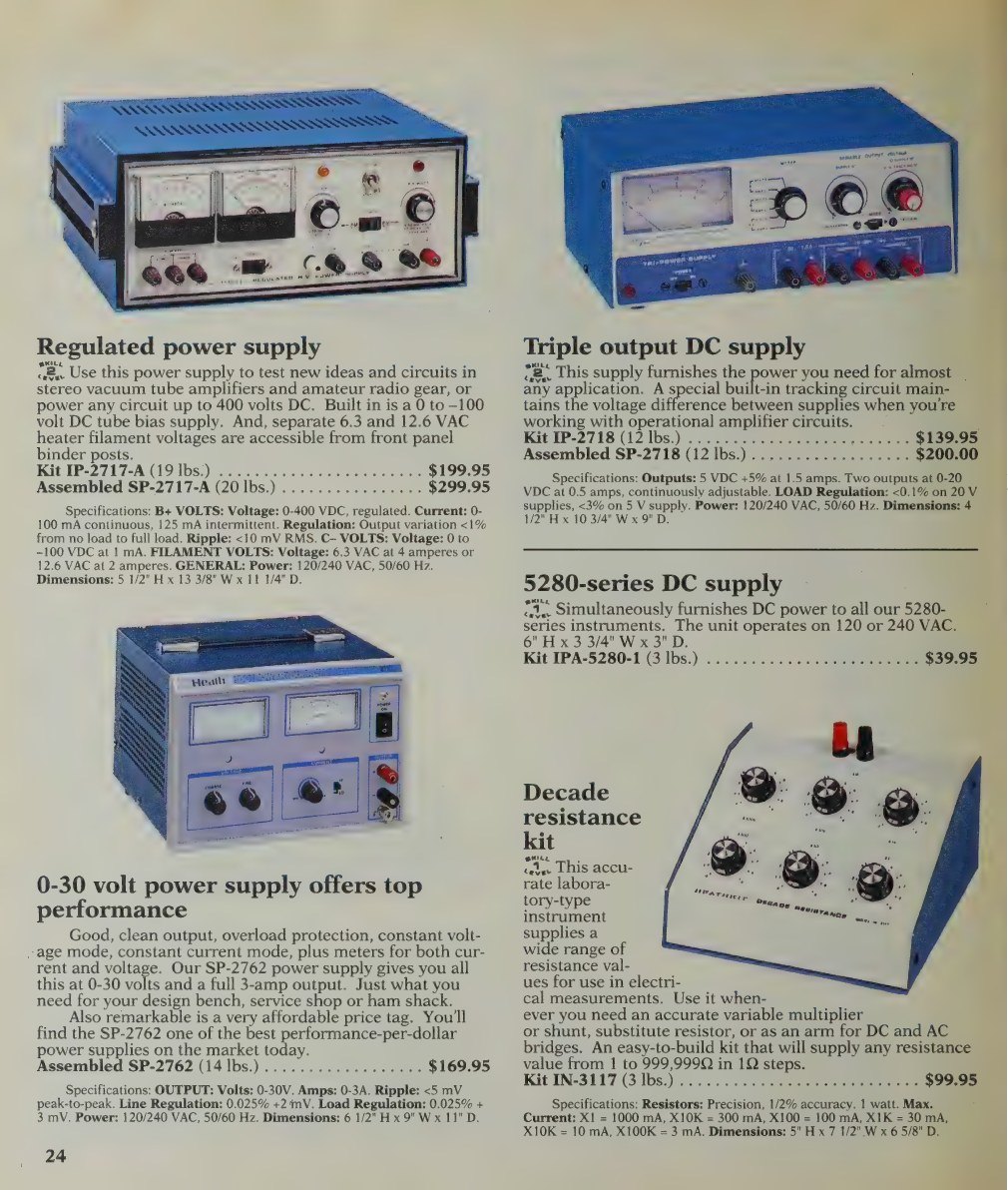
The Winter 1991 catalogue, the last general Heathkit catalogue in the World Radio History archive, still had a test-instrument section, and its kits are a fair list of what the line had come down to: the IM-2260 benchtop DMM ($129.95), the IM-2400 handheld counter, the IM-5215 high-voltage probe meter, the IG-5260 TV alignment generator, the IC-1001 logic analyser, the IN-3117 decade resistance box ($99.95), the IP-2717A high-voltage tube-circuit supply ($199.95, or $299.95 assembled as the SP-2717A) and the IP-2718 triple-output supply ($139.95). Beside them were thirteen assembled instruments: the SO-4552 and SO-4554 scopes, the SM-series meters, the SG-1274 function and pulse generator, and the SP-2762 0–30 V supply (Winter 1991 catalogue, pp. 18–28).
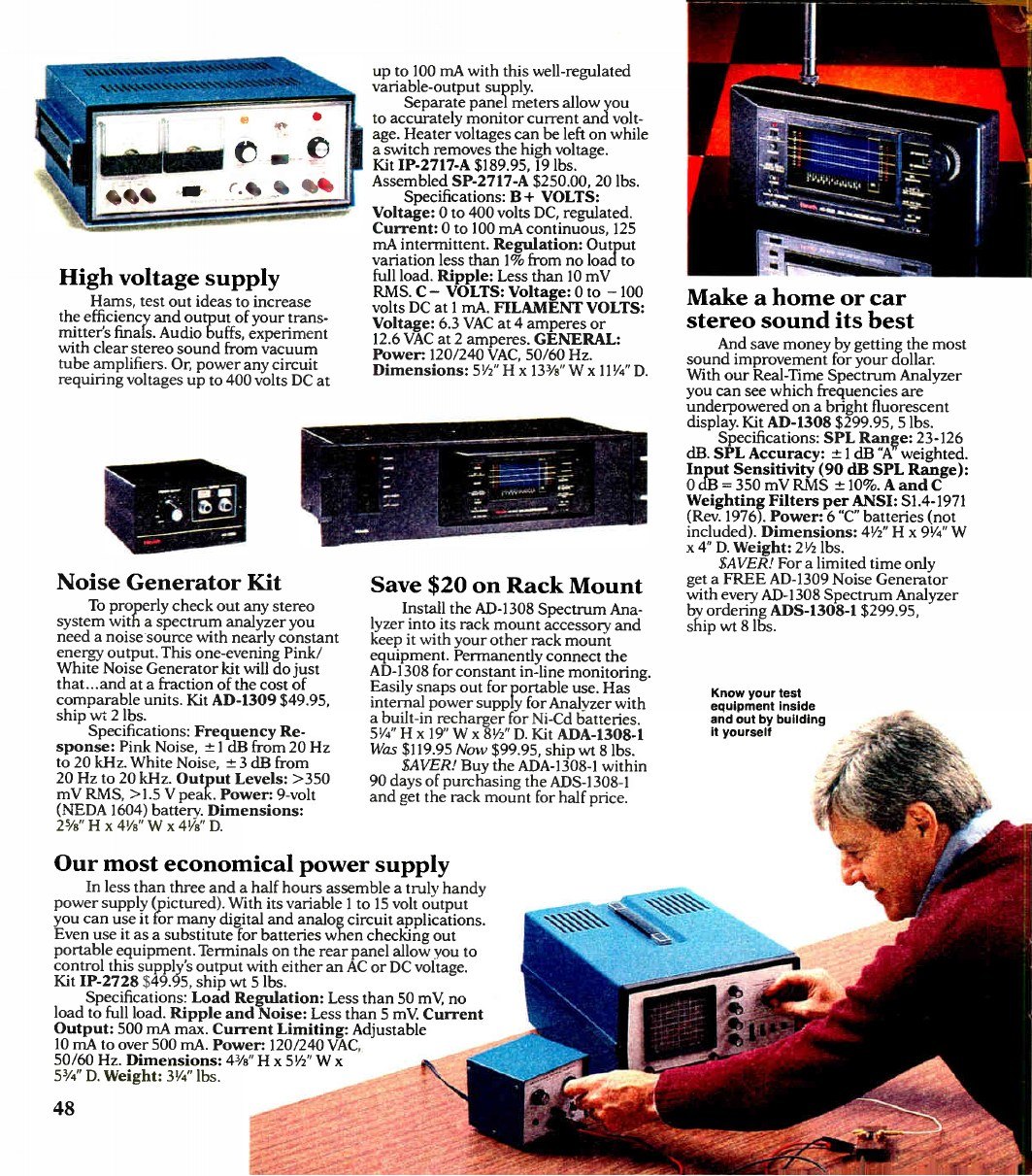
In March 1992 Heath announced that it would stop selling kits. The history dive covers the announcement, The New York Times report of 30 March 1992 and the businesses that survived (volume 6). Frank Beacham’s account of the last catalogue listed a DC power supply among the few kits that remained. Heathkit Educational Systems, which continued, sold trainers and courses to schools. The Nostalgic Kits Central matrix records three assembled ETI-series bench instruments for that market in 1990 (a DMM, a function generator with counter and a 175 MHz counter); whether the educational business went on selling instruments after 1992 was not established (Nostalgic Kits Central).
4.7 Why the instrument kits went first
The catalogue record fixes the order of events. It does not by itself give the reasons, and the explanations below are drawn from people who were there and from the history dive’s analysis (volume 6, “Two readings”).
Three pressures were specific to test equipment. The first was the price of the finished product. A kit saved the builder the cost of assembly labour, but Gilmore put labour at 4 to 5 per cent of manufacturing cost by the late 1970s, against about 50 per cent in the late 1960s (EEJournal, “The Rise and Fall of Heathkit,” part 4). An instrument such as a handheld DMM, dominated by one large-scale integrated circuit and a display, left almost nothing for a builder to save. The 1990 catalogue sold an assembled pocket auto-ranging DMM for $19.95. The second was calibration. Heath’s original promise was that a builder could calibrate an instrument against the mains and a flashlight cell; a 35 MHz scope or a 512 MHz counter needed a calibrator or a reference, which Heath sold (the IG-4244, the IG-4505) but which added to the cost and difficulty. The third was competition in the laboratory market that Heath/Schlumberger had entered. Gilmore recalled that the assembled line “competed poorly” there against Hewlett-Packard, Fluke and Tektronix when sold mainly by mail (EEJournal, part 2).
None of these pressures is quantified in a Heath document, and the relative weight of ownership, economics and the aging of the kit-building customer cannot be settled from the catalogues. What the catalogues do show is that the instruments followed the rest of the line down. The instrument section held up better than most, and it was among the last sections of the catalogue to keep Heath-designed kits.
Sources
- Heathkit catalogues: No. 848 (1980), Winter 1981, Fall 1983, Fall 1985, Fall 1986, Fall 1987, Spring 1988 (211), Summer 1990 (221-412), Winter 1991 (223). World Radio History. https://www.worldradiohistory.com/Archive-Catalogs/Heathkit_Catalogs.htm
- Eckweiler, Bob (AF6C). “Heathkit of the Month” #51 (IG-4505 and the scope calibrators). https://www.w6ze.org/Heathkit/Heathkit_051_IO4505.pdf
- Gilmore, Charles. “Heathkit: An Employee’s Look Back.” Electronic Design, 30 November 2020. https://www.electronicdesign.com/blogs/contributed-blogs/archive/communiqu/article/21148923/electronic-design-heathkit-an-employees-look-back
- Leibson, Steven, with Chas Gilmore. “The Rise and Fall of Heathkit,” parts 2 and 4. EEJournal. https://www.eejournal.com/article/the-rise-and-fall-of-heathkit-part-2-the-1960s-through-the-mid-1970s/ · https://www.eejournal.com/article/the-rise-and-fall-of-heathkit-part-4-the-demise-of-heathkit/
- Heathkit history dive, this site, volume 6. https://heathkit.fubsypoly.com/heathkit/vol-6/
- Related dives: SP-2717A power supply; VTVM.
Comments (0)