Television · Volume 1
Origins
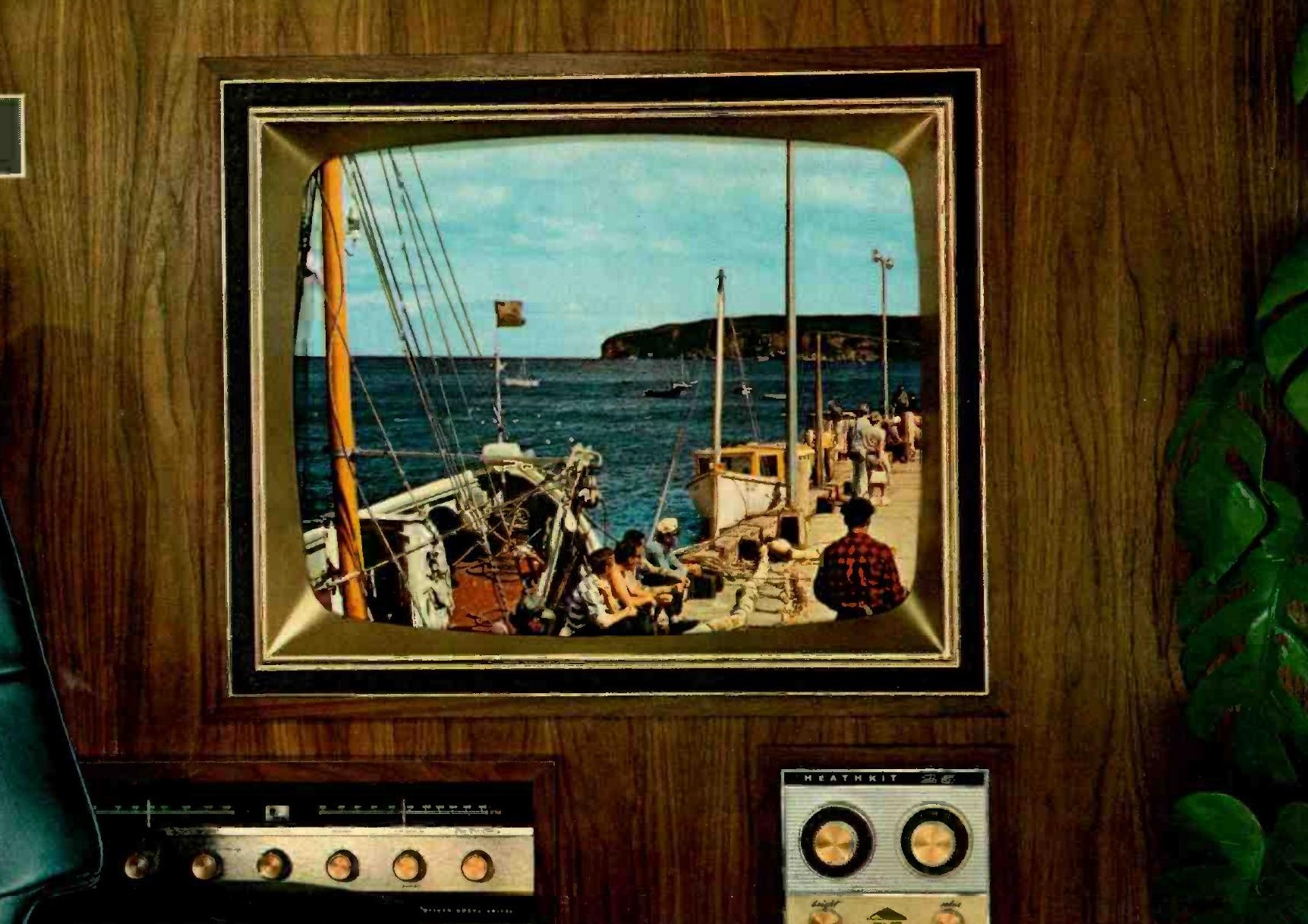
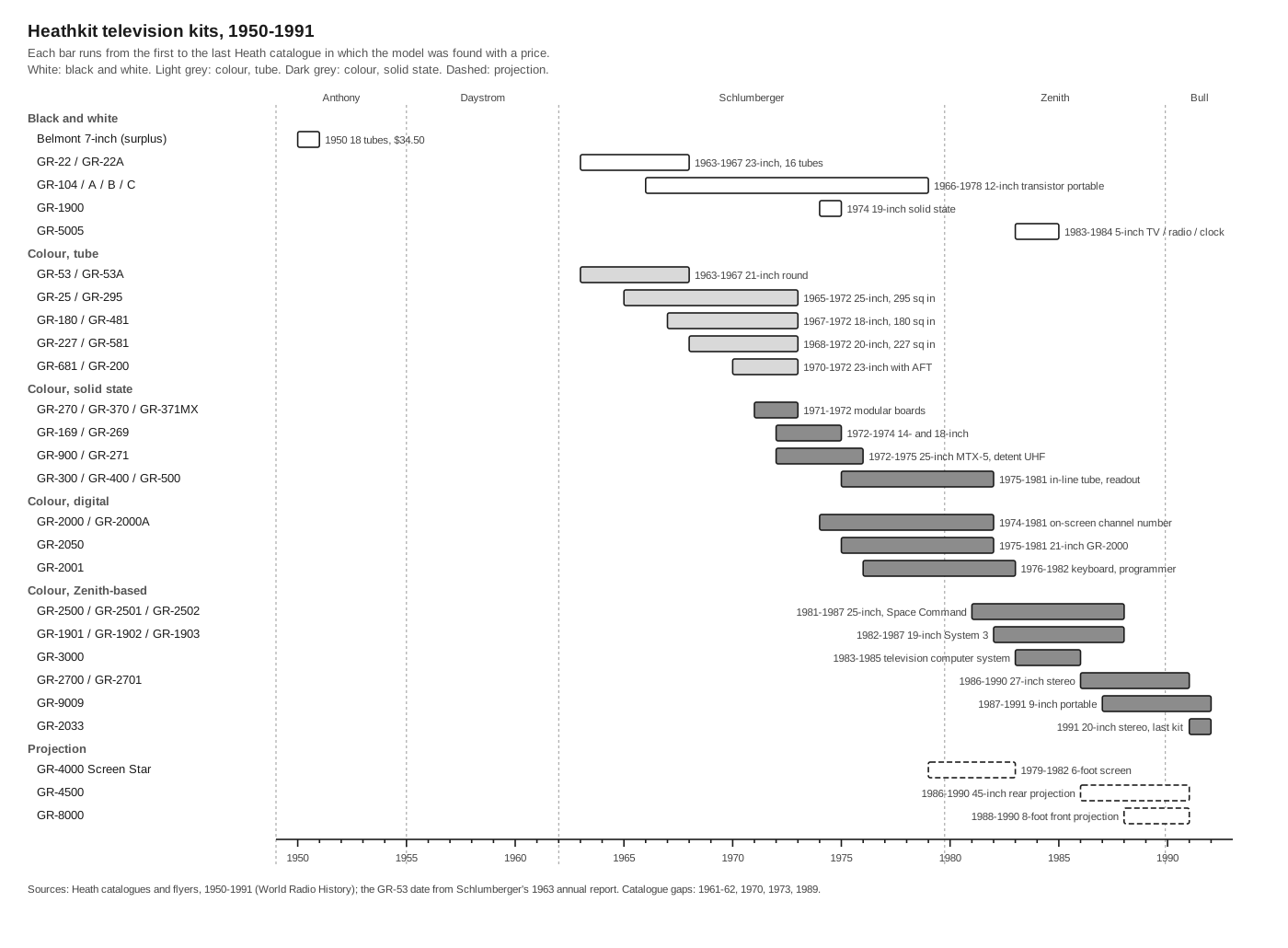
For its first fifteen years the Heath Company sold the instruments that other people used to repair televisions. It did not sell the television itself. When it did, in 1963, it went straight to colour: the most complicated consumer product then made, at a time when most American families had never seen a colour picture. Over the next twenty-eight years Heath offered about fifty television kits: colour sets from 14 to 27 inches, black-and-white portables, a television that doubled as a computer terminal, and three projection sets. The last one appeared in the Winter 1991 catalogue, a few months before Heath left the kit business.
This dive tells the story of that line as a whole. The GR-2000 of 1974, the best-known Heathkit television, has its own six-volume dive, starting at the GR-2000 overview, and is only summarised here. The company’s own history, from the aeroplane kits to the present owner, is told in the Heath Company dive.
This volume covers the years before the colour kits and the first colour set itself. The volumes that follow take the line era by era: the tube colour sets of 1965–1972, the solid-state and digital sets of 1970–1981, and the Zenith years to 1991. The fifth volume covers servicing, restoring and collecting the sets today, and the last volume is a reference with a model table of every set found.
1.1 Test gear for the television boom
Heath’s first television product was not a television. A flyer of October 1948 offered a TV sweep generator at $24.50 for aligning television receivers, and the flyers that followed added the TS-2 and TS-3 television alignment generators, a 30,000-volt probe for the vacuum-tube voltmeter and a picture-tube adapter for the tube checker. These were aimed at the radio servicemen who were retraining for television, many of them on the GI Bill. The company history tells that part of the story in the volume on the first kits.
Chas Gilmore, who joined Heath as a design engineer in 1966 and rose to vice-president of engineering, later described the 1950s catalogue as built around the television trade. He counted forty-two test-equipment kits and nine amateur-radio products in the 1956 catalogue, and said that “the real focus was on service instruments at that time”, because tube television sets were going into every home and their unreliability created a large market for test gear (EEJournal, “Heathkits and Hams”, part 1).
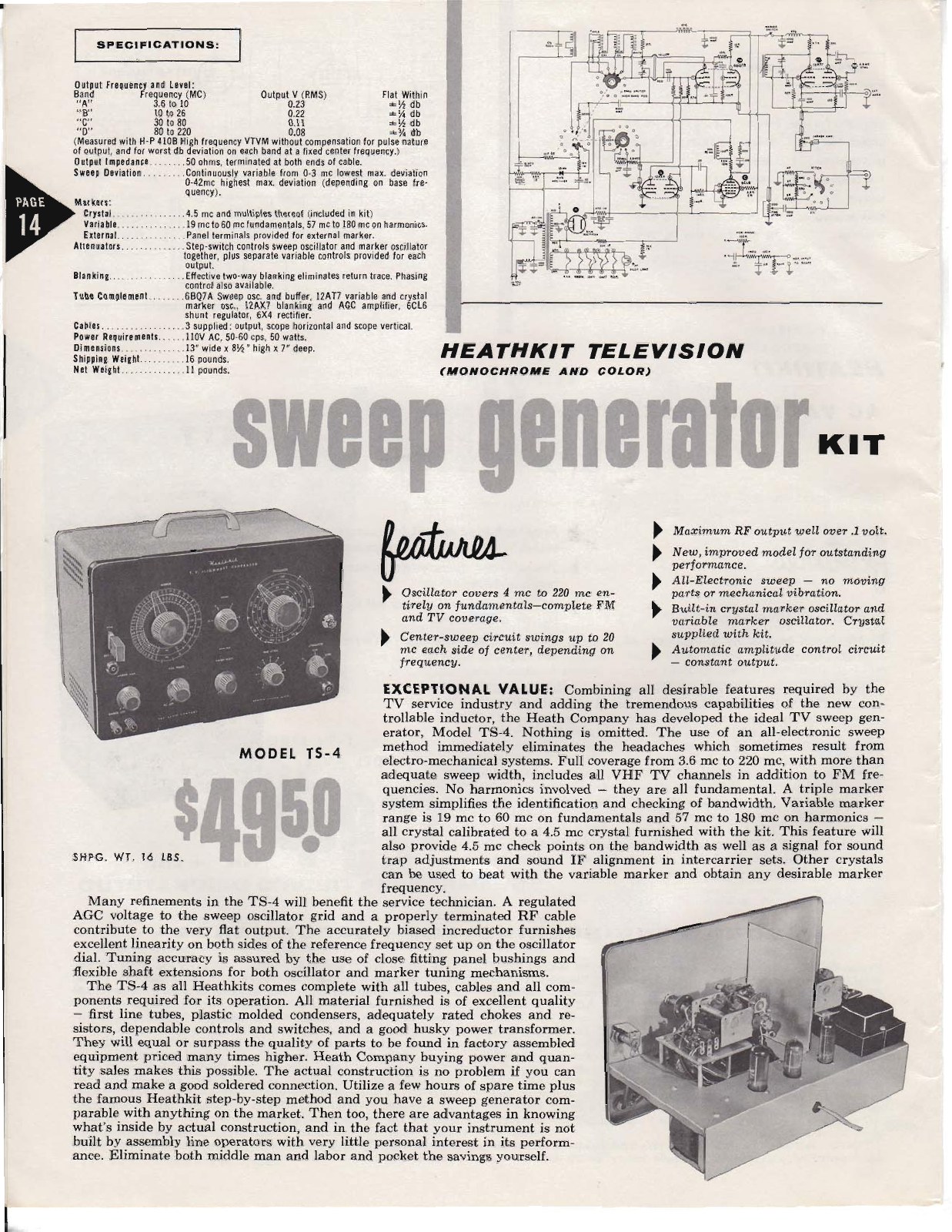
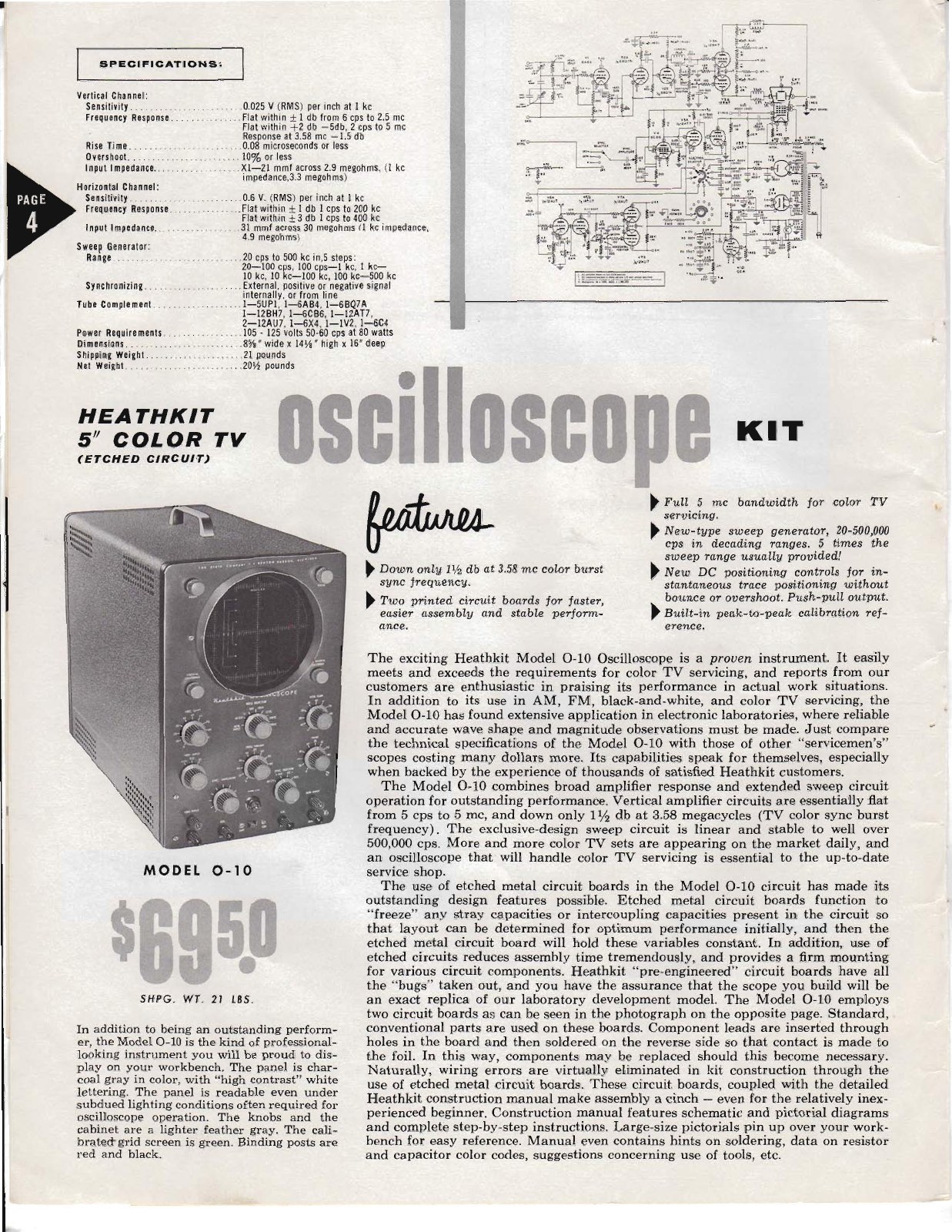
The 1956 catalogue shows how far that line had developed. The TS-4 television sweep generator ($49.50) covered 3.6 to 220 Mc with an all-electronic sweep for aligning the i.f. strips and tuners of television and FM sets. The O-10 oscilloscope ($69.50) was sold as a “5-inch colour TV” scope. Its vertical amplifier was down only 1½ dB at 3.58 Mc, the colour-burst frequency, and the copy warned servicemen that “more and more color TV sets are appearing on the market daily” (Heathkit 1956 catalogue, pp. 4, 14). The same catalogue offered a linearity pattern generator, a bar generator and the CC-1 cathode-ray-tube checker. Heath knew colour television from the service bench a decade before it sold a colour set.
1.2 The 1950 surplus set
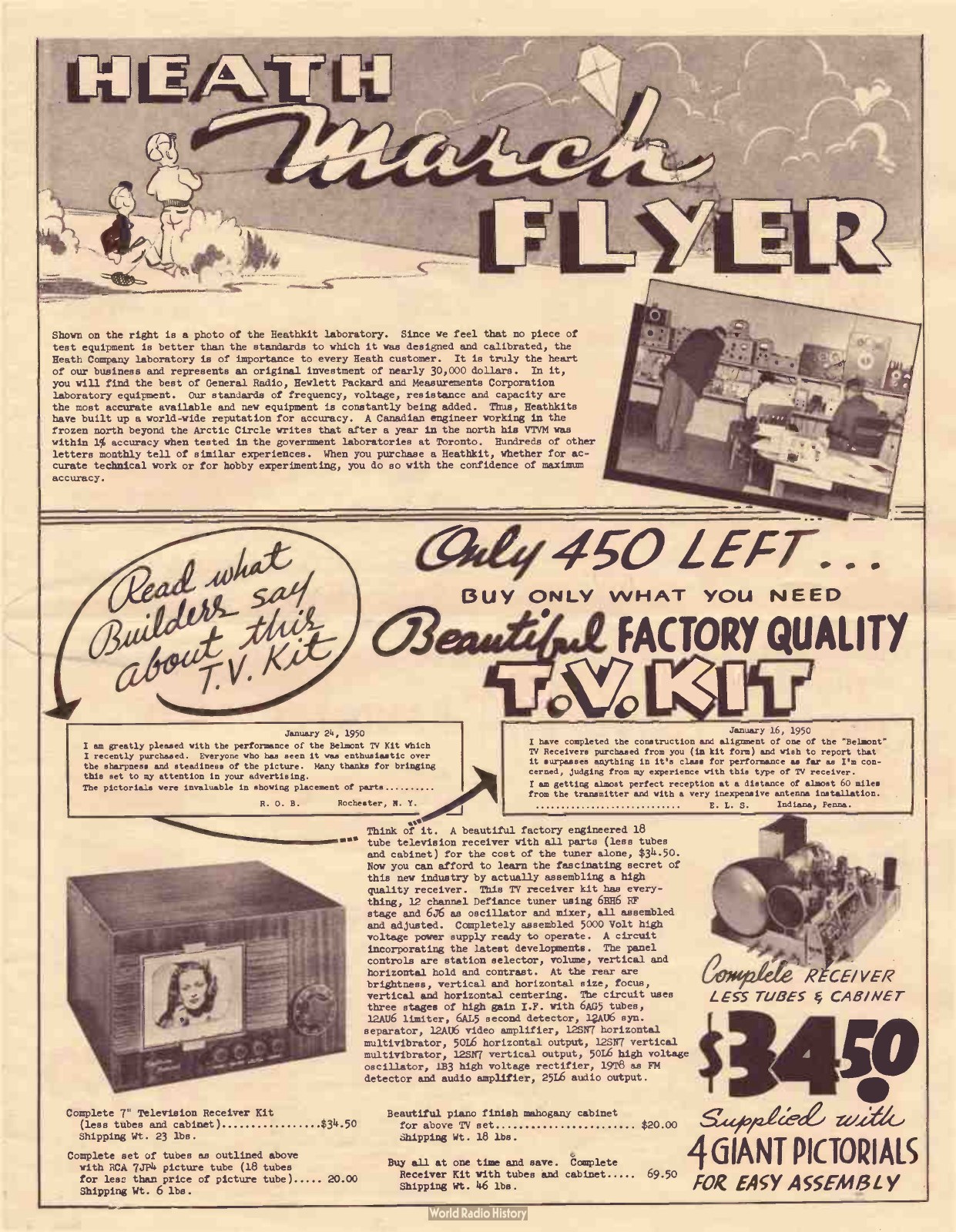
Before 1963 Heath sold one television, and it was not its own design. The March 1950 flyer offered, under the headline “Only 450 left…”, a “beautiful factory quality T.V. kit” for $34.50: an 18-tube receiver with every part except the tubes and cabinet, “for the cost of the tuner alone”. The picture tube was an RCA 7JP4, a 7-inch round tube. A full set of tubes cost $20.00 more, and the receiver with tubes and cabinet cost $69.50. Letters printed in the flyer identify the set as a Belmont chassis, so this was a closeout purchase from Belmont Radio rather than a Heath product (Heath March flyer, 1950).
The set is a footnote, but it shows the pattern of Heath’s surplus years: buy a stock of parts, add a manual and “4 giant pictorials for easy assembly”, and sell the result by mail. It was never repeated. Heath’s next television came thirteen years later and was designed in Benton Harbor.
1.3 Colour, and the black-and-white GR-22
By the early 1960s the market had changed in two ways. Black-and-white sets were cheap and reliable enough that a kit offered little saving, and colour, which RCA had been promoting since the mid-1950s, was at last starting to sell. Electronics Illustrated wrote in 1964 of “a boom in color TV, which seemingly took a long time to get off the ground”. Heath’s answer was to launch both at almost the same moment.
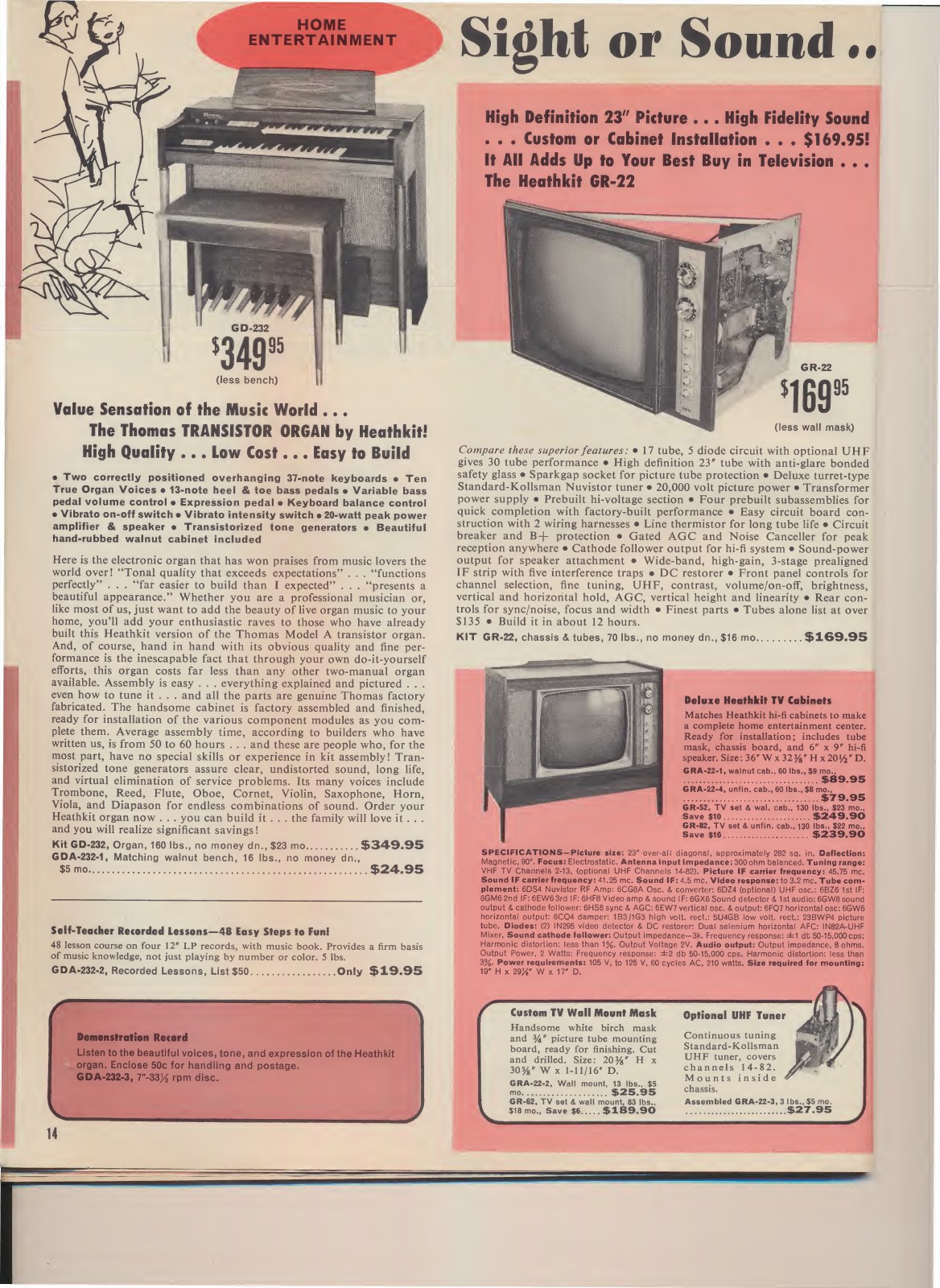
Schlumberger, which had owned Heath since buying Daystrom in 1962, wrote in its 1963 annual report that “the most important addition in 1963 was a color television” (Schlumberger annual reports). The same year brought a black-and-white set. The May 1963 catalogue offered the GR-22, a 23-inch receiver with “high definition 23-inch picture … high fidelity sound” for $169.95 as chassis and tubes (Heathkit catalogue, May 1963, p. 14).
The GR-22 set the pattern for every Heath set that followed.
- Pre-built critical sections. The high-voltage section and four sub-assemblies came pre-built, including the Standard-Kollsman turret tuner with its Nuvistor RF stage and a three-stage i.f. strip with five interference traps. The builder wired a circuit board and two harnesses and could finish in “about 12 hours”.
- A chassis, not a cabinet. The price bought the chassis and tubes only. The buyer could mount it in a wall with a $25.95 birch mask, or buy a walnut cabinet for $89.95 that matched Heath’s hi-fi furniture. Complete packages were offered as the GR-52 (with walnut cabinet, $249.90), the GR-82 (with unfinished cabinet) and the GR-62 (with wall mount).
- Hi-fi sound. The set had a cathode-follower output to feed a separate amplifier. Heath sold televisions as part of a home entertainment centre, next to its stereo and organ kits, rather than as appliances.
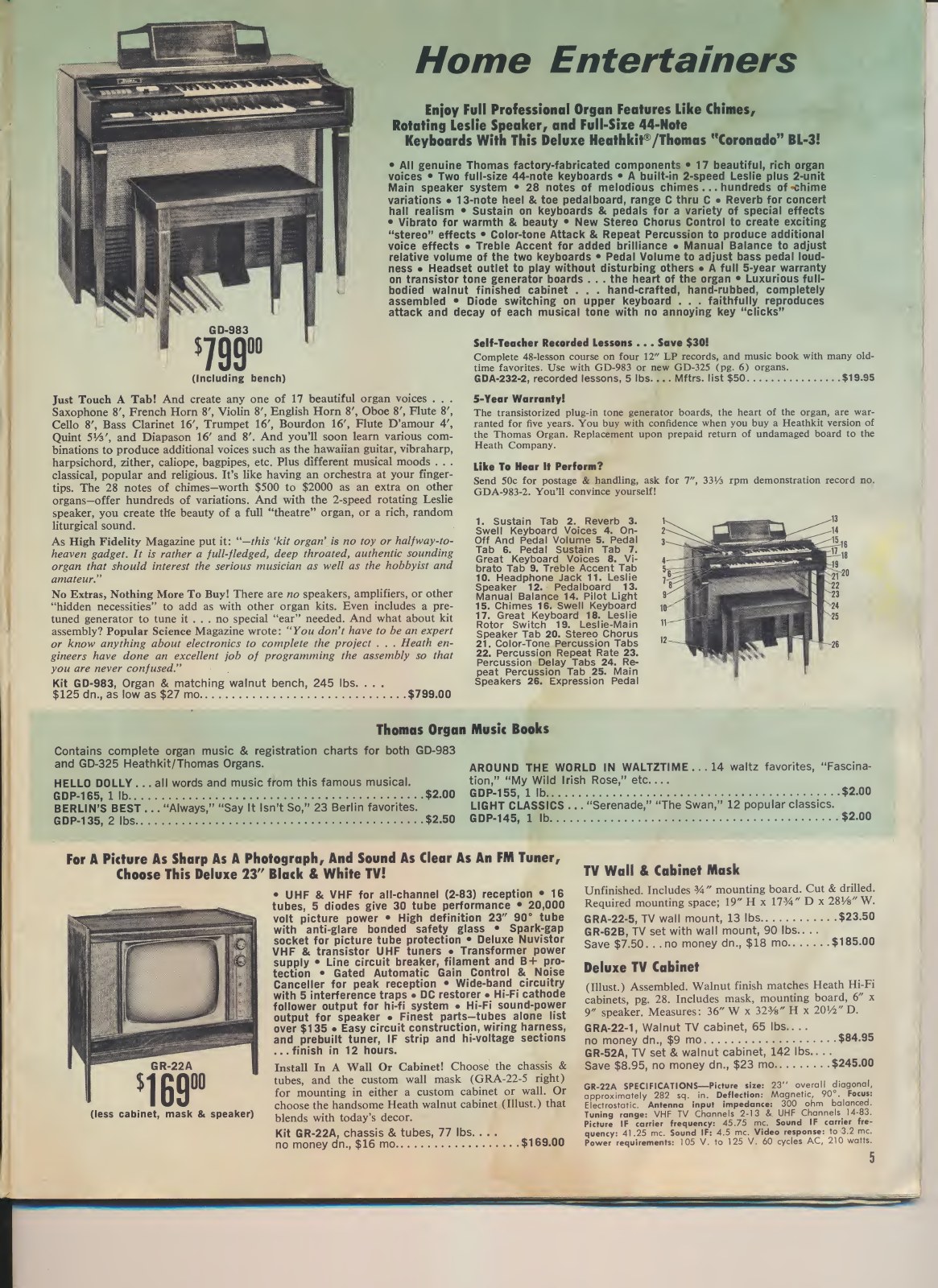
The revised GR-22A added an all-channel tuner (VHF 2–13 and UHF 14–83). It cost $199.00 in March 1965 and $169.00 from 1966, and stayed in the catalogue until 1967. Heath would not sell another black-and-white console. Its later black-and-white sets were all portables.
1.4 The GR-53: a colour kit anyone could converge
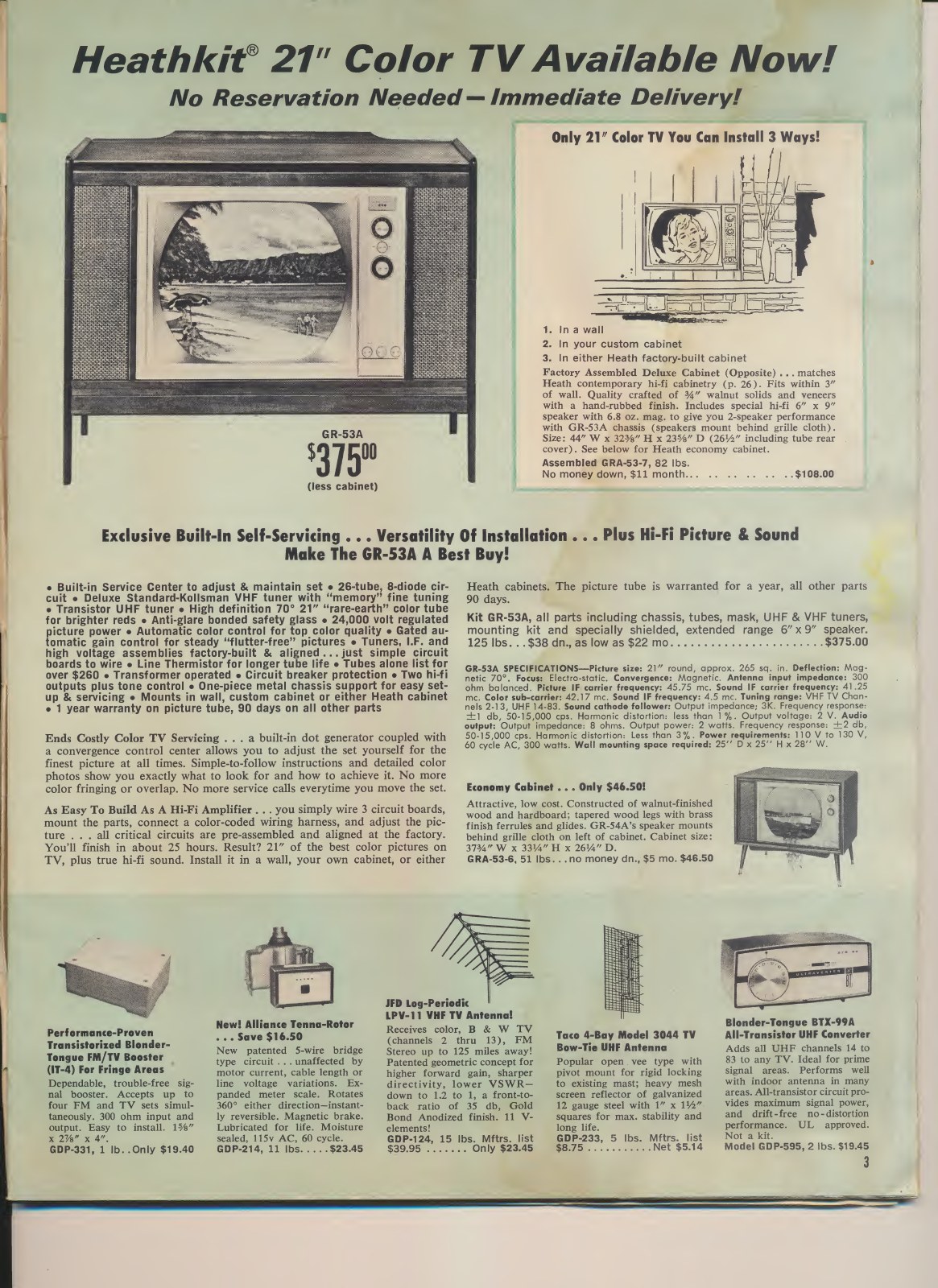
The first Heathkit colour television, the GR-53, was a 21-inch round-screen set. Gilmore recalled it at $349 with the UHF tuner optional and cabinets from $49. He also recalled the design decision that defined every Heathkit colour set afterwards: the customer built “a dot generator and a convergence setup out of some of the other circuits within the television, which could be switched back and forth between the test mode for alignment and operational modes”, so that “a non-technical person” could build and align a colour set with no test equipment (EEJournal, “Heathkits and Hams”, part 2).
That was the problem colour posed for a kit maker. A black-and-white set needs little adjustment once it works. A shadow-mask colour tube has three electron guns, and their three pictures must be made to coincide across the whole screen (convergence). Each beam must also strike only its own colour of phosphor dot (purity). Both jobs normally needed a dot generator and a serviceman, and both had to be repeated when the set was moved. Heath put the generator inside the set, together with a front-panel convergence board and a mobile degaussing coil. Its advertising turned a burden into a selling point: every colour set needs periodic adjustment, and only the Heathkit owner could do it himself.
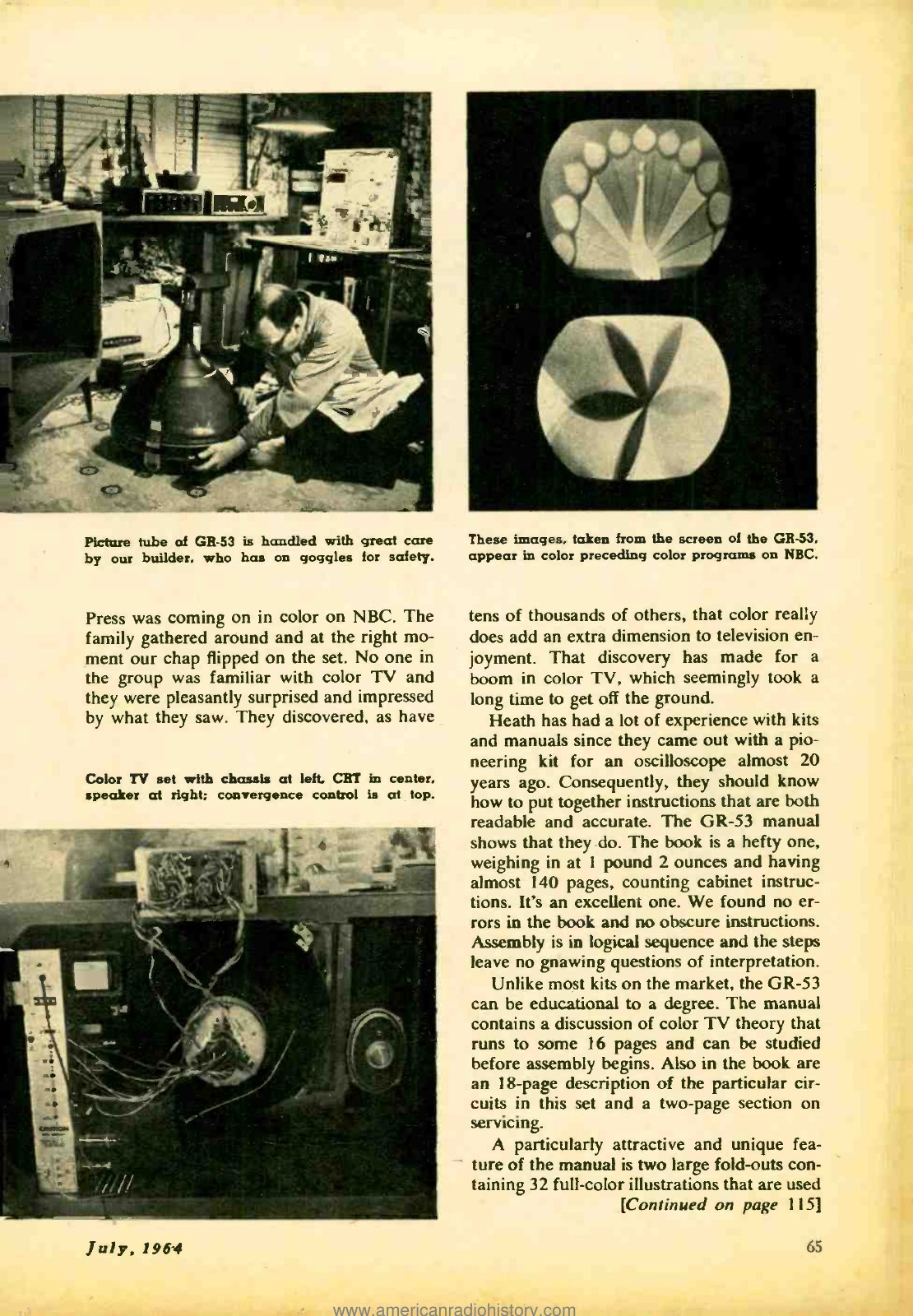
Some circuits were built at the factory. The high-voltage supply, the i.f. board and the tuner came assembled and aligned, and the builder wired two printed boards (colour and sound-sync) and connected everything with a harness. Electronics Illustrated built a GR-53 for its July 1964 issue and called the set “a semi-kit in some respects”. It also noted, without criticism, that “the Heath receiver uses many basic RCA circuits (on license) and an RCA picture tube” (Electronics Illustrated, July 1964, pp. 63–65, 115).
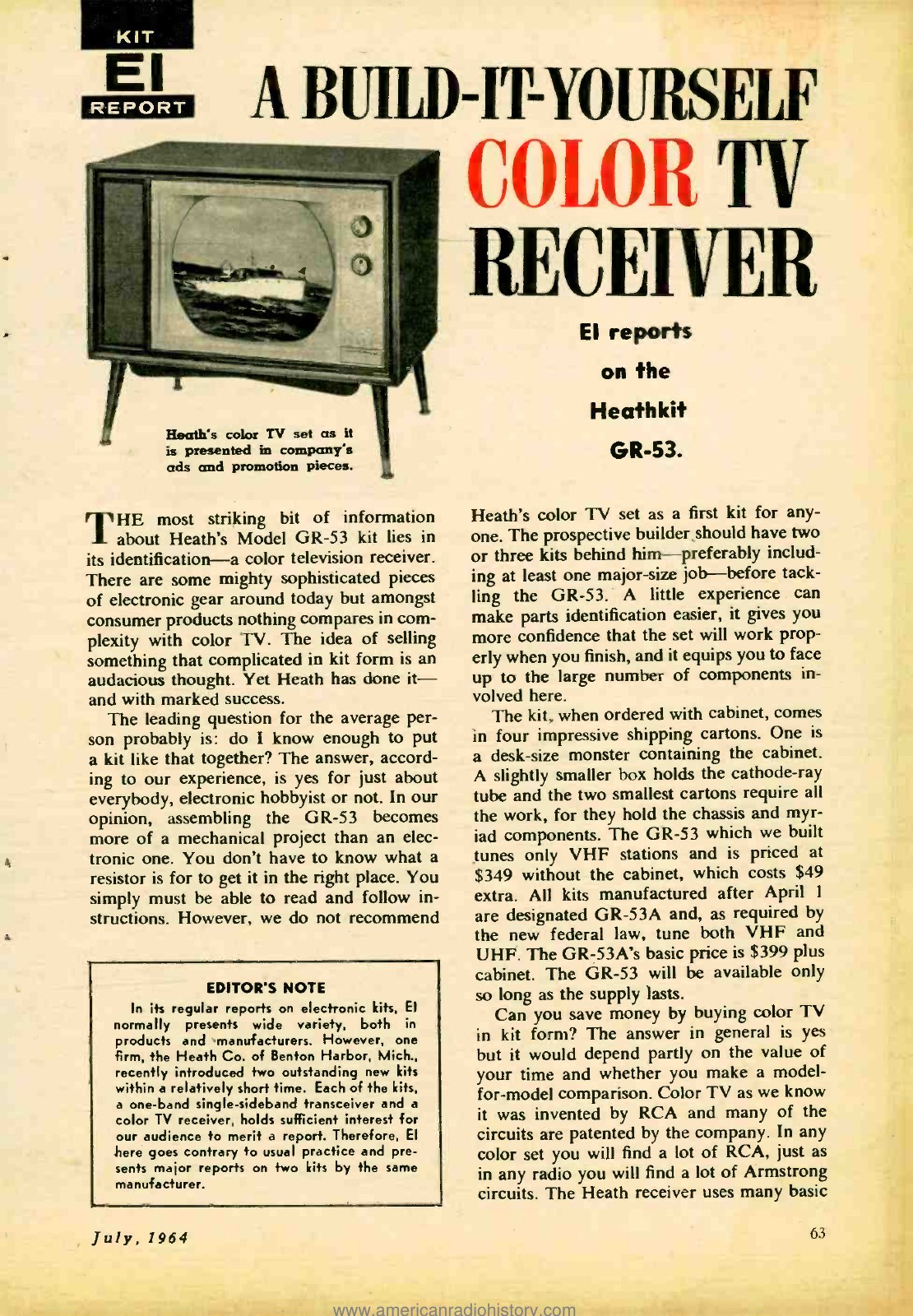
The magazine’s builder was a self-described novice. His timings are the most detailed record of a first-generation Heathkit colour build:
Table 1 — The magazine's builder was a self-described novice. His timings are the most detailed record of a first-generation Heathkit colour build
| Stage | Time |
|---|---|
| Unpacking | 2 h |
| Wiring the chassis | 26 h 40 min |
| Installing in the cabinet | 4 h 30 min |
| Fault-finding (a focus lead grounded, then an open power-supply resistor) | about 3 h |
| Convergence, done three times over | 4 h |
| Total | 40 h 10 min |
Heath claimed 25 hours. The magazine judged that fair “for a builder with some experience”. It praised the manual (almost 140 pages, 16 pages of colour-TV theory, an 18-page circuit description and two fold-outs with 32 full-colour illustrations of convergence faults) and found no errors in it. The set was switched on for the first time for an NBC colour broadcast of Meet the Press. Its verdict: “if you want color TV and have an ounce of sporting blood in your veins, tackle the GR-53.”
1.4.1 From GR-53 to GR-53A: the all-channel law
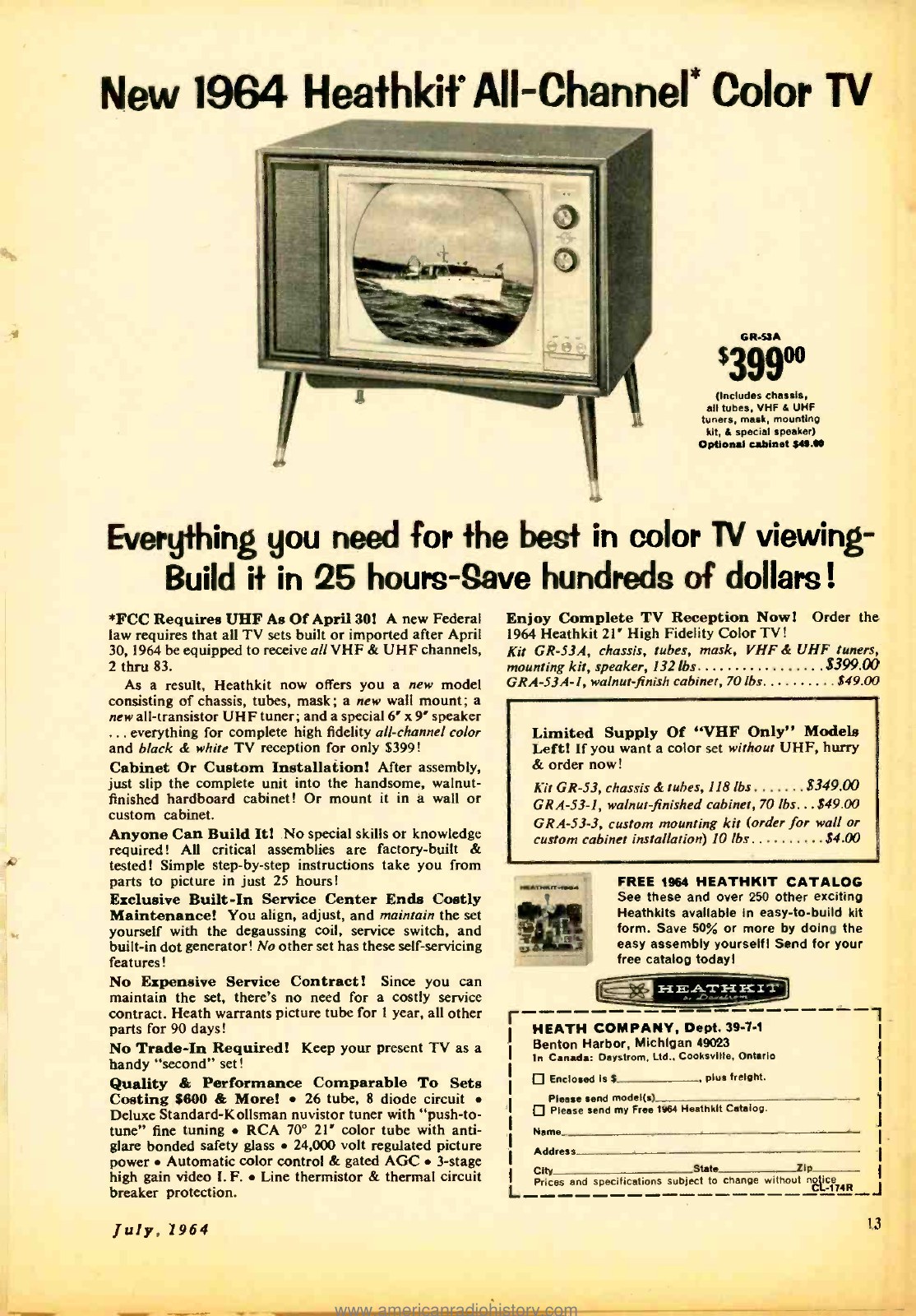
The suffix A marks a change in federal law. The All-Channel Receiver Act of 1962 required every television set built or imported after 30 April 1964 to tune UHF channels 14–83 as well as VHF. Heath’s advertisement in the same issue put it plainly: “FCC requires UHF as of April 30!” The UHF-equipped GR-53A, with a new all-transistor UHF tuner, sold at $399.00. The remaining VHF-only GR-53s were cleared at $349.00 while stocks lasted (Electronics Illustrated, July 1964, p. 13).
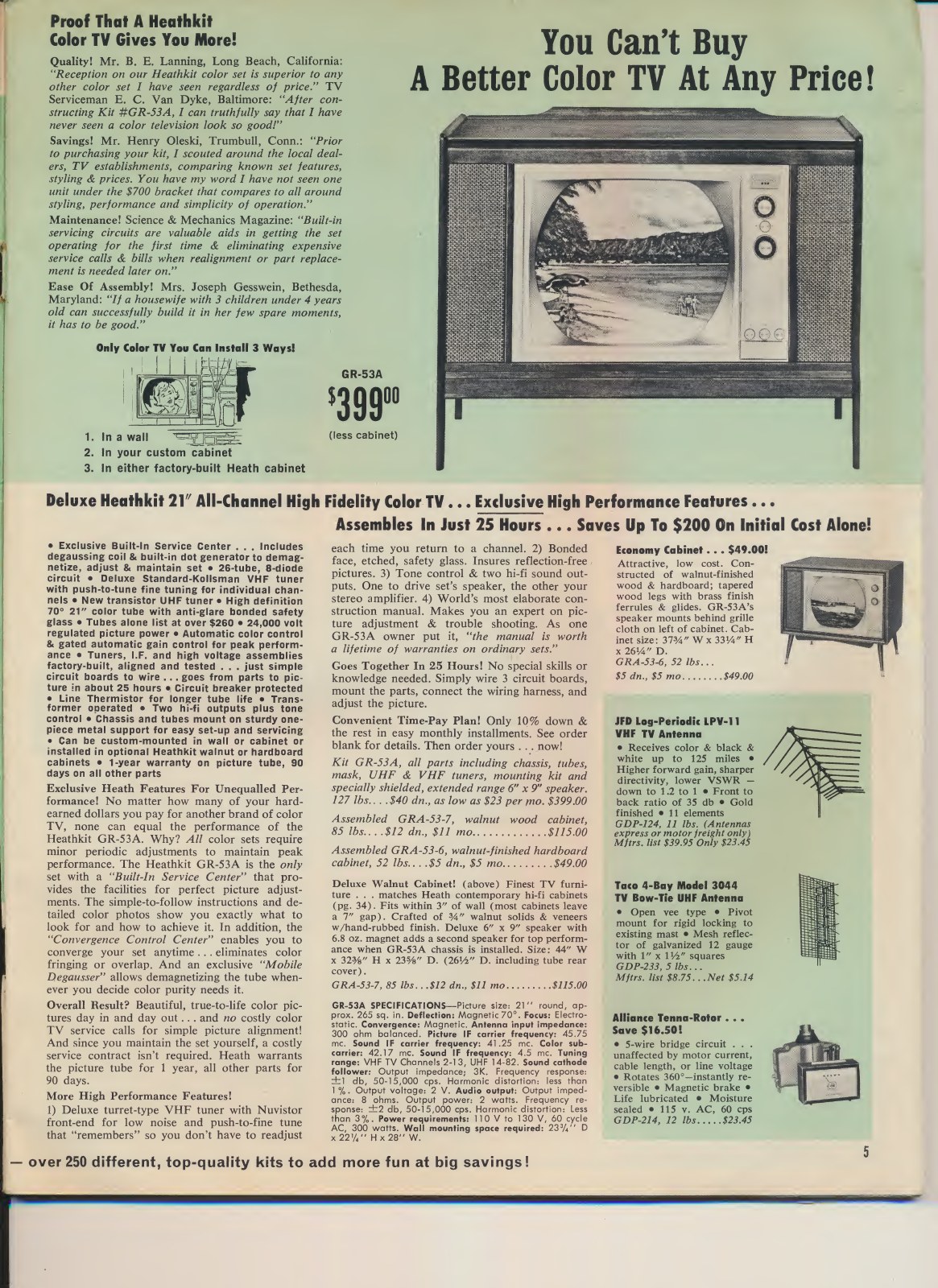
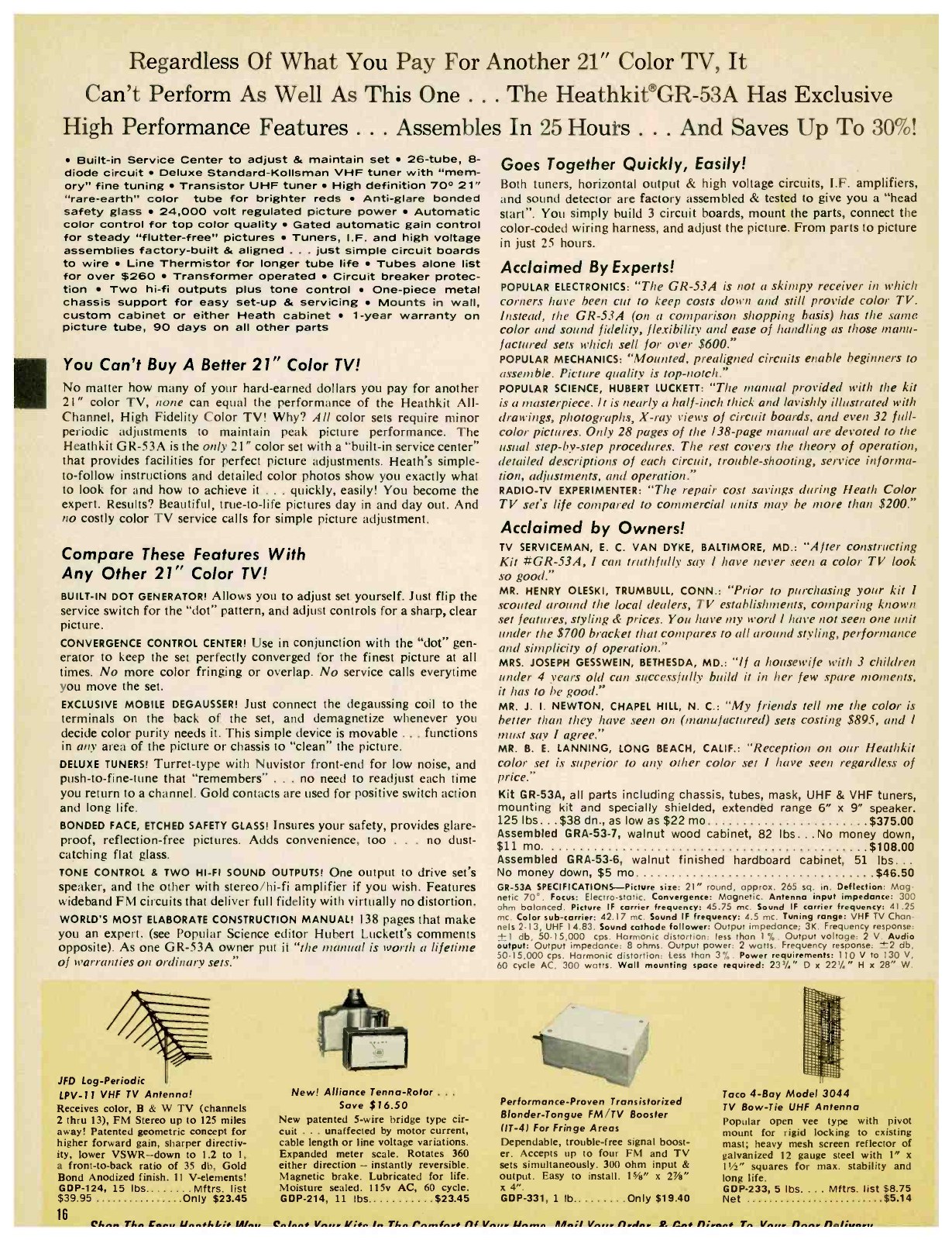
The GR-53A that stayed in the catalogues until 1967 was a 26-tube, 8-diode set. It had a 70-degree 21-inch “rare-earth” tube with anti-glare bonded glass, a regulated 24,000-volt supply, automatic colour control, gated a.g.c. and two hi-fi outputs. The picture tube carried a one-year warranty, and every other part 90 days. The March 1965 catalogue kept the price at $399.00. By early 1966 it was $375.00, and the GR-53A was advertised as “available now … no reservation needed”, in contrast to the new 25-inch set, which was (Heathkit catalogue 800/53, March 1965, p. 5; Heath flyer, early 1966, p. 3).
1.5 What a colour kit was up against
In 1964 a Heathkit colour set was not a cheap set. It was a way to get a good set for less money. Electronics Illustrated priced the GR-53A in its cabinet at “roughly $450 plus 25 hours or more of work”. It compared this with factory-built consoles from Zenith at $580 to $755 (New York prices) and RCA at $579.95 to $755 (f.o.b. Indianapolis), and noted that the cheapest table models, which were not directly comparable, cost $479.95 (Zenith) and $525 (RCA). Radiomuseum’s entry for the GR-53A lists factory colour sets from Admiral, Emerson, Motorola, Olympic and RCA at about $370 to $400 at the time. These were table models without the Heath set’s hi-fi outputs and built-in service aids, and the figure is secondary (Radiomuseum, GR-53A). Either way the saving came from the buyer’s labour and from the service calls the set would not need, not from a low price.
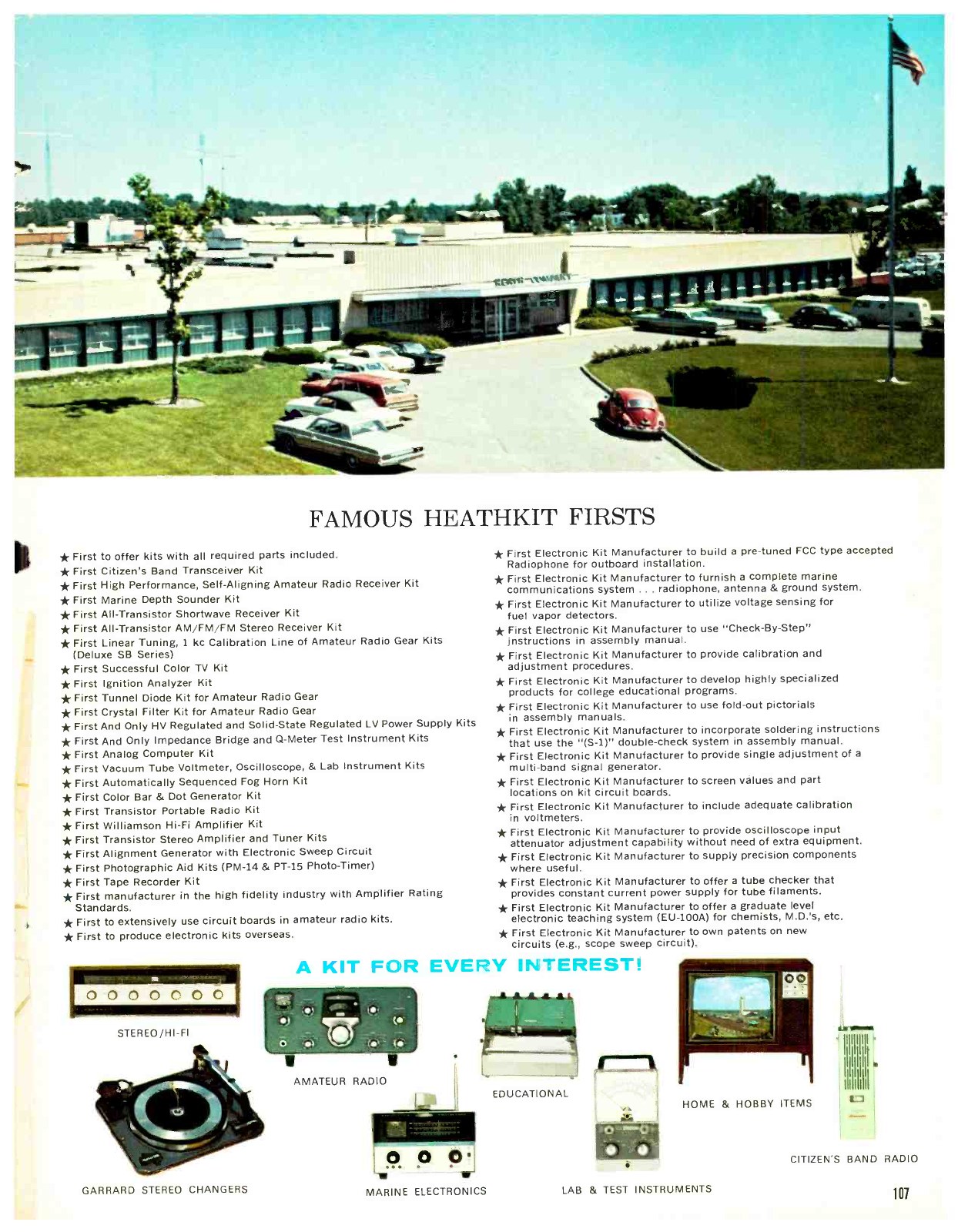
Heath presented itself as the pioneer. The 1966 catalogue’s list of “Famous Heathkit firsts” includes “First successful color TV kit” and “First color bar & dot generator kit” (Heathkit 1966 catalogue, p. 107). The qualifier “successful” is Heath’s own. Collector sources describe the GR-53 as very likely the first colour television sold as a kit, and no earlier colour kit has been found in the sources consulted for this dive. The claim is recorded as probable, not proven.
1.6 Who designed the sets
The sources consulted name the Heath executives, the magazine editors and the customers, but not the engineers who designed the colour sets. Gilmore describes the engineering department of the late 1960s as six sections under a vice-president of engineering, and television was one of them, alongside amateur radio, audio, kit instruments, scientific instruments and a “general” section (EEJournal, “Rise and Fall”, part 2). He did not design television kits himself. Each product had a product-line manager, usually promoted from engineering, and design engineering and the manual department spent roughly equal hours on each kit. That working method is described in the company history’s volume on the golden age and its volume on the manual.
The executives who signed the television pages are easier to name. C. M. Kirkland signed the president’s letter in the early-1966 flyer that carried the first 25-inch set. David W. Nurse signed the catalogue letters from 1967 until the Zenith purchase in 1979. After that the televisions carried Zenith’s engineering, as the fourth volume shows.
Sources
- Heath Company March flyer, 1950, World Radio History.
- Heathkit 1956 catalogue, pp. 4, 14, 16–17.
- Heathkit catalogue, May 1963, p. 14 (GR-22).
- Heath flyer, early 1966, pp. 1–5 (filed by World Radio History as “Heathkit-1963-Supplement-80-33”; the “News and Views” page dates it to early 1966).
- Heathkit catalogue 800/53, March 1965, p. 5.
- Heathkit 1966 catalogue, pp. 13–17, 107.
- “A build-it-yourself color TV receiver”, Electronics Illustrated, July 1964, pp. 13, 63–65, 115.
- Steven Leibson, interviews with Chas Gilmore: EEJournal, “Heathkits and Hams”, part 1, part 2; “The Rise and Fall of Heathkit”, part 2.
- Schlumberger Limited annual reports, Internet Archive.
- Radiomuseum, Heathkit GR-53A (secondary).
- Heath Company dive, volumes 2, 4 and 8.
Comments (0)