Television · Volume 2
The Tube Colour Sets, 1965–1972
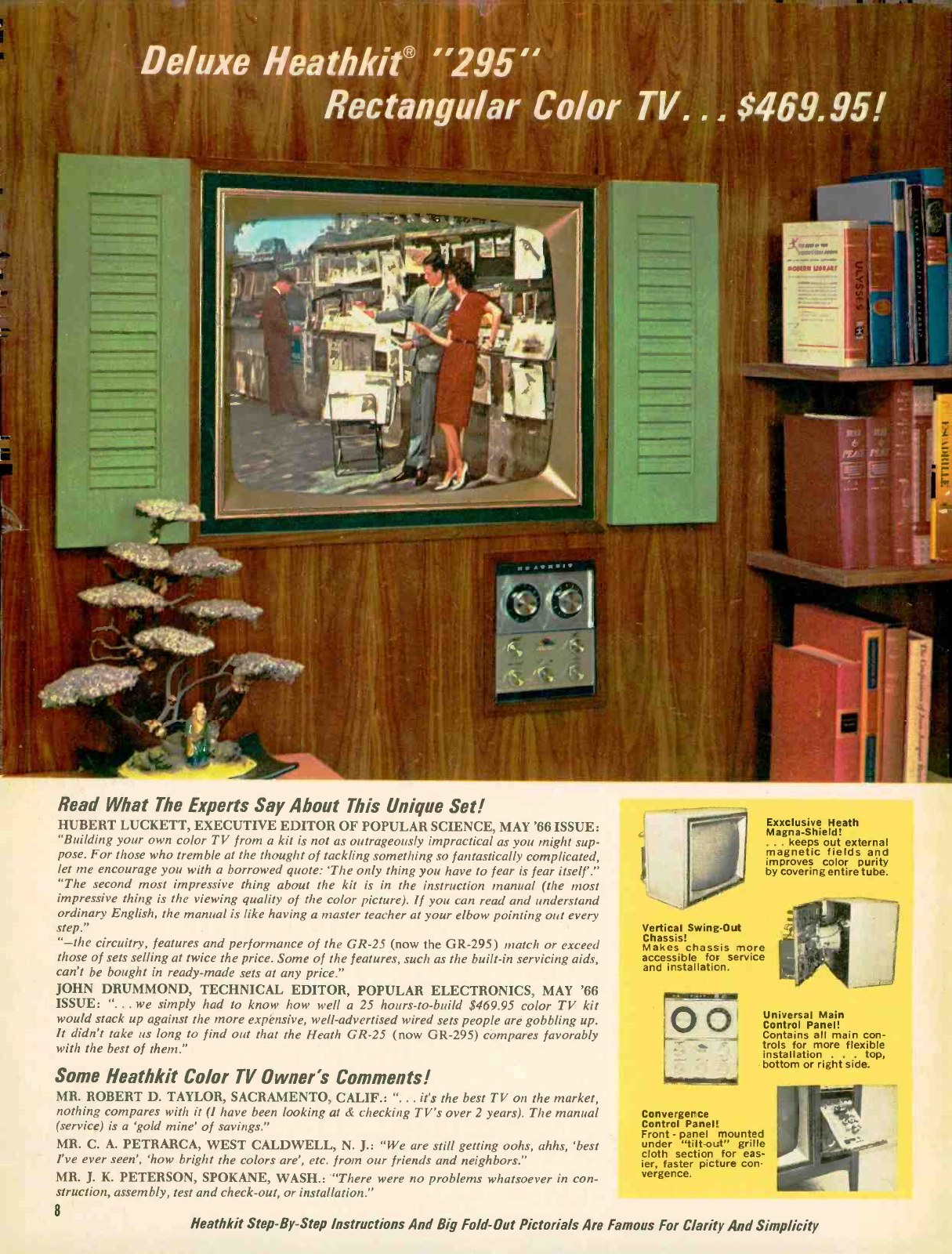
Between late 1965 and 1972 Heath sold a family of vacuum-tube colour sets that were all descended from the GR-53A and all sold on the same promise: build it yourself, converge it yourself, and never pay for a service call. The line grew from one 21-inch set to three picture sizes, gained a wireless remote control, automatic fine tuning and a two-year picture-tube warranty, and was then overtaken by Heath’s own solid-state sets. Alongside it Heath sold the kit it called the world’s first transistor portable black-and-white television. This volume follows those sets from the 25-inch GR-25 to the clearance of the last tube chassis in 1972.
2.1 The GR-25: a 25-inch set on reservation
Schlumberger’s annual report for 1965 recorded a new rectangular 25-inch colour kit “in late fall”, with sales “limited by inability to purchase a larger number of color tubes” (Schlumberger annual reports). The shortage is visible in Heath’s own advertising. An early-1966 flyer headed the set “Your best 25-inch color TV buy!” and then, in a box, “25-inch color TV on reservation basis only! Demand continues to exceed our tube allocation.” Customers were told to send a separate order form marked “GR-25 Reservation Only”. Heath would assign each one a priority number and confirm before shipping (Heath flyer, early 1966, p. 4). The 21-inch GR-53A on the facing page was offered with “no reservation needed—immediate delivery”.
Heath made no picture tubes of its own, so every 25-inch set depended on an allocation from a tube maker whose other customers were the big set manufacturers. Its reports say only that it could not buy enough tubes. Which supplier was involved, and how long the reservation list became, is not recorded in the sources consulted.
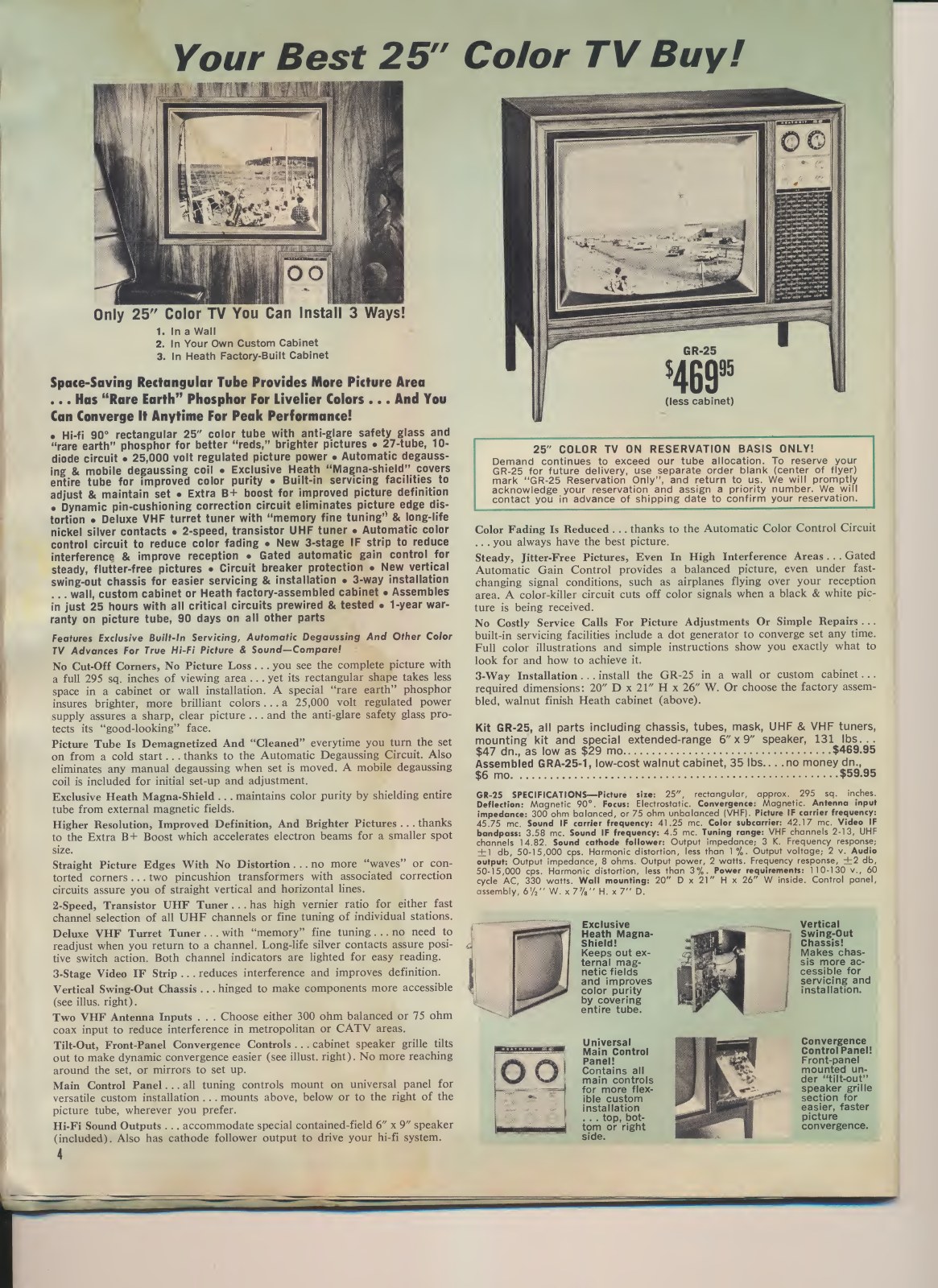
The GR-25 cost $469.95 for the kit, which included the chassis, tubes, mask, UHF and VHF tuners and a 6 × 9-inch speaker, and weighed 131 pounds. It kept the GR-53A’s self-servicing and changed almost everything else:
Table 1 — The GR-25 cost $469.95 for the kit, which included the chassis, tubes, mask, UHF and VHF tuners and a 6 × 9-inch speaker, and weighed 131 pounds. It kept the GR-53A's self-servicing and changed almost everything else
| Feature | GR-53A (1964) | GR-25 (1965) |
|---|---|---|
| Picture tube | 21-inch round, 70°, about 265 sq in | 25-inch rectangular, 90°, about 295 sq in |
| Tubes and diodes | 26 tubes, 8 diodes | 27 tubes, 10 diodes |
| Picture supply | 24,000 V regulated | 25,000 V regulated |
| Degaussing | mobile coil | automatic at every cold start, plus mobile coil |
| Magnetic shielding | none listed | ”Magna-Shield” covering the whole tube |
| Geometry | none listed | dynamic pincushion correction |
| Chassis | one-piece metal support | vertical swing-out chassis |
| Convergence controls | convergence board | tilt-out panel behind the speaker grille |
| Main controls | on the chassis | separate universal control panel, mounted above, below or beside the tube |
| Aerial inputs | 300 Ω | 300 Ω balanced or 75 Ω coaxial |
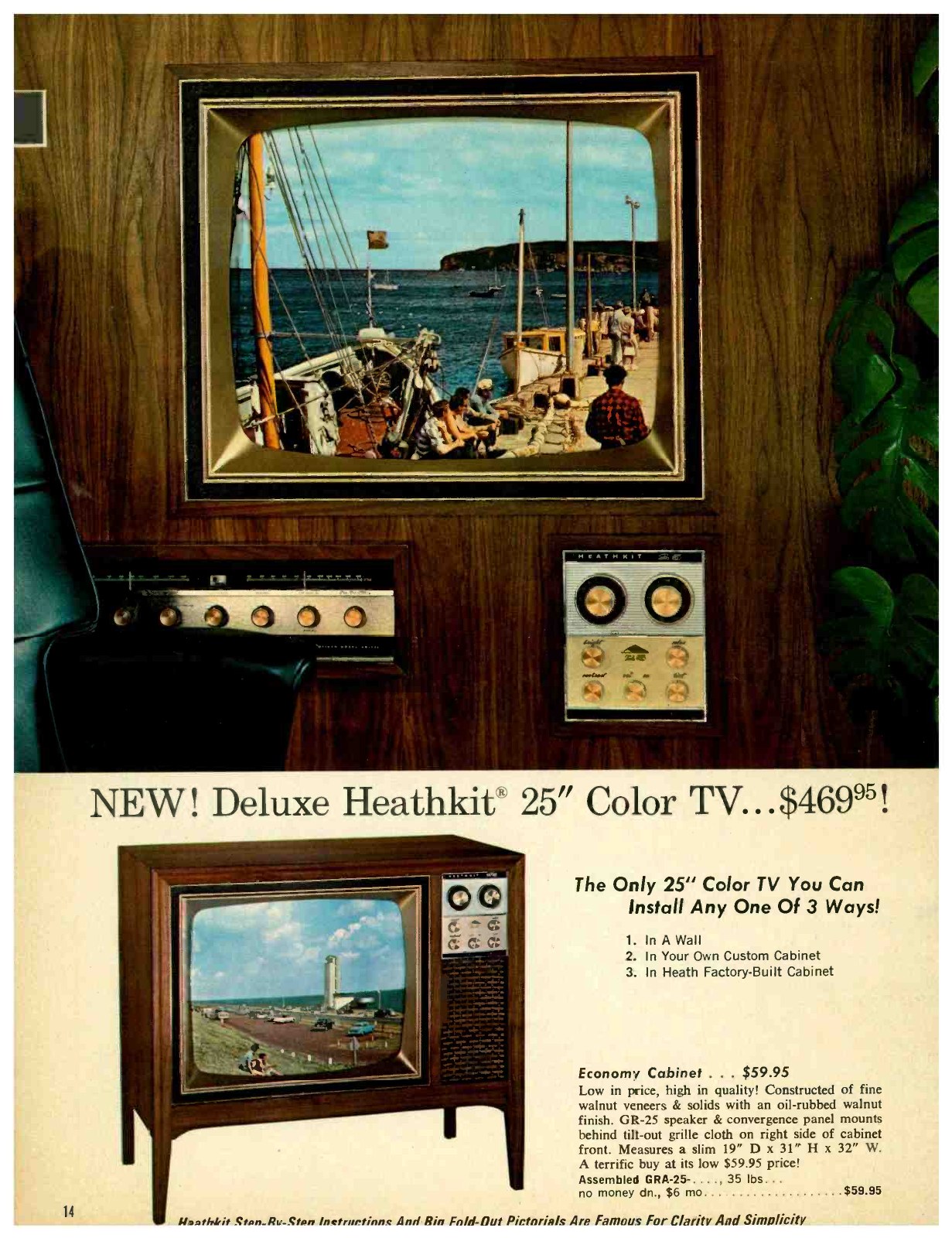
The separate control panel and the tilt-out convergence panel show what Heath expected its buyers to do. Most GR-25s were built into walls and home-made cabinets, so the controls had to be mountable wherever the owner wanted them, and the convergence controls had to be reachable from the front. As the catalogue put it, “no more reaching around the set, or mirrors to set up” (Heathkit 1966 catalogue, pp. 14–15).
2.1.1 What the magazines said
Two magazines built the 25-inch set for their May 1966 issues, and Heath quoted both in the 1967 catalogue. Hubert Luckett, executive editor of Popular Science, reassured nervous readers that building a colour set “is not as outrageously impractical as you might suppose”. He ranked the manual as the second most impressive thing about the kit, after the picture. John Drummond, technical editor of Popular Electronics, wrote that the magazine “simply had to know how well a 25 hours-to-build $469.95 color TV kit would stack up against the more expensive, well-advertised wired sets”, and concluded that the GR-25 “compares favorably with the best of them” (both as quoted in the Heathkit 1967 catalogue, p. 8). The two reviews were not read at source for this dive. The quotations are those Heath chose to print.
2.2 From inches to square inches
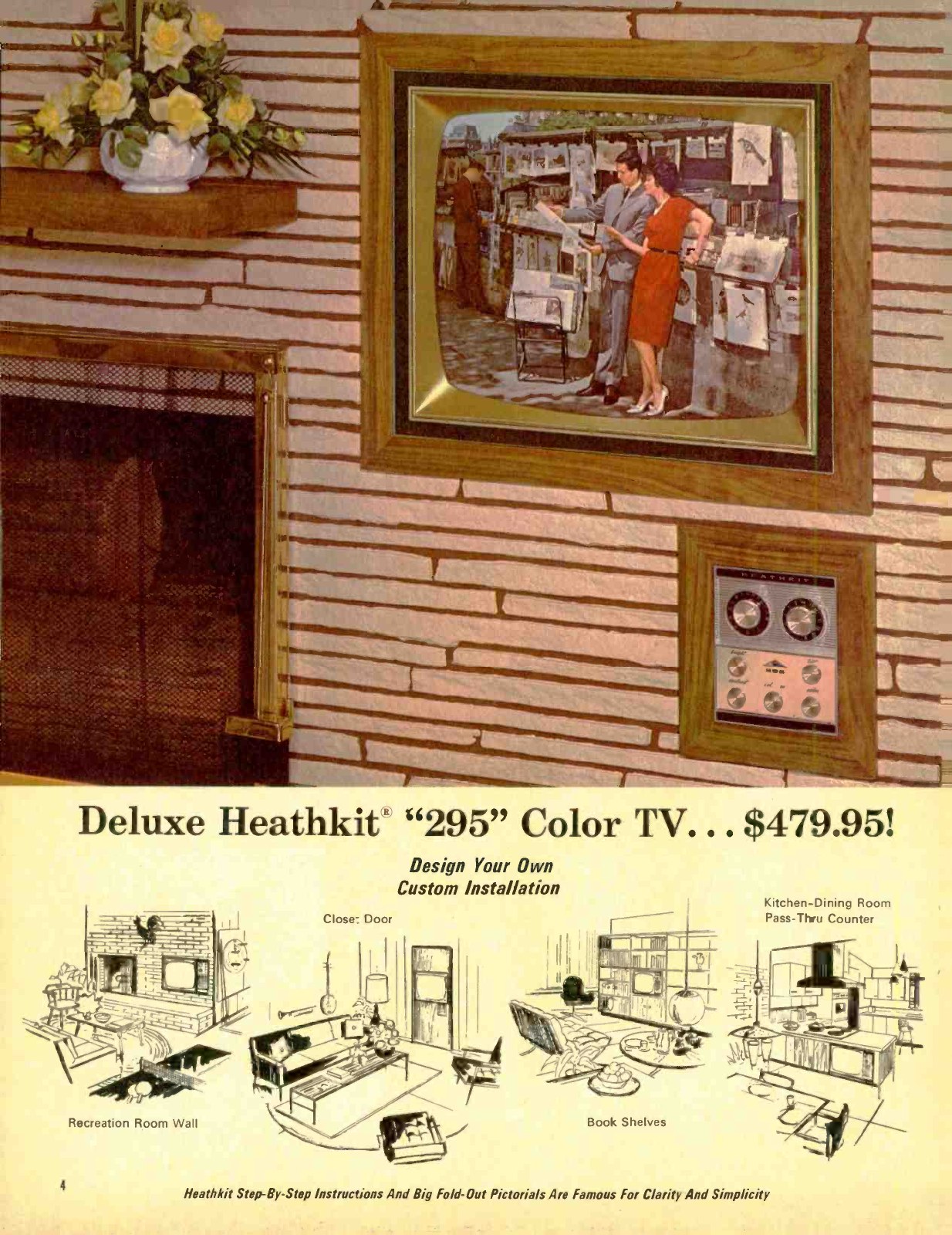
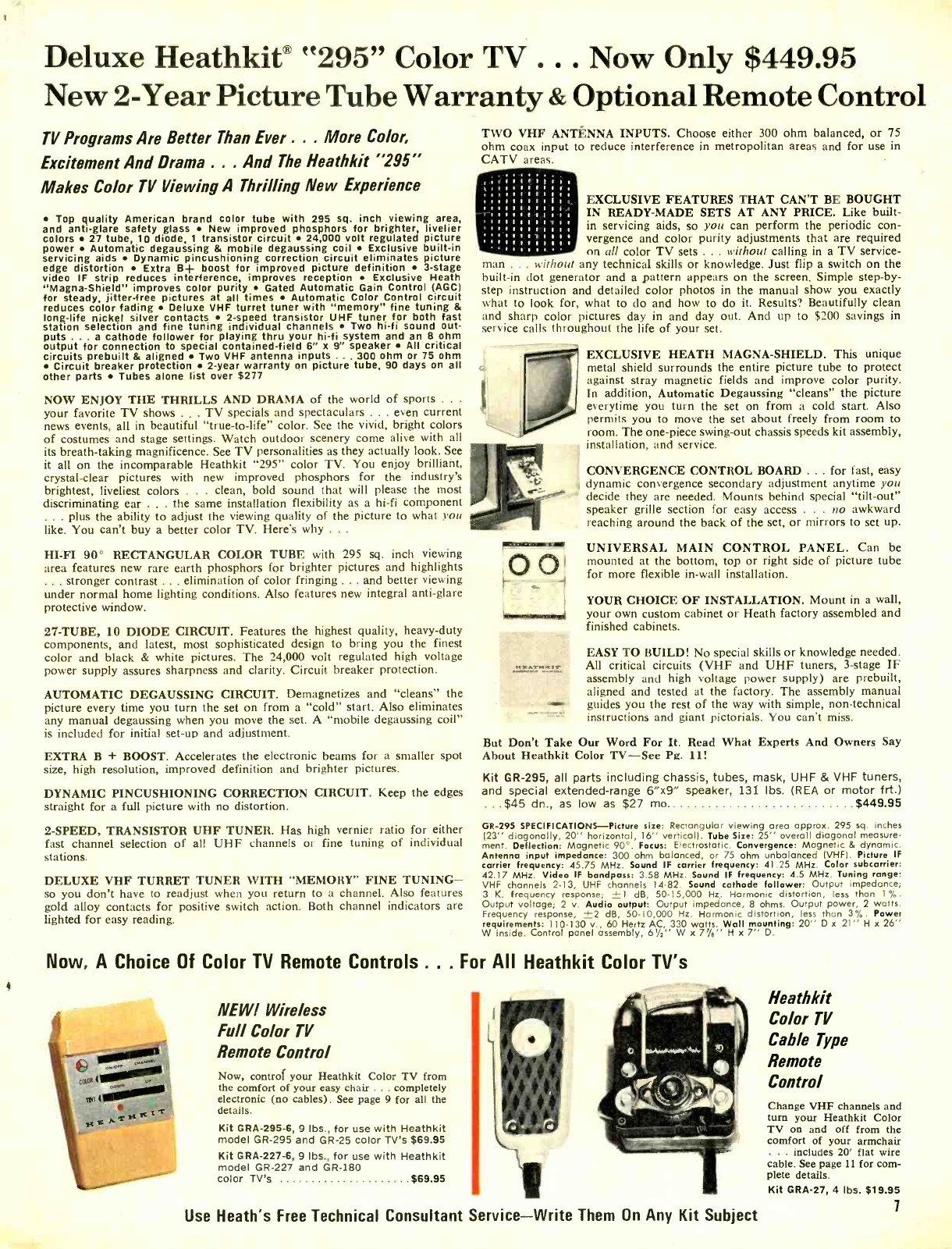
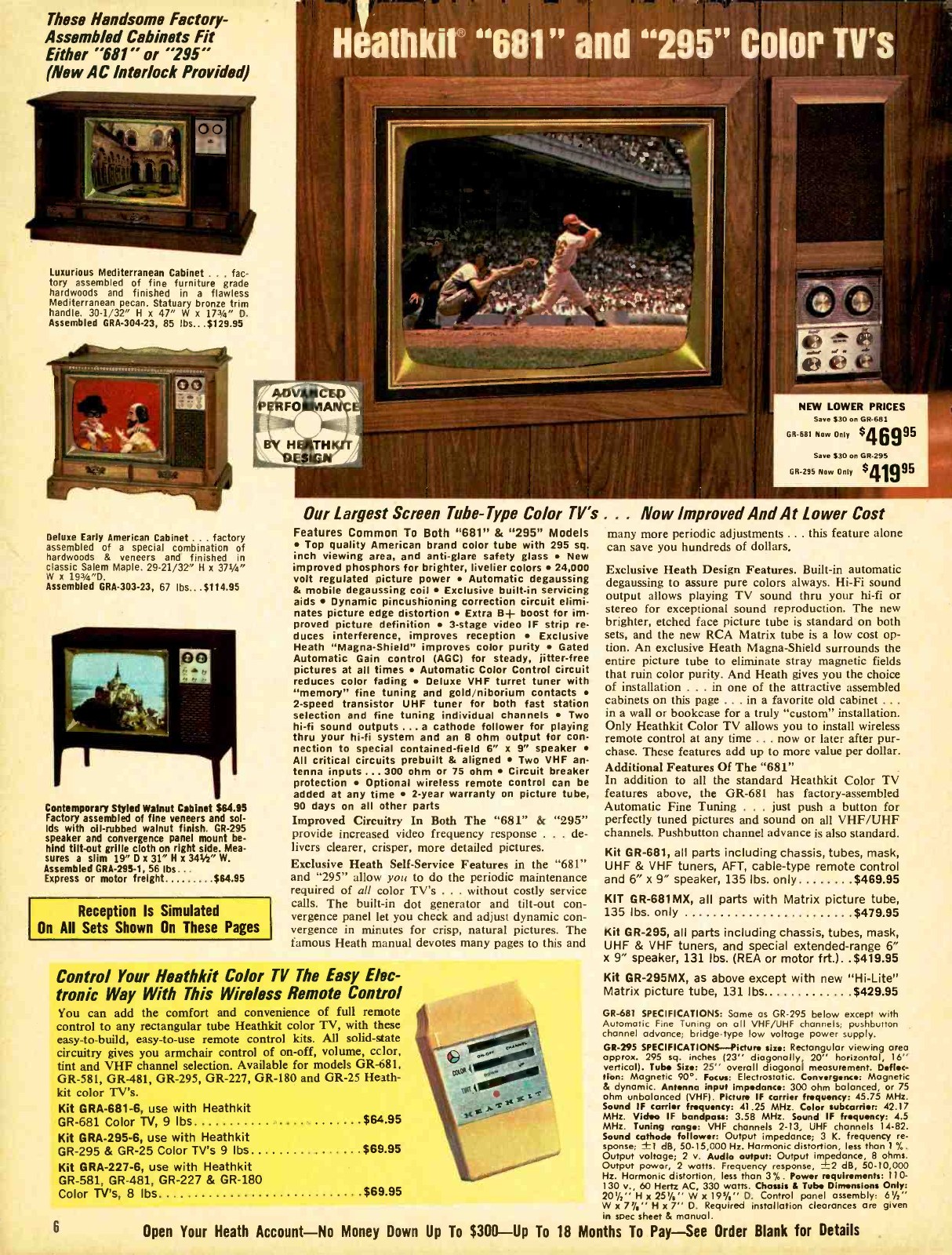
The 1967 catalogue renamed the GR-25. A box at the foot of the GR-295 page explained that “effective January 1, 1967, a new FTC ruling requires TV manufacturers to specify tube size in terms of viewable area”, and that “manufacturers can no longer relate model numbers to nominal picture tube size”. The GR-25 therefore became the GR-295, after its 295 square inches of picture. Heath added the dimensions: 20 inches horizontal, 15½ inches vertical and 23 inches diagonal (Heathkit 1967 catalogue, p. 9). The “25-inch” set had never shown a 25-inch picture. The rule was aimed at the whole industry’s habit of quoting the glass rather than the image.
For the next three years Heath’s model numbers were viewing areas. Two smaller sets joined the GR-295:
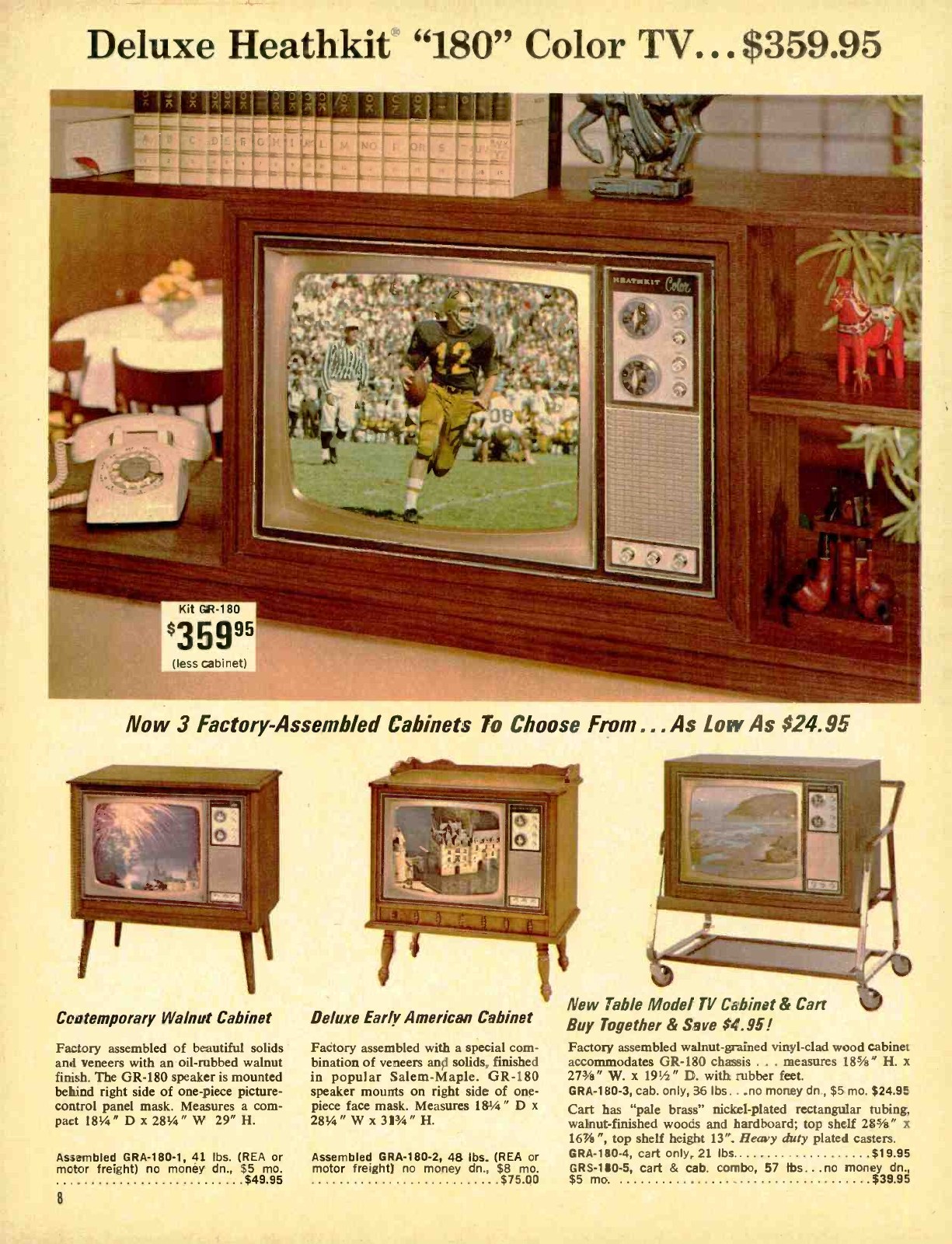
- GR-180 (180 sq in). It first appears in the June 1967 flyer, already marked down from $379.95. By the 1968 catalogue it cost $359.95, with cabinets from $24.95 and a roll-around table cart.
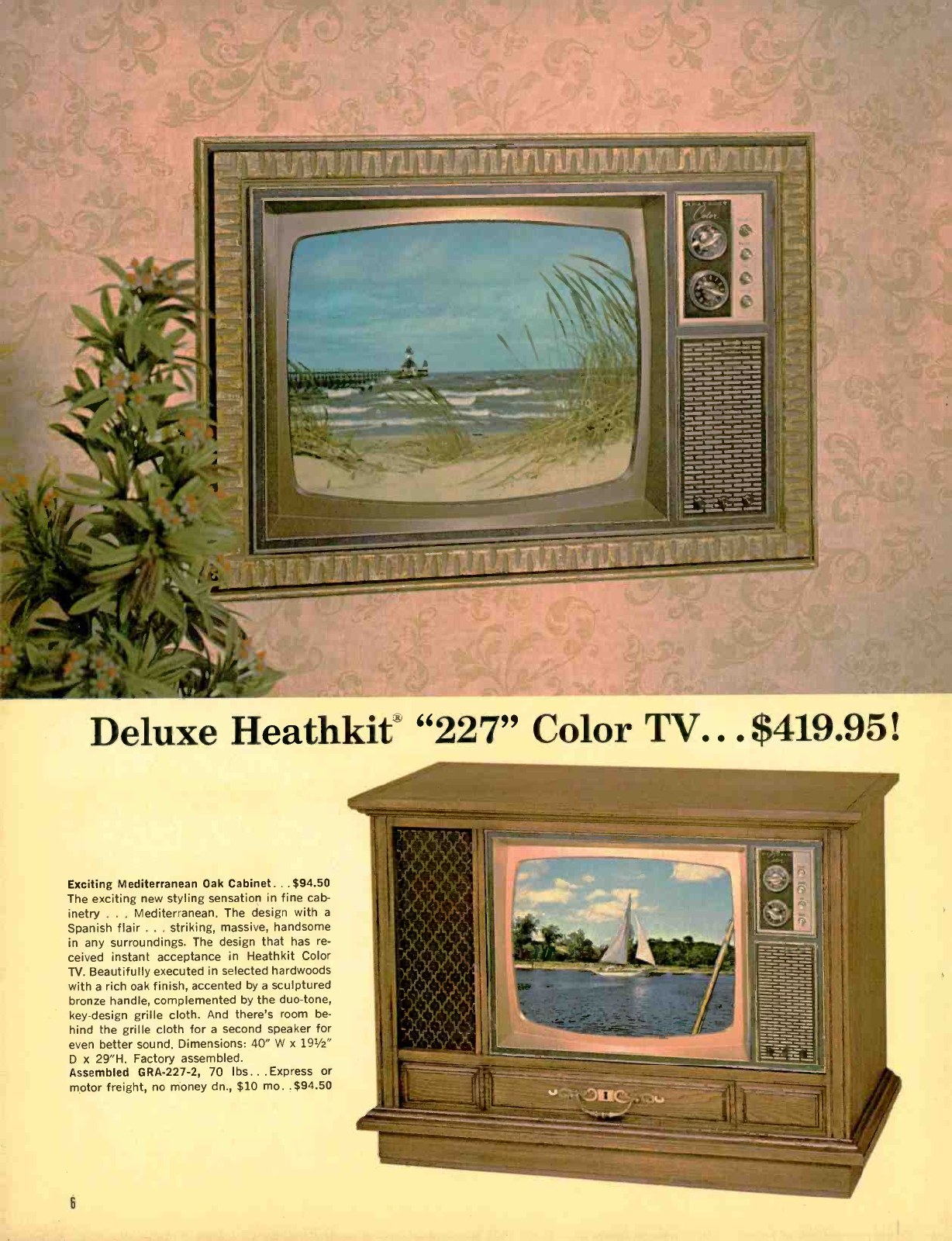
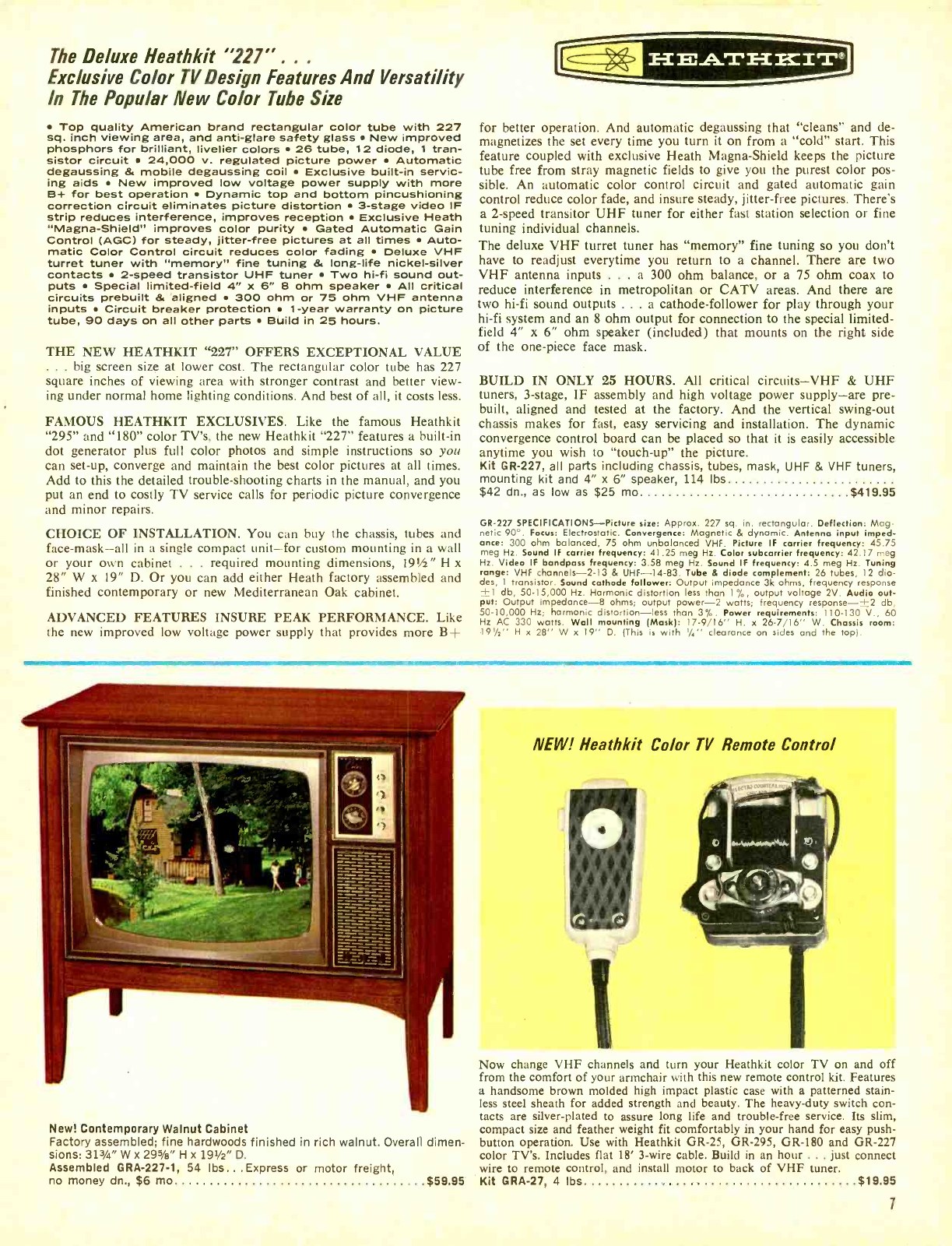
- GR-227 (227 sq in). It first appears in the 1968 catalogue at $419.95.
All three used the same built-in dot generator, automatic degaussing and factory-built tuners, i.f. strip and high-voltage supply. The 1968 catalogue again claimed that the remainder could be assembled in about 25 hours (Heathkit 1968 catalogue, pp. 4–9).
2.3 Remote control
Schlumberger’s report for 1968 records the addition of a wireless remote control (Schlumberger annual reports). The catalogues show it arriving in two steps.
- Wired, 1968. The GRA-27 “color TV remote control” at $19.95 was a cable-type unit on an 18- or 20-foot flat cable, usable with the GR-25, GR-295, GR-180 and GR-227 (Heathkit 1968 catalogue, p. 7).
- Wireless, 1969. The 1969 catalogue offered a wireless electronic remote in two versions: the GRA-295-6 for the GR-295 and GR-25, and the GRA-227-6 for the GR-227 and GR-180, each $69.95. It switched the set on and off and worked volume, VHF channel, colour and tint (Heathkit 1969 catalogue, pp. 7–11). The specification printed in 1971 shows how it worked. Each function had its own ultrasonic tone between 36 and 44 kHz (on-off and volume at 40 kHz, VHF channel at 38 kHz, colour and tint on the others), sent from a small beige hand-held transmitter (Heathkit 1971 catalogue, p. 10).
As with everything else on these sets, the remote was a separate kit that could be added at any time. The same catalogue cut the prices of all three sets (GR-295 $449.95, GR-227 $399.95, GR-180 $349.95) and extended the picture-tube warranty to two years.
2.4 The GR-104: a transistor portable
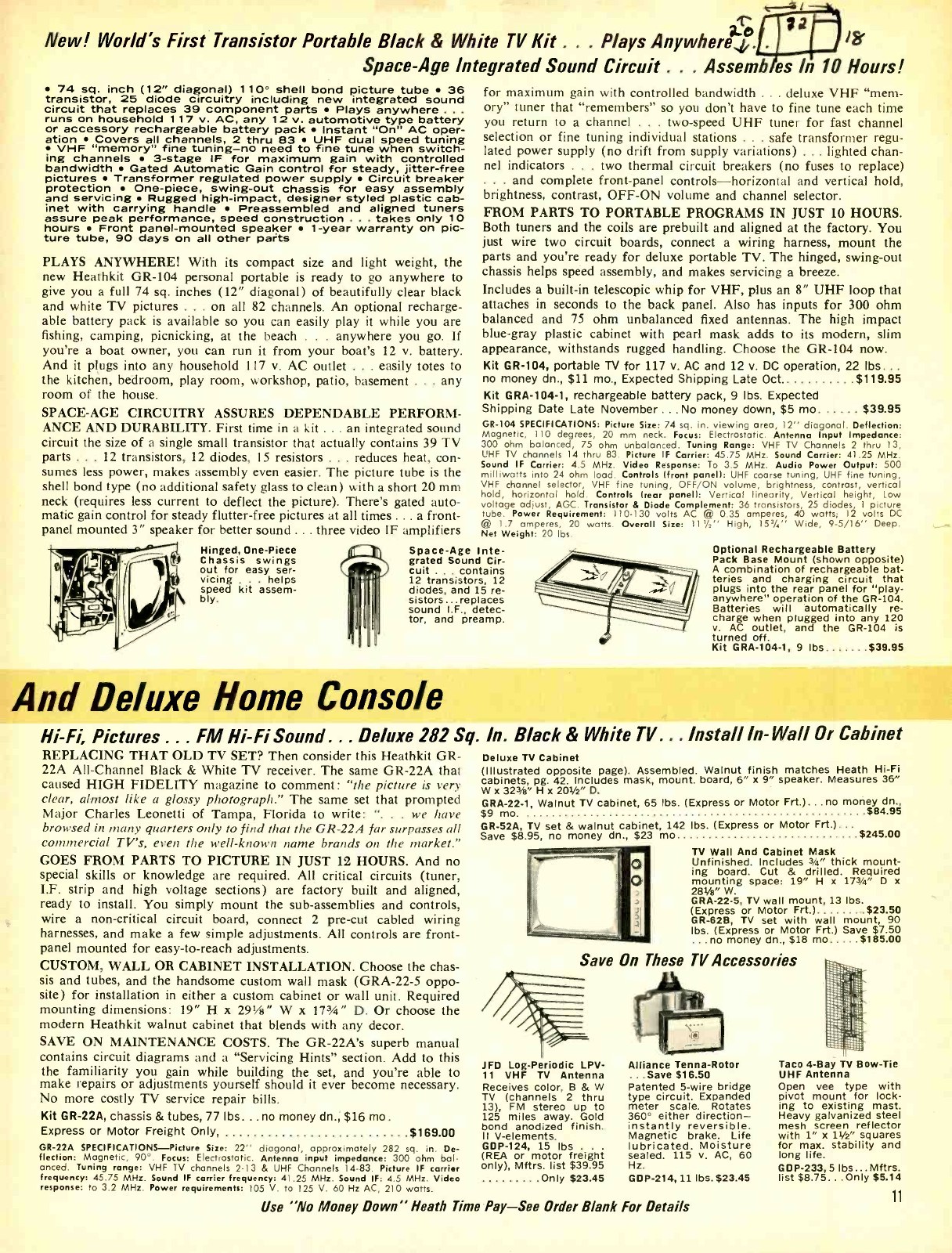
The black-and-white line took a different direction. Schlumberger’s 1966 report mentions a 12-inch solid-state portable (Schlumberger annual reports). The 1967 catalogue, issued in the autumn of 1966, introduced it as the GR-104 under the headline “New! World’s first transistor portable black & white TV kit … plays anywhere”, at $119.95 with an expected shipping date of late October (Heathkit 1967 catalogue, p. 11).
It was a 12-inch (74 sq in) set with a 110-degree “shell-bond” tube that needed no separate safety glass, and a short 20 mm neck to reduce deflection power. The circuit had 36 transistors and 25 diodes, including what Heath called a “space-age integrated sound circuit” the size of a small transistor. That device contained 12 transistors, 12 diodes and 15 resistors, and the catalogue called it a first in a kit. It ran from 117 V a.c., a 12 V car or boat battery, or an optional rechargeable battery pack (GRA-104-1, $39.95). The tuners and coils came pre-built and aligned, and the builder wired two circuit boards: “from parts to portable programs in just 10 hours”.
The GR-104 outlasted every tube colour set. It went through A, B and C revisions: the GR-104A at $124.95 in 1971–72, the GR-104B at $129.95 in 1972, and the GR-104C at $149.95 in 1975, rising to $179.95 in 1978 (Heathkit catalogue 810/72; Christmas 1975, p. 21; Spring 1978, p. 11). It was last seen in the Christmas 1978 catalogue, twelve years after launch.
2.5 Automatic fine tuning and the “681”
The last generation of Heath’s tube sets added automatic fine tuning (AFT). The Winter 1970 catalogue introduced three AFT models alongside the existing sets:
Table 2 — The last generation of Heath's tube sets added automatic fine tuning (AFT). The Winter 1970 catalogue introduced three AFT models alongside the existing sets
| AFT model | Picture | Non-AFT twin | 1971 prices (AFT / non-AFT) |
|---|---|---|---|
| GR-681 | 295 sq in, 23-inch | GR-295 | $469.95 / $419.95 |
| GR-581 | 227 sq in | GR-227 | $399.95 / $359.95 |
| GR-481 | 180 sq in | GR-180 | $329.95 / $299.95 |
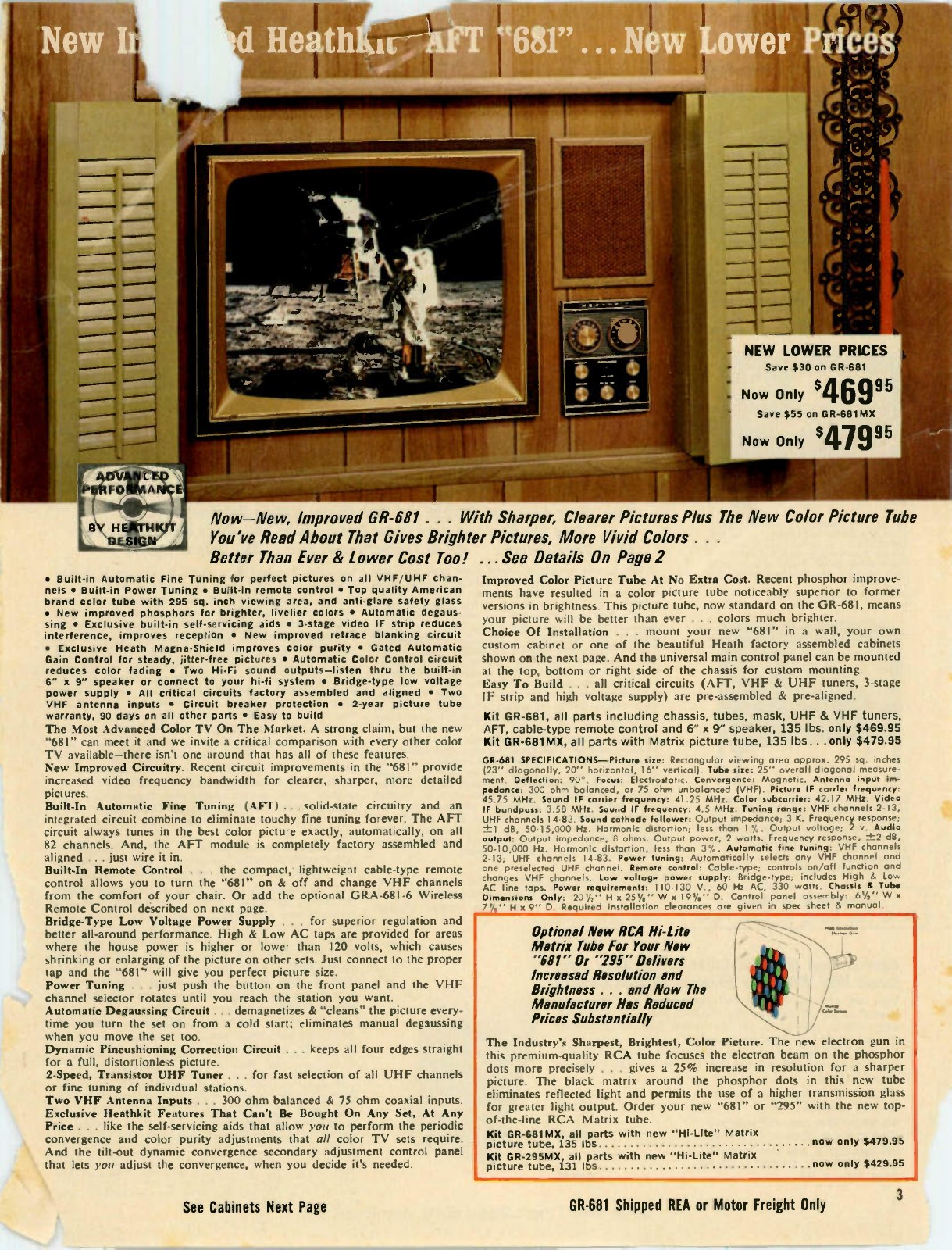
The GR-681 had the largest feature list of any Heath tube set. It had an integrated-circuit AFT module, a new “brighter” bonded-face tube and retrace blanking, and an “MX” version with RCA’s Hi-Lite black-matrix tube for $10 more (GR-681MX and GR-295MX, 1971) (Heathkit catalogue, Winter 1970, pp. 2–5; Heathkit 1971 catalogue, pp. 6–8). The catalogue photograph of the new “681” showed a moon landing on its screen.
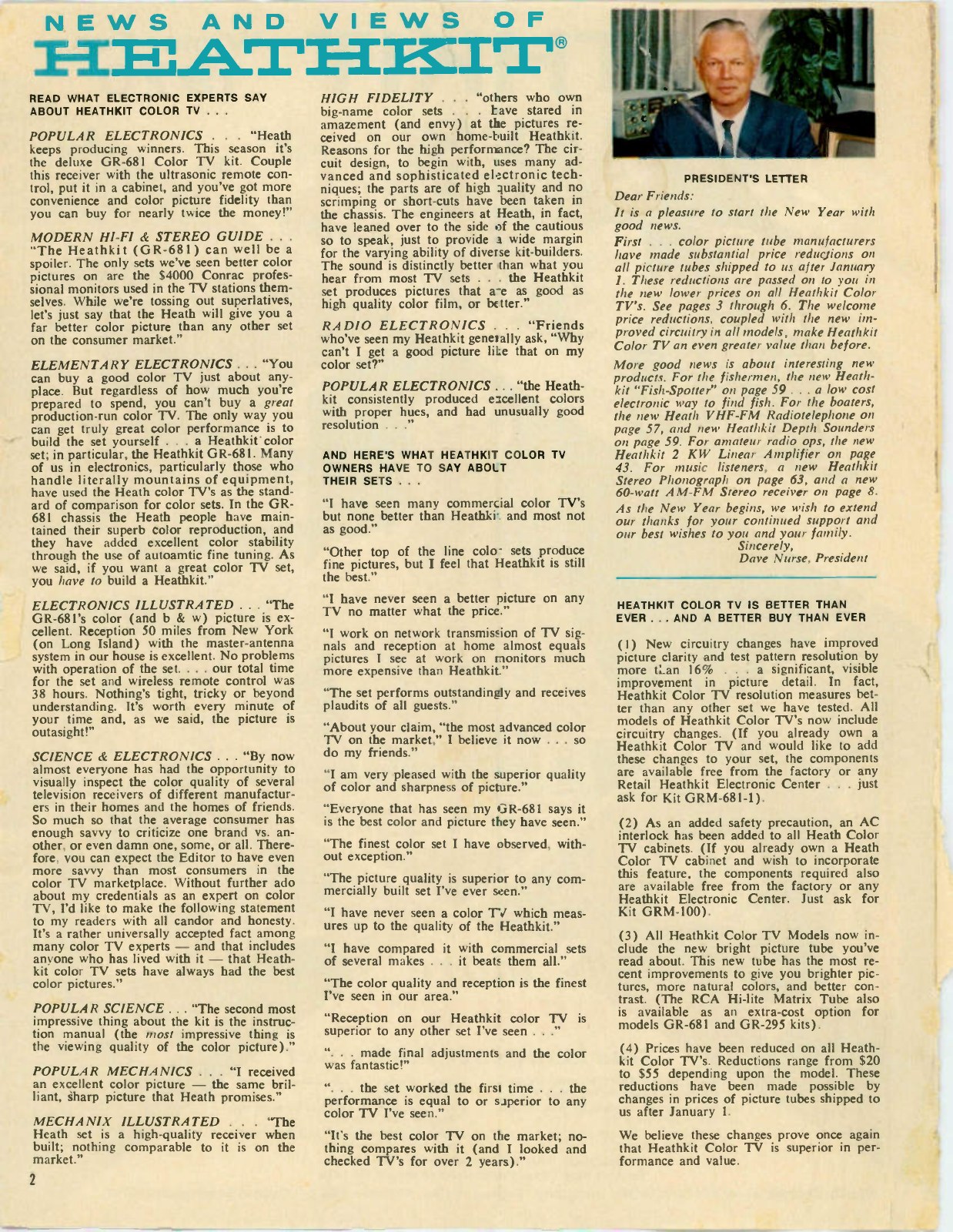
The same pages carried a new warning line, “New AC interlock provided”. David Nurse’s letter in Winter 1970 explained the lower prices: colour picture-tube manufacturers had made “substantial price reductions” on all tubes shipped after 1 January, and Heath was passing them on. The shortage of 1965 had become a surplus.
2.6 Colour television as a correspondence course
The colour kits had a second market that barely appears in Heath’s own advertising: the correspondence schools. Heath’s 1971 catalogue carried a two-page insert from National Technical Schools of Los Angeles headed “Double your fun. Learn TV-radio while you build your Heathkit color set or black and white set.” A student could enrol in the NTS colour-TV servicing course and build a complete Heathkit GR-295 as the course’s practical work. The total was $795.00 on the longest payment plan, or $759.00 cash. The black-and-white course was built around the GR-104A at $389.00, or $345.00 cash (Heathkit 1971 catalogue, pp. 11–12). The January 1972 catalogue carried the same offer with the solid-state GR-371MX in place of the GR-295.
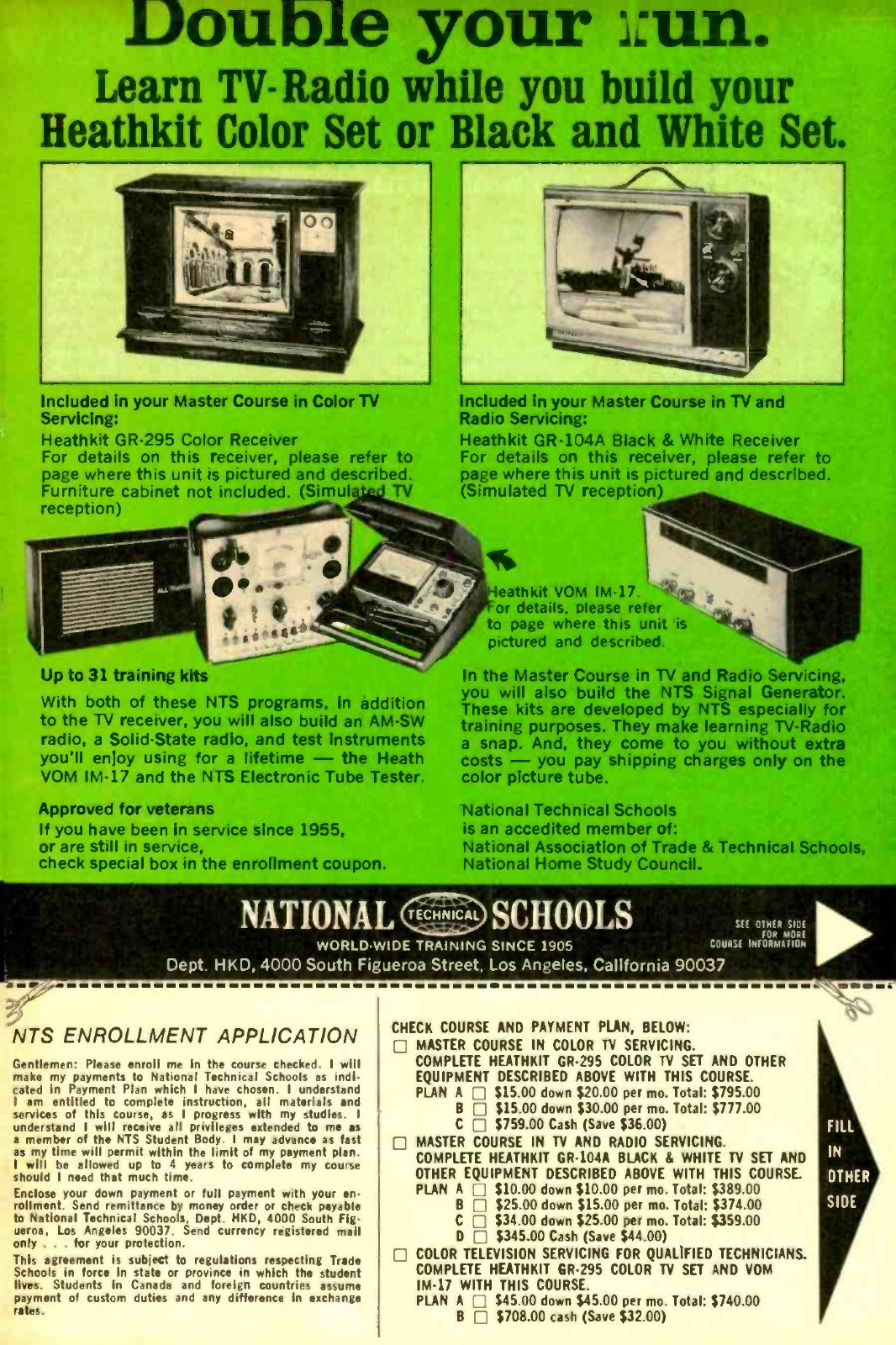
Schlumberger’s reports show how much this mattered. By 1972 correspondence schools were buying colour kits in quantity. Heath counted the business separately as “contract sales”, and it made television the largest single contributor to the growth of 1974–76. Its loss in 1977–78 accounts for most of Heath’s revenue decline in those years (company history, volume 4). The GR-295 in a student’s living room was a Heathkit set with no Heathkit customer’s name attached to it, which is part of why the number of tube sets built cannot be estimated from the catalogues.
2.7 The end of the tube sets
Heath’s first solid-state colour sets arrived in 1971 (the next volume), and the tube line was cleared within two years. The January 1972 catalogue cut the GR-681 from $459.95 to $439.95. A 1972 flyer introduced one last tube set, the GR-200: a 295 sq in set with AFT at $399.95, called “the easiest color TV kit you can build” and pitched as a second set for the recreation room (Heathkit catalogue 800/40, 1972, p. 9). The 810/72 catalogue cleared the remaining tube chassis, the GR-295, GR-227 and GR-180, at $419.95, $299.95 and $259.95 (the page is reproduced in the GR-2000 overview). No tube colour set appears in the catalogues after 1972.
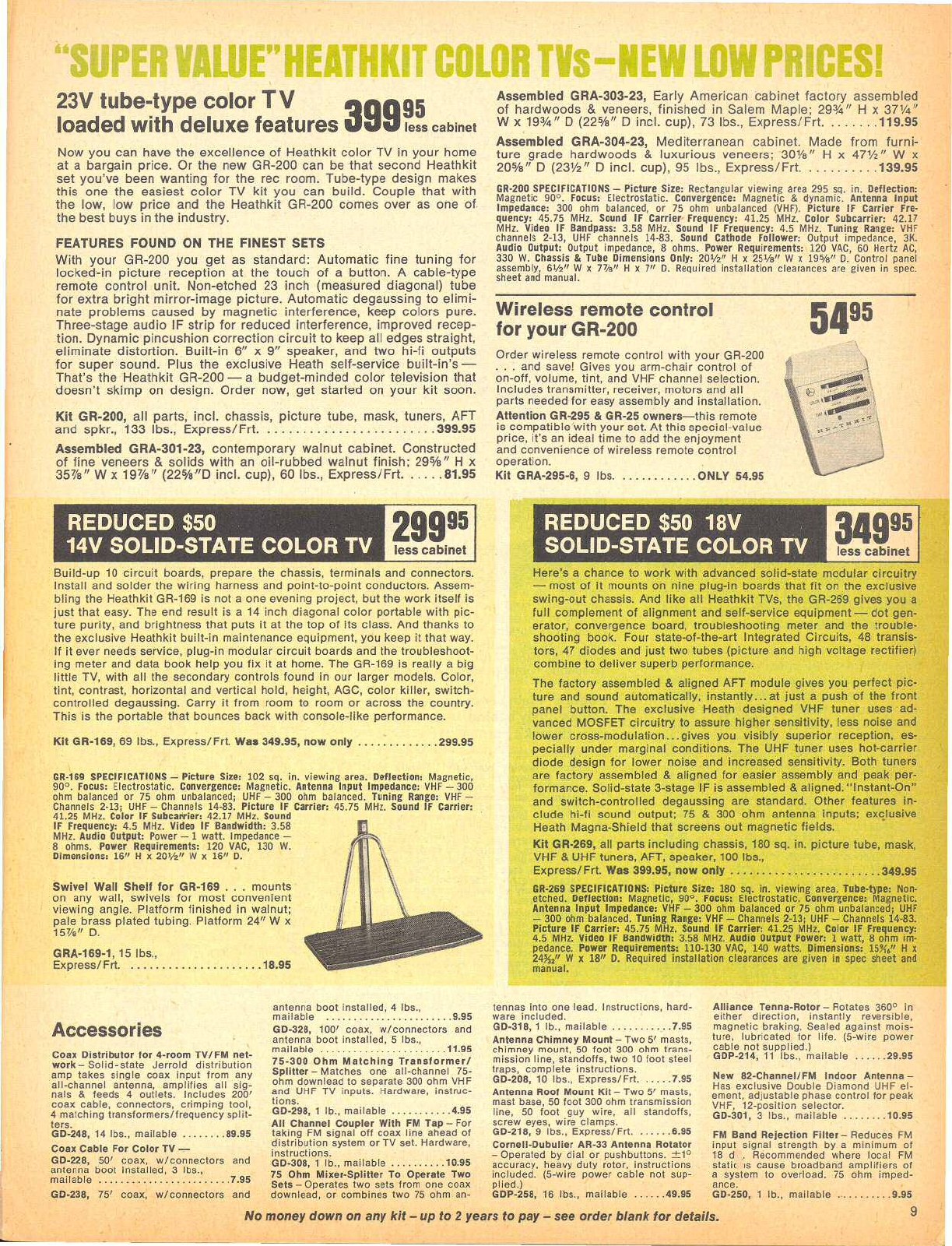
The prices tell the story of the era. A 21-inch round-screen set cost $399 in 1964. Eight years later the same money bought a 23-inch rectangular set with AFT and a two-year tube warranty. Heath’s kit was never the cheapest colour set on the market, but by 1972 a tube colour set was no longer a luxury.
Sources
- Heath flyer, early 1966, pp. 3–5, in the World Radio History file “Heathkit-1963-Supplement-80-33”.
- Heathkit catalogues, World Radio History: 1966, pp. 13–17; 1967, pp. 8–11; June 1967, p. 3; 1968, pp. 4–10; 1969, pp. 7–14; Winter 1970, pp. 2–5; 1971, pp. 3–12; 800/28, January 1972, pp. 8–11; 800/40, 1972, pp. 7–10; 810/72, pp. 8–10; Christmas 1975, p. 21; Spring 1978, p. 11.
- Popular Science and Popular Electronics, May 1966, as quoted in the 1967 catalogue (not read at source).
- Schlumberger Limited annual reports, 1965–1972, Internet Archive.
- Heath Company dive, volume 4 (contract sales to correspondence schools).
Comments (0)