Television · Volume 5
Servicing, Restoring and Collecting
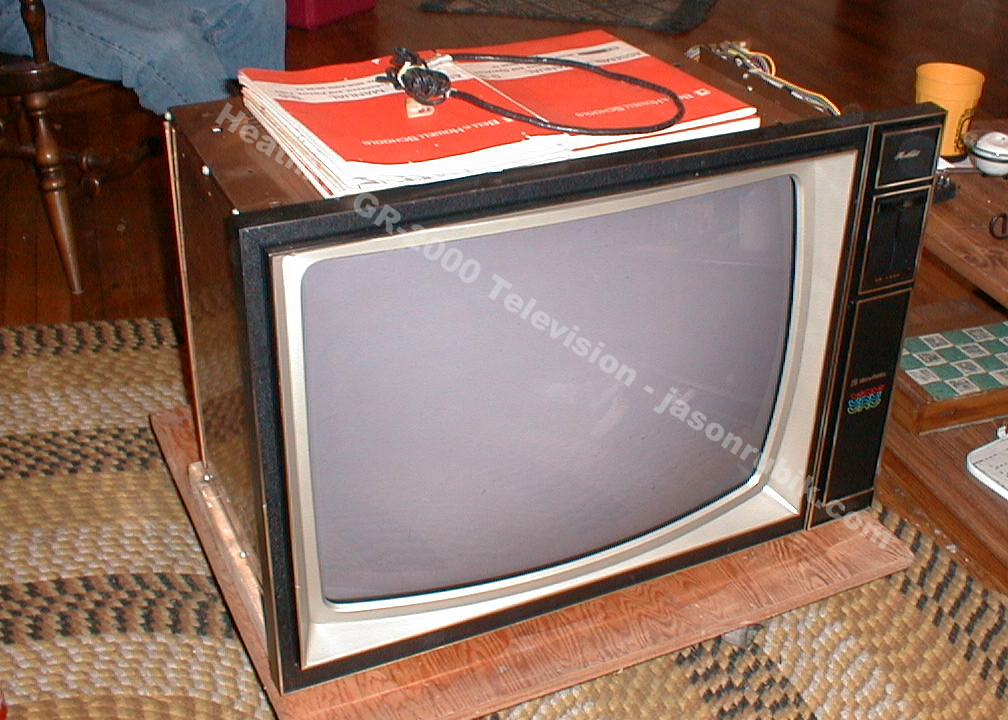
A Heathkit television today is a heavy, high-voltage object assembled forty to sixty years ago by an amateur, with a picture tube that cannot be replaced from new. It is also one of the best-documented televisions of its time, because its owner was given the complete manual, the schematics, a troubleshooting section and, from 1963 to 1975, the instruments to set it up. This volume covers what that means for anyone servicing, restoring or collecting one now: the safety rules, the problems each generation of set brings, the instruments Heath sold for the job, and where the sets, the documents and the people who know them can be found. The GR-2000 has its own detailed restoration volume (GR-2000, “Restoration and Common Faults”), and what follows applies it to the whole line.
5.1 Safety
Every Heathkit colour set carries a high voltage that can kill. The first colour set ran its picture tube at a regulated 24,000 volts, the 25-inch tube sets at 25,000 volts, and the GR-2001 manual gives 26,000 volts. Heath’s own warning in that manual states the working rule: never touch the horizontal output assembly or the second anode while the set is running, and work “with one hand … behind your back” (GR-2001 Book Three, p. 3-21). A colour picture tube also holds its charge after the set is switched off, between its inner and outer coatings, and must be discharged to the chassis through a grounded lead before the anode cap is touched.
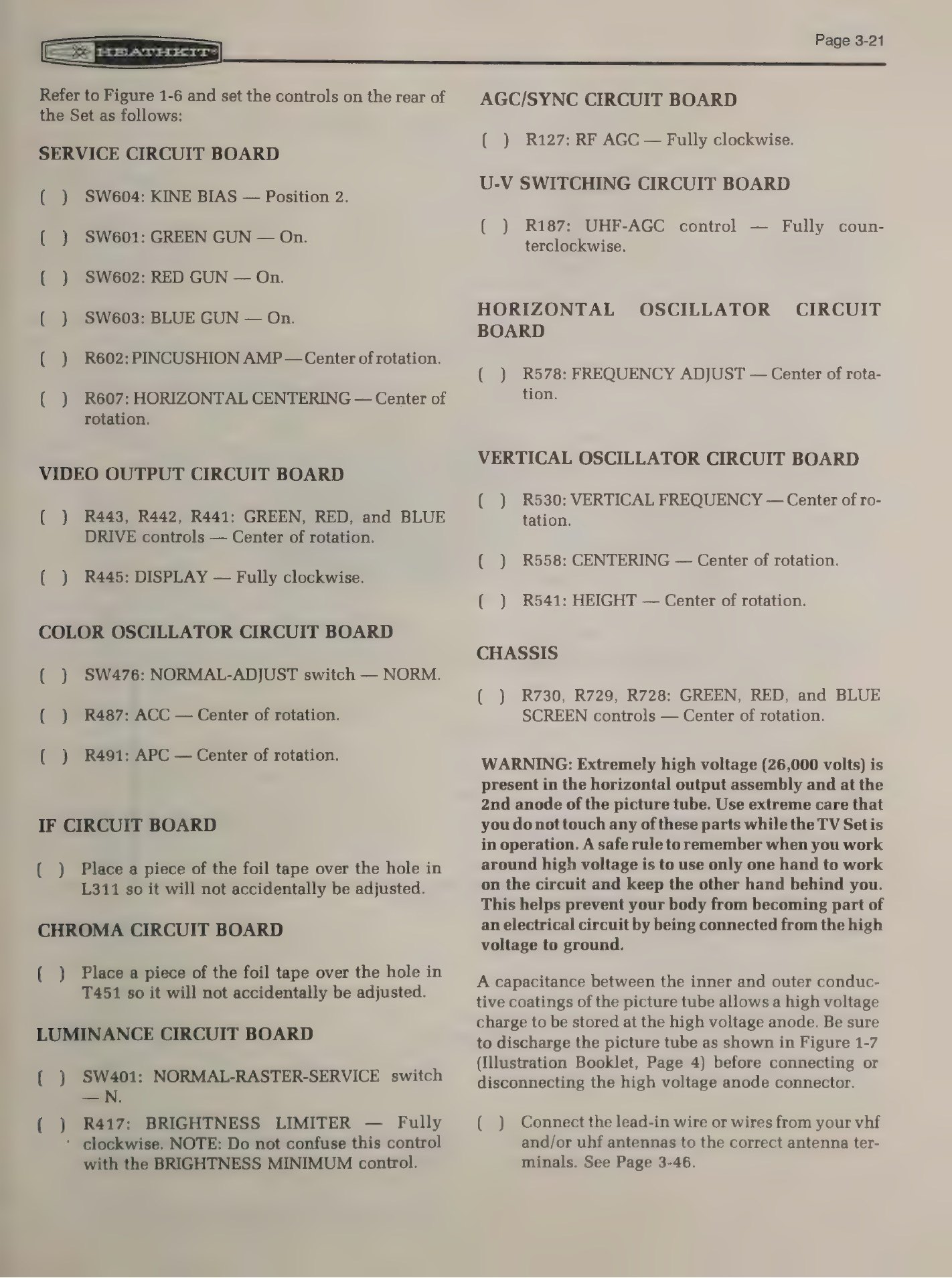
Three further points apply across the line:
- X-radiation. After excessive X-ray emission was found in some factory colour sets in the late 1960s, a federal performance standard, now 21 CFR 1020.10, limited emission from receivers made after 15 January 1970. The GR-2000 family’s high-voltage lockout is one response: it throws the picture out of sync if the high voltage rises too far. Such a circuit must never be defeated, and the high voltage should be measured with a proper probe and set to the manual’s figure.
- Mains. The Heath-designed sets whose specifications were checked for this dive, the GR-22, the GR-53A and the GR-2001, were transformer-operated (“transformer operated” is in the GR-53A’s feature list, and the GR-2001 manual names its power transformer). That makes them safer to work on than the transformerless “hot chassis” sets common in the industry, but voltage is still present at many points around the chassis.
- Implosion. A 25-inch picture tube is a large evacuated glass bulb. It should be handled by the faceplate and mounting ears, never the neck, and worn eye protection is standard practice. The Electronics Illustrated builder of 1964 wore goggles to install his GR-53’s tube.
A set that has been in storage should not simply be plugged in. The usual approach is to inspect it, check for shorts, then bring it up slowly on a variable transformer with a series lamp while watching the low-voltage supplies. The Heath manuals help here. The GR-2001’s adjustment book, for example, begins with resistance checks of every supply before power is applied, set out as flowcharts built around the set’s own meter. Those checks are the first thing to do on a set that has not run for decades.
5.2 The problems each generation brings
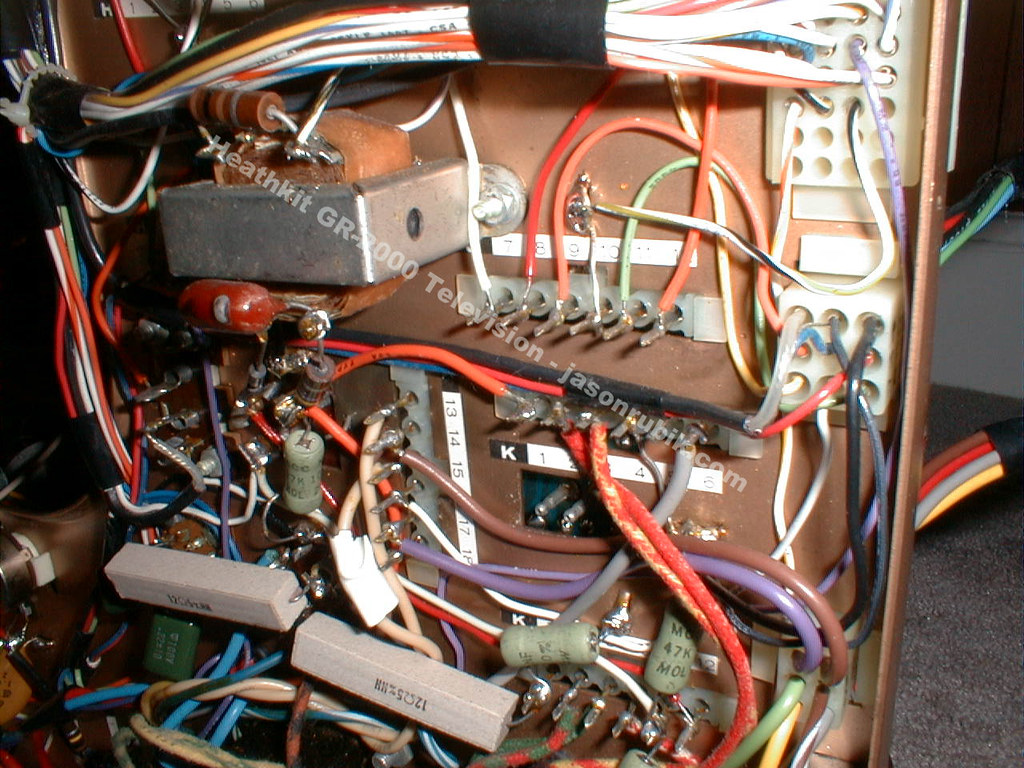
Tube sets, 1963–1972. The GR-53A, GR-295, GR-227, GR-180 and their AFT versions have the problems of any tube colour set of the period, plus one that is peculiar to kits. A restorer on the VideoKarma forum brought a GR-53A back to life in February 2014 and recorded the problems in order. He recapped it, and then found numerous connections the original builder had never soldered, deviations from the published schematic, and an intermittent loss of the luminance signal caused, in his words, by “a wire just stuck in a hole”. The colour oscillator would not lock until three adjustments on the colour board were set, and a horizontal hum bar remained, with the selenium diodes and paper capacitors on the convergence board still to be replaced (VideoKarma, “Heathkit GR-53A color TV”). His experience is a fair guide to the class. The components have aged as in any set, and the workmanship is a second unknown on top of that.
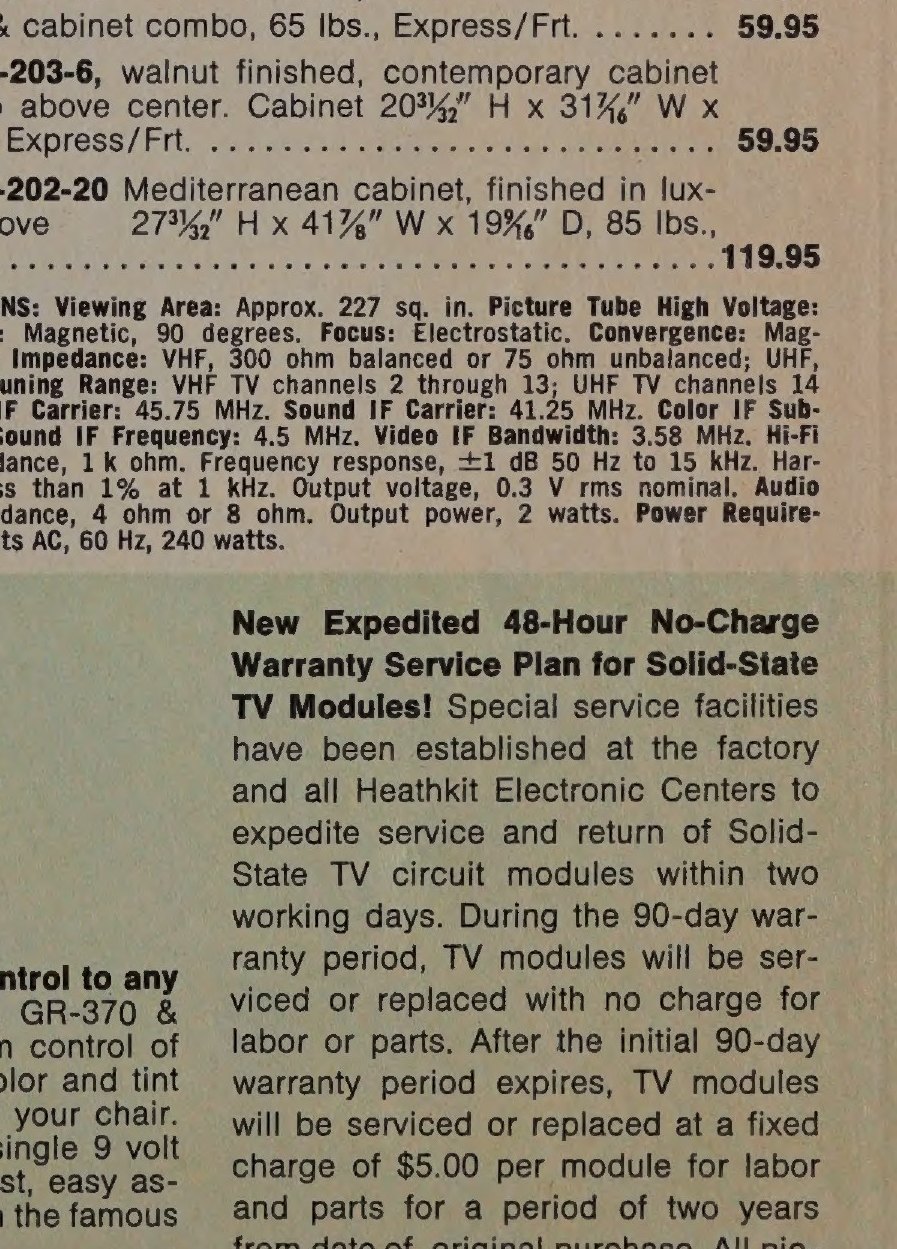
Early solid-state sets, 1971–1981. The modular chassis are easier to work on, because boards unplug and many semiconductors are socketed. Their weak points are the ones the GR-2000 restoration volume lists: crumbling plastic cores in the convergence coils, degaussing thermistors and posistors, charred carbon-composition resistors in the horizontal output stage, and boards refitted in the wrong socket after servicing. Heath’s module exchange, 48 hours and $5.00 a module in 1972, is long gone, so donor boards are the supply.
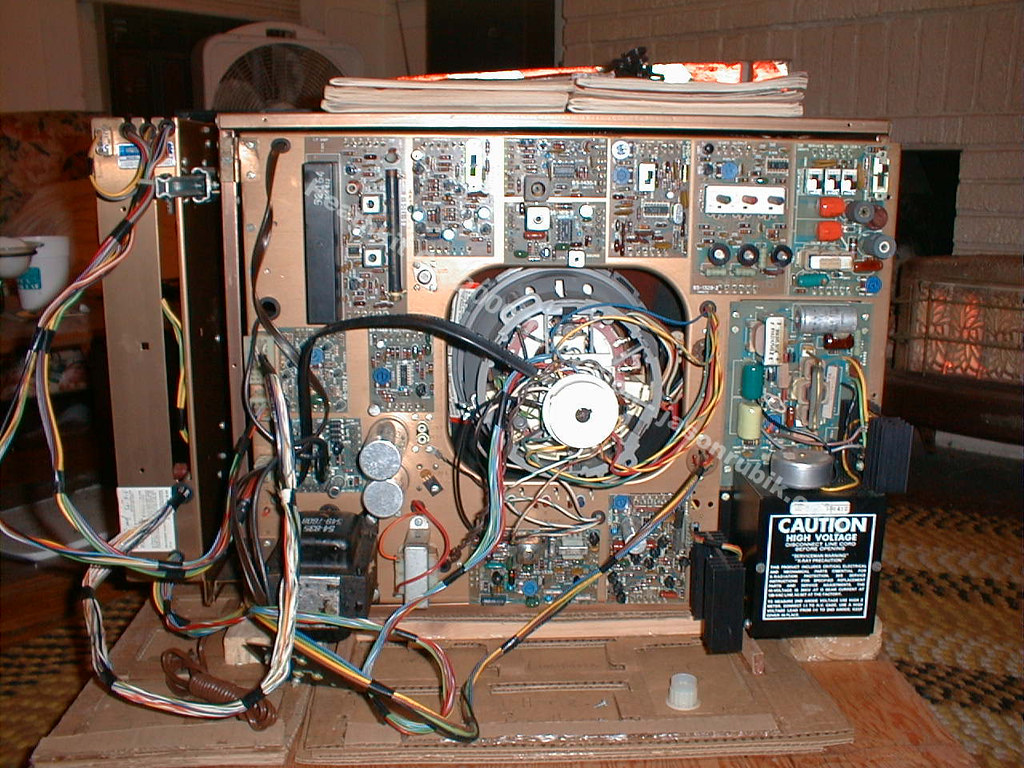
Custom parts. From the GR-2000 onward the sets contain custom integrated circuits for the channel readout, the clock, the programmer and, in the GR-3000, the microprocessor system. No replacements are known. A set whose custom IC has failed may still work as a television but lose the feature that made it interesting.
Zenith-era sets, 1981–1991. The later kits were built on Zenith System 3 and Advanced System 3 chassis, and their manuals refer owners to Zenith dealers for accessories. It is reasonable to expect that Zenith service literature and Zenith donor chassis of the same generation will help with these sets. No source examined for this dive confirms which Zenith model numbers correspond to which Heathkit, so that correspondence needs checking chassis by chassis.
5.3 Picture tubes
The picture tube decides whether a set can be restored. A tube that has lost emission can sometimes be helped by a rejuvenator. A tube with lost vacuum, a cracked neck or a burnt screen ends the set as a television unless a replacement of the same type can be found. The Early Television Museum notes that while hundreds of companies rebuilt picture tubes in the 1950s and 1960s, “today picture tubes outlast the average TV set, and only a few companies still rebuild them” (Early Television Museum, “CRT Rebuilding”).
The problem is worst for the rarest sets. The GR-53A’s 21-inch round tube is a type from colour television’s first decade. A collector on VideoKarma, discussing Heathkit televisions in general, was still looking for a GR-180 “with the correct type CRT”, and another wished he could find a replacement tube for his set (VideoKarma, “Heathkit TVs”). The MTX-5 of the GR-900 and GR-2000 families and the in-line tubes of the later sets are more common. Even so, a 25-inch colour tube is expensive and risky to ship, so a donor set with a good tube is usually worth more than the tube alone.
5.4 Service instruments
The instruments Heath sold to television servicemen are the ones a restorer needs now. The self-servicing sets were designed so that an owner would not need them. A restorer working without the set’s own dot generator or meter, on a set whose built-in aids have failed, or on a tube set with its i.f. strip out of alignment, will.
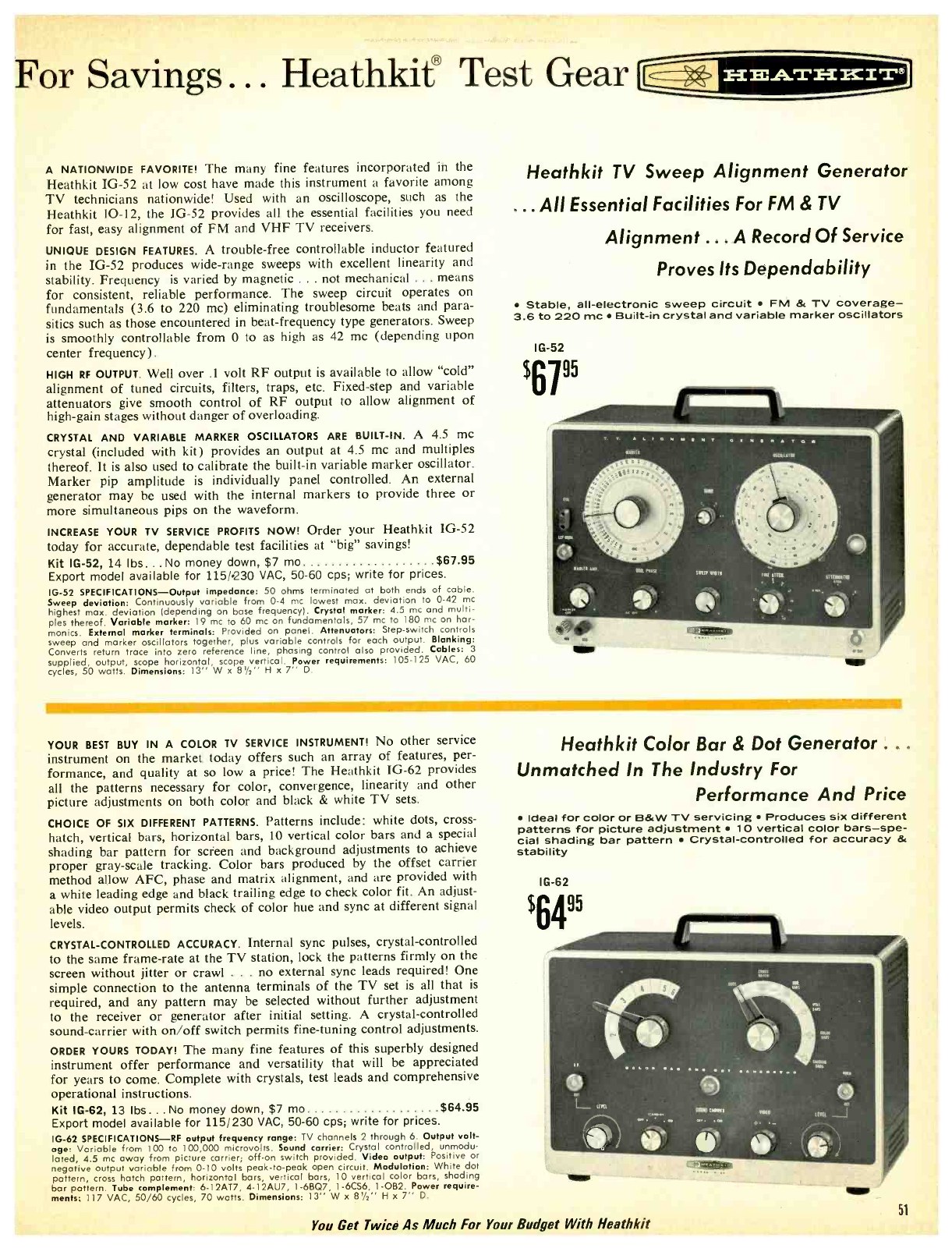
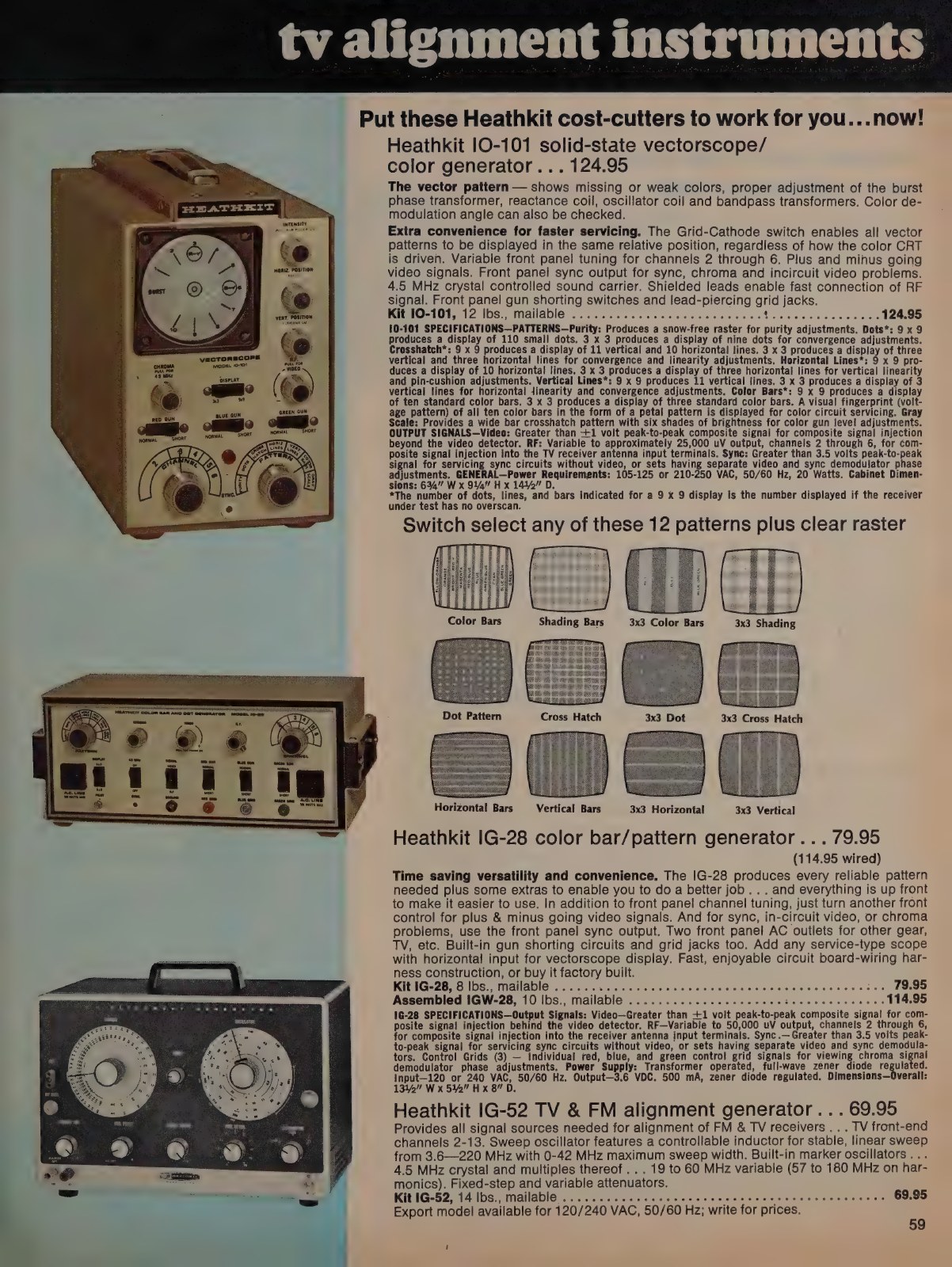
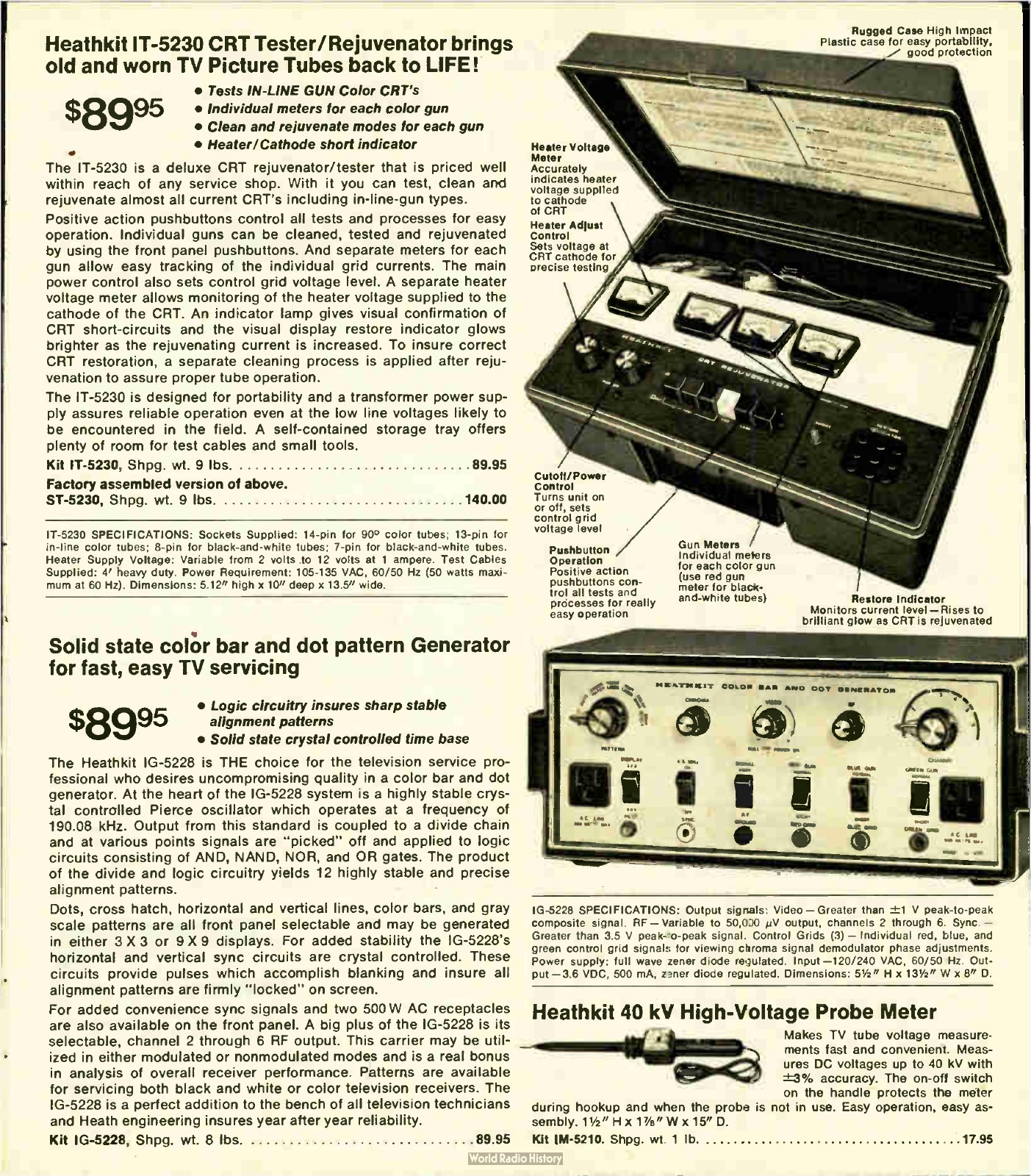
Table 1 — Service instruments
| Instrument | First found | Price | Use on a Heathkit television |
|---|---|---|---|
| TS-4 sweep generator | 1956 | $49.50 | i.f. and tuner alignment, 3.6–220 Mc |
| O-10 “colour TV” oscilloscope | 1956 | $69.50 | general servicing, 5 Mc bandwidth |
| CC-1 CRT checker | 1956 | not noted | picture-tube emission and gun checks |
| IG-52 TV and FM sweep alignment generator | 1966 | $67.95 | i.f. alignment |
| IG-62 colour bar and dot generator | 1966 | $64.95 | convergence, purity, colour alignment |
| IG-28 colour bar and pattern generator | 1972 | $79.95 kit, $114.95 wired | convergence and colour, 12 patterns |
| IO-101 solid-state vectorscope and colour generator | 1972 | $124.95 | chroma demodulator and phase alignment |
| IG-57A post-marker sweep generator | by 1969 | not noted | i.f. response alignment with markers |
| IT-5230 CRT tester and rejuvenator | 1977 | $89.95 | tests in-line-gun tubes, individual gun meters |
| IG-5228 colour bar and dot generator | 1977 | $89.95 | convergence and colour, crystal-controlled |
Sources: Heathkit catalogues 1956, pp. 4, 14, 17; 1966, p. 51; 810/72, p. 67; Fall 1977, p. 57; the IG-57A assembly manual of 1969 at the Internet Archive.
The IT-5230 is a small piece of history in itself. Its 1977 copy advertised that it “tests IN-LINE GUN color CRT’s”, with sockets for 90-degree colour tubes, in-line colour tubes and two kinds of black-and-white tube. The tester changed with the tube, as the Heath sets had changed with the GR-500.
5.5 Feeding a picture to a 1970s set
Every Heathkit television was designed for analogue broadcast signals, and full-power analogue broadcasting ended in the United States on 12 June 2009 (Wikipedia, “Digital television transition in the United States”). A set restored today needs a digital converter box or a modulator feeding its aerial terminals on a VHF channel. Sets with video inputs, beginning with the GR-4000’s input panel and the GR-3000’s audio and video jacks and ending with the GR-2033’s S-video input, can take a composite signal directly. The GR-2000 restoration volume records one trap. The head-switching pulse of some video recorders upsets the automatic frequency control of 1970s sets, producing a jump at the top of the picture that is not the set’s fault.
5.6 Collecting
Rarity. The early round-screen sets are rare. The forum member who restored the GR-53A in 2014 was told by another collector that “roundy” Heathkits were so rare he had only heard of them being offered. The 1960s rectangular tube sets and the GR-2000 family turn up more often, and the GR-104 portable, sold for twelve years, is the easiest to find. Unbuilt kits appear from time to time. A complete unbuilt GR-104C with its picture tube has been listed at auction (WorthPoint), and unbuilt GR-2000 kits are recorded in the GR-2000 dive.
Condition. A factory set’s condition depends on age and use. A kit set’s depends also on who built it. As one VideoKarma member put it, a Heathkit set is “only as good as the builder”. Another, who had built one in the 1980s, remembered them as “really classy”. A third, who finished a half-built set left by its previous owner, recorded fixing “all the cracked boards and build errors” (VideoKarma, “Heathkit TVs”). A prospective buyer should open the chassis and judge the soldering before judging anything else.
Weight. A console set weighs roughly 100 to 250 pounds shipped, so most sets change hands locally. Heath’s own cabinets, sold fully assembled and finished, are often scarcer than the chassis, because many buyers built the set into a wall. A chassis without its cabinet, mask or control panel may have come out of a wall.
Provenance. Heath did not serialise kit-built sets in any meaningful way. Date codes on boards and parts, the stick-on channel numbers of the digital sets, pencilled names inside cabinets, the order paperwork and the manual’s check-marked steps are the evidence of when and by whom a set was built. They should be photographed before restoration begins.
5.7 Where the sets and the knowledge are
- VideoKarma, the vintage television and video forum, where the restoration threads cited in this volume are archived.
- Antique Radio Forums, which has a television section and many Heathkit threads.
- The Early Television Museum in Hilliard, Ohio, which publishes technical and historical notes on picture tubes and colour television.
- Radiomuseum, whose entries for the GR-53A, GR-104 and GR-2000 record data and photographs contributed by collectors.
- Nostalgic Kits Central, which keeps a Heathkit model matrix including the television and accessory numbers. Its years are incomplete and some are wrong: it dates the GR-9009 to 1969–76, for example, where the catalogues show 1987–91.
- World Radio History, which holds the catalogue scans on which this dive rests.
In St. Joseph, a Heathkit television was part of the display when the Heritage Museum and Cultural Center held its Heath history evening in August 2015 (Heath Company dive, volume 7).
5.8 Manuals
The manuals are the most valuable document a restorer can have, and their availability varies by era. Free scans exist for the GR-295 (1966), the GR-2001 adjustment book, the GR-2000 clock and several Zenith-era sets. None has been found for the GR-53 or GR-53A. Paper reprints of many Heath manuals are sold commercially by Data Professionals, a Heath business. The editions traced, with their part numbers, dates and the copyright evidence gathered for the project’s hosting rule, are listed in the reference volume.
Sources
- Heathkit GR-2001 Color Television, Book Three, 595-1865-06 (1976), Internet Archive.
- 21 CFR 1020.10, Television receivers.
- “Heathkit GR-53A color TV”, VideoKarma (restoration thread, February 2014).
- “Heathkit TVs”, VideoKarma.
- Early Television Museum, “CRT Rebuilding”.
- Wikipedia, “Digital television transition in the United States”.
- Heathkit catalogues 1956, 1966, 810/72 and Fall 1977.
- Heathkit IG-57A assembly manual (1969), Internet Archive.
- GR-2000 dive, volume 5.
- Nostalgic Kits Central, Heathkit TV matrix.
Comments (0)