SB-301 / SB-401 Station · Volume 1
Overview
The Heathkit SB-301 receiver and SB-401 transmitter were sold as separate kits, but they were designed to work as one station. With three short coaxial cables between their rear panels, the pair behaves like a transceiver. The transmitter then takes its frequency from the receiver’s tuning dial and borrows the receiver’s crystal oscillators. The SB-401 can run on the SB-301’s crystals because in this mode it has no crystals of its own apart from a single CW carrier crystal. That is why it cost forty dollars less than the SB-400 it replaced. Turn one switch on the transmitter’s front panel and the two units work independently again, each with its own tuning, which was a real advantage for DX operators working stations that listened on one frequency and transmitted on another.
In 1966 the pair cost $545 as kits. Heath’s catalogue copy set that against the Collins S-Line, which the SB series was styled after, and it earned the SB-300/SB-400 generation the nickname “the poor man’s Collins” (Eckweiler, Heathkit of the Month #30). The receiver was sold until the end of 1970, when the solid-state SB-303 replaced it. The transmitter lasted until 1975 and worked with either receiver.
1.1 What the two units are
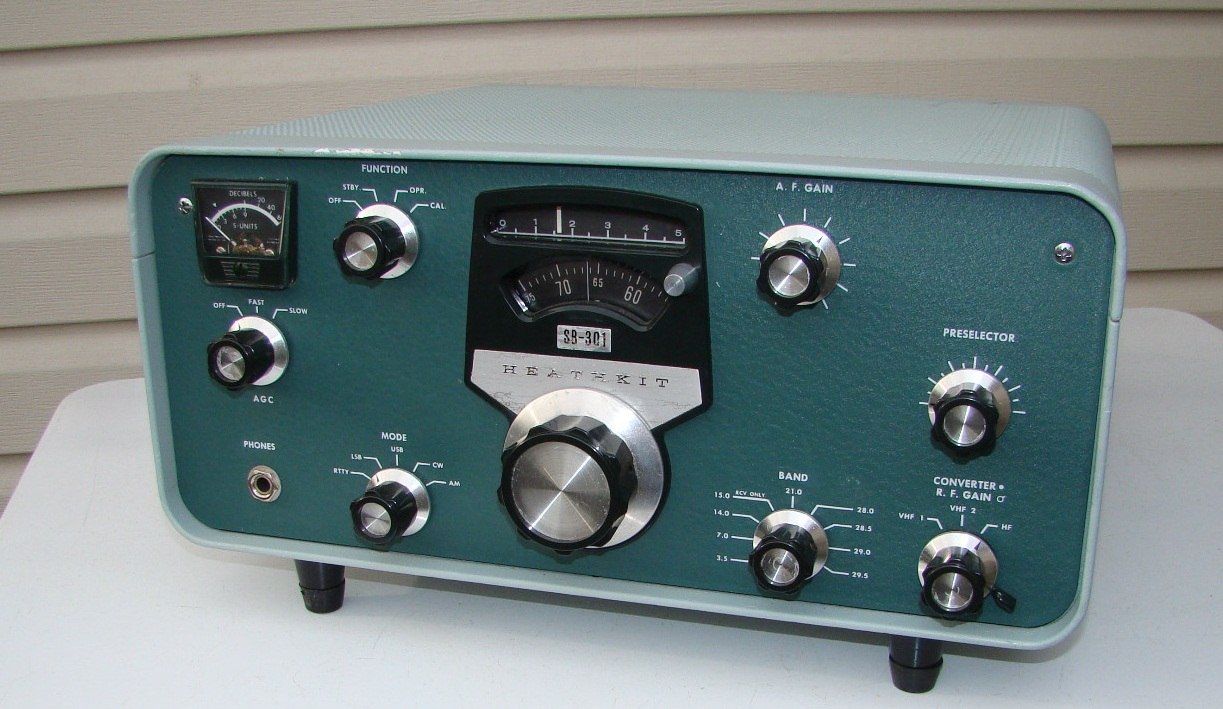
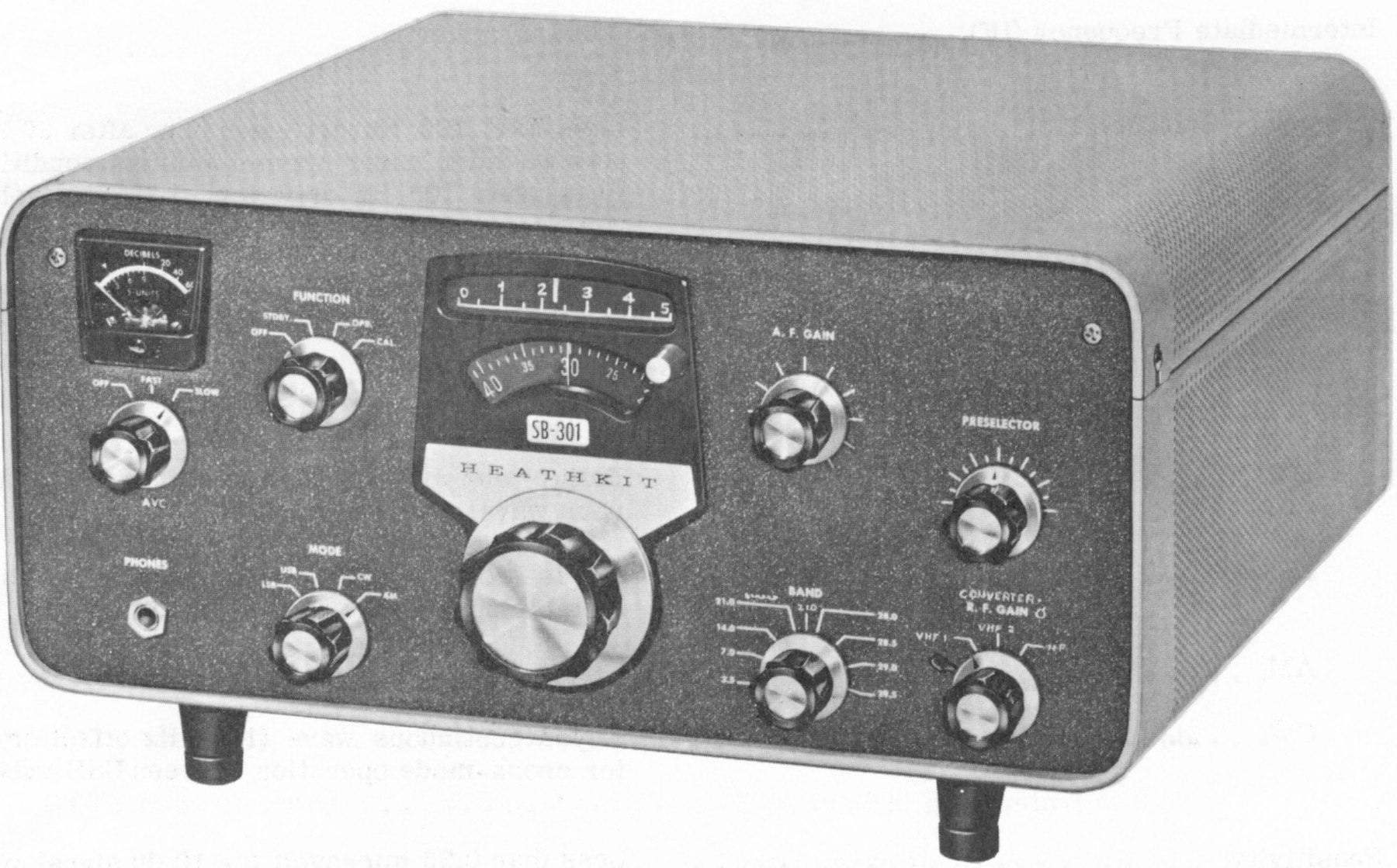
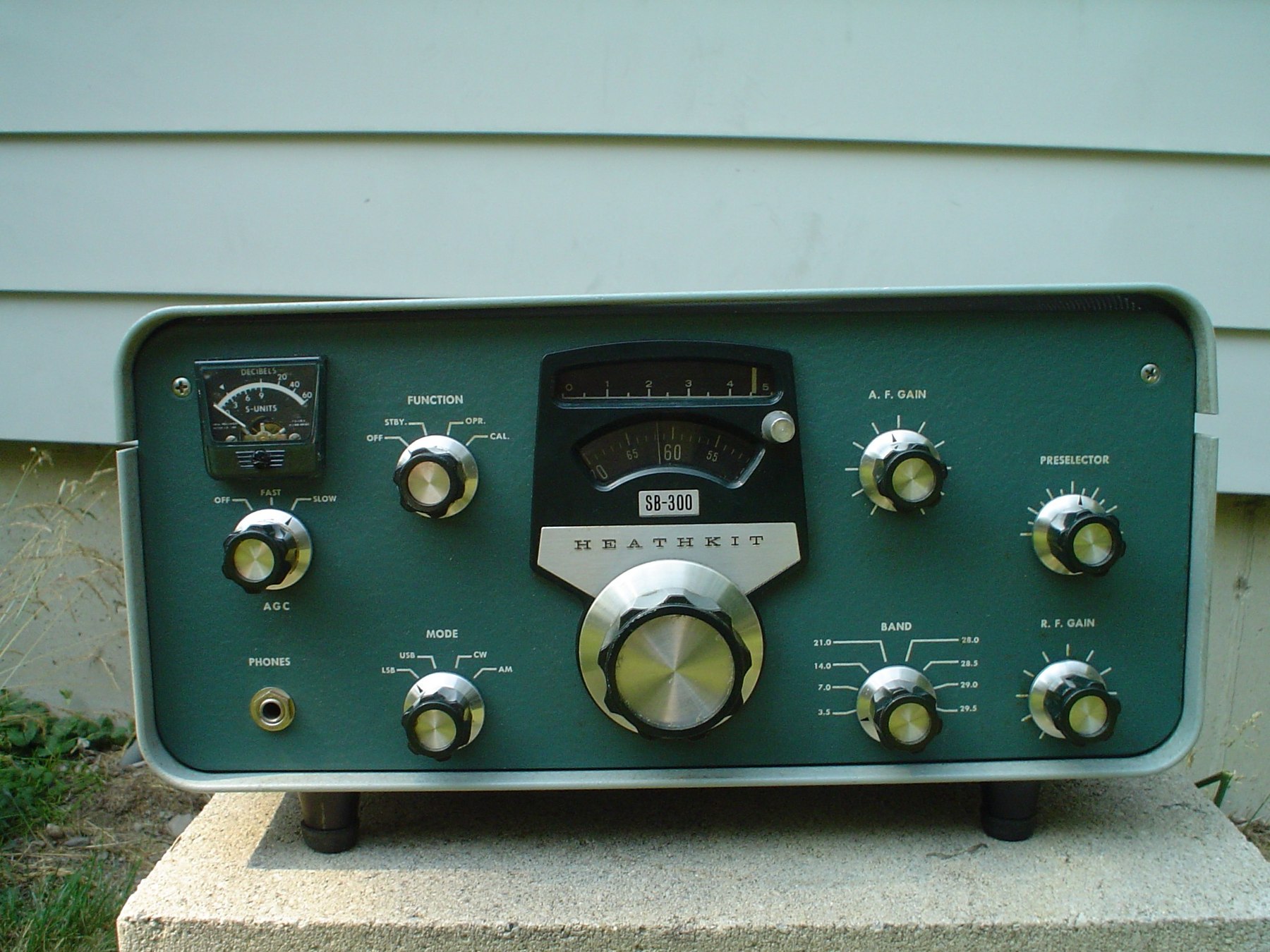
The SB-301 is a ham-bands-only, double-conversion superheterodyne receiver. It covers 80, 40, 20 and 15 metres and all of 10 metres in 500 kHz segments, and it has an extra receive-only segment at 15.0–15.5 MHz for the WWV time signals. It receives SSB, CW, AM and RTTY. The first conversion is crystal-controlled and the tunable IF runs from 8.395 to 8.895 MHz. The second conversion uses a sealed, factory-aligned linear master oscillator (LMO) tuning from 5.5 down to 5.0 MHz, and it feeds a 2.1 kHz crystal-lattice filter at 3.395 MHz. It has ten tubes and a built-in, transformer-operated supply.
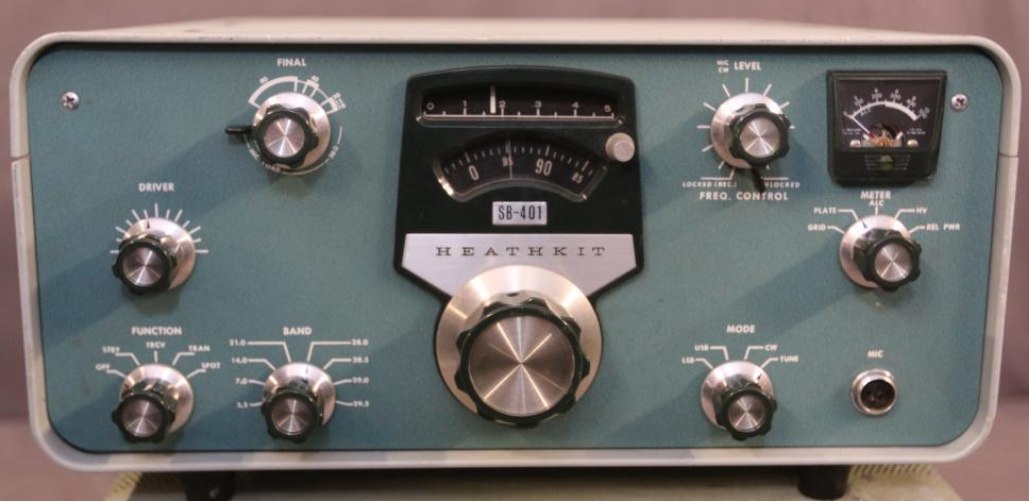
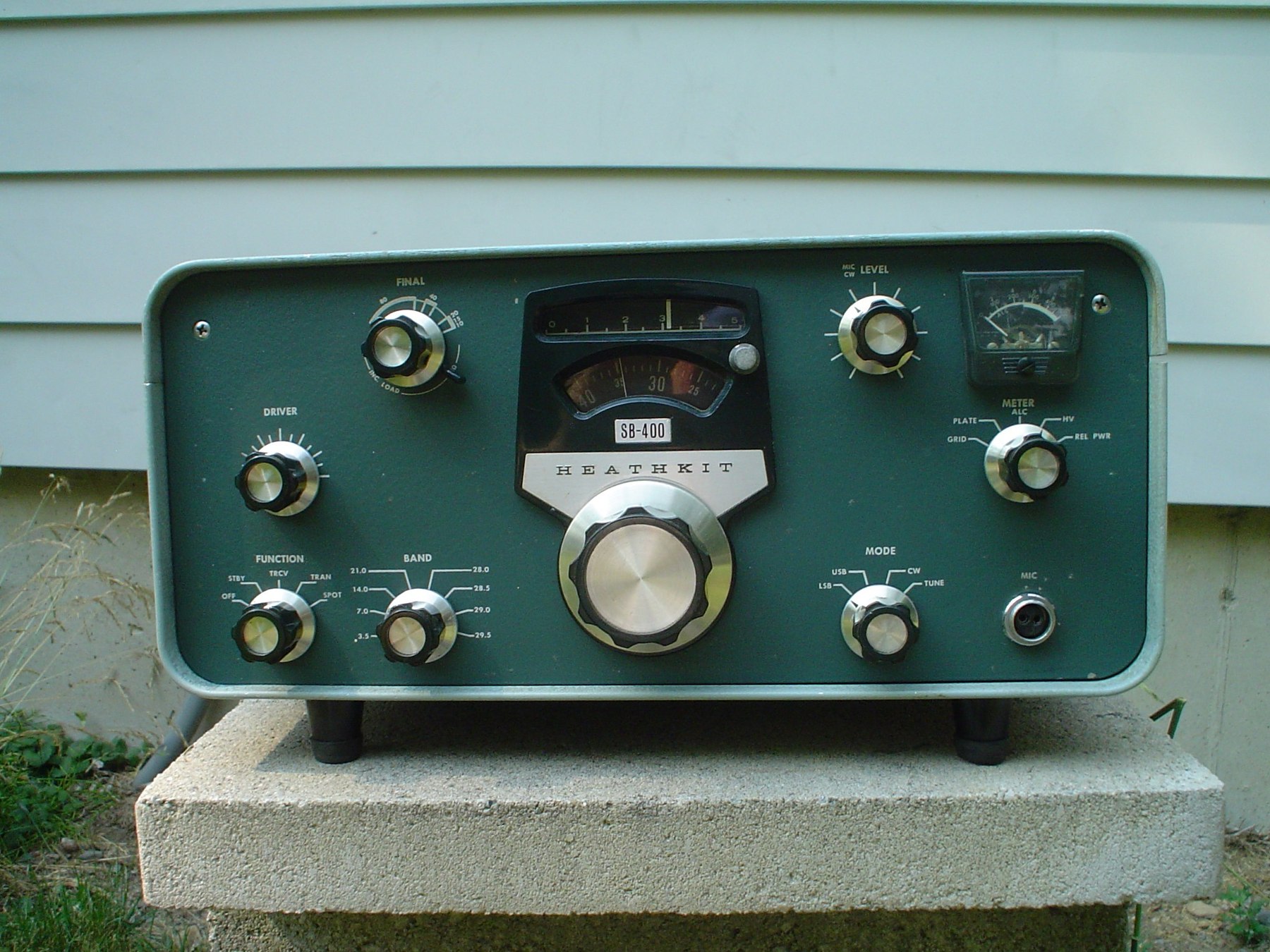
The SB-401 is the same signal chain run backwards. It is a filter-type SSB and CW exciter-transmitter with two 6146 beam tetrodes in the final, and it is rated at 180 W PEP input on SSB and 170 W on CW. Output is 100 W from 80 through 15 metres and 80 W on 10 metres. The high-voltage supply is built in, which set the Heath pair apart from the Collins 32S-series transmitters with their separate supplies (Eckweiler, HOTM #30). It has thirteen tubes and needs a separate receiver: an SB-300, SB-301 or SB-303 for transceive, or any receiver if the optional crystal pack is fitted.
Heath’s story in these years, from Benton Harbor and the Daystrom period to the arrival of the SB line, is told in the site history dive and is not retold here.
1.2 The headline figures
Table 1 — The headline figures
| SB-301 receiver | SB-401 transmitter | |
|---|---|---|
| Coverage (MHz) | 3.5–4.0, 7.0–7.5, 14.0–14.5, 15.0–15.5 (WWV), 21.0–21.5, 28.0–30.0 in four segments | 3.5–4.0, 7.0–7.5, 14.0–14.5, 21.0–21.5, 28.0–30.0 in four segments |
| Modes | LSB, USB, CW, AM, RTTY | LSB, USB, CW (no AM) |
| Frequency control | Crystal heterodyne oscillator plus 5.0–5.5 MHz LMO | Its own LMO, or the receiver’s (switch-selected) |
| Stability | Under 100 Hz per hour after 20 minutes | Same |
| Dial | 1 kHz divisions, 100 kHz per turn; within 200 Hz visually and 400 Hz electrically after calibration | Same |
| Sensitivity / power | Under 0.25 µV for 10 dB S+N/N on SSB (1968 sheet; 0.3 µV in the 1967 catalogue) | 180 W PEP input SSB, 170 W CW; 100 W out (80 on 10 m) |
| Selectivity / suppression | 2.1 kHz at 6 dB, 5.0 kHz at 60 dB; AM 3.75 kHz and CW 400 Hz filters optional | Carrier and unwanted sideband 55 dB down; third-order products 30 dB down |
| Tubes | 10 | 13, including two 6146 and an OA2 |
| Size, weight | 14⅞ × 6⅝ × 13⅜ in; 17 lb | 14⅞ × 6⅝ × 13⅜ in; 26½ lb |
| Kit price, 1967 | $260.00 | $285.00 |
The figures come from the SB-301 specification sheet and the SB-401 manual’s specifications page. Both are reproduced and discussed in the Reference volume.
1.3 Where the pair came from
Heath’s first single-sideband station had been built from parts that were never meant to be one: the RX-1 Mohawk receiver, the Apache TX-1 transmitter, which was an AM and CW set, and the SB-10 phasing adapter, which added SSB to the Apache (Eckweiler, HOTM #30). The SB series was a clean start. It was built from the beginning around filter-type sideband generation and around one stable tuning element shared by everything. The site history dive explains why the SB pair is not a successor to the DX-100, despite what some video retellings say. The DX-100’s successor as Heath’s top transmitter was the Apache.
The SB-300 receiver and SB-400 transmitter came first. Sources disagree about exactly when. Eckweiler’s overview puts them in late 1963 and early 1964, while his SB-301 article says the SB-300 arrived in mid-1964. A contemporary Heath-list reply gives May 1964 for the SB-400 (Kechkaylo, heath mailing list, 25 March 2002). The Fall-Winter 1963 catalogue 81-30 does not list either unit, which was checked for this dive. By the time of the March 1965 catalogue both were established: the SB-300 at $265 and the SB-400 at $325. CQ reviewed the SB-400 in December 1964, and 73 Magazine ran an article on the SB-300 in August 1964 (Leedham, WA2TDH, via Nostalgic Kits Central). A mid-1964 introduction fits all of that.
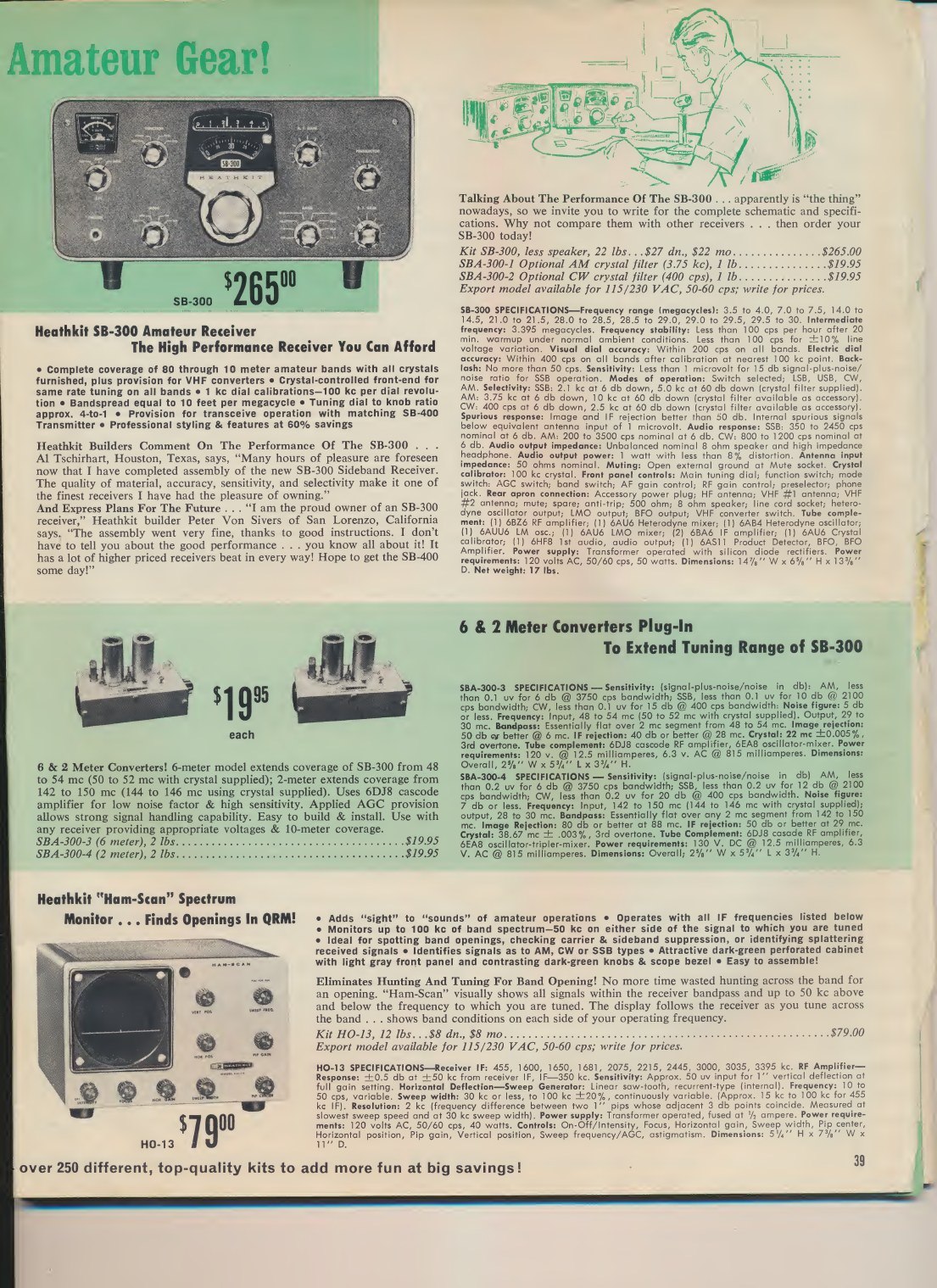
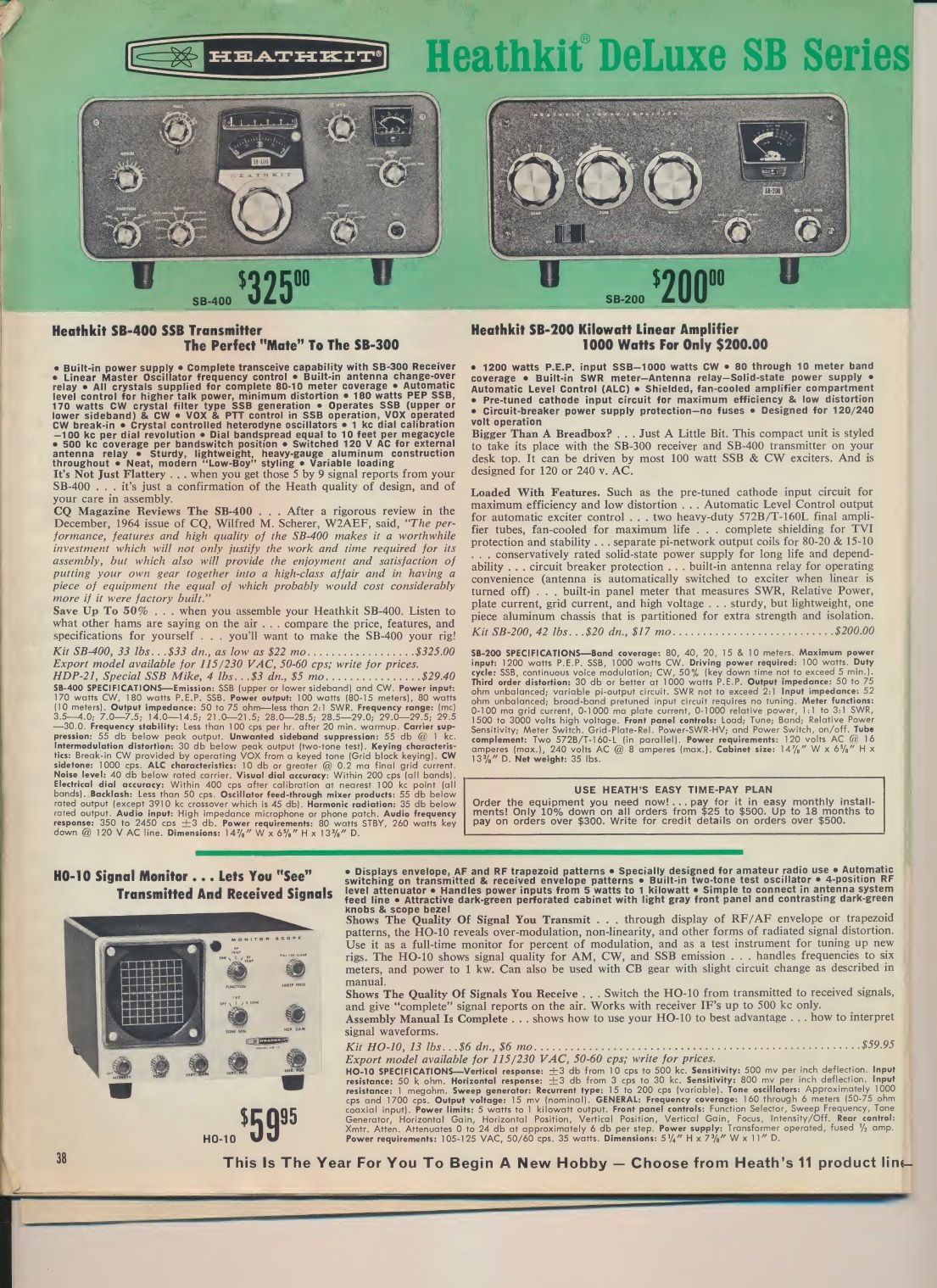
The resemblance to Collins is deliberate and has been widely noted. The styling is close, the dial works the same way (a round kilohertz scale under a slide-rule hundreds scale), and the transmitter’s mixing scheme mirrors the receiver’s as it does in the S-Line. The IF frequencies differ, and so do the filters: Heath used crystal-lattice filters where Collins used mechanical ones (W2PA, “Collins S/Line Influence on Heathkit’s SB-Series”). Chas Gilmore’s account adds that several engineers on Heath’s SB radios came from Collins after layoffs there (EEJournal, part 2). That is a recollection, not a documented staff list.
1.4 The SB-301 and SB-401 arrive
The SB-300 and SB-400 still appear in the July 1966 mail-order catalogue, 800/64. The replacements first appear in the 1967 annual catalogue, 810/67A, which carries a 1966 copyright and was printed that autumn. Both are marked “New!”. The SB-301 was priced at $260 ready to ship. The SB-401 was $285, with an “Expected Shipping Date Late September” (catalogue 810/67A, pp. 82–83). The SB-301 manual’s cover also carries a 1966 copyright, and a Radio-Electronics advertisement of December 1966 lists the receiver at $260 (Heathkit Interests blog). The earliest SB-401 manual Eckweiler found dates its block diagram 24 March 1967 (HOTM #43). Taken together, the evidence points to an announcement in late 1966 and deliveries in late 1966 and early 1967, with the transmitter slightly behind the receiver.
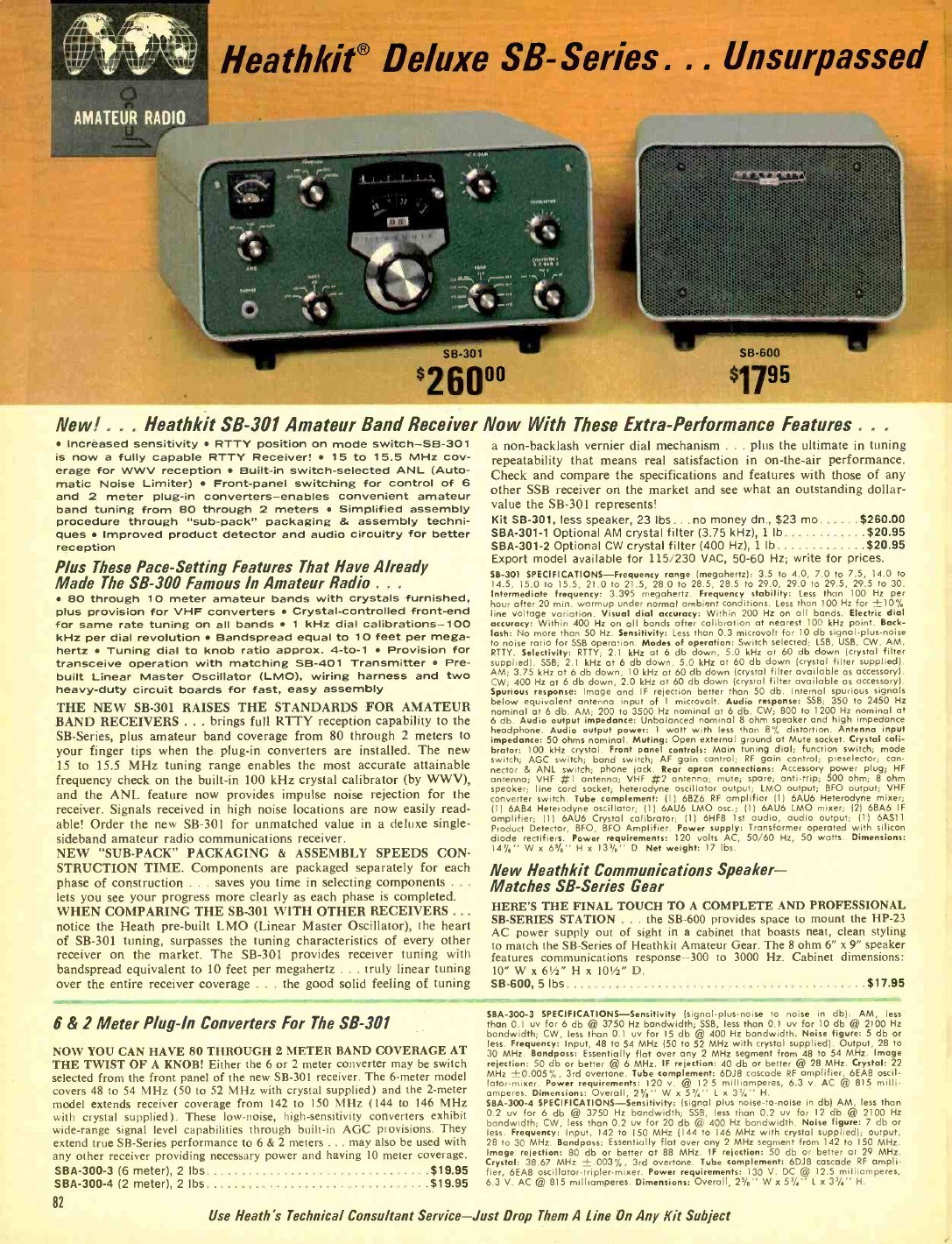
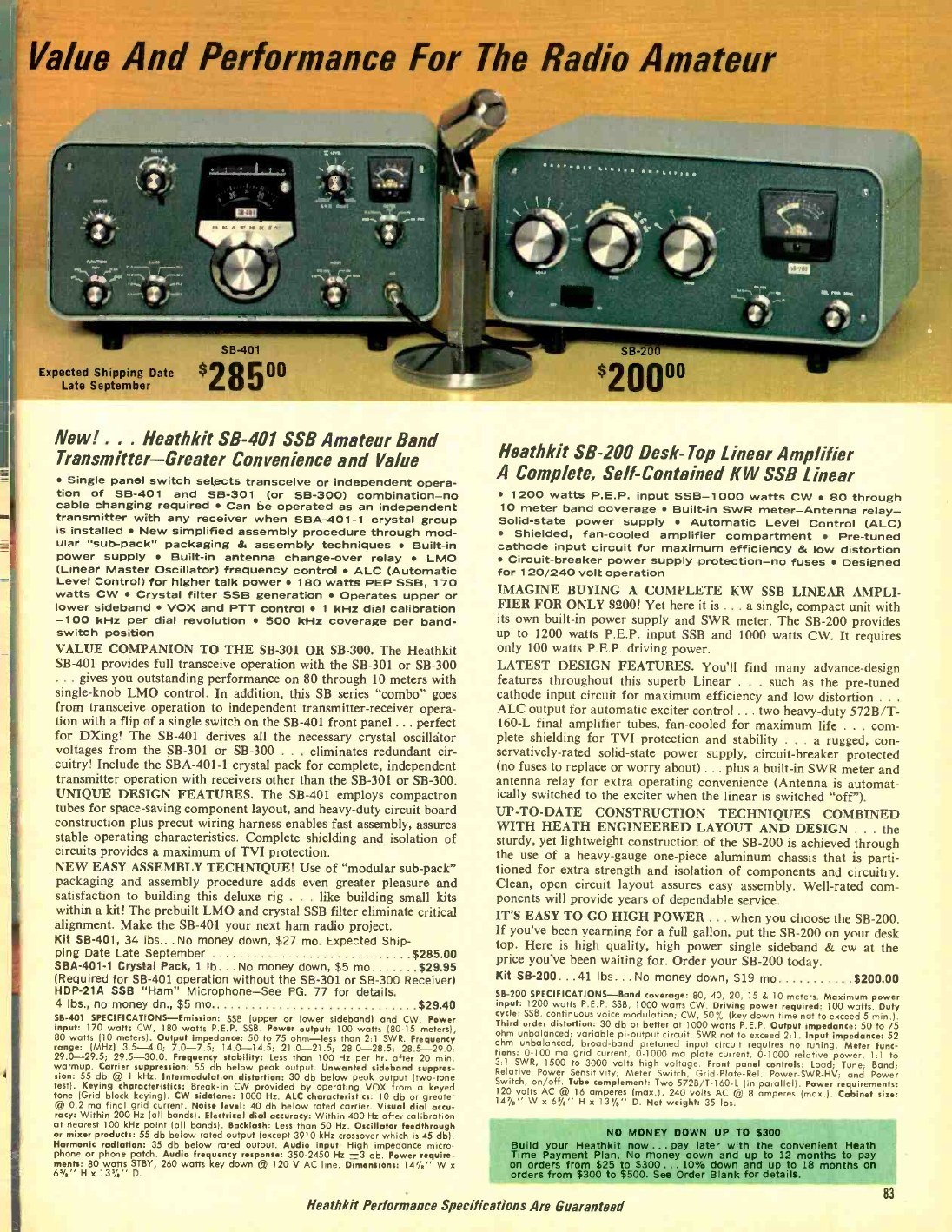
The changes from the SB-300 to the SB-301 are all receiver refinements.
- Sensitivity. Heath’s figure went from 1 µV for 15 dB to 0.3 µV for 10 dB in the catalogue, and to 0.25 µV on the 1968 specification sheet.
- RTTY mode. A third BFO crystal, at 3392.110 kHz, places 2125 and 2975 Hz teletype tones in the middle of the SSB filter.
- WWV position. A ninth band-switch position at 15 MHz, so the 100 kHz calibrator can be checked against WWV.
- Noise limiter. A full-wave, self-biased diode limiter, switched by pulling the AF GAIN knob.
- Front-panel converter switch. It is concentric with the RF GAIN control. On the SB-300 the switch was on top of the chassis.
- Smaller crystal filters. The new filters have tighter skirts: the CW filter was now 2.0 kHz wide at 60 dB, down from 2.5 kHz.
- Assembly. The kit came in “sub-packs”, one for each assembly phase.
- LMO tube. The LMO now used a 6BZ6 in place of the 6AU6.
Mort Waters, W2JDL, reviewing the new receiver for 73 Magazine, set most of these side by side with the SB-300. He found the LMO’s drift “completely unnoticeable from a cold start” (73, June 1967, pp. 76–78).
The SB-401’s changes are partly engineering and partly marketing.
- The LOCKED/UNLOCKED switch. The front-panel FREQ CONTROL switch replaced the SB-400’s internal coaxial jumper. W2JDL noted that so many SB-400 owners had home-brewed the conversion that articles on it had already appeared in the magazines (73, July 1967).
- An extra driver coil for the top of 10 metres. It is peaked at 29 MHz. The SB-400’s single 28 MHz coil had left drive short in the upper part of the band.
- A reworked LMO mixer stage with a 21 MHz trap.
- A 680 Ω resistor in the finals’ screen supply. Heath said it cut distortion products by another 3 to 4 dB.
- A sidetone level control under the lid.
- Crystals optional. The kit shipped with only the CW carrier crystal. Every other crystal went into the separate SBA-401-1 pack, because Heath had noticed that most SB-400s were being used with SB-300s, which already contained those oscillators (Eckweiler, HOTM #43).
How It Works covers the circuit, and Transceive covers exactly what the transmitter borrows and how.
1.5 Who it was for
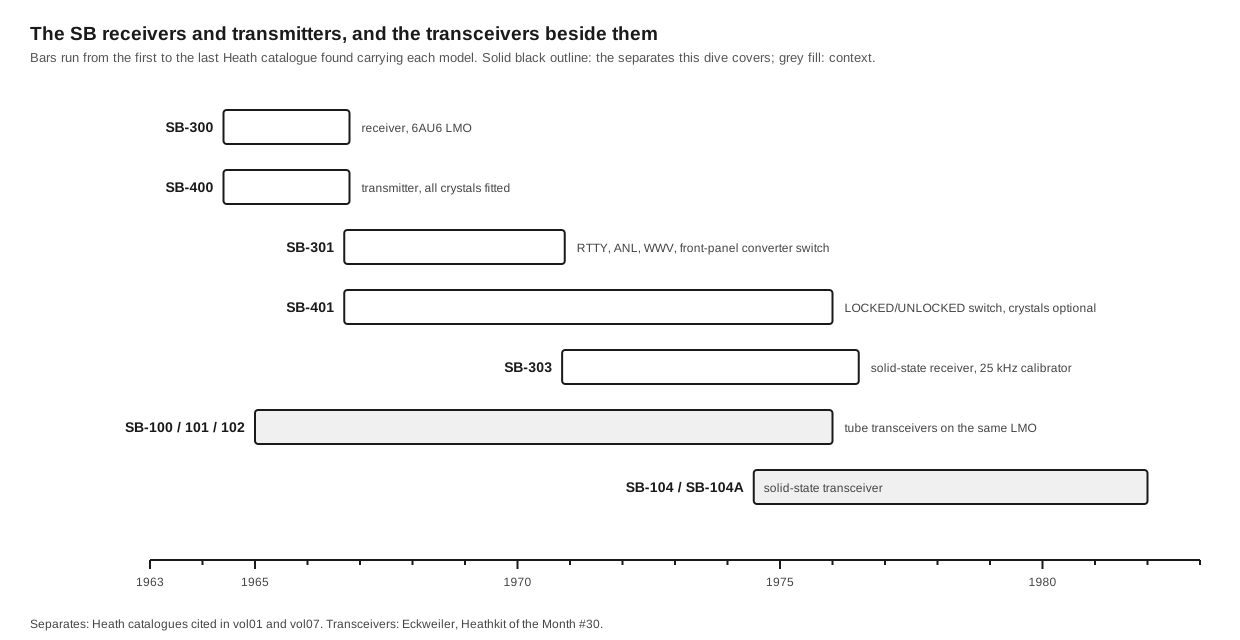
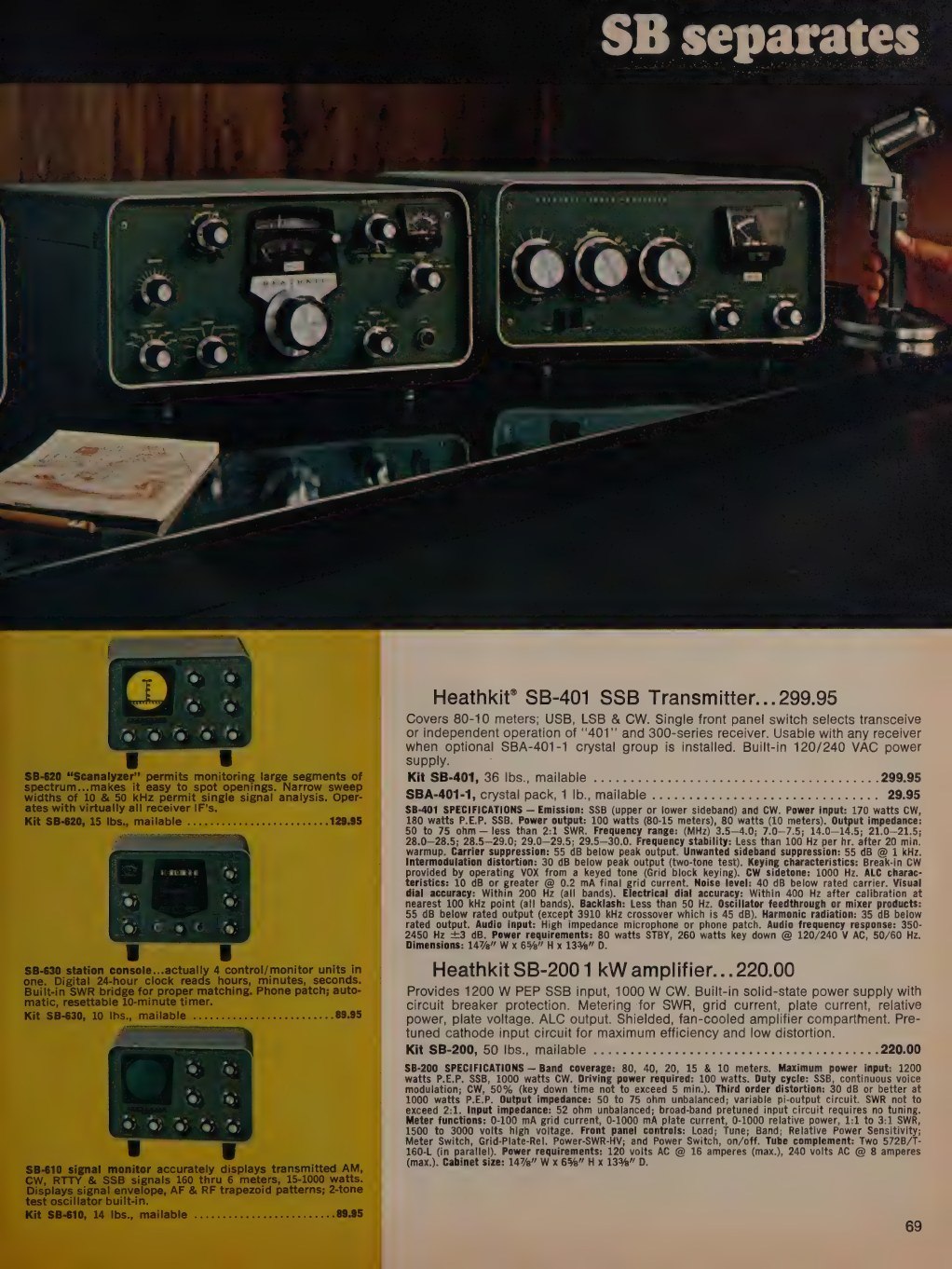
The copy was aimed at the serious home-station operator. It sold the pair as a full-featured station: “Single panel switch selects transceive or independent operation … perfect for DXing!”. It also sold them on value, claiming “Professional styling & features at 60% savings” as early as the SB-300 page of 1965. The station was modular, and Heath sold every part of it: the SB-600 speaker, the SB-200 kilowatt linear styled to match, the HO-10 and later SB-610 monitor scope, the SB-620 panadapter, the SB-630 station console, and the 6- and 2-metre plug-in converters. The receiver’s octal accessory socket powered the converters, and its front-panel switch selected them. That turned the SB-301 into an 80-through-2-metre receiver without a second set of knobs.
The separates cost more than the SB-100 series transceivers, and the extra money bought flexibility. A transceiver ties receive and transmit to one oscillator. The separates can listen and transmit on different frequencies in the same band, which the transceivers could only do with an extra remote VFO, the SB-640. They can also be upgraded one box at a time. Eckweiler bought his receiver in September 1968 and ran it with an old Apache until he could afford the SB-401 that December. The SB-300 series had been designed for exactly that kind of staged purchase (HOTM #36; HOTM #43).
1.6 Prices and the catalogue years
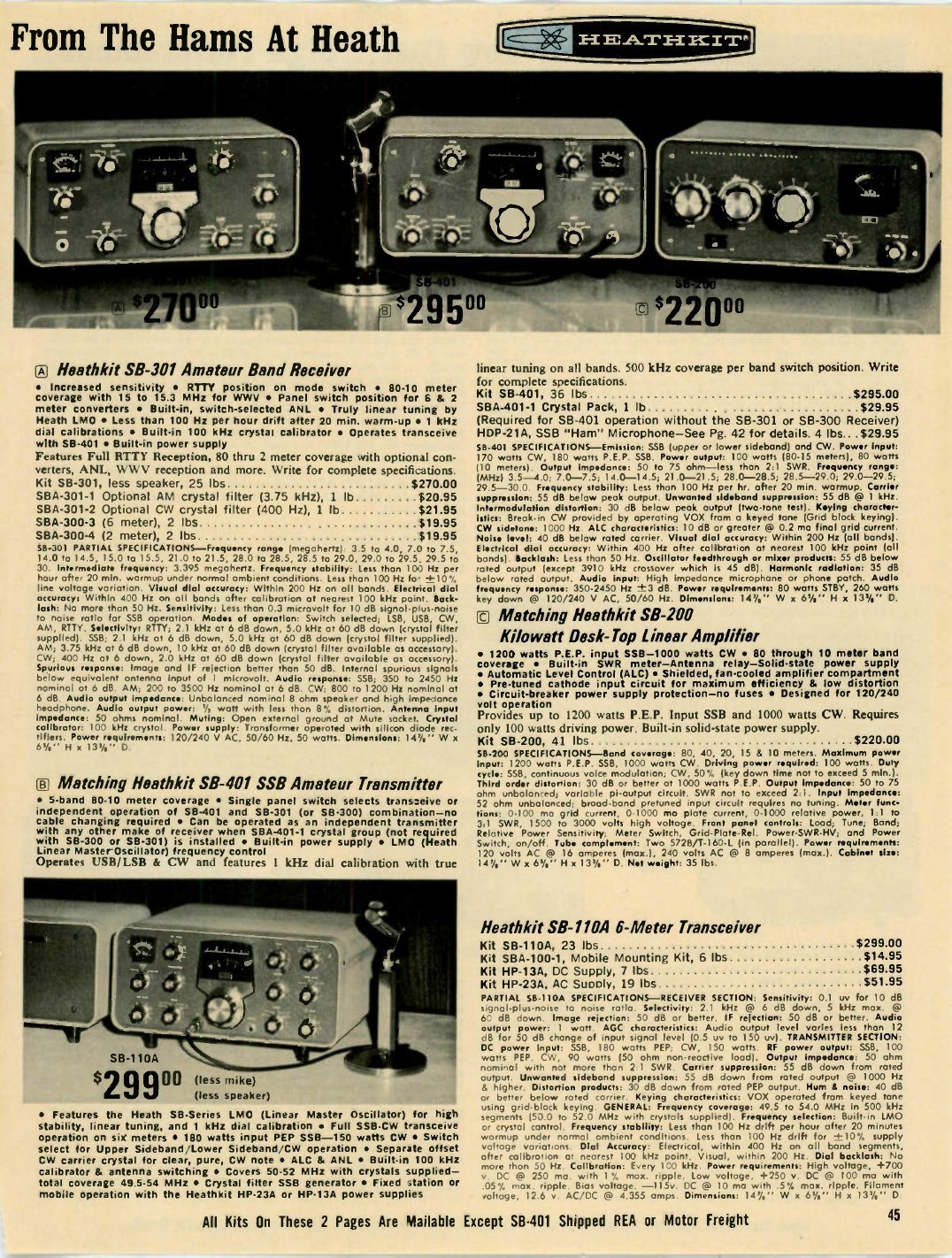
Table 2 — Prices and the catalogue years
| Catalogue | SB-300 | SB-400 | SB-301 | SB-401 | SB-303 |
|---|---|---|---|---|---|
| 800/53, March 1965 | $265.00 | $325.00 | — | — | — |
| 1966 annual | $250.00 | $325.00 | — | — | — |
| 800/64, July 1966 | listed | listed | — | — | — |
| 810/67A, 1967 annual (© 1966) | — | — | $260.00 (new) | $285.00 (new) | — |
| June 1967 | — | — | $260.00 | $285.00 | — |
| 1968 and 1969 annuals | — | — | $260.00 | $285.00 | — |
| Winter 1970 | — | — | $270.00 | $295.00 | — |
| 1971 annual | — | — | — | $295.00 | $319.95 (new, “Available November”) |
| 810/72 | — | — | — | $299.95 | $319.95 |
| Christmas 1975 | — | — | — | $389.95 | $389.95 |
| Spring 1976 | — | — | — | not listed | $389.95 |
| Christmas 1976 | — | — | — | — | not listed |
The optional crystal filters followed the same pattern: $19.95 each for the SB-300’s, $20.95 for the SB-301’s in 1967, and by 1975 $24.95 for the AM filter and $29.95 for the CW filter. The SBA-401-1 crystal pack cost $29.95 from the first listing to the last.
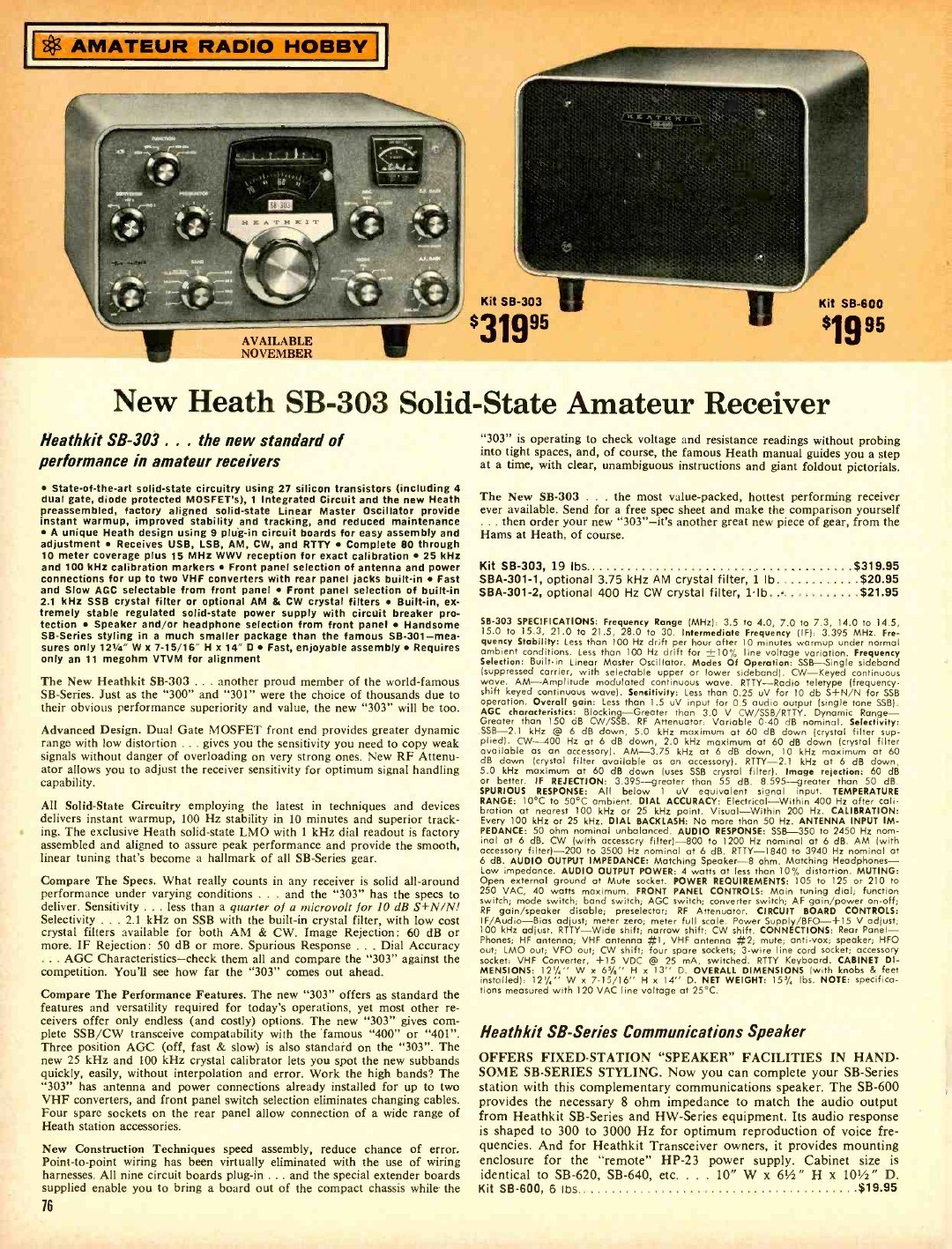
The receiver’s end is clearly dated. The SB-303 was advertised in the 1971 annual catalogue, printed in autumn 1970, as “Available November”. Heath’s first SB-303 service bulletins are dated 25 November 1970 (Lutz, SB-3XX service bulletin index). This matches Eckweiler’s statement that the SB-301 was replaced in late 1970. The transmitter’s end is less precise. The SB-401 is in the Christmas 1975 catalogue at $389.95 and is gone from Spring 1976, which fits Eckweiler’s “into 1976”. The SB-303 lasted one catalogue longer and was absent by Christmas 1976. By then Heath’s HF line was the solid-state SB-104 transceiver. The stand-alone receiver and transmitter as a product category ended there, and no production figures for either model have been found.
1.7 The SB-303
The SB-303 is covered in this dive because the SB-401 was built to work with it. It is not a tube receiver with transistors added. It is a new design with the same architecture: crystal first conversion, 8.395–8.895 MHz tunable IF, a now solid-state LMO, and the 3.395 MHz crystal filters that are interchangeable with the SB-301’s. It also has the same transceive jacks. Its assembly manual (595-1124, © 1970) describes 28 silicon transistors, four of them MOSFETs, and an integrated-circuit calibrator on plug-in “Switch-Boards”. The receiver needs one small change to the SB-401 before the two will transceive. That change, and the reasons for it, are covered in Transceive. There was also a shortwave-listener sibling, the SB-310 (and later the SB-313). It had the SB-301’s cabinet and circuit layout but covered the broadcast bands, and it came with a wider 5 kHz AM filter (Eckweiler, HOTM #30).
1.8 Variants and revisions
Table 3 — Variants and revisions
| Model | Years (catalogue) | What changed |
|---|---|---|
| SB-300 receiver | 1964–1966 | First SB receiver; 6AU6 LMO (110-13); large 404-200 filters on #6-32 studs; no RTTY, WWV or noise limiter |
| SB-400 transmitter | 1964–1966 | All crystals supplied; transceive or separate chosen by an internal coax jumper; 6AU6 LMO |
| SB-301 receiver | late 1966–1970 | Changes listed above; LMO 110-32 with 6BZ6, then 110-40 from November 1967 (service bulletin SB-301-1D) |
| SB-401 transmitter | late 1966–1975 | Front-panel FREQ CONTROL switch; crystals in the optional SBA-401-1 pack; 404-283 filter; LMO 110-32 then 110-40; later kits with a dual-primary 120/240 V transformer (54-198 replacing 54-143, believed autumn 1968) |
| SB-303 receiver | November 1970–1976 | Solid-state; same IF and transceive jacks; needs a small modification to the SB-401 |
| SB-310 / SB-313 | SB-310 by 1968; SB-313 later | Shortwave-listener versions of the SB-301 and SB-303 |
Eckweiler records one visible sign of an early SB-401: on the earliest units the FREQ CONTROL switch was labelled “LMO MODE” (HOTM #43). The two LMO part numbers matter to anyone restoring a set, and they are covered in the Restoration volume.
1.9 Related dives
The same LMO, dial and mixing scheme are packed into one box in the SB-100 family of transceivers, documented in the SB-102 dive. The HW-101, the budget transceiver derived from those, is covered in the HW-101 dive. The solid-state SB-104A that ended the tube SB line has its own dive.
Sources
- Heath Company. Assembly Manual, SSB Receiver Model SB-301, 595-946-01 (copyright 1966; printing of 11-29-68), with specification sheet dated 3/22/68 and change letter of 6 January 1969. W5RKL scan
- Heath Company. Assembly and Operation of the SSB Receiver Model SB-300. W5RKL scan · Internet Archive, abridged
- Heath Company. Assembly and Operation of the SSB Transmitter Model SB-401 (later printing covering the SB-303). Internet Archive
- Heath Company. Assembly Manual, Solid-State SSB Receiver Model SB-303, 595-1124 (copyright 1970). Internet Archive
- Heathkit catalogues, World Radio History: 800/53, March 1965 · 1966 · 800/64, July 1966 · 810/67A · June 1967 · 1968 · 1969 · Winter 1970 · 1971 · 810/72 · Christmas 1975 · Spring 1976 · Christmas 1976 · Fall-Winter 1963, 81-30
- Eckweiler, Bob, AF6C. “Heathkit of the Month #30: The Amateur Radio SB-Line Overview” (2011). PDF; “#36: SB-301 HF Ham Band Receiver”, rev. A (2012–2023). PDF; “#43: SB-401 HF Transmitter” (2012). PDF
- Waters, Mort, W2JDL. “The Heathkit SB301 Receiver.” 73 Magazine, June 1967, pp. 76–78. Internet Archive; “The Heathkit SB401 Transmitter.” 73 Magazine, July 1967. Internet Archive
- Leedham, Charles, WA2TDH. “The Heath SB-300 Receiver.” 73 Magazine, August 1964. Nostalgic Kits Central
- Kechkaylo, Dave, W8QIZ. “Differences between SB-400 and SB-401?” heath mailing list, 25 March 2002. Archive
- Lutz, Joseph W. “Heathkit Service Bulletins – SB-3XX (Complete).” heath mailing list, 19 January 1998. Archive
- W2PA. “Collins S/Line Influence on Heathkit’s SB-Series” (2008). Link
- Gilmore, Chas, Chuck Penson and Terry Perdue. “‘H’ is for Heathkits and Hams: Part 2 – The 1960s.” EEJournal. Link
- Heathkit Interests blog. “SB-301 Amateur Receiver” (2019). Link
- Janis, AB2RA. “SB400 & SB300 Heathkit Twins.” Link
Comments (0)