SB-301 / SB-401 Station · Volume 7
Reference
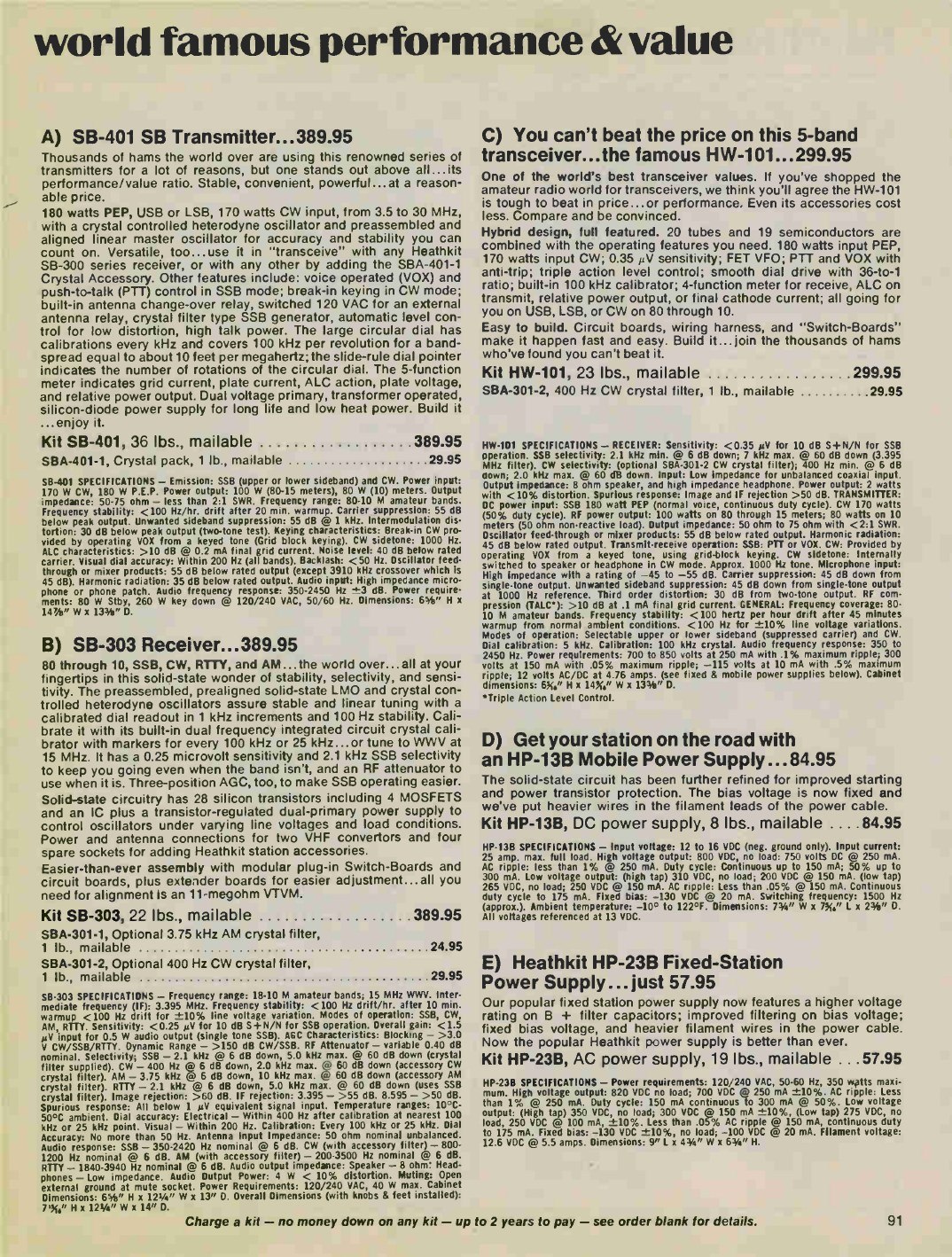
This volume collects the specifications, tube and crystal complements, controls and connections, accessories, and the manuals and documents for the SB-301 and SB-401. For each manual it records the data the project’s hosting rule needs. The earlier SB-300 and SB-400 and the later SB-303 are included where they bear on the pair.
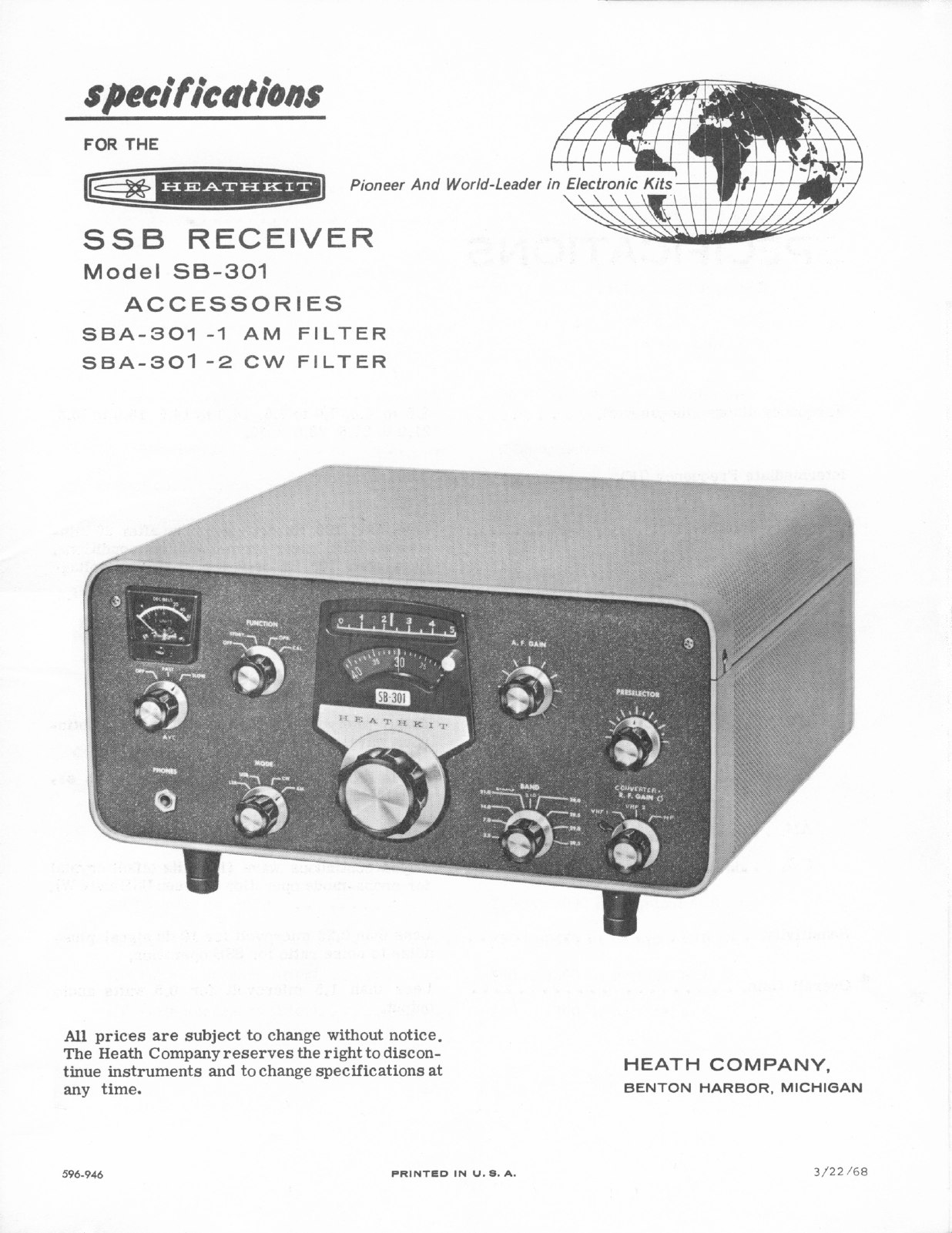
7.1 SB-301 specifications
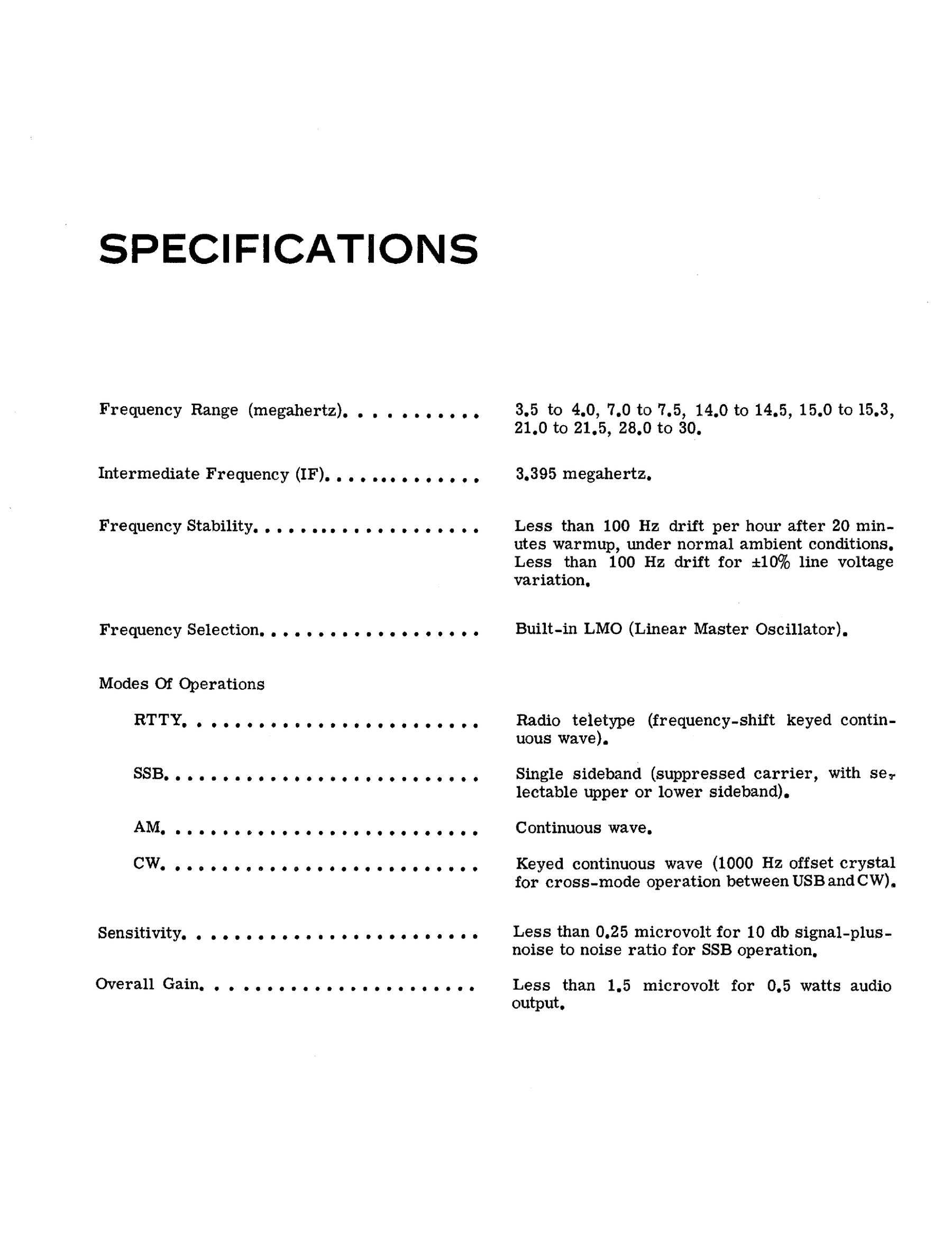
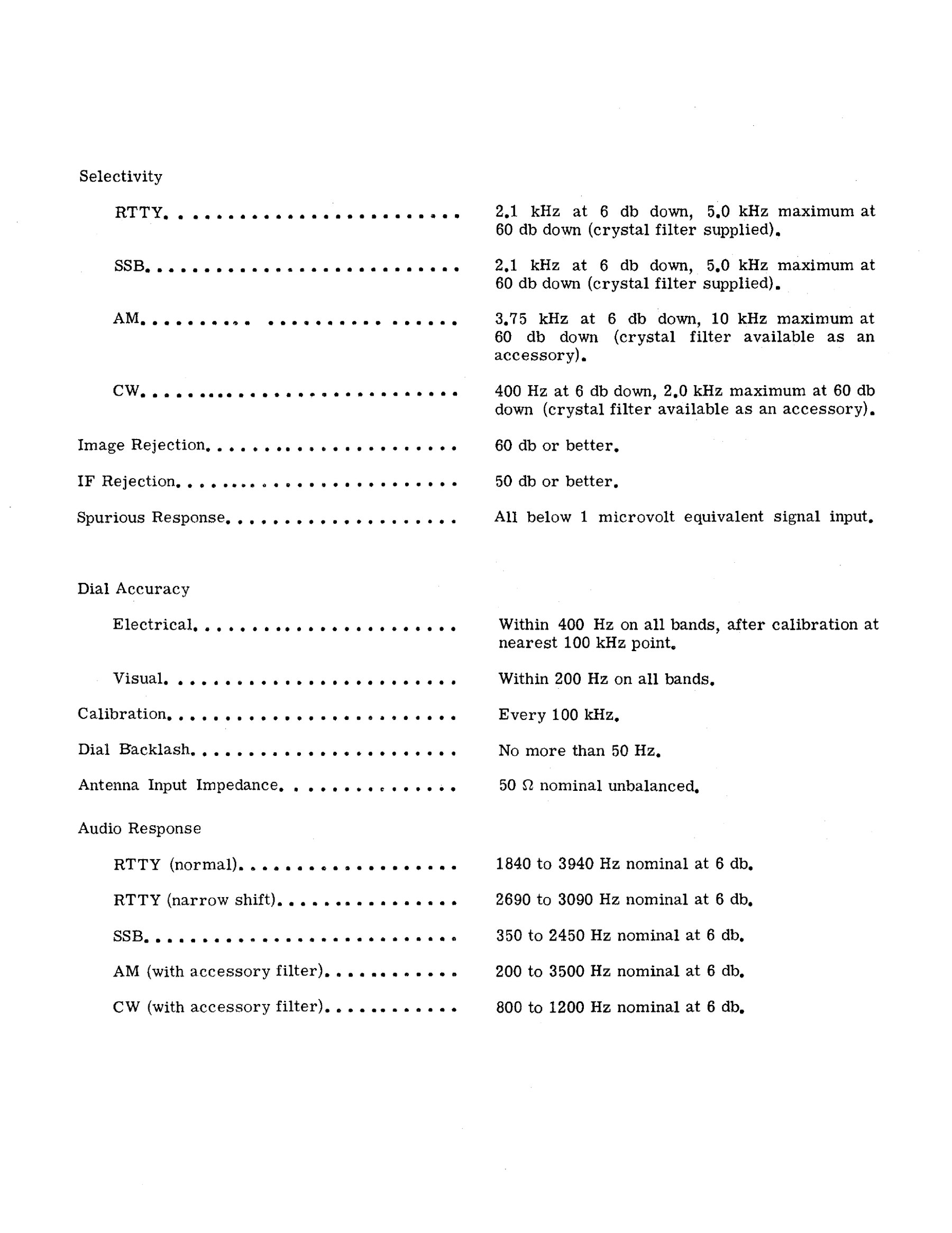
From Heath’s specification sheet of 22 March 1968 (SB-301 manual scan):
Table 1 — From Heath's specification sheet of 22 March 1968 ([SB-301 manual scan](https://w5rkl.com/wp-content/uploads/2023/07/sb-301-Manual.pdf))
| Frequency range | 3.5–4.0, 7.0–7.5, 14.0–14.5, 15.0–15.5, 21.0–21.5, 28.0–30.0 MHz |
| Intermediate frequency | 3.395 MHz (first IF 8.395–8.895 MHz, tunable) |
| Frequency stability | Under 100 Hz drift per hour after 20 minutes’ warm-up; under 100 Hz for ±10 per cent line-voltage change |
| Frequency selection | Built-in LMO |
| Modes | RTTY (frequency-shift keyed CW); SSB (upper or lower sideband); AM; CW (1000 Hz offset crystal for cross-mode operation between USB and CW) |
| Sensitivity | Under 0.25 µV for 10 dB (S+N)/N on SSB |
| Overall gain | Under 1.5 µV for 0.5 W audio output |
| Selectivity, SSB and RTTY | 2.1 kHz at 6 dB; 5.0 kHz maximum at 60 dB (filter supplied) |
| Selectivity, AM | 3.75 kHz at 6 dB; 10 kHz maximum at 60 dB (SBA-301-1) |
| Selectivity, CW | 400 Hz at 6 dB; 2.0 kHz maximum at 60 dB (SBA-301-2) |
| Image rejection | 60 dB or better |
| IF rejection | 50 dB or better |
| Spurious responses | All below 1 µV equivalent signal input |
| Dial accuracy | Electrical: within 400 Hz on all bands after calibration at the nearest 100 kHz point. Visual: within 200 Hz |
| Calibration | Every 100 kHz |
| Backlash | No more than 50 Hz |
| Antenna input | 50 Ω nominal, unbalanced |
| Audio response (6 dB) | RTTY 1840–3940 Hz; RTTY narrow 2690–3090 Hz; SSB 350–2450 Hz; AM 200–3500 Hz; CW 800–1200 Hz |
| Audio output | 8 Ω speaker; high-impedance headphones; 1 W at under 8 per cent distortion |
| Muting | Open external ground at the MUTE socket |
| Power | 105–125 or 210–250 V AC, 50/60 Hz, 50 W |
| Cabinet | 14⅞ in wide × 6⅝ in high × 13⅜ in deep |
| Net weight | 17 lb |
The 1967 catalogue gave the sensitivity as 0.3 µV. The SB-300 was rated at 1 µV for 15 dB. Its other specifications are much the same, except that it had no RTTY, WWV or noise limiter, its CW filter was 2.5 kHz at 60 dB, it ran on 120 V only, and it had a 6AU6 LMO.
7.2 SB-401 specifications
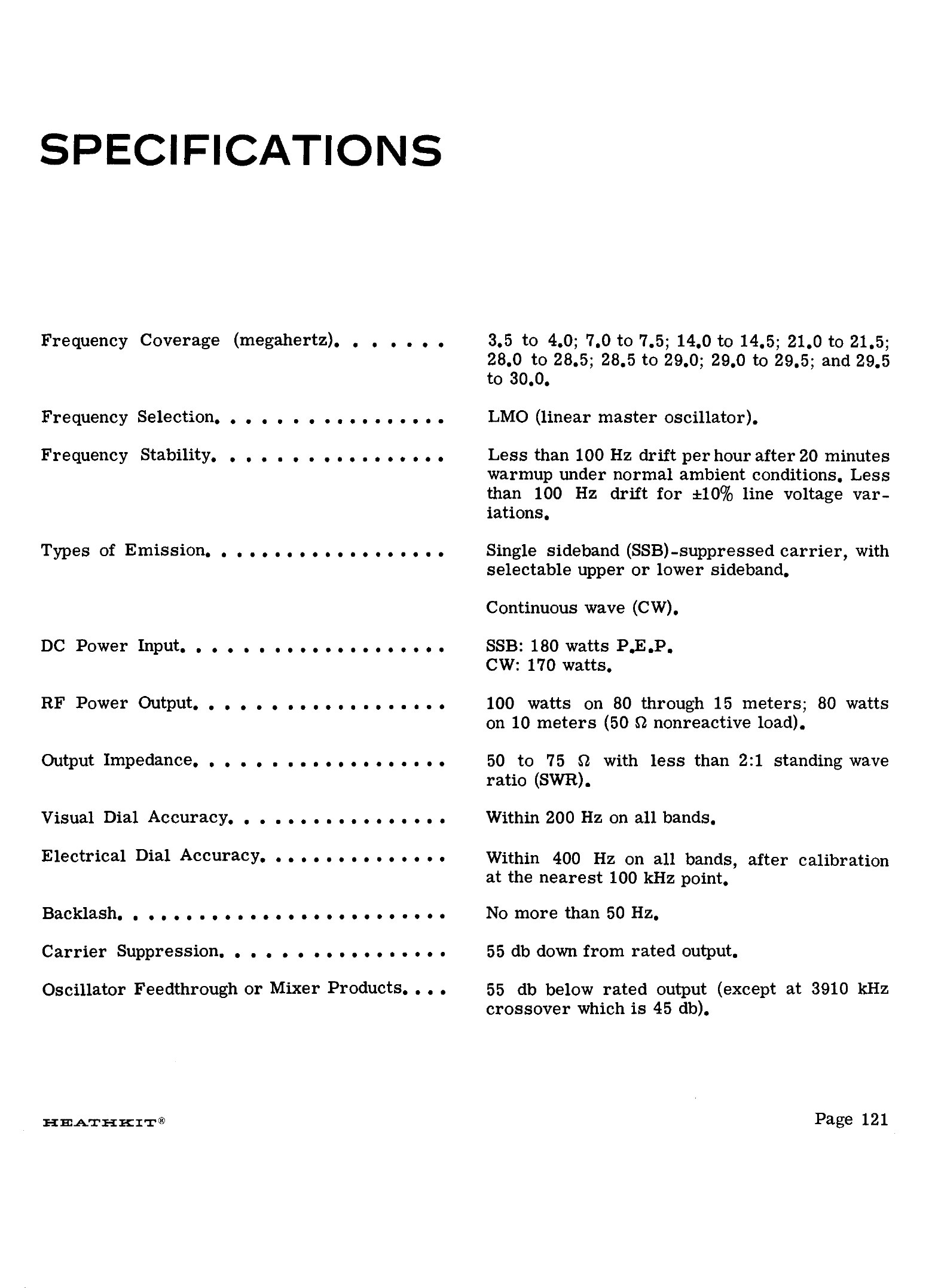
From the SB-401 manual, pp. 121–123 (Internet Archive):
Table 2 — From the SB-401 manual, pp. 121–123 ([Internet Archive](https://archive.org/details/heathkit-sb401-manual))
| Frequency coverage | 3.5–4.0, 7.0–7.5, 14.0–14.5, 21.0–21.5, 28.0–28.5, 28.5–29.0, 29.0–29.5, 29.5–30.0 MHz |
| Frequency selection | LMO |
| Frequency stability | Under 100 Hz drift per hour after 20 minutes; under 100 Hz for ±10 per cent line-voltage change |
| Emission | SSB, suppressed carrier, upper or lower sideband; CW |
| DC power input | SSB 180 W PEP; CW 170 W |
| RF power output | 100 W on 80–15 m; 80 W on 10 m (into 50 Ω non-reactive) |
| Output impedance | 50–75 Ω, SWR under 2:1 |
| Dial accuracy | Visual within 200 Hz; electrical within 400 Hz after calibration at the nearest 100 kHz point |
| Backlash | No more than 50 Hz |
| Carrier suppression | 55 dB below rated output |
| Unwanted sideband | 55 dB down at 1000 Hz and higher |
| Oscillator feedthrough and mixer products | 55 dB below rated output (45 dB at the 3910 kHz crossover) |
| Harmonic radiation | 35 dB below rated output |
| Third-order distortion | 30 dB below rated PEP output |
| Noise level | At least 40 dB below rated carrier |
| Audio response | 350–2450 Hz ±3 dB |
| Audio compression (ALC) | 10 dB nominal at 0.2 mA final grid current |
| Audio input | High-impedance microphone or phone patch |
| CW sidetone | About 1000 Hz, switched to the speaker with the key down |
| Keying | Break-in CW, VOX operated by a keyed tone; grid-block keying |
| Power | 105–125 or 210–250 V AC, 50/60 Hz; 80 W standby, 260 W key-down CW |
| Cabinet | 14⅞ × 6⅝ × 13⅜ in |
| Net weight | 26½ lb |
The SB-400’s published figures are the same, apart from the transmitter being rated for 120 V AC (March 1965 catalogue, p. 38). Heath listed the test equipment used to prepare the specifications: its own IG-72 audio generator, IM-11 VTVM with 309-C probe, IM-21 AC VTVM and HN-31 Cantenna, plus a Panoramic SB-12A analyser, a Measurements Corporation Model 80 signal generator, a Hewlett-Packard 524B counter, Boonton 91-C and 91-CA RF voltmeters, and a Bird 43 wattmeter.
7.3 Tube and semiconductor complements
SB-301 (spec sheet and parts list; function from the circuit description):
Table 3 — SB-301 (spec sheet and parts list; function from the circuit description)
| Tube | Type | Function |
|---|---|---|
| V1 | 6BZ6 | RF amplifier |
| V2 | 6AU6 | First mixer |
| V3 | 6AU6 | Second mixer |
| V4 | 6AB4 | Heterodyne oscillator |
| V5 | 6BZ6 (6CB6 on one spec sheet; 6AU6 in the SB-300) | LMO, inside the sealed unit |
| V6, V7 | 6BA6 | First and second IF amplifiers |
| V8 | 6AU6 | 100 kHz crystal calibrator |
| V9 | 6AS11 | Product detector, BFO, BFO amplifier |
| V10 | 6HF8 | First audio, audio output |
Diodes: 1N191 germanium (AM detector); two 1N458 silicon (AGC); two S-187 silicon (noise limiter); 1N2079 silicon rectifiers (power supply); plus the LMO’s switching diode.
SB-401 (manual, p. 123):
Table 4 — SB-401 (manual, p. 123)
| Tube | Type | Function |
|---|---|---|
| V1 | 6EA8 | Audio preamplifier, cathode follower |
| V2 | 6AV11 | LSB and USB/CW carrier generators, cathode follower |
| V3 | 6AU6 | Isolation amplifier (ALC controlled) |
| V4 | 6EW6 | LMO mixer |
| V5 | 6EW6 | Heterodyne mixer |
| V6 | 6BZ6 (6AU6 in the SB-400) | LMO |
| V7 | OA2 | 150 V regulator |
| V8 | 6AW8 | Heterodyne oscillator; receiver heterodyne amplifier |
| V9 | 6CL6 | Driver |
| V10, V11 | 6146 | Final amplifiers |
| V12 | 6D10 | VOX, relay and sidetone amplifiers |
| V13 | 6J11 | Anti-VOX amplifier, tone oscillator |
Diodes: five germanium (balanced modulator, relative-power metering) and twelve silicon (power supply, VOX and ALC rectifiers, DC blocking).
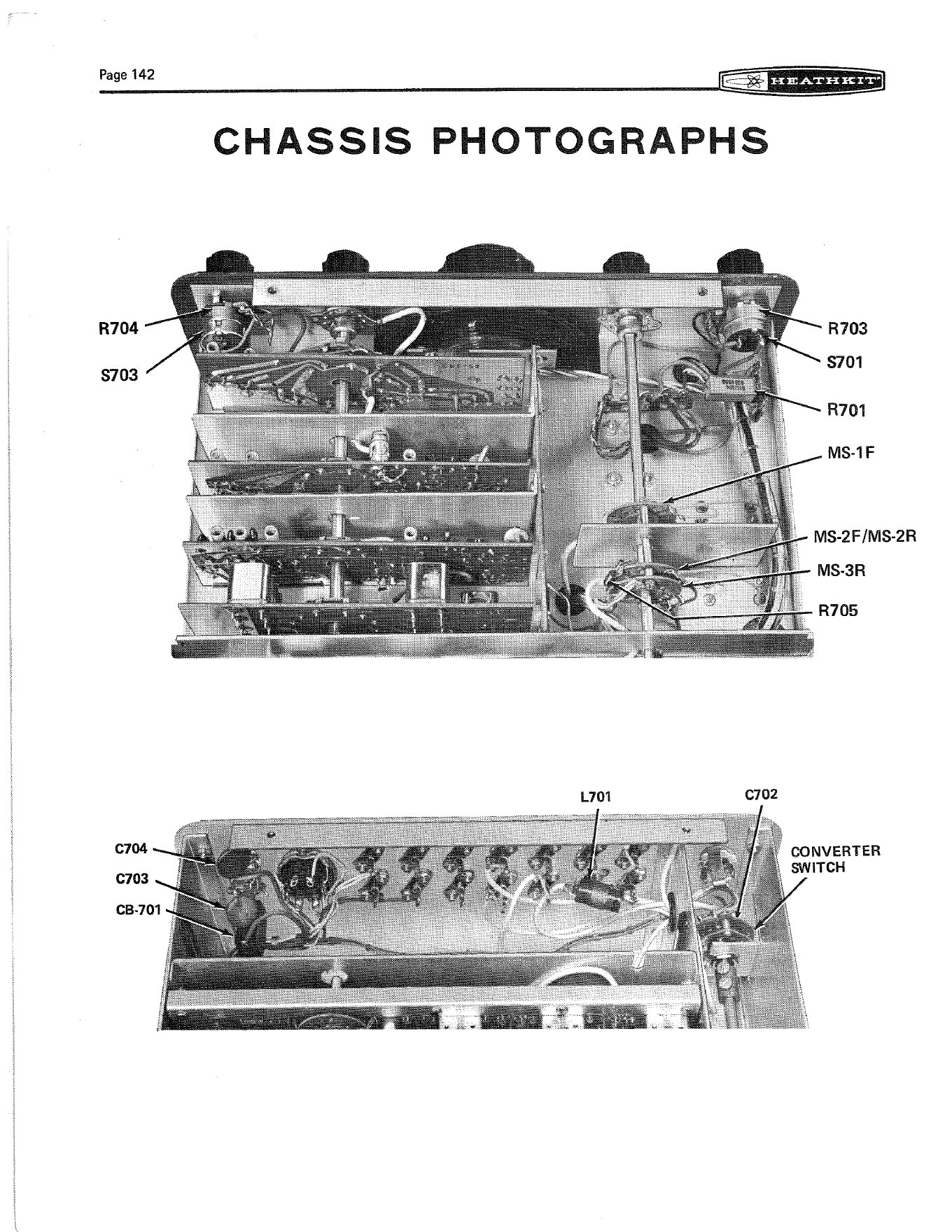
SB-303: 28 silicon transistors including four MOSFETs, plus one integrated circuit, according to the assembly manual. The 1971 catalogue says 27 transistors.
7.4 Crystals
Table 5 — Crystals
| Frequency (kHz) | SB-301 | SB-401 kit | SBA-401-1 pack |
|---|---|---|---|
| 12,395 / 15,895 / 22,895 / 29,895 | 80, 40, 20, 15 m heterodyne | — | ✓ |
| 23,895 | 15 MHz WWV heterodyne | — | — |
| 36,895 / 37,395 / 37,895 / 38,395 | 10 m segments | — | ✓ |
| 3,393.6 | LSB BFO | — | ✓ (LSB carrier) |
| 3,396.4 | USB/CW/AM BFO | — | ✓ (USB carrier) |
| 3,392.110 | RTTY BFO | — | — |
| 3,395.4 | — | CW carrier (Y10) | — |
| 100 | Calibrator | — | — |
7.5 Controls and connections
SB-301 front panel: S-meter; FUNCTION (OFF, STBY, OPR, CAL); AF GAIN with pull-on ANL; AGC (OFF, FAST, SLOW); main tuning with ZERO SET; PRESELECTOR; PHONES; MODE (RTTY, LSB, USB, CW, AM); BAND (nine positions); CONVERTER (VHF 1, VHF 2, HF) concentric with RF GAIN. Chassis: S-METER ADJ.
SB-301 rear: HF ANT; VHF NO 1 and NO 2 antenna inputs; MUTE; ANTI-VOX 500 Ω; SPKR 8 Ω; AC input; the HET. OSC., LMO and BFO outputs; octal converter socket (6.3 V AC and 140 V DC for each converter, AGC); four spare phono sockets (Eckweiler, HOTM #36).
SB-401 front panel: FINAL tune and LOAD (concentric); MIC/CW LEVEL with FREQ CONTROL (LOCKED (RCVR), UNLOCKED); meter; DRIVER; main tuning; METER (GRID, PLATE, ALC, HV, REL PWR); FUNCTION (OFF, STBY, TRCV, TRAN, SPOT); BAND; MODE (LSB, USB, CW, TUNE); MIC. Internal controls: bias adjust, VOX gain, VOX delay, anti-VOX, ALC adjust, carrier null control and capacitor, sideband amplitude balance, relative power adjust, and sidetone level.
SB-401 rear: PATCH (600 Ω) and KEY; AC input; accessory socket (switched 120 V AC for an external antenna relay); RCVR AUDIO, SPKR, RCVR LMO, ANTI-VOX, HET OSC, RCVR BFO, RCVR MUTE, spare, LINEAR RELAY, ALC INPUT; ANTENNA (SO-239); RCVR ANT and a spare (Eckweiler, HOTM #43).
7.6 Heath accessories
Table 6 — Heath accessories
| Model | What it is | Price (catalogue) |
|---|---|---|
| SBA-301-1 | 3.75 kHz AM crystal filter for the SB-301 (and SB-303) | $20.95 (1967); $24.95 (1975) |
| SBA-301-2 | 400 Hz CW crystal filter for the SB-301 and SB-303; also used in the SB-101, SB-102 and HW-101 | $20.95 (1967); $21.95 (1970); $29.95 (1975) |
| SBA-300-1 / -2 | AM and CW filters for the SB-300 (larger, different mounting) | $19.95 each (1965) |
| SBA-300-3 / -4 | 6-metre (50–52 MHz) and 2-metre (144–146 MHz) plug-in converters, 6DJ8 cascode front ends, mounted on the receiver’s rear | $19.95 each |
| SBA-401-1 | Crystal pack: eight heterodyne and two sideband carrier crystals for independent SB-401 operation | $29.95 |
| SB-600 | Matching 8 Ω communications speaker, 6 × 9 in, with room for an HP-23 supply | $17.95 (1967); $19.95 (1971) |
| HDP-21 / HDP-21A | Desk microphone for the SB series | $29.40 |
| SB-200 | Kilowatt linear amplifier styled to match, two 572B | $200 (1967); $220 (1970) |
| SB-610 | Monitor oscilloscope (envelope and trapezoid patterns) | $89.95 (810/72) |
| SB-620 | ”Scanalyzer” panoramic adapter | $129.95 (810/72) |
| SB-630 | Station console: clock, timer, SWR bridge, phone patch | $89.95 (810/72) |
| SB-640 | External LMO. The SB-401 manual lists it as a frequency source in LOCKED with the crystal pack fitted | — |
The SB-610 is on the list of Heath titles that Tubular Electronics identifies as still in copyright (Tubular Electronics). This project therefore links a third-party copy of its manual (Internet Archive) and does not host it.
7.7 Manuals and documents
The project’s rule (decision 5 in the Heathkit project file) is to host a title only when it is likely to be in the public domain, and to link everything else to the best free copy. Two routes to public domain qualify. The first is publication before 1964 with no renewal found. The second is publication without a copyright notice before 1 March 1989, provided that for 1978–89 the work was not registered within five years. For each document below, the year, whether a notice was seen, and whether a renewal search was done are recorded. No renewal search has been done for any of these titles. None was published before 1964, so a renewal search would only matter for a title found to lack a notice.
SB-301 Assembly Manual, “SSB Receiver Model SB-301”, Heath part 595-946-01.
- Year: copyright 1966. The printing scanned is dated 11-29-68 on the cover, and the manual also carries a later change letter.
- Copyright notice seen: yes, on the cover (“Copyright © 1966 Heath Company, All rights reserved”).
- Renewal search: not done.
- Hosting decision under the rule: link only.
- Free scans: the complete manual, 132 pages including fold-outs, at W5RKL. A five-page extract (introduction, block diagram, schematic) is at the Internet Archive’s heathkitmanuals collection and in a second copy at W5RKL. No DLARC copy was found.
SB-301 specification sheet (bound with the W5RKL scan).
- Year: 1968 (dated 3/22/68). The form number is printed as 596-946 as far as the scan can be read.
- Copyright notice seen: not on the cover page. The inner pages were read for their text but not examined specifically for a notice.
- Renewal search: not done.
- Hosting decision: a possible candidate under the no-notice route, subject to a full-page notice check.
SB-301 change letter, “Dear Customer”, dated 6 January 1969, reference SB-301/1-6-69.
- Copyright notice seen: no.
- Hosting decision: a possible candidate on the same basis. It is only useful together with the manual.
SB-300 Assembly and Operation manual.
- Year: not printed on the pages seen. The SB-300 was introduced in 1964.
- Copyright notice seen: not seen. Neither scan includes the cover.
- Renewal search: not done.
- Hosting decision: undetermined; link.
- Free scans: the complete manual, 86 pages, at W5RKL. An abridged 37-page version, with specifications, circuit description, alignment, operation, service and schematic but no assembly steps, is at the Internet Archive.
SB-401 Assembly and Operation manual, later printing.
- Year: 1970 or later, because its main alignment procedure is written for the SB-303, which appeared in November 1970. Eckweiler reproduces a block diagram from an early printing dated 3/24/67 and gives its part number as 595-823. That early printing was not seen for this dive.
- Copyright notice seen: not seen. The scan has no cover or copyright page and omits most of the step-by-step assembly (88 pages against the manual’s 148).
- Renewal search: not done.
- Hosting decision: undetermined; link.
- Free scans: Internet Archive; the same scan as the “SB401 Abbreviated Manual” at W5RKL.
SB-400 manual. No free scan was found at the Internet Archive or W5RKL.
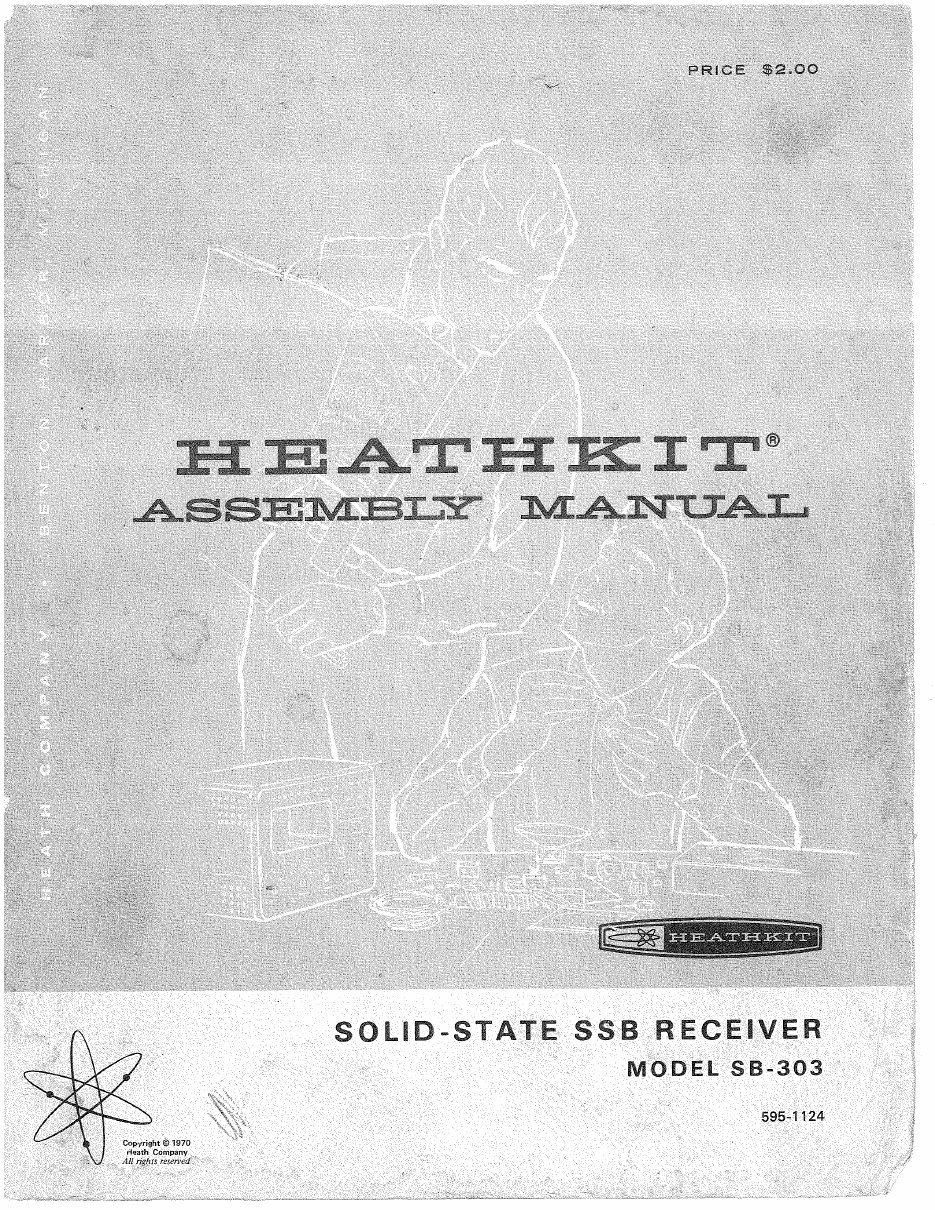
SB-303 Assembly Manual, “Solid-State SSB Receiver Model SB-303”, 595-1124.
- Year: copyright 1970.
- Copyright notice seen: yes, on the cover.
- Renewal search: not done.
- Hosting decision: link only.
- Free scans: the complete manual, 186 pages, at the Internet Archive; a four-page extract in heathkitmanuals. W5RKL hosts an SB-303 schematic, a simple alignment, and “SB303 and SB401 Transceive adjustments”.
SB-310 shortwave receiver manual.
- Copyright notice: not examined.
- Hosting decision: link.
- Free scan: Internet Archive, 26 pages.
Service bulletins. No scans of the bulletins themselves were found. Joseph Lutz’s transcribed indexes, with dates, symptoms and fixes, are in the heath mailing-list archive: SB-300, SB-301, SB-303, SB-313 and SB-401.
Catalogues. All the catalogues cited in this dive are on World Radio History’s Heathkit catalogue pages. Under the project’s rule, catalogues count as advertising and are handled the same way as manuals. The 1967 annual catalogue, 810/67A, carries “COPYRIGHT 1966 HEATH COMPANY” on its opening page. The other catalogues cited have not been checked for a notice.
7.8 Related Heath equipment
Table 7 — Related Heath equipment
| Model | Relationship |
|---|---|
| SB-300, SB-400 (1964) | The first SB receiver and transmitter; the SB-301 and SB-401 revise them |
| SB-303 (1970) | Solid-state replacement for the SB-301; transceives with a modified SB-401 |
| SB-310, SB-313 | Shortwave-listener versions of the SB-301 and SB-303 |
| SB-100, SB-101, SB-102 | The same LMO and scheme in one transceiver (SB-102 dive) |
| SB-110 / SB-110A | Six-metre transceiver on the same lines |
| HW-100, HW-101 | Cost-reduced transceivers derived from the SB-101 (HW-101 dive) |
| SB-104, SB-104A (1974, 1977) | The solid-state transceiver that ended the tube separates (SB-104A dive) |
| RX-1, TX-1, SB-10 | The earlier Mohawk, Apache and phasing adapter, which the SB series replaced |
Further reading
- Eckweiler, Bob, AF6C. The three Heathkit of the Month articles cited throughout. They are the best short histories of the line and are written by someone who built and used the pair. #30 · #36 · #43
- Waters, Mort, W2JDL. Contemporary reviews in 73 Magazine, June 1967 (SB-301) and July 1967 (SB-401).
- Leedham, Charles, WA2TDH. “The Heath SB-300 Receiver”, 73, August 1964. Nostalgic Kits Central
- W2PA. “Collins S/Line Influence on Heathkit’s SB-Series.” Link
- The site history dive on Heath’s amateur-radio years, and its field guide to model numbers.
Sources
- Heath Company. SB-301 Assembly Manual and specification sheet. W5RKL
- Heath Company. SB-300 Assembly and Operation manual. W5RKL · Internet Archive
- Heath Company. SB-401 Assembly and Operation manual. Internet Archive
- Heath Company. SB-303 Assembly Manual, 595-1124. Internet Archive
- Heathkit catalogues, World Radio History: 800/53, March 1965 · 810/67A · Winter 1970 · 1971 · 810/72 · Christmas 1975
- Eckweiler, Bob, AF6C. HOTM #30, #36, #43 (links above).
- Lutz, Joseph W. Service bulletin indexes, heath mailing list, 1998 (links above).
- Tubular Electronics. Heathkit manuals and copyright status. Link
Comments (0)