Heathkit · Volume 1
From Aeroplanes to Oscilloscopes
The Heath Company that shipped its last electronic kit in 1992 began, on paper at least, as an aircraft business in Chicago before the First World War. For thirty-eight years the name belonged to airplanes: to a small, fast-talking racing pilot named Edward Bayard Heath, to a line of single-seat monoplanes sold as kits of raw tubing and spruce, to a bankrupt successor company in Niles, Michigan, and then to a young radio man from Dowagiac who bought what was left for a few hundred dollars. The electronic Heathkit of 1947 grew out of that aviation business rather than replacing it overnight. The mail-order habit, the kit sold in affordable groups, the step-by-step instruction sheet, the reliance on war-surplus material and the conviction that ordinary people could build complicated machines were all in place, in aluminium tube and doped fabric, twenty years before the first oscilloscope kit left Benton Harbor.
This volume follows the company from Heath’s first attempts at flight around 1909 to the summer of 1947, when a nine-line advertisement at the foot of a column of surplus bargains offered a complete five-inch oscilloscope kit for $39.50. The story of that kit’s success, the manuals and the mail-order machine that followed belongs to the next volume.
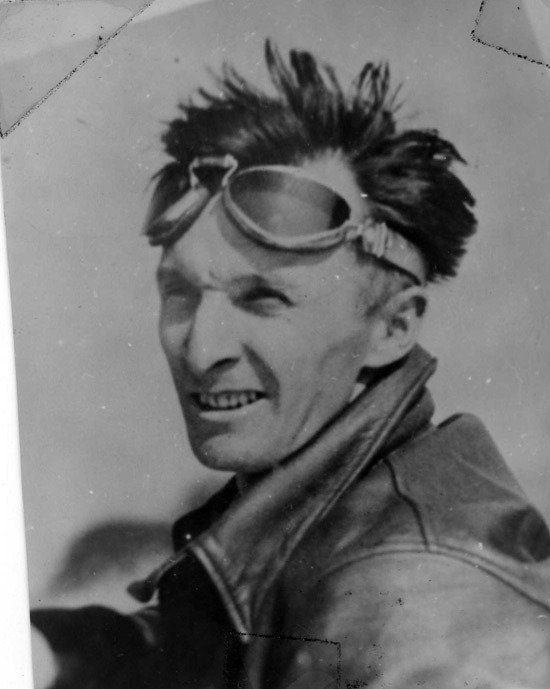
1.1 Edward Bayard Heath
Edward Bayard Heath was born on 17 November 1888. Brueschke and Mack’s 2019 history, drawing on Chet Peek’s biography The Heath Story (2003), gives the birthplace as Brooklyn and the parents as Clark and Ada Heath (Brueschke and Mack, AWA Review vol. 32); Bob Eckweiler’s account says Long Island (Eckweiler, Heathkit of the Month #100), and some secondary sources name Amsterdam, New York, where he spent part of his youth and built his first aircraft. His father, a machinist, died when he was three. His mother remarried a travelling machine-parts salesman, and the family moved often enough that Heath is said to have attended more than thirty schools. One of them was Chicago’s Lane Technical High School, where he met his future wife and absorbed a good deal about the new science of flight. He was a voracious reader of technical literature, raced motorcycles as a teenager and, by one account, once raced against Glenn Curtiss himself.
His middle name is often misprinted. Eckweiler notes that Heath himself wrote “Baird” on his First World War draft registration, and that “Bavard” in some references began as a typing error (Eckweiler #100).
1.1.1 First flights at Amsterdam
The story of Heath’s first aircraft exists in two incompatible versions, and both came from people who knew him. Peek’s version, based on local newspapers, has a Blériot-like monoplane built at Amsterdam, New York, in 1910. It failed to leave the ground on 12 September 1910 at the Antlers Country Club, collapsing a landing-gear post, and failed again on 9 October 1910 near the Fonda fairgrounds, about nine and a half miles to the west, when a wing caught on something. His mother’s version, printed in Popular Aviation in December 1931 as part of a memorial article, puts successful half-mile hops at the Antlers Club on 10 October 1909 and at the Fonda fairgrounds on 2 November 1909 (Eckweiler #100). The Aerofiles register of American aircraft follows the earlier date, listing a first plane “and motor of Heath’s own design (25hp 2-cylinder)” first flown in September 1909 at Amsterdam (Aerofiles, “Heath”). Which account is right could not be settled from the sources available here. What both agree on is that Heath designed, built and tried to fly his own powered aircraft while barely out of his teens.
He then spent a short time with the Curtiss company at Hammondsport, New York, assigned to motorcycles rather than aircraft, before returning to Chicago.
1.2 The Chicago business, 1909–1925
The founding date of the Heath business is the least settled fact in the company’s history. Every source agrees that Heath bought an existing Chicago aircraft firm owned by Carl S. Bates and renamed it, but the dates offered for the founding and for the Bates purchase span fourteen years.
Table 1 — The Chicago business, 1909–1925
| Source | Founding or key date given | What it says |
|---|---|---|
| Brueschke and Mack, 2019 | 1909 | E. B. Heath Aerial Vehicle Company organized 1909; Bates Aeroworks (founded 1907) bought 1912 |
| Aerofiles | 1910 / 1912 | Heath Aerial Vehicle Co. a parts supply house from 1910; Bates Aeroplane Co. acquired 1912 and renamed Heath Aircraft Co. Inc., 1721 Sedgwick St. |
| Peek via Eckweiler | 1911 | Bates Aeroplane Company bought in 1911 and renamed E. B. Heath Aerial Vehicle Company |
| Museum of Flight | 1911 | E. B. Heath Aerial Vehicle Company founded 1911 |
| Wikipedia (lead only) | 1911 and 1912 | Two different Wikipedia articles give different years |
| The Model Builder, 1973 | 1918 | ”by 1918 he had opened the Heath Aeroplane Company” |
| USA Today, 22 November 1983 | 1923 | ”Founded in 1923 by an ex-military pilot” |
| Penson, QST April 1997 | about 1900 | ”About 1900 – Ed Heath founds the Heath Aeroplane Company” |
Sources: Brueschke and Mack; Aerofiles; Eckweiler #100; Museum of Flight; Wikipedia, “Heathkit” and Wikipedia, “Edward Bayard Heath”; the 1973 and 1983 articles as transcribed in Heyning, Heath Stories vol. 1; Penson, Heathkit Virtual Museum.
The most defensible reading is that Heath was trading in aircraft parts under his own name by 1909–1910 and acquired the Bates firm in 1911 or 1912. The later “1918” and “1923” dates are clearly wrong, and the “about 1900” date in Penson’s timeline would make Heath a twelve-year-old company founder. The company went by several names in this period: E. B. Heath Aerial Vehicle Company, Heath Aircraft Company, Heath Aeroplane Company and, after the war, Heath Airplane Company. Brueschke and Mack call it the oldest aircraft manufacturing firm in Illinois.
1.2.1 Parts, propellers and a school
The early business made parts and carved propellers. By 1913 Heath was selling a Model 2B flying boat for $1,500 and a wheeled version for $1,450, and around 1918 a Model 2B tractor biplane with a six-cylinder Anzani engine (Aerofiles). War work, supplying parts and propellers for the First World War training programme, appears to have been most of the firm’s business during 1917–1918.
Heath also ran a flying school with an unusual tuition scheme. Students worked in the factory building aircraft and parts, and their hours earned flight time in the company’s trainers at a rate that came out, by Eckweiler’s reckoning, to about one minute of flying per hour of work, or about thirty minutes a week on a six-and-a-half-hour, five-day schedule (Eckweiler #100). The factory labour doubled as instruction in aircraft construction. One former student, Albert B. Meyer, answered an advertisement in Popular Mechanics, arrived to find the school had no flyable aircraft, and spent six months carving propellers at 25 cents an hour before the one rebuilt Standard biplane was ready. He later returned as a flight instructor, rose to second in command, and went on to a long career as a federal aviation inspector (Daily Press, St. Marys, Pennsylvania, 29 January 1976, in Heyning, Heath Stories vol. 1).
1.2.2 The 1919 catalogue and the “knockdown” aircraft
Heath’s 24-page 1919 catalogue offered eleven types of aircraft, from gliders to seaplanes, either assembled or as “knockdown” sets (Aerofiles). A knockdown aircraft seems to have been assembled at the factory, taken apart and crated. The cheaper alternative was a “list of parts”: the raw material and fittings to build the aircraft oneself. The catalogue’s own wording, quoted by Brueschke and Mack, reads almost like a Heathkit advertisement of the 1950s: the parts were “so made that anyone with ordinary ability can readily put them together, thereby gaining the gratification of creation, and at the same time saving money”, and each set came with “complete blue prints and detailed constructional literature.”
Table 2 — The 1919 catalogue and the "knockdown" aircraft
| Model (1919 catalogue) | Complete | List of parts |
|---|---|---|
| Heath Glider | $90.00 (tail $20 extra) | $42.00 |
| Heath Motorcycle Model Biplane | $700.00 | $195.00 |
| Heath Model 2C Monoplane | $1,000.00 | $325.00 |
| Heath Model 2B Tractor Biplane | $1,450.00 | $350.00 |
| Heath Ford Motored Biplane | $1,375.00 | $425.00 |
| Heath Standard Trainer | $4,275.00 | $850.00 |
| Heath 6-B Flying Boat (90 hp OX-5) | $6,800.00 | — |
Source: Eckweiler’s Table I from the 1919 catalogue (Eckweiler #100); the flying boat price from Aerofiles.
1.2.3 The Feather, the Favorite and war surplus
In 1919 Heath designed the Feather, his first attempt at a light aircraft for the mass market. It was a single-seat biplane of 20-foot span weighing about 270 pounds, powered by a two-cylinder Thor motorcycle engine of 76 cubic inches that the company modified to give about 18 horsepower and a 45 mph cruise. Heath planned to sell it for $1,200 ready to fly, $990 without engine or $250 as a kit of materials. The market collapsed before it reached production, because the government released thousands of surplus military trainers at prices no new light aircraft could match. Aerofiles records only one example built (Aerofiles; Eckweiler #100).
Heath adapted. He became a surplus dealer, buying and brokering war-surplus aircraft parts by mail and at the plant. Among his purchases were large numbers of lower wings for the Thomas-Morse S-4 Scout, a single-seat advanced trainer whose lower wings had been built in quantity because they were the part most often broken in training accidents. A 1928 Heath advertisement in Popular Aviation offered wheels, tyres and newly covered Curtiss Jenny wings for $60 each. In 1922 Heath built the Favorite, a four-seat biplane on a modified Jenny fuselage with a 90 hp OX-5; it was used for passenger-hopping and, fitted with lights under the lower wing, for some of the first night-time aerial advertising flights (Aerofiles).
The parallel with 1946 is exact, and Eckweiler draws it explicitly. A generation before Howard Anthony turned war-surplus cathode-ray tubes into oscilloscope kits, Ed Heath turned war-surplus Thomas-Morse wings into kit aeroplanes.
1.3 Racing at the National Air Races
Heath used the new National Air Races as advertising. The record, assembled from Aerofiles and Eckweiler’s reading of Popular Aviation, runs as follows.
Table 3 — Racing at the National Air Races
| Year and venue | Heath entry | Result |
|---|---|---|
| 1923, St. Louis | Favorite biplane, four aboard, in the “On to St. Louis” cross-country race | Third place after a forced landing on the way |
| 1924, Dayton | Feather | Overturned in high gusty wind |
| 1925, Mitchel Field, Long Island | Humming Bird, a 300-lb monoplane with a modified Henderson engine | Failed to start in any event; outpaced by a Bristol Cherub-powered rival |
| 1926, Philadelphia | Tomboy (the Humming Bird rebuilt with a 32 hp Bristol Cherub) | Won every race entered; about $2,200–2,500 in prize money |
| 1927, Spokane | Parasol fitted with a racing wing and the Cherub (the “Spokane Parasol”) | Won both events entered |
| 1928, Mines Field, Los Angeles | Baby Bullet (Cherub, 32–34 hp) | Won the 300 cubic-inch class, lapping the field twice |
| 1929, Cleveland | Modified Baby Bullet and a Heath-Henderson Parasol | Parasol won its race; Baby Bullet one win, two seconds |
| 1930, Curtiss-Reynolds Field, Chicago | Parasol V; the new Cannon Ball with a Heath 200 cu. in. engine of about 65–70 hp | Won the men’s 100 cu. in. and 275 cu. in. classes |
Sources: Aerofiles; Eckweiler #100.
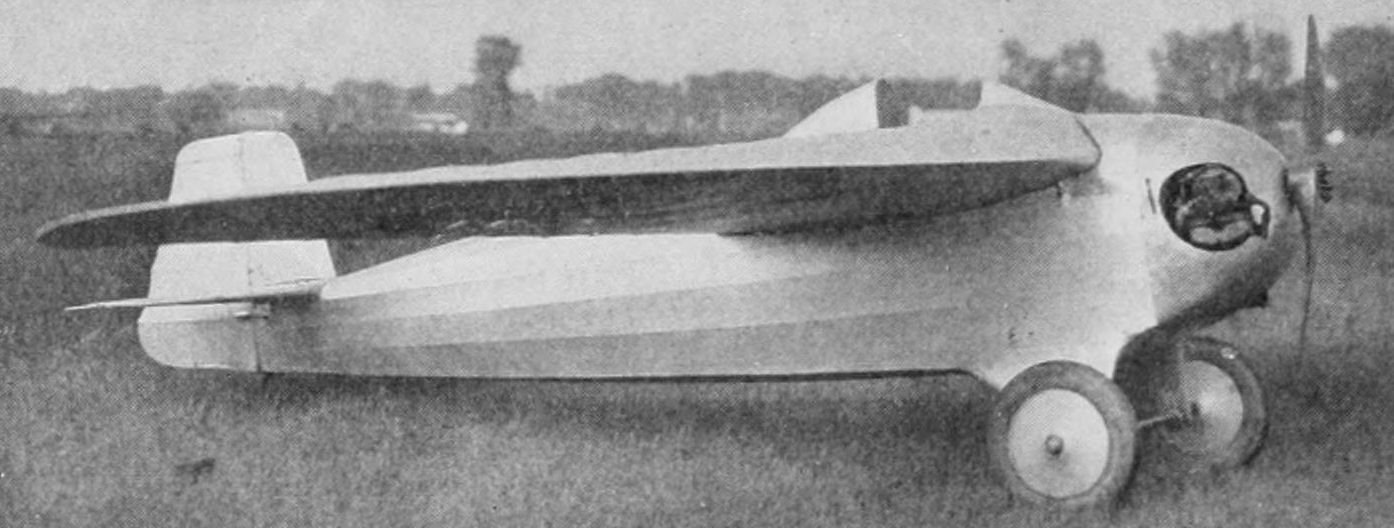
The Baby Bullet was Heath’s most famous racer. It began as a smaller design called the Wee-Mite, which was badly damaged in the summer of 1928 when fire struck the Heath plant at 2856 Broadway, Chicago. The company moved quickly to new premises on Sedgwick Street, repaired the aircraft, renamed it and shipped it to Los Angeles in time for the races. With a 75 cubic-inch Cherub in a class allowing 300 cubic inches, it lapped the field twice (Eckweiler #100). Aerofiles credits it with a top speed of 140 mph and the 300 cubic-inch trophy at the 1928, 1929 and 1930 Nationals.
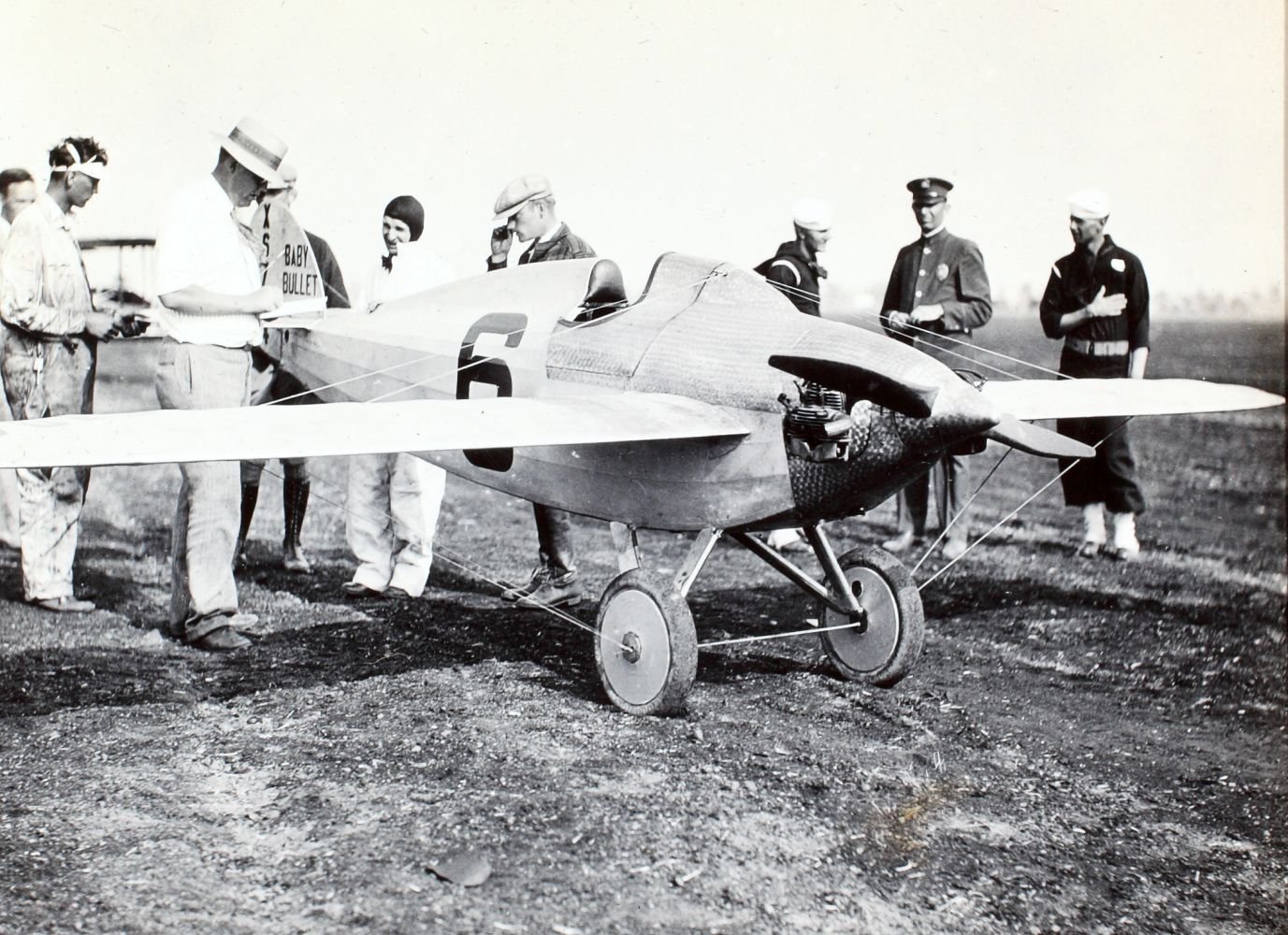
1.4 The Parasol
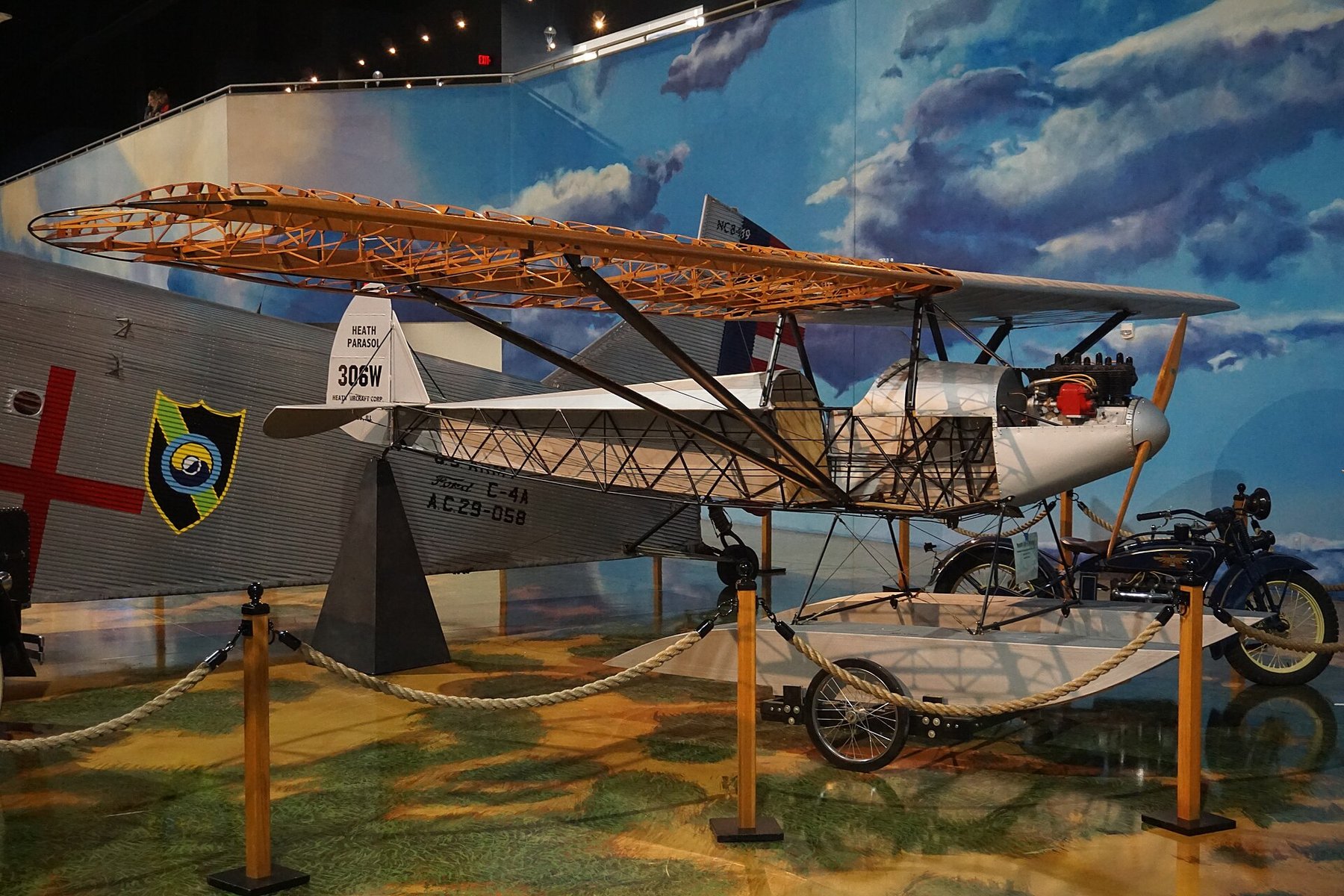
With the Tomboy’s prize money, Heath and the designer Clare (or Claire) Lindstedt produced the Parasol in late 1926. It was a single-seat, strut-braced monoplane with its wing mounted above the fuselage on struts, like an umbrella, which gave the type its name. The first version used a pair of the surplus Thomas-Morse Scout lower wings for a 23-foot span and 94 square feet of area, and a 23 hp Henderson De Luxe four-cylinder motorcycle engine. It was announced in Aviation in February 1927 and sold for $575 ready to fly at Chicago (Eckweiler #100; Museum of Flight). Brueschke and Mack reproduce Peek’s date of 28 February 1927 for the first complete Heath construction kit.
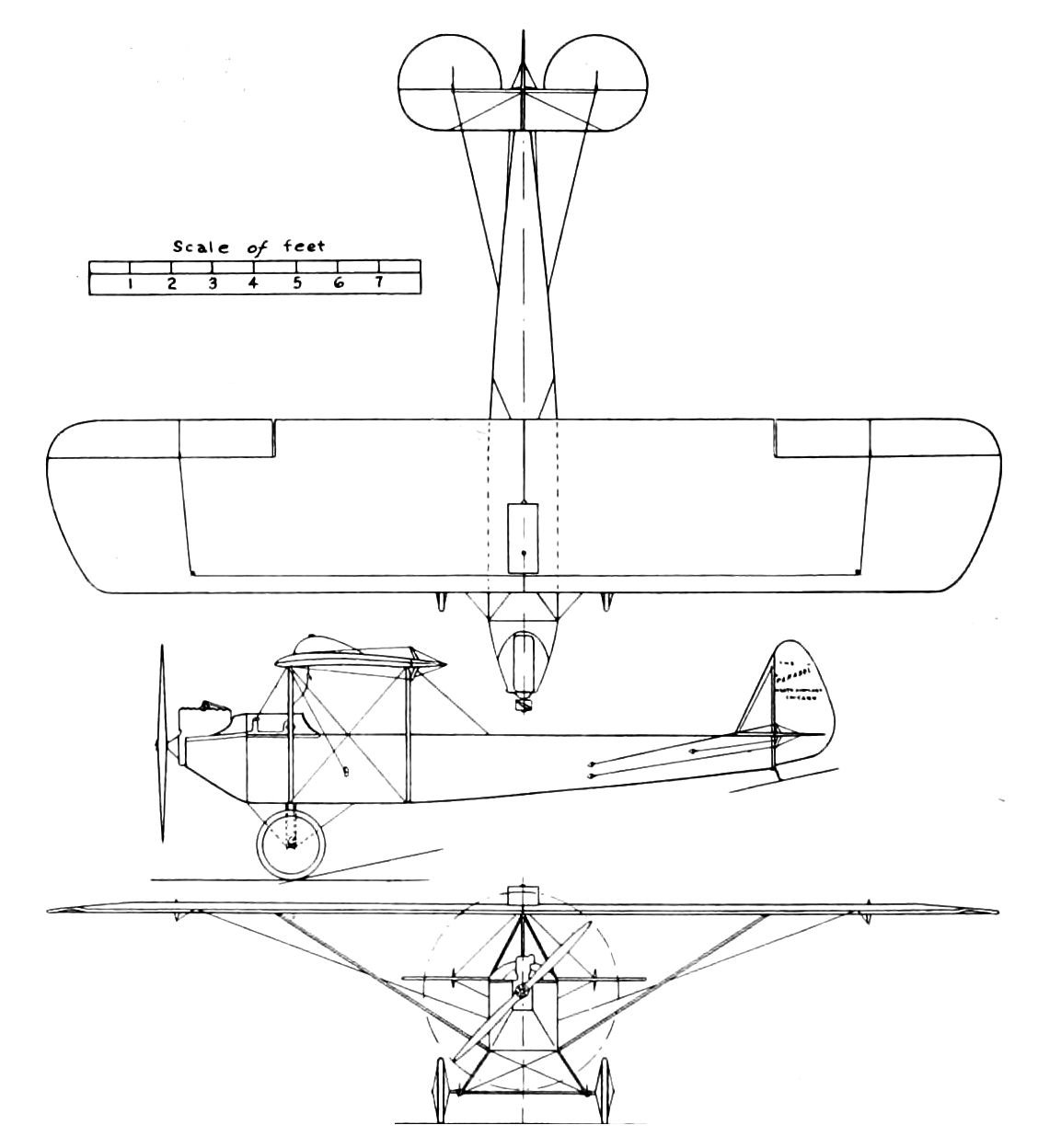
The surplus wings could not last, and many would-be buyers could not raise $575 in one sum. Heath’s answer, from 1928, was the Super Parasol. It had a new, longer wing of Clark Y section, 25-foot span and 110 square feet, and a Henderson engine modified by the company into the Heath-Henderson B-4, which gave about 16 per cent more power. The new wing raised the ready-to-fly price to $975, but Heath broke the kit into eleven “groups”, each with its own drawings, that could be bought one at a time. All eleven cost $199 without motor; the cheapest group was under $12 and the dearest, the landing gear, under $37.50 (Eckweiler #100).
Table 4 — The Parasol
| Group | Content | Price (after 10% discount) |
|---|---|---|
| 1 | Wing ribs (jig $4 extra) | $11.76 |
| 2 | Initial wing structure | $14.01 |
| 3 | Wing frame structure | $10.58 |
| 4 | Material to complete wing, less cover | $11.66 |
| 5 | Complete tail section, less cover | $12.79 |
| 6 | Fuselage longerons and front section | $22.21 |
| 7 | Fuselage rear section | $17.61 |
| 8 | Aircraft controls | $17.55 |
| 9 | Landing gear with wheels, tyres and tubes | $37.31 |
| 10 | Remaining parts less cover and motor | $21.01 |
| 11 | Covering and doping material | $30.60 |
Source: Eckweiler #100, from period Heath literature.
This was instalment buying by the part, and it is the clearest ancestor of the electronic kit. It let a builder start for less than twelve dollars and keep going as money allowed. Eckweiler notes, drily, that Heath must have sold many more first groups than eleventh groups, and that many half-built wings must have gathered dust in garages. The kits were not pre-cut: tubing came by the foot, cloth by the yard and metal by the sheet. The required tools were a short list (centre punch, hand drill, chisel, pliers, file, rule, hacksaw, screwdriver and hammer), and Heath devised a way to build the steel-tube fuselage without welding, joining 5/8-inch 20-gauge tube with sheet-steel fittings, nuts and bolts and two-penny shingle nails used as rivets, braced with wire and turnbuckles. Factory-built aircraft had welded fuselages.
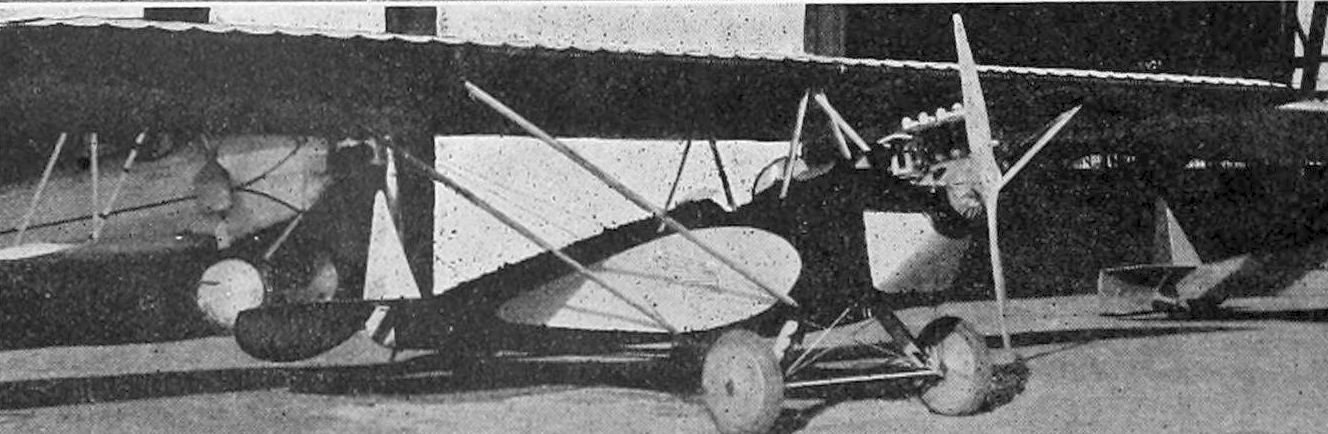
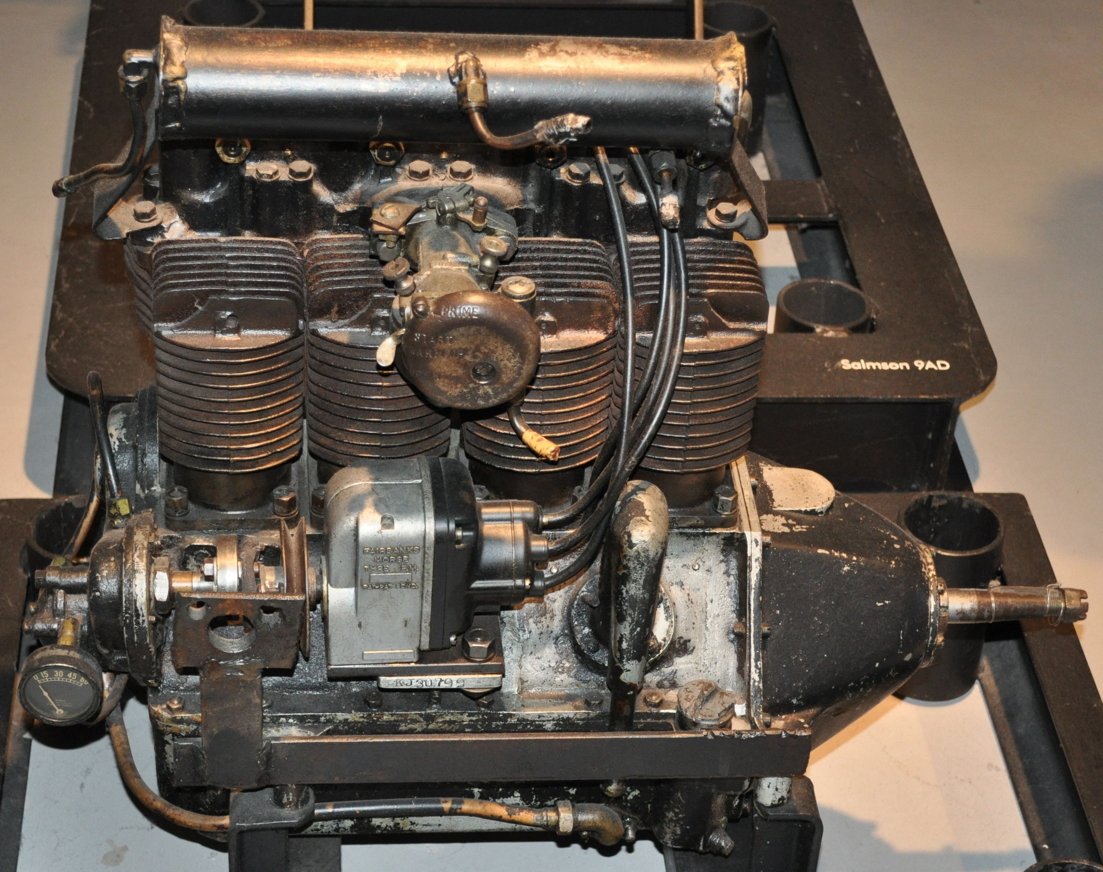
Heath extended the idea to publishing. From December 1930 through July 1931 Popular Aviation ran a seven-part series by Heath, “How to Build the Heath Parasol”, about forty pages of plans and instructions for the V Parasol. The series was intended to feed the mail-order business in plans, kits and engines, and it did (Brueschke and Mack). Bjorn Heyning, who later spent most of his career as a Heath engineer, first met the Heath name as a boy in Norway reading about the Parasol in Modern Mechanics. He remembered that the instructions went so far as to include a basic course in meteorology and a self-taught course in how to fly the aircraft, since the single-seater had no room for an instructor (Heyning, Heath Stories #1).
1.4.1 The Parasol family
Table 5 — The Parasol family
| Model | Year | Span | Engine | Price ready to fly | Kit price |
|---|---|---|---|---|---|
| Parasol (original) | 1926 | 23 ft 0 in | Henderson De Luxe, 23 hp | $575 | Not advertised |
| Super Parasol (CA-1A) | 1928 | 25 ft 0 in | Heath-Henderson B-4, 25/27 hp | $975 | $199 in 11 groups |
| V Parasol | 1930 | 25 ft 0 in | B-4 and various, 30–65 hp | $975 | $199 |
| LNB-4 | 1931 (ATC 456, 16 Dec 1931) | 31 ft 3 in | Heath B-4, 27/30 hp | $1,074; later $925 | $399–499; knock-down $549 |
| LNA-40 | 1932 (ATC 487, 3 June 1932) | 31 ft 3 in | Continental A-40, 37 hp | $1,224–1,324; later $1,085–1,095 | — |
| CNA-40 Center-Wing | 1932 (ATC 495, 27 Oct 1932) | 26 ft 10 in | Continental A-40-2, 37 hp | $1,095 (1935) | — |
Sources: Eckweiler #100 Table III; Aerofiles; George Hardie Jr., “Evolution of the Heath Parasol”, EAA Experimenter, as reprinted in Heyning, Heath Stories Supplement 3. The LNA-40 prices differ between sources ($1,224 in Eckweiler’s table, $1,324 in Hardie); both give a later reduction to about $1,085–1,095. Wikipedia’s Parasol article gives the LNA-40 certification date as 3 June 1932 but pairs it with ATC 457, while Aerofiles, Eckweiler and Hardie give ATC 487; the latter is taken as correct here.
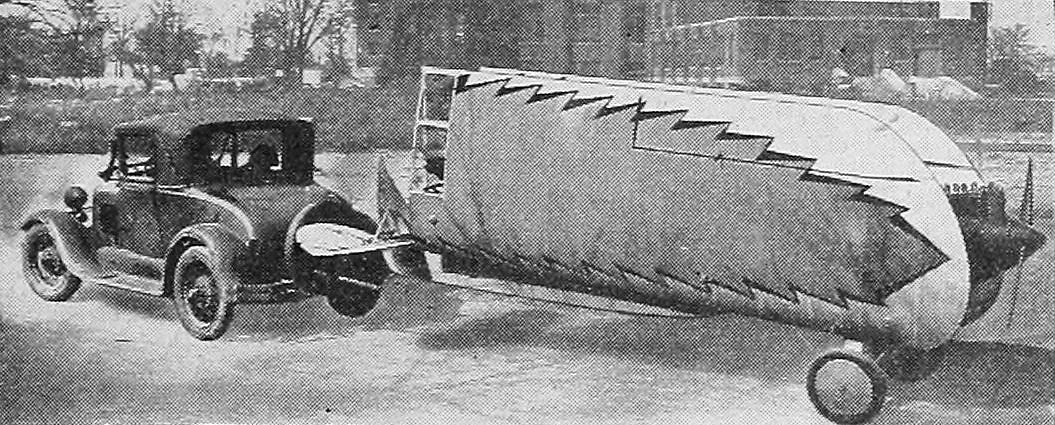
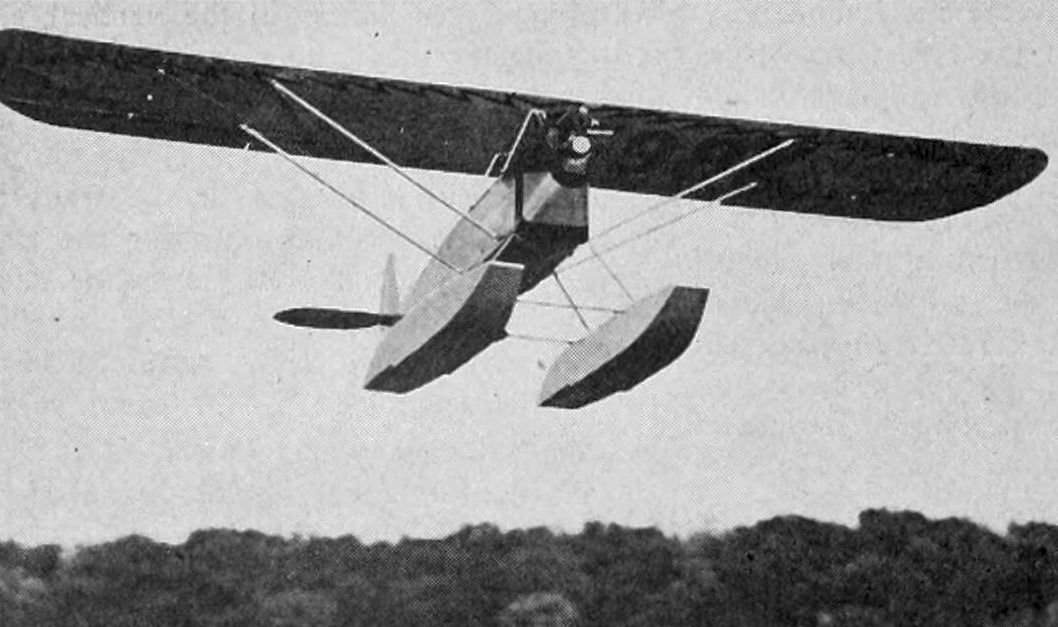
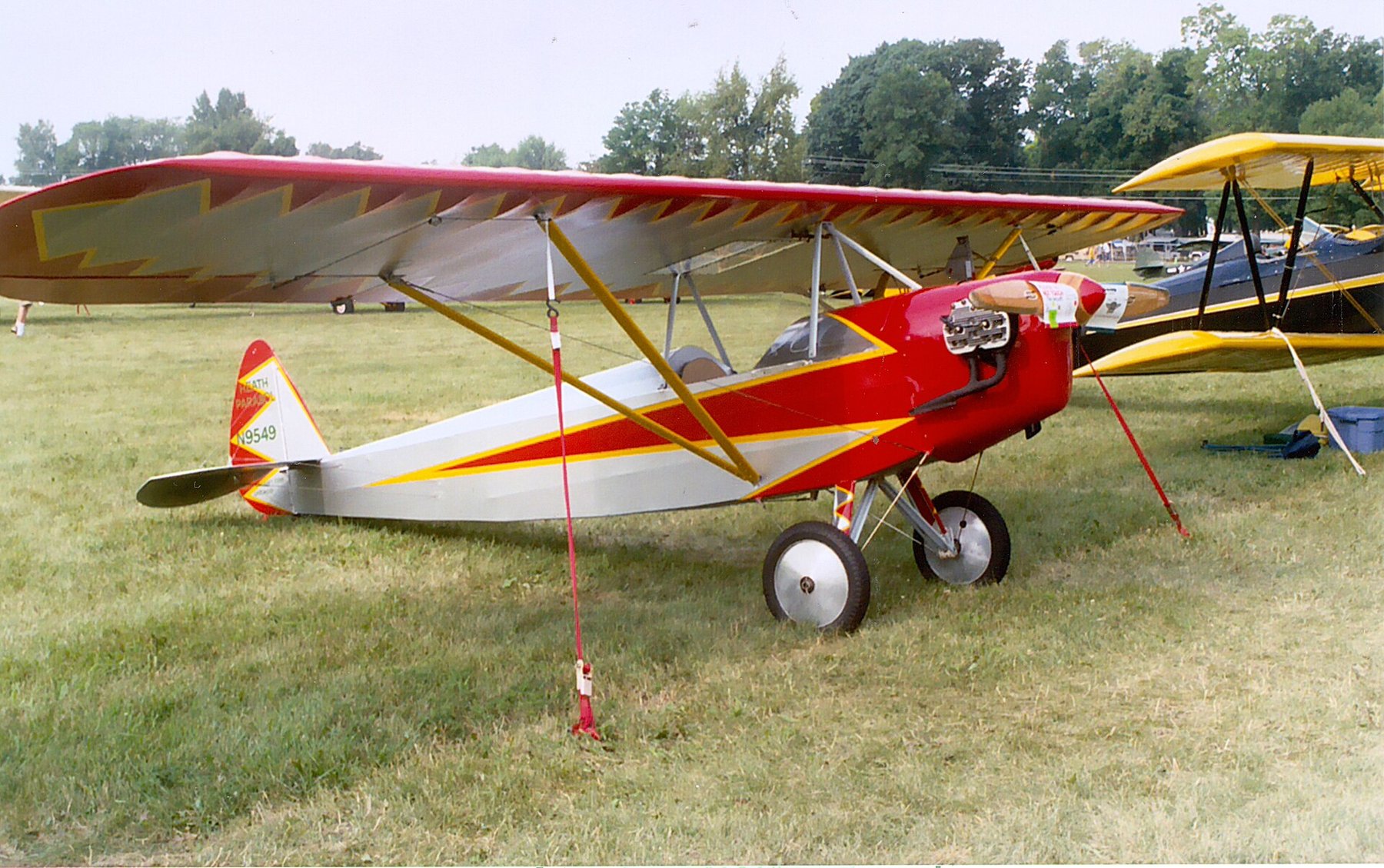
The V Parasol of 1930 was named for its V-shaped struts. It added quickly removable wings so that the aircraft could be stored in a garage and towed behind a car, a door for easier entry, a skylight in the wing centre so the fuel sight-gauge could be read, and (on factory aircraft) a welded Warren-truss fuselage. It was the model covered in the Popular Aviation series and, Aerofiles says, a popular home-builder project through the 1930s “with countless personal modifications.”
1.4.2 How many were built
No production records survive in the sources consulted, and the estimates differ by an order of magnitude on the factory side. The Museum of Flight and Wikipedia give about 1,000 kits and about 50 complete aircraft sold (Museum of Flight; Wikipedia). Aerofiles puts factory-assembled Parasols at fewer than ten, and kit sales at “well over 1,000, and perhaps as many sets of plans” (Aerofiles). Eckweiler believes nine factory LNB-4s were sold. The two figures can be reconciled if the “about 50” counts every factory-built Heath of all types rather than Parasols alone, but that could not be confirmed. The kit number, about a thousand, is consistent across sources.
At least a dozen Parasols survive in museums, including examples at the Museum of Flight in Seattle, the EAA Aviation Museum at Oshkosh (LNB-4, N953M), Old Rhinebeck Aerodrome (LNA-40), the New England Air Museum and the Air Zoo in Kalamazoo, Michigan, forty miles from the later Heath factory (Wikipedia). Others still fly.
1.5 The death of Ed Heath
By the end of 1930 a friend of Heath’s had rebuilt his own Parasol with the wing lowered to the middle of the fuselage, and Heath went further, designing a low-wing aircraft. Essentially a Parasol V with the wing attached at the bottom of the fuselage, it was braced by two struts on each side running up to the top longerons. On a low-wing aircraft, those struts are in compression under positive g rather than in tension. Eckweiler reports that they were rumoured to be aluminium rather than steel; one former employee, William Sandel, remembered the use of aluminium struts as “a completely new idea” of Heath’s and Lindstedt’s (Eckweiler #100; Sandel, Heath Stories #25).
On Sunday, 1 February 1931, Heath drove to the company airfield at Potter Road and Dempster Street in western Morton Grove, Illinois, near what is now Maine East High School. Two of his test pilots had flown the new aircraft the day before and reported that it handled well. Sandel recalled that Heath had told the test pilot to fly it gently and do no stunts, because he would do the final testing himself. Heath flew it that morning, took the crew to lunch, and went up again in the afternoon. Witnesses saw the right wing fold as he pulled out of a short dive (Sandel says a spin), and the aircraft fell from about 1,500 feet. Heath, who did not believe in wearing a parachute, was killed instantly at the age of 42 (Eckweiler #100; Sandel). Aerofiles identifies the aircraft as an experimental low-wing version of the LN series, registered X10717. Wikipedia gives the place of death as Maine Township, Cook County, citing the Illinois death index (Wikipedia).
Some later retellings put Heath in the Baby Bullet when he died. That is wrong: he was flying a new low-wing test aircraft. Brueschke and Mack give his age as 43, which is also wrong; he was eleven weeks past his 42nd birthday.
At the time of his death Popular Aviation was midway through his seven-part Parasol series, which Heath had evidently finished writing in advance; it continued to run through July 1931, with a short death notice in the fourth instalment.
1.6 Clinnin, Niles and International Aircraft
Three months after the crash, the company was sold. Brueschke and Mack say it was Heath’s mother who sold it, to General John V. Clinnin, a wealthy Chicago lawyer who had helped Heath incorporate the year before, and his brother Walter Clinnin, who took over on 1 May 1931 (Brueschke and Mack; Eckweiler #100). The Tech District video renders the name as “Walter Clinton”, which is an error for Clinnin.
Offered a rent-free and, by Sandel’s account, tax-free building in Niles, Michigan, the stockholders moved the business there, about seventy miles east of Chicago, with a staff cut to about twelve. A new head, Fred Seiler, and a new chief engineer, Charles Morris, took the Parasol through federal certification: state and federal regulators were starting to restrict unlicensed home-built aircraft, and some states briefly banned them outright. Morris lengthened the span to 31 feet 3 inches, added full-span ailerons, deepened the fuselage and enlarged the tail to produce the LNB-4, which received Approved Type Certificate 456 on 16 December 1931 and was advertised as the least expensive certified aircraft in the world. Its kit, less engine, sold for $399 plus $5 crating from Niles, later $269, and a factory-parts “knock-down” kit for $549. A kit could be licensed if a federal inspector examined the work as it went along; Heath’s literature explained that because a customer-built kit could not otherwise be licensed, the company offered “licensed assembly kits” with ribs built and all drilling and welding done (Hardie, in Heath Stories Supplement 3; Eckweiler #100).
Henderson stopped making motorcycles in 1931, which ended the supply of engines for the B-4 conversion. The answer was the 37 hp Continental A-40 in the LNA-40 (ATC 487, 3 June 1932) and the Center-Wing CNA-40 (ATC 495, 27 October 1932). Three CNA-40s flew at the Century of Progress exposition in Chicago in 1933. Sandel recalled that Walter Clinnin invested some of the remaining company money in the World’s Fair of 1933–34 and lost it.
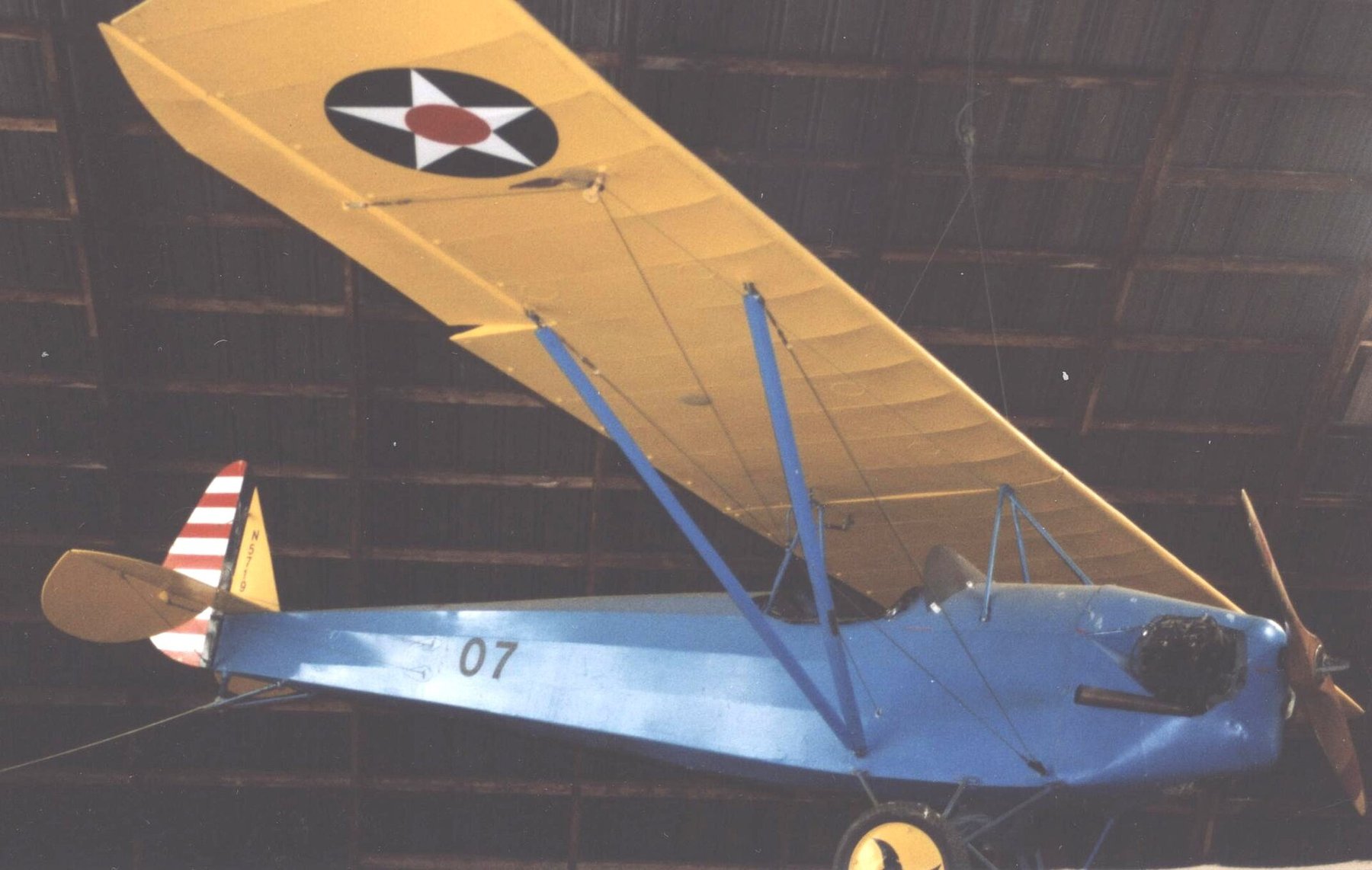
The company changed its name as its fortunes fell. Roger Lorenzen of Niles, hired by Ed Heath in 1928 and one of the largest stockholders, wrote that the Heath name was dropped in 1932 in favour of International Aircraft Corporation; Hardie dates the reorganization to 1933, Brueschke and Mack to 1934. Aircraft built from 1933 to 1935 were known as International-Heath (Lorenzen, Heath Stories #38; Aerofiles). This Niles company has no connection with the unrelated International Aircraft Corporation of Long Beach, California, and Cincinnati that built Catron and Fisk designs in 1927–1929 (Wikipedia, “International Aircraft”).
International Aircraft went bankrupt. Brueschke and Mack give 1934; Hardie says it was declared bankrupt in 1935; Lorenzen says the company “folded” in 1935. The bankruptcy most likely began at the end of 1934 and the assets were disposed of in 1935, which fits both.
1.7 Howard Anthony
Howard E. Anthony was born on 9 February 1912 in Dowagiac, Michigan, a small town about fifteen miles east of Niles (Find a Grave; Brueschke and Mack). He was twenty-three when he bought the Heath assets.
Recollections collected by Bjorn Heyning in the 1980s give a picture of him before Heath. Robert Paxson, whose brother Gordon was Anthony’s closest friend, remembered that as a high-school student Anthony designed a mains-powered radio receiver, built a dozen or so in a round-topped wooden cabinet on his kitchen table, sold them for $9.95 and found he had lost money on every one. He fitted a radio to his 1918 Dodge touring car, the first car radio the Paxson brothers had ever heard, with the chassis and batteries in a trunk behind the seat. After graduating from high school in about 1930 he spent at least a year at Hillsdale College, earning his tuition the next summer by growing cucumbers (Paxson, Heath Stories #58). Heyning, who knew him from 1943, believed he did not graduate from Hillsdale; Brueschke and Mack say he graduated in engineering. This could not be resolved from the sources available. Heyning also heard that Anthony had set up a small production line for radio receivers in his parents’ garage, with neighbour women doing the assembly, until zoning ended it (Heyning, Heath Stories #3). Brueschke and Mack say he ran a radio sales, service and custom design shop from 1932 to 1935, and a 1941 newspaper profile says he had previously worked for “a nationally-known radio company” (News-Palladium, 31 December 1941, in Heath Stories #39).
Brueschke and Mack, and Rich Post before them, say he built and flew his own aircraft at the age of twelve (Post). Both appear to draw on the same company-sourced biography, and no contemporary evidence for it was found; Sandel’s recollection that the Niles company built a racing aircraft for Anthony before the bankruptcy is the only other link between him and the Heath aircraft business before 1935. The claim is recorded here without endorsement.
1.7.1 How the Heath assets changed hands
Several accounts of the purchase survive, and they agree on the essentials while differing on the mechanism.
- The inventory. Anthony was brought in by the federal government to take an inventory of the bankrupt company. The News-Palladium said so in 1941, while he was alive: “Anthony, who had been called in by the U.S. government to inventory the bankrupt International Aircraft Corp., a few years ago, bought that firm” (Heath Stories #39). Brueschke and Mack say it was the Internal Revenue Service that asked him.
- The price. Heyning wrote in 1986 that Anthony “later told me that he had talked Helen out of her $300 life savings, and with that he had bought the company, its good name and some spare parts for the 3-cylinder Szekely engines” (Heath Stories #1). This first-hand report of Anthony’s own account is the earliest source for the $300 figure found in this research. The Model Builder repeated “$300” in 1973, and Brueschke and Mack say $300 “at auction”, including all assets and the rights to the Heath name. One company source gives a different figure. In an August 1982 speech, printed in the Heath users’ magazine Sextant in the winter of 1983, Heath president William E. Johnson said Anthony paid $700 for the Heath name in 1935 (Sextant no. 4). The $300 figure has the better provenance, since it comes from a colleague’s report of Anthony’s own words, but the discrepancy is unresolved.
- The kind of sale. Brueschke and Mack call it an IRS auction. Carl Helber recalled Anthony telling him in November 1951 that he had got the company “through some kind of a tax sale.” Gene D. Woods, an aircraft engineer who rented space from Heath in 1939 and later became its chief engineer, saw US Treasury Department tags on the office furniture and concluded the Anthonys had picked up Heath for back federal taxes (Helber, Heath Stories #52; Woods, Heath Stories #30).
- Helen. Helen Ballard had been Walter or John Clinnin’s secretary at the Niles company (the sources name each brother). Anthony courted and married her about the time of the purchase, and she ran the company’s finances from then until 1955. Whether the “$300 life savings” were a wife’s or a fiancée’s depends on the exact date of the wedding, which the sources do not give.
1.7.2 Did the Heath name come with it?
One dissent deserves recording. In a 1989 letter, Roger Lorenzen, the former Heath employee and stockholder, wrote that nobody at the old company understood how “a nobody” had acquired all the machines, materials and semi-finished parts for so little money. He said Anthony first moved the equipment to Dowagiac, not Benton Harbor; first called the business “Anthony Aircraft”; and changed the name to Heath Company only later. When Lorenzen objected that Anthony had bought only the equipment and not the name, Anthony replied, by Lorenzen’s account, “Yes, I know, but Helen has an uncle by that name and we will say it came from there.” Lorenzen had also written to the Chicago Tribune in 1974 to correct an article linking the electronics company to Ed Heath (Lorenzen, Heath Stories #38).
Lorenzen’s view is one man’s recollection at fifty years’ distance, and it conflicts with Anthony’s own account to Heyning that he had bought “its good name.” But it is not unsupported. The Heath name had been off the letterhead since 1932 or 1933, and the new owner did continue to sell Parasol literature, kits and parts under the Heath name, which suggests either that he bought the rights or that nobody was left to object. The truth could not be established here. What is certain is that the electronics company, from its first days, presented itself as the continuation of Ed Heath’s business, and that its later management took some trouble to maintain that connection.
1.8 Benton Harbor, 1936–1941
By January 1936 Anthony had moved to Benton Harbor, on the Lake Michigan shore; a Herald-Palladium notice of 1 January 1937 is the source Eckweiler cites for the move (Eckweiler #100). The company took a bay or two in the Baker-Vawter building on Park Street, space that Lorenzen remembered as fenced off with chicken wire. In June 1939 Heath occupied about 3,000 square feet there, and when Gene Woods returned to join the company in September 1940 it had exactly four people: Howard, Helen, a self-taught pilot and builder called Lee Smaglinski, and an office clerk. Woods’s first job was to put on paper the designs for products that existed only in Anthony’s head (Woods, Heath Stories #30).
The first years were close to destitution. Paxson remembered the Anthonys advertising Parasol literature in aviation and home-mechanics magazines for a dime, going to the post office every morning to shake the dimes out of the envelopes, and buying breakfast with the day’s receipts. They lived in one rented room. Heyning heard that for a couple of weeks they survived on canned fruit that a cannery stored in the basement of the Baker-Vawter building, and that Anthony paid it back as soon as airport operators paid for his tailwheels. Lorenzen, called in to make parts, recalled being paid in whatever he could find on the shelves, and paying for the groceries and cinema tickets himself when the Anthonys had no money. An annuity left to Anthony by his grandfather may have kept the business alive (Heath Stories #3, #30, #38, #58).
The company lived on what was left of the Parasol stock (Henderson engines, valves, parts and kits) while Anthony looked for a product. It was, Paxson wrote, a replacement light-plane tailwheel tyre from a mould Anthony had made and a local rubber company produced. Goodyear’s equivalent cost about $5.95; Heath’s sold for $2.00, in a one-inch advertisement Paxson himself wrote at his brother’s advertising agency. A complete tailwheel assembly followed, designed to bolt onto the tailskids of Piper Cubs, Taylorcrafts and Aeroncas. Ralph Lhotka, hired straight out of high school to machine the castings, became Anthony’s right hand for the next twenty years.
The product line that followed shows the same habit of mind that would later produce the Heathkit: find a need among small operators that the big suppliers ignored, and meet it for a fraction of the going price.
- The Heath Airphone, a speaking tube for open-cockpit trainers. A rubber mouthpiece for the instructor fed a rubber hose to modified earphones for the student. It cost $5, sold “by the thousands” and was standard equipment in training aircraft; Anthony claimed more pilots had been trained with it than without.
- Inspection covers, carburettor air filters, tie-down stakes that screwed into the ground and weighed two pounds, and skis.
- Moulded Plexiglas windshields for Aeronca, Taylorcraft and Piper aircraft, formed by heating the sheet in an oven and draping it over form blocks. By 1941 one could be made every six minutes, and Heath was among the pioneers of non-yellowing plastic windshields.
- The Heath radio, a compact aircraft receiver built by Meissner Manufacturing of Mount Carmel, Illinois, to Anthony’s specification after he discovered that the $125 RCA aircraft receiver he had been made to buy for Chicago Municipal airport was a long-wave version of a $25 car radio. The Meissner set, later designated MA-4 and MA-4A, used filament tubes so it could run from dry cells held in a drawer under the chassis, replaceable in flight, and had a switch for fixed-tuned 278 kc control-tower reception. Heyning gives the price as $39.50 through airport operators; the 1941 News-Palladium says $50 retail, “an item on which the company constantly is sold out.”
- Plywood seaplane floats with four watertight bulkheads, designed by the engineer Gene Woods and tested on Paw Paw Lake and Austin Lake, at $500 a pair.
Sources: News-Palladium, 31 December 1941, Heath Stories #39; Heyning, Heath Stories #1–4; Paxson, #58.
By 1941 the company, now styled Heath Aviation Company, had fifteen employees, business “topping the $150,000 mark”, a 300 per cent increase for the year, an A-10 priority rating, and a claim to be the largest maker of aircraft tailwheels in the United States, supplying parts to the government’s 3,000 civilian pilot-training schools. It planned to add the building at 305 Territorial Road, with 4,000 square feet, to the 3,000 square feet it held in the Industrial Building at 304 Park Street. The sales manager was Don Reagan and the production manager a former Benton Harbor high-school teacher, Donald Elferdink (News-Palladium, 31 December 1941). Paxson recalled that by 1941 Heath’s advertising ran in Aero Digest, Aviation, Popular Aviation, Air Facts and, most profitably, Trade-A-Plane, in advertisements up to 7 by 17 inches showing eighteen products.
Anthony owned a Parasol for a while, flew it to Dowagiac, and is said to have crashed it and broken his jaw. He once drove to Colorado to repossess a Parasol on which the buyer had stopped paying, and burned the tyres off its wheels towing it home too fast.
1.9 The war
When Bjorn Heyning, a Norwegian-born radio engineer with a degree from Tri-State College, answered Anthony’s call for a “radio man” and moved to Benton Harbor in August 1943, the plant occupied the lower floor of 305 Territorial, below street level and subject to flooding from Ox Creek, with overflow space across the alley in the Baker-Vawter building. The office staff was Howard and Helen, Cliff Edwards (advertising), Don Reagan (sales), Gene Woods (chief engineer), Chuck Christy (draughtsman) and Dick Cook (purchasing) (Heyning, Heath Stories #2). Heyning’s first jobs were checking every Meissner receiver before shipment and putting into production a four-tube, 6-volt aircraft transmitter, the HT-4, working on the then-universal 3105 and 6210 kc frequencies and based on a prototype from Southwest Airmotive at Love Field, Dallas. Several hundred were built and sold under A-2 priority to the Civil Air Patrol and War Training Service.
The war work that followed, as recorded by Heyning, Paxson and a 1973 company history:
- Skids for the Waco CG-4A cargo glider, the standard American assault glider. Anthony had a local boilermaker weld a frame round two Ausco hydraulic jacks, making a press that squeezed laminated wood blanks between steam-heated moulds. It took a few weeks to reach production.
- Moulded Plexiglas canopies and “bubbles” for military aircraft, pulled over moulds by hand with vise-grips as the hot sheet cooled.
- Floats and windshields for light observation aircraft such as the Stinson L-5.
- Direction-finding loop antennas for the Civil Air Patrol and War Training Service. Anthony avoided the noisy slip rings of conventional loops by limiting rotation to a little over 360 degrees with a stack of washers and connecting the loop with flexible tinsel wire, which let him sell a loop for under a third of the price of competing models.
- Receivers: the battery-powered HBR-4 and HBR-5, designed by Heyning for the beacon (200–400 kHz) and broadcast bands and built on a four-person line with Heyning’s step-by-step assembly instructions on file cards. That was already the Heathkit manual in miniature.
- Vacuum-tube voltmeters for Don St. Clair, a Chicago designer who arrived asking for scrap Plexiglas for chassis. Heath made the metal chassis and cabinets and ran the assembly line while St. Clair calibrated on weekends. Heyning called this “a forerunner of our own Heathkit version, the V-1.”
Sources: Heyning, Heath Stories #1–4 and #8; Evans and Heyning, Heath Stories #55.
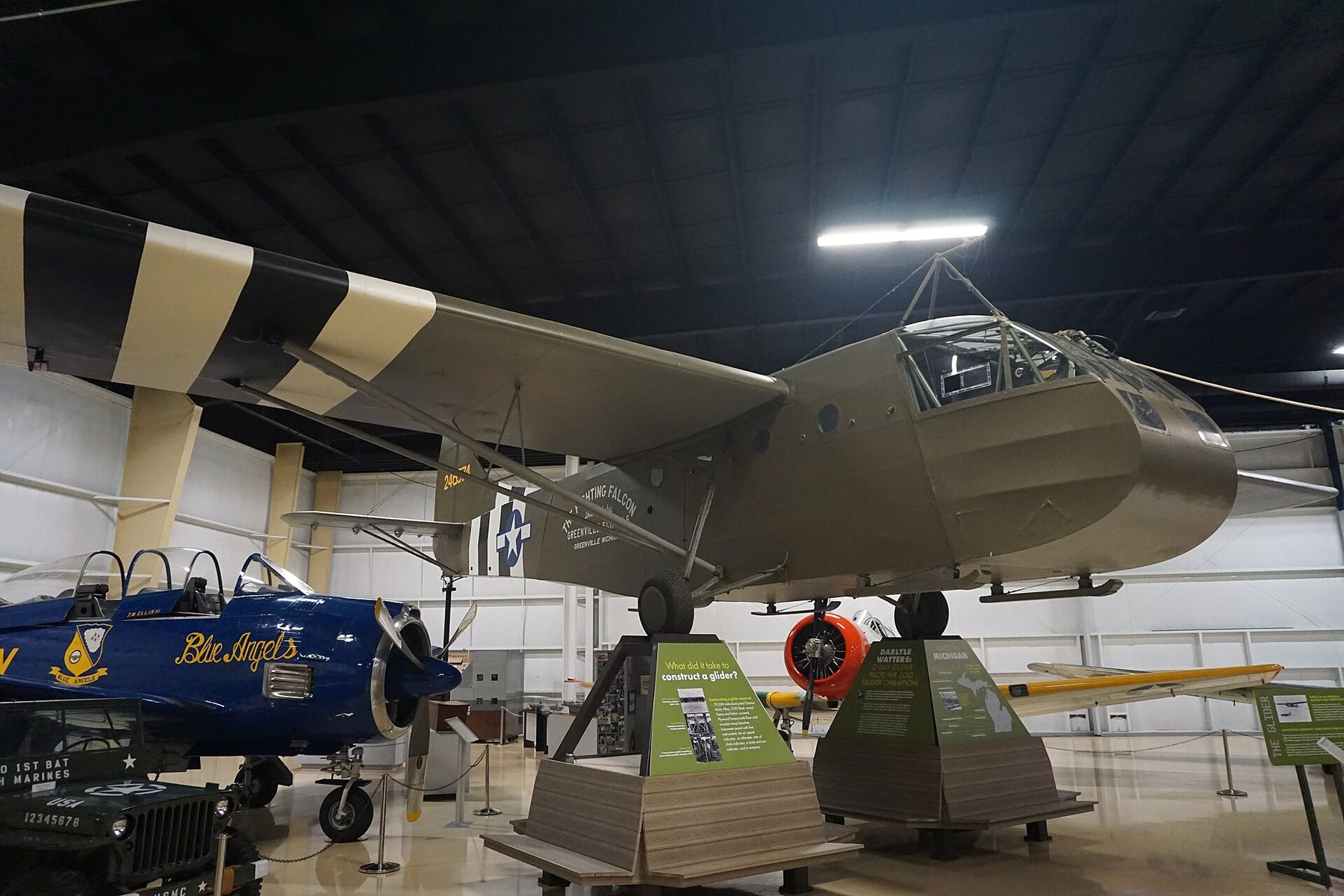
Anthony also experimented with fibreglass. He hired a consultant, Charlie Skogland, to develop a moulding process for floats, then commissioned the yacht designer John Alden to draw a seven-foot fibreglass dinghy, sold as the “HeathCraft by John Alden.” The round-bottomed dinghy capsized if boarded off-centre, and a later fibreglass fishing boat leaked through porous spots; neither sold (Heyning, Heath Stories #4).
The employee count peaked at more than 125. Staff remembered the Anthonys as generous employers: company-paid Blue Cross and Blue Shield from 1943, lavish Christmas parties, a line of children’s wagons built after hours when toy wagons were unobtainable, fitted with Heath ball-bearing tailwheels. Anthony also spent spare time during the war building an oscilloscope from magazine circuits and experimenting with bridges (Heath Stories #3, #13).
1.10 The collapse of 1945–1946
The defence contracts ended with the war in the summer of 1945, and private flying did not recover quickly enough to replace them. Worse, Heyning recalled, without wartime priorities a small firm like Heath could expect to wait years for components such as tuning capacitors while RCA and the large makers claimed the supply. In the spring of 1946 the staff fell “from over 125 to only 8”; Anthony arranged for Heyning himself to move to Wilmak Corporation (Heyning, Heath Stories #5). The 1973 company history in The Model Builder says “from more than 125 employees to less than 10.” Wikipedia’s figure of five employees (Wikipedia) is not supported by these first-hand accounts.
Anthony found other work. The News-Palladium’s review of 1946 at Ross Field notes that “Howard Anthony, head of the Heath company, has converted several Cessna T-50’s for local airmen, and will continue until the sale of the surplus aircraft is discontinued by the government” (Heath Stories Supplement 3).
1.11 The surplus business
The way out was war surplus, as it had been for Ed Heath in 1919. Heyning credits Anthony’s flying friends Charles and Herman Zollar with teaching him how to bid on government surplus lots. They bought jointly at first, including crates of spark plugs for fourteen-cylinder radial engines, but split the venture when a Zollar failed to put the proceeds of one sale into the common fund. The Zollars kept the aircraft parts and formed Aircraft Components Inc. at the airport; Anthony kept the radio parts. Heyning called that division “the key to the change at Heath from Aircraft to Radio business” (Heath Stories #5).
Anthony bought at something like five to fifteen cents on the dollar, and soon had several warehouses full. He opened a surplus store in the old basement office at 305 Territorial and sold much of the stock by mail and through advertisements in Radio News. Military whip antennas were sold as collapsible fishing poles; ammunition boxes and crystal cases as tool boxes. Heath also sold complete wartime radio equipment to radio amateurs (the BC-375 transmitter, SCR-522 VHF sets, BC-454/455 “command set” receivers) and designed a kit to run command sets from the mains, with a custom transformer from K. C. “Casey” Retzlaff of Grand Transformer in Grand Haven. To catalogue and find everything in the warehouses, Anthony hired H. C. “Curley” Knapp, who toured the buildings noting what was worth selling, built a numbered list and set up the bins and racks from which, soon, women packers filled bags with kit parts (Heyning, Heath Stories #5–6).
How the surplus arrived became a legend of its own. Paxson recalled that Anthony “bid and won a carload of unknown crated materiel”, containing two radio transmitting stations, a quantity of typewriters, Astrographs (a navigation instrument for pilots) and large numbers of radio and radar tubes and parts. Hank Evans remembered Anthony going to Washington “to talk the government into selling him some surplus”, after which he “suddenly had warehouses full”, and the two of them working late filling paper bags of assorted parts to sell for a dollar (Heath Stories #55, #58). The number of railway cars grows with each retelling: “a carload” (Paxson), “four boxcars of surplus military parts” (USA Today, 1983), “three or five boxcar loads” (Leibson, 2024), and five in the Tech District video. No primary document giving a count was found. A later Heath employee described a trailer load of electronic components bought on the West Coast arriving in Benton Harbor in the late 1940s or early 1950s, so the surplus came in over years and in several lots, not in one famous train (Heath Stories #21; Heath Stories #18; Leibson, EE Journal).
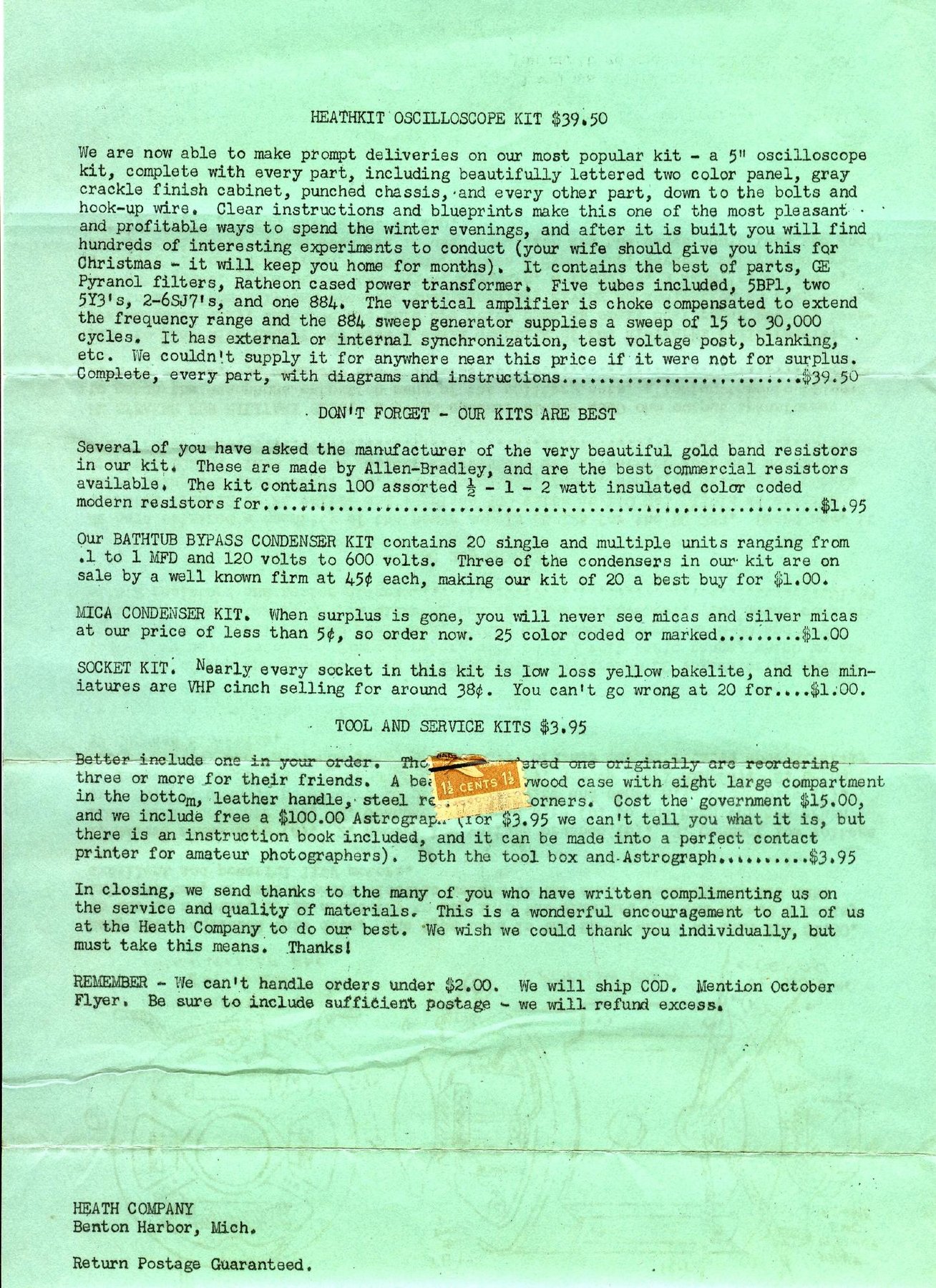
The October 1947 Heath flyer, printed on green paper, shows what the business was on the eve of the kits: a surplus house offering a new GE BC-375 150-watt transmitter for $9.95, dynamotor-to-motor conversion instructions, PE-125 power supplies, 5-inch speakers, RT-7/APN-1 radar altimeters “for $9.95 you can have a lot of fun”, kits of Allen-Bradley resistors, bathtub condensers, mica condensers and sockets at $1 or $1.95 a bag, and a tool box with a free Astrograph thrown in. It is signed “Heath Company, Benton Harbor, Mich.” and sets a $2 minimum order, cash on delivery available (Heath October flyer, 1947, worldradiohistory.com).
1.12 The oscilloscope
Among the surplus were cathode-ray tubes, hundreds of type 5BP1 by Heyning’s recollection. The 5BP1 was a five-inch electrostatic-deflection tube with a green P1 phosphor, the standard wartime oscilloscope and radar indicator tube. Eckweiler records the rumour that Heath bought “a boxcar full” and notes that some turned out to have P4 white phosphor, so Heath later specified either tube (Eckweiler, Heathkit of the Month #85). An oscilloscope in 1947 was an expensive laboratory and service tool, typically $80 to $200 or more factory-built, and one that radio servicemen increasingly needed for FM and television work.
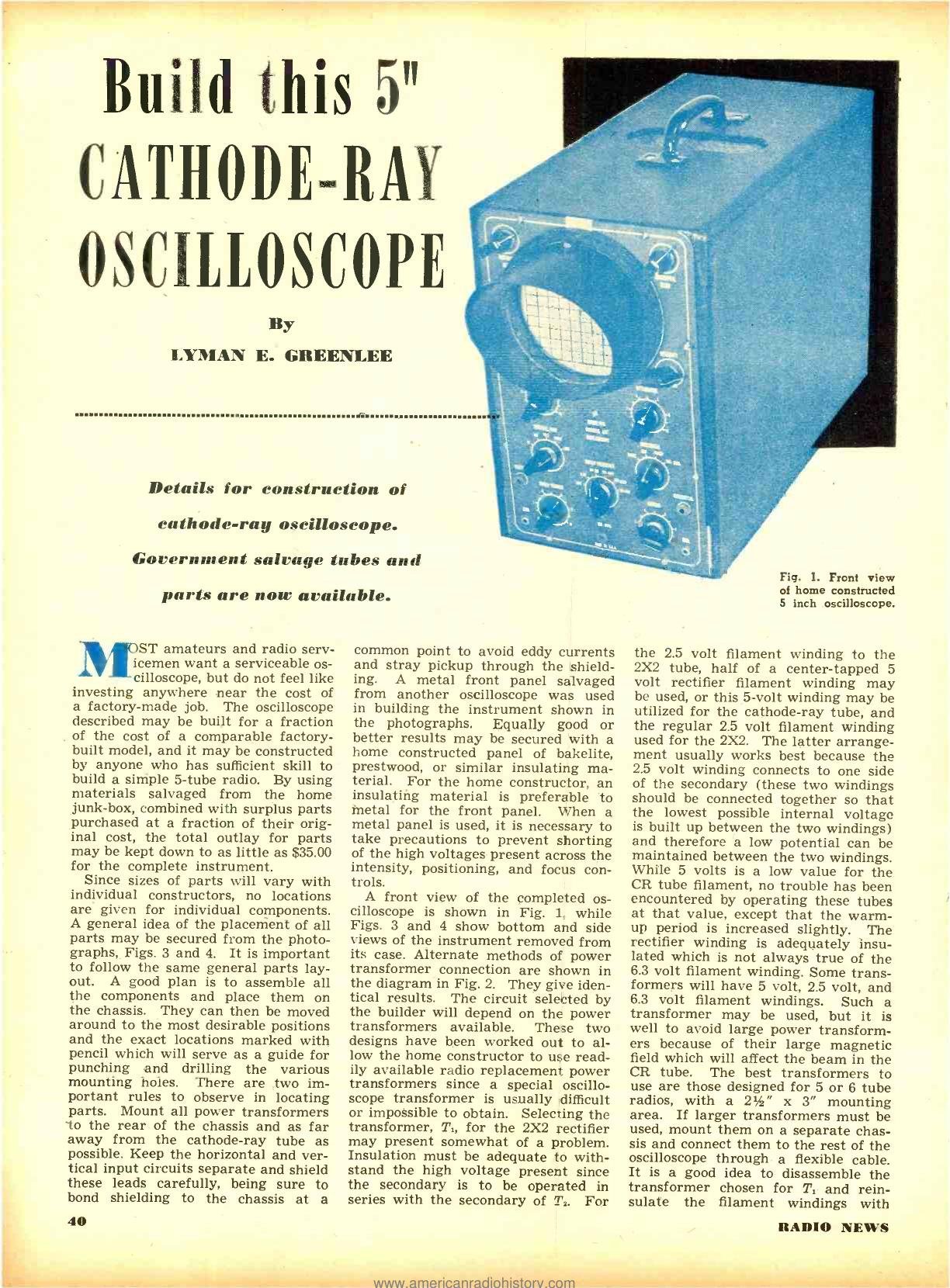
The idea of making the tubes into kits had a specific, documented source. In October 1946 Radio News published “Build This 5” Cathode-Ray Oscilloscope” by Lyman E. Greenlee, subtitled “Details for construction of cathode-ray oscilloscope. Government salvage tubes and parts are now available.” Greenlee estimated that a builder could make the instrument for about $35 from surplus parts, but the builder still had to find the parts, lay out and drill the chassis and make a front panel. In 2018 a collector who had acquired magazines from Anthony’s personal library found this issue with Anthony’s handwritten notes on the schematic, and Brueschke and Mack, comparing it with the O-1 circuit, found the two “nearly identical, except for the power supply” (Brueschke and Mack; Radio News, October 1946; Post, “The Heathkit Legacy”).
Anthony had considered test equipment in kit form before the war. Heyning heard that he had suggested it to the Hickok Electrical Instrument Company and been laughed at, and a 1974 internal history by Heyning repeats it (Heath Stories #5, #13). Before the war there had been Meissner receiver kits, Allied Radio’s Knight-Kit beginner sets, Thordarson amplifier kits and Stancor transmitter kits, and Gernsback’s Electro Importing Company had sold wireless kits as early as 1905 (Brueschke and Mack). What Heyning stressed was that “none were really complete kits.” Anthony’s would include every part, a finished cabinet and a lettered panel.
A couple of months’ work produced a prototype. On 18 April 1947 the Heath Company filed to register “Heathkit” as a trade name (Brueschke and Mack). Then, in the July 1947 issue of Radio News, at the bottom of a one-third-page column headed “Heath Electronic Surplus Bargains”, among Weston ammeters, Bakelite rod by the pound and Cutler-Hammer toggle switches, came a nine-line paragraph:
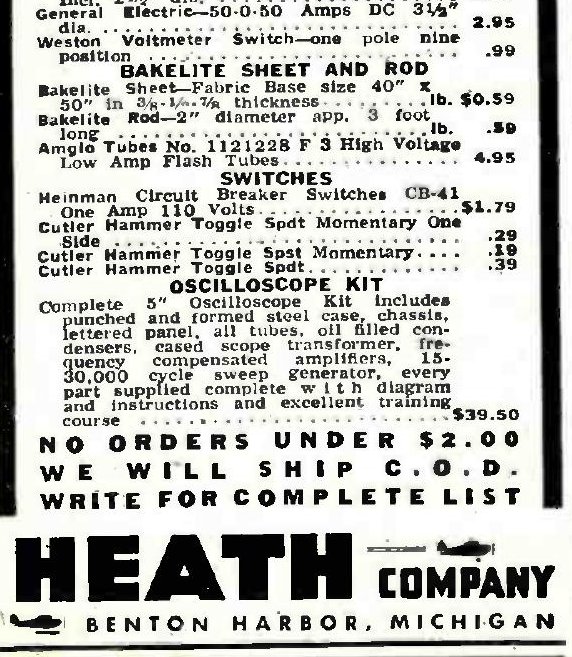
The text offered a “Complete 5” Oscilloscope Kit” with a punched and formed steel case and chassis, lettered panel, all tubes, oil-filled condensers, a cased scope transformer, frequency-compensated amplifiers and a 15–30,000 cycle sweep generator, “every part supplied complete with diagram and instructions and excellent training course”, for $39.50. The small aircraft flanking the Heath Company name in the logo appear, as Brueschke and Mack observe, to be Parasols (Radio News, July 1947, p. 122).
The kit had no model number. Collectors call it the O-1 only because its successor carried “O-2” on its panel (Eckweiler #85). It weighed about 55 pounds, mostly because of its huge sealed surplus power transformer with ceramic terminals, and measured 15 by 10 by 17 inches in a grey crackle steel cabinet. It used five tubes and the CRT: two 5Y3 rectifiers (one for B+ and one, wired as a single diode, for about –1,000 V on the CRT), two 6SJ7 pentodes as vertical and horizontal amplifiers, and an 884 gas-thyratron sawtooth sweep generator. The panel was cream-beige and maroon, lettered “Heathkit” in script, with push-in binding posts that were themselves surplus. The cast aluminium bezel for the tube was turned on a lathe at Heath by the machinist Jimmy Pakela (Eckweiler #85; Heyning, Heath Stories #5).
Anthony wrote the instructions himself. They came to three legal-size sheets, or five according to Eckweiler: schematic, parts list, instructions, construction notes and an isometric drawing, with sketches by Cliff Edwards, who also silk-screened the panels. Component values were not on the schematic but on a separate parts sheet (Heyning #5, #7; Eckweiler #85).
1.12.1 How fast the orders came
Heyning, who was working elsewhere that summer, wrote that the small advertisement “brought a stream of orders” and kept Anthony busy packing kits himself. Brueschke and Mack say the “tremendous response to an initial trial of 100 oscilloscope kits” persuaded Anthony to pursue the line. Wikipedia’s often-repeated version, that “500 flyers offering the kit for $39.95 resulted in 350 orders”, cites a 1983 report of a talk at the Heath Users’ Group conference in Sextant magazine (Wikipedia). That article was not consulted here, and no contemporary source for the 500 and 350 figures was found. The anecdote may be true, but it rests on a single retelling thirty-six years after the event. It also quotes the wrong price: every surviving 1947 advertisement and flyer gives $39.50, not $39.95.
What the primary sources do show is that the oscilloscope became the centre of the business within months. The September 1947 Radio News advertisement showed the kit for the first time and was the first to use the name “Heathkit” in print, under the heading “Heathkit 5” Oscilloscope.” In the October 1947 flyer the surplus house called it “our most popular kit” and promised prompt delivery; the same flyer suggested that “your wife should give you this for Christmas – it will keep you home for months” and admitted: “We couldn’t supply it for anywhere near this price if it were not for surplus” (Eckweiler #85; October 1947 flyer). A 1948 school flyer claimed, perhaps generously, that Heathkit oscilloscopes had “been under development and test since 1943”, presumably a reference to Anthony’s wartime tinkering (Heath schools flyer, 1948).
In October 1947 Anthony rehired Bjorn Heyning and set him to work on the second kit, a vacuum-tube voltmeter. The Heath Company that Ed Heath had founded to sell aeroplane parts was about to become the largest maker of electronic kits in the world. The next volume follows that change, from the O-1 to the day in July 1954 when Anthony, like Heath before him, died in an aircraft.
1.13 Summary of dates
Table 6 — Summary of dates
| Date | Event |
|---|---|
| 17 Nov 1888 | Edward Bayard Heath born, New York |
| 1909–1910 | First Heath aircraft at Amsterdam, NY; parts business in Chicago (dates disputed) |
| 1911 or 1912 | Heath buys the Bates aircraft firm, Chicago; E. B. Heath Aerial Vehicle Co. |
| 1919 | 24-page catalogue of “knockdown” aircraft; Feather designed |
| 1922 | Favorite biplane on a surplus Jenny fuselage |
| 1926 | Tomboy wins at Philadelphia; Parasol designed with Clare Lindstedt |
| Feb 1927 | Parasol announced; first complete construction kit |
| 1928 | Super Parasol; fire at 2856 Broadway; Baby Bullet wins at Los Angeles |
| 1930 | V Parasol; “How to Build” series begins in Popular Aviation |
| 1 Feb 1931 | Heath killed testing a low-wing aircraft at Morton Grove, Illinois, aged 42 |
| 1 May 1931 | Walter and John Clinnin take control; move to Niles, Michigan |
| 16 Dec 1931 | LNB-4 certificated (ATC 456) |
| 1932 | LNA-40 (ATC 487) and CNA-40 (ATC 495) certificated |
| 1932–1934 | Company renamed International Aircraft Corporation |
| 1934–1935 | Bankruptcy; Howard Anthony buys the assets, reportedly for $300 (one 1982 company source says $700) |
| Jan 1936 | Anthony moves the business to Benton Harbor |
| 1941 | Heath Aviation Co.: 15 employees, about $150,000 in sales |
| 1942–1945 | War work; peak of more than 125 employees |
| Spring 1946 | Staff falls to 8; surplus dealing begins |
| Oct 1946 | Greenlee oscilloscope article in Radio News |
| 18 Apr 1947 | ”Heathkit” trade-name registration filed |
| Jul 1947 | First oscilloscope kit advertised, $39.50 |
| Sep 1947 | First printed use of “Heathkit” in an advertisement |
Sources
- Brueschke, Erich E., and Michael Mack. “The History of the Heath Companies and Heathkits: 1909 to 2019.” The AWA Review 32 (2019), pp. 125–164. Internet Archive.
- Eckweiler, Bob (AF6C). “Heathkit of the Month #100: Heath Parasol Airplane.” RF (Orange County Amateur Radio Club), April 2020. PDF.
- Eckweiler, Bob. “Heathkit of the Month #85: Heathkit ‘O’ Series Oscilloscopes Part I.” RF, June 2018. PDF.
- Heyning, Bjorn, ed. Heath Stories, vols. 1–2 and supplements (1986–1990), transcribed by Bill Wilkinson. Index; vol. 1; Supplement 1; Supplement 2; vol. 2; Supplement 3; Supplement 4. Includes the News-Palladium articles of 31 December 1941 and July 1954, Hardie’s EAA Experimenter article, The Model Builder (1973) and USA Today (1983).
- Aerofiles. “American airplanes: Heath, International-Heath.” aerofiles.com.
- The Museum of Flight. “Heath Parasol.” museumofflight.org.
- Penson, Chuck (WA7ZZE). “Heathkit’s 50th.” Electric Radio, January 1997; QST, April 1997. Heathkit Virtual Museum.
- Heathkit Virtual Museum. “History.” heathkit-museum.com.
- Post, Rich (KB8TAD). “The Heathkit Legacy.” Monitoring Times, July 2013. boatanchorpix.
- Leibson, Steven. “The Rise and Fall of Heathkit – Part 1: Early Days.” EE Journal, 11 November 2024. eejournal.com.
- Hi-Fi Hall of Fame. “Heathkit.” hifihalloffame.com.
- Wikipedia (leads only): “Heathkit”; “Edward Bayard Heath”; “Heath Parasol”; “International Aircraft”.
- Find a Grave. “Howard E. Anthony (1912–1954).” findagrave.com.
- Radio News, October 1946 and July 1947, via worldradiohistory.com.
- Heath Company. October flyer, 1947. worldradiohistory.com.
- Heath Company. Schools flyer, 1948. worldradiohistory.com.
- Peek, Chet. The Heath Story. Norman, Oklahoma: Three Peaks Publishing, 2003. Cited through Eckweiler and Brueschke and Mack; not consulted directly.
Comments (0)