Heathkit · Volume 5
Heathkit Goes Digital
In the autumn of 1977 a company best known for oscilloscopes, stereo amplifiers and amateur radio transmitters shipped its first general-purpose digital computer. Within three years computers made up about 40 percent of Heath Company sales. Within four, Heath had been bought by a television maker that wanted the computer business and had little use for anything else. This volume covers the years from 1974 to about 1985, when the kit company in Benton Harbor, Michigan, briefly became one of the largest personal-computer makers in the United States. It traces the people who pushed the project, the machines they built (the H8, H11, H9, H17, H19, H88, H89 and H100), the software that made them usable, the ET-3400 microprocessor trainer, and the HERO 1 robot. It also covers how quickly the computer line came to dominate the company.
5.1 A company that had “always been interested in computers”
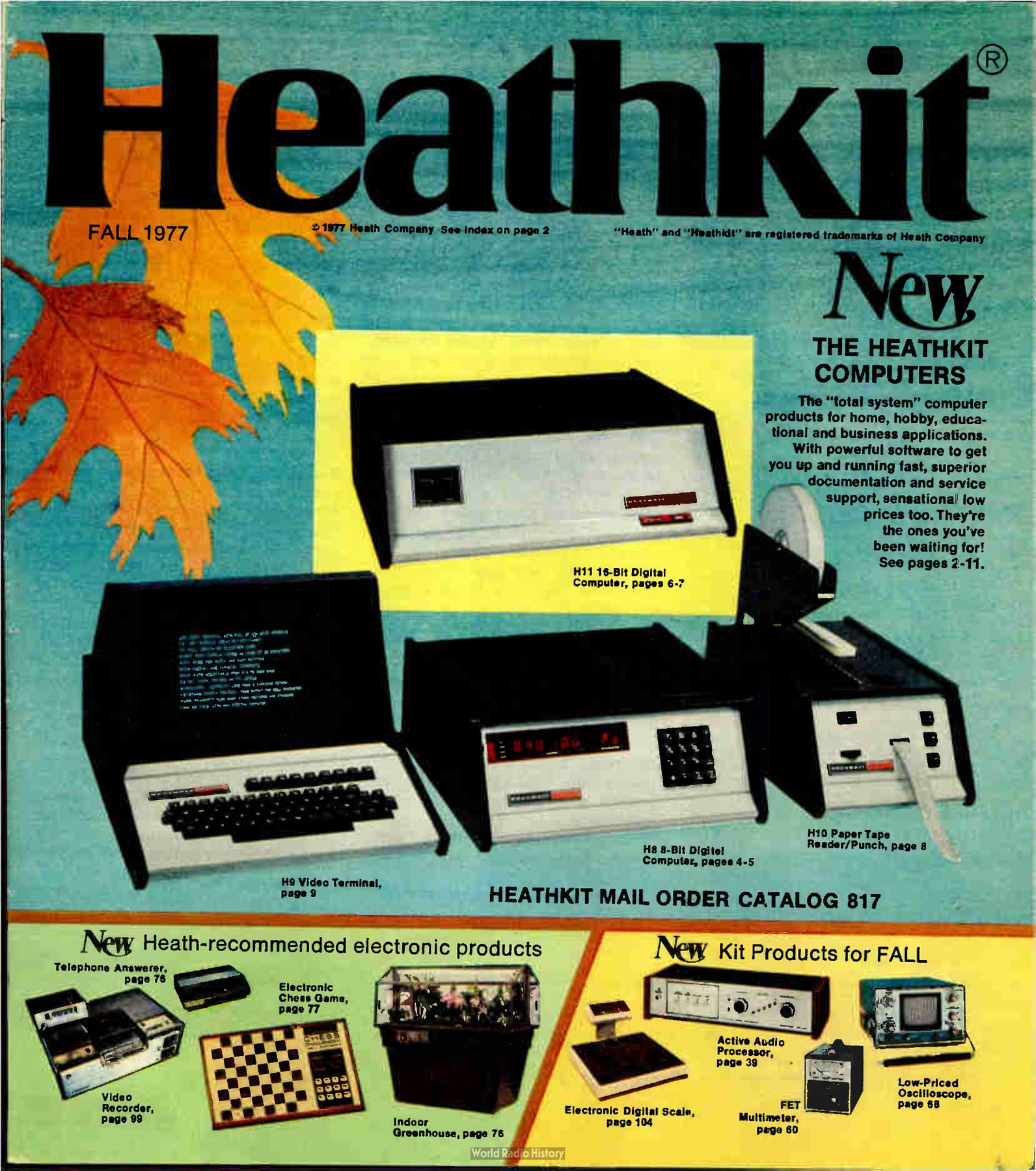
Heath’s microcomputers did not come from nowhere. The company had sold an analog computer kit in the late 1950s, the EC-1 educational analog computer and its larger relatives, and the Fall 1977 catalogue began its computer section by pointing back to it. Heath, the copy said, “has been interested and involved in personal computing since we first marketed an analog computer system all the way back in 1957” (Heathkit catalogue 817, Fall 1977, p. 2). In 1982 the retired Heath president David Nurse told Sextant magazine much the same thing: “Heath had always been interested in computers” (Zimmerman, Sextant no. 3, Fall 1982, p. 11).
Interest is not a product line, however. The push for a digital computer came from the engineering and product-management staff, and the two names that recur in every first-hand account are Louis E. (Lou) Frenzel and Chas Gilmore.
Frenzel had designed a computer-training kit for McGraw-Hill’s National Radio Institute (NRI) in 1972. He joined Heath in 1973 and later served as its computer product-line manager (Frenzel, Electronic Design, 30 December 2013). Gilmore had joined Heath in 1966 as a design engineer in the scientific-instruments group. By 1976 he was director of engineering for Heath’s technical products, which put him in charge of the design groups that would build the computers (Leibson, EEJournal, “The Rise and Fall of Heathkit, Part 3”).
5.1.1 The 1974 argument
Frenzel told Sextant in 1982 that he and several colleagues began lobbying for a microcomputer project in 1974. An opposing faction, made up of people whose work centred on Heath’s traditional consumer lines, asked the obvious question: what would anyone do with one (Sextant no. 3, p. 11)? Gilmore remembered the executive reaction in blunter terms when Steven Leibson interviewed him in October 2024: “What the hell is somebody gonna do with a computer? Balance a checkbook?” (EEJournal, Part 3).
What changed the argument was the MITS Altair 8800 on the cover of Popular Electronics in January 1975. The Altair was a kit, sold by mail order to exactly the kind of customer who already bought Heathkits, and it sold in thousands. In the Sextant account the Altair’s reception “overwhelmed” the resistance, and Heath began the H8 project soon after. Gilmore’s 2024 recollection attributes the wake-up call to “that 1975 article in Radio-Electronics on the Altair”. The Altair article ran in Popular Electronics, however, and Radio-Electronics had published the Mark-8 in 1974. The substance is the same either way: a competitor had proved that kit computers sold.
5.2 Building the H8
5.2.1 Choosing a processor
The first engineering decision was the microprocessor. According to Sextant’s 1982 interviews with the design team, Heath looked at the Motorola 6800, the MOS Technology 6502 and the Signetics 2650, and the choice came down to the 6800 against the Intel 8080. Many of Heath’s engineers preferred the 6800 because they thought a 6800 machine would be easier to design. Frenzel made what he called an “unpopular” decision in favour of the 8080, because he believed “there was more software available for the 8080 than the 6800”. That mattered to a company that knew it had no software expertise. The Zilog Z80, which later became the favourite 8-bit processor for small business machines, was not a realistic option; as Frenzel put it, “The Z80 didn’t exist!” when the design was frozen (Sextant no. 3, pp. 13–14).
The software worry was well founded. One engineer at the meeting that launched the computer line reportedly said: “All right, we’ll build a computer, but we’re not going to get involved in software!” (Sextant no. 3, p. 11).
5.2.2 The Benton Harbor bus
The second decision drew more criticism later. Heath did not adopt the Altair’s 100-pin bus, which was becoming the hobbyist standard as the S-100. It designed its own 50-line bus instead, later called the “Benton Harbor bus”. The hardware engineer on the H8, Neal Beneditz, told Sextant that the cabinet had already been styled and an S-100 card cage would not have fitted, but that “cost was the primary concern”. Frenzel stressed how young and unreliable the technology still was: “No one had ever heard of the S100! And the early versions of the bus were glitchy.” Tom Yeager, another engineer closely involved in the design, gave a third reason. Heath “didn’t want to encourage suppliers, many of whom were unreliable at that time… to build weird hardware accessories, then have Heath get blamed when the computer didn’t work” (Sextant no. 3, p. 13).
Behind all three answers lay Heath’s customer-service promise. The company would help any buyer get any kit working, and a machine full of unvetted third-party cards threatened that. As Frenzel put it, “If they started getting too many returns, it would put the company out of business.” The irony, which Sextant noted in 1982, is that H8 owners later complained that too few accessories existed for the proprietary bus.
5.2.3 Memory and the front panel
Heath expected the H8 to need 16 KB of memory, 32 KB at the most. A late survey of hobbyists had “guessed rather low”, in Frenzel’s words, and memory chips were “horribly expensive” in 1976. Both Beneditz and the software designer J. Gordon Letwin told Sextant that they had personally thought 16 KB would be enough. Memory prices then fell quickly, and by the time the first H8s shipped the company expected owners to want the full 64 KB. The cabinet had been designed for at most 32 KB and had no fan. A reader told Sextant that with 56 KB and I/O cards installed his machine “nearly fries” (Sextant no. 3, pp. 12–14).
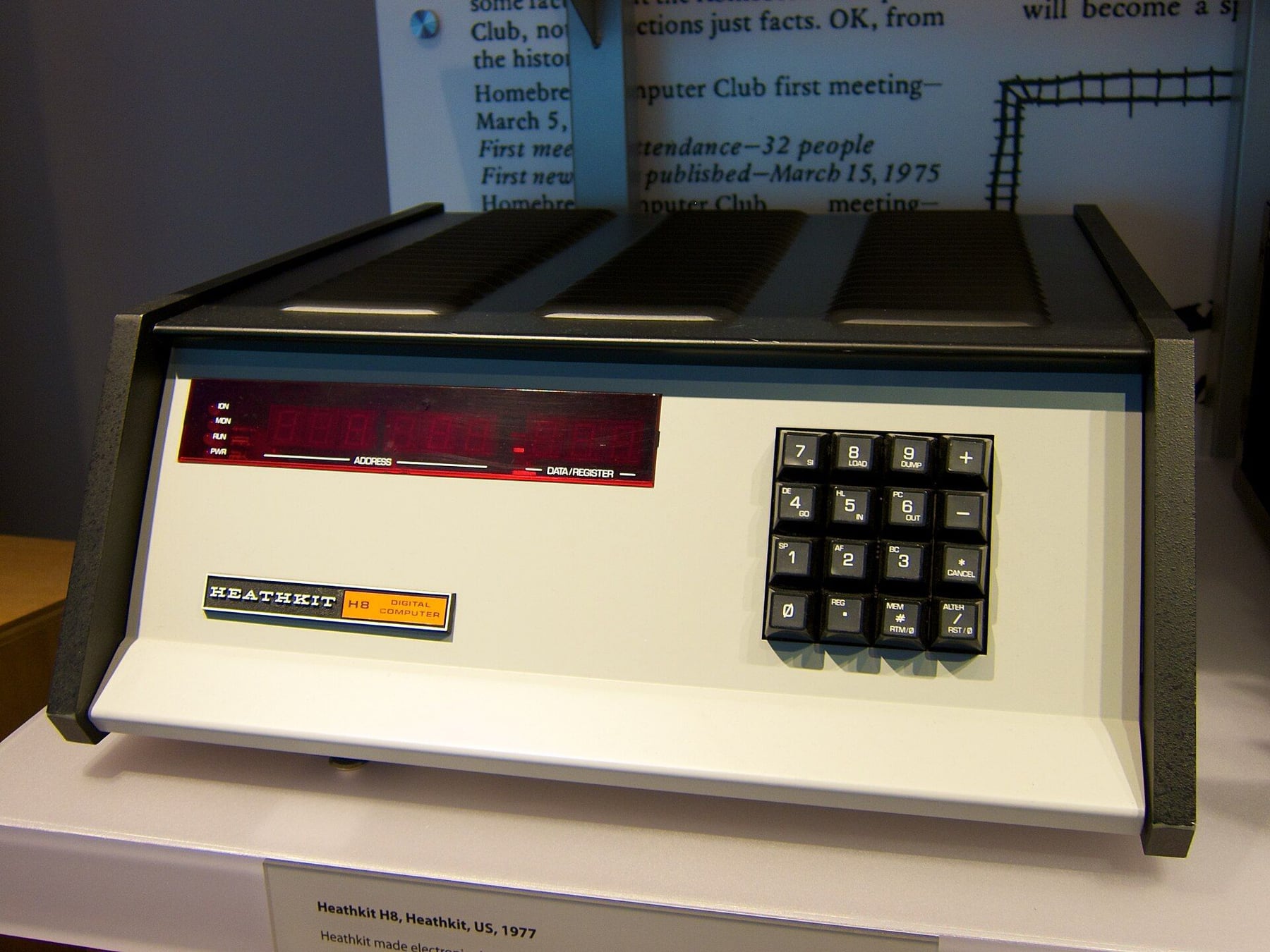
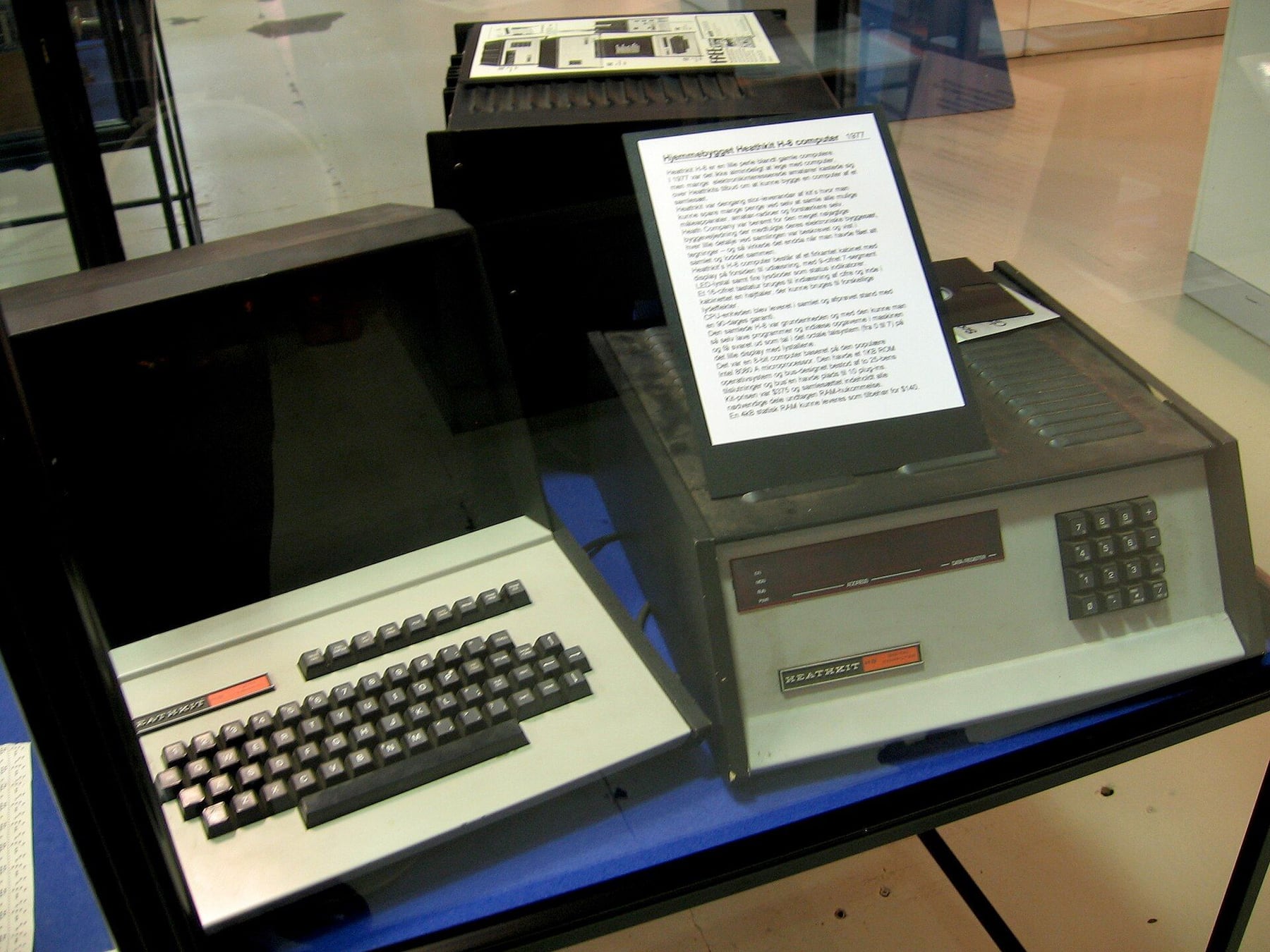
The H8’s front panel was its most distinctive feature. Instead of the Altair’s rows of toggle switches and lamps, it had a 16-key keypad and a nine-digit seven-segment LED display, run by a resident monitor program in ROM (PAM-8). An owner could examine and change memory and registers, and single-step a program, without buying a terminal. Entry was in octal, not hexadecimal, which reflected the 8080’s instruction encoding and DEC minicomputer habits, and puzzled later users. The panel was also a pricing strategy. It kept the entry-level system within reach of an ordinary Heathkit buyer, who could add a terminal, more memory and storage later.
5.3 The 1977 launch
5.3.1 Announcement, show and first shipment
Heath announced the H8 and H11 in the summer of 1977. Computerworld reported on 4 July 1977 that the company, with about $90 million in 1976 sales, hoped computers would soon provide more than 20 percent of its revenue (Surden, Computerworld, 4 July 1977, p. 35, as cited in the Wikipedia article on Heathkit; the original page could not be read for this volume). Gilmore told Leibson that Heath “introduced the H8 in August of 1977 at the first annual PC Show in Atlantic City” (EEJournal, Part 3). Sextant’s fifth-anniversary article dates the first H8 shipment to September 1977, and Beneditz confirmed that month (Sextant no. 3, pp. 11–12).
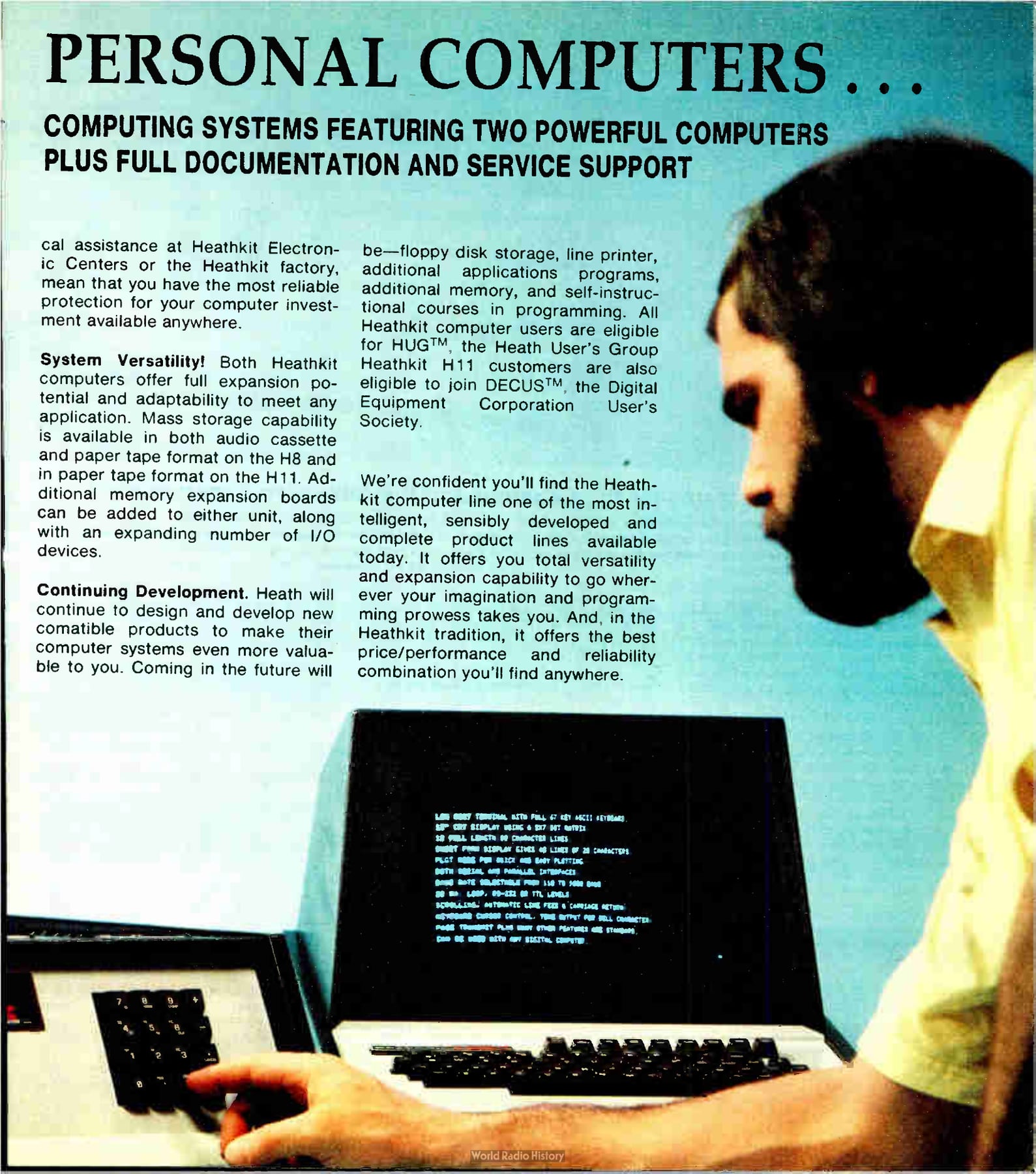
That was the same year as the Apple II, the Commodore PET and the Radio Shack TRS-80, the three machines usually called the “1977 trinity”. Heath’s machines are rarely mentioned in that company. The Heath machines were a different kind of product, however. They were sold as a system with peripherals, systems software and full documentation, to customers who expected to build and understand their equipment.
5.3.2 What was on offer in the Fall 1977 catalogue
The Fall 1977 catalogue (No. 817) devoted pages 2 to 11 to “The Heathkit Computers”. It is the earliest primary price list for the line, and its figures differ from the ones usually repeated online:
Table 1 — The Fall 1977 catalogue (No. 817) devoted pages 2 to 11 to "The Heathkit Computers". It is the earliest primary price list for the line, and its figures differ from the ones usually repeated online
| Item | Description | Fall 1977 kit price |
|---|---|---|
| H8 | 8080A computer, front panel, cabinet and power supply | $375.00 |
| H8-1 | 4K static-RAM memory card | $140.00 |
| H8-3 | 4K RAM chip set (to expand an H8-1 to 8K) | $95.00 |
| H8-2 | Parallel interface | $150.00 |
| H8-5 | Serial I/O and cassette interface | $110.00 |
| H9 | Video terminal (12 lines of 80 characters) | $530.00 |
| H10 | Paper-tape reader/punch | $350.00 |
| H11 | DEC LSI-11 16-bit computer | $1,295.00 |
| H11-1 | 4K × 16-bit memory module | $275.00 |
| H11-5 | Serial interface | $95.00 |
Source: Heathkit catalogue 817, Fall 1977, pp. 4–10; prices repeated in the Christmas 1977 catalogue (No. 818).
The H8 price widely quoted today, $379, is not the launch catalogue price. Both 1977 catalogues list the H8 kit at $375. The price rose to $395 in the Winter and Spring 1978 catalogues and came back to $379 in the Winter 1979 catalogue (Winter 1978; Spring 1978; Winter 1979). The $379 figure in secondary sources (for example oldcomputers.net and the Wikipedia H8 article) may come from a July 1977 announcement advertisement. That could not be confirmed, so the catalogue figure is used here.
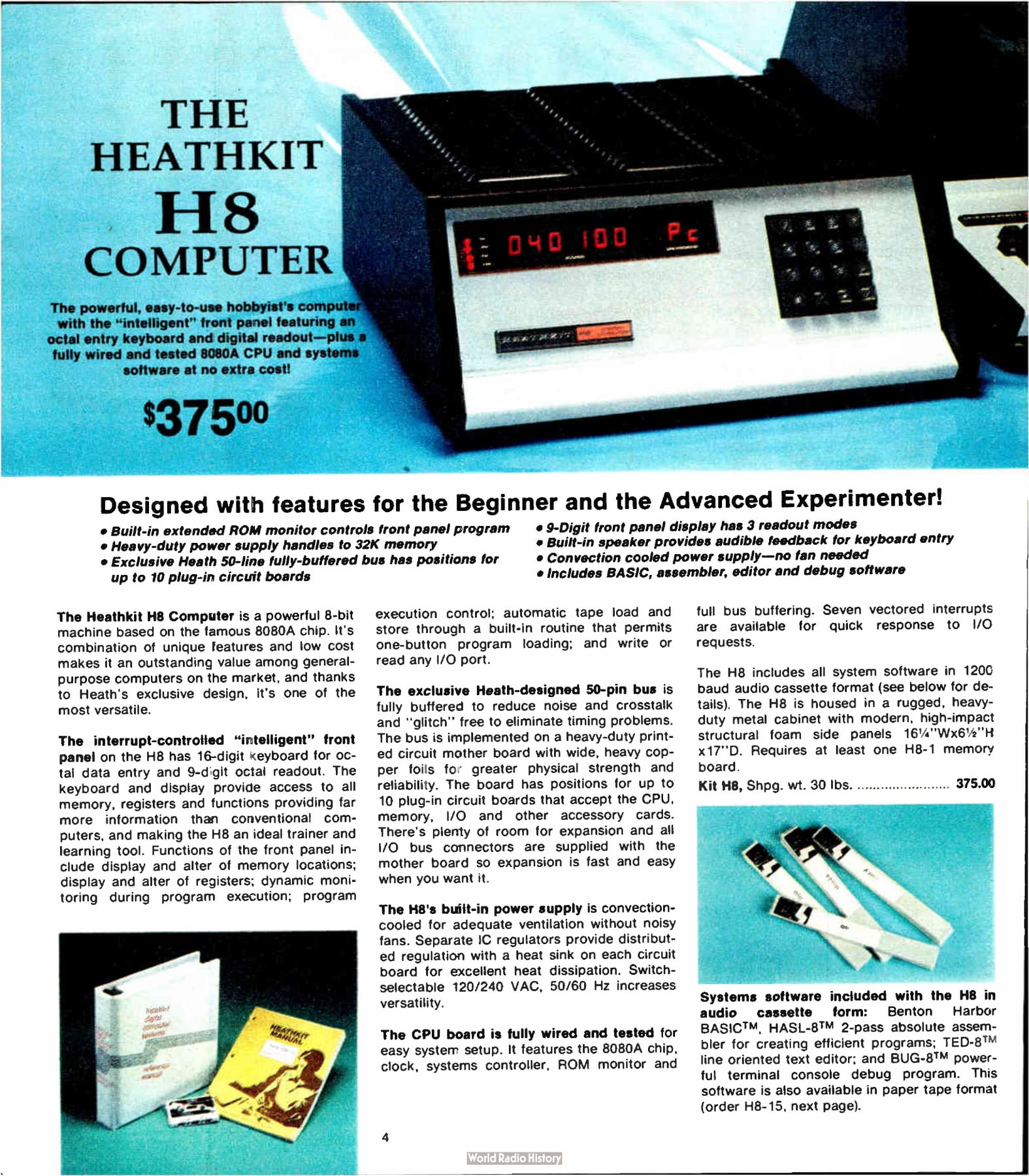
A bare H8 could not do much. The $375 bought the chassis, power supply, front panel and CPU card, but no memory. A usable cassette-based system needed at least an H8-1 memory card and an H8-5 serial and cassette card, plus a terminal or a teletype. The Brueschke and Mack history notes that the CPU board was shipped preassembled while everything else came as a kit (Brueschke & Mack, AWA Review vol. 32, 2019, p. 150).
5.3.3 The H11: a PDP-11 in kit form
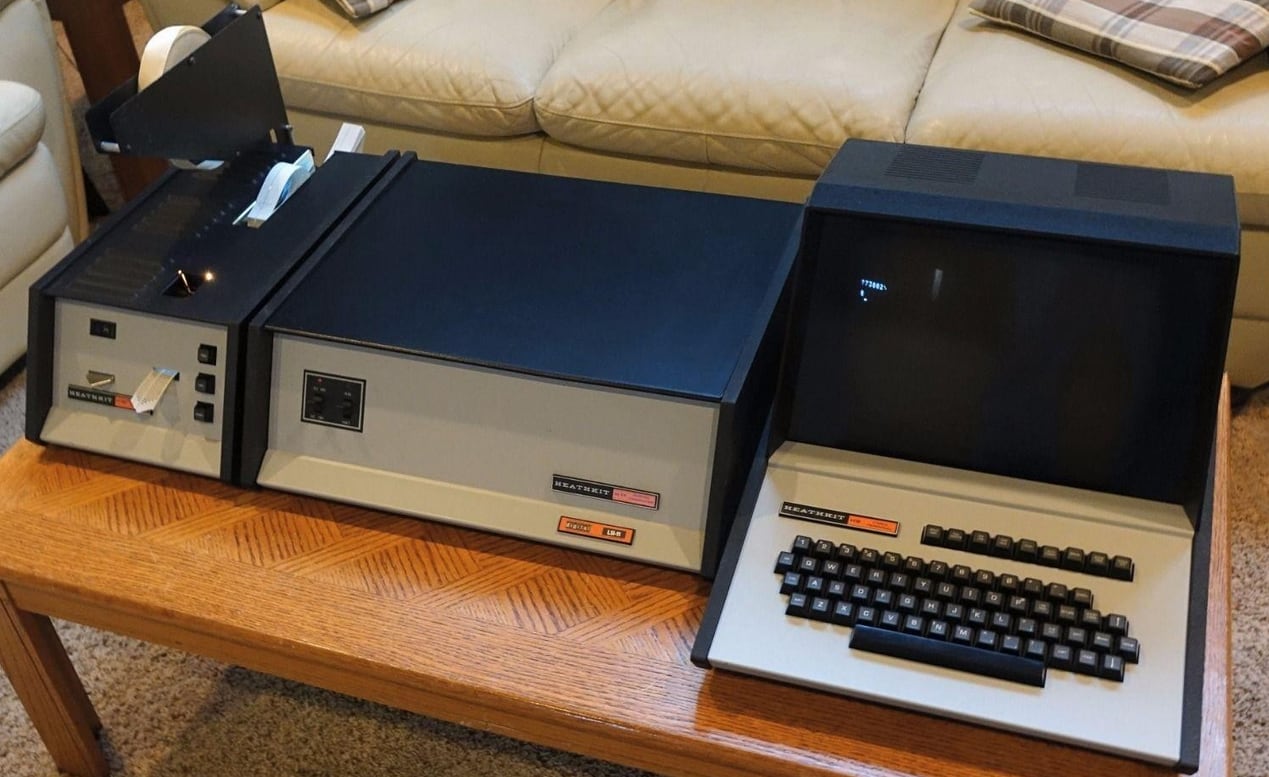
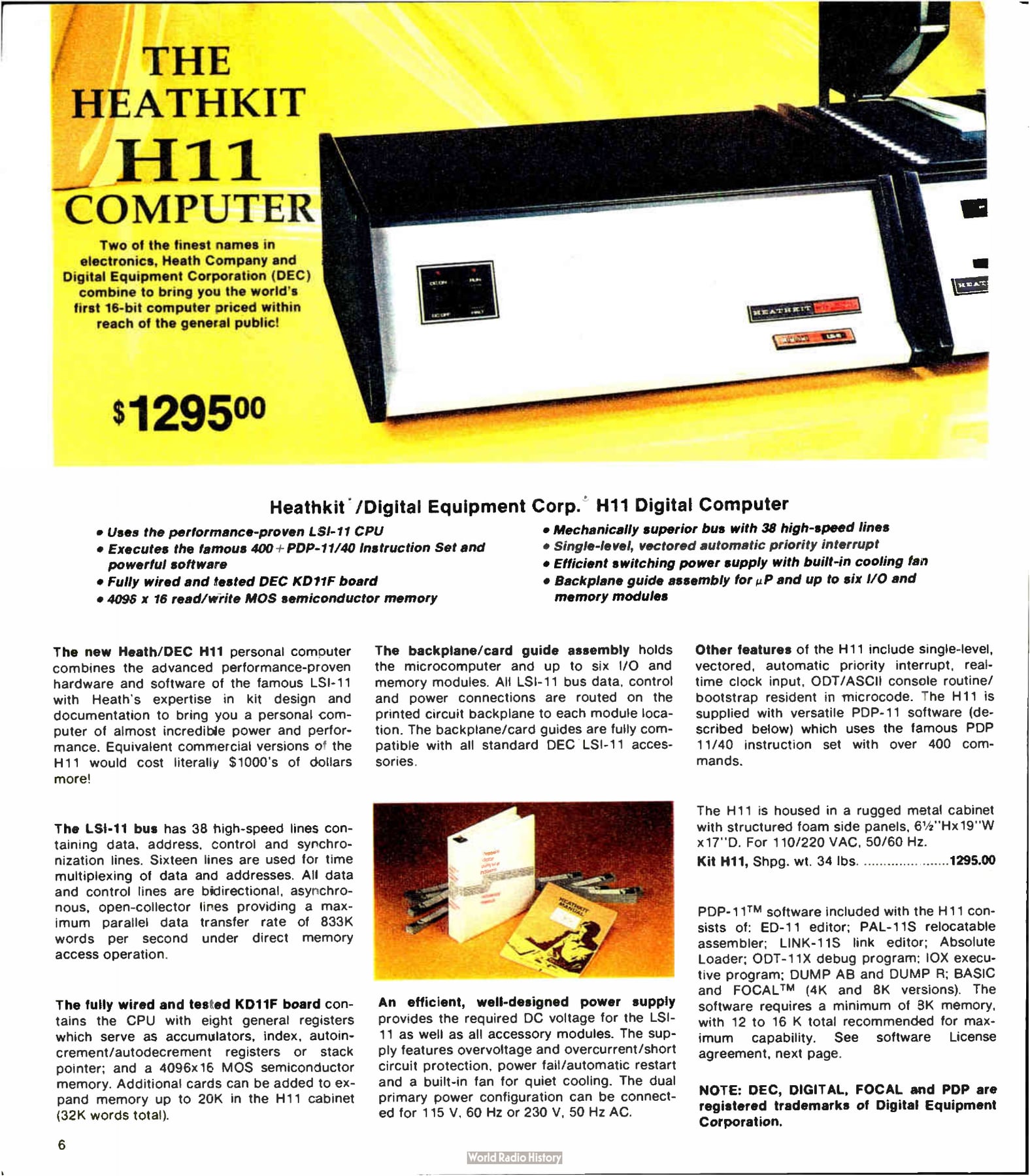
The second machine was more ambitious. The H11 put Digital Equipment Corporation’s LSI-11 processor board (the KD11-F, a four-chip implementation of the PDP-11 instruction set) into a Heath cabinet with a Heath backplane and power supply. The catalogue called it “the world’s first 16-bit computer priced within reach of the general public”, and the “Heathkit/Digital Equipment Corp. H11”. At $1,295 for the kit with no memory it was more than three times the price of an H8, but it ran real PDP-11 software. Heath supplied PDP-11 software on paper tape, and H11 buyers were eligible to join DECUS, DEC’s user society (catalogue 817, pp. 6–7).
The DEC connection carried legal baggage. Every H11 order had to be accompanied by a signed software-licence agreement. The catalogue printed the form with the warning “This form MUST accompany your H11 computer order.” A September 1977 advertisement (reproduced by nosher.net as from BYTE) gave the delivery date: “The H11 and all its accessories will be available November 15th, 1977” (nosher.net). BYTE reported in November 1979 that Heath had entered into a three-year contract with DEC (BYTE, November 1979, “BYTE News”).
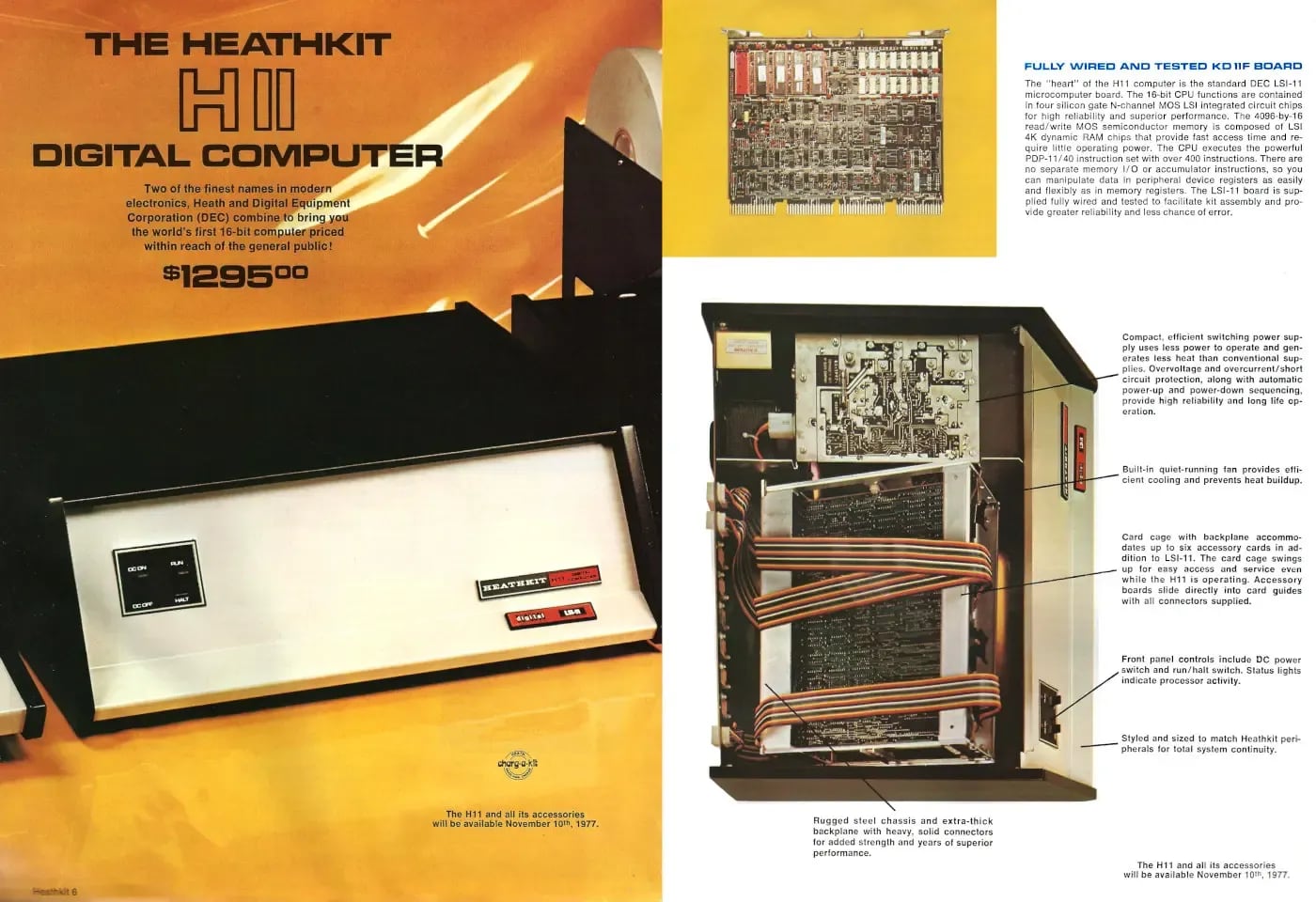
The H11 was never a volume product. Its price rose to $1,350 in 1978. It was replaced by the H11A at $1,195 in the Fall 1979 catalogue (Fall 1979, p. 37). InfoWorld reported it discontinued in 1982, and most accounts agree it was too expensive for the typical Heathkit customer (Wikipedia, “Heathkit H11”, citing Wise, InfoWorld, 13 September 1982). Gilmore’s and Frenzel’s accounts also describe a strategic limit. Heath engineers concluded that DEC’s low-end PDP-11 parts could not carry the company to more powerful systems at a Heathkit price.
5.3.4 The H9 and H10
Heath designed its own peripherals to match. The H9 video terminal displayed twelve lines of eighty upper-case characters on a 12-inch CRT and had a full keyboard and an RS-232 or current-loop interface. It sold for $530 as a kit in 1977 (catalogue 817, p. 9). Sextant recorded that the engineer designing the H9 “left to work for Atari” during the project (Sextant no. 3, p. 12). The H10 paper-tape reader/punch ($350) worked at about ten characters per second. Frenzel later wrote that it sold poorly (Frenzel, 2013).
5.3.5 The H17 floppy disk
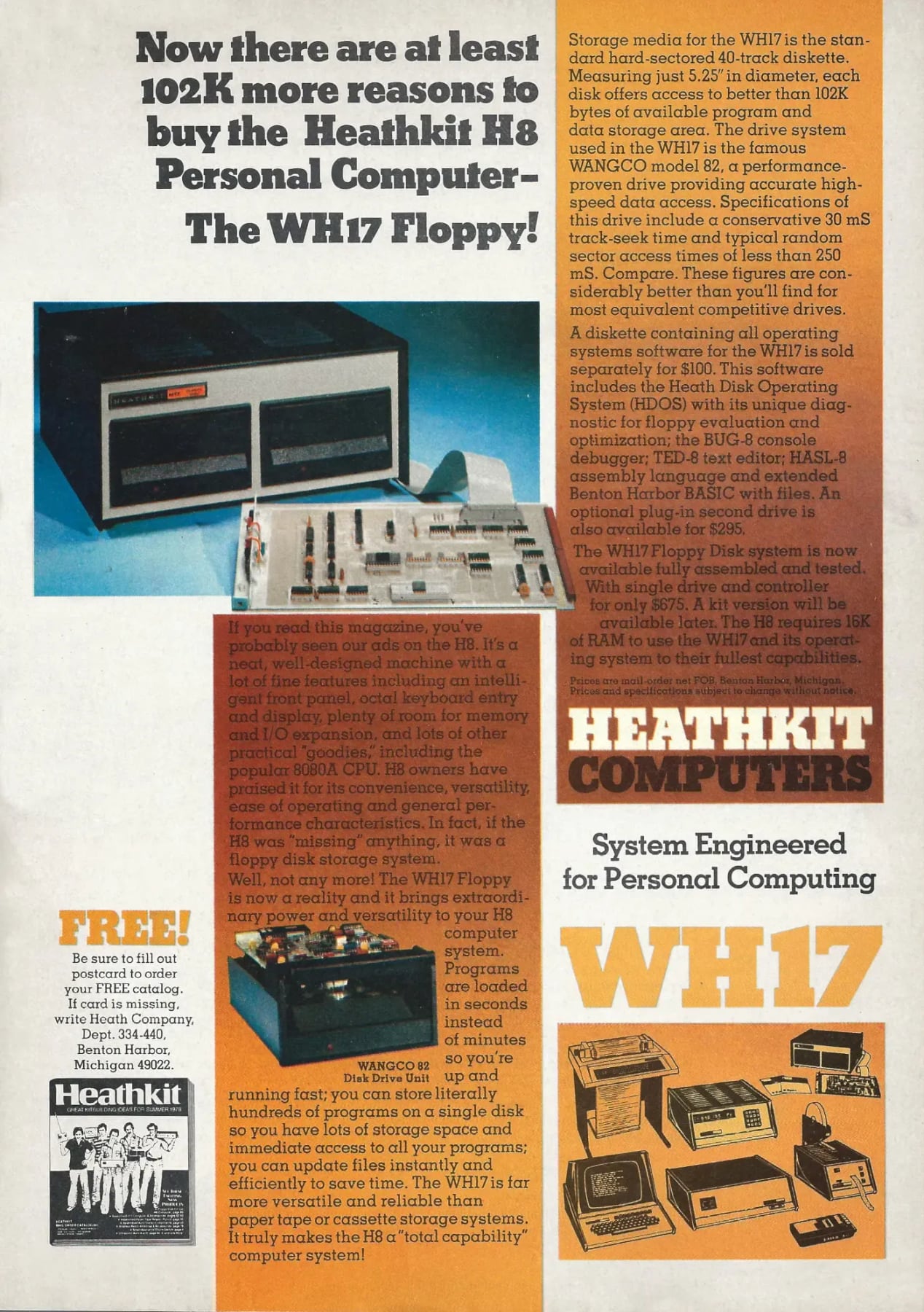
Cassette and paper tape were stop-gaps. Heath announced a floppy-disk system, the WH17, in March 1978. The first units were shipped fully assembled in June 1978, and the kit-form H17 followed about six months later (Sextant no. 3). The August 1978 advertisement priced the WH17 at $675 and a second drive at $295. It used a Wangco Model 82 5.25-inch drive on hard-sectored diskettes of “better than 102K bytes”. The disk software was sold separately for $100, and the H8 needed 16 KB of RAM to use it (BYTE, August 1978, via nosher.net). The WH17 was, in effect, Heath’s first factory-assembled computer product. The drive alignment was more than a kit builder could be expected to do.
5.4 Software: HDOS, Benton Harbor BASIC and Gordon Letwin
The engineer who had vowed Heath would not “get involved in software” lost that argument quickly. Heath hired J. Gordon Letwin from Wintek Corporation as its first software developer. Letwin recalled at the 1982 Heath Users’ Group conference that the hardware engineers’ reaction was: “What? We need software programmers? What’s he going to do?” He wrote the H8’s front-panel monitor firmware and the original Heath Disk Operating System (HDOS) (Sextant no. 4, Winter 1983). He also wrote the dialect of BASIC that shipped with the H8, Benton Harbor BASIC, named after the company’s home town, and the extended version with string variables and disk commands.
Letwin moved to Microsoft in 1978 and appears in the well-known Albuquerque staff photograph taken that year. There he later became chief architect of OS/2 on the Microsoft side (Wikipedia, “Gordon Letwin”). His name is sometimes given as “Lewin” in online retellings; the correct spelling is Letwin.
HDOS went through several releases. The Classic Heathkit Computers archive lists version 1.0 in 1978 for the H8 alone; a 1979 revision adding the H89; 1.5 and 1.6 in 1979–1980; 2.0 in 1980, which added 8-inch floppy support; and a public 3.0 in August 1986. Gregg Chandler is credited with the later 1.x and 2.0 releases. One unusual policy made HDOS popular with its users: Heath sold the source listing. Sextant called HDOS “the most widely available operating system that lets the user ‘look inside’” (Sextant no. 3).
Frenzel’s 2013 account records two licensing attempts that failed. Heath asked Digital Research’s Gary Kildall for CP/M and was refused. Bill Gates visited Benton Harbor and offered Microsoft BASIC “for an outrageous per license cost”. Heath’s then president, Dave Nurse, turned him down, and Frenzel describes Gates’s manner on that visit as arrogant (Frenzel, 2013). This is one participant’s memory, written more than thirty-five years later. The outcome is not in doubt, though: Heath wrote its own operating system and BASIC. By the Fall 1979 catalogue Heath was nonetheless selling Microsoft BASIC for the H8 and H89 (H8-21, $100), and CP/M followed for the H89 (Fall 1979, p. 33).
The users organised early. The Heath Users’ Group (HUG) was run by the company from St. Joseph. The first issue of its magazine, REMark, appeared in early 1978 and led with Heath’s defence of its non-S-100 bus (Sextant no. 3). Local groups followed. The Capital Heath Users’ Group in the Washington area started in September 1978 with 22 people and had 536 members by late 1982 (Sextant no. 4). An independent magazine, Sextant, began publication in Spring 1982 for “the entire Zenith computer community”.
5.5 The ET-3400 and the teaching thread
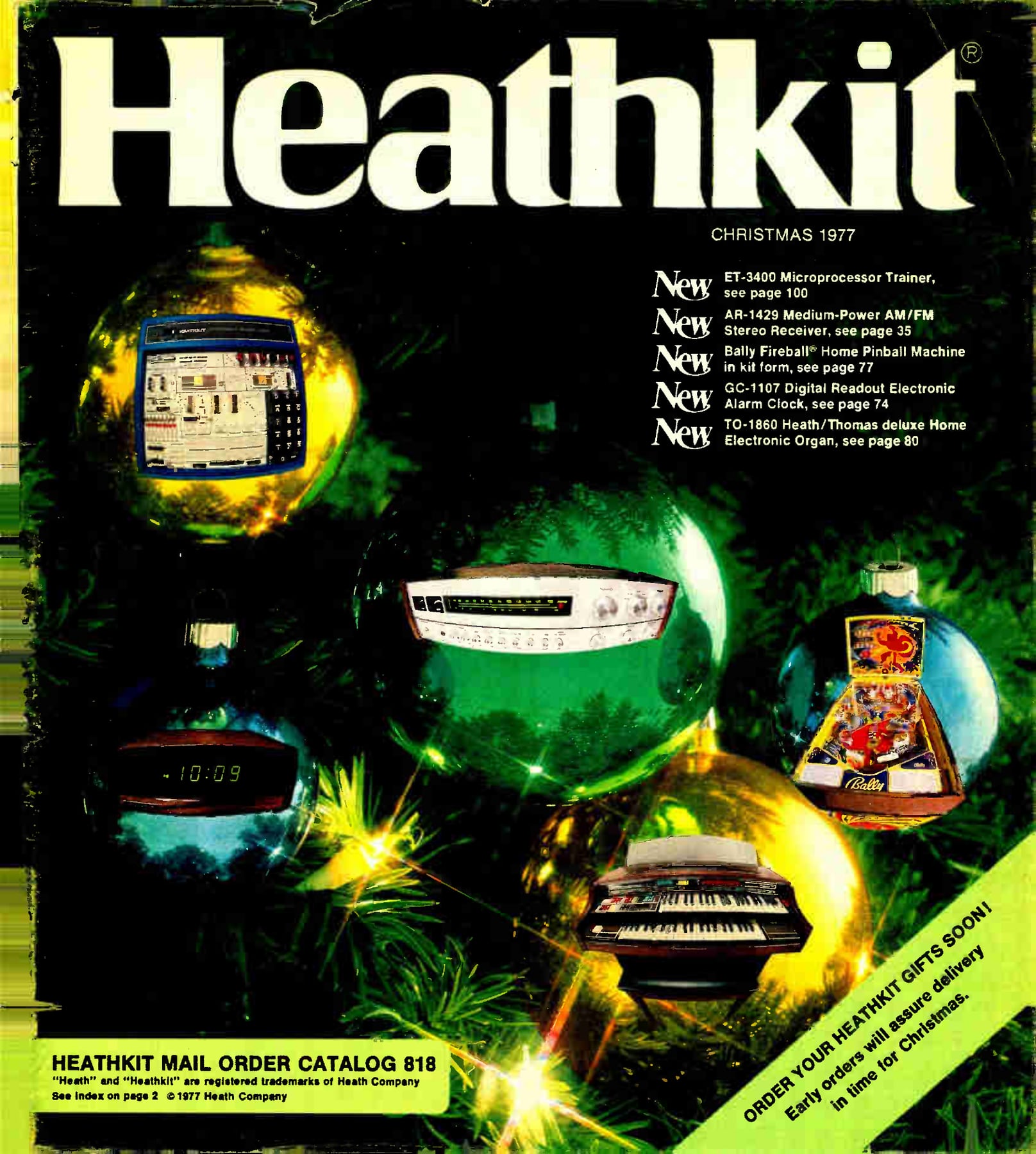
Heath’s other digital product of 1977 came from its education business, not its computer group. The ET-3400 Microprocessor Trainer and its companion course EE-3401 first appeared as “New” items in the Christmas 1977 catalogue (No. 818). The trainer’s picture filled a Christmas ornament on the cover (Christmas 1977, cover and p. 100). The Fall 1977 catalogue offers only the earlier ET-3200 digital trainer. The date of 1976 sometimes given for the ET-3400 is therefore probably too early.
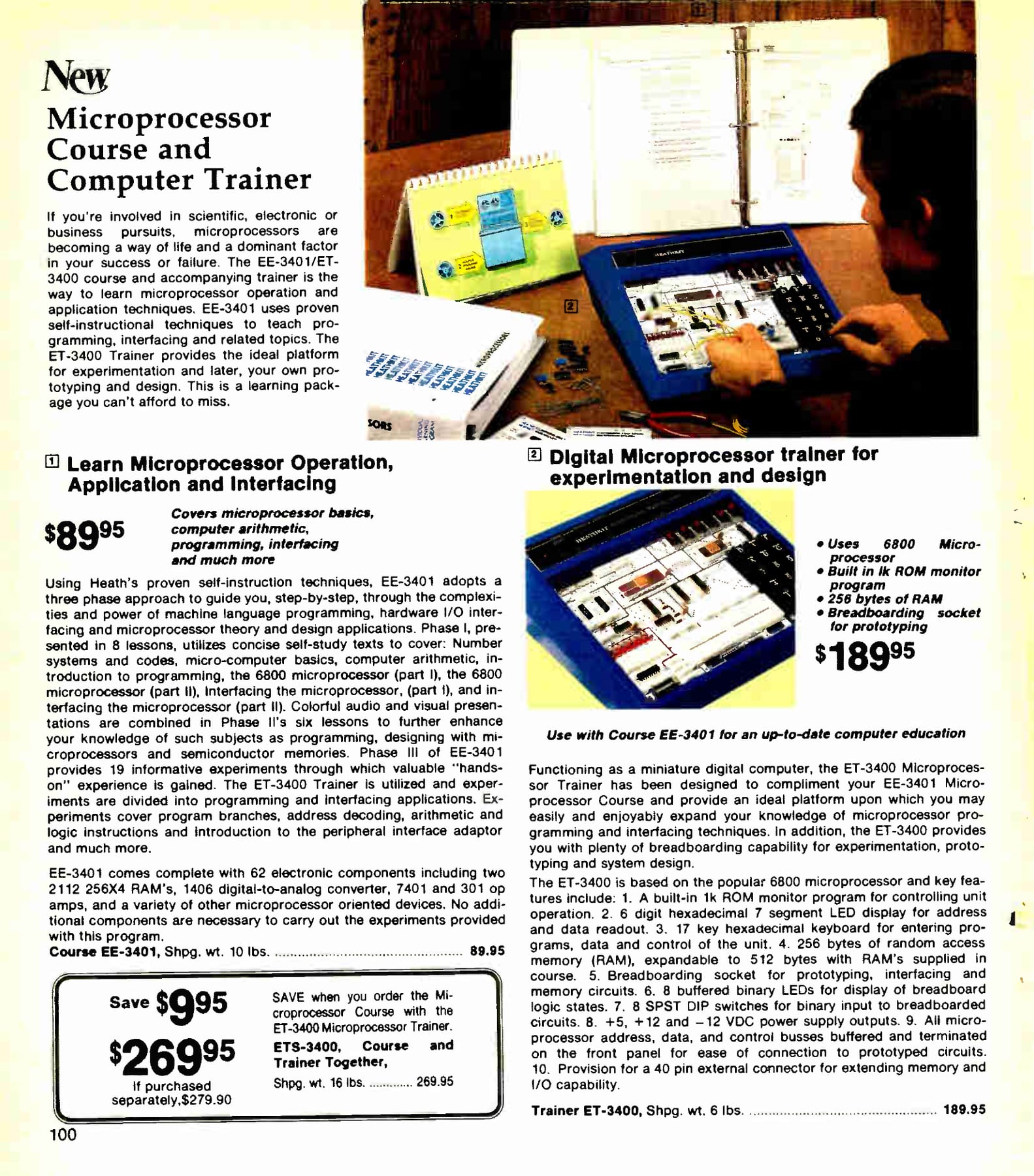
The ET-3400 used the Motorola 6800, the processor Frenzel had rejected for the H8. It was a single open board in a blue case, with a built-in 1K ROM monitor, 256 bytes of RAM (expandable to 512 bytes with chips supplied in the course), a six-digit hexadecimal LED display, a 17-key hexadecimal keypad, eight logic LEDs, eight DIP switches, a solderless breadboard, and +5, +12 and −12 volt supplies. The kit cost $189.95. The EE-3401 course, with 62 components for its 19 experiments, cost $89.95, and the two together cost $269.95 (Christmas 1977, p. 100). By Fall 1979 the kit price had risen to about $209. An ETA-3400 accessory ($160) added 1K of RAM, a cassette interface, a serial port for an H9 terminal and a Tiny BASIC in ROM, which turned the trainer into a small computer (Fall 1979, p. 69).
The trainer mattered more than its price suggests. It sat inside Heath’s self-study and classroom programmes (later sold as Heathkit/Zenith Educational Systems), and it went into community colleges, technical schools and military training in large numbers. Revised as the ET-3400A, it was still in the Winter 1991 catalogue, after every Heath-designed general-purpose computer had gone (Winter 1991 catalogue). A 1979 paper in Behavior Research Methods & Instrumentation described an ET-3400 used as a backup control system for laboratory experiments, which shows that it served as a working controller as well as a teaching toy (Wikipedia, “Heathkit”, citing Milligan and Richardson, 1979). The educational line outlived the kit business, as Volume 7 describes.
5.6 The money, 1977 to 1979
Frenzel wrote that “within a year we were making $40 million annually with computers”, which pushed Heath “well over the $100 million revenue mark” (Frenzel, 2013). Gilmore’s 2024 figures are more modest for the first months. He recalled that September-to-December 1977 sales “came out to be in the seven or eight million dollar area”, against about $18 million a year in electronic instruments (Heath’s best-selling line), $12 million to $14 million in amateur radio, and total company sales “in the $65 or $71 million range” (EEJournal, Part 3). In a separate interview Gilmore put Heath’s first-year computer sales at one third of its amateur-radio sales. He said that by the time of the 1979 sale “the Heath computer business was over $30 million, with two thirds in kits and one third assembled product” (EEJournal, “H is for Heathkits and Hams, Part 4”).
These recollections do not agree on total company revenue ($65–71 million in Gilmore’s account against $90 million in 1976 in Computerworld), and none of them comes from a financial filing. Heath was a Schlumberger subsidiary and did not report separately. Two contemporary data points help. BYTE, reporting the Zenith sale in November 1979, said “Heath sales for the last several years have declined at a 3 to 5% rate” (BYTE, November 1979). And Sextant’s interview with the head of Zenith Data Systems put 1980 computer sales at $43.6 million (Sextant no. 1, Spring 1982). So computers grew fast inside a company whose older lines were shrinking. Brueschke and Mack add that amateur radio, once 40 percent of Heath sales, had fallen to 25 percent (Brueschke & Mack, p. 150).
5.6.1 H8 price history
The catalogues also show how quickly the H8 aged. By Fall 1979, with the H89 on sale, the H8 kit was marked down to $289 (“Was $399.00”), and a new factory-assembled WH8 sold for $349 (Fall 1979, p. 34).
Table 2 — H8 price history
| Catalogue | H8 kit | H11 / H11A kit | H9 kit | H17 disk |
|---|---|---|---|---|
| Fall 1977 (817) | $375 | $1,295 | $530 | not yet offered |
| Christmas 1977 (818) | $375 | $1,295 | $530 | not yet offered |
| Winter 1978 | $395 | $1,350 | n/a | WH17 announced March 1978 ($675 assembled) |
| Winter 1979 | $379 | H11A | n/a | n/a |
| Fall 1979 | $289 (was $399) | H11A $1,195 | $499 (was $580) | H17 kit $495 (was $595) |
| Early 1980 (848) | n/a | H11A | $379 (was $479) | n/a |
Sources: the World Radio History scans of the Fall 1977, Christmas 1977, Winter 1978, Winter 1979, Fall 1979 and No. 848 catalogues. “n/a” means the figure was not extracted from that catalogue, not that the product was absent.
5.7 The H19, H88 and H89: the all-in-one
5.7.1 The H19 terminal
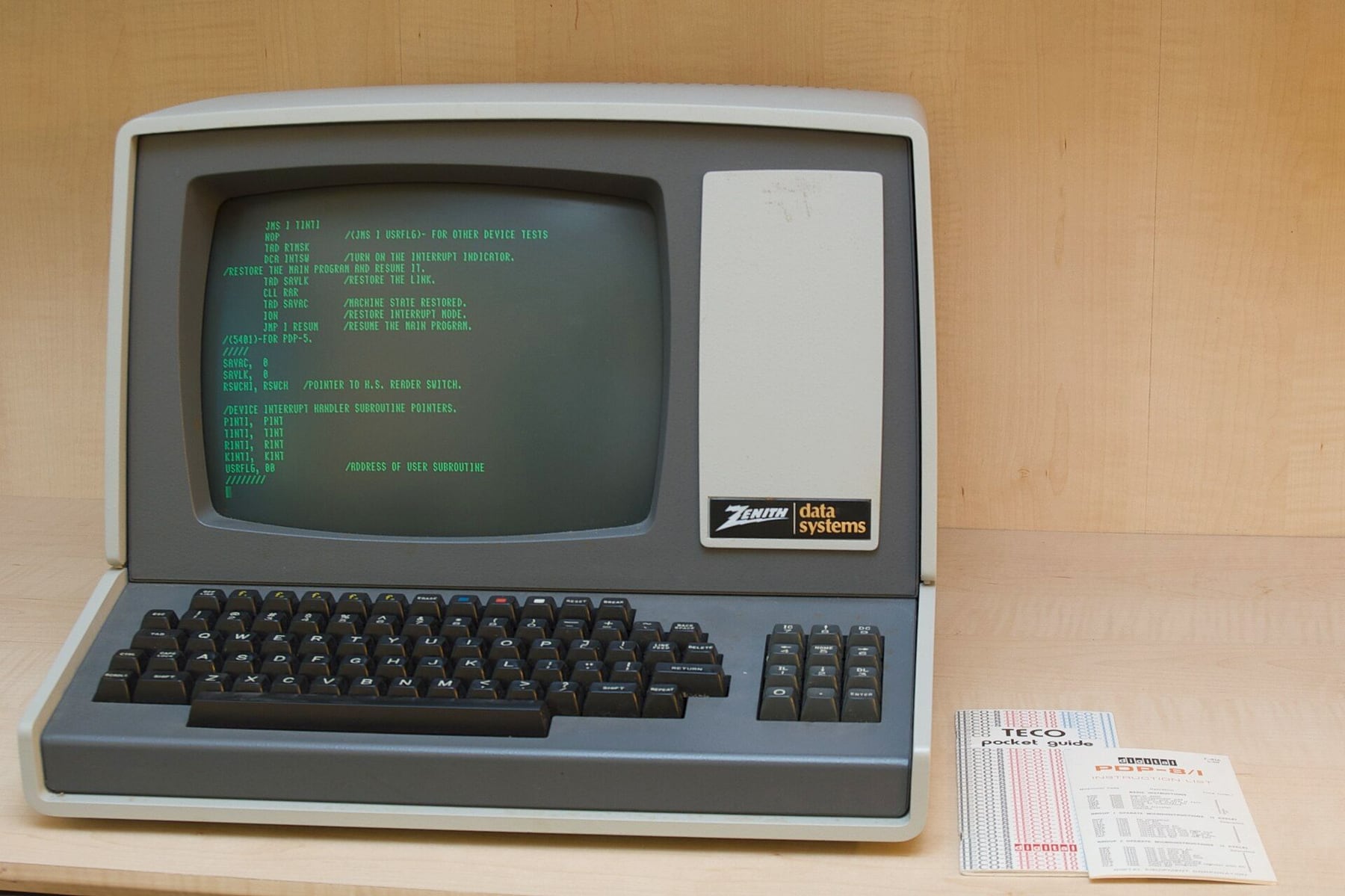
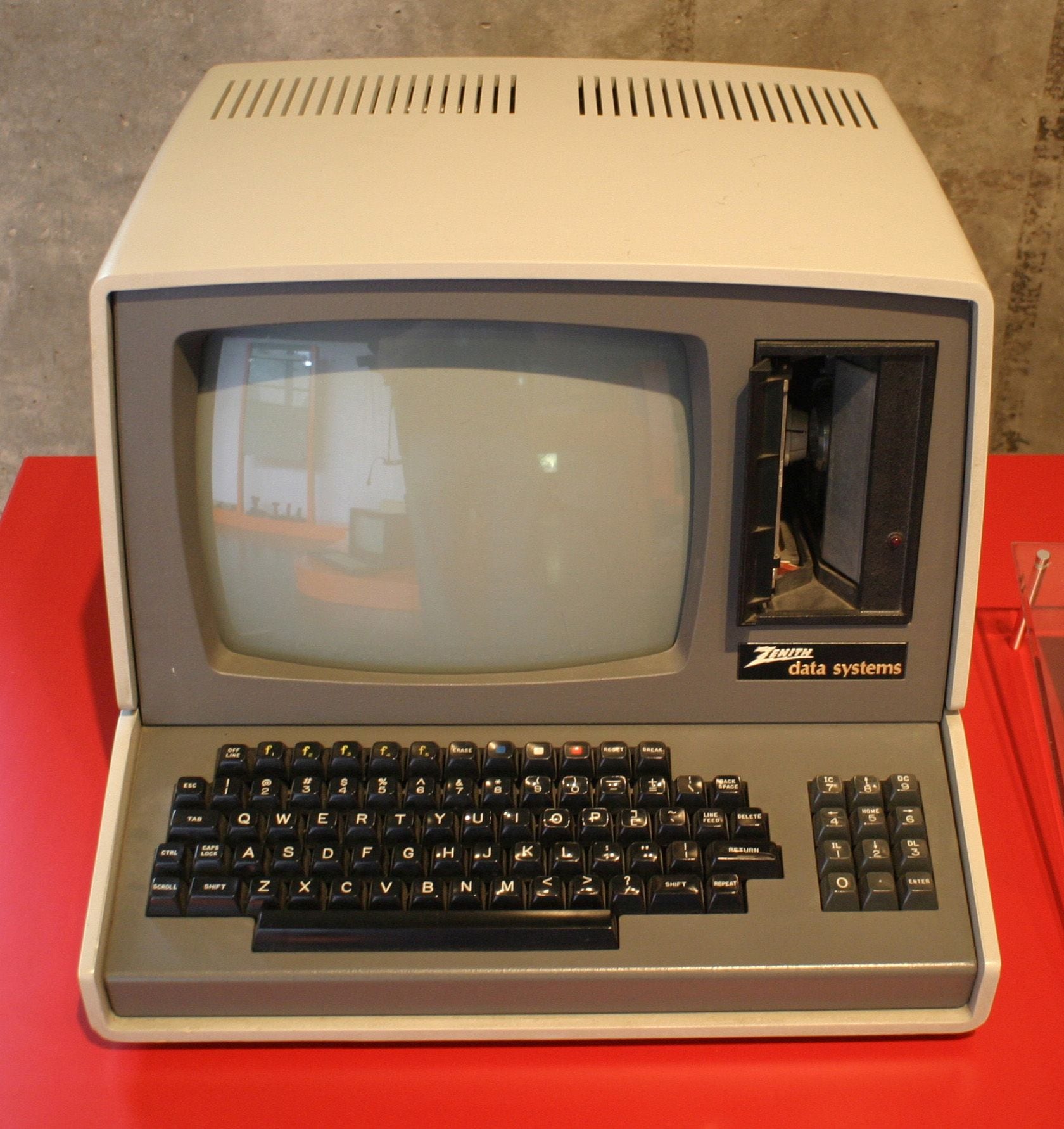
The H9 was soon outclassed by smart terminals from other makers. Heath’s reply was the H19, a Z80-controlled 80-by-24 terminal (plus a 25th status line) with a numeric keypad and user-definable function keys. It supported VT52-style escape sequences. The Intelligent Machines Journal reported the H19 in June 1979, in an article on Heath’s plan to sell computer products through distributors (Wikipedia, “Heathkit”, citing Williams, IMJ, 11 June 1979). The Fall 1979 catalogue priced the H19 kit at $695 and the assembled WH19 at $995 (Fall 1979, p. 40). Sold assembled under the Zenith name as the Z-19, it became one of the most respected terminals of its day. Jerry Pournelle wrote in BYTE in 1982: “I recommend it” (Wikipedia, “Zenith Z-89”).
5.7.2 Two Z80s in one cabinet
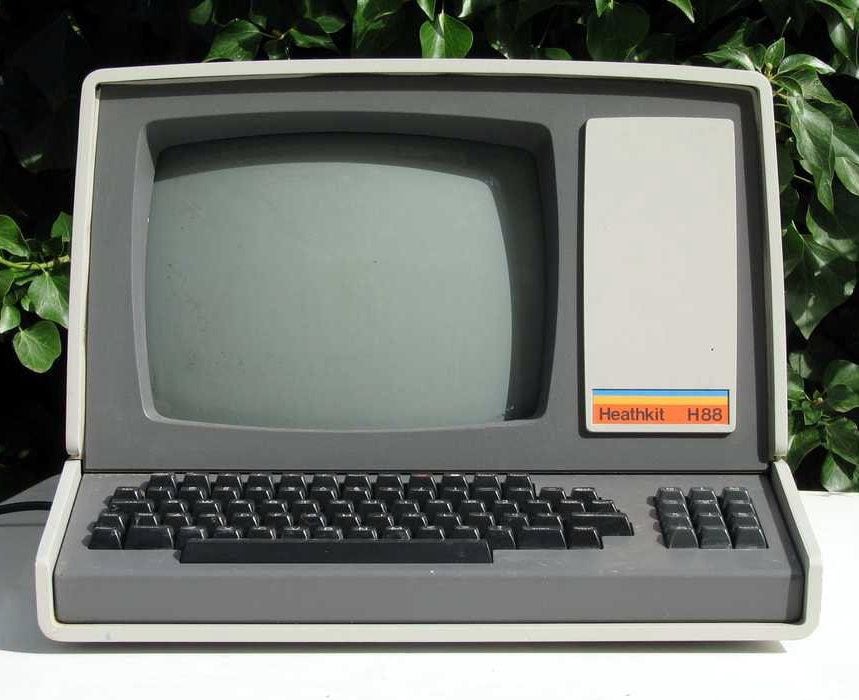
The logical next step was to put the computer inside the terminal. The H88 and H89 used the H19 cabinet, keyboard and 12-inch display. One Z80 ran the terminal, and a second Z80 ran the computer on a CPU board with 16 KB of RAM, expandable to 48 KB. Card cages on either side of the CRT took cards on the Heath bus. The H88 relied on a cassette interface. The H89 added a 5.25-inch hard-sectored floppy drive, about 100 KB, built in beside the screen. The machines ran HDOS, Benton Harbor BASIC and, after a ROM change, CP/M (Fall 1979, pp. 32–33; Wikipedia, “Zenith Z-89”).
The H89 was also less of a kit than the H8. Brueschke and Mack note that the disk drive, terminal-interface boards, keyboard and CPU boards came preassembled and tested, and the builder mainly assembled the power supply and fitted the sub-assemblies together (Brueschke & Mack, p. 151). Kilobaud Microcomputing nonetheless ran a two-part build article in 1981, and later reviewers put assembly at about twenty hours.
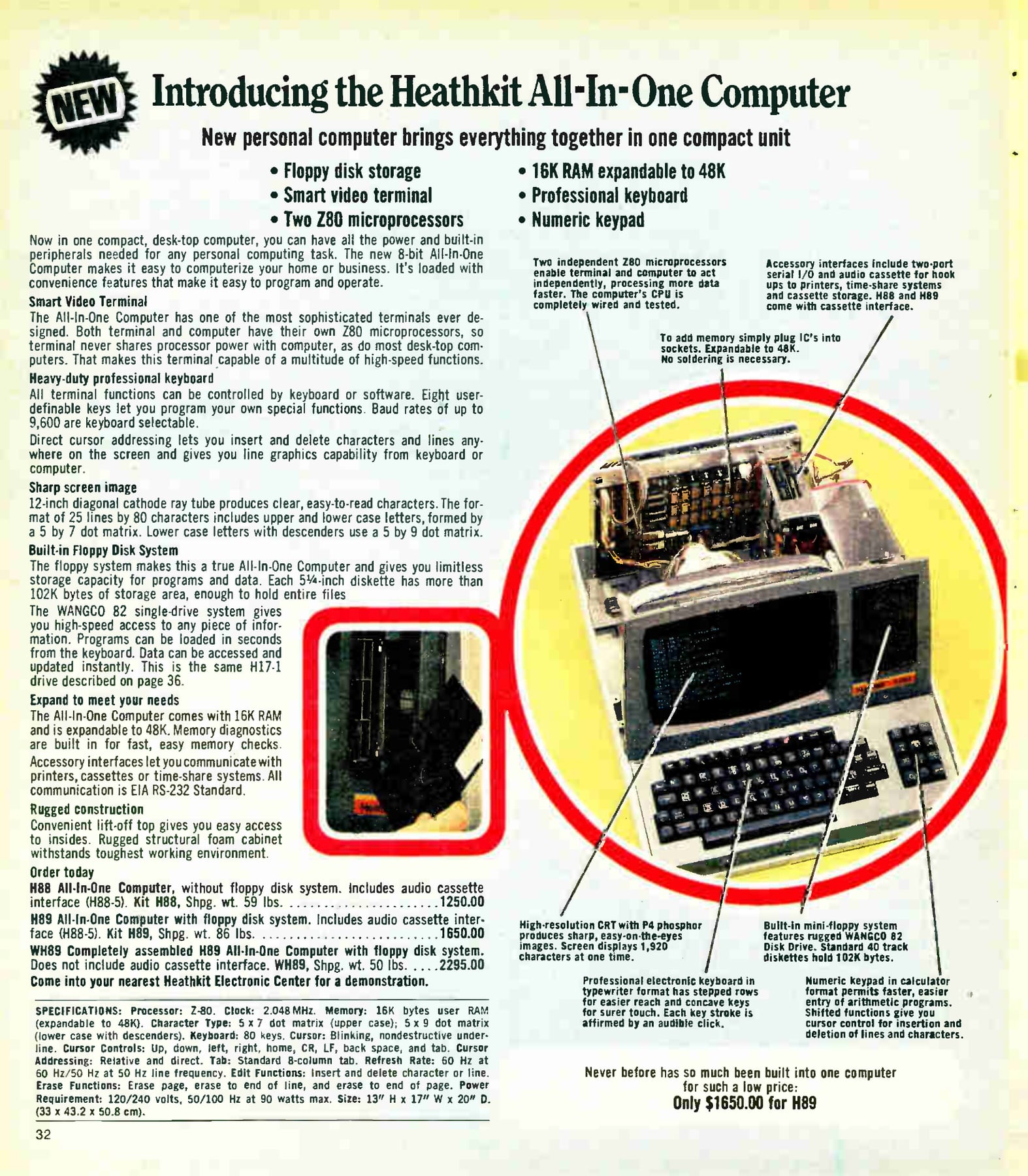
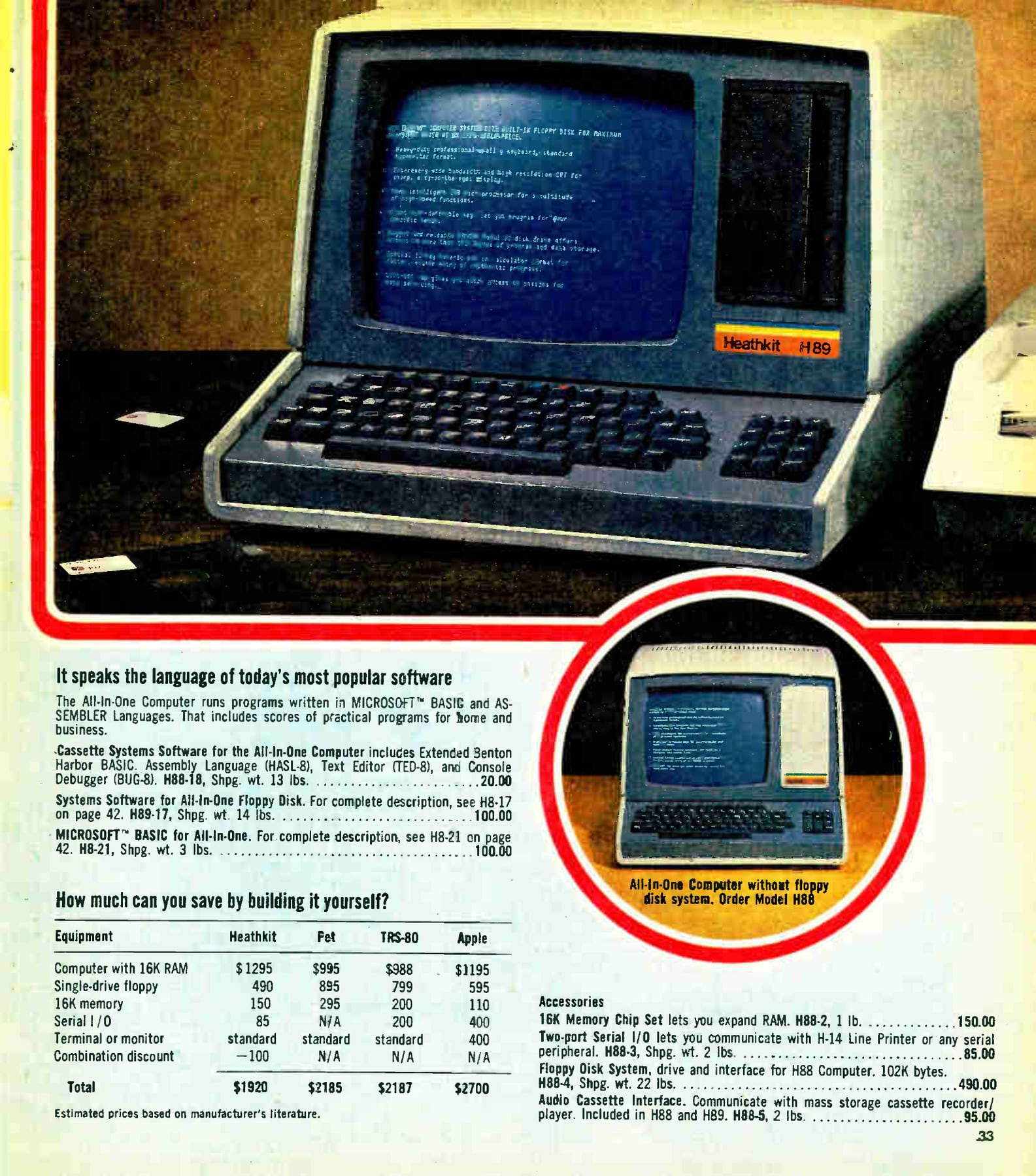
The Fall 1979 catalogue introduced the pair at $1,250 (H88 kit), $1,650 (H89 kit) and $2,295 (assembled WH89). By the early-1980 catalogue (No. 848) the H89 kit had risen to $1,695 and the H88 to $1,295 (Fall 1979, p. 32; No. 848). Brueschke and Mack describe the H89 as first offered in the summer 1979 catalogue at about $2,000 depending on options. That catalogue was not examined for this volume.
The Fall 1979 catalogue made the value argument explicitly with a comparison table titled “How much can you save by building it yourself?” A Heathkit system with 16K computer, single floppy, a further 16K of memory, serial I/O and a built-in terminal came to $1,920. The catalogue’s estimates for comparable systems were $2,185 for a Commodore PET, $2,187 for a Radio Shack TRS-80 and $2,700 for an Apple II. The table’s footnote says the rival prices were “based on manufacturer’s literature” (Fall 1979, p. 33).
5.7.3 “H/S Data Systems”: assembled computers before Zenith
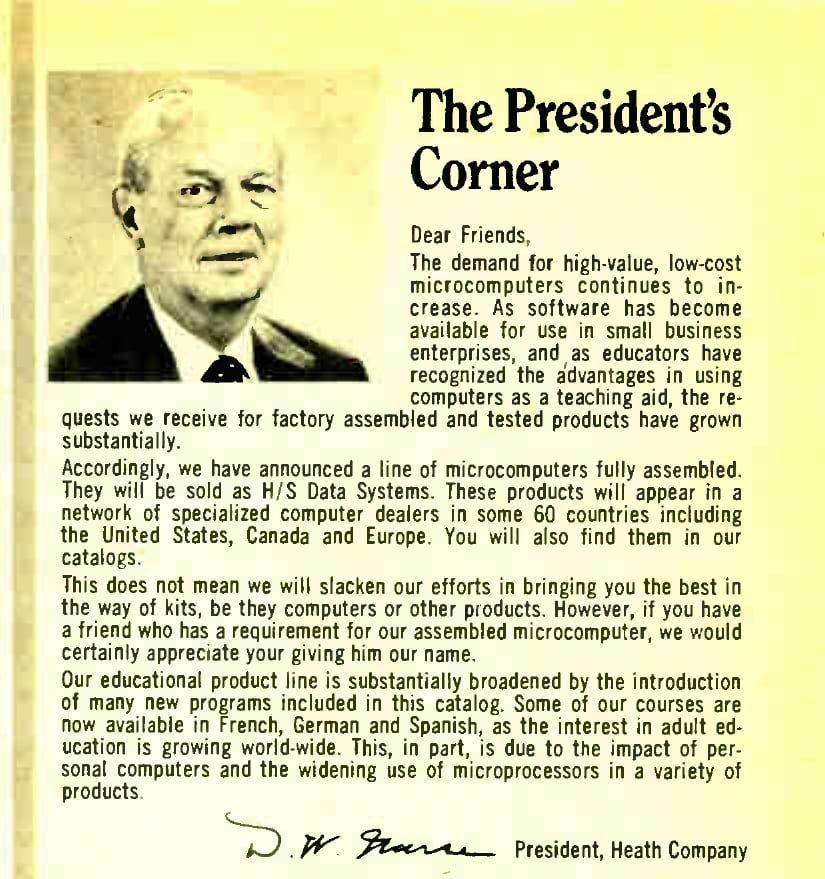
The Fall 1979 catalogue also shows that Heath was moving toward assembled machines before Zenith bought it. In “The President’s Corner”, David W. Nurse wrote that demand for “factory assembled and tested products” had grown substantially. Heath had therefore “announced a line of microcomputers fully assembled. They will be sold as H/S Data Systems” (Heath/Schlumberger) through “a network of specialized computer dealers in some 60 countries”. He added that this “does not mean we will slacken our efforts in bringing you the best in the way of kits” (Fall 1979, p. 55). BYTE reported the same programme immediately after the Zenith acquisition (BYTE, November 1979). The H/S Data Systems name was dropped almost at once, and the assembled machines became Zenith Data Systems products. According to Zenith’s Jerry Pearlman, speaking in 1982, the request to put the ZDS name on the Z-89 came “from senior Heath management, in order to connote quality assembled products” (Sextant no. 4).
5.8 How computers came to dominate
Zenith Radio Corporation bought Heath in October 1979; Volume 6 tells that story. The computer business kept growing through the ownership change. In an interview published in Spring 1982, Donald P. Moffet, president of Zenith Data Systems, predicted that 1981 computer sales would exceed $65 million, “about a 50 percent increase over 1980’s $43.6 million”, and might reach $70 million. Sextant added that computers “account today for about 40 percent of the Heath Company’s total sales”. Heath then marketed “more than 400 kit products… through mail order catalogs and more than 70 retail stores” (Sextant no. 1, Spring 1982).
By unit volume Heath/Zenith was a serious competitor, although the figures are rough. Sextant cited InfoWorld’s 14 September 1981 figures placing Heath/Zenith fifth in US personal-computer sales for 1980. Its own adjustment for Commodore’s overseas sales suggested third or fourth, and Computer Retailing reported Heath/Zenith “pushing Apple for number two” (Sextant no. 1). The Heath plant at Benton Harbor/St. Joseph had just received a $2 million addition, bringing it to 540,000 square feet. Secondary sources, citing InfoWorld of April and September 1982, put output at about 150 computers a day from 1,200 workers on three shifts, and nearly 50,000 kit and assembled computers a year by 1982 (Wikipedia, “Zenith Data Systems”). Those InfoWorld pages could not be read for this volume, so the figures are unconfirmed.
Two more details show where the growth came from. Sextant’s Fall 1982 reader survey found that about four-fifths of its readers used an H89 or Z-89 and only a minority an H8. And the claim that by 1982 “preassembled computers outsold kit versions four to one”, repeated in the Wikipedia articles and attributed to Sextant’s Winter 1983 issue, could not be found in that issue’s text. It remains plausible but unverified.
The H8 itself went out of production in 1981 (Wikipedia, “Heathkit H8”). Its owners got a late upgrade in July 1981, when Heath offered the HA-8-6 Z80 CPU card, after REMark had said in 1979 that no such product was planned (Sextant no. 3). Five years after the first shipment, Sextant called the H8 “an orphan whose parents were still alive”, quoting one unhappy owner, while most survey respondents praised the design and the documentation.
5.9 The H100 and the end of Heath-designed computers
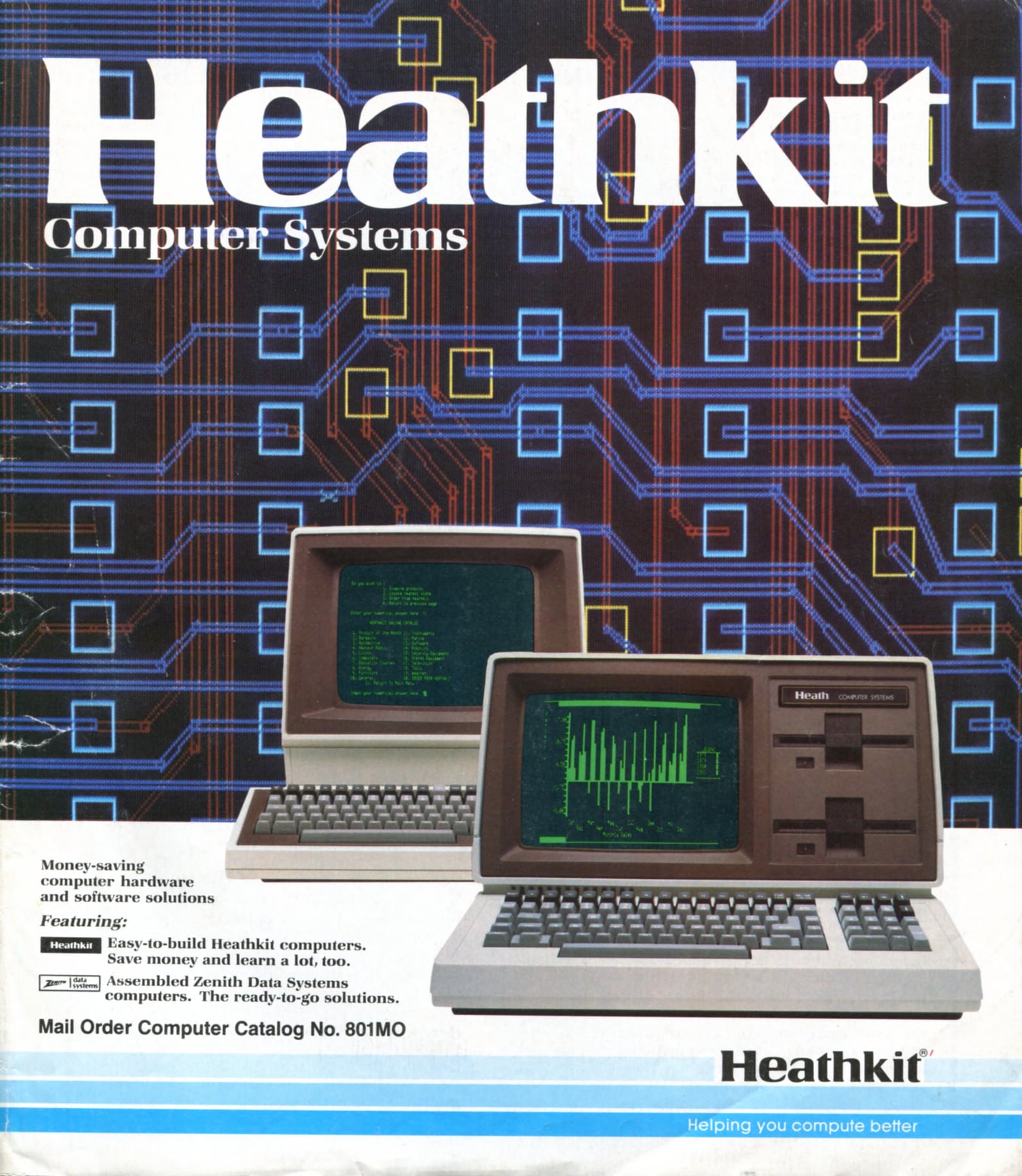
The last computer designed in the Heath tradition was the H100, sold assembled as the Zenith Z-100. It had two processors, an Intel 8085 for 8-bit CP/M software and an Intel 8088 for 16-bit software. It had bit-mapped colour graphics (up to 640 by 225 pixels in eight colours), an S-100 (IEEE-696) expansion bus, and a choice of CP/M or Z-DOS, Zenith’s OEM version of MS-DOS. It came in “low-profile” (separate monitor) and “all-in-one” versions. The Z-100 appeared in 1982 (Wikipedia, “Zenith Z-100”). Heath had now adopted the S-100 bus it had rejected in 1976. The computer catalogue No. 801MO listed the kit HS-100-31 (low-profile, 192 KB RAM, one drive) at $2,199 and the all-in-one HSA/HSG/HSW-120-31 kits at $2,349. Assembled Z-100s ran from $2,899 to $5,599 with a Winchester disk (catalogue 801MO, p. 3). The same catalogue listed the H-89 kit, now with 48 KB, at $1,399–$1,429.
The Z-100 marked the reversal of the relationship between kit and product. InfoWorld reported in April 1982 that selling computers designed as kits in assembled form “sometimes caused problems”. The Z-100 was therefore the first Heath/Zenith computer designed first as an assembled product (Wikipedia, “Zenith Z-100”, citing Mace, InfoWorld, 12 April 1982). From then on the kit was a version of a Zenith product. The IBM-compatible Z-150 of 1984 had a kit twin, the H-150/HS-151. BYTE found in December 1984 that the kit cost about $100 more than the assembled Z-150 bought from some dealers, and still needed about twenty hours and soldering skills (BYTE, December 1984, as cited in Wikipedia, “Heathkit”). The Fall 1984 catalogue shows the HS-151 at new, lower prices, from $1,899 with two 640 KB drives (Fall 1984).
The collectors’ archive at heathkit.garlanger.com dates Heath’s non-PC-compatible 8-bit and 16-bit computers from “the Fall of 1977 to around 1985” (Classic Heathkit Computers). Heath kits of Zenith PCs continued into the 1990s (the H-386 in 1987 and the HS-5100 and HS-3629 of 1990–91), and Volume 6 covers them. They were Zenith designs sold as kits, not Heath designs.
5.10 HERO 1 in context
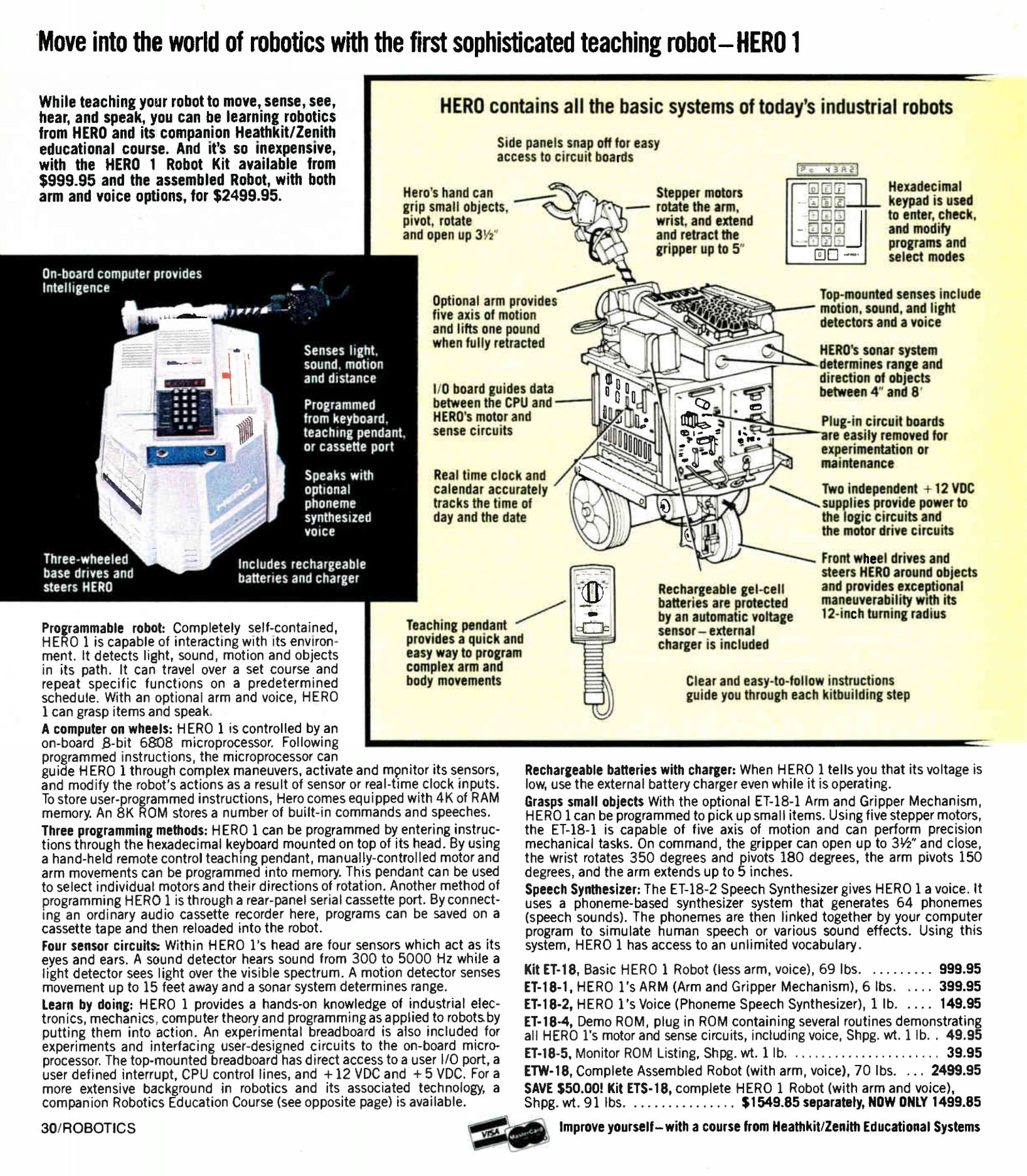
The best-remembered Heath product of the Zenith years was not a computer in a box but a computer on wheels. The HERO 1 (Heathkit Educational RObot) is documented in detail in its own dive in the Robots category, and only its place in the company story is summarised here.
Heath hinted at a robot at the 1982 West Coast Computer Faire and launched the HERO 1 later that year “to teach principles of industrial robotics”. BYTE ran a technical article on it in January 1983 by Steve Leininger, “Heath’s HERO-1 Robot” (BYTE, January 1983, pp. 86–96, cited in Brueschke & Mack, note 36). Leininger had designed the Radio Shack TRS-80 Model I before joining Heath. The robot was built around a Motorola 6808, the same 6800 family as the ET-3400 trainer. That kept the robot inside Heath’s educational range, where the 6800 had become the house teaching processor.
The Fall 1983 catalogue gives the actual prices and model numbers (Fall 1983, p. 28):
Table 3 — The Fall 1983 catalogue gives the actual prices and model numbers ([Fall 1983, p. 28](https://www.worldradiohistory.com/Archive-Catalogs/Heathkit-Catalogs/Heathkit-1983-Fall.pdf))
| Model | Description | Price |
|---|---|---|
| ET-18 | Kit, basic HERO 1 (less arm and voice) | $999.95 |
| ET-18-1 | Arm and gripper mechanism | $399.95 |
| ET-18-2 | Phoneme speech synthesizer | $149.95 |
| ETS-18 | Kit, complete robot with arm and voice | $1,499.85 |
| ETW-18 | Assembled robot with arm and voice | $2,499.95 |
The catalogue describes 4K of RAM and “an 8K ROM” holding built-in commands and speech. Heath’s usual convention held for the robot: the plain ET-18 number was the kit and the W in ETW-18 marked the factory-wired version. The often-quoted “$1,500 kit, $2,500 assembled” corresponds to the complete kit and the assembled robot, and the $999 figure to the basic kit. The widely repeated total of about 14,000 units sold could not be traced to a primary source. The HERO line continued with the smaller HERO Jr. (RT-1) in 1984 and the HERO 2000 (ET-19) in 1986, both of which also have their own dives.
For Heath’s history the robot’s significance is commercial. By 1983 the non-computer kit lines were shrinking. The HERO 1 showed that Heath could still create a new category, sell it to schools through the educational division, and sell it to hobbyists as a kit.
5.11 Claims checked
Several claims about this period circulate widely in online retellings of the Heathkit story. Their status after checking primary sources:
Table 4 — Several claims about this period circulate widely in online retellings of the Heathkit story. Their status after checking primary sources
| Claim | Verdict | Evidence |
|---|---|---|
| H8 introduced 1977 | Confirmed | Shown at the Atlantic City PC show, August 1977 (Gilmore); first shipped September 1977 (Sextant no. 3); in catalogue 817, Fall 1977 |
| H8 used an 8080 at 2 MHz | Confirmed | 8080A per catalogues; 2.048 MHz per oldcomputers.net and the H89 literature |
| H8 had 4 KB | Misleading | The bare H8 had no RAM; the first memory card (H8-1) held 4K, and at least one was needed |
| H8 price $379 | Partly confirmed | Launch catalogues say $375; $395 in 1978; $379 in Winter 1979 |
| HDOS by Gordon “Lewin” | Name wrong | J. Gordon Letwin, hired from Wintek; wrote HDOS and the front-panel monitor (Sextant no. 4) |
| H89 released 1979 with a Z80 | Confirmed, and understated | Two Z80s, one for the terminal and one for the computer; introduced in the summer or Fall 1979 catalogue |
| H89 kit $1,695 | Confirmed with a date | $1,650 in Fall 1979; $1,695 in the early-1980 catalogue No. 848; assembled WH89 $2,295 |
| ”Zylo” as the Z80’s maker | Name wrong | Zilog |
| HERO 1 = ET-18, 1982, 6808, 4 KB RAM | Confirmed | Fall 1983 catalogue; ET-18 is the kit number |
| HERO 1 $1,500 kit / $2,500 assembled | Confirmed with qualification | Complete kit $1,499.85; assembled $2,499.95; basic kit $999.95 |
| HERO 1 sold about 14,000 | Unverified | Appears only in secondary sources |
| HERO on Mr. Wizard’s World | Unverified | Not checked against a primary source in this volume |
Sources
- Heathkit catalogues, scanned by World Radio History: Fall 1977 (No. 817); Christmas 1977 (No. 818); Winter 1978; Spring 1978; Winter 1979; Fall 1979; No. 848, early 1980; Computer catalogue No. 801MO; Fall 1983 (No. 862); Fall 1984; Winter 1991 (No. 223).
- Frederick Zimmerman, “The H8’s Fifth Anniversary: Origins and Outlooks”, Sextant no. 3, Fall 1982.
- John Walker and David Johnstone, “Heath/Zenith Computers: An Interview and Overview”, Sextant no. 1, Spring 1982.
- Frederick Zimmerman, “HUGCon 1”, Sextant no. 4, Winter 1983.
- “Heath Acquired by Zenith”, BYTE News, BYTE vol. 4 no. 11, November 1979.
- Heathkit advertisements as reproduced by nosher.net: H11, 1977; WH17, August 1978.
- Steven Leibson, “The Rise and Fall of Heathkit, Part 3: The Microcomputer Kit Era”, EEJournal (interview with Chas Gilmore).
- Steven Leibson, “‘H’ is for Heathkits and Hams: Part 4”, EEJournal, 12 February 2025.
- Lou Frenzel, “The History of Personal Computers, Part 2: The Heathkit Story”, Electronic Design, 30 December 2013.
- Erich E. Brueschke and Michael Mack, “The History of the Heath Companies and Heathkits: 1909 to 2019”, AWA Review vol. 32 (2019), pp. 125–164, Internet Archive copy.
- Classic Heathkit Computers: HDOS; catalogues.
- oldcomputers.net, “Heathkit H8”.
- Wikipedia (used for leads and for citations to sources that could not be read directly): “Heathkit”; “Heathkit H8”; “Zenith Z-89”; “Heathkit H11”; “Zenith Z-100”; “Zenith Data Systems”; “Gordon Letwin”.
- Photographs from Wikimedia Commons, credited in each figure caption.
Comments (0)