Heathkit · Volume 2
The Manual Is the Product
Between the summer of 1947 and the summer of 1954 the Heath Company changed from a war-surplus house that happened to sell an oscilloscope kit into the largest maker of electronic kits in the world. In those seven years it worked out almost everything that later generations would think of as “Heathkit”: the complete kit with every part down to the last lock washer, the check-off instruction manual with its artist-drawn pictorials, the calibration tricks that let a builder with no laboratory get useful accuracy, direct sale by mail with no dealers, a technical correspondence staff that answered every letter, and a catalogue that spread from test equipment into high fidelity, receivers and amateur radio transmitters. It was run throughout by Howard and Helen Anthony, from a cramped plant on Territorial Road in Benton Harbor, Michigan. It ended when Howard Anthony was killed in the crash of a demonstration aircraft over Tennessee on 23 July 1954.
The title of this volume is not a slogan found in the period literature. It is a summary of what the company learned in these years: parts could be bought by anyone, and what Heath actually sold was the certainty that the parts would fit and the instructions would work. The mechanics of the manual as a document are the subject of a later volume in this series, How a Heathkit Manual Works; this volume follows how the manual, and the business built round it, came to be.
2.1 The second kit and the first manual
When the oscilloscope began to sell in the summer of 1947, Anthony asked Bjorn Heyning, the Norwegian-born radio engineer who had worked for him through the war, to come back. Heyning rejoined in October 1947 and was given a vacuum-tube voltmeter to design. He recalled the conversation years later. He asked how the builder was supposed to calibrate the instrument: send it back to Benton Harbor, or borrow Heath’s precision standards? Anthony’s answer was to measure the battery that powered the ohms circuit, mark its voltage on the battery, and tell the builder to use it as the DC standard; for AC, the builder would set the meter to 115 volts on the household mains. Heyning objected that mains voltage was rarely close to 115. Anthony replied that it would get the customer started, and that anyone needing better accuracy could borrow a better standard from the electric company. “And history proved that he was right,” Heyning wrote, “for that idea worked without fault for many years” (Heyning, Heath Stories #5). Rich Post adds that Heath VTVMs carried a small red dot on the scale marking the expected reading from a fresh 1.55-volt carbon-zinc cell, which gave a builder roughly 3 per cent accuracy with no instruments at all (Post, “The Heathkit Legacy”).
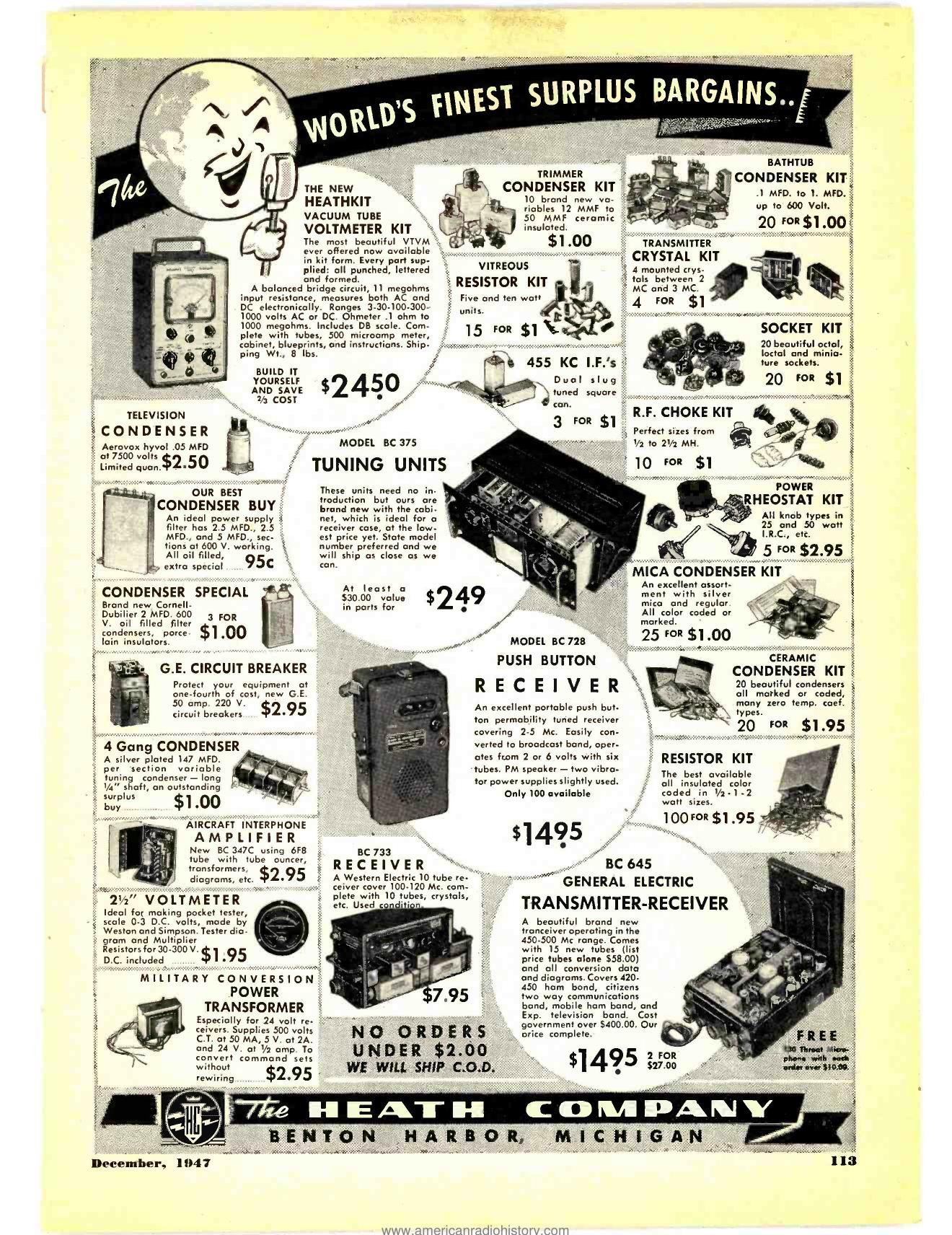
The kit, later called the V-1, was advertised in Radio News in December 1947 and in the November 1947 Heath flyer at $24.50, with the slogan that became a Heath catchphrase: “Nothing else to buy.” It used three octal tubes (a 6X5 rectifier, a 6H6 double diode for AC and a 6SN7 double triode in a balanced bridge), 1 per cent precision divider resistors, two flashlight cells for the ohms ranges, and five ranges from 3 to 1,000 volts, AC and DC. It shipped at 8 pounds (Eckweiler, Heathkit of the Month #19; Brueschke and Mack). The November flyer that introduced it opened by explaining that “our family of customers has outgrown a mimeographed sheet”, so the flyer was now printed with pictures, “especially appropriate because we are to show you the latest Heath Kit — the promised vacuum tube voltmeter.” Assembling one’s own instruments, it argued, “not only saves two-thirds the cost, but gives you valuable knowledge of the construction and use of test instruments” (Heath November flyer, 1947).
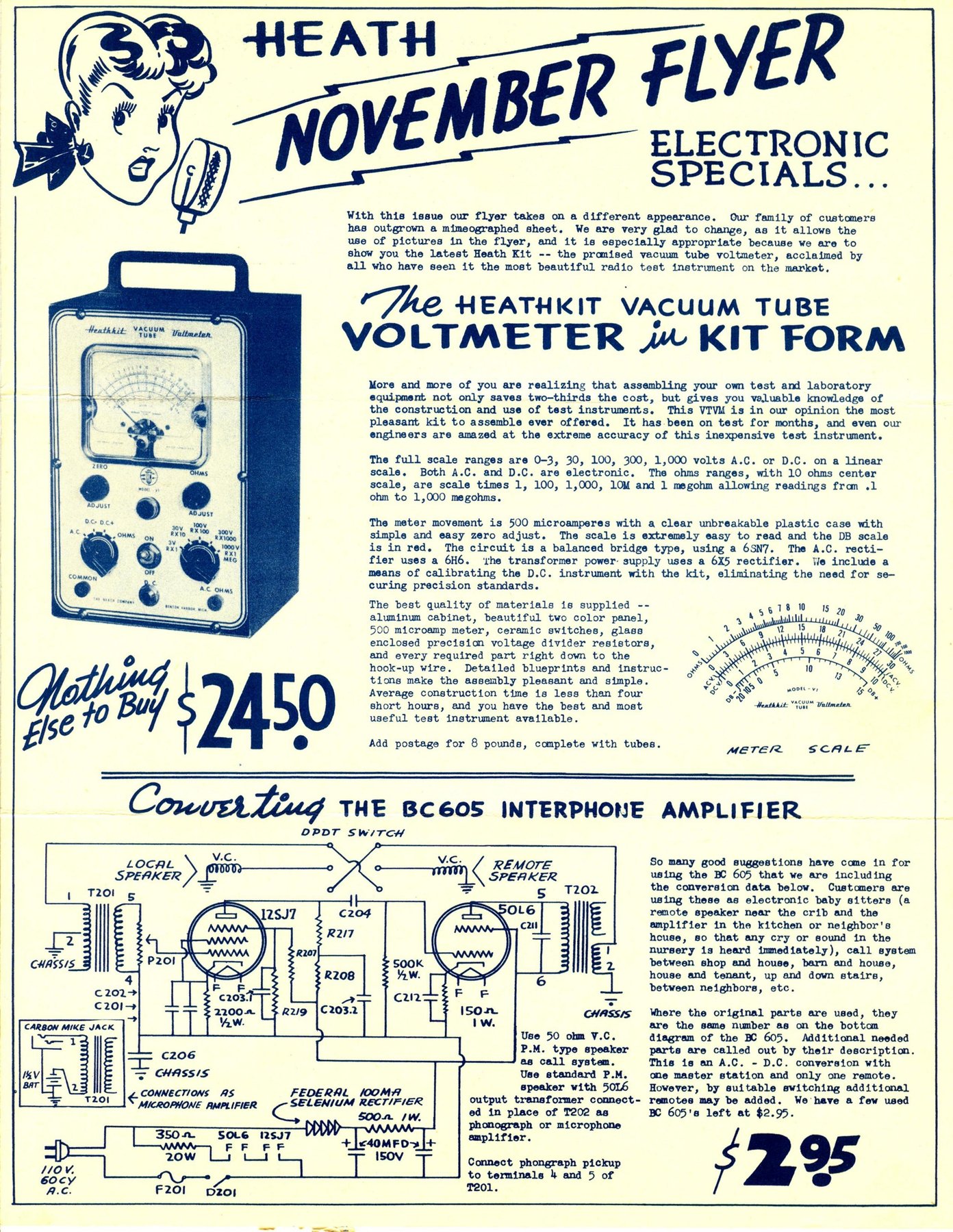
The V-1 also brought the first true Heathkit manual. The O-1 had shipped with a few legal-size sheets of schematic, parts list and brief instructions. Heyning recalled the V-1’s documentation as standard-size pages stapled inside a green cover: “A real manual!” It covered assembly and calibration, what to do in case of difficulty, sketches, the parts list and schematic, and even an optional RF test probe. It also listed articles and books on the subject so that the builder could go on learning (Heyning, Heath Stories #7).
Customers asked for more pictures, and Heath first added pages of photographic prints, then something better. Cliff Edwards, the advertising manager who had silk-screened the O-1 panels, began drawing detailed pictorial diagrams: artist’s drawings of each stage of assembly with every part identifiable. His first assistant was Lloyd Cookson; later a young illustrator named Colleen, who married Edwards’s son Jack, the head of the machine shop. Early text was typed and mimeographed. Anthony then arranged with a printer across the street, “Pat” Patterson, for typists to justify the text on IBM typewriters for offset printing. Anthony wrote the first instructions himself, Heyning the next several, and then each engineer wrote the manual for his own kit (Heath Stories #7).
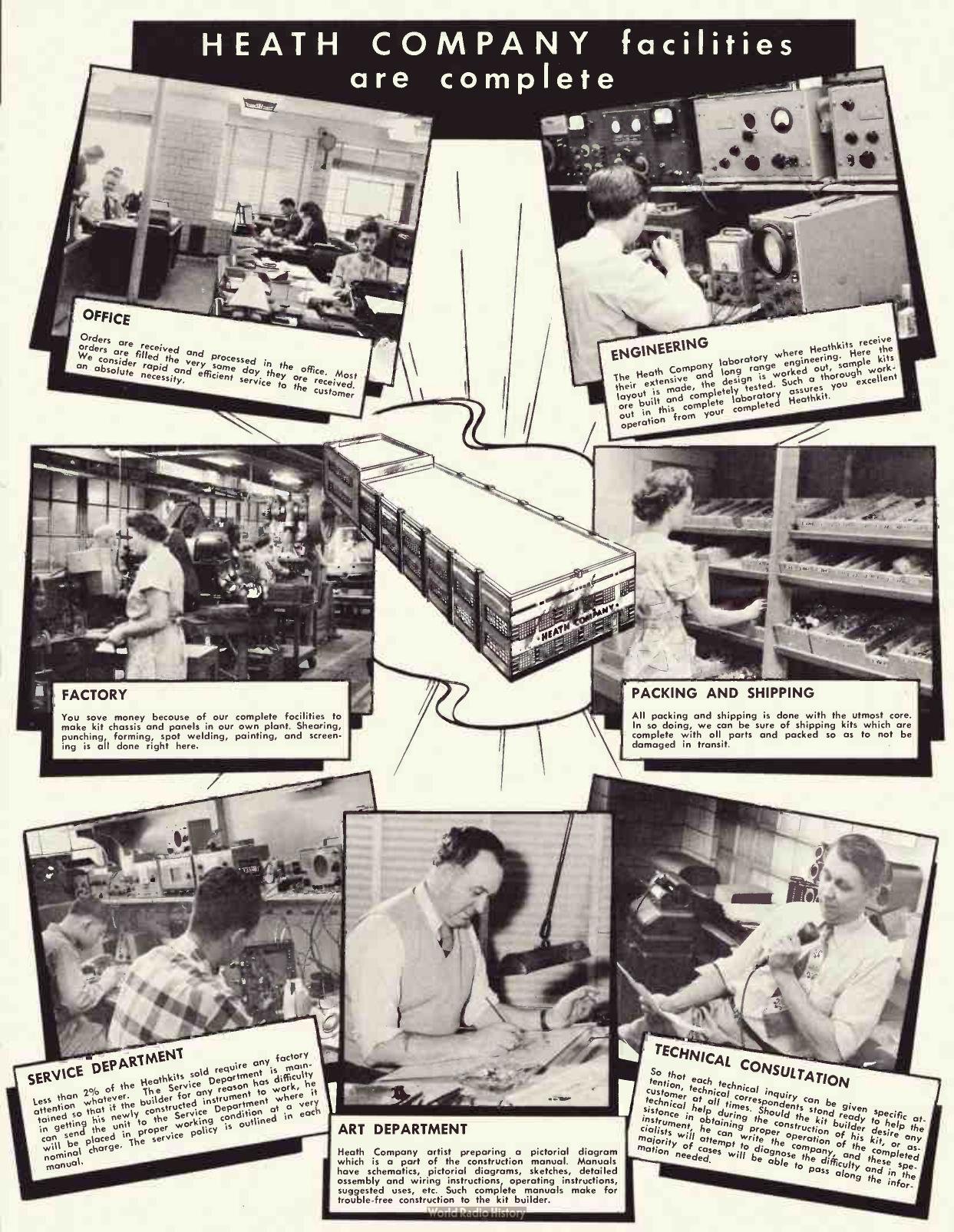
By 1952 the catalogue devoted a photograph to the art department: “Heath Company artist preparing a pictorial diagram which is a part of the construction manual. Manuals have schematics, pictorial diagrams, sketches, detailed assembly and wiring instructions, operating instructions, suggested uses, etc.” (Heathkit catalogue, 1952, p. 16). The January 1951 flyer’s description was almost a specification for the later Heathkit manual: assembly data “arranged in a step-by-step manner”, artists’ pictorials of each phase detailed enough to identify the parts, and photographs to help place the wiring (Heath flyer, January 1951).
2.2 The product line takes shape, 1947–1949
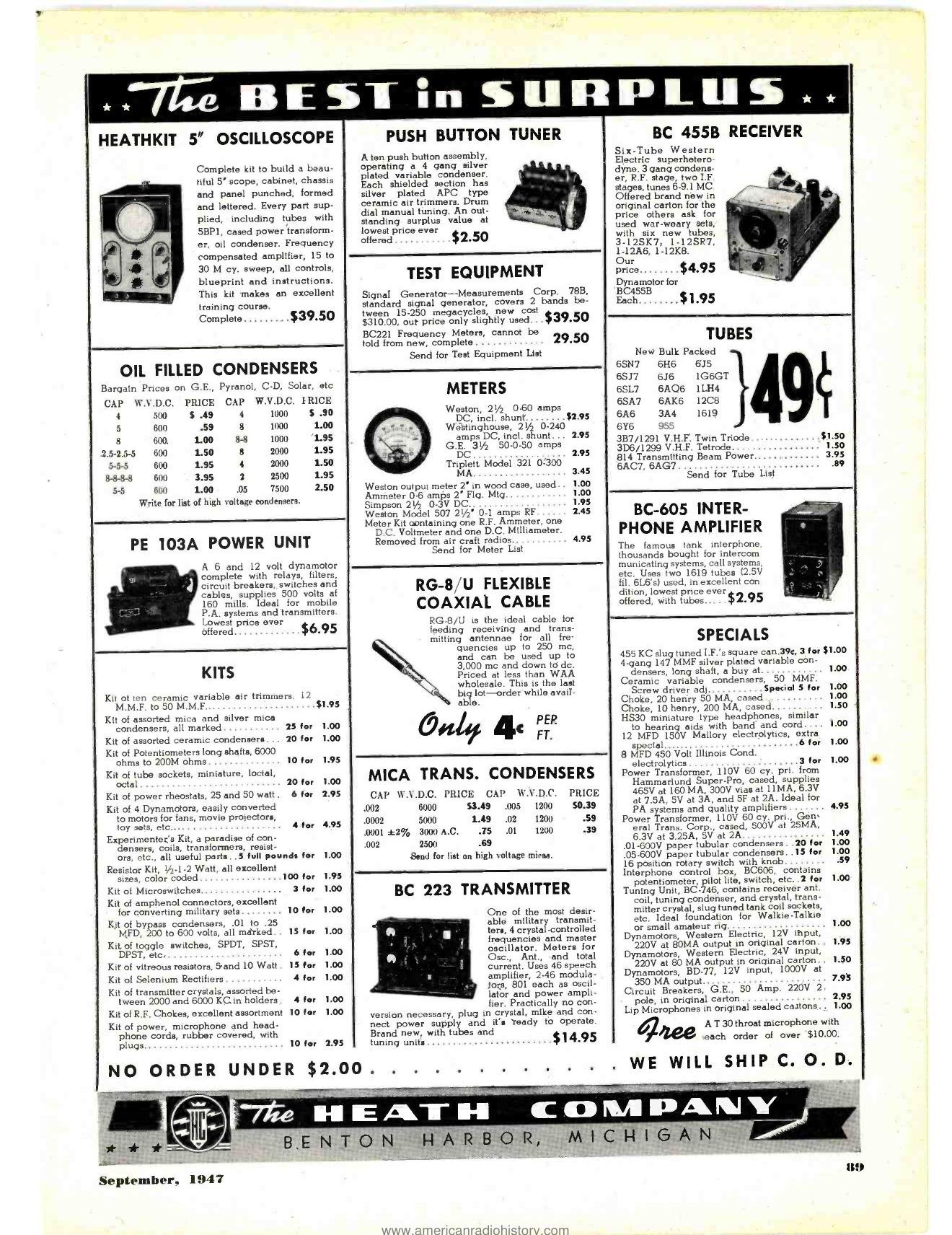
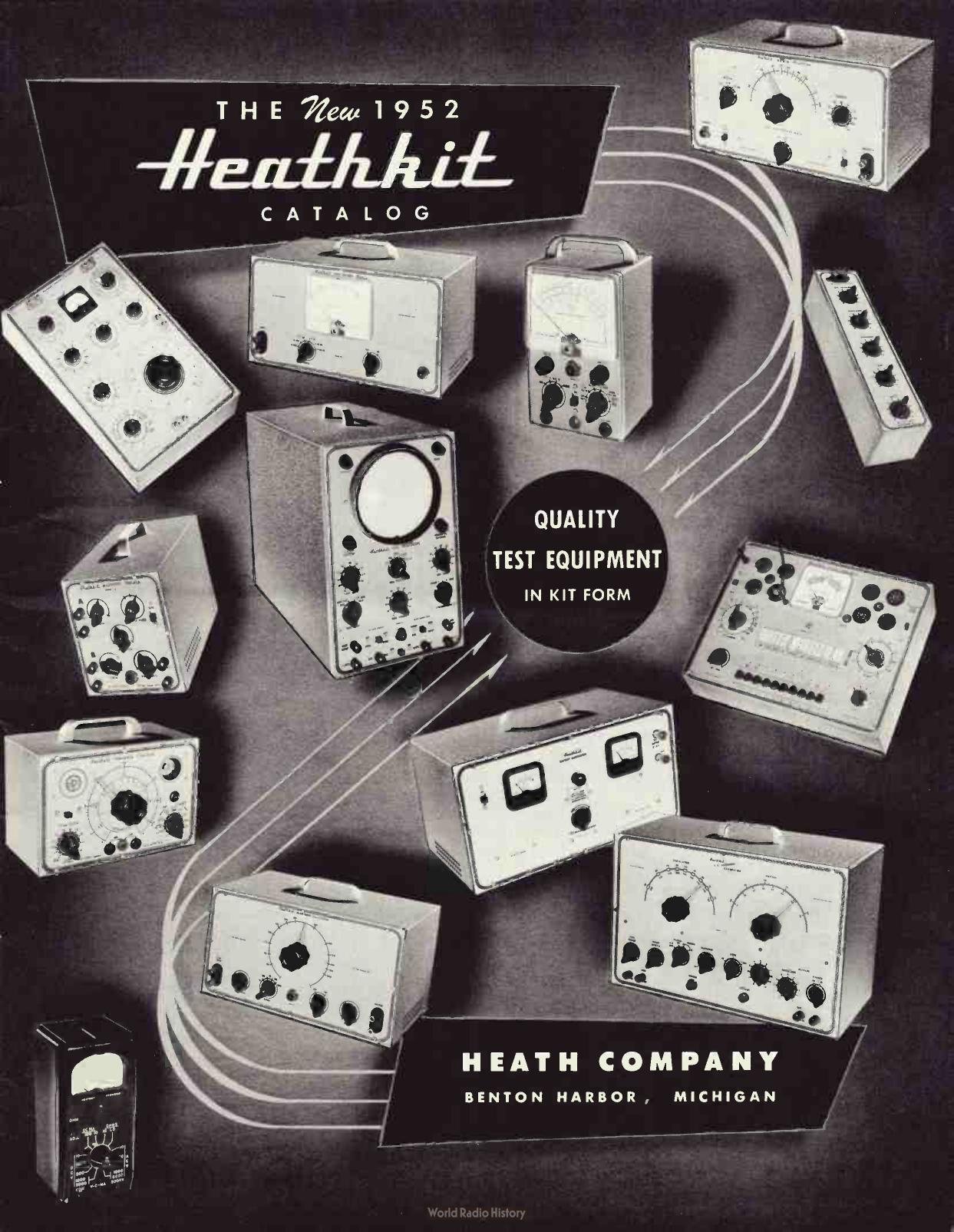
Kits followed the voltmeter at a pace of roughly one a month. Brueschke and Mack count more than 33 products by the end of 1948 (Brueschke and Mack). The table gives the early kits as they first appeared in Radio News and the Heath flyers. None of the early advertisements gave model numbers; the designations below are those that appeared on panels, schematics or later literature.
Table 1 — The product line takes shape, 1947–1949
| Kit | First advertised | Price | Notes |
|---|---|---|---|
| Oscilloscope (O-1) | Radio News, July 1947 | $39.50 | 5BP1 CRT; 55 lb; first Heathkit |
| Vacuum-tube voltmeter (V-1) | November 1947 flyer; Radio News, Dec. 1947 | $24.50 | First real manual |
| Push-pull amplifier (A-1) | November 1947 flyer; Radio News, Jan. 1948 | $14.95 | Two surplus 1619 output tubes |
| RF signal generator (G-1) | Radio News, Jan. 1948 | $19.50 | Coils by Joe Miller; one trimmer for all bands |
| 25-watt amateur transmitter | Radio News, Jan.–Mar. 1948 | $19.50 (power supply $10) | Never produced |
| Oscilloscope (O-2) | Dec. 1947/Jan. 1948 flyer; Radio News, Feb. 1948 | $39.50 | Half the weight of the O-1 |
| Condenser checker (C-1) and signal tracer (T-1) | March 1948 | $19.50 each | |
| All-Wave radio (K-1) | Popular Mechanics, Apr. 1948 | $5.95 prototype; $8.75 production | Three-tube regenerative set |
| Oscilloscope (O-3) | Mid-1948 | $39.50 | Direct deflection-plate inputs |
| Amplifier (A-2) | August 1948 flyer | $14.95 | Gain “tripled” |
| TV sweep generator | October 1948 flyer | $24.50 | For television alignment |
| Improved VTVM (V-2) | Late 1948 / January 1949 flyer | $24.50 | 200 µA movement, sixth range |
| Tube checker (TC-1) | February 1949 flyer | $29.50 | |
| Impedance bridge (IB-1) | April 1949 flyer | $69.50 | General Radio dial and hummer |
| Oscilloscope (O-4) | April 1949 flyer | $39.50 | Last five-tube scope |
| Handitester (M-1) and FM tuner | June 1949 flyer | $13.50; $14.75 | Pocket multimeter; transformer-operated FM tuner |
| Electronic switch | August 1949 flyer | $34.50 | Dual-trace adapter for the scope |
| Oscilloscope (O-5) | September 1949 | $39.50 | Push-pull amplifiers, 7 tubes |
| Three-band receiver (AR-1) | 1949 | $23.50 | No BFO, no speaker, no AVC |
Sources: Eckweiler #85, #19, #32, #95; Brueschke and Mack; Post; the Heath flyers of June 1948, October 1948, January 1949, February 1949, April 1949, June 1949, August 1949 and December 1949.
2.2.1 The signal generator and the single trimmer
The third kit, the G-1 RF signal generator, came from Joe Miller, who had run Standard Coil’s wartime plant at Bangor, Michigan, and after the war had sworn off coils and started making parking meters. Anthony, convinced that Miller’s talent was in coils, gave or sold him some surplus coil-winding machines. Miller set up Milleradio in South Haven and designed a five-band generator whose coils were wound so accurately that a single trimmer across the tuning capacitor calibrated all five bands. The builder adjusted it against a local broadcast station. Heyning recalled a customer who planned to add trimmers to every coil, tried Heath’s way first, checked it in his company’s laboratory and found the single trimmer was right. The audio modulation came from a neon-bulb relaxation oscillator, which produced a sour sawtooth tone; Anthony turned the defect into a feature, advertising that “the distinctive audio modulation makes the signal easy to find.” When Miller quoted a dollar for the set of five coils, Anthony insisted on paying $1.25 so that his supplier would not go broke (Heyning, Heath Stories #6 and #13). The G-1 was sold from January 1948 to September 1949 at $19.50; its successors, the G-5, SG-6, SG-7 and SG-8, held the same $19.50 price into 1954 (Eckweiler, Heathkit of the Month #32).
2.2.2 The oscilloscope series
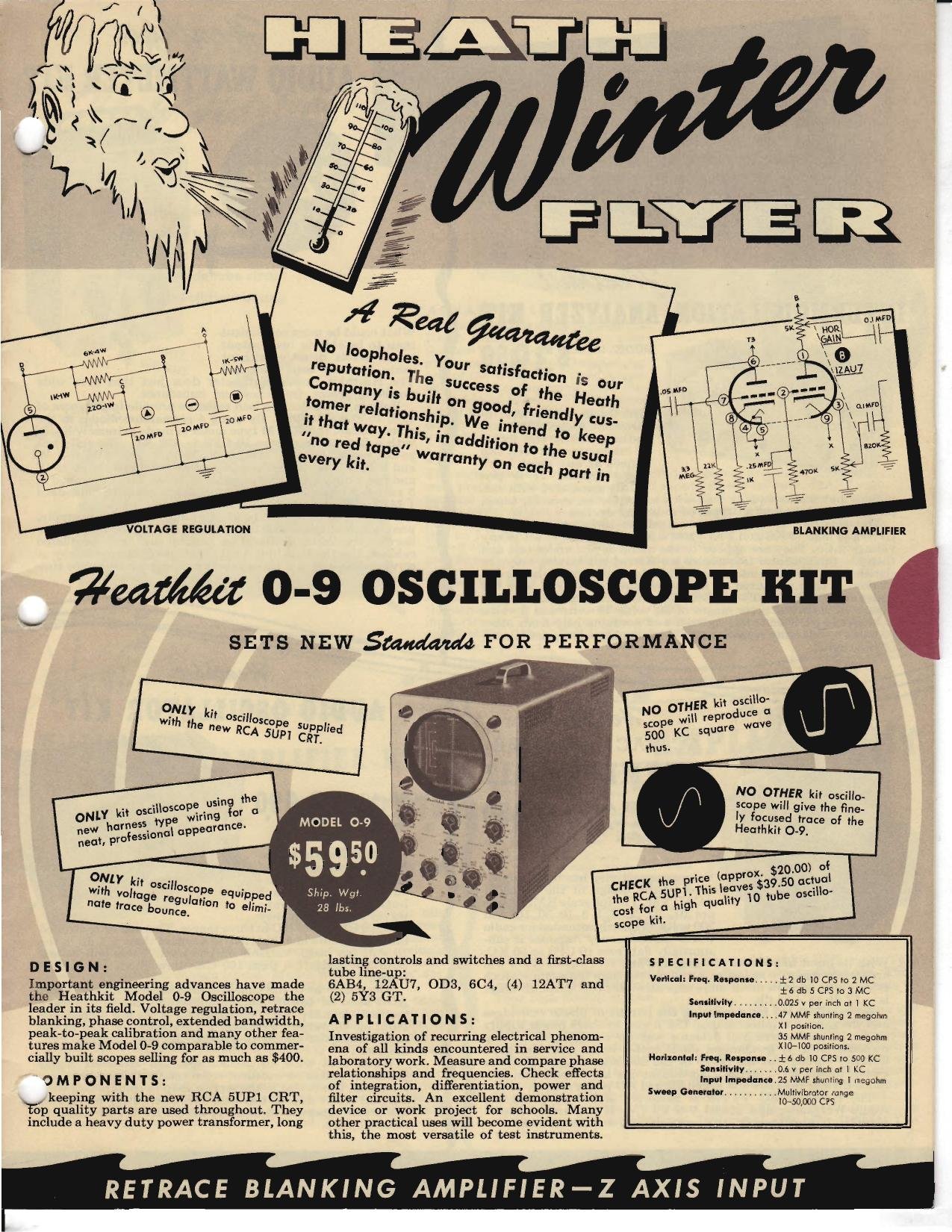
The oscilloscope stayed at $39.50 from July 1947 until late 1951 through six models, while Heath reworked the circuit under it.
Table 2 — The oscilloscope series
| Model | Announced | Withdrawn | Weight | Principal change |
|---|---|---|---|---|
| O-1 | July 1947 | Dec. 1947 | 55 lb | Surplus transformer; 884 thyratron sweep |
| O-2 | Jan. 1948 | June 1948 | 26 lb | Smaller cabinet; lighter transformer; 0.65 V/in vertical |
| O-3 | July 1948 | Apr. 1949 | 26 lb | Direct inputs to deflection plates; Z-axis input; first part-numbering system |
| O-4 | Apr. 1949 | Sep. 1949 | 24 lb shipping | Surplus oil condensers replaced by new electrolytics and paper tubulars |
| O-5 | Sep. 1949 | — | — | Push-pull amplifiers; seven tubes |
| O-7 | 1951 | — | 29 lb shipping | Price rises to $43.50 |
Sources: Eckweiler #85 (O-1 to O-4 dates, weights and circuit changes); 1952 catalogue (O-7 price and weight).
The O-4 marks the end of the surplus era inside the kits. Its advertisements named, for the first time, the new-component makers Heath was buying from (Mallory, Centralab, Ken-Rad and Chicago Transformer), and its design replaced the long-life wartime oil-filled condensers, which Heath had also been selling as surplus “by the truckload”, with new parts. Surplus 5BP1 tubes remained plentiful (Eckweiler #85). The CRT stock lasted a remarkably long time: Neal Turner remembered a heated board meeting at Daystrom’s Murray Hill headquarters after 1955 about how Heath had been valuing its “still quite large” inventory of surplus cathode-ray tubes (Turner, Heath Stories #17).
The O-3 also introduced Heath’s first parts-numbering scheme: one or two letters indicating the kit type in which a part was first used (O for oscilloscope, V for voltmeter, A for amplifier) followed by a serial number starting at 10. It lasted until late 1951, when the numbering system Heath used for the rest of its life appeared with the O-7 and V-6 manuals (Eckweiler #85). The dates matter to collectors, because early parts lists are the easiest way to tell one version of an early kit from another.
2.2.3 The voltmeter series
Table 3 — The voltmeter series
| Model | Introduced | Price | Principal change |
|---|---|---|---|
| V-1 | Dec. 1947 | $24.50 | Five ranges; 6X5, 6H6, 6SN7 |
| V-2 | Late 1948 | $24.50 | Sixth range; 200 µA meter |
| V-3 | Planned April 1949 | $34.50 (announced) | Battery version; few if any made |
| V-4 | 1950 | $24.50 | Larger meter; selenium rectifier |
| V-4A | Late 1950 / early 1951 | $23.50 | Revised AC circuit |
| V-5 | Sep. 1951 | $24.50 | Formed aluminium cabinet; 4½-inch meter; 12AU7 |
| V-5A | 1952 | — | Returns to 6H6 |
| V-6 | 1952 | — | Seven ranges, 1.5 V to 1,500 V |
| V-7 | Early 1955 | $24.50 | First Heathkit with a printed circuit board |
Source: Eckweiler #19; V-5 price from the September 1951 flyer.
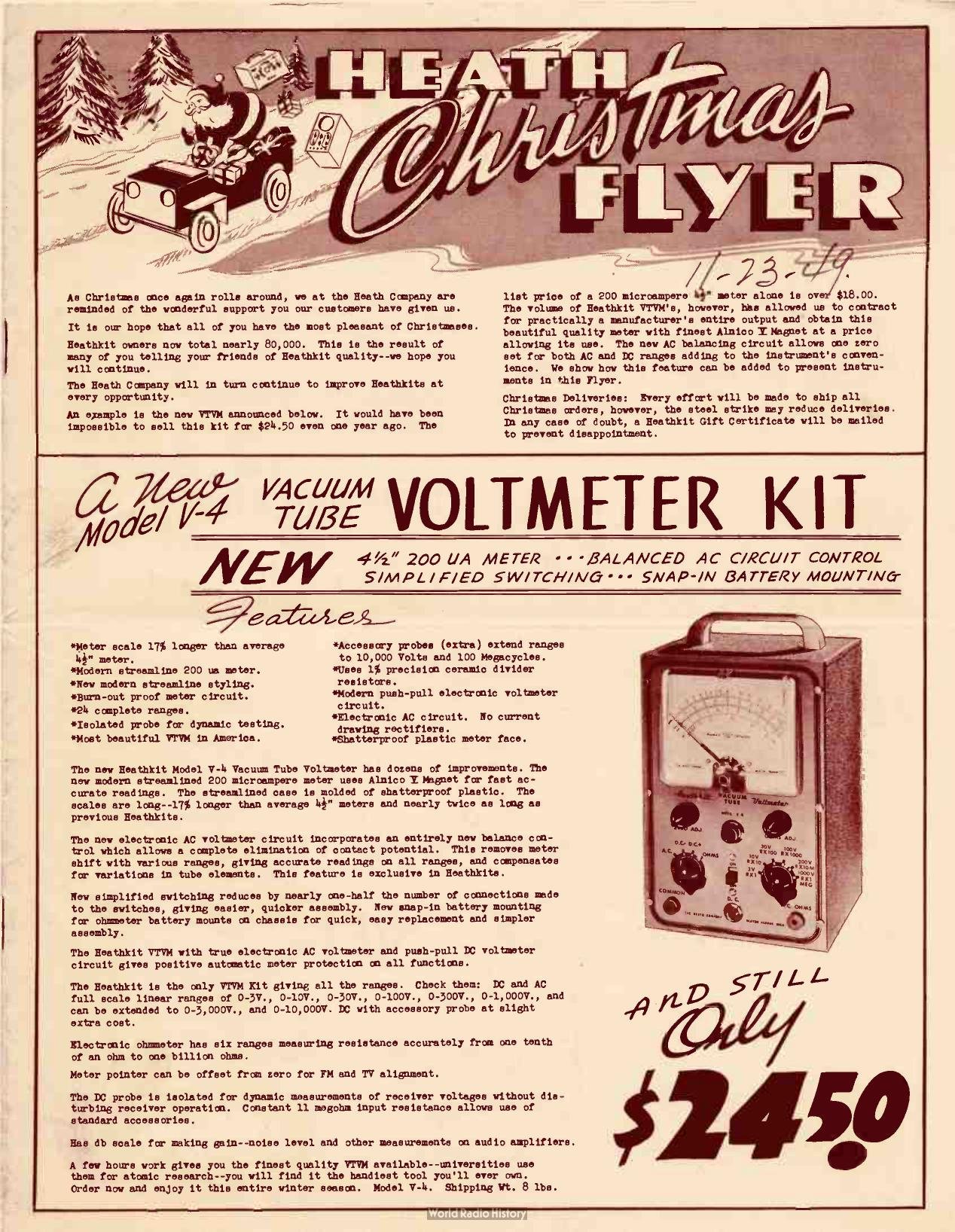
The V-2 illustrates how Heath’s scale began to buy it better parts. The Christmas 1949 flyer explained that the meter manufacturer had agreed to supply a 200-microampere movement in place of the 500-microampere one if Heath bought in sufficient quantity, and the instrument was redesigned around it (Heath Christmas flyer, 1949). The VTVM was also, by Carl Helber’s recollection of a November 1951 conversation, Anthony’s favourite kit, the one he said the company would keep selling as long as he was around (Helber, Heath Stories #52).
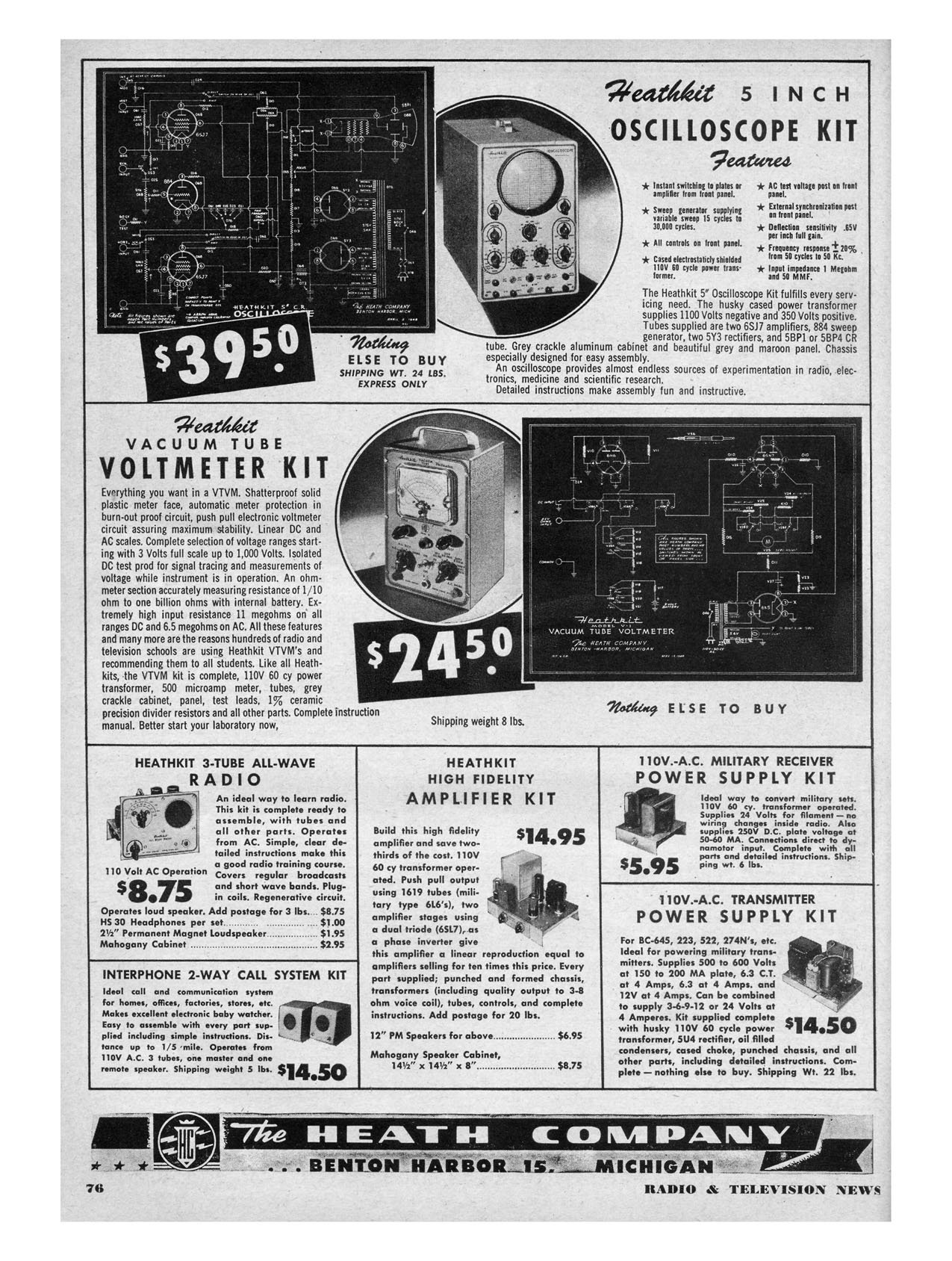
Penson’s often-quoted figure of “more than 2,000,000” Heathkit VTVMs sold over the company’s life (Penson, QST, April 1997) spans forty years and many models and is outside the scope of this volume. It is examined in the field-guide volume of this series.
2.3 Selling by mail
Anthony’s earlier business had depended on airport operators and, in the war, the government, both slow to pay. The kit business reversed that. Customers paid in advance, with cash in the envelope more often than not. Heyning wrote that Anthony “was elated at the idea of Cash with Order for the kits. Now, instead of the customers operating on his capital, he was working on their capital!” Helen Anthony kept the incoming cash in escrow until the kit had shipped, and took pride in paying suppliers within ten days and deducting a 2 per cent discount “whether it said so or not”, which earned Heath the lasting goodwill of its vendors (Heyning, Heath Stories #5). Every early flyer set a $2 minimum order and offered to ship cash on delivery.
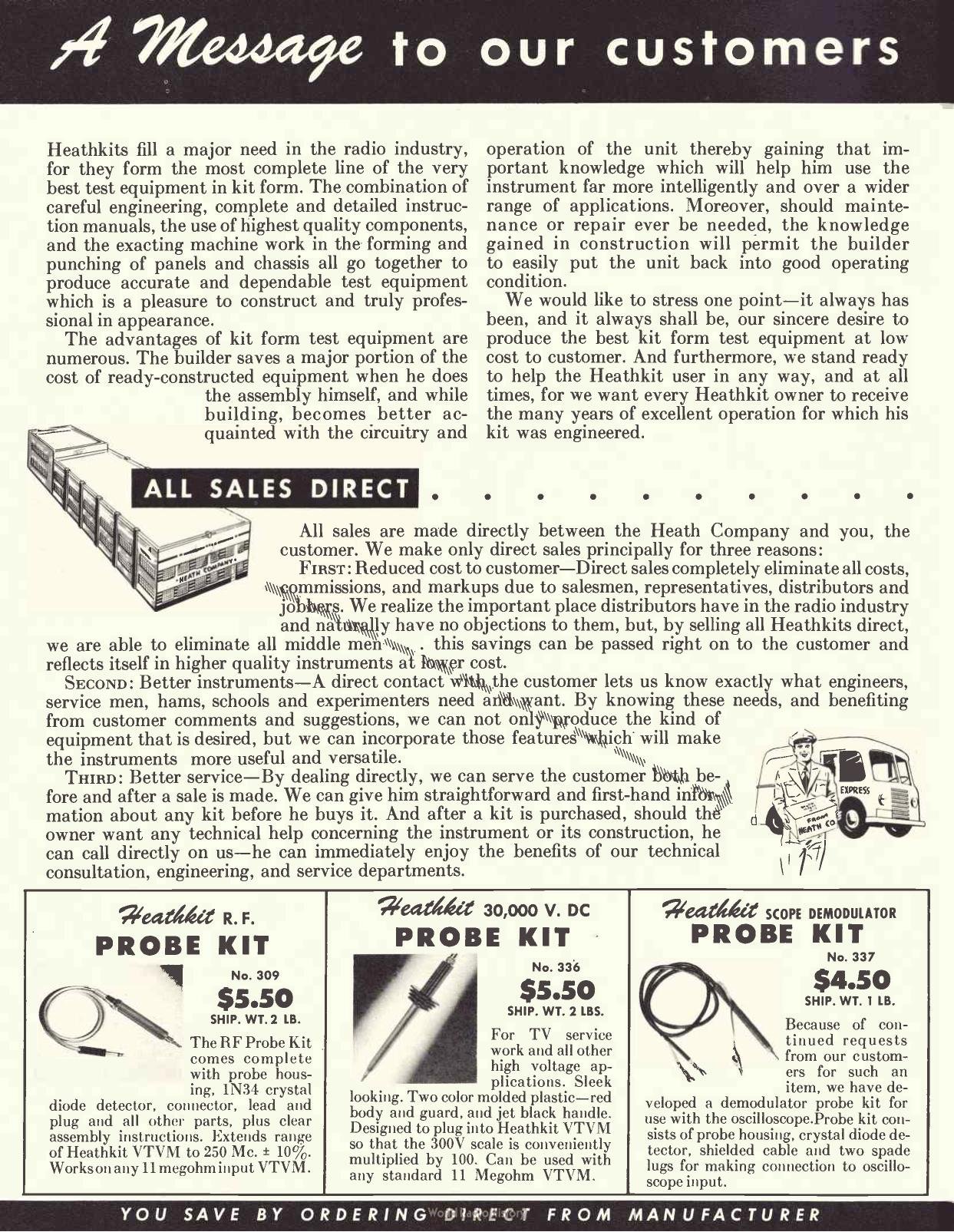
Heath sold only by mail and only direct. The 1952 catalogue set out the policy under the heading “All Sales Direct”:
All sales are made directly between the Heath Company and you, the customer. We make only direct sales principally for three reasons.
The reasons were lower cost (“Direct sales completely eliminate all costs, commissions, and markups due to salesmen, representatives, distributors”), better instruments, because direct contact told the engineers “exactly what engineers, service men, hams, schools and experimenters need”, and better service before and after the sale (Heathkit catalogue, 1952, p. 2). A February 1950 flyer was blunter: visitors to the factory were surprised to find no sales department and no sales manager, because “our customers do the selling.” Whereas most manufacturers spent 30 per cent or more on selling, the flyer said, Heath spent 5 per cent, and it added that “this Flyer is produced by the engineering department” (Heath flyer, February 1950). The footer on every catalogue page carried the same message: “You save by ordering direct from manufacturer.”
The advertising itself was heavy. Heath depended on seasonal flyers, an annual catalogue and what Gene Fiebich called “saturation advertising of 12 to 16 continuing advertising pages in two popular trade magazines. In fact, many customers assumed that Heath owned the magazines” (Fiebich, Heath Stories #14). Brueschke and Mack report the same rumour about Radio News, where from 1955 Heath ran twelve full pages a month for nearly a year. Heath also began exhibiting at trade shows in the early 1950s: an Omaha show, a ham convention at French Lick, Indiana, the National Electronics Conference at the Edgewater Beach Hotel in Chicago and the Institute of Radio Engineers show in New York, where a ten-foot booth drew crowds that blocked the aisle all day. At the first NEC show, Heyning recalled, the staff found only one Heath flyer left in the hall after closing, fallen behind another exhibit (Heyning, Heath Stories #16).
2.3.1 The Monday mail
The growth can be followed through the Monday mail. Fiebich remembered that Anthony personally opened the Monday post, the heaviest of the week, and watched orders climb from 500 to 1,000 to 1,500 a week. One Monday he announced that if orders ever reached 2,500 he would treat the whole plant to steak dinners. About three weeks later they passed the mark, and his secretary, Lois Rudduck, booked Tosi’s restaurant; it was too small for everyone at once, so the dinners ran on two successive Wednesdays, and “certain conniving employees managed to go to both of them” (Fiebich, Heath Stories #15). The date is not given, but Fiebich joined in 1950, which places the 2,500-order week in the early 1950s. Bob Swander, purchasing agent from 1951, remembered Anthony emptying the mail sack onto a table in his office to see the orders come in, still amazed at how much cash customers sent instead of cheques (Swander, Heath Stories #61).
2.3.2 Answering every letter
Early customers were often not radio professionals. Heyning’s favourite letter came from a physician who had ordered the oscilloscope: the kit arrived in three days, every part was on the list, every part fitted, the finished instrument did what the advertisement said, “Marvelous! What do I do with it now? … Please send me your next kit” (Heyning, Heath Stories #5). Heyning’s 1974 history for store technicians noted that “Doctors, Lawyers, Preachers and other professionals” placed orders alongside engineers and technicians (Heath Stories #13).
“Any inquiry or letter got a prompt reply.” At first Anthony answered them himself. Then the engineers did, with Lois Rudduck turning their marginal notes into letters for them to sign. As volume rose Heath created a full-time technical correspondent; Gene Fiebich, a licensed amateur and radio serviceman whom Anthony had met in his repair shop, was hired in 1950 as employee number 48 and cleared a backlog of 200 letters in two weeks (Heyning, Heath Stories #9; Brueschke and Mack). He soon led a group of technical correspondents, and within two years was acting as chief engineer. The correspondents’ reports from the field went back to the designers. This technical-consultation service is the origin of the customer service culture later summed up as “We won’t let you fail”, a phrase not found in the literature of this period; its later history belongs to a later volume.
2.3.3 A laboratory for accuracy
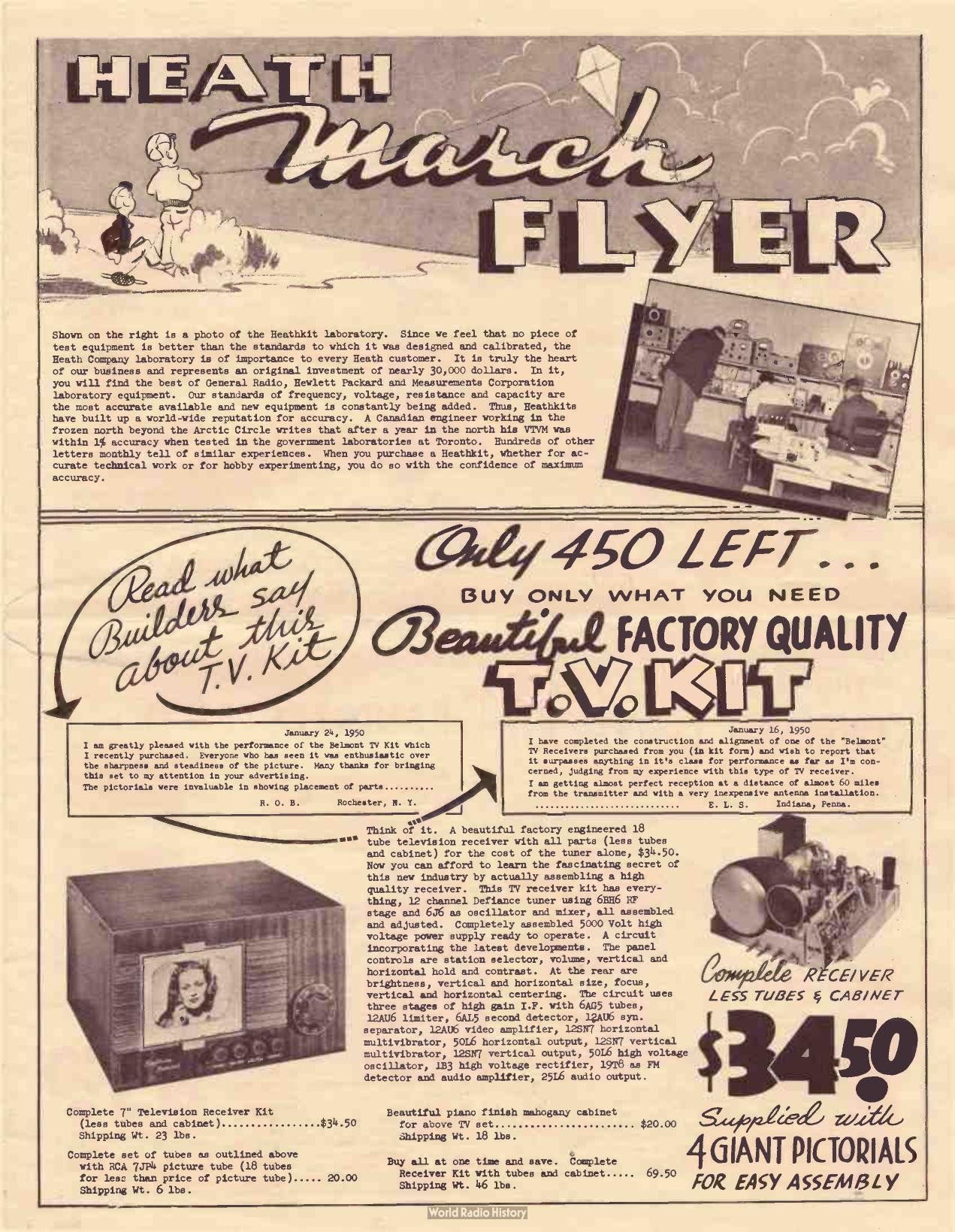
A March 1950 flyer showed the Heath laboratory and claimed “an original investment of nearly 30,000 dollars” in General Radio, Hewlett-Packard and Measurements Corporation standards, describing it as “truly the heart of our business.” It quoted a Canadian engineer beyond the Arctic Circle whose VTVM was still within 1 per cent after a year (Heath March flyer, 1950). The claim was really about the kit’s calibration method: a kit is only as accurate as the standards used to select and grade its parts at the factory.
2.4 Schools and training
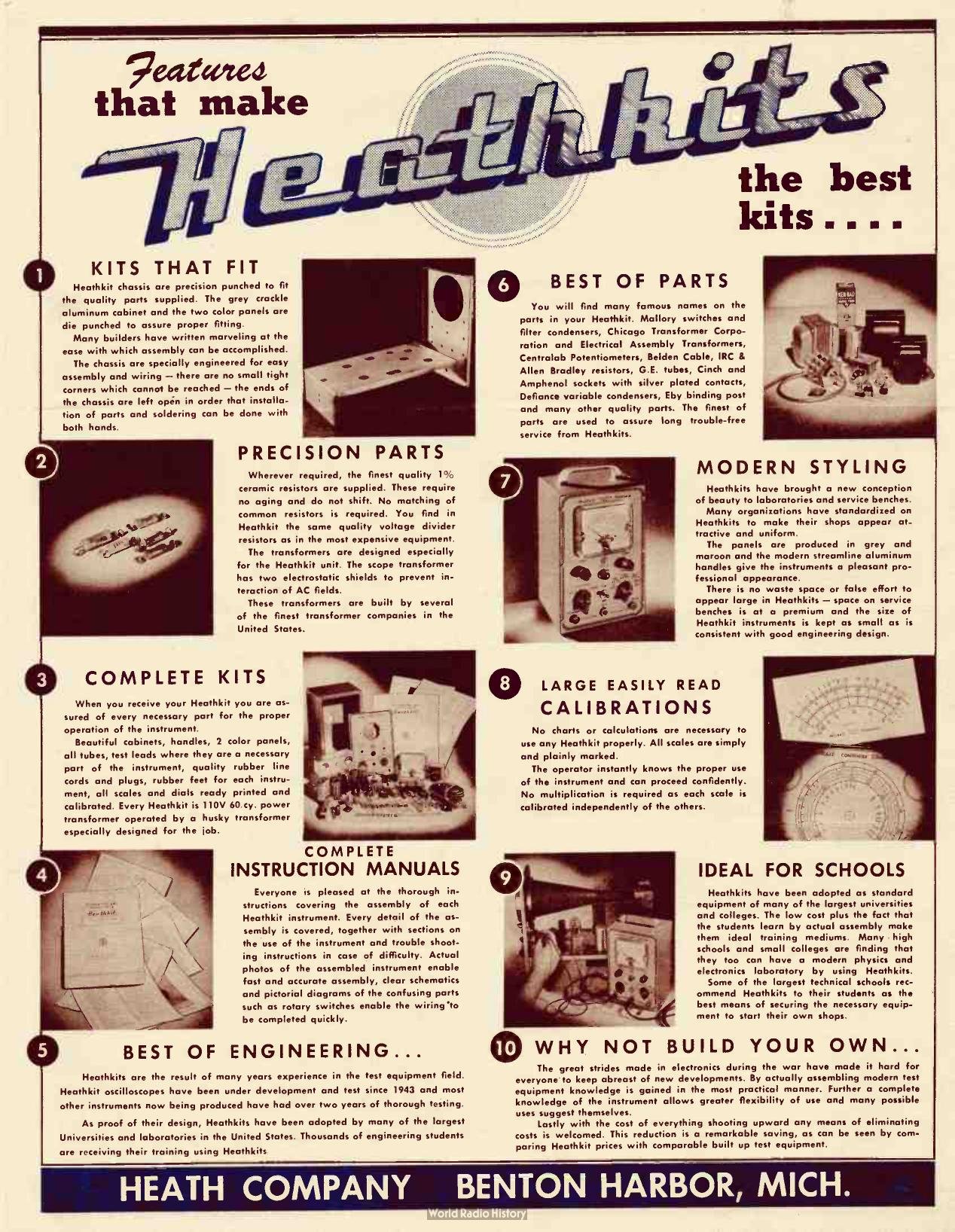
From the first advertisement, which promised “every part supplied complete with diagram and instructions and excellent training course”, Heath sold the kit as education as well as equipment. A flyer headed “Features that make Heathkits the best kits”, distributed in 1948, included a panel “Ideal for Schools”:
Heathkits have been adopted as standard equipment of many of the largest universities and colleges. The low cost plus the fact that the students learn by actual assembly make them ideal training mediums.
It added that high schools and small colleges could equip “a modern physics and electronics laboratory by using Heathkits”, that “some of the largest technical schools recommend Heathkits to their students as the best means of securing the necessary equipment to start their own shops”, and that “thousands of engineering students are receiving their training using Heathkits” (Heath schools flyer, 1948). A near-identical flyer was reissued in 1950 (1950 schools flyer). By January 1951 the language was stronger: “Heathkits are found in every leading university from Massachusetts to California … Technical schools often include Heathkits in their course and these become the property of the students” (January 1951 flyer). Laboratory instruments in the early 1950s catalogues were routinely described as “ideal for schools, laboratories, service shops, serious experimenters.”
The timing was right. Brueschke and Mack point out that the GI Bill paid vocational-school and college tuition for millions of returning veterans, and that radio and television servicing was one of the most popular trades taught. A technical school whose students kept their own instruments on graduation was a natural customer for $25 and $40 kits. How much of Heath’s early volume came through correspondence and technical schools could not be established from the sources consulted. The period flyers claim the business but give no numbers, and none of the large radio correspondence schools of the era (National Radio Institute, DeVry, Coyne and others) is named in the Heath literature examined; several of them are known to have supplied their own training kits. The formal Heathkit educational courses and the later Heath/Zenith educational business are covered in later volumes.
2.5 Television
Television dominated the radio trade in these years, and Heath’s line followed it. The TV sweep generator of 1948, the TS-2 and TS-3 television alignment generators, the scope demodulator probe, the 30,000-volt high-voltage probe and the TV picture-tube adapter for the tube checker were all aimed at servicemen learning to repair television sets. A March 1950 flyer also offered, under the headline “Only 450 left”, a “beautiful factory engineered 18 tube television receiver” in kit form with every part except tubes and cabinet for $34.50, “the cost of the tuner alone.” Customer letters in the flyer identify it as a Belmont chassis, so it appears to have been a surplus or closeout purchase from Belmont Radio rather than a Heath design (Heath March flyer, 1950). Heath’s own television receivers came much later. Carl Helber recalled asking Anthony in 1951 about the television business, and understood that he “wanted no part of it” (Helber, Heath Stories #52).
2.6 High fidelity
2.6.1 From surplus amplifier to Williamson
Heath’s audio business began with a lucky purchase. Among the surplus were a large number of RCA power transformers with a 100-volt primary, which Heath offered for 98 cents each in Radio News in November 1947. Their 6.3-volt winding could only light one tube, but they had a centre-tapped 2.5-volt winding, so Heath needed an output tube with a 2.5-volt filament. It found the surplus 1619, a military beam tetrode that Heath described as a filament-type 6L6. A series 25-ohm, 25-watt resistor dropped the 115-volt mains to the transformer’s 100-volt primary. Surplus Thordarson output transformers completed the design. The result, later known as the A-1, was a four-tube push-pull amplifier (5Y3 rectifier, 6SN7 preamplifier and phase splitter, two 1619s) with tone and volume controls, advertised in the November 1947 flyer at $14.95 and in Radio News from January 1948. The advertisements called it a 25-watt amplifier; data sheets for a pair of 1619s suggest about 17½ watts. When the Thordarson transformers ran out, Chicago Transformer units replaced them, dropping the 15-ohm output tap (Eckweiler, Heathkit of the Month #95). Hank Evans, who had worked for Heath during the war, recalled building “the prototype of the first Hi-Fi amplifier. It had 1619’s in the output”; Heyning believed Evans designed the A-1 and A-2 (Heath Stories #55).
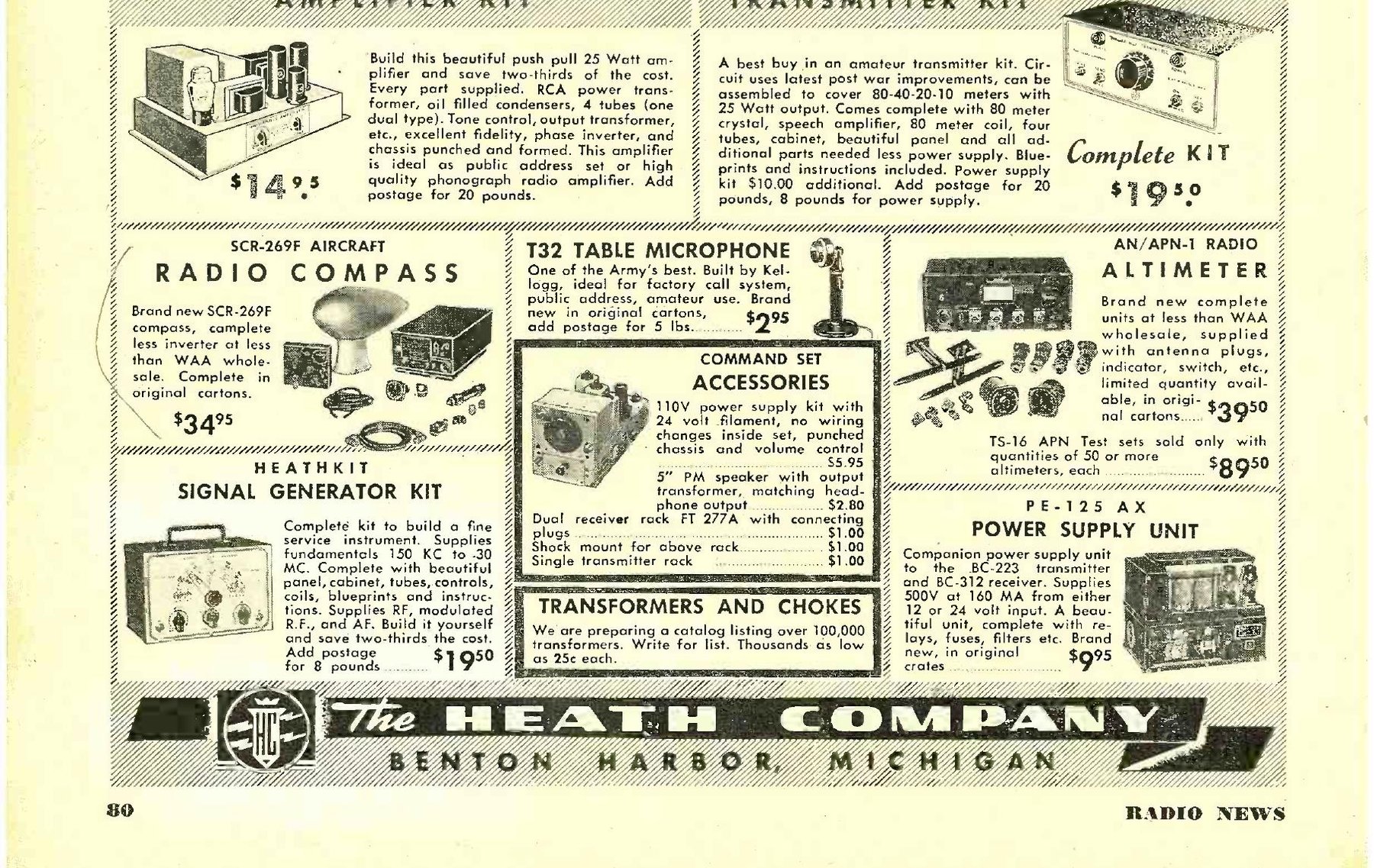
The A-2 followed in August 1948, with the gain “tripled” by a higher-mu 6SL7, and Heath offered A-1 owners the new circuit free for a stamped addressed envelope. The A-3 remained on sale into 1950 at the same $14.95 (Eckweiler #95). In January 1948 Heath’s Radio News advertisement announced a catalogue of “over 100,000 transformers” it was preparing to sell, “thousands as low as 25c each” (Radio News, January 1948, p. 80).
The transformation of amateur audio came from England. In April and May 1947 D. T. N. Williamson published “Design of a High Quality Amplifier” in Wireless World: a push-pull triode amplifier with no interstage transformers and heavy overall negative feedback from the output transformer secondary back to the first stage, giving harmonic and intermodulation distortion far below anything commercially available. In November 1949 D. Sarser and M. C. Sprinkle published a practical American version, “Musician’s Amplifier”, in Audio Engineering (Eckweiler, Heathkit of the Month #29). Heath’s first Williamson-type amplifier, the W-1, followed in 1949 or 1950: two 6SN7s driving triode-connected 807s, with the power supply on a separate chassis, closely following the Sarser and Sprinkle circuit. By 1951 the W-2M (with a Peerless output transformer) and W-3M (with an Acrosound “Ultra-Linear” transformer) had replaced it, using 5881 output tubes at $49.75 each for the amplifier alone; ordered with the WA-P1 preamplifier they became the W-2 and W-3. The W-4 and W-4M followed (Eckweiler #29; Heath Winter flyer, 1954).
The 1952 catalogue sold the “WA-A1” as the “first Williamson type amplifier supplied with matching preamplifier”, claiming harmonic and intermodulation distortion both under half of one per cent at 5 watts and response within 1 dB from 10 cycles to 100 kc. The main amplifier and power supply came for $49.75; with the WA-P1 preamplifier (which had a turnover control for LP and 78 records and separate bass and treble controls with 15 dB of range) for $69.50; and with an Electro-Voice SP12B speaker added for $96.00. It was the most expensive item in the catalogue and had to be shipped by express (Heathkit catalogue, 1952, pp. 15 and 17).
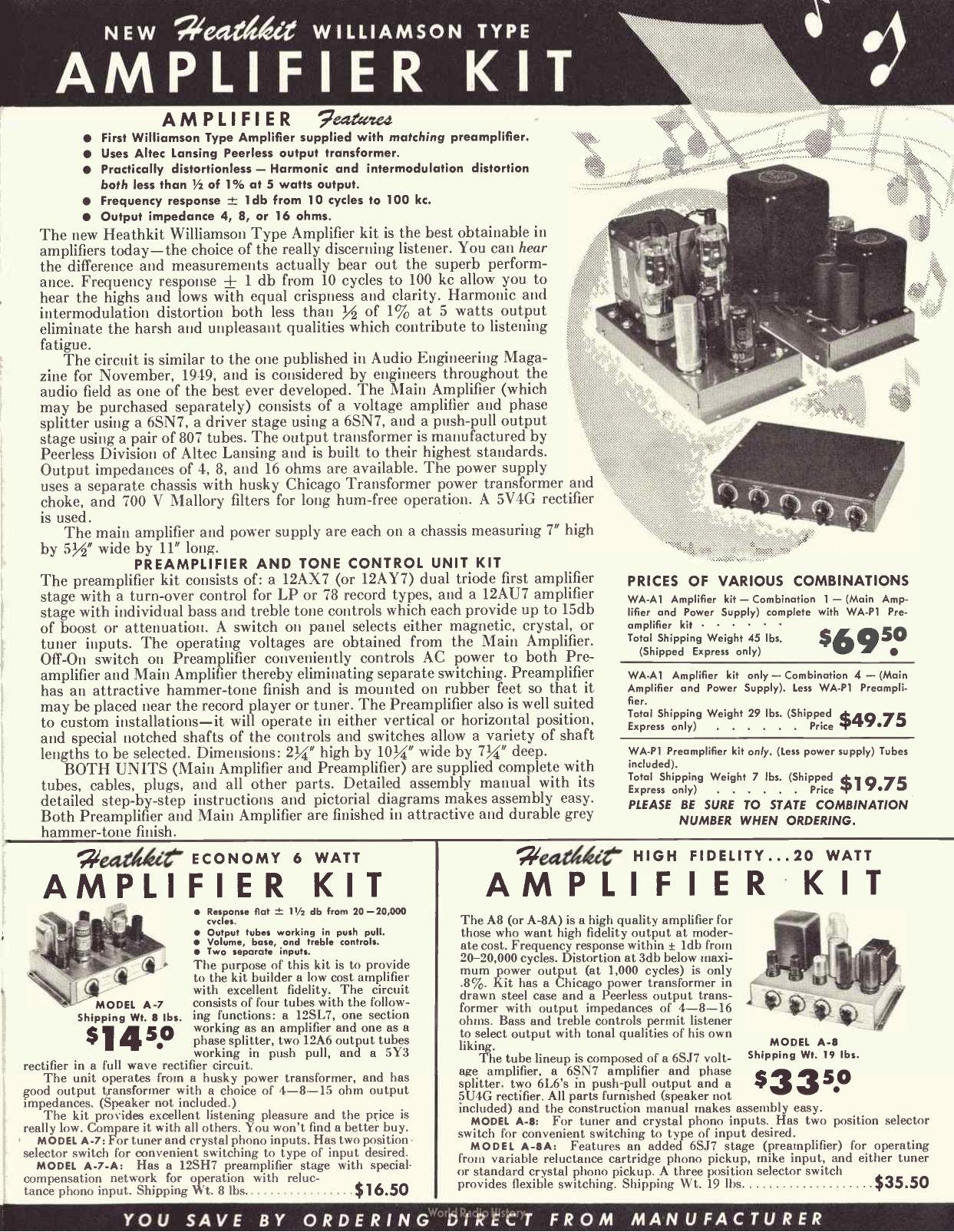
High fidelity grew fast enough to cause friction. Neal Turner recalled that the hi-fi manufacturers’ trade association refused Heath membership because Heath was “not a manufacturer”, which kept it out of the audio shows. The response came after Anthony’s death: in February 1958 Heath took rooms across the street from the Los Angeles show at the Ambassador Hotel and drew crowds large enough that the fire department had to turn people away (Turner, Heath Stories #17). The Heath audio catalogue of 1951–1954 also included the FM-2 tuner, a dual record-player kit at $59.50 in the Summer 1951 flyer, and the economy A-7 and A-8 amplifiers.
2.7 Receivers and the first ham transmitter
The early radio kits were modest. The K-1 All-Wave radio, a three-tube regenerative receiver with plug-in coils, first appeared in Popular Mechanics in April 1948 at $5.95, illustrated by a reversed photograph of a prototype that was never built; the production model, at $8.75, was advertised in July 1948. A battery version was advertised but, Brueschke and Mack conclude, never sold. Erich Brueschke, then a teenager on a South Dakota ranch without mains power, ordered the battery set in 1948 and was sent an AC set instead (Brueschke and Mack). The AR-1 of 1949–1951 at $23.50 was a bare general-coverage superheterodyne with no speaker, no beat-frequency oscillator for CW, no headphone jack and no AVC. The AR-2 of 1952–1955 at $25.50 added a speaker, bandspread, BFO, RF gain with AVC and a headphone jack, and coverage from 535 kc to 35 Mc, and was the first real Heathkit communications receiver.
2.7.1 Refuting the “A1” transmitter
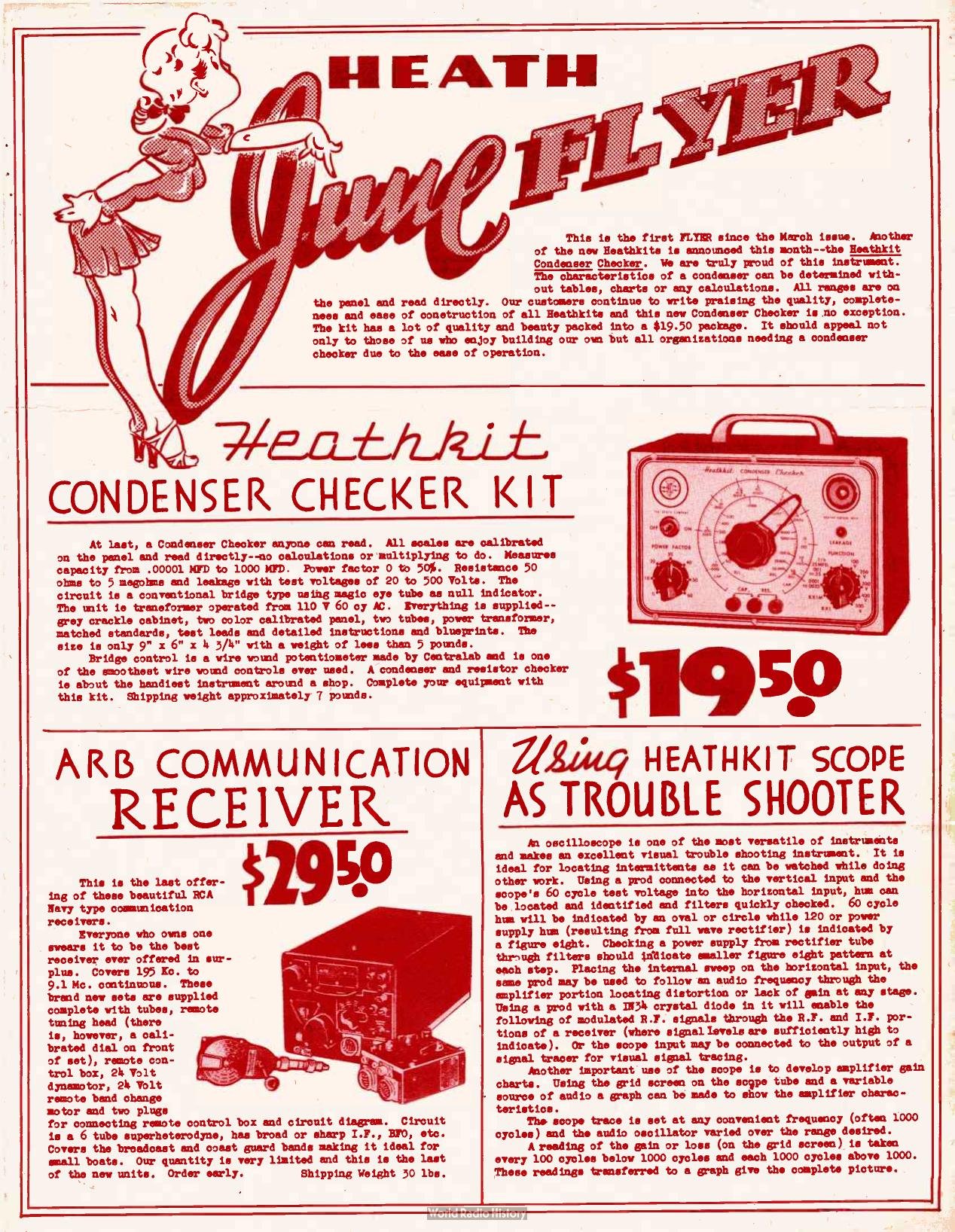
The Tech District video names Heath’s first amateur transmitter as the “A1.” That is a confusion. The A-1 was the first Heathkit hi-fi amplifier. Heath’s first attempt at an amateur transmitter was an unnumbered 25-watt kit for 80, 40, 20 and 10 metres with a crystal oscillator and speech amplifier, advertised in Radio News from January to March 1948 at $19.50, with a $10 power supply. It is visible in the January 1948 advertisement above. According to Brueschke and Mack, Heath could not get it past the prototype stage and none was sold (Brueschke and Mack).
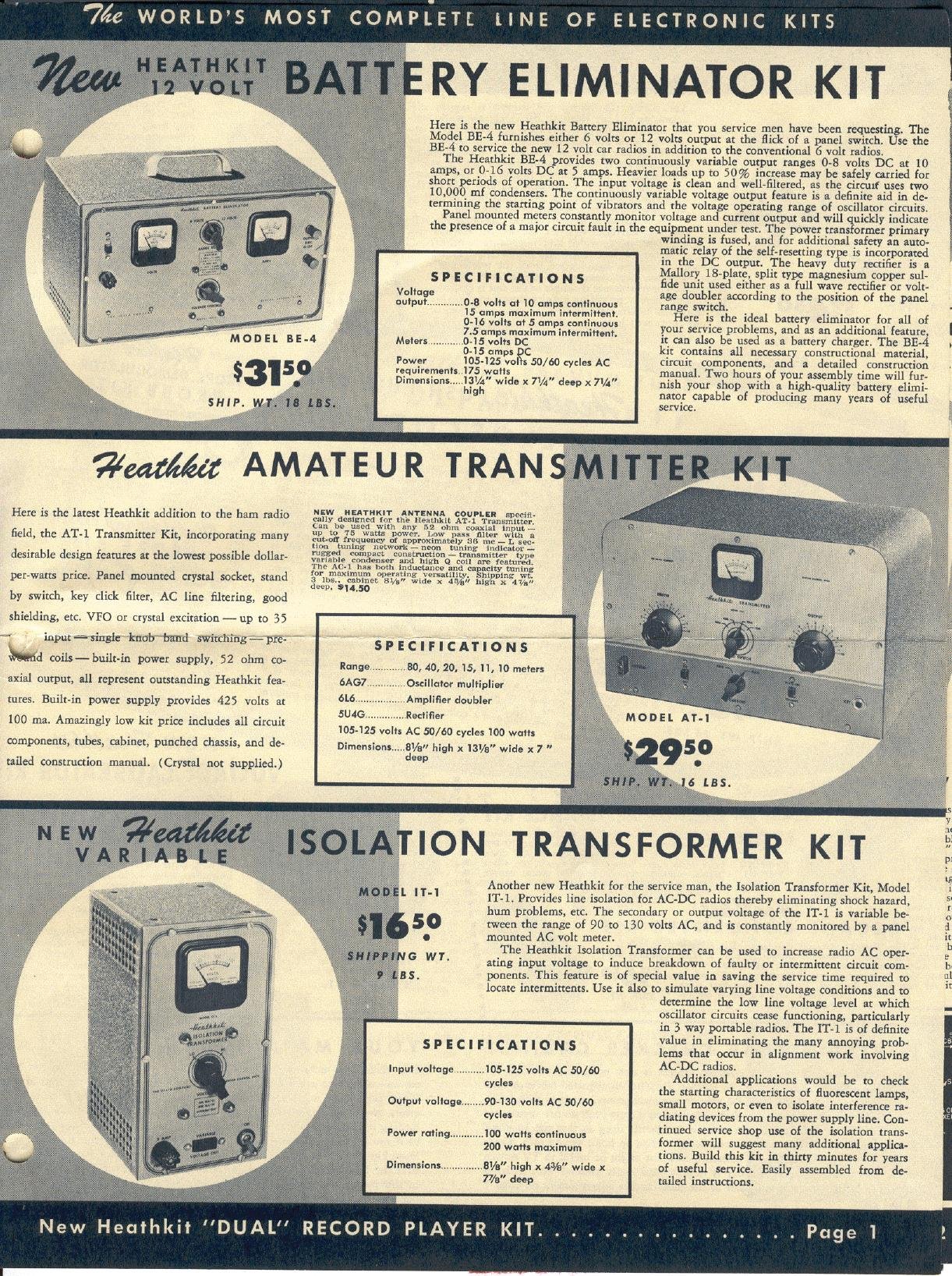
The first Heath amateur transmitter actually produced was the AT-1. The occasion was the Federal Communications Commission’s 1951 reorganization of amateur licensing into six classes, including a new entry-level Novice class limited to crystal-controlled CW on small segments of 80 and 11 metres at up to 75 watts input, with a one-year, non-renewable licence (Eckweiler, Heathkit of the Month #79). The AT-1 was a three-tube, crystal-controlled CW transmitter: a 5U4G rectifier, a 6AG7 Colpitts crystal oscillator and multiplier, and a 6L6 amplifier or doubler, with link-coupled output rather than a pi-network, coverage of 80, 40, 20, 15, 11 and 10 metres, and sockets for an external VFO and modulator. Advertisements said 35 watts input; the manual more honestly said 25 to 30. It sold for $29.50 and remained in production until 1956. Its manual included a chapter on television interference with instructions for building low-pass, high-pass and line filters (Eckweiler, Heathkit of the Month #25). The VF-1 VFO followed in 1952, giving new General-class operators a way off fixed crystal frequencies.
The introduction date is uncertain. The AT-1 appears as “New Heathkit Amateur Transmitter Kit” in the Summer 1951 flyer, and Eckweiler dates it to 1951. Brueschke and Mack say 1952–1956 and credit the design to Roger Mace, whom Fiebich hired in 1952 as an experienced amateur. The flyer shows the kit was being advertised by mid-1951, so either the flyer showed a prototype, as Heath often did, or Mace’s arrival date is a year late. This could not be resolved.
The famous Heath ham gear of the 1950s, the DX-35, DX-100 and the rest, came after Anthony’s death. The Daystrom-era letter announcing the sale in 1955 promised that “amateur radio kits which will make their appearance soon should rate cheers from you Hams” (Post).
2.8 Laboratory instruments and outside designers
By the early 1950s Heath was reaching well beyond the service bench. The 1952 catalogue included an impedance bridge (IB-1B, $69.50) with a General Radio dial and 1,000-cycle hummer, an intermodulation analyser (IM-1, $39.50), an audio-frequency meter, a square-wave generator, a resistance decade, a laboratory power supply and an electronic switch. Several of these came from outside consultants paid by the hour.
Carl Helber, an electronics design engineer at an aircraft company in Akron, Ohio, was introduced by Walther Buhl, who was designing the GD-1 grid-dip meter for Heath. Helber visited Benton Harbor on 3 November 1951. Anthony wanted a Q-meter covering 160 kc to 30 Mc, measuring Q up to 250 or 500 within 10 per cent, to sell for $69.50 or less. His pricing rule was simple: add up the cost of the parts as if bought from the Allied Radio catalogue, and that would be 80 per cent of the selling price, because Heath bought in large enough quantity for the difference to pay for packing. He paid Helber $5 an hour, raised to $7.50 for the next project so that Helber could hire a painter for his house instead of doing it himself. The Q-meter (QM-1) appeared in the March 1952 flyer at $39.50, well under Anthony’s target, and Helber’s next design, begun in April 1952 and finished on 25 July 1952, became the LG-1 laboratory signal generator (Helber, Heath Stories #52; March 1952 flyer). Anthony also told Helber that one advantage of the kit business was that the patent laws did not cover kits, so Heath need not fear infringement suits, a belief that may have been more convenient than accurate.
In April 1954 Anthony asked Helber for help with an analog computer then under development at Heath; Helber, whose employer worked in that field, spent an afternoon advising the engineer George Zindler instead. That project led, after Anthony’s death, to the Heathkit analog computers documented elsewhere on this site.
2.9 Scale, 1947–1954
Anthony never published his figures, and the numbers that survive are recollections. They are not fully consistent, but together they give a picture.
Table 4 — Scale, 1947–1954
| Measure | Figure | Source |
|---|---|---|
| Sales, first year of kits (about 1948) | About $1 million | Anthony to Helber, November 1951 |
| Second and third years | About $2 million and $3 million | Anthony to Helber |
| Expected 1952 | About $5 million | Anthony to Helber |
| Expected 1954 | ”Five million dollars this year” | Anthony to Neal Turner, 1954 |
| Growth, four years to about 1955 | About 80 per cent a year | Turner, from his own statistics |
| Employees, 1950 | Fewer than 50 | Fiebich |
| Weekly orders | 500 rising past 2,500 | Fiebich |
| Products by end of 1948 | More than 33 | Brueschke and Mack |
| Items in the 1952 catalogue | About three dozen, including probes | 1952 catalogue order form |
| Kits in the 1954 catalogue | 48 | Post |
| Daystrom’s purchase price, 1955 | About $1.8 million | Brueschke and Mack |
Sources: Helber, Heath Stories #52; Turner, #17; Fiebich, #14 and #15; Brueschke and Mack; Post; 1952 catalogue.
Wikipedia states that Heath had “$10 million in annual revenue” by 1954, citing a 1983 Sextant article (Wikipedia, “Heathkit”). Both of Anthony’s own reported statements, in 1951 and in 1954, point to about $5 million. The $10 million figure is therefore doubtful for 1954; it may describe the year after the sale, since Turner wrote that under Daystrom “we exceeded that number by an order of magnitude” within a few years. Neither figure is supported by a company document found in this research.
Rich Post’s statement that Heath had sold “nearly 100,000 oscilloscope units” by 1954 (Post) is plausible at the growth rates above but is unsourced, and is recorded here as unverified.
2.9.1 The plant on Territorial Road
The kit business grew inside the same buildings the aircraft-parts business had used. The company held 305 Territorial Road and the neighbouring Baker-Vawter building on Park Street, and more warehouse space around Benton Harbor for surplus stock. As it grew, Anthony bought the lot next door to 305 Territorial, which had been the house of a local brothel-keeper named Bertha Russell until the State Police closed it, and razed the house to expand the plant. When the city installed parking meters on Territorial, where employee parking was already scarce, Anthony had them removed after one visit to City Hall (Heyning, Heath Stories #9; Fiebich, #62). He backed his right-hand man Ralph Lhotka for the City Commission in about 1952.
Heath made its own metalwork. The 1952 catalogue told customers they saved money “because of our complete facilities to make kit chassis and panels in our own plant. Shearing, punching, forming, spot welding, painting, and screening is all done right here” (1952 catalogue, p. 16). There were no dimensioned drawings: the machine shop ran production from templates made by the engineers, and purchasing bought parts to match a vendor’s sample, which became a problem when a second supplier was needed and the sample had gone. Quality control was informal; the women packing kits noticed missing socket pins or pulled transformer leads (Fiebich, Heath Stories #14).
By 1954, Turner wrote, “we were running out of places to put people, stock and, frankly, money!” The move to a new plant came under Daystrom in 1958 and is covered in the next volume.
2.10 The Anthonys as employers
The recollections Heyning collected in the 1980s are affectionate but not uncritical. Anthony was “enthusiastic, energetic, eccentric, excitable, volatile”, in Robert Paxson’s words; he fired Ralph Lhotka so often that Lhotka simply said “Yes, boss” and came back the next morning. He also let employees sail his ketch Betsy on Lake Michigan for the cost of the fuel, once sent the whole plant home on a fine spring Friday with full pay, paid for his employees’ Blue Cross and Blue Shield, and bought a carload of mahogany with Gordon Paxson to build their houses. He commissioned Frank Lloyd Wright to design a house on Miami Road in Benton Harbor, and Paxson recalled that Wright named it “Scherzo” to suit its owner’s temperament (Paxson, Heath Stories #58; Heyning, #3, #11; Fiebich, #15). A lucky investment in a wildcat oil well eventually made him a director of the bank that had once refused him a loan.
Nearly everyone who wrote about the company in these years credited Helen Anthony with its survival. “It’s really her who keeps the company going,” Hank Evans thought. “Oh, he has the ideas, but it is she who makes the company go.” Fiebich attributed the morale of the early Heath company “directly” to “the practices and relationships of Howard and Helen Anthony”, adding that under them “Heath was indeed a great family” (Heath Stories #55; #15).
2.11 The death of Howard Anthony
Anthony flew his own twin-engined Aero Commander on company business, with a corporate pilot, Lawrence (Larry) Durham. In March 1954 he flew Bjorn Heyning, Ellis Grear and Bob Swander to the Institute of Radio Engineers show in New York. East of Cleveland the unpressurized aircraft climbed to escape icing and Swander became ill from lack of oxygen. Anthony, upset, promised to buy a safer aircraft with a pressurized cabin and full de-icing, and in early summer he told Swander he was buying a de Havilland Dove (Swander, Heath Stories #50).
On the morning of Friday, 23 July 1954, Gordon Wyrick of Gordon’s Flying Service in Pontiac, Michigan, flew a twin-engined de Havilland DH.104 Dove, valued at $60,000, into Ross Field, Benton Harbor, to demonstrate it to Anthony. At 11:45 it took off for Tampa and Miami with six aboard: Wyrick, Durham, Anthony, his closest friend the industrial designer Gordon Paxson (on his 42nd birthday), and Laurel (“Brownie”) Brown of Lawrence, Michigan, and his wife Florence. Anthony and Paxson planned to go on to Jamaica by airline for two weeks. Florence Brown kept a log in a paperbound booklet, later found in the wreckage: lunch over Logansport, Indiana, at 9,500 feet at 12:30; over Indianapolis at 12:42; across the Ohio River at 13:10; a climb to 13,000 feet at 14:00 to get over a cold front; down to 12,000 at 14:10 (News-Palladium, 24 July 1954, in Heath Stories #59).
Minutes later, witnesses on the ground in the Walden Ridge mountains of Tennessee saw the aircraft come out of a stormy overcast at about 3,800 feet in a steep spiral or flat spin, heard a roar “like a bunch of jets”, and saw parts falling from it. One woman watched an engine land about 100 feet from her house. The aircraft hit the ground nearly vertically and wreckage was scattered for almost a mile; a wing and both engines lay a quarter of a mile from the fuselage. All six were killed. Local officials at first suspected a mid-air explosion. Harvey P. Gassaway, the Civil Aeronautics Authority’s aviation safety agent from Nashville, interviewed about a dozen witnesses and said that the aircraft “did not explode or burn until after it hit the ground”; he considered the violent up- and down-draughts of “a vicious thunderhead” the strongest possibility, with a wing probably failing first, and de Havilland sent two experts to join the investigation (News-Palladium, 26 July 1954, in Heath Stories #59; Paxson, #58).
The crash site is described variously. The News-Palladium placed it on “Brayton mountain” near Dayton, Tennessee, on the Walden Ridge; Find a Grave gives Brayton, Bledsoe County; a local historian’s 2025 book places it on Walden’s Ridge near Brayton and the Sale Creek Mountain community (Find a Grave; Chattanoogan.com, 5 April 2025). The area lies where Bledsoe, Rhea and Hamilton counties meet, which explains the differences. Anthony was 42, the same age as Ed Heath at his death twenty-three years earlier. He is buried in Riverside Cemetery, Dowagiac.
Neal Turner remembered the last time he saw him. On a Friday morning in July 1954 Anthony walked into Turner’s laboratory and dropped a prototype five-inch oscilloscope on the bench. “Turner, there it is, it’s all done, it’s designed, it works. All you need to do is to put it on printed circuit boards.” Then: “I am heading for Florida, I’m going to look at a new airplane and I’ll see you when I get back” (Turner, Heath Stories #17). That printed-circuit scope, and the printed-circuit V-7 voltmeter of early 1955, were the first fruits of the Daystrom era.
Bob Swander carried for years the feeling that the crash was his fault: had he not been sick on the flight to New York, Anthony would never have bought the Dove (Heath Stories #50).
2.12 Helen Anthony and the sale
Helen Anthony took over the company. Brueschke and Mack write that, “numb with grief, her heart was not in it,” and that she chose to interview only buyers who would keep the existing staff. Neal Turner recalled that she ran the corporation until January 1955, when she told the employees she had agreed to sell to Daystrom, Inc., on condition that the company stay in Benton Harbor and that the key staff stay with it. The sale was negotiated for Daystrom by Robert Erickson, soon nicknamed “Rapid Robert” in Benton Harbor, who stayed to run the company through its move to St. Joseph. One of Helen’s last acts was to promote Gene Fiebich to director of engineering, a post he held for nineteen years (Turner, Heath Stories #17; Brueschke and Mack).
A letter to customers dated 1 February 1955, twenty-four years to the day after Ed Heath’s death, signed by Helen Anthony and Daystrom’s president Thomas Roy Jones, announced the transaction (Post). The Tech District video’s “Dastrom” is a mis-transcription of Daystrom. Brueschke and Mack give the price as about $1.8 million and say Daystrom recovered it in less than a year; Turner, who had seen the figures, would say only that gross sales in the three months after the sale “were more than enough to cover the cost of the company to Daystrom.” The 1955 catalogue opened with four pages of tribute to the founder it called “Mr. Heathkit” (Brueschke and Mack). The Daystrom years, the plant on Hilltop Road and the product explosion that followed are the subject of the next volume.
2.13 Summary of dates
Table 5 — Summary of dates
| Date | Event |
|---|---|
| Jul 1947 | First oscilloscope kit advertised, $39.50 |
| Sep 1947 | ”Heathkit” name first used in an advertisement |
| Oct 1947 | Heyning rejoins; begins the VTVM |
| Nov 1947 | V-1 VTVM ($24.50) and A-1 amplifier ($14.95) in the November flyer |
| Jan 1948 | O-2; G-1 signal generator; phantom 25-W transmitter advertised |
| 1948 | Schools flyer; more than 33 products by year’s end |
| Apr 1949 | O-4; IB-1 impedance bridge |
| 1949–1950 | W-1 Williamson amplifier; AR-1 receiver |
| 1950 | Fiebich hired as employee no. 48; fewer than 50 staff |
| 1951 | FCC Novice class; AT-1 transmitter; W-2M and W-3M |
| Late 1951 | New parts-numbering system; O-7 at $43.50 |
| 1952 | ”All Sales Direct” catalogue; Q-meter; LG-1; VF-1 |
| Mar 1954 | Anthony decides to buy a pressurized aircraft |
| 23 Jul 1954 | Anthony and five others killed in a Dove crash on Walden Ridge, Tennessee |
| Jan 1955 | Helen Anthony announces the sale to Daystrom |
| 1 Feb 1955 | Sale announced to customers |
Sources
- Heyning, Bjorn, ed. Heath Stories, vols. 1–2 and supplements (1986–1990), transcribed by Bill Wilkinson. Index; vol. 1 (Heyning, Fiebich, Turner); Supplement 1; Supplement 2; vol. 2; Supplement 3 (Swander, Helber); Supplement 4 (Evans, Paxson, News-Palladium crash reports of 24 and 26 July 1954).
- Brueschke, Erich E., and Michael Mack. “The History of the Heath Companies and Heathkits: 1909 to 2019.” The AWA Review 32 (2019). Internet Archive.
- Eckweiler, Bob (AF6C). Heathkit of the Month series, RF newsletter, Orange County Amateur Radio Club: #19 V-series VTVMs; #25 AT-1; #29 W-4AM Williamson; #32 signal generators; #79 VF-1; #85 O-1 to O-4; #95 A-1; index.
- Post, Rich (KB8TAD). “The Heathkit Legacy.” Monitoring Times, July 2013. boatanchorpix.
- Penson, Chuck (WA7ZZE). “Heathkit’s 50th.” QST, April 1997. Heathkit Virtual Museum.
- Heath Company flyers and catalogues, via worldradiohistory.com, “Heathkit Catalogs”: November 1947; June 1948; October 1948; schools 1948; January 1949; February 1949; April 1949; June 1949; August 1949; December 1949; February 1950; March 1950; schools 1950; January 1951; Summer 1951; September 1951; March 1952; 1952 catalogue; Winter 1954.
- Radio News: September 1947; December 1947; January 1948; Radio & Television News, January 1949, p. 76, via Wikimedia Commons.
- Find a Grave. “Howard E. Anthony (1912–1954).” findagrave.com.
- Chattanoogan.com. “New Book By Curtis Coulter Details 1954 Sale Creek Plane Crash,” 5 April 2025. chattanoogan.com.
- Wikipedia (lead only). “Heathkit”.

Comments (0)