Heathkit · Volume 4
The Golden Age
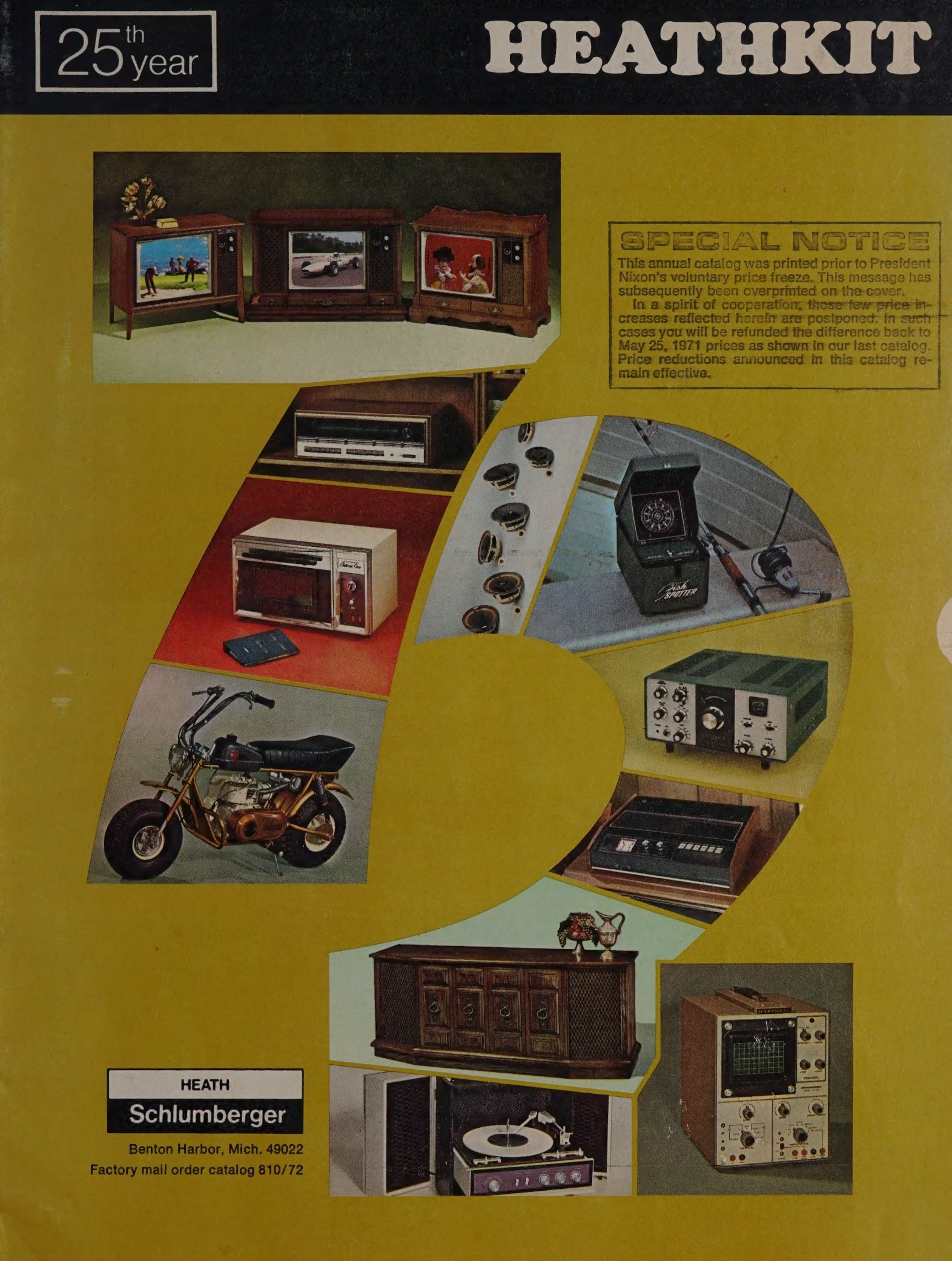
Between 1962 and 1979 the Heath Company belonged to Schlumberger, an oilfield measurement company that had not set out to own it. Schlumberger bought Daystrom for its Weston instrument business, and Heath came with the deal. Left largely alone and supplied with capital, the kit company grew from a $20-million mail-order house into a $90-million business. By the mid-1970s it had more than 1,600 employees in eight countries, a plant in St. Joseph approaching half a million square feet, and roughly fifty retail stores in the United States. It offered a line of kits that ran from a $5 lamp dimmer to a 25-inch colour television with channel numbers on the screen. These years produced the SB and HW ham stations that still fill the used-equipment tables at hamfests, the AR-15 receiver and the solid-state colour sets, the Malmstadt–Enke laboratory instruments, and the first Heathkit self-study courses. This volume covers the company’s organisation, plant, stores and catalogue during that period, and the product lines that defined it. The computers, which began in 1977 and changed the company’s direction, are the subject of the next volume.
4.1 An oil-service company’s only consumer business
Schlumberger acquired the business and net assets of Daystrom, Incorporated on 1 February 1962 in exchange for 629,820 shares of Schlumberger common stock (Schlumberger Limited Annual Report 1962). The acquisition is covered in the previous volume. Its effect on Heath was that the kit company became, in the words of a later summary, “the only consumer business at Schlumberger” until 1979 (SLB, Wikipedia). In Schlumberger’s reports Heath appears inside the “Electronics and Instrumentation” group, later “Measurement & Control,” alongside Weston, Electro-Mechanical Research, Solartron in England and the Société d’Instrumentation Schlumberger in France. Those were companies that sold telemetry to NASA and potentiometers to the Air Force. Heath sold kits to hobbyists by mail.
The mismatch did not harm Heath, and it may have helped. Brueschke and Mack write that Schlumberger “had no particular interest in the Heath Company, but supported Heath since it was highly profitable.” They credit Schlumberger with helping Heath expand its test equipment, amateur radio and hi-fi lines, “with great success” (Brueschke and Mack, AWA Review 32, 2019). The annual reports bear this out. Year after year Heath is one of the few electronics units that the report can praise without qualification. In 1971 electronics results were “generally below expectations, except for the Heath Company.” In 1973 the U.S. electronics group had its best year yet, and “the biggest improvement was at Heath” (Schlumberger Annual Reports 1971, 1973).
4.1.1 Sales by year
Schlumberger’s annual reports give the only continuous public record of Heath’s size during these years. The figures below are taken from them. Where a report gives only a percentage change, that is shown.
Table 1 — Sales by year
| Year | Heath sales, as reported by Schlumberger | Notes from the report |
|---|---|---|
| 1962 | $20 million, all by mail order | figure given retrospectively in the 1972 report |
| 1965 | +11% | foreign sales grew fastest; profit margin “satisfactory” |
| 1966 | increased | ”excellent 1966 results, with both sales and profits increasing” |
| 1967 | increased | ”an excellent year”; AR-15 the best-selling kit at year end |
| 1968 | record | ”another record year both in sales and profit” |
| 1969 | +8%, record | slowdown in October–November; costs of opening new stores |
| 1970 | ”over $50 million” | equal to 1969 despite a consumer slump; sales had doubled in five years |
| 1972 | $66 million ($56 million in the U.S.) | sales now one-third retail, two-thirds mail order |
| 1973 | +17% | “biggest improvement” in the U.S. electronics group |
| 1974 | $90 million (+18%) | colour TV led the gains; margins squeezed by price controls |
| 1975 | $83 million (−8%) | recession year |
| 1976 | $92 million (+10%) | record sales and profit; mail order and retail about equal |
| 1977 | −3% | correspondence-school TV contracts phased out; computers launched |
| 1978 | −5% | the same cause |
| 1979 | sold 1 October to Zenith for $64.5 million | see the volume on Zenith and Bull |
Gilmore, looking back as a former general manager, puts the late-1970s figure at “about $400 million” in today’s money and describes the company as “the world’s largest manufacturer of electronic products in kit form” (EEJournal, “Heathkits and Hams,” part 5).
4.2 The presidents
The catalogues opened with a letter from the president, so the sequence of Heath’s chief executives can be read from them.
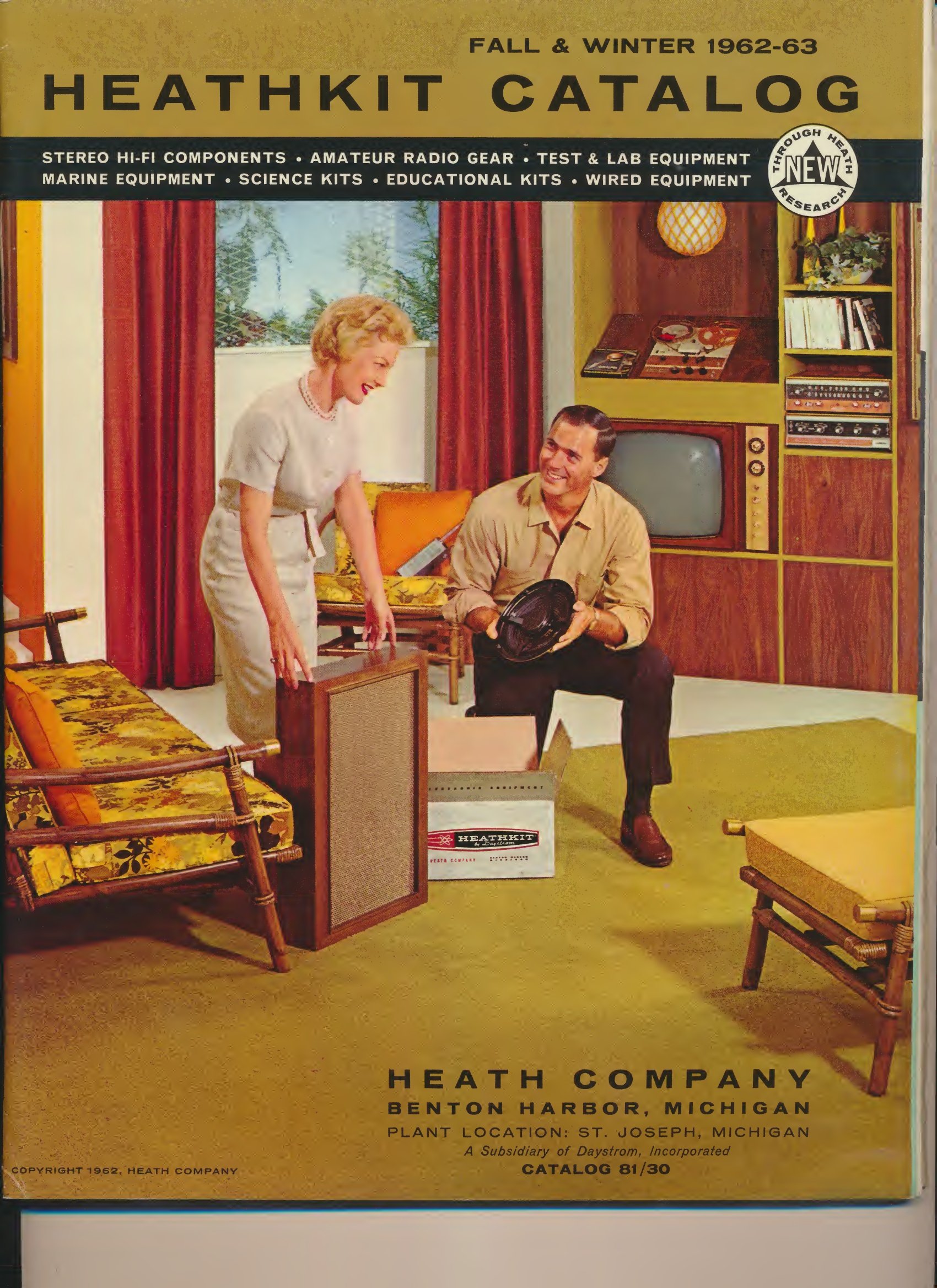
- A. W. Greene signed the “Welcome to Heathkit” letter in the Fall and Winter 1962–63 catalogue (1962–63 catalogue).
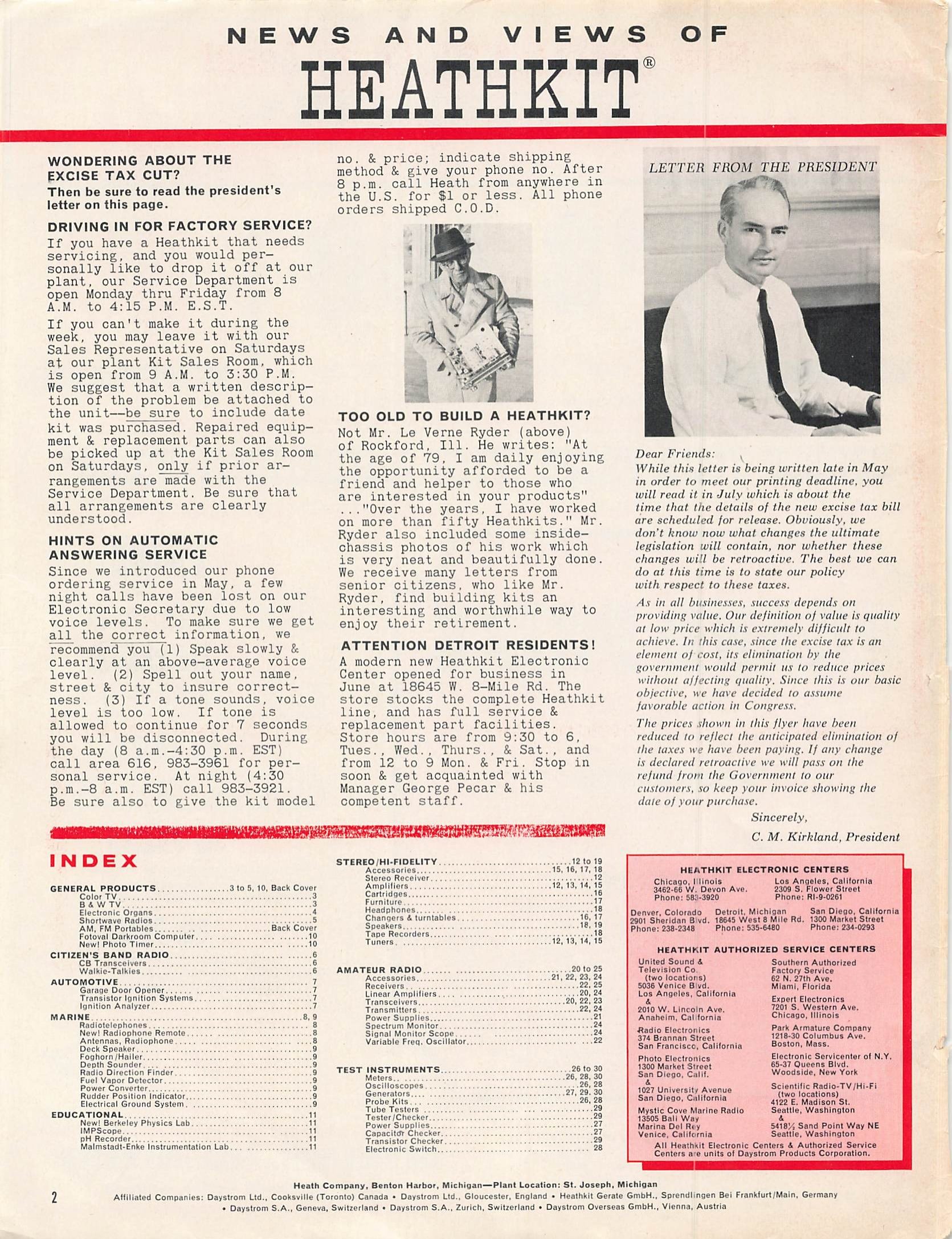
- Charles M. Kirkland was president by 1965. His photograph heads the “Letter from the President” in a mid-1965 catalogue (1965 catalogue, p. 2). On 1 April 1966 he was promoted to marketing coordinator for Schlumberger’s electronics and instrumentation group. He later became president of Weston Instruments and retired in 1977 as a Schlumberger vice president, after fifteen years with the group (Schlumberger Annual Reports 1966, 1967, 1977).
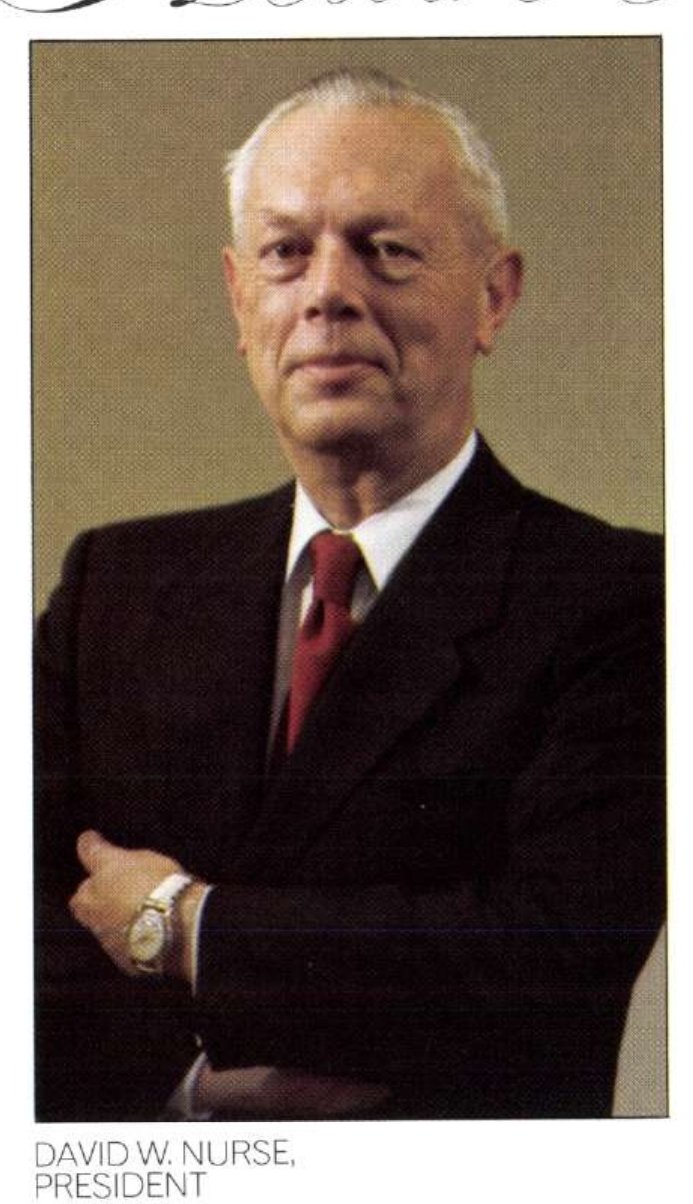
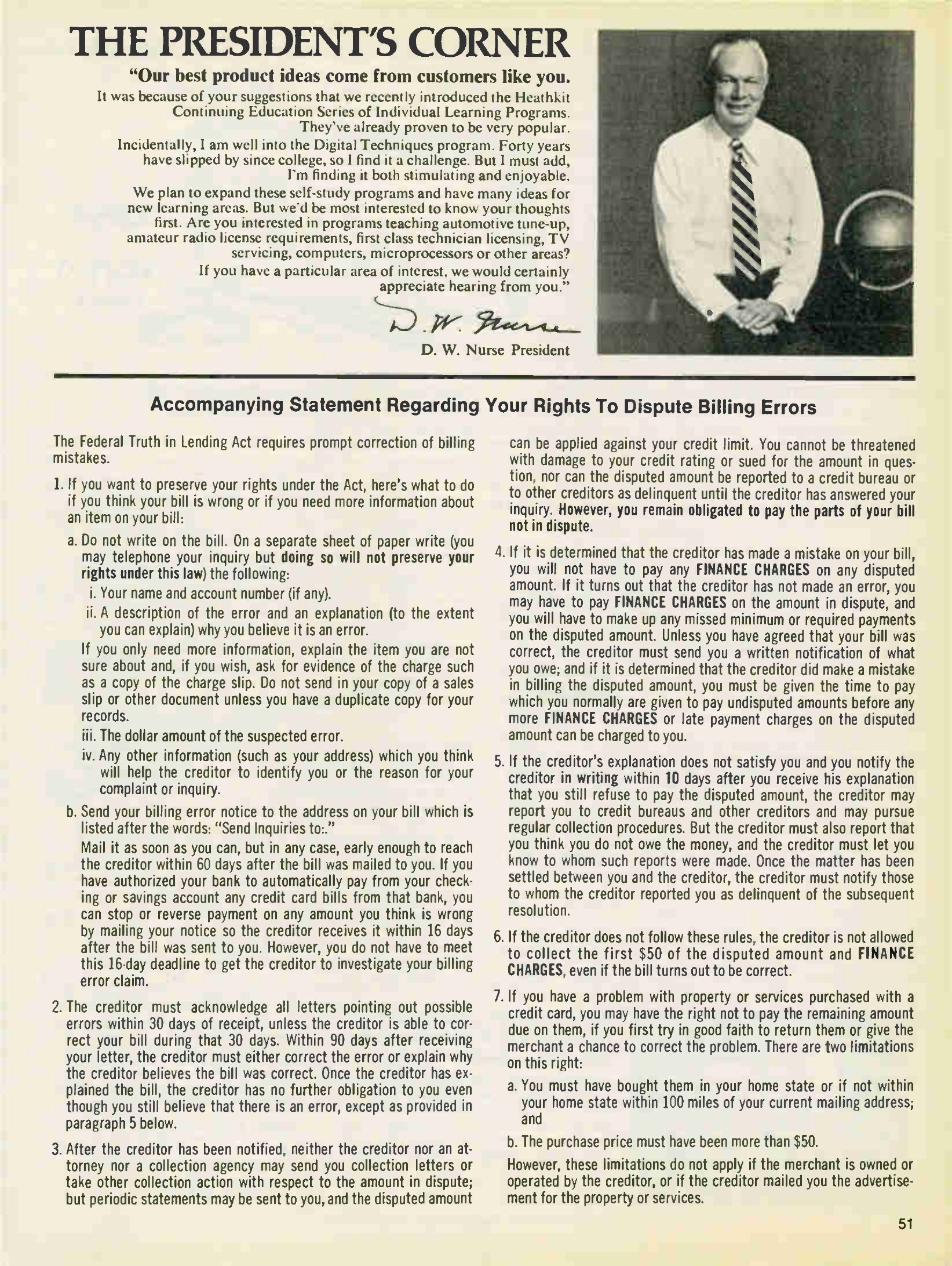
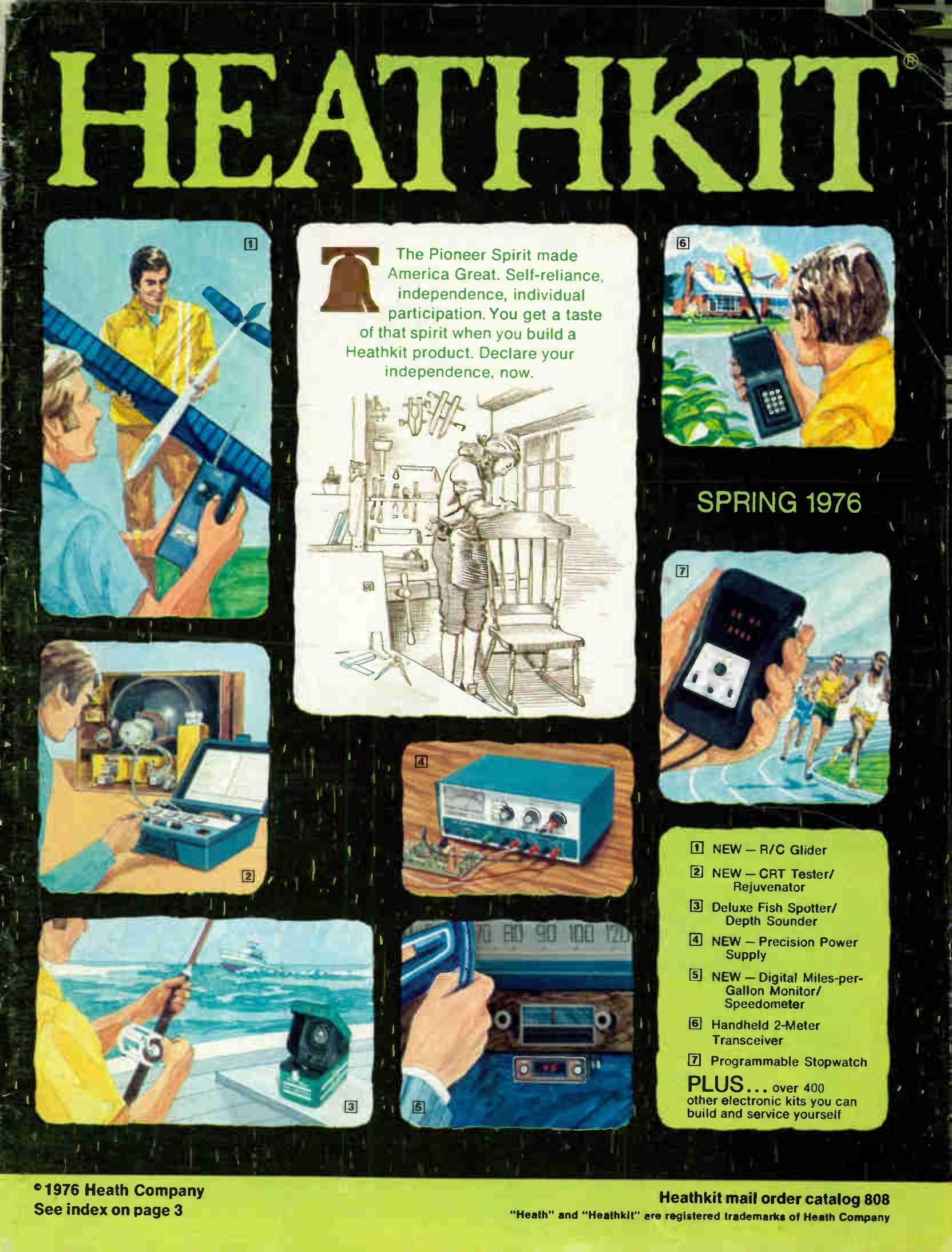
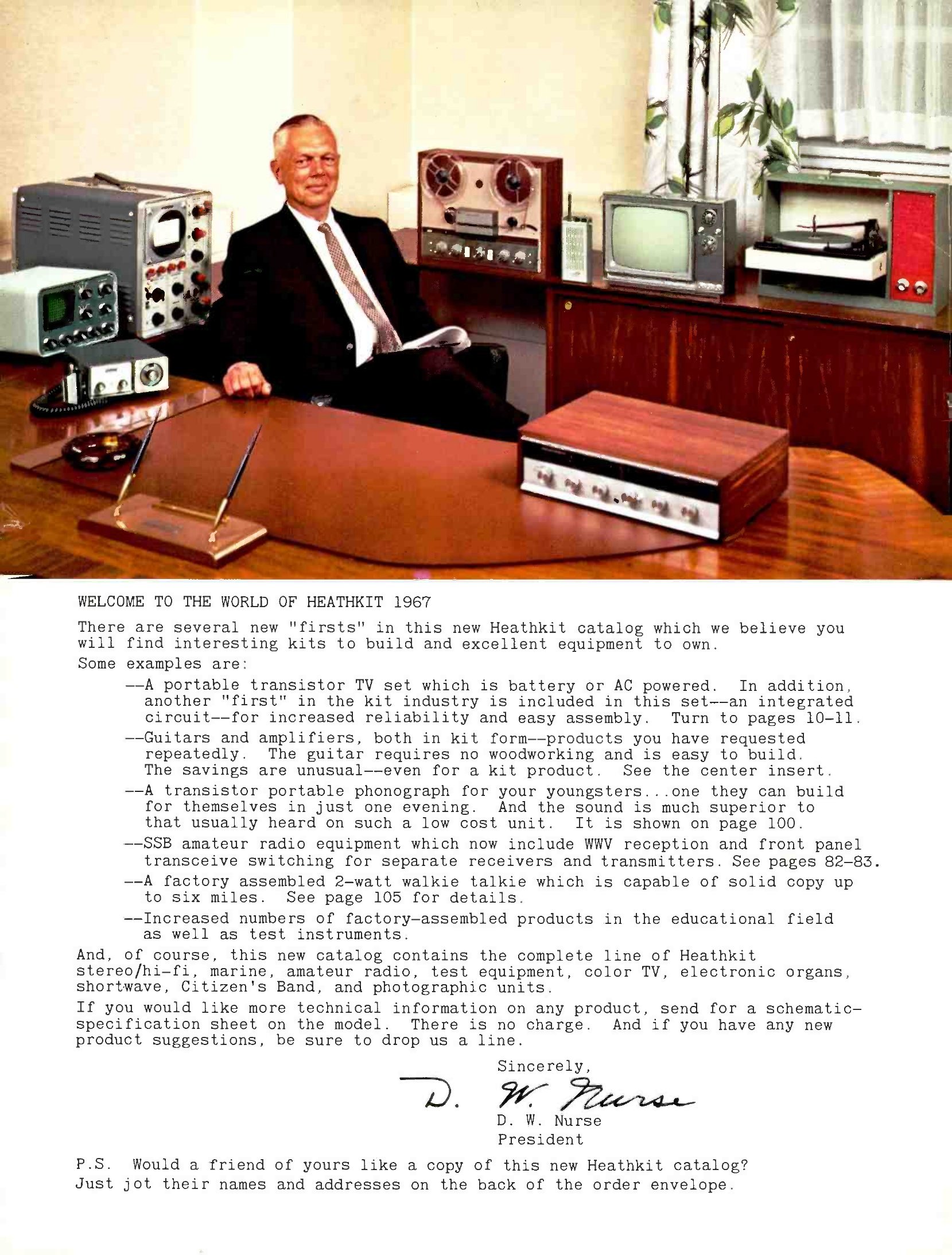
- David W. Nurse, previously executive vice president, became president on the same day, 1 April 1966 (Schlumberger Annual Report 1966). He signed the catalogue letters from 1967 to at least spring 1978. In the “President’s Corner” of the Spring 1976 catalogue he told customers that he was working through Heath’s own Digital Techniques course. “Forty years have slipped by since college,” he wrote, “so I find it a challenge” (Spring 1976 catalogue).
Nurse’s twelve years coincide with most of the golden age. Schlumberger’s 1972 report made Heath its feature subsidiary and printed his portrait.
4.3 The plant fills in
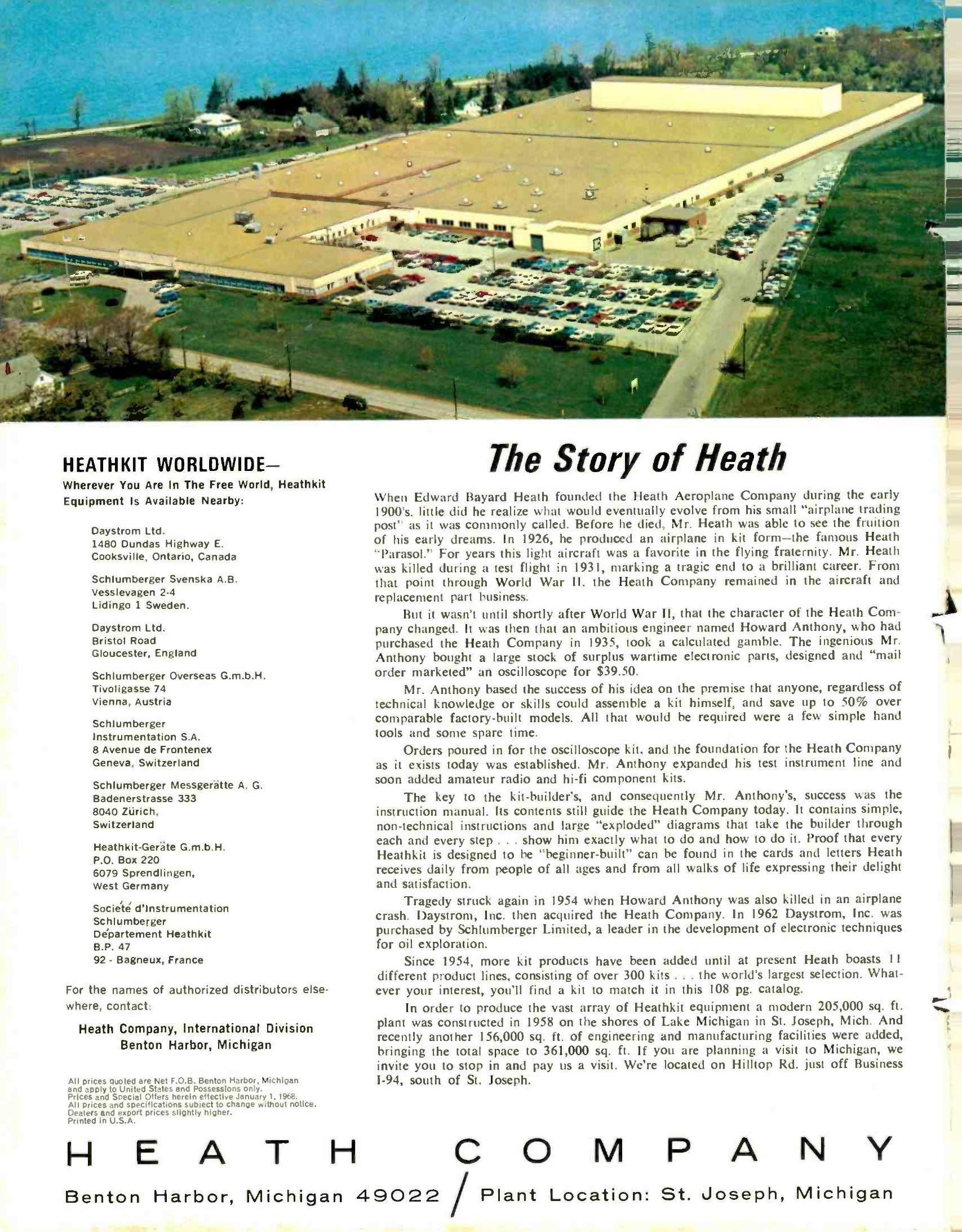
The St. Joseph plant opened in 1958 with 140,000 square feet (see the previous volume). In the Schlumberger years it was enlarged repeatedly. Gilmore’s summary is that the building “which started out as that cute ‘H,’ was filled in seven times,” growing to 550,000 square feet (EEJournal, part 5). The documented steps are:
Table 2 — The St. Joseph plant opened in 1958 with 140,000 square feet (see the previous volume). In the Schlumberger years it was enlarged repeatedly. Gilmore's summary is that the building "which started out as that cute 'H,' was filled in seven times," growing to 550,000 square feet ([EEJournal, part 5](https://www.eejournal.com/article/h-is-for-heathkits-and-hams-part-5-reasons-for-heaths-success-in-amateur-radio/)). The documented steps are
| Year | Change | Source |
|---|---|---|
| 1958 | plant opens, 140,000 sq ft | 1958 and 1959 catalogues |
| by 1965 | 205,000 sq ft (an early-1960s addition) | Schlumberger 1965 report; 1966 catalogue |
| 1967 | more than 160,000 sq ft added for engineering, production and warehousing, at a cost of $2 million | Schlumberger 1967 report |
| 1968 | expansion completed, giving 361,000 sq ft; computer-controlled warehousing installed; 14,600 sq ft office addition started in September | 1968 catalogue; Schlumberger 1968 report |
| 1972 | about 400,000 sq ft | Schlumberger 1972 report |
| 1973 | 60,000 sq ft for manufacturing and 40,000 for engineering, bringing the headquarters to “nearly a half million square feet” | Schlumberger 1973 report |
| late 1970s | about 550,000 sq ft | Gilmore’s recollection |
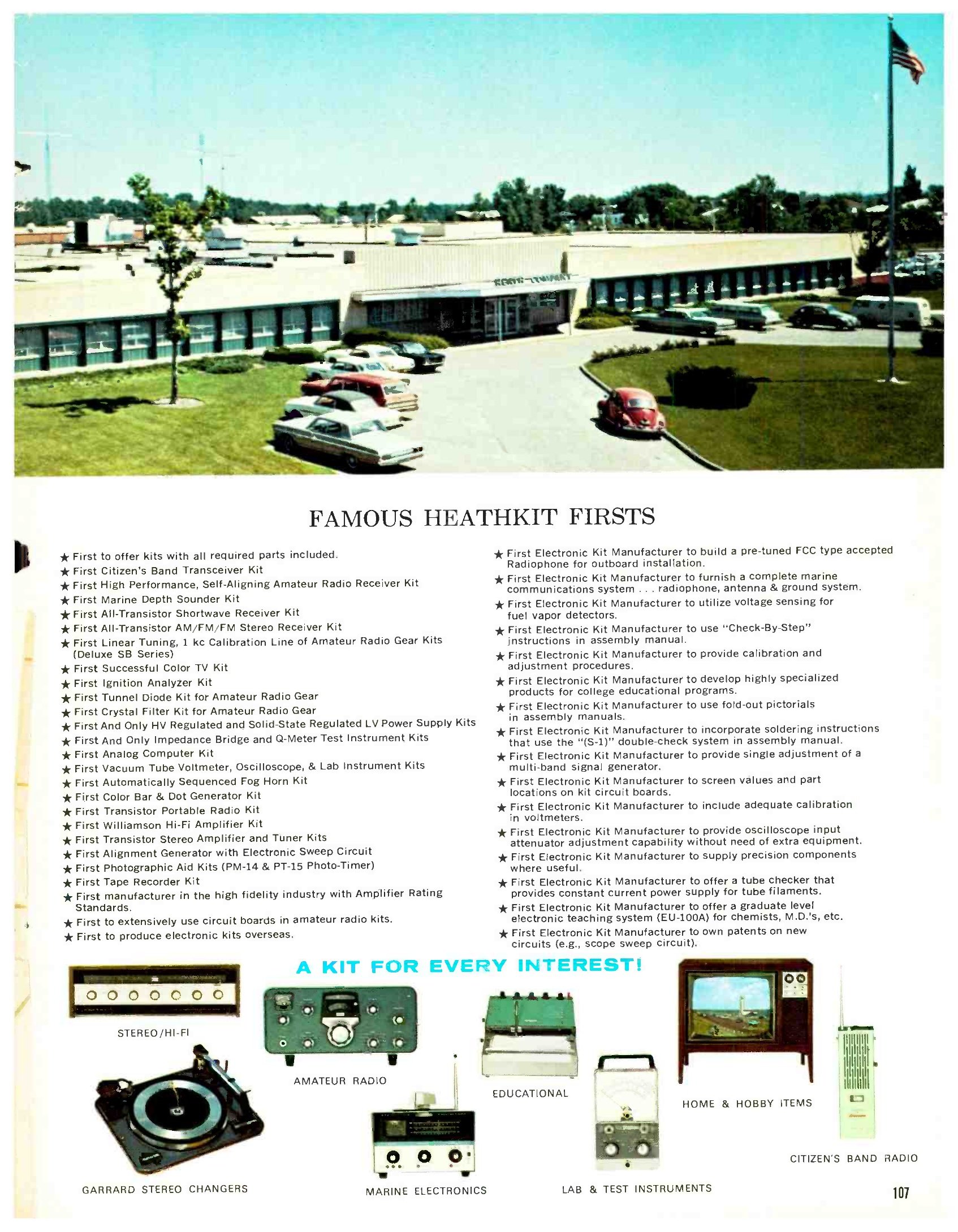
The catalogues’ “Story of Heath” page used the round numbers. In 1968 and 1969 it said that a 205,000 sq ft plant built in 1958 had “recently” been joined by “another 156,000 sq. ft. of engineering and manufacturing facilities … bringing the total space to 361,000 sq. ft.” (Heathkit 1968 catalogue, p. 108). The Heathkit Virtual Museum quotes the same text (Heathkit Virtual Museum, “History”). The expansion years often repeated in retellings (1962, 1967, 1968, 1969, 1972 and 1974) therefore fit the record. The 1967–68 and 1973 steps are documented, and the others are consistent with the gaps between the documented sizes.
The mail on its own was a substantial operation. In 1972 Heath handled “ten million pieces of mail” a year, through “a U.S. Post Office branch … located inside the Benton Harbor plant just for Heath.” Each mailing of the annual catalogue and its four seasonal supplements, “some in four languages,” went to a million and a half potential customers. A 24-hour telephone answering service took orders, a second service handled order status, lost shipments and damaged kits, and a ten-man technical consultation group answered builders’ questions by phone or letter. In all, 125 people at headquarters worked directly on customer relations (Schlumberger Annual Report 1972).
Visiting amateurs photographed the plant from the road. WD8DAS’s page shows it in 1968 and 1975 and records that by 2009 it housed a Whirlpool facility and several small businesses (WD8DAS, “Heath Factory”).
4.4 The Heathkit Electronic Centers
For its first fifteen years Heath sold only by mail. The retail stores were the most important commercial change of the Schlumberger period. By 1976 they brought in about half of the company’s revenue.
4.4.1 How the stores began
Accounts of the first store differ by a year. Gilmore told Electronic Design in 2020 that “in 1961, Heath experimented with retail stores” (Frenzel, Electronic Design). In a later interview he said “we opened our first store in 1962” (EEJournal, part 5). Brueschke and Mack say only that the stores began after Schlumberger bought Daystrom. The most specific account comes from Schlumberger’s 1972 annual report:
By Schlumberger’s own account the first Heathkit retail store opened in Denver, Colorado, in March 1962 and did well. A second store followed in Chicago nearly a year later, and a third in Los Angeles in June 1963 (Schlumberger Annual Report 1972).
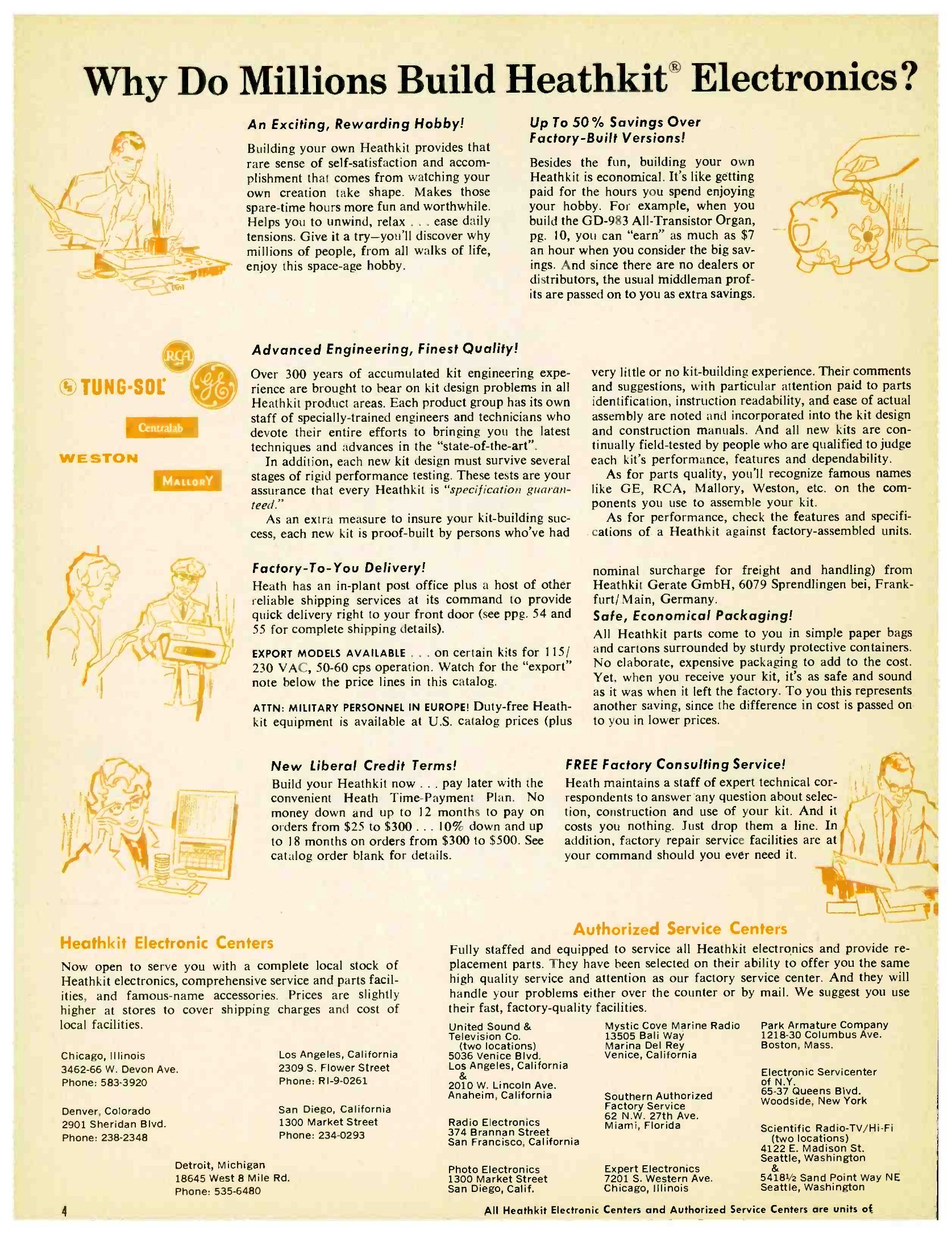
The same report explains the reasoning behind the stores. Customers “like to see the Heathkit products and try them out,” and they bought more readily knowing that technical advice, parts and service were close by. The open question had been price: “retail prices had to be higher than mail order; would people pay for the added convenience? Time would tell, and did.” Every catalogue store page repeated the warning that “prices are slightly higher at stores to cover shipping charges and cost of local facilities” (1966 catalogue). By 1972 the report could state that “retail sales are as profitable as mail order.” The stores also did much of the repair work for mail-order customers.
The stores did not appear in the catalogues at first. The Fall and Winter 1962–63 catalogue lists factory-authorised service centres but no Heathkit stores. By 1965 the catalogue listed five Heathkit Electronic Centers: Chicago (3462–66 W. Devon Avenue), Los Angeles (2309 S. Flower Street), Denver, San Diego and Detroit. The Detroit center, at 18645 W. 8-Mile Road, was new: the same catalogue announced that it “opened for business in June” (1965 catalogue). Schlumberger’s 1965 report names the same five cities and adds new stores that year in Anaheim, London and Munich (Schlumberger Annual Report 1965).
4.4.2 Store counts, year by year
The store count is one of the figures most often overstated in retellings. The table assembles every count found in primary sources. Schlumberger’s reports sometimes count U.S. stores only and sometimes all stores, so the “Scope” column matters.
Table 3 — Store counts, year by year
| Date | Count | Scope | New locations named | Source |
|---|---|---|---|---|
| March 1962 | 1 | U.S. | Denver | Schlumberger 1972 report |
| early 1963 | 2 | U.S. | Chicago | same |
| June 1963 | 3 | U.S. | Los Angeles | same |
| 1965 | 5 in the U.S. plus Anaheim, London, Munich | all | San Diego, Detroit (June), Anaheim, London, Munich | 1965 catalogue; Schlumberger 1965 report |
| end 1966 | 11 | all | Philadelphia, Toronto, Quebec | Schlumberger 1966 report |
| end 1967 | 16 | all | New York City, Washington D.C. (Rockville), Cleveland, Milwaukee, Birmingham (England) | Schlumberger 1967 report |
| end 1968 | 18–20 (“11 in the United States, three in Canada, two in England, and one each in Germany and France,” with Seattle and Redwood City new that year) | all | Seattle, Redwood City | Schlumberger 1968 report |
| end 1969 | 25 (17 U.S.) | all | four new | Schlumberger 1969 report |
| end 1970 | 26 | U.S. | nine new | Schlumberger 1970 report |
| early 1973 | 47 (36 U.S., 4 Canada, 7 Europe) | all | — | Schlumberger 1972 report |
| end 1973 | 44 | U.S. | eight new | Schlumberger 1973 report |
| end 1974 | 46 | U.S. | Toledo, Norfolk | Schlumberger 1974 report |
| end 1975 | 47 | U.S. | — | Schlumberger 1975 report |
| 1976–77 | 50 planned in the U.S., plus 6 in Canada and 8 in Europe | all | three new U.S. in 1977 | Schlumberger 1976 report |
| Fall 1977 | 49 “coast to coast” | U.S. | Alexandria VA and San Jose CA “opening this fall” | Fall 1977 catalogue |
| Fall 1979 | about 55 listed | U.S. | — | Fall 1979 catalogue |
Rich Post counts 47 stores in the Summer 1977 catalogue and 54 in the Winter 1979 catalogue (Post, “The Heathkit Legacy”). The Fall 1977 catalogue itself says “there are 49 Heathkit Electronic Centers coast to coast.” Its list runs from Anaheim to Milwaukee and includes the St. Joseph “Heathkit Factory Store and Customer Center” (Fall 1977 catalogue).
Two points follow from the table. The “more than 60 stores by the mid-1970s” given by Gilmore and by the YouTube retellings is true only if the Canadian and European outlets are counted: about 50 U.S. stores, 6 in Canada and 8 in Europe gives 64 in 1976–77. The U.S. network alone never exceeded the mid-fifties under Schlumberger. Gilmore’s recollection of “about 70” or “around 76” stores most likely refers to the Zenith years. It falls in the next two volumes’ period and is not supported for the 1970s.
4.4.3 Who owned the stores
The stores were never legally part of the Heath Company. From 1966 to 1968 the catalogues state that “all Heathkit Electronic Centers and Authorized Service Centers are units of Daystrom Products Corporation,” and from 1969 “units of Schlumberger Products Corporation” (1967 catalogue; 1969 catalogue). The Schlumberger name remains in the Fall 1979 catalogue. The 1980 catalogue, the first after the Zenith sale, changes it to “Units of Veritechnology Electronics Corporation” (Heathkit catalogue 848, 1980). Brueschke and Mack’s statement that Schlumberger “established Veritechnology Electronics Corporation (VEC) to operate the centers” therefore compresses two steps. Under Schlumberger the operating company was Schlumberger Products Corporation (earlier Daystrom Products Corporation). The Veritechnology name first appears after the Zenith purchase.
4.5 The catalogue by the numbers
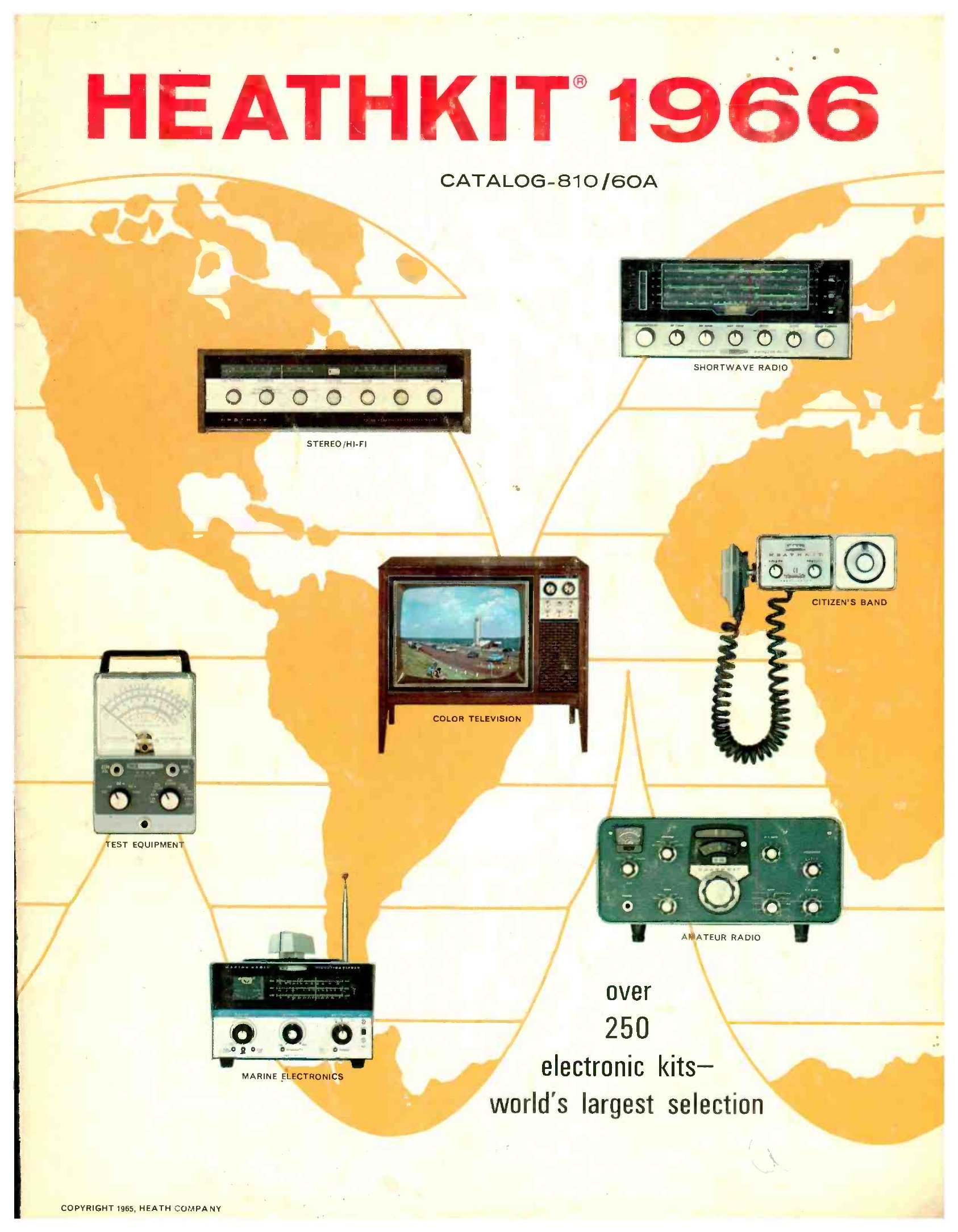
“Catalogue size” is another figure where retellings and sources disagree, largely because different counts measure different things. Heath’s own cover claims counted models, including variants, and sometimes accessories. Independent counts by collectors counted distinct kits.
Table 4 — The catalogue by the numbers
| Catalogue | Count | What was counted | Source |
|---|---|---|---|
| 1955 | 53 kits | distinct kits | Post |
| 1961 | about 180 products (29 ham, 36 instruments) | products | Gilmore |
| Fall–Winter 1962–63 | ”over 250 kits” | Heath’s claim | catalogue |
| 1963 | 200 Heathkits | Schlumberger’s statement to shareholders | Schlumberger 1963 report |
| 1965–67 | ”over 250 kits,” “11 different product lines” | Heath’s claim | catalogues; Schlumberger 1965 report |
| 1967 | 181 kits | distinct kits | Post |
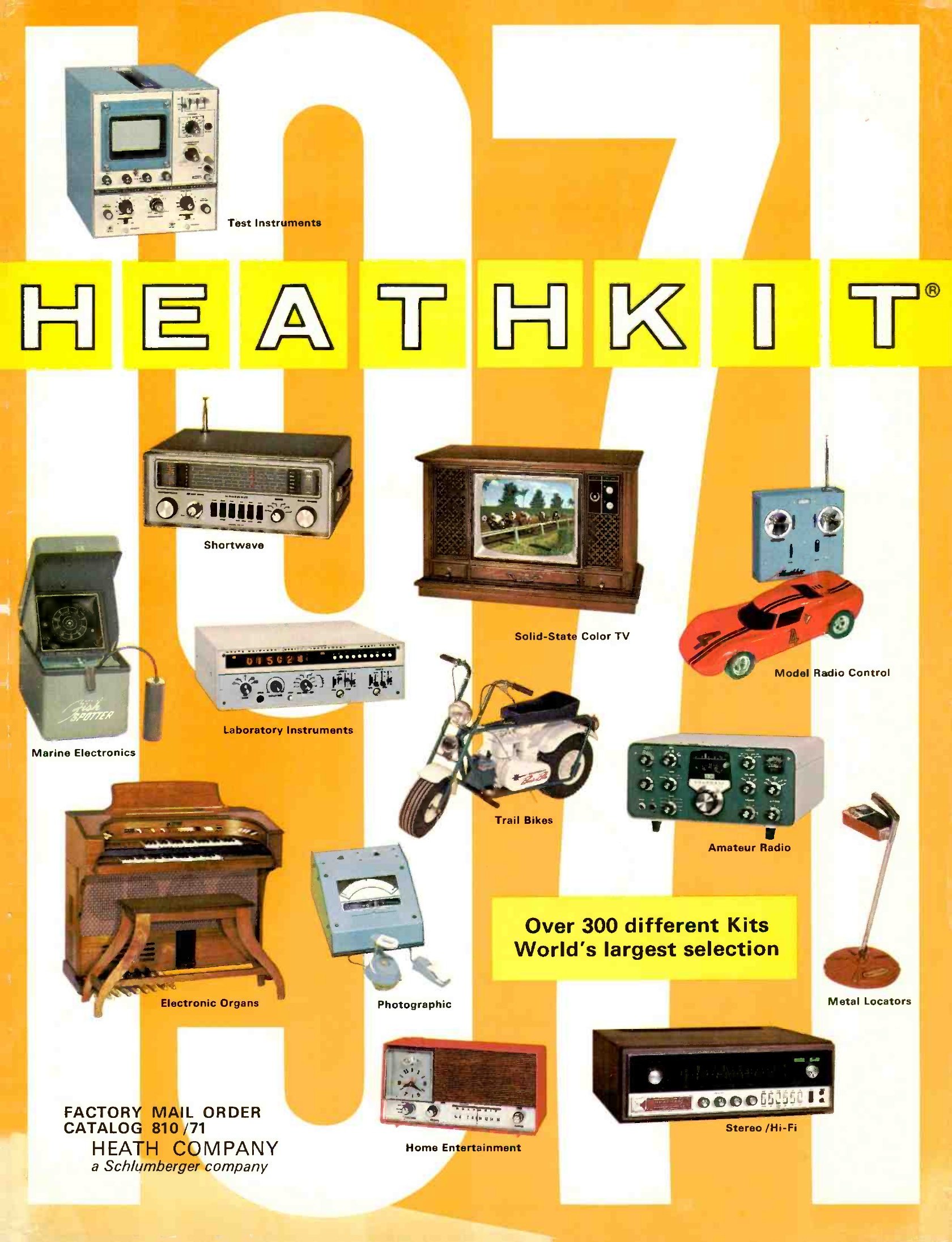
| 1968–71 | ”over 300 kits” / “over 300 different Heathkit models” | Heath’s claim | catalogues; Schlumberger 1968 and 1971 reports |
| 1970 | 44 amateur-radio products | products | Gilmore |
| 1972 | 350 kit models, plus over 200 accessory items and about 150 assembled instruments: “over 700 items” | product listing | Schlumberger 1972 report |
| Spring 1976 | ”plus over 400 other electronic kits” | cover claim | catalogue |
| mid-1970s | ”over 400 products in kit form” | recollection | Gilmore, Electronic Design |
| Summer 1977 | 288 kits | distinct kits | Post |
The “400+ kits” of the retellings is therefore Heath’s own claim for the mid-1970s, printed on the cover of the Spring 1976 catalogue. A collector’s count of distinct kits in 1977 found 288. Both are correct measures of different things. The largest honest figure for a single year is the 1972 listing of 350 kit models.
The line also turned over quickly. In 1972 two-thirds of Heathkit products had been in the catalogue for less than four years, and only a few for more than six. Heath needed about 50 major new products a year, “25 to stay even and another 25 to maintain a healthy growth rate.” It claimed to meet its sales objectives “on ninety percent of new products selected” (Schlumberger Annual Report 1972). Gilmore recalls one year in the 1970s when Heath added 300 new products (EEJournal, “Heathkits and Hams,” part 3). That figure is hard to reconcile with the 50-a-year target unless it counts every accessory and variant.
4.6 Amateur radio: the SB and HW lines
Amateur radio was the product line through which Heath is best remembered, although it was never the largest by revenue. In 1972 the order of popularity by dollar sales was home entertainment first (colour TV, electronic organs and hi-fi), test equipment second and amateur radio third (Schlumberger Annual Report 1972). Brueschke and Mack report that ham products “once accounted for 40 percent of sales” and had fallen to 25 per cent by the late 1970s.
4.6.1 The SB system, 1964
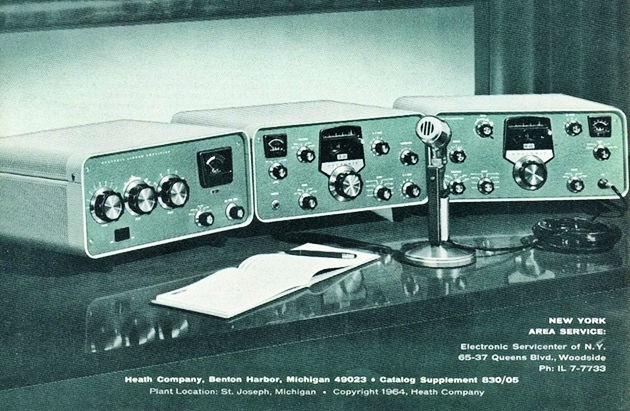
In 1964 Heath introduced a coordinated single-sideband station: the SB-300 receiver, the SB-400 transmitter and the SB-200 linear amplifier. These radios covered 80 through 10 metres, SSB and CW only. Gilmore notes that they “closely resembled the Collins S line,” and “several engineers who worked on Heath’s SB radios came from Collins” after layoffs there (EEJournal, “Heathkits and Hams,” part 2). The key to the system was the Linear Master Oscillator (LMO). It was a 5.0–5.5 MHz VFO with linear tuning, supplied to the builder pre-assembled, tested and calibrated, and it read to within about 200 Hz. The builder never had to align the most critical part of the radio. Every band was produced by heterodyning the LMO against crystal oscillators, which is why each band-switch position covered exactly 500 kHz.
The system then developed in stages:
- SB-100 transceiver (1965). It was planned for the 1964 launch, but the first design was scrapped and redone. It became the SB-101, and then the SB-102 (1967) with a solid-state LMO.
- SB-110 (1965), a 6-metre version, and the SB-110A (1969).
- SB-301 and SB-401, the revised receiver and transmitter, which could transceive on a single LMO. The SB-303 was the solid-state receiver that followed.
- SB-220 (1970), a 2-kilowatt PEP linear. The SB-200 itself, Gilmore says, “outsold all linear amplifiers anywhere.”
- SB-104 (Christmas 1974, $699.95), a fully solid-state transceiver with a digital synthesizer and frequency display. It is discussed below.
The line was also sold as a complete station. A family portrait of the SB line around 1970 shows the station monitor scope, a panoramic adapter with a yellow CRT and a station clock around the transceiver (EEJournal, part 3).
4.6.2 The HW line: Heath’s low-cost ham gear
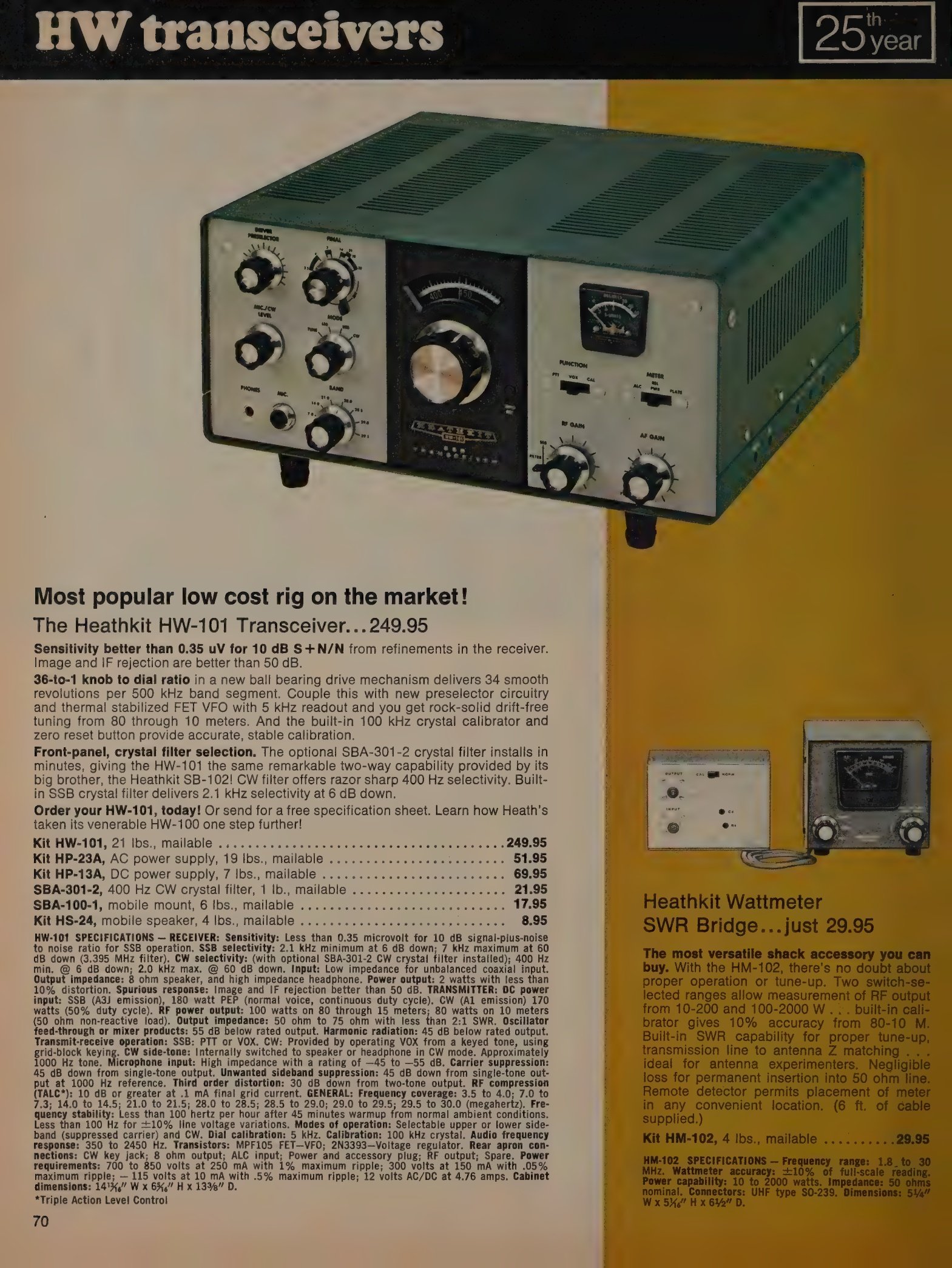
Alongside the SB line, Heath built a lower-cost HW (Heathkit ham) line. It began with the single-band SSB “Monobanders” of 1963, 100-watt transceivers for 80, 40 or 20 metres at $119.95. Their entire radio was built on one circuit board, which Heath’s own staff had said could not be done (EEJournal, part 2). The multiband HW-100 is in the 1969 catalogue. Its successor, the HW-101, appears in the 1972 catalogue at $249.95 under the headline “Most popular low cost rig on the market!” It was described as Heath’s “venerable HW-100” taken “one step further.” It added a 36:1 ball-bearing dial drive, preselector circuitry, a thermally stabilised FET VFO and an optional 400 Hz CW filter shared with “its big brother,” the SB-102 (Heathkit 1972 catalogue, p. 78).
How many HW-101s were sold is a common question. The figure most often quoted comes from Chuck Penson, the leading collector-historian of Heath’s ham products: Heath “sold nearly 40,000 HW-101 transceivers alone—more of a single product than anyone before or since, even more than Collins” (Penson, “Heathkit’s 50th: The Green Turns to Gold,” via the Heathkit Virtual Museum). No Heath production record was found to confirm it. It is best treated as a well-informed estimate by the leading specialist, and the comparison with Collins as his judgement.
The rest of the 1970s ham line followed the move to VHF FM and solid state (EEJournal, part 3):
- HW-16 (1969, $99.50), a novice CW-only transceiver.
- HW-202 (spring 1973), a crystal-controlled 2-metre FM transceiver, Heath’s rather late entry into FM repeater operation.
- HW-2021 (1975), a 1-watt, 5-channel handheld with a built-in autopatch (DTMF) encoder. Gilmore calls it “a tough kit to build” because of how tightly the parts were packed.
- HW-2026 (Christmas 1975), a synthesized 2-metre transceiver. Its synthesizer produced so many spurious signals that it keyed up several repeaters at once. It was recalled, “one of the very first, if not the only, major recall ever done for a Heathkit product,” and replaced in 1976 by the HW-2036. Schlumberger’s 1976 report records that the new two-metre synthesized transceiver set a dollar-volume record for a single product in one quarter.
- HW-8, a low-power CW transceiver, in the catalogue from 1976.
4.6.3 The SB-104 and the limits of the kit
The SB-104 was the company’s most ambitious ham kit of the decade, and it exposed a problem that later spread to the whole business. Brueschke and Mack describe it as having 275 solid-state devices, including 31 integrated circuits, plus hundreds of passive parts. Parts tolerances proved more critical than expected. Sampling incoming parts was not enough, so every part had to be tested in advance, and even that did not solve the problem. “Many were sent back to Heath several times and still would not work right,” they write, and “virtually none of the SB-104s could meet specifications” (Brueschke and Mack). Gilmore’s account is milder: the radio “turned out to be fairly difficult to build,” with “a fair number of difficulties … because of the complexity and the number of parts” (EEJournal, part 3). Both accounts point to the same underlying problem. Heath’s founding assumption was that the customer had no test or alignment equipment, and that assumption was ceasing to hold for state-of-the-art radios. Gene Fiebich had given offshore competition as one reason for retiring as Director of Engineering in 1973, and Brueschke and Mack conclude that “the quality foundation was beginning to crumble.”
4.6.4 A company of hams
The ham line’s credibility depended on the people who designed it. Gilmore estimates that “more than 25 percent of Heath’s 1500 employees were Hams” in the late 1960s and early 1970s. The company club had over forty members and ran a Field Day station from Mud Lake, Michigan under the name “Mud Lake Michigan UFO Sighting, Atomic-Powered Field Day Society.” Heath issued its amateur employees QSL cards with the company name on them (EEJournal, part 3). The 1958 catalogue’s portrait of sixteen “Heath hams” (see the previous volume) had set the pattern of presenting those engineers as the customers’ own representatives.
4.7 Television: from the “295” to the GR-2000
In dollar terms television was Heath’s most important consumer line, and it is where the golden-age company took its biggest engineering risks. A colour set was by far the most complex product a customer could buy as a kit. Heath’s approach was to make the set align itself.
4.7.1 Colour television arrives, 1963–1971
Schlumberger’s 1963 report states that “the most important addition in 1963 was a color television” (Schlumberger Annual Report 1963). Gilmore describes it as a set with a 21-inch round CRT selling for $349, with cabinets from $49 and the UHF tuner optional. The tuners came pre-built. The key design decision was to have the customer build a dot generator and convergence circuitry from sections of the set itself, switched between test and operating modes, so that “a non-technical person” could “build and align a color television set at home with no additional test equipment” (EEJournal, part 2). The GR-53A of that line is quoted in the 1966 catalogue’s testimonials.
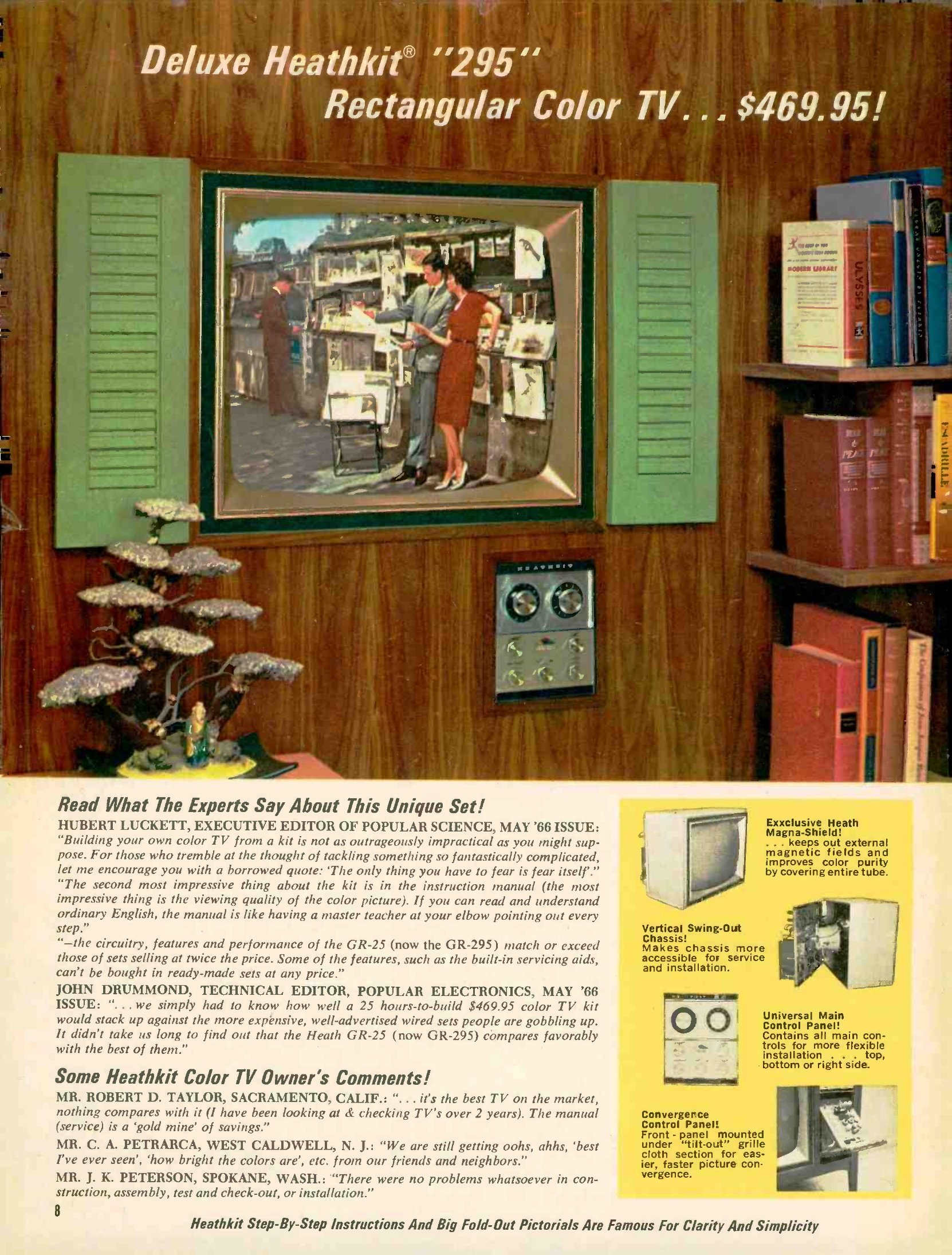
The reports follow the line from there. A new rectangular 25-inch colour kit came “in late fall” 1965, though sales were “limited by inability to purchase a larger number of color tubes.” A 19-inch model followed in 1966, along with a 12-inch solid-state black-and-white portable. By 1967 the kits came “with picture tubes in the popular 295, 227 and 180 square inch sizes.” Their critical circuits were factory-built and aligned, and the remainder could be assembled “in about 25 hours.” A wireless remote control was added in 1968. Solid-state colour sets arrived in 1970, and in 1971 came “several new solid state color TV models” with plug-in modular circuit boards (Schlumberger Annual Reports 1965–1971). By 1972 correspondence schools were buying significant numbers of Heathkit colour TV kits for their electronics courses. Schlumberger counted that business separately as “contract sales,” and its loss in 1977–78 accounts for most of Heath’s revenue decline in those years.
4.7.2 The GR-2000
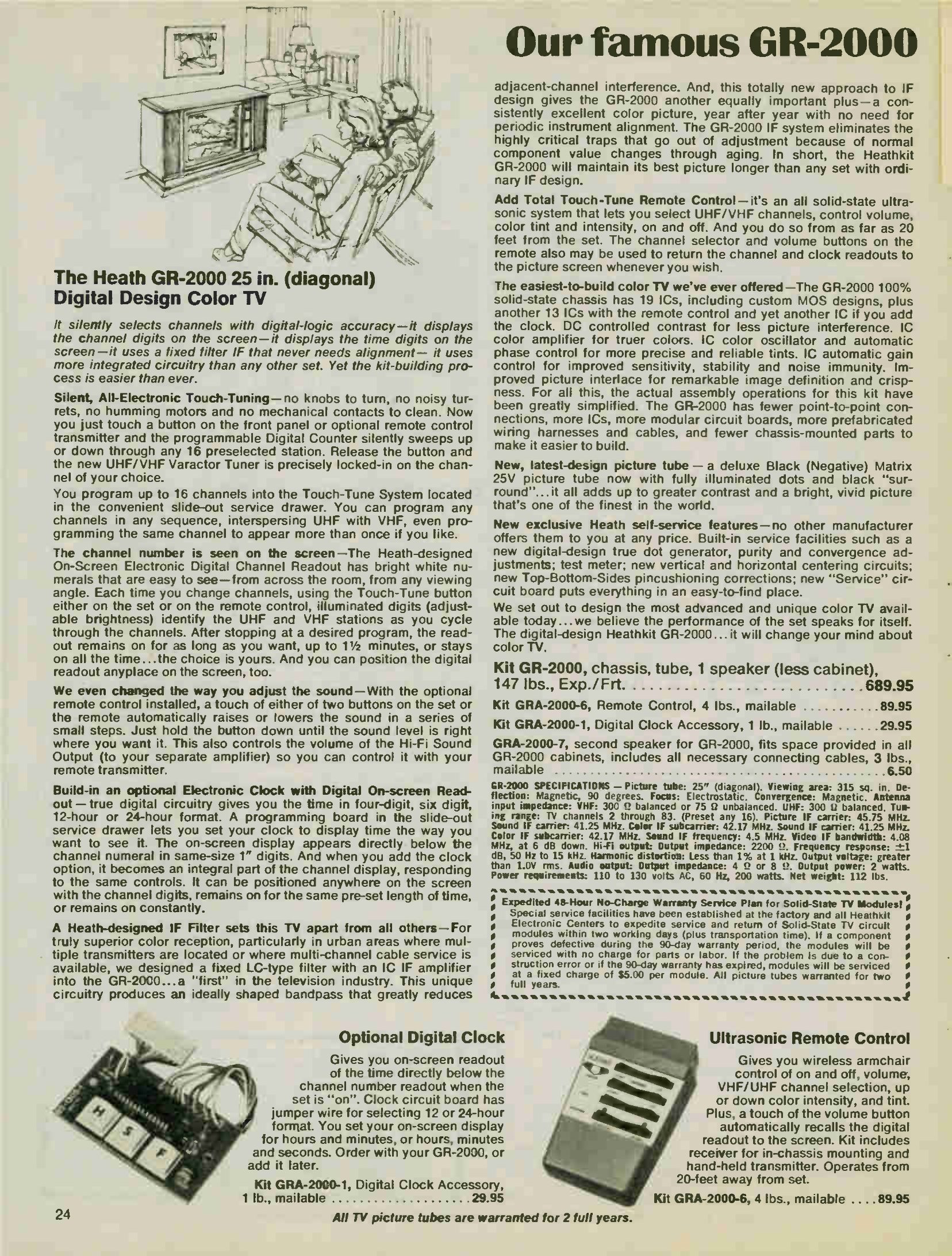
The GR-2000 “digital design” colour set is Heath’s best-known television and the subject of the most specific claims in the popular retellings. Three claims circulate: that it was the first television with the channel and time on the screen, that Heath sold 47,000 in a year, and that Heath held 27 patents. All three come from a single source: Chas Gilmore’s 2024 interview with Steven Leibson.
“It was the first television anywhere that had on-screen channel and time. And it was a kit. I think one year we sold 47,000 of them.” (EEJournal, “Rise and Fall of Heathkit,” part 5)
On patents, Gilmore adds that Heath had “I think, when Zenith acquired us, 27 patents on improvements to color televisions.” That statement is about Heath’s colour-TV work in general, not specifically about the GR-2000. The documentary record allows each claim to be checked in turn.
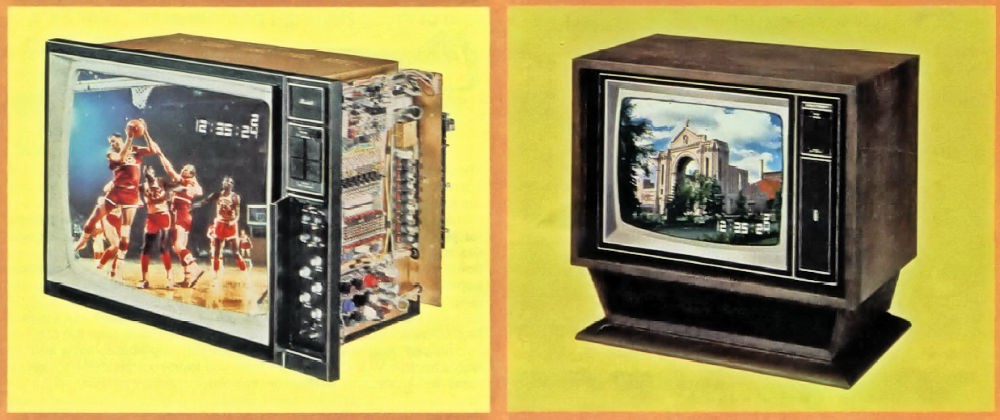
The date and the features. Schlumberger’s 1973 annual report dates the set precisely: “A new digital color TV model, GR 2000, introduced in January 1974, features all-electronic control of tuning and sound level, and displays channel number on the screen. Initial acceptance has been unusually good.” The 1974 report adds “display of time and channel number on the screen, and touch-controlled sound level” (Schlumberger Annual Reports 1973, 1974). A late-1974 Heath advertisement collected the press reviews. Radio-Electronics was quoted as saying the set had “features that are not to be found in any other production color TV being sold in the U.S.,” beginning with “on-screen electronic digital channel readout.” Popular Science singled out “an industry first: the permanently tuned I.F. filter.” The same advertisement gives the mail-order price as $669.95 for chassis and tube, with the remote control at $89.95, the clock at $29.95 and cabinets from $154.95 (Elementary Electronics, Nov.–Dec. 1974, p. 72).
The details. The Fall 1977 catalogue shows how the features were divided. The on-screen channel number was standard. It could be set to stay on the screen for up to 1½ minutes or permanently, and it reappeared at each channel change or at a touch of the remote. The on-screen time was an option: the GRA-601 clock module, $29.95, which added 1-inch digits below the channel number in 12- or 24-hour format. The set had varactor tuning of up to 16 preselected channels, “the first TV to utilize a fixed IF filter,” a built-in “digital-design dot generator” and test meter, and a pull-out service drawer. The kit, with chassis, one speaker and picture tube, cost $599.95 and shipped at 147 lb by motor freight (Fall 1977 catalogue, p. 96).
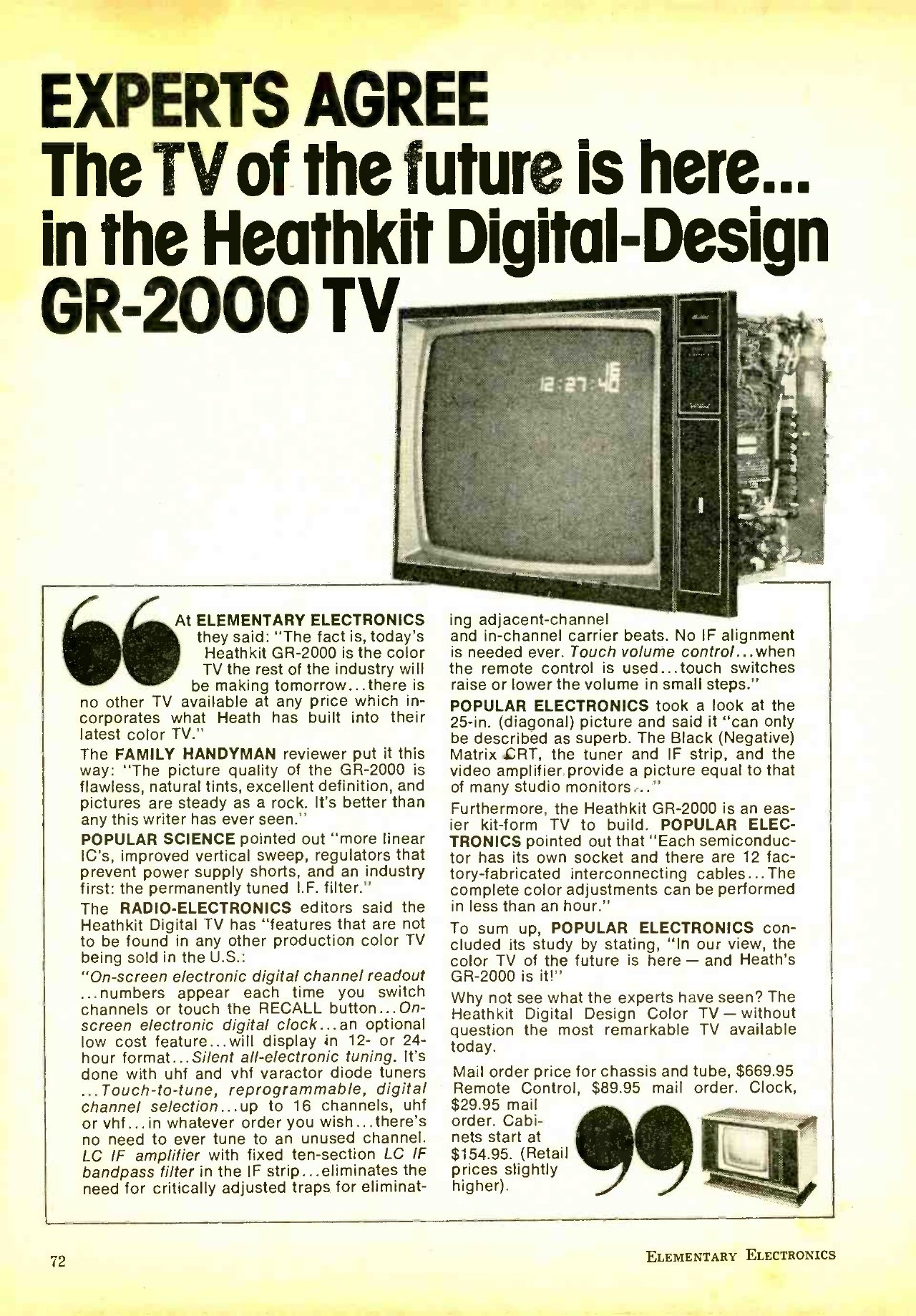
First with on-screen channel and time. Contemporary evidence supports the claim for the United States. When the GR-2000 appeared in January 1974, the Radio-Electronics editors could find no other production colour set sold in the U.S. with an on-screen channel readout. Wikipedia’s general history of on-screen displays puts “some of the first OSD-equipped televisions” at RCA “in the late 1970s,” several years after the Heathkit (On-screen display, Wikipedia). Two qualifications apply. The time display was an optional $29.95 module, not a standard feature. And “first anywhere” cannot be proved from the sources consulted here: no survey of European or Japanese sets of 1972–74 was found. The defensible statement is that the GR-2000 was the first colour set sold in the U.S. with an on-screen channel readout, with an on-screen clock available as an option.
47,000 in one year. This figure could not be confirmed. Schlumberger’s 1974 report says that television “made the biggest gains” that year, from correspondence-school sales and from the GR-2000, but gives no unit counts. As a rough check, 47,000 chassis at $600–$670 each would be $28–31 million before cabinets and accessories. That is about a third of Heath’s entire 1974 revenue of $90 million, on a single model in a year when the catalogue listed several hundred. The figure is not impossible, especially if correspondence-school contract units or all colour sets are included. Gilmore himself hedged it (“I think”). It should be quoted as a recollection, not as a documented number.
27 patents. This is Gilmore’s recollection of Heath’s colour-television patent portfolio at the time of the 1979 Zenith acquisition, not a GR-2000 figure. He hedged it as well (“I think”). A patent search was outside the scope of this dive. The claim is recorded as unverified.
The GR-2000 was followed by the GR-2001 and the 21-inch GR-2050. By 1976 Heath had added a programmer that selected channels up to 24 hours in advance, plus an accessory that turned the antenna to the best heading for each programmed channel (Schlumberger Annual Report 1976). Heath called the result “The World’s First (and only) Programmable Color TV” (Post). A 1976 TV game kit for owners of Heathkit solid-state sets recorded “the highest [unit sales] ever recorded by Heath during a three month period” (Schlumberger Annual Report 1976).
4.8 Audio: the AR-15 and after
Audio was Heath’s second consumer pillar. The key product of the decade was the AR-15 AM/FM stereo receiver, introduced in 1967. Schlumberger reported that it “won outstanding recognition in the high fidelity press” and was “the best selling Heathkit at year end” 1967. In 1968 its tuner and amplifier sections were also offered as separate components (Schlumberger Annual Reports 1967, 1968). Gilmore says it put Heath “in the top tier of the Audio/HiFi market” (Frenzel, Electronic Design). The line continued with the following:
- the AR-29 of 1969, described in the report as “the first kit in modular form”
- the AR-1500 of 1971, which “exceeds the performance of the highly successful predecessor Model AR-15”
- the AA-2004 quadraphonic amplifier, whose manual writer, Robert Gast, is pictured in the 1971 report building the kit himself to check each step
- the Modulus component system of 1975
- the AR-1515 of 1976, with digital frequency readout and 70 watts per channel at 0.08 per cent distortion
(Schlumberger Annual Reports 1969–1976)
Electronic organs, built in association with Thomas, and guitar kits with matching amplifiers were counted with audio as “home entertainment.” Taken together, that group was Heath’s largest by dollar sales.
4.9 Scientific instruments and the Malmstadt–Enke partnership
The most unexpected product line of the golden age was built for chemists, not hobbyists. In 1962 Heath began developing “a line of assembled products to fill a need for low-cost specialized equipment to teach electronics to scientists.” The first product, a strip-chart recorder, was introduced in August 1963 (Schlumberger Annual Report 1972). The partners were Howard Malmstadt of the University of Illinois and his former doctoral student Christie Enke, then at Princeton and later at Michigan State. Gilmore says they wanted instruments built “with the Heath mentality, not the Hewlett Packard mentality … to the 80/20 rule so we can teach electronics and electronic instrumentation to chemists” (EEJournal, “Rise and Fall,” part 2). The instruments carried EU model numbers and a green-and-white finish, and they supported the textbooks Electronics for Scientists, Digital Electronics for Scientists and the four-volume Instrumentation for Scientists. By 1964 Schlumberger’s report showed the University of Illinois “equipped with Heathkit Malmstadt-Enke lab stations.”
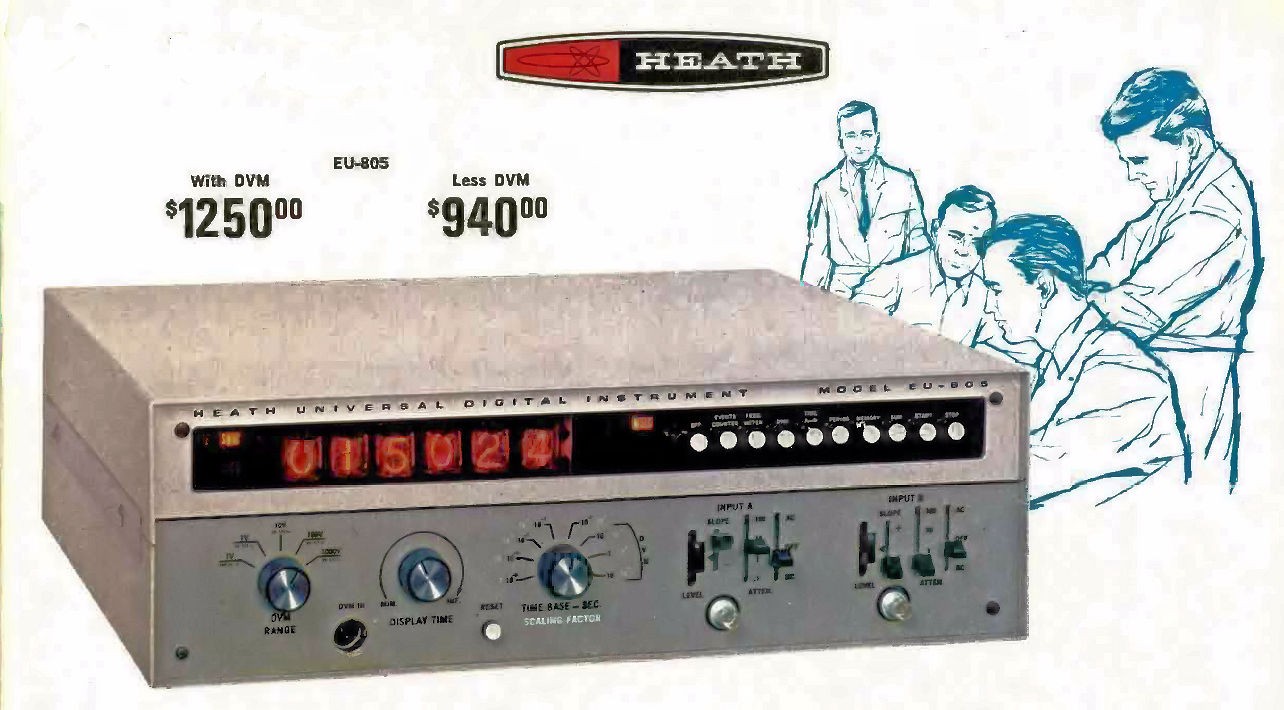
Gilmore joined this Scientific Instruments group in 1966 as a design engineer. His first major design was the EU-805 Universal Digital Instrument: a 12.5 MHz counter-timer with a 0.05 per cent, 1-gigohm digital voltmeter on Nixie tubes, built with early TI 7400-series logic. It sold assembled for $1,350, or $1,130 without the DMM. He recalls that 7490 decade counters cost $24 each when design began and $4.95 by launch, “otherwise the instrument would not have been viable” (EEJournal, “Rise and Fall,” part 2; EEJournal, “Heathkits and Hams,” part 2). In December 1967 Heath shipped its first laboratory monochromator, the basis of a modular spectroscopy system. The spectroscopy line was later sold off as “too far out for Heath.”
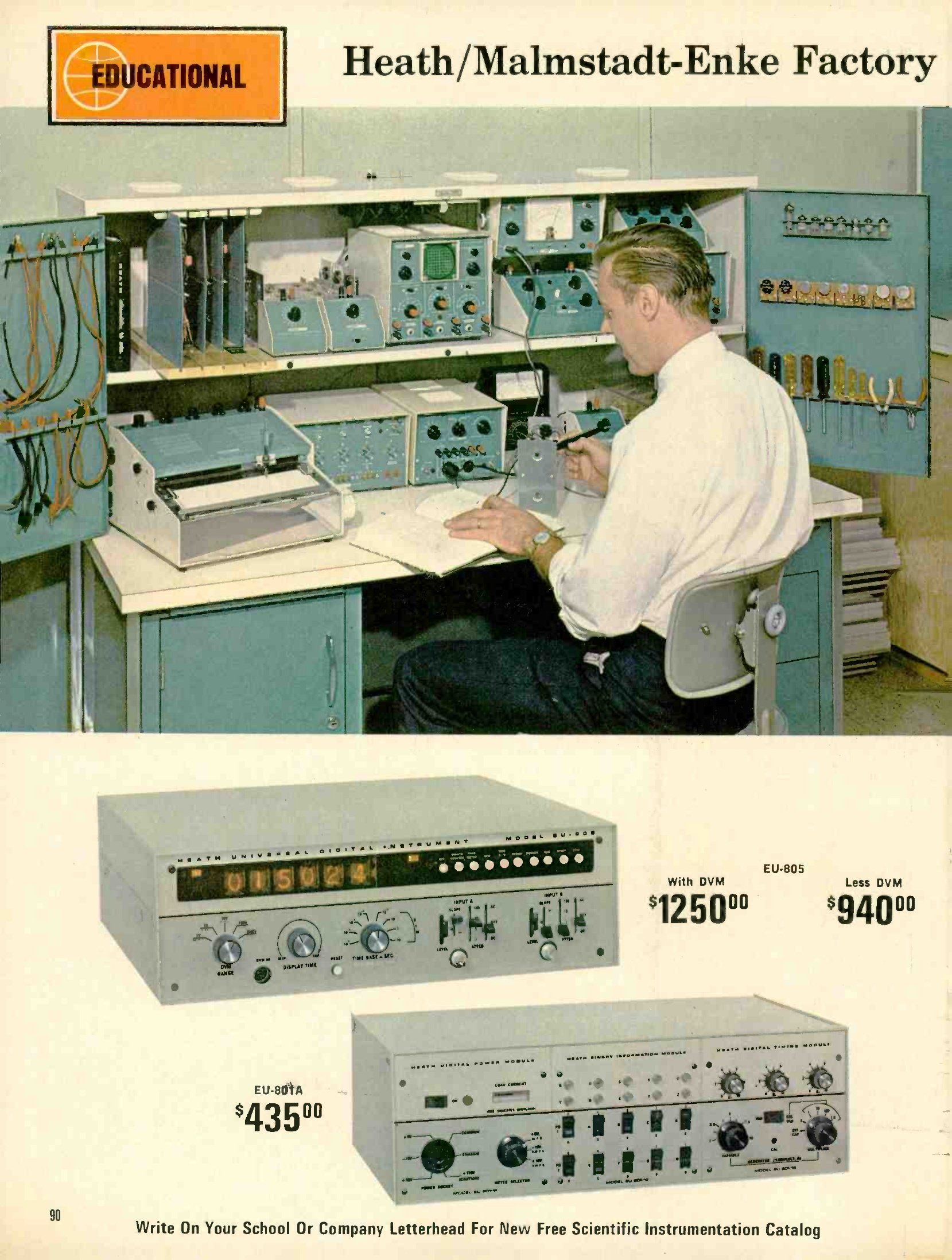
The partnership spread further. In 1965 Heath advertised a set of assembled instruments for the Berkeley Physics Laboratory course developed by Professor A. M. Portis at the University of California. That line left the catalogue in 1970. The “Heath/Malmstadt-Enke” name was dropped in 1974, and the series continued as “Heath/Schlumberger” (Brueschke and Mack). By 1972, 70 per cent of the assembled instrument line’s sales went to educational institutions, mostly universities, and 30 per cent to industry (Schlumberger Annual Report 1972). Gilmore recalls that a new vice president brought in from Schlumberger’s oil-well services about 1972 steered the group toward general-purpose instruments: frequency counters, function generators, chart recorders, power supplies. In that market, as assembled products sold mainly by mail, they competed poorly with Hewlett-Packard, Fluke and Tektronix.
4.10 Teaching electronics: Heathkit Educational Systems and the Continuing Education Series
The manuals had always taught as well as instructed. In the 1970s Heath began selling teaching directly. Brueschke and Mack date the founding of Heathkit Educational Systems, “offering educational materials for schools,” to 1974. Its consumer counterpart followed. Schlumberger’s 1975 report notes that “Heath is now selling home study courses for kit builders and hobbyists which provide individual comprehensive training in electronics; self-evaluation quizzes help the student check his own progress.” It also noted that the courses built customer interest in more complex kits (Schlumberger Annual Report 1975). By 1976 the “new line of educational products designed to teach electronic subjects through individual self-paced learning programs” was one of the three fastest-growing parts of the business. In the Spring 1976 catalogue the president described the “Heathkit Continuing Education Series of Individual Learning Programs” as a response to customer suggestions. He asked readers whether they wanted courses in automotive tune-up, amateur licensing, TV servicing, computers or microprocessors (Spring 1976 catalogue).
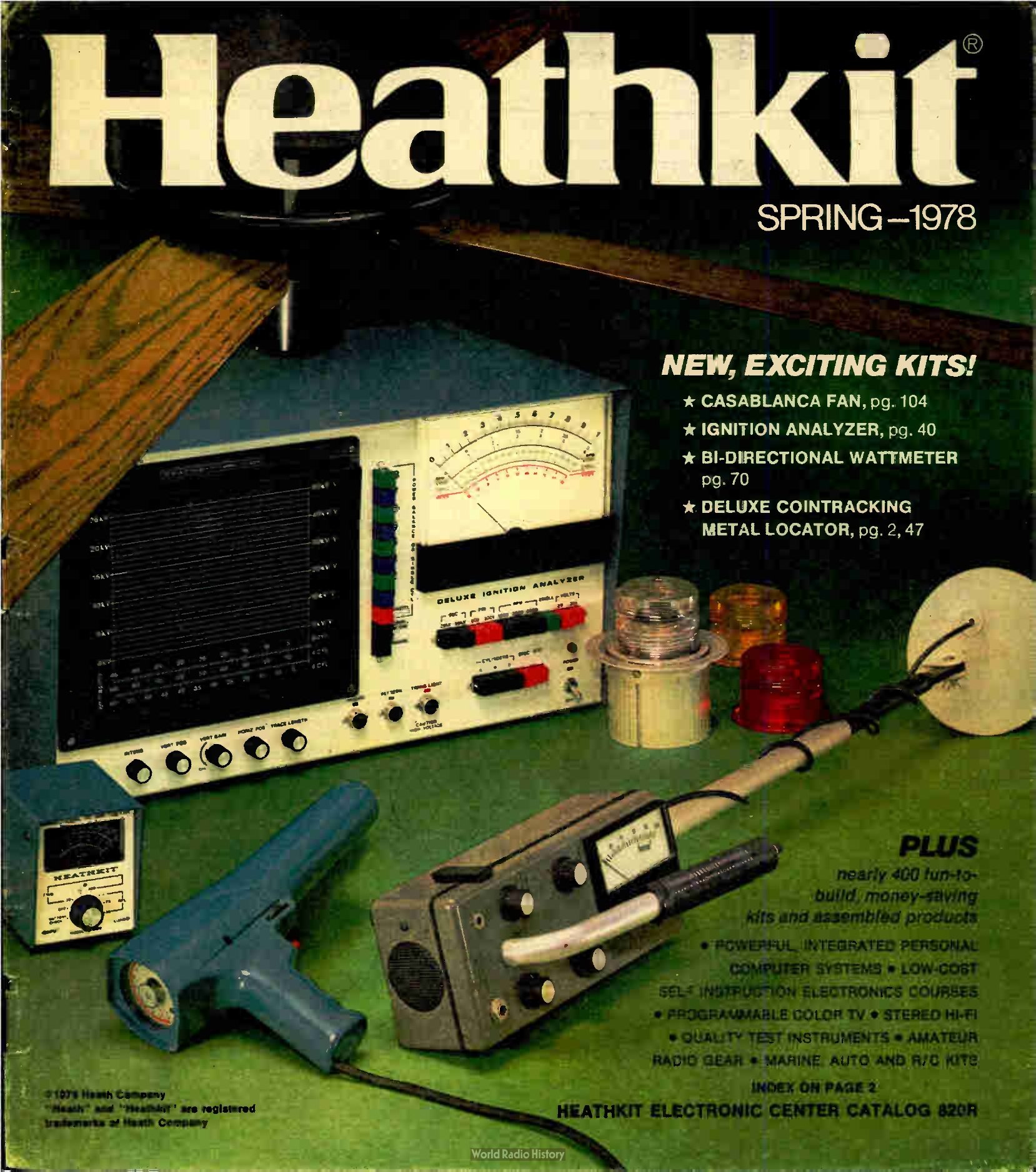
They did. In 1977 Heath added a microprocessor course with a hands-on trainer, a self-study BASIC course, an electronic-circuits course and a course preparing novices for their first amateur licence examination. The 1977 report calls the educational products “a successful and growing business since their introduction two years ago” (Schlumberger Annual Report 1977). The trainer was the ET-3400, which is in the Spring 1978 catalogue. Lou Frenzel, who ran Heathkit Educational Systems, and Gilmore credit the combination of that 6800-based course and trainer with the January 1975 Popular Electronics Altair cover as the start of Heath’s computer programme. That story, and the H8 and H11, belong to the next volume.
4.11 Home, car, boat and hobby
The 1970s catalogue reached well beyond the lab bench and the ham shack. Heath looked for customers who had never built a kit. Schlumberger’s reports list what that search produced:
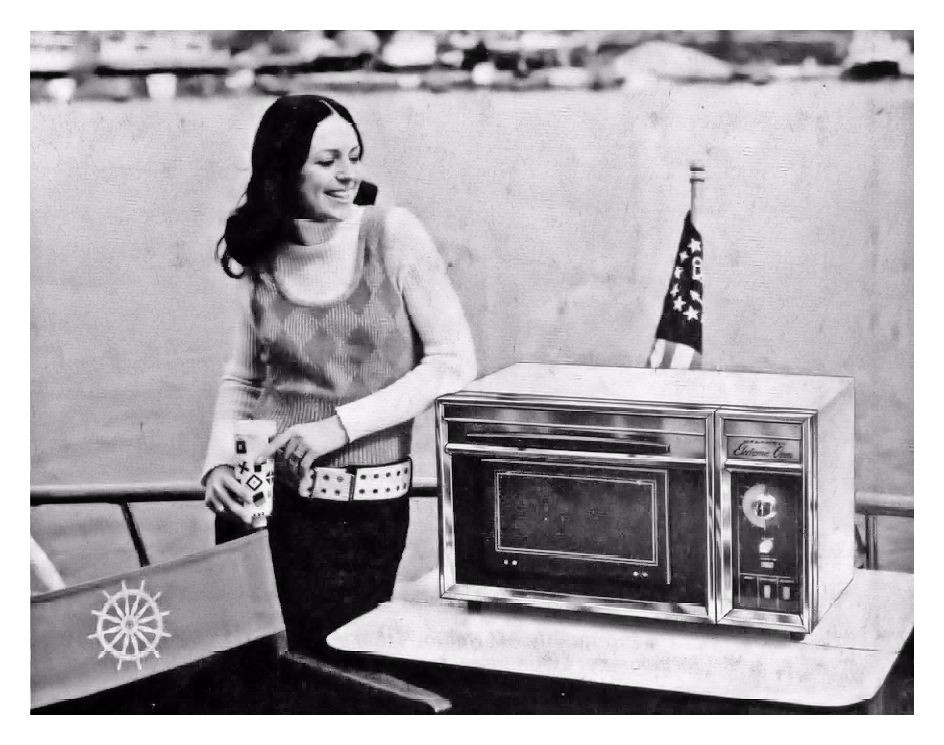
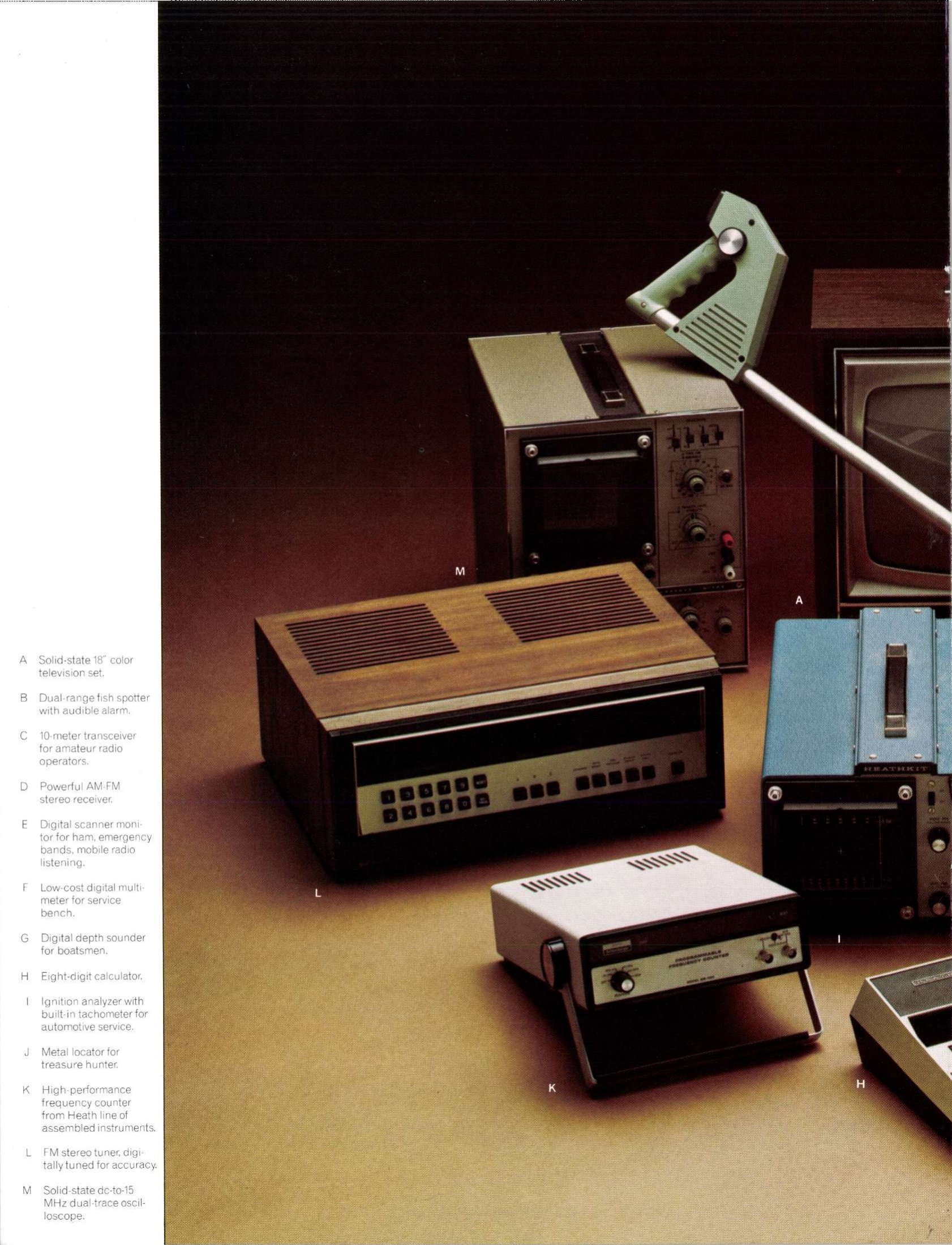
- Home. An electronic (microwave) oven for household use in 1970. Gilmore explains that it was “fundamentally a Whirlpool design,” obtained by asking Whirlpool’s product manager in Benton Harbor whether it could be made into a kit (EEJournal, “Rise and Fall,” part 5). The report also lists a digital clock and an electronic calculator in 1972; the calculator was the best-selling kit by units that year, followed by automotive tune-up meters and the clock. Then came a weather station, an ultrasonic intruder alarm and an ultrasonic cleaner in 1973; a complete home-protection system in 1974; and in 1976 a central electrostatic air cleaner and fire and smoke detectors.
- Beginners. In 1973 four kits priced at $5 to $15 (a photoelectric lamp switch, a lamp dimmer, a portable AM radio and a telephone amplifier) were aimed at people put off by “too many unknowns.”
- Car. Ignition analyzers, a portable engine analyzer, a digital tachometer, electronic ignition, windshield-wiper delay kits, and in 1976 what the report calls “the first commercially available digital miles-per-gallon meter.”
- Boat. Depth sounders, a chart-recording depth sounder and a “fish spotter that really does what the name implies.”
- Hobby. The first radio-control system for model aircraft in 1968, a model-railroad power supply, and a metal locator developed at customers’ request. The metal locator sold 50,000 in its first two years. In the 1972 report, one owner claimed to have paid for his kit “in just five hours” of treasure hunting.
(Schlumberger Annual Reports 1968–1976)
Chuck Penson’s list from the same period includes Boonie-Bikes, slot cars and trash compactors, and he recalls that “for a while you could even get furniture in kit form” (Penson, via the Heathkit Virtual Museum).
4.12 How the company worked
4.12.1 People
Staffing figures depend on the year and on what is counted. The best-documented figure is from Schlumberger in 1972: “over 1600 employees located in eight countries” (Schlumberger Annual Report 1972). Gilmore gives two different figures for the late 1960s. He told Electronic Design that engineering was “about 80 people” in design and 80 in the manual department “out of some 700 in total at Heath.” In a later interview he spoke of “Heath’s 1500 employees” (Frenzel, Electronic Design; EEJournal, part 3). The lower figure probably refers to the mid-1960s, before the 1967 expansion, and the higher one to the early 1970s. The 1972 report counted “more than 150 engineers, technicians, and writers” working on new products.
The “1,800 workers” in the retellings comes from later local reporting. When Heathkit Educational Systems closed in 2012, the ARRL reported that “Heathkit employed more than 1800 people in its heyday” (ARRL, 2012). No date or source is given for the peak. The documented Schlumberger-era figure is somewhat above 1,600 in 1972 across all countries. A peak near 1,800 is plausible for the mid-to-late 1970s or the early Zenith years, but no primary source for it was found.
4.12.2 Engineering and the manual department
Gilmore describes the engineering organisation of the late 1960s as six sections reporting to a vice president of engineering. The sections were amateur radio, television, audio, kit instruments, scientific instruments and “general,” which covered model-aircraft radio control and “anything you couldn’t place in the other departments.” They were supported by a component-evaluation group, drafting, and a manual department as large as design engineering itself (EEJournal, “Rise and Fall,” part 2). “A typical kit design took approximately an equal number of Design Engineering and Manual Department hours.” Product line managers, mostly promoted from engineering, owned each product from proposal to obsolescence, and a Product Development Committee approved new kits.
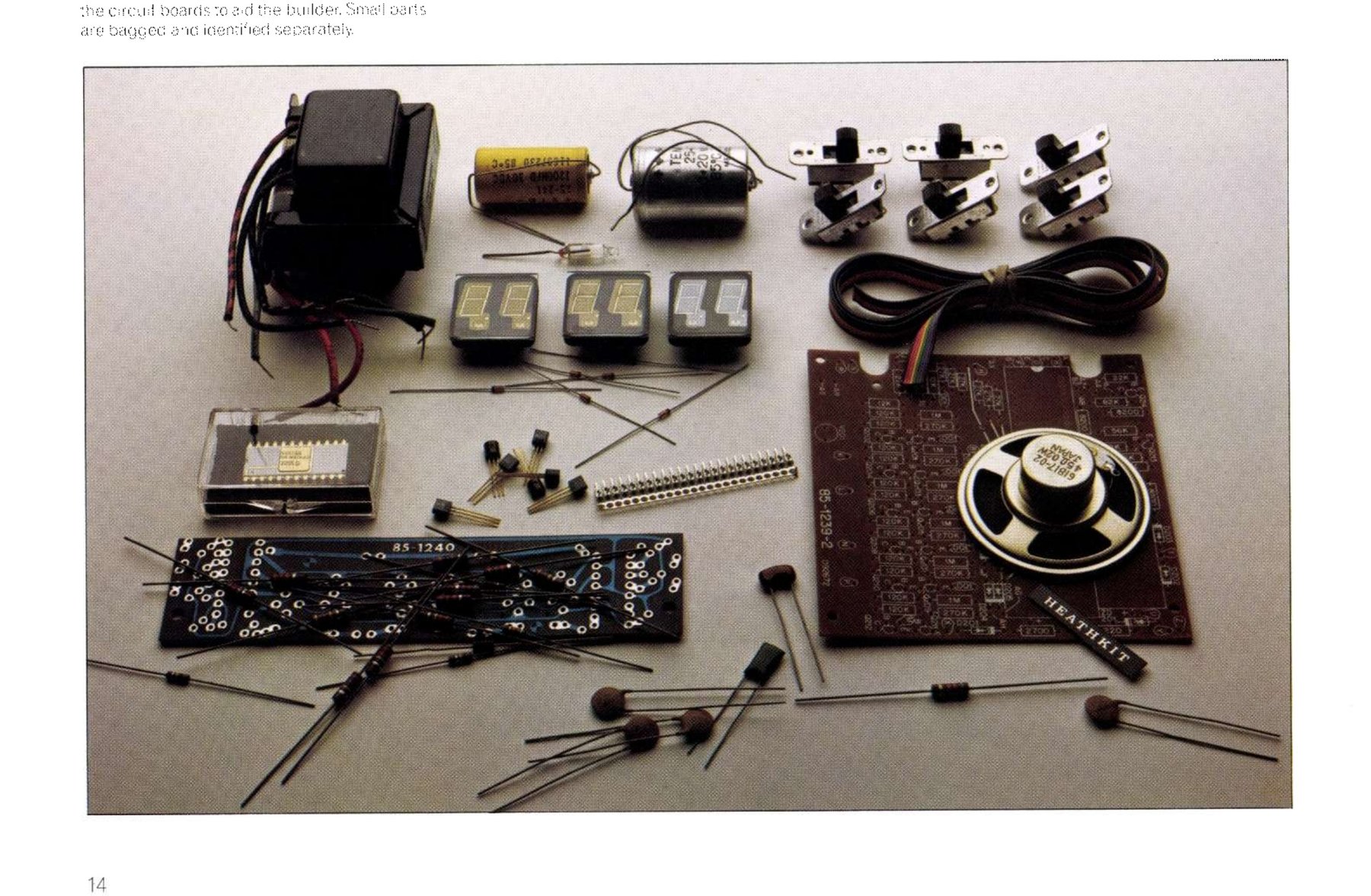
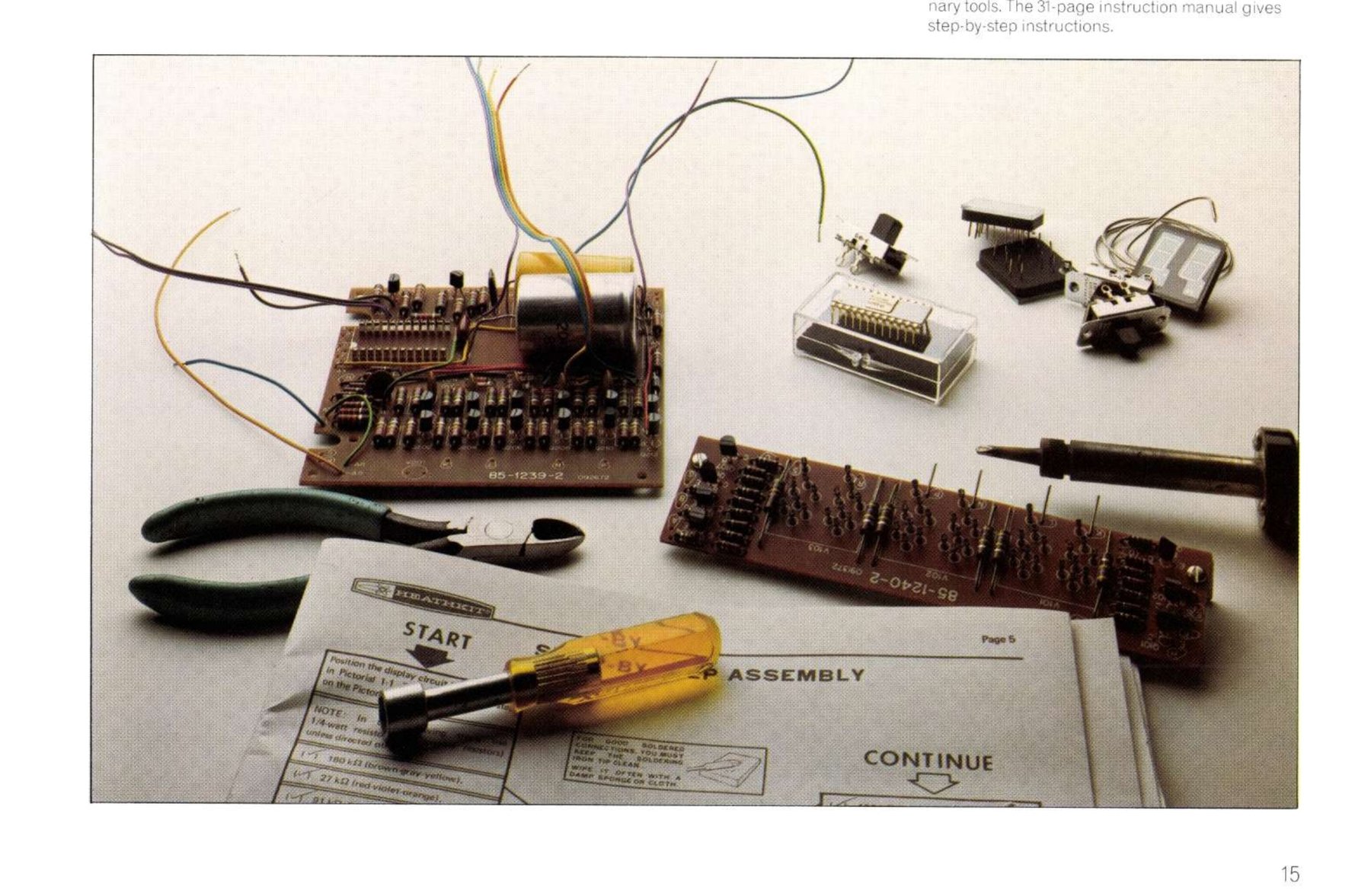
The 1972 report shows what the method produced. The first oscilloscope’s instructions had fitted on four sheets. In 1972 “a manual may have up to 350 pages and 700 illustrations.” The colour TV’s manual came in four volumes, and its parts came in sub-packs so that a builder who reached the last step of a board with a part left over knew he had made an error (Schlumberger Annual Reports 1971, 1972). Preparing a manual took 25 steps and “more than a dozen kits” actually built by writers, service technicians “and by entirely inexperienced persons.” The proof-build process and the anatomy of the manual are covered in detail in the volume on how a Heathkit manual works.
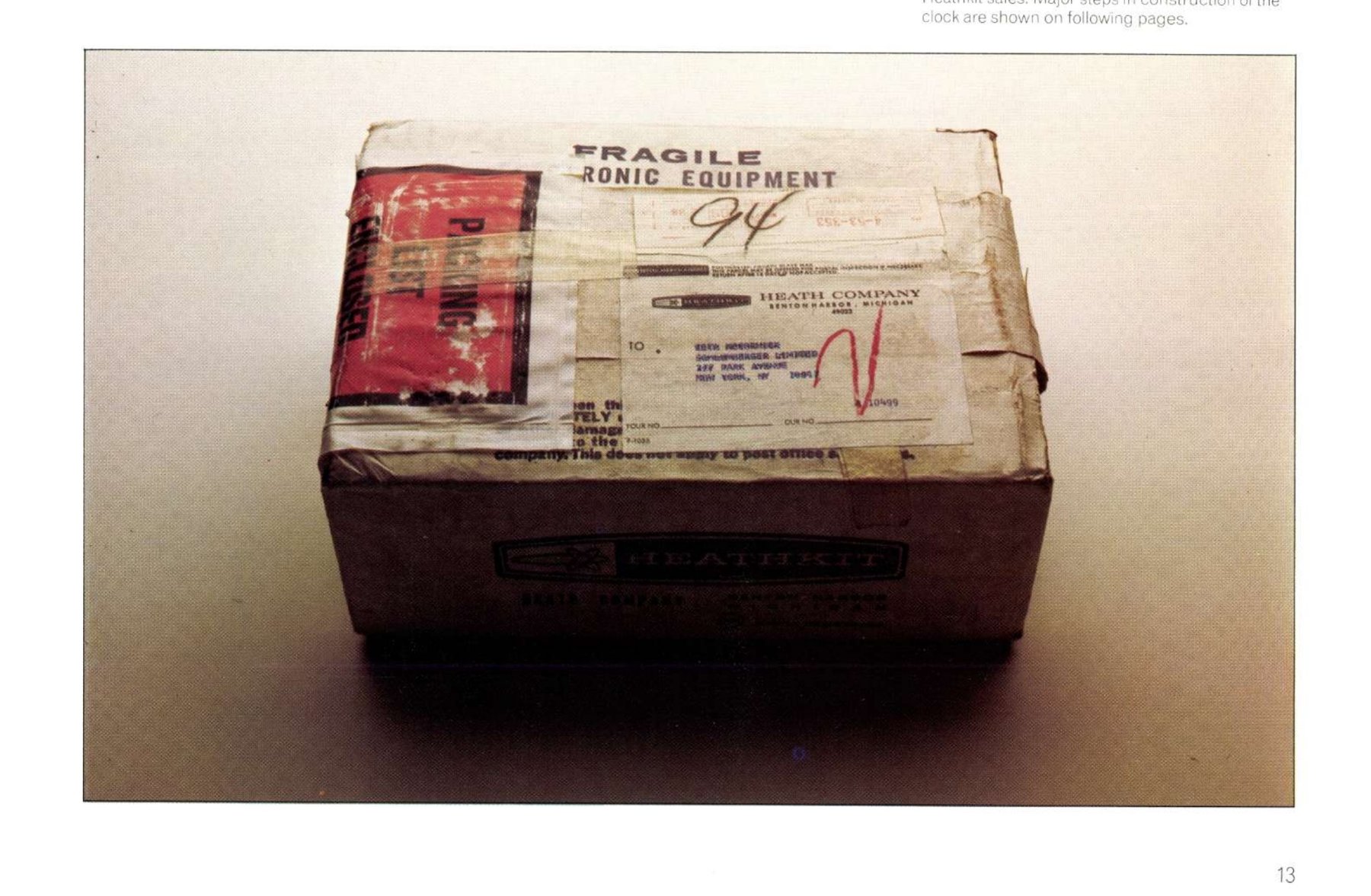
Heath was also highly vertically integrated. It made its own sheet metal, ran its own paint shop and silk-screening, and made its own cartons from bulk corrugated board. It weighed every bag of hardware to be sure the count was exact, “because being one piece short is a problem, of course, but one extra piece is also a problem” (EEJournal, “Heathkits and Hams,” part 5).
4.12.3 Customers
In 1972 about half a million people ordered one or more Heathkits, and more than a million counted as active customers, meaning those who had ordered more than once in four years. The largest occupational groups were engineers and technicians. Asked why they bought kits, customers named quality of components, design and performance first, price second and the enjoyment of building third (Schlumberger Annual Report 1972). Gilmore’s figures are that the customer base was “95+ percent male” and about 40 per cent technical people. He says sales were mainly by mail order until the mid-1960s and “50/50 mail order and retail” by the 1970s (EEJournal, part 5). Schlumberger’s reports put the split at two-thirds mail and one-third retail in 1972, and “almost equally split” by 1976. The report also records one customer, a Chicago doctor with a standing order for every new Heathkit oscilloscope, who enjoyed building them and “never used his oscilloscopes.”
4.13 “We won’t let you fail”
The phrase most associated with Heath in these years is a service promise, not a product. Gilmore puts it at the centre of the company: “Heath lived by ‘We will not let you fail.’ Even before this slogan was formally introduced, it was the company mantra” (Frenzel, Electronic Design). In another interview he calls it “a very fundamental philosophy that guided kit design – and really the whole company” (EEJournal, part 5). Brueschke and Mack give the motto as “we won’t let you fail.” Both wordings are recorded, and no source consulted here dates the first printed use of the slogan.
The promise was older than the slogan. The 1958 catalogue’s service department and free consultation service offered the same guarantee in plainer words (see the previous volume). Schlumberger’s 1972 description of the business turned it into a business model:
Schlumberger’s 1972 annual report described the arrangement as a partnership “with every person who builds a kit”. Heath designed the product and wrote the instructions, and the customer built and tested it. If the customer ran into trouble, Heath’s staff helped solve it, and the report credited that protection from failure for bringing builders back for another kit (Schlumberger Annual Report 1972).
In practice the promise rested on the ten-man technical correspondence group and the factory service department. From the late 1960s it also rested on the stores, where a builder could bring an unfinished kit to the counter. In 1969 the stores added a “quick service” section offering over-the-counter diagnosis (Schlumberger Annual Report 1969). Gilmore’s service statistic explains why the manuals devoted so many pages to soldering: “90 percent of all service problems came from a soldering problem of one kind or another” (EEJournal, part 5).
4.14 The end of the golden age
By the late 1970s the pressures that ended the kit business were visible. Offshore competition had worried Fiebich enough to cite it when he retired in 1973. Radios like the SB-104 were testing the limits of what a customer could build without instruments. The correspondence-school colour TV contracts, a large part of the 1974–76 growth, were phased out in 1977–78, and Heath’s revenue fell 3 per cent in 1977 and 5 per cent in 1978. The computer kits launched in the third quarter of 1977 pointed to where the business could grow next (Schlumberger Annual Reports 1977, 1979).
Schlumberger then decided to sell. In 1979 it acquired Fairchild Camera and Instrument, including Fairchild Semiconductor (SLB, Wikipedia). Brueschke and Mack attribute the sale of Heath to Federal Trade Commission objections to Schlumberger owning both a semiconductor source and a consumer maker that used its parts. They describe Heath as up for sale by December 1978. They call the chip maker “Fairchild Electric,” but it was Fairchild Camera and Instrument. Their account of the FTC’s role was not independently confirmed here. The result is documented: “On October 1, 1979, Schlumberger sold the Heath business to Zenith Radio Corporation for $64.5 million” (Schlumberger Annual Report 1979). Zenith’s motives and what it did with Heath are covered in the volume on Zenith and Bull.
4.15 Chronology, 1962–1979
Table 5 — Chronology, 1962–1979
| Year | Event |
|---|---|
| 1962 | Schlumberger acquires Daystrom (1 Feb); first Heathkit store opens in Denver (March); Heath begins developing assembled instruments for science education |
| 1963 | Chicago and Los Angeles (June) stores; Monobanders; first colour TV kit; first Malmstadt–Enke instrument, a strip-chart recorder (August) |
| 1964 | SB-300/SB-400/SB-200 single-sideband system; Daystrom, Inc. renamed Weston Instruments |
| 1965 | SB-100 transceiver; five U.S. stores plus Anaheim, London and Munich; rectangular 25-inch colour kit (late fall) |
| 1966 | David W. Nurse becomes president (1 April); 11 stores; 12-inch solid-state B&W portable |
| 1967 | AR-15 receiver, the best-selling kit at year end; SB-102; more than 160,000 sq ft added to the plant; 16 stores |
| 1968 | First model-aircraft radio-control kit; wireless TV remote; 361,000 sq ft plant with computerised warehousing |
| 1969 | Stores become “units of Schlumberger Products Corporation”; 25 stores; AR-29; HW-16 |
| 1970 | Sales over $50 million; microwave oven kit; solid-state colour TV; SB-220 |
| 1971 | AR-1500; modular solid-state colour sets |
| 1972 | Sales $66 million; 1,600+ employees; 350 kit models; electronic calculator and clock; HW-101 in catalogue |
| 1973 | Plant to nearly 500,000 sq ft; HW-202 FM transceiver; beginner kits at $5–$15; Fiebich retires |
| 1974 | GR-2000 introduced (January); Heathkit Educational Systems founded; SB-104 (Christmas); sales $90 million |
| 1975 | Recession, sales $83 million; home-study courses; Modulus audio; HW-2021; HW-2026 recalled |
| 1976 | Record sales of $92 million; Continuing Education Series; GR-2001 programmer; AR-1515; HW-2036; TV game kit |
| 1977 | H8 and H11 computers (third quarter); ET-3400 and microprocessor course; 49 U.S. stores |
| 1979 | Schlumberger sells Heath to Zenith (1 October, $64.5 million) |
Sources
- Schlumberger Limited. Annual Reports 1962–1977 and 1979, including “A Report on a Schlumberger Subsidiary: Heath” (1972 report, pp. 12–20). Internet Archive. https://archive.org/details/01.-schlumberger
- Brueschke, Erich E., and Michael Mack. “The History of the Heath Companies and Heathkits: 1909 to 2019.” The AWA Review 32 (2019). http://www.ontheshortwaves.com/Ads/The_History_of_the_Heath_Companies_and_Heathkits-1909-2019.pdf
- Leibson, Steven. “The Rise and Fall of Heathkit,” parts 2 and 5 (interviews with Chas Gilmore). EEJournal, 2024. https://www.eejournal.com/article/the-rise-and-fall-of-heathkit-part-2-the-1960s-through-the-mid-1970s/ ; https://www.eejournal.com/article/the-rise-and-fall-of-heathkit-part-5-final-thoughts/
- Leibson, Steven. “‘H’ is for Heathkits and Hams,” parts 2, 3 and 5. EEJournal, 2025. https://www.eejournal.com/article/h-is-for-heathkits-and-hams-part-2-the-1960s/ ; https://www.eejournal.com/article/h-is-for-heathkits-and-hams-part-3-the-1970s/ ; https://www.eejournal.com/article/h-is-for-heathkits-and-hams-part-5-reasons-for-heaths-success-in-amateur-radio/
- Frenzel, Lou. “Heathkit: An Employee’s Look Back.” Electronic Design, 30 November 2020. https://www.electronicdesign.com/blogs/contributed-blogs/archive/communiqu/article/21148923/electronic-design-heathkit-an-employees-look-back
- Penson, Chuck (WA7ZZE). “Heathkit’s 50th: The Green Turns to Gold.” Electric Radio, January 1997, and QST, April 1997; reproduced by the Heathkit Virtual Museum. https://heathkit-museum.com/hkarticle1.html
- Post, Rich (KB8TAD). “The Heathkit Legacy.” Monitoring Times, July 2013. https://people.ohio.edu/postr/bapix/HLegacy.htm
- Heathkit Virtual Museum. “History.” https://heathkit-museum.com/hkhistory.html
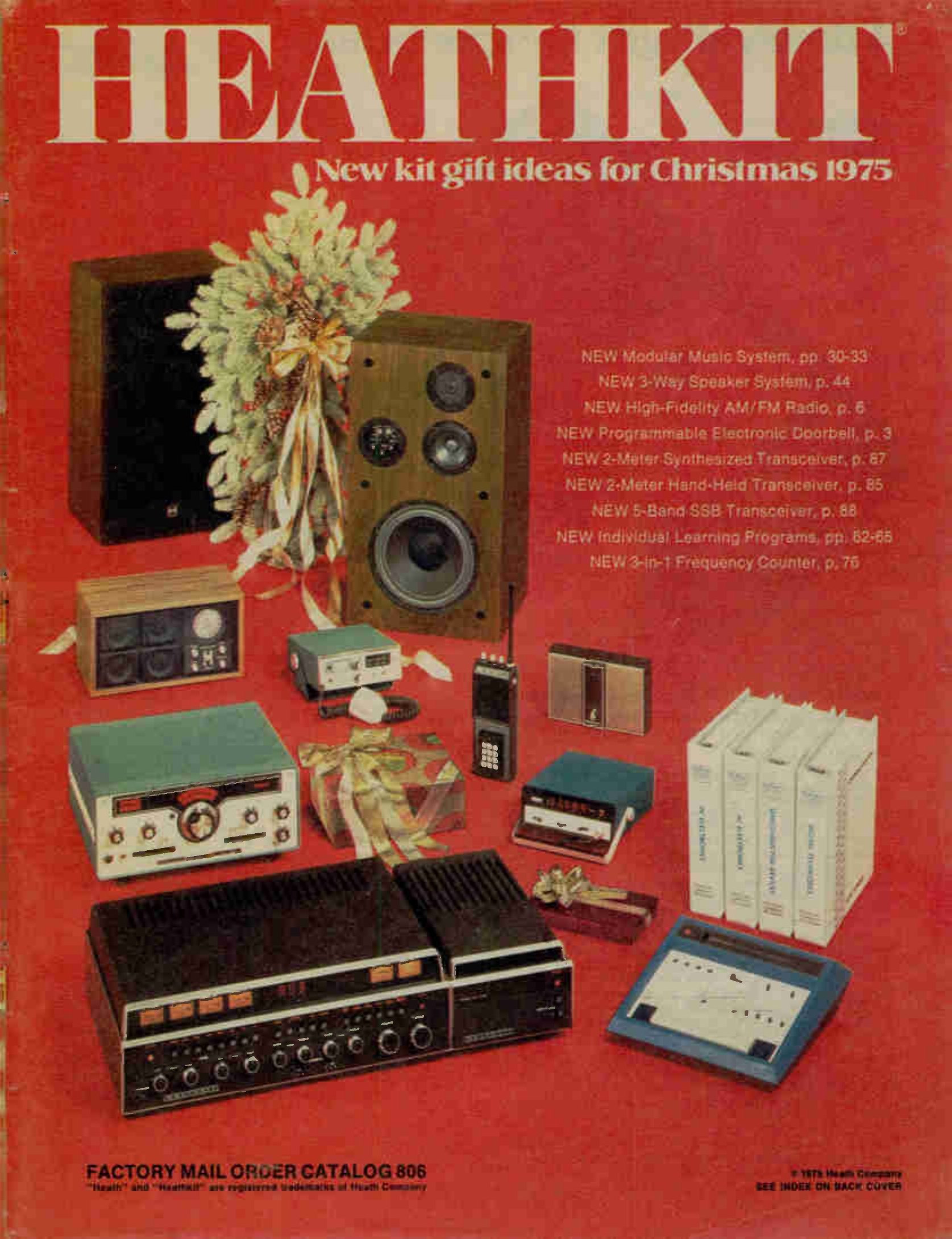
- Heath Company catalogues: Fall–Winter 1962–63; 1965 (800-55); 1966; 1967; 1968; 1969; 1971; 1972 (810-72); Christmas 1975; Spring 1976; Fall 1977 (817); Spring 1978; Fall 1979; 1980 (848). World Radio History. https://www.worldradiohistory.com/Archive-Catalogs/Heathkit_Catalogs.htm
- Heath Company advertisement, “Experts agree: the TV of the future is here.” Elementary Electronics, November–December 1974, p. 72. https://www.worldradiohistory.com/hd2/IDX-Consumer/Archive-Elementary-Electronics-IDX/IDX/70s/Elementary-Electronics-1974-11-12-OCR-Page-0066.pdf
- ARRL. “Heathkit Declares Bankruptcy, Closes for Good (Again).” 2012. https://www.arrl.org/news/heathkit-declares-bankruptcy-closes-for-good-again
- WD8DAS. “Heath Factory.” http://www.wd8das.net/HeathFactory.html
- “On-screen display.” Wikipedia. https://en.wikipedia.org/wiki/On-screen_display
- “SLB” (Schlumberger). Wikipedia. https://en.wikipedia.org/wiki/SLB
Comments (0)