Heathkit · Volume 3
Daystrom and the House Shaped Like an H
For seven years, from the first of February 1955 to the first of February 1962, the Heath Company belonged to Daystrom, Incorporated, a New Jersey holding company better known for typefounding, dinette sets and electrical meters than for anything a hobbyist would build at a kitchen table. Those seven years are easy to pass over: they fall between Howard Anthony’s founding decade and the long Schlumberger boom that followed. Yet almost everything that later defined Heathkit was settled in them. The company left a scatter of rented buildings in Benton Harbor for a single purpose-built plant on Hilltop Road in St. Joseph. The catalogue grew from about fifty kits to well over two hundred. Heath moved beyond test instruments into serious amateur transmitters, high-fidelity audio, marine electronics, an analog computer and science-education kits. It also opened its first subsidiaries abroad. Daystrom’s name was printed beside Heath’s on every catalogue page. The parent generally left the kit business to run itself, and that restraint may have been its most important contribution.
3.1 The sale Helen Anthony made
Howard Anthony died in an airplane crash on 23 July 1954. It was the second time a head of the Heath company had been killed in the air, after Edward Heath in 1931. The circumstances of the crash belong to the previous volume. What matters here is what his widow did next. Helen Anthony had kept the company’s books and finances since the surplus days. Chas Gilmore, a Heath engineer and later executive who heard the story from Anthony-era staff, describes the division of labour in the mail room: Howard opened the envelopes and thought about filling the orders, and Helen took out the checks and banked them (Gilmore in EEJournal, “H is for Heathkits and Hams,” part 1).
According to the most thorough published history of the company, by Erich Brueschke and Michael Mack for the Antique Wireless Association, Helen Anthony took over the business, found that her heart was not in it, and put the company up for sale. She interviewed only buyers who would keep the existing staff, and she accepted an offer from Daystrom of about $1.8 million (Brueschke and Mack, AWA Review vol. 32, 2019). Rich Post’s account of the company, first published in Monitoring Times in 2013, adds that she was determined to keep the business in Benton Harbor as well as to keep its people (Post, “The Heathkit Legacy”). The $1.8 million figure comes from the AWA history. No contemporary filing giving the price was found for this dive, so it should be treated as the best available secondary figure rather than a documented one.
The change of ownership was announced to customers in two letters dated 1 February 1955. One was signed by Helen Anthony and one by Thomas Roy Jones, Daystrom’s chief executive. Post notes that the date was the twenty-fourth anniversary of Edward Heath’s fatal crash. Jones’s letter, as Post quotes it, opens: “Yesterday was indeed an important day for Daystrom as well as Heath.” That wording suggests the transaction closed on 31 January 1955 and the letters went out the next day. Jones also claimed to have used Heathkits “in my own basement workshop at home for years.” He promised to “join our material and engineering resources with those of Heath to develop still finer kits,” and he singled out amateur radio kits “which will make their appearance soon” (Post).
One of Helen Anthony’s last acts, according to Brueschke and Mack, was to promote Gene Fiebich to Director of Engineering. Fiebich had been Heath’s employee number 19. He held the post for nineteen years, retired in 1973, and died in 1995 (Brueschke and Mack; Frenzel, Electronic Design, 2020). He was the link between Anthony’s improvised company and the engineering organisation Daystrom paid for. The continuity he provided is one reason the kits of the late 1950s feel like a natural development of the kits of 1950 rather than a corporate reinvention.
The company also made a public show of grief and continuity. According to Brueschke and Mack, the first four pages of the 1955 Heathkit catalogue were a tribute to Anthony as “Mr. Heathkit.”
3.2 What Daystrom was
Daystrom is now remembered mainly because Heath and Weston belonged to it. In the mid-1950s it was a diversified holding company headed by Thomas Roy Jones, a Kansas-born manager (1890–1985) who had come to American Type Founders in the early 1930s. The group Jones built was organised as a management holding company over separate operating companies. Wikipedia’s account lists five: American Type Founders, Daystrom Furniture, Daystrom Electric, Daystrom Laminates and the Daystrom Instruments Division (Thomas Roy Jones, Wikipedia). Gilmore’s summary is blunter. Daystrom “owned a furniture business that made chrome-legged tables and chairs, Weston instruments, and other businesses” (EEJournal, part 1).
Two things made Heath a sensible purchase for such a group. The first was instruments. Daystrom had bought the Weston Electrical Instrument Corporation of Newark, the meter maker founded by Edward Weston in 1888, in 1954, the year before it bought Heath. Rich Post describes Daystrom at the time of the Heath purchase as “a manufacturer diversifying into military electronics and technology.” Its instrument and military-electronics businesses sat alongside the furniture and typefounding. The second was the way the group was run. As a holding company, Brueschke and Mack note, Daystrom “did not manage companies they acquired.” Heath kept its own management, its own engineering and its own direct-mail culture.
The instrument connection was not only on paper. By 1962 the Heath catalogue said its engineers were “backed by the Central Research facility of Daystrom, Inc.” (Heathkit catalogue, March 1962, p. 3). At least one Heathkit, the TT-1 mutual-conductance tube tester, was a kit redesign of a professional Weston instrument (the Weston 981-3), made possible because the two companies had the same parent. That lineage is documented in the TT-1 dive in the Test Equipment wing of this site.
In the Schlumberger annual report for 1962, Daystrom’s headquarters appears as Murray Hill, New Jersey. Its president by then was John B. Montgomery, who joined the Schlumberger board after the merger (Schlumberger Limited Annual Report 1962). The 1963 report describes a Daystrom Furniture plant at South Boston, Virginia, occupied in 1962. The furniture business outlived the rest of Daystrom and was sold to Sperry & Hutchinson in 1971 (SLB, Wikipedia).
3.3 Paying for itself in under a year
The price Daystrom paid did not stay on its books for long. Brueschke and Mack state that it “took Daystrom less than a year to recover the $1.8 million they invested in purchasing the Heath Company,” and Post repeats that Daystrom “reportedly recovered their investment in just a matter of months.” Neither gives a profit figure, so the claim cannot be checked arithmetically. Gilmore’s recollection of the scale supports it. He puts sales at four or five million dollars a year by 1952–54 and “around five million dollars” by 1956 (EEJournal, “Rise and Fall,” part 1; EEJournal, “Heathkits and Hams,” part 1). A kit business with almost no labour content, cash in advance on mail orders, and five million dollars of sales could plausibly return a $1.8 million purchase price within a year or two.
By the time Schlumberger bought Daystrom in 1962, Heath’s annual sales volume was $20 million, all of it by mail order, according to Schlumberger’s own later account (Schlumberger Annual Report 1972, feature on Heath). If Gilmore’s figure for 1956 is roughly right, sales quadrupled in six years of Daystrom ownership.
Much of that growth was bought with advertising. Brueschke and Mack record that from 1955 Heath ran twelve full pages of advertising a month in Radio News (later Radio & Television News) for nearly a year. It ran so much that collectors joked Heath must have owned part of the magazine. The success of the DX-100 transmitter, they add, paid for five full-page advertisements in QST every month (Brueschke and Mack).
3.4 Seven buildings under one roof
The most visible thing Daystrom did was build Heath a factory. When the sale closed, Heath’s operations were, in the words of the 1959 catalogue, “diversified throughout seven separate buildings in the Benton Harbor area” (Heathkit catalogue 1959, p. 14). Anthony had been renting and borrowing space since the boxcars of surplus arrived in 1946. The kit business had outgrown that arrangement long before he died.
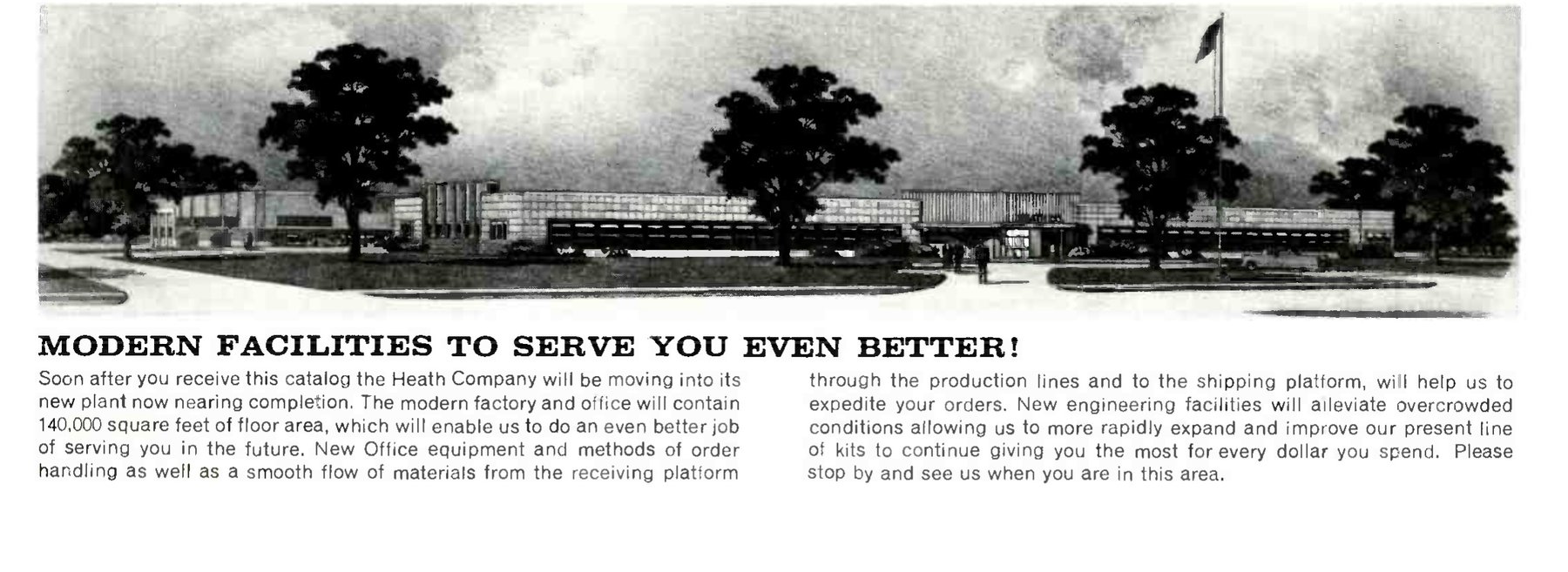
According to Brueschke and Mack, Daystrom “quickly drew up plans” for a large new facility. Construction began in 1957 on a site on Hilltop Road, south of St. Joseph, the twin city across the St. Joseph River from Benton Harbor. The building was finished in early 1958, just before the company moved in. The 1958 catalogue gave customers advance notice:
“Soon after you receive this catalog the Heath Company will be moving into its new plant now nearing completion. The modern factory and office will contain 140,000 square feet of floor area…” (Heathkit catalogue 1958)
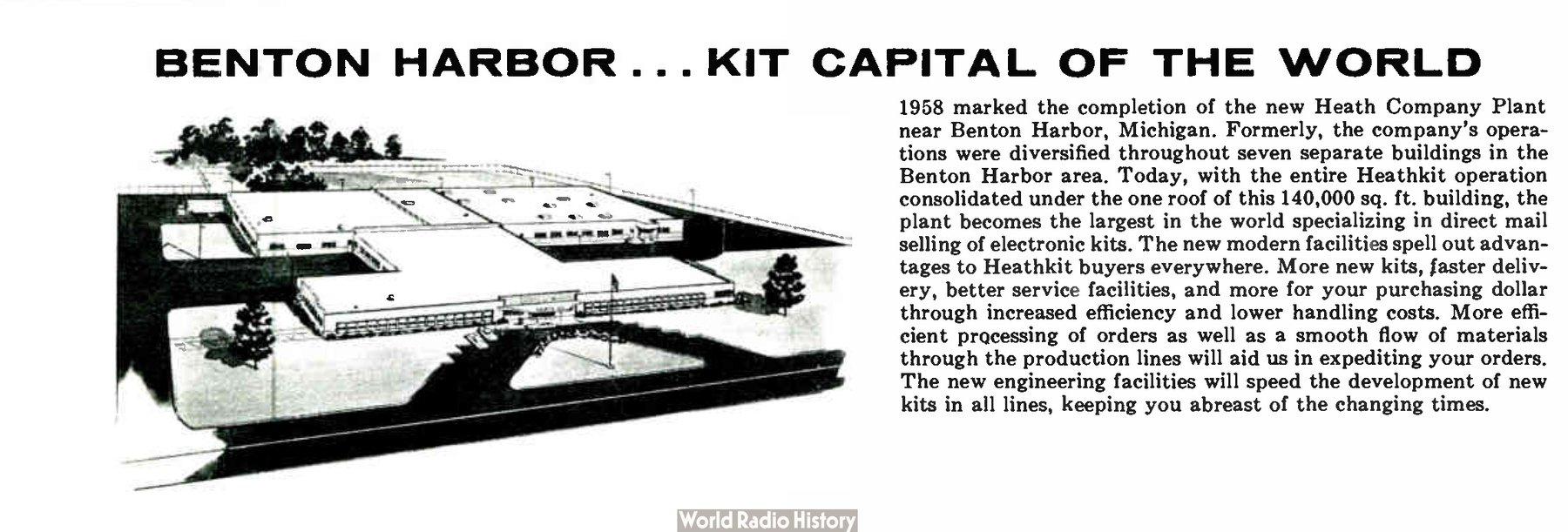
The same page promised new office equipment and methods of order handling, and “a smooth flow of materials from the receiving platform through the production lines and to the shipping platform.” It also promised new engineering facilities that would “alleviate overcrowded conditions.” The catalogue invited readers who were in the area to stop by. The following year’s catalogue reported the move as done, calling Benton Harbor the “kit capital of the world.” With the whole Heathkit operation “consolidated under the one roof of this 140,000 sq. ft. building,” it said, the plant was “the largest in the world specializing in direct mail selling of electronic kits” (1959 catalogue, p. 14).
3.4.1 The address that did not move
The plant stood in St. Joseph, but the company kept Benton Harbor as its address. Brueschke and Mack say a post office was established at Benton Harbor for the purpose. Gilmore explains that by then “the Heath Company of Benton Harbor, Michigan was famous, and nobody wanted to tamper with that address” (EEJournal, part 1). Catalogues of the 1960s printed both: “Heath Company, Benton Harbor, Michigan / Plant location: St. Joseph, Michigan” (Fall and Winter 1962–63 catalogue). Later catalogues gave directions to visitors: “on Hilltop Rd. just off Business route I-94, south of St. Joseph” (Heathkit 1966 catalogue). Visiting radio amateurs later described the same geography: the “Benton Harbor” factory was in fact in St. Joseph (WD8DAS, “Heath Factory”).
By 1972 the mail volume justified a full U.S. Post Office branch inside the plant “just for Heath,” handling about ten million pieces of mail a year (Schlumberger Annual Report 1972). Gilmore recalls that Heath had its own ZIP code “just to manage the mail” (EEJournal, “Heathkits and Hams,” part 5).
3.4.2 How big, and what shape
Two numbers circulate for the size of the 1958 building, 140,000 and 150,000 square feet. A third, 205,000, appears in later catalogues. They can be reconciled.
- 140,000 sq ft is the figure Heath itself gave in 1958 and 1959, when the building was new.
- 150,000 sq ft comes from Gilmore’s recollection, repeated in the EEJournal series. It is also the figure given in the YouTube retellings. He also remembers the building as “designed in the shape of an ‘H’” (EEJournal, part 1). Heath never gave the H shape as a design fact in any catalogue consulted here, but aerial photographs in later catalogues show a building made of connected wings. The layout of those wings is consistent with an H that was later “filled in,” as Gilmore put it.
- 205,000 sq ft appears in the Schlumberger annual report for 1965 as the size of Heath’s headquarters plant (Schlumberger Annual Report 1965). The 1966 catalogue says that “a modern 205,000 sq. ft. plant … was constructed in 1958.” That sentence projects the building’s size at the time of printing back onto the year it opened. Gilmore separately remembers an expansion in 1962 (EEJournal, “Heathkits and Hams,” part 5), and that is the most likely source of the extra 65,000 square feet.
This dive therefore uses 140,000 square feet for the building as opened in 1958. The later expansions, which took the plant to roughly half a million square feet, belong to the Schlumberger years and are covered in the next volume.
3.4.3 Inside the new plant
The 1958 catalogue used its bottom margins to walk the customer through the organisation behind the kit. Its photographs are the best record of what Heath looked like at the moment of the move.
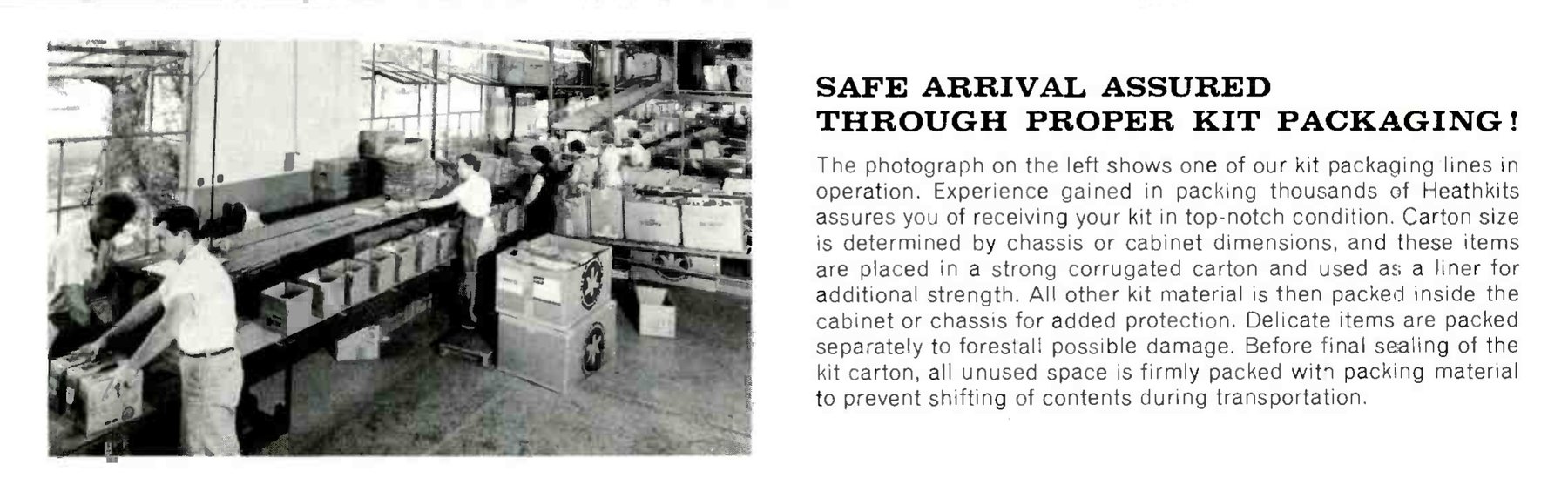
The packaging line was where a Heathkit took physical shape as a product. The catalogue explained that the carton size was set by the chassis or cabinet, which went into a strong corrugated carton and served as an extra liner. Everything else was packed inside the cabinet or chassis. Delicate items were packed separately, and all unused space was filled “to prevent shifting of contents during transportation.” The photograph shows workers at long packing benches, the pattern for kit production at Heath for the next thirty years. Much of the “manufacturing” in a kit company is picking, counting and packing, not assembly.
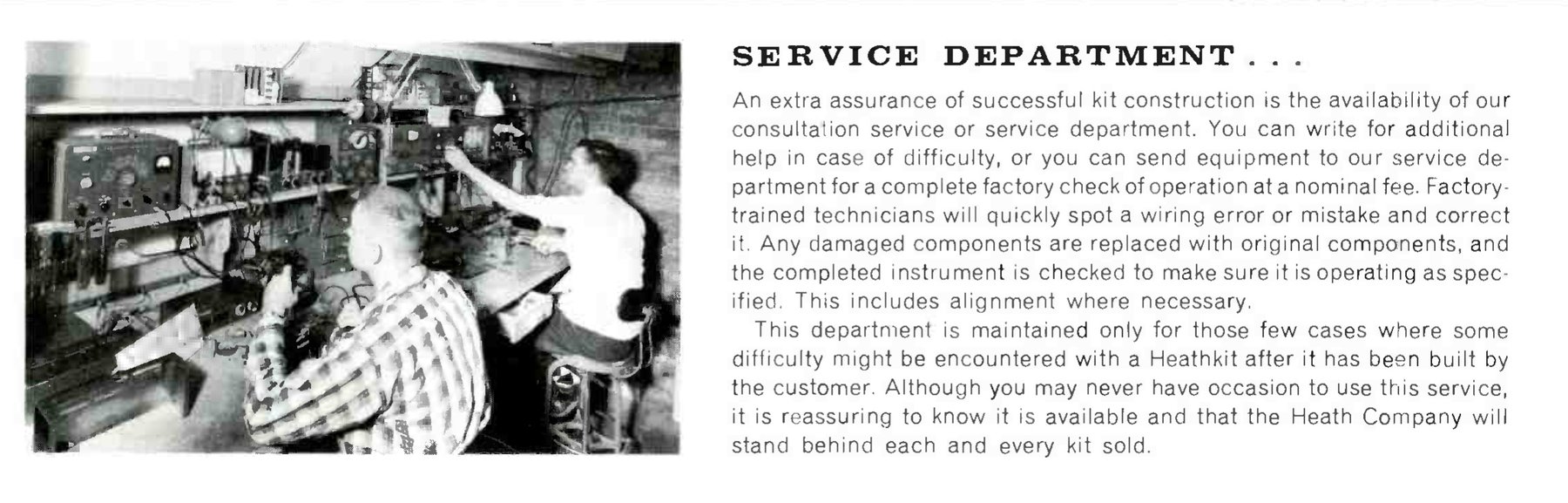
The service department was the promise behind the product. In 1958 a builder whose kit would not work could write for help or send the instrument to Benton Harbor “for a complete factory check of operation at a nominal fee.” Factory technicians would find the wiring error, replace damaged parts with original components and realign the set where necessary. The catalogue presented the department as a reassurance “maintained only for those few cases where some difficulty might be encountered” (Heathkit Virtual Museum, “Service Department,” quoting the 1958 catalogue). The consultation service answered technical letters free of charge. Heath’s “factory trained engineering consultants” would give “a prompt and personal reply” (Heathkit Virtual Museum, “Consultation Department”). The mail-order department described Heath as “strictly a Mail Order firm” whose sales went directly from factory to consumer, so the customer would “pocket the middleman’s profit” (Heathkit Virtual Museum, “Mail Order Department”).
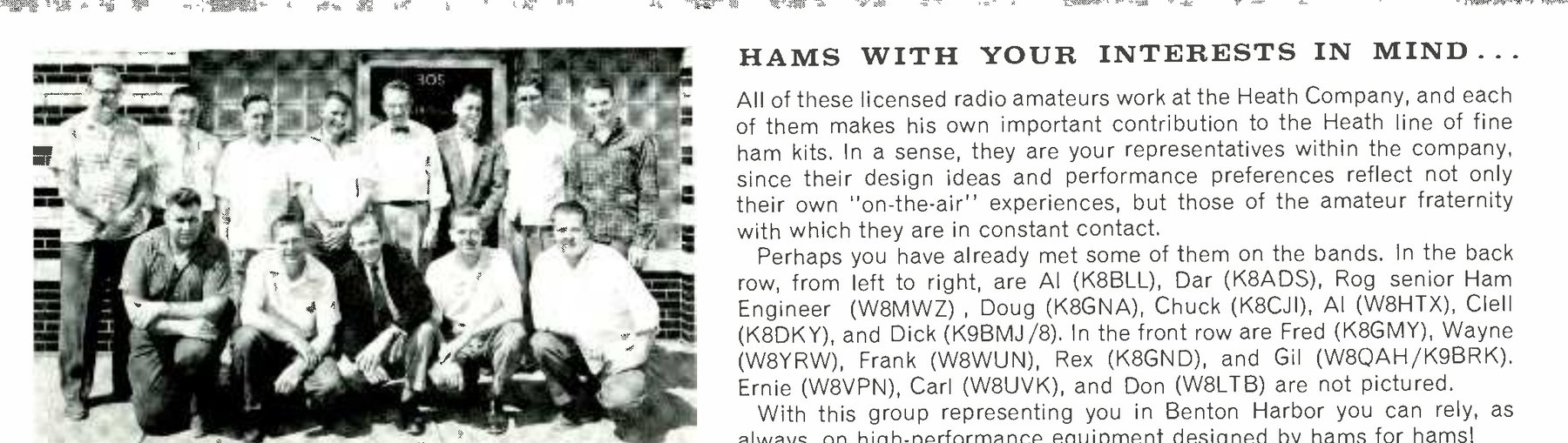
The same catalogue introduced the people who designed the ham gear. It printed a group portrait of sixteen licensed amateurs on the staff, from the senior ham engineer Rog (W8MWZ) to Gil (W8QAH/K9BRK), under the heading “Hams with your interests in mind.” The text called them “your representatives within the company,” whose design preferences reflected their own on-the-air experience (Heathkit Virtual Museum, “Heath Hams”). Heath’s amateur-radio line was designed by radio amateurs, and the company made sure its customers knew it.
3.5 “Heathkit by Daystrom”
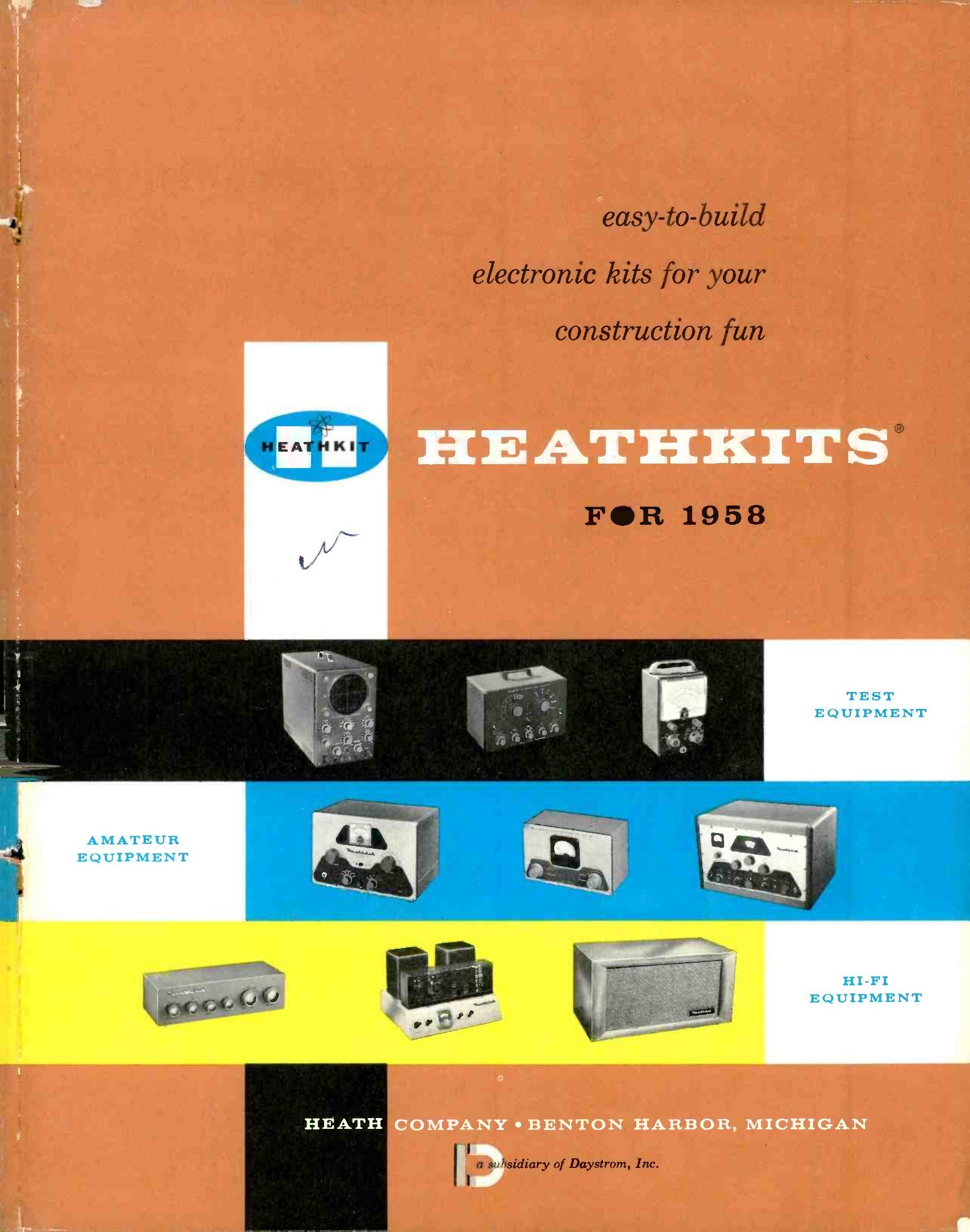
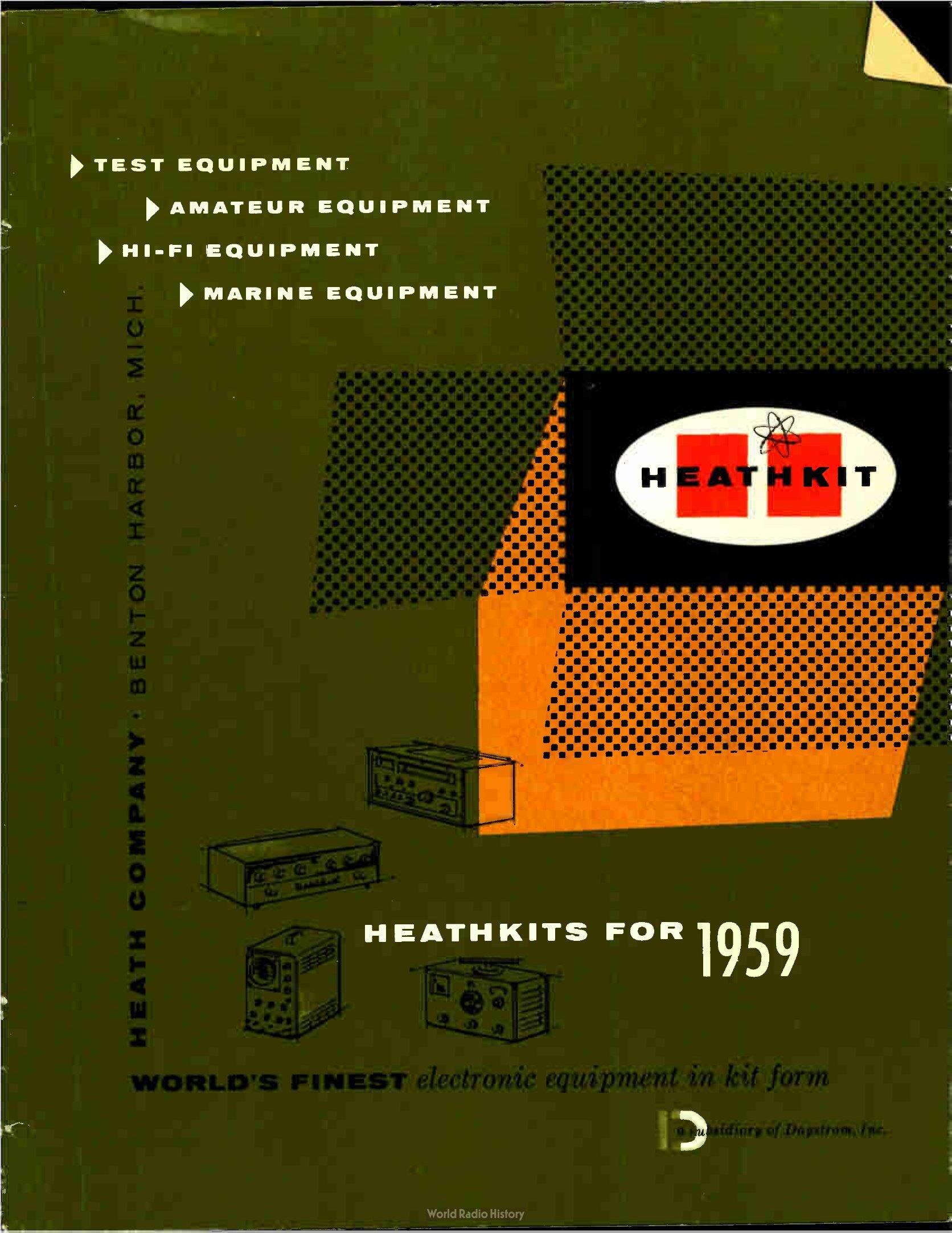
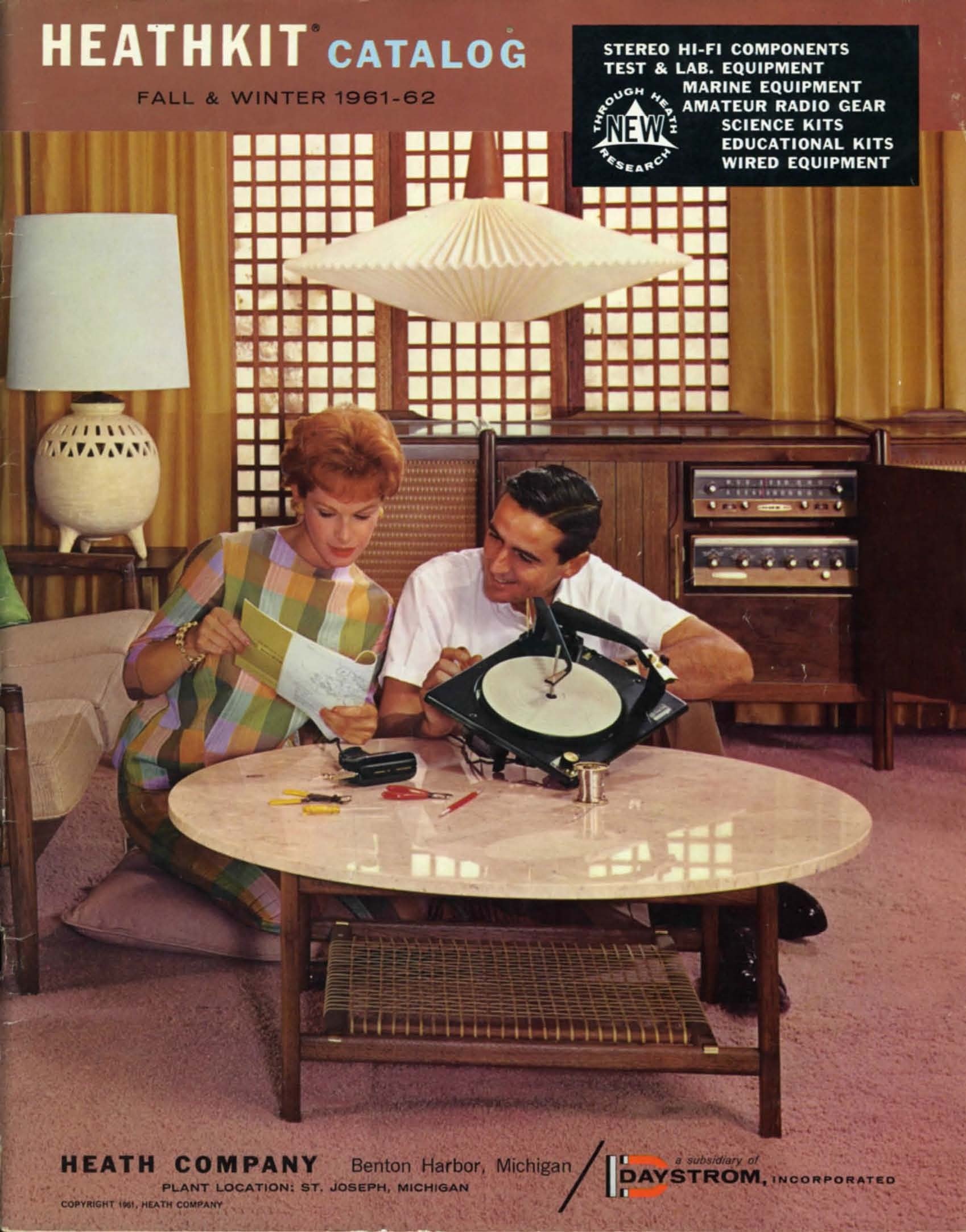
Daystrom was self-effacing as a manager but not as a brand. From 1958 the running head on catalogue pages read “HEATHKIT by Daystrom,” and covers carried “a subsidiary of Daystrom, Inc.” (1958 catalogue). The words “Daystrom” or “Daystrom, Inc.” appear more than fifty times in the 1958 catalogue. The 1961 Fall and Winter catalogue carries the Daystrom logo in its lower corner (1961 Fall–Winter catalogue).
Brueschke and Mack add a further detail. In late 1961 Daystrom introduced a series of kits that were sometimes essentially the same as existing Heathkits but had enhanced styling and manuals and carried both the Daystrom and the Heath names. The joint branding outlived Daystrom’s ownership. The Fall and Winter 1962–63 catalogue still described Heath as “A Subsidiary of Daystrom, Incorporated.” In corporate terms that was accurate: Schlumberger kept Daystrom as an intermediate company until 1964. Brueschke and Mack put the disappearance of the Daystrom name from Heath catalogues at about 1964. The last traces lasted longer. The 1967 and 1968 catalogues state that all Heathkit Electronic Centers “are units of Daystrom Products Corporation” (Heathkit 1967 catalogue; 1968 catalogue).
3.6 The product explosion
The Anthony-era catalogue was mostly test equipment. In 1954 it listed 48 kits, and in 1955 it listed 53 (Post, citing the 1954 and 1955 catalogues). Gilmore’s count from the 1956 catalogue is nine amateur-radio products and forty-two test-equipment kits. “The real focus,” he says, “was on service instruments at that time,” because vacuum-tube television sets were going into every home and their unreliability created a large market for test gear (EEJournal, “Heathkits and Hams,” part 1). By 1961, in his count, the catalogue ran to about 100 pages, some in colour, with 180 products, 29 of them for amateur radio and 36 instruments (EEJournal, “Heathkits and Hams,” part 2). The Fall and Winter 1962–63 catalogue claimed “over 250 kits … the greatest lineup of electronic kits in the world.” It also reported “more than 100 new and restyled kits since the last edition” (1962–63 catalogue).
Those counts are not directly comparable. Heath’s own “over 250” counted each variant, and later catalogues counted accessories as well. Gilmore and Post counted distinct products. Schlumberger’s 1963 annual report, written for shareholders rather than customers, put the figure at 200 Heathkits (Schlumberger Annual Report 1963). By any of these measures the line roughly quadrupled between the sale in 1955 and the Schlumberger takeover in 1962.
3.6.1 The transmitters that made Heath a ham company
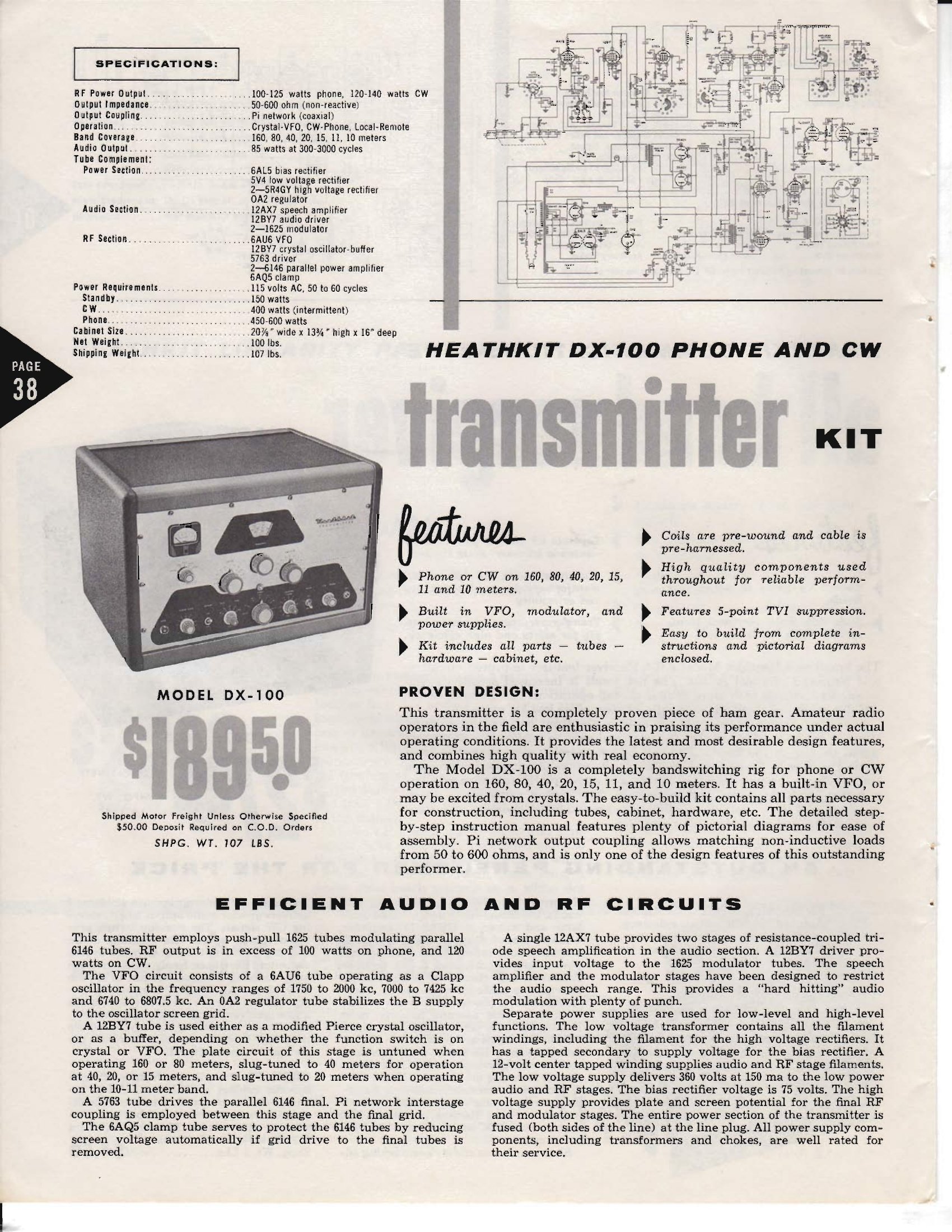
The DX-100 was the product that turned Heath from a test-equipment house with a few ham accessories into a major amateur-radio manufacturer. Gilmore dates its introduction to 1955 at $189 (EEJournal, part 1). The 1956 catalogue lists it at $189.50, with a shipping weight of 107 lb, shipped by motor freight with a $50 deposit on C.O.D. orders. The catalogue describes a bandswitching transmitter for phone and CW on 160, 80, 40, 20, 15, 11 and 10 metres. It had a built-in VFO (a 6AU6 Clapp oscillator) or crystal control, a pair of 6146 tubes in parallel in the final amplifier, push-pull 1625 modulators, and a pi-network output that would match loads of 50 to 600 ohms. The catalogue gave RF output as “in excess of 100 watts on phone, and 120 watts on CW” (Heathkit 1956 catalogue, p. 50).
Brueschke and Mack say that Heath arrived at the DX-100 by reverse-engineering the E. F. Johnson Viking II. The Viking II sold for about $100 more. They add that the DX-100’s success allowed Heath to hire graduate engineers “so that Heath could abandon the reverse engineering of other manufacturer’s products and develop original designs of its own” (Brueschke and Mack). Their reading is that the DX-100 financed both Heath’s advertising and its engineering.
Below the DX-100 sat a ladder of cheaper transmitters for novices. The DX-35 of 1956 was a 65-watt CW, 50-watt phone rig with a single 6146 final and three switch-selected crystals, at $56.95 (1956 catalogue). Gilmore bought one as his first commercial transmitter. It was followed by the DX-20 (in the 1958 catalogue), the DX-40 (in the 1959 catalogue) and, in the 1960s, the DX-60 series (EEJournal, part 2). The receivers climbed a similar ladder, from the AR-2 of 1952–55 to the AR-3. The accessories made the station complete: the VF-1 VFO, the AC-1 antenna coupler, the QF-1 Q-multiplier and the GD-1 grid-dip meter. Gilmore says Heath sold more than 15,000 GD-1s in their first two years.
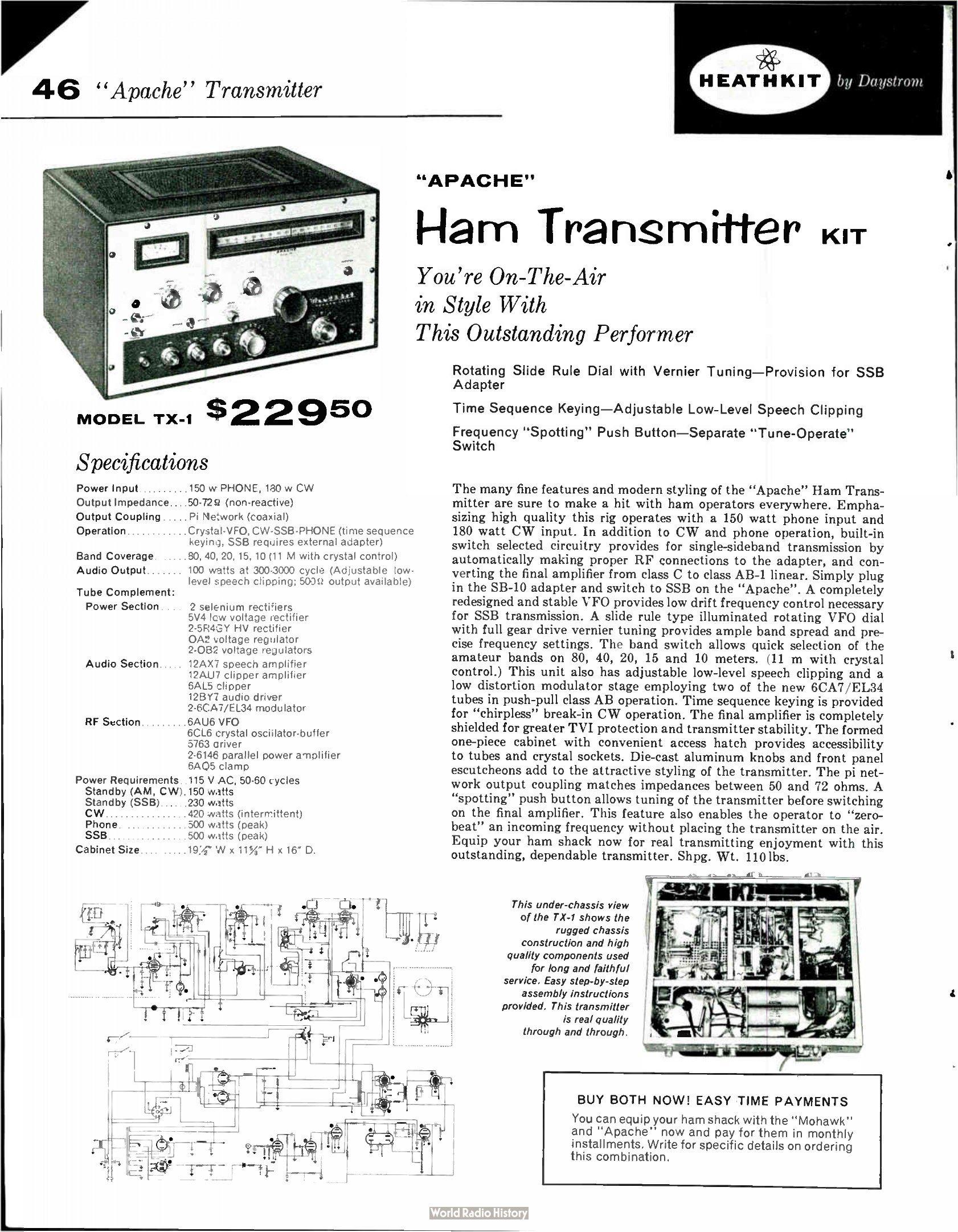
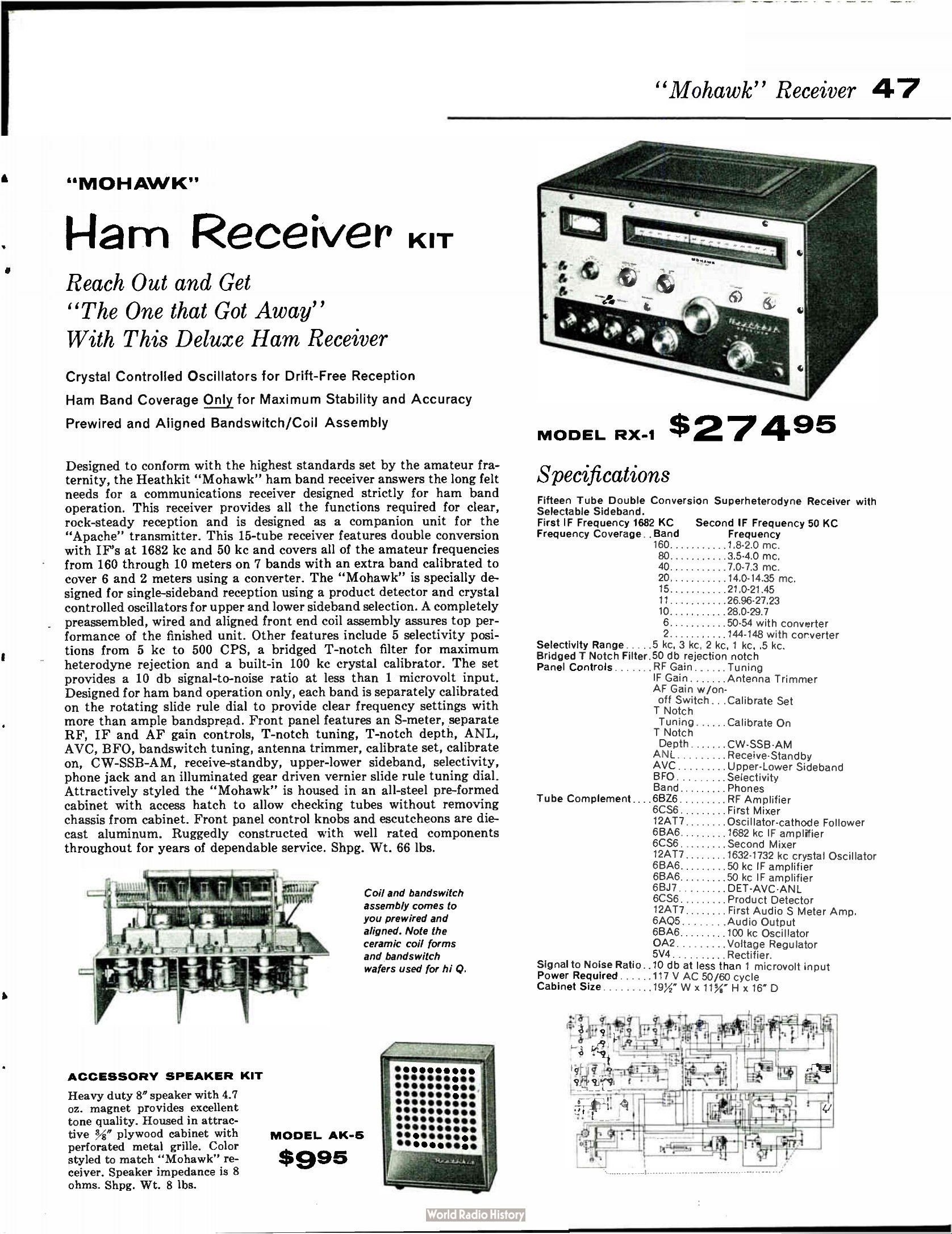
The top of the line came at the end of the decade. The “Apache” TX-1 transmitter and the matching “Mohawk” RX-1 receiver were the first of Heath’s big cabinet stations named after tribes. The 1959 catalogue priced the Apache at $229.50 and the Mohawk at $274.95 (1959 catalogue, pp. 46–47). The Apache ran 150 watts phone and 180 watts CW input, and the catalogue already offered a way to single sideband. The SB-10 adapter was “designed as a compatible plug-in adapter unit for the TX-1 ‘Apache’” and could also be used with the DX-100. It generated SSB by the phasing method rather than with a filter. The Seneca VHF-1 extended the same styling to 6 and 2 metres.
Gilmore dates the Mohawk and Apache to “the early 1960s” and gives kit prices of $299.99 and $252.50. His dates and prices are one to three years late for the introduction, since both sets are in the 1959 catalogue at the lower prices. They may reflect later price lists. On Gilmore’s account, the tribal names kept multiplying: the Warrior kilowatt linear, the Shawnee (6 m) and Pawnee (2 m) mobile transceivers of 1961, the Marauder SSB transmitter, and the MR-1 “Comanche” receiver and MT-1 “Cheyenne” transmitter, a mobile pair at $119.95 and $99.95. Heath also sold and the “Benton Harbor Lunchbox” series of self-contained AM transceivers: the Tenner, Sixer and Twoer at $44.95 (EEJournal, part 2). The Marauder HX-10 appears in the Fall and Winter 1962–63 catalogue. The Cantenna dummy load, introduced in 1961 at $9.95, stayed in production until the early 1990s. Gilmore believes it sold “more than a couple of hundred thousand” over thirty years, likely more than any other Heath ham product.
The lineage from the DX-100 to the later SB-301/SB-401 pair, which the YouTube retellings compress into “successor,” is loose. The DX-100 was an AM/CW transmitter of 1955. Its commercial successor in the Heath line was the Apache, with SSB added through the SB-10 adapter. The SB series of 1964 was a clean-sheet single-sideband system built around a pre-assembled linear master oscillator. Several of the engineers who designed it came from Collins (EEJournal, part 2). The SB-301 and SB-401 were revisions of that 1964 system. They succeeded the DX-100 only in the sense that they became Heath’s flagship station a decade later.
3.6.2 Test equipment grows up
Test instruments remained the base of the business under Daystrom. The V-7 vacuum-tube voltmeter introduced the printed circuit board to Heathkits. Its board carried the part number 85-1. Brueschke and Mack record that the V-7’s 1/8-inch board was prone to breakage, and the V-7A of early 1955 increased its thickness. They describe the change as 50 per cent, which is inconsistent with their own figure of 3/32 inch. Gilmore gives the new thickness as 3/16 inch. The V-7A sold for $24.50 from 1955 to 1961. It was one of the most popular VTVMs ever made, and its 34-page manual is Brueschke and Mack’s example of a fully developed Heathkit manual (Brueschke and Mack). Heath claimed that the printed board cut construction time by half. Management had worried that printed circuits would spoil the building experience, and the worry proved unfounded. Heathkits used printed boards for the next four decades.
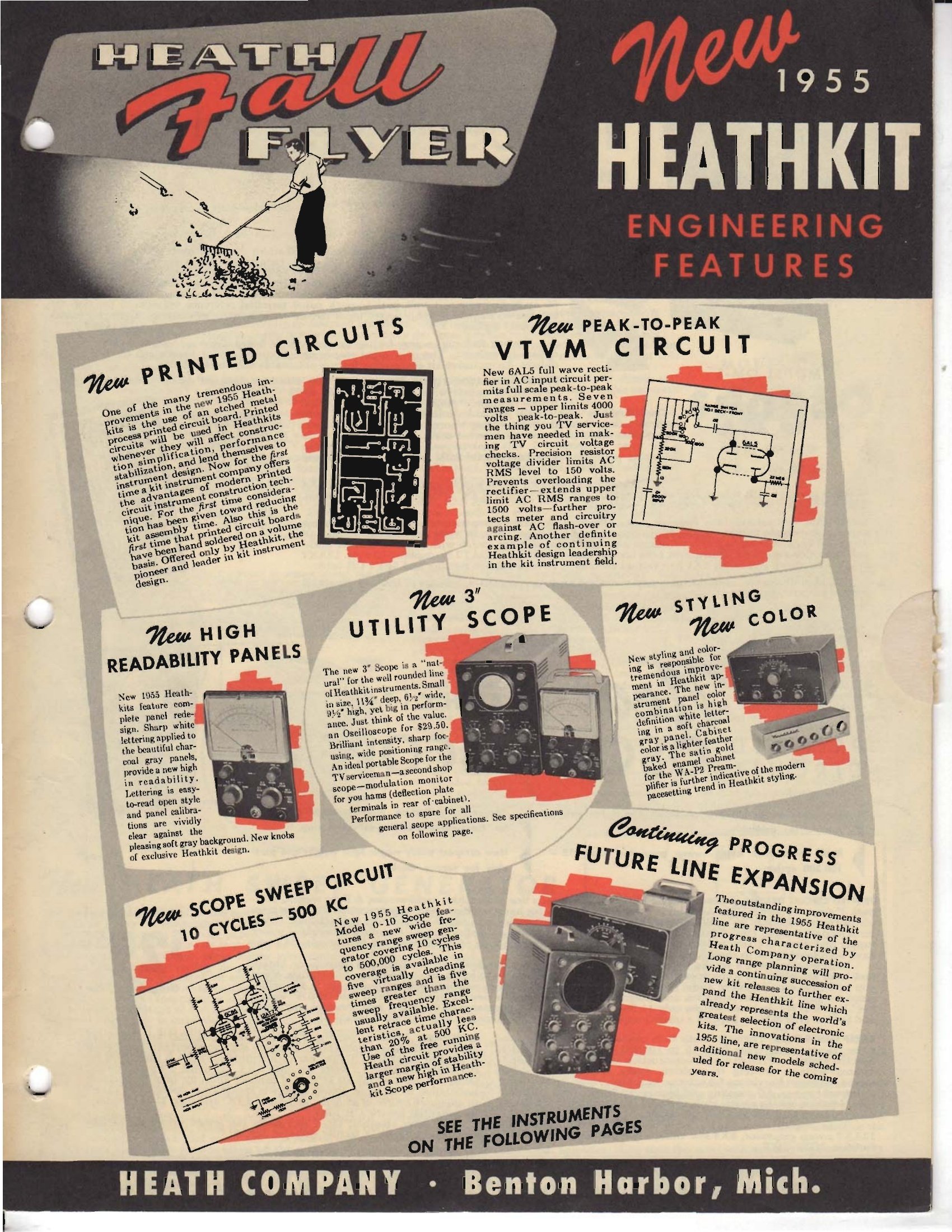
The Fall 1955 flyer, the first catalogue season under Daystrom, advertised exactly this progress. It headlined “new printed circuits,” a “new peak-to-peak VTVM circuit,” a new utility scope and a new scope sweep circuit (Fall 1955 flyer). By 1956 the flagship oscilloscope was the O-11, and the low-priced OM-2 offered a 1 MHz bandwidth. There were five audio generators, RF signal generators, power supplies and a wide range of television service instruments. The 1958 catalogue added a radiation counter kit at $79.95, sold during the Cold War fallout scares (1958 catalogue).
3.6.3 Hi-fi, the audio boom and the “Legato”
Audio was the growth line of the late 1950s. Anthony had entered high-fidelity with Williamson-type amplifiers in the W series. Under Daystrom the line widened into preamplifiers, AM and FM tuners, crossovers and speaker systems, and after 1958 into stereo. Gilmore calls the period “the heyday of big-time audio for Heath,” when “not many audio products came from Japan” (EEJournal, part 2). The 1959 catalogue’s top speaker system, the “Legato,” sold for $299.95 in kit form, and Heath’s Benton Harbor and St. Joseph plants both contained audio test chambers. Gilmore argues that speaker kits made more economic sense than they appear to. A good speaker enclosure is labour-intensive to build and finish, and the builder supplied that labour.
3.6.4 An analog computer, marine gear and the classroom
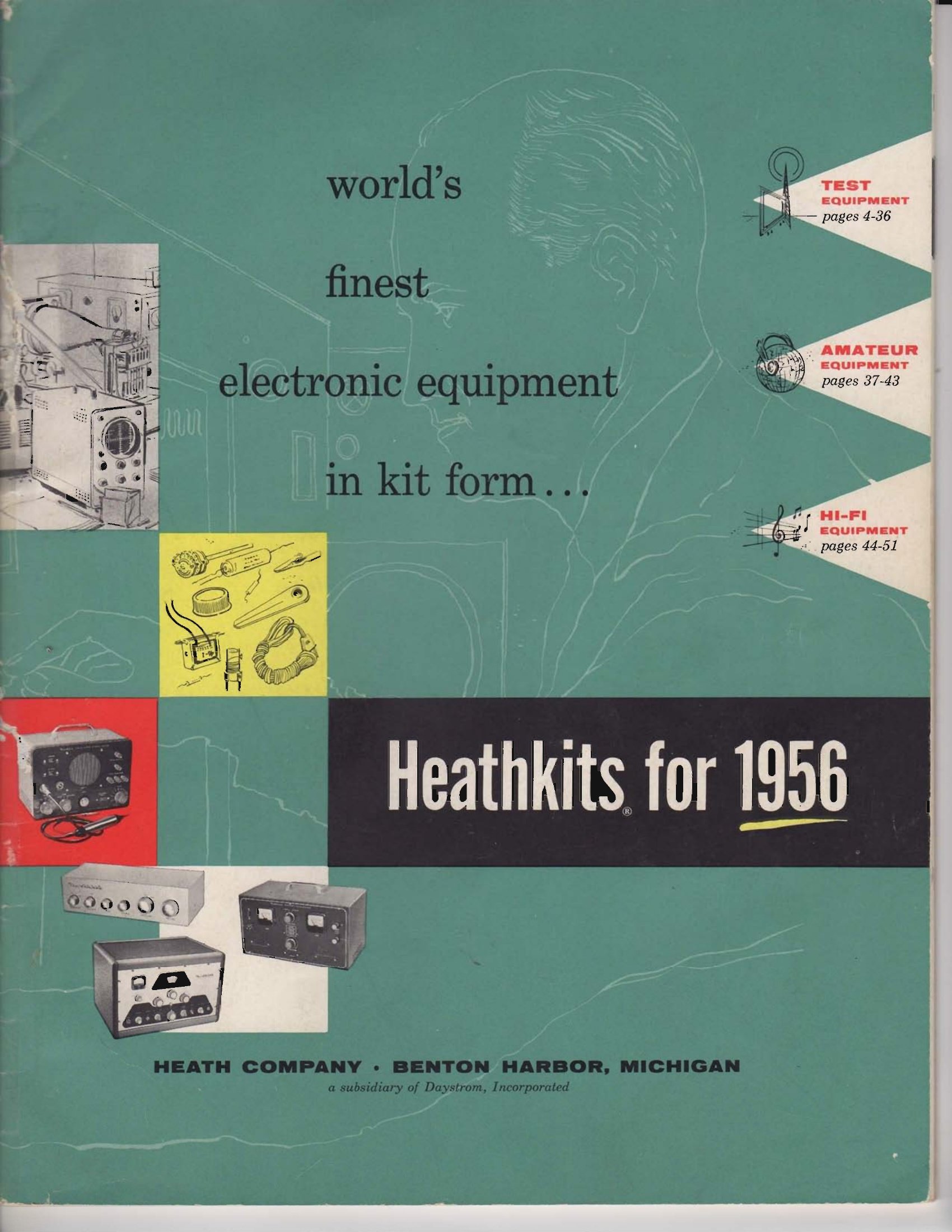
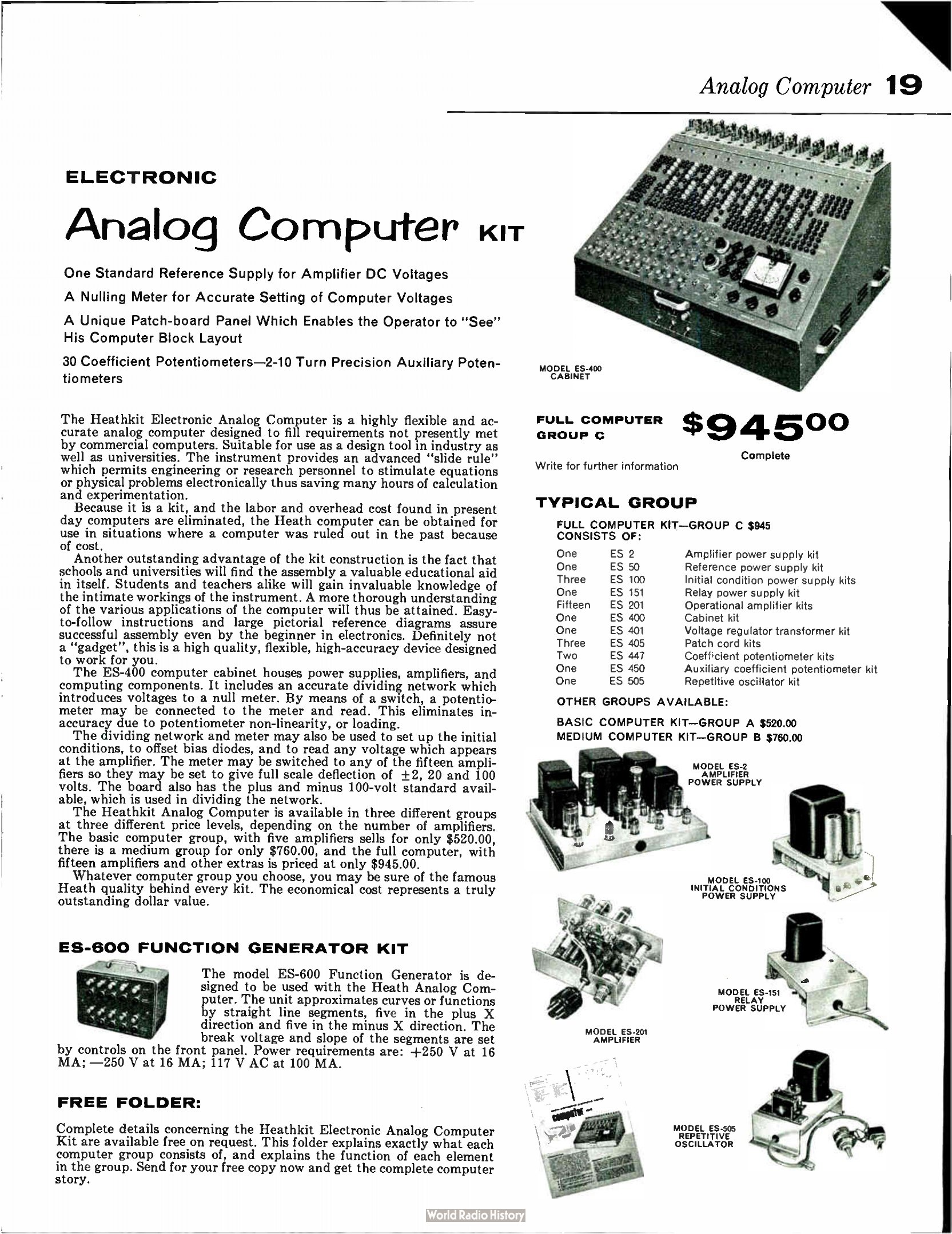
The late Daystrom catalogues show Heath moving into markets far from its base in service instruments. The 1959 catalogue offered an electronic analog computer kit, the EC-1, at $945 (1959 catalogue, p. 27). It was a teaching machine that put operational amplifiers, patch panels and potentiometers into classrooms, and it is covered in its own dive in the Analog Computers wing of this site. The same catalogue’s cover listed four divisions: test equipment, amateur equipment, hi-fi equipment and marine equipment. Marine radiotelephones and depth sounders led Heath to buy a cabin cruiser, which it kept in the Benton Harbor–St. Joseph marina to test the gear on Lake Michigan (EEJournal, part 2). Citizens Band sets arrived as well. Gilmore recalls that they made amateurs “grind their teeth,” because the new band had been taken from the old amateur 11-metre allocation.
Education became a product line of its own at the end of the Daystrom years. In 1962, the Schlumberger annual report later recalled, “Heath began the development of a line of assembled products to fill a need for low-cost specialized equipment to teach electronics to scientists.” The first of them, a strip-chart recorder, went on sale in August 1963 (Schlumberger Annual Report 1972). This work with Howard Malmstadt of the University of Illinois and Christie Enke of Princeton is covered in the next volume, because it developed under Schlumberger.
3.7 The engineering organisation Daystrom paid for
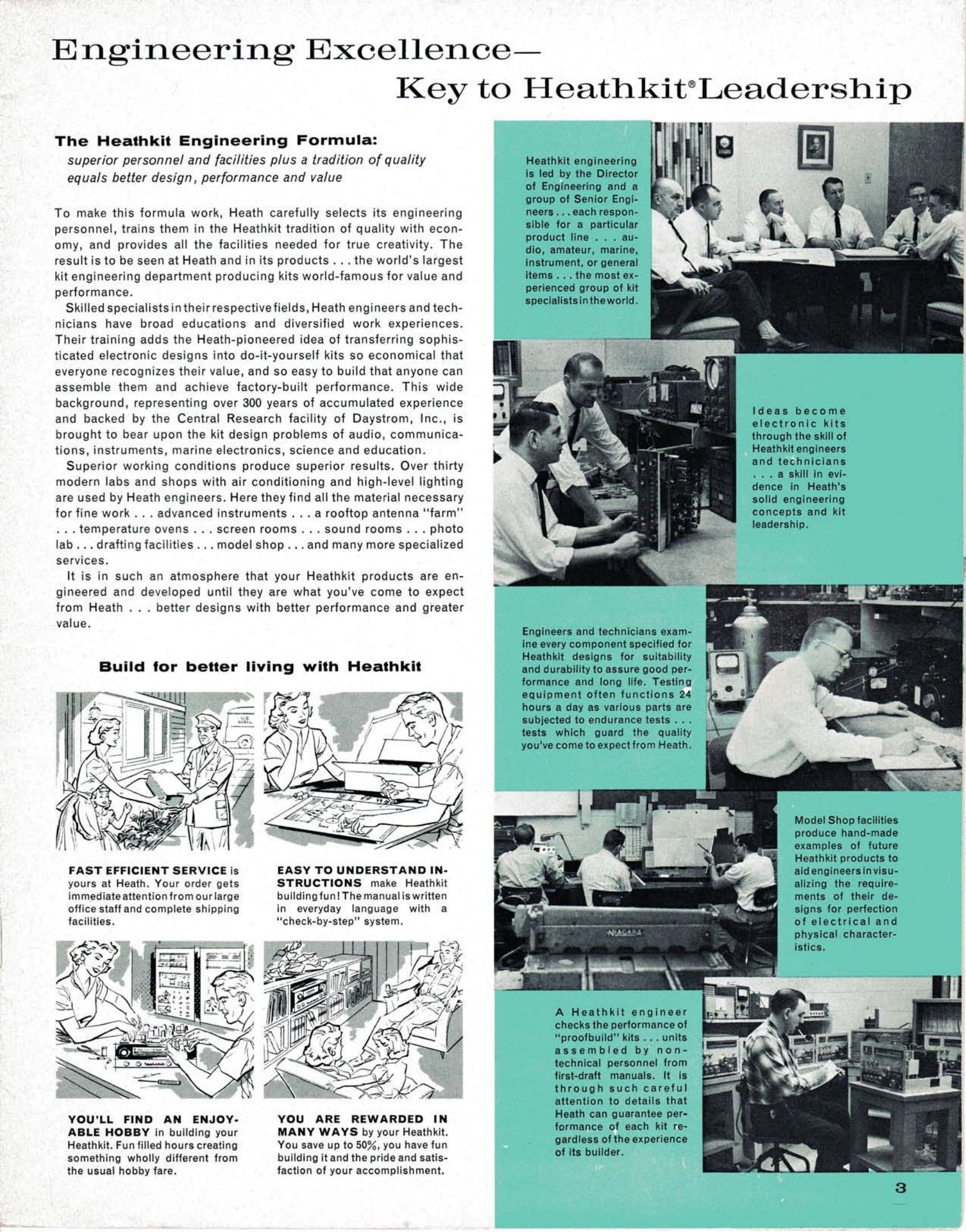
The best description of Heath’s engineering at the end of the Daystrom period is the “Engineering Excellence” spread in the March 1962 catalogue. It shows the organisation that the DX-100 profits and the new building had made possible. Heath described “the world’s largest kit engineering department,” with “over 300 years of accumulated experience” among its staff. It was “backed by the Central Research facility of Daystrom, Inc.” and applied to “audio, communications, instruments, marine electronics, science and education.” Its engineers worked in “over thirty modern labs and shops with air conditioning and high-level lighting.” The facilities included a rooftop antenna farm, temperature ovens, screen rooms, sound rooms, a photo lab, drafting facilities and a model shop.
The spread describes the structure: a Director of Engineering and a group of senior engineers, “each responsible for a particular product line … audio, amateur, marine, instrument, or general items.” It also describes the procedures that later became the core of the Heathkit method. Components were endurance-tested, with test equipment “often” running twenty-four hours a day. And “proofbuild” kits were assembled “by non-technical personnel from first-draft manuals,” so that Heath “can guarantee performance of each kit regardless of the experience of its builder” (March 1962 catalogue, p. 3). The proof-build system is described in detail in the volume on how a Heathkit manual works.
3.8 Heath abroad
Heath’s international business also began under Daystrom. Brueschke and Mack record that Daystrom “established Heath distribution centers in Canada, Germany, and England.” The mid-1960s catalogues list the resulting companies as “Affiliated Companies.” They were Daystrom Ltd. at Cooksville (Toronto), Ontario; Daystrom Ltd. at Gloucester, England; and Heathkit Geräte GmbH at Sprendlingen, near Frankfurt. A 1965 catalogue adds Daystrom S.A. offices in Geneva and Zurich (1965 catalogue, p. 2; 1966 catalogue). The German company sold Heathkits duty-free at U.S. catalogue prices to American military personnel in Europe, plus a surcharge for freight (1967 catalogue). Foreign-language catalogues followed. The World Radio History archive holds Italian Heathkit catalogues for 1961 and 1964, a French amateur-radio catalogue of 1969 and a German catalogue of 1978 (World Radio History, Heathkit catalogue index).
The English company eventually became a manufacturer as well as a distributor. By 1972 the Gloucester plant produced kits for sale in Europe, and its engineering group designed products for European preferences. Instructions were prepared in English, French and German (Schlumberger Annual Report 1972).
3.9 The end of Daystrom
In the early 1960s Schlumberger, the French-founded oilfield measurement company, was building an electronics and instrumentation group, and Daystrom owned the piece it most wanted. Gilmore gives the motive: Schlumberger “acquired Daystrom because it owned Weston instruments, a premier electronic instrumentation company at the time … Along with the deal came this little electronic kit company in St. Joe, Michigan” (EEJournal, part 2). Brueschke and Mack put it more simply: Schlumberger bought Daystrom “in order to get Weston and got Heath as well.”
Schlumberger’s 1962 annual report gives the terms. Schlumberger acquired “the business and net assets of Daystrom, Incorporated on February 1, 1962 in exchange for 629,820 shares of previously unissued Schlumberger common stock.” The deal was accounted for as a pooling of interests, so Schlumberger restated its 1961 figures to include Daystrom. It also took over $10.0 million of Daystrom sinking-fund debentures due in 1980 (Schlumberger Annual Report 1962). The transaction thus closed seven years to the day after Helen Anthony’s and Thomas Roy Jones’s letters. The dates are consistent with the report and with Post. The occasional statement that Schlumberger bought Daystrom in 1961, repeated by Post, probably reflects when the deal was agreed rather than when it closed.
Daystrom did not disappear at once. For two years it was an intermediate Schlumberger subsidiary with its headquarters still at Murray Hill. In 1963 its Control Systems Division at La Jolla was sold to Control Data Corporation, and several operations were folded into Weston at Newark. In 1964 “the name of our subsidiary, Daystrom, Inc., was changed to Weston Instruments, Inc.,” and the Murray Hill property was sold (Schlumberger Annual Reports 1963 and 1964). Thomas Roy Jones retired in 1963 (Wikipedia). By 1964 Schlumberger listed Heath as one of five electronics companies in its group, alongside Electro-Mechanical Research, Weston, Solartron and the Société d’Instrumentation Schlumberger. Heath now reported directly to Schlumberger rather than through Daystrom.
3.10 What the Daystrom years added up to
Table 1 — What the Daystrom years added up to
| At the sale (early 1955) | At the Schlumberger merger (1962) | |
|---|---|---|
| Owner | Helen Anthony (estate of Howard Anthony) | Daystrom, Inc. (to 1 Feb 1962), then Schlumberger |
| Price | about $1.8 million (Brueschke and Mack) | 629,820 Schlumberger shares for all of Daystrom |
| Annual sales | about $5 million (Gilmore, for 1956) | $20 million, all mail order (Schlumberger, 1972) |
| Premises | seven buildings in Benton Harbor | 140,000 sq ft plant on Hilltop Road, St. Joseph (1958), about 205,000 sq ft by 1965 |
| Catalogue | 53 kits (1955) | about 180 products (1961, Gilmore); 200 kits (Schlumberger 1963 report); “over 250” (Heath’s own count, 1962–63) |
| Amateur radio | AT-1, AR-2, VF-1 and similar | DX-35/40/100, Apache, Mohawk, Seneca, Marauder, mobile and “Lunchbox” sets |
| Abroad | none | Daystrom Ltd. (Canada, England), Heathkit Geräte (Germany), Swiss offices |
| Retail stores | none | the first, Denver, opened March 1962 (see next volume) |
3.10.1 A short chronology
Table 2 — A short chronology
| Date | Event |
|---|---|
| 23 July 1954 | Howard Anthony killed in an air crash |
| 31 Jan–1 Feb 1955 | Daystrom acquires Heath; letters from Helen Anthony and T. R. Jones dated 1 February |
| 1955 | DX-100 introduced; V-7A VTVM released |
| 1956 | Catalogue lists 9 ham and 42 test-equipment kits; DX-35 at $56.95 |
| 1957 | Construction starts on the Hilltop Road plant |
| Early 1958 | Plant completed (140,000 sq ft); operations consolidated from seven buildings |
| 1959 | Apache TX-1, Mohawk RX-1, SB-10 SSB adapter, EC-1 analog computer in the catalogue |
| 1961 | Cantenna; Shawnee and Pawnee VHF transceivers; Daystrom-labelled kit variants appear late in the year |
| March 1962 | First Heathkit retail store opens in Denver |
| 1 Feb 1962 | Schlumberger acquires Daystrom’s business and net assets |
| 1964 | Daystrom, Inc. renamed Weston Instruments, Inc.; Daystrom name leaves Heath catalogues about this time |
3.11 Retellings checked against the record
Several statements in popular retellings of this period can now be checked against primary sources.
- “Sold to Daystrom on 1 February 1955.” Confirmed, with the spelling Daystrom. The customer letters are dated 1 February 1955, and Jones’s letter implies the closing took place the day before.
- “The H-shaped St. Joseph plant of 1958, 150,000 sq ft.” Partly confirmed. The plant was completed in early 1958, but Heath’s own 1958 and 1959 catalogues give 140,000 square feet. The 150,000 figure is Gilmore’s recollection. The H shape is also Gilmore’s recollection and is consistent with later aerial views.
- “Expansions in 1962 … 1974.” Consistent with the evidence. Schlumberger’s reports document additions in 1967 (more than 160,000 sq ft), 1968 (office wing) and 1973 (100,000 sq ft), and the plant’s size went from 140,000 in 1958 to 205,000 by 1965. The next volume covers them.
- “Schlumberger bought Daystrom in 1962.” Confirmed: 1 February 1962, for 629,820 shares.
- “DX-100, 1956, about 100 lb, $190, 100 W or more.” Mostly confirmed, but the year is wrong. The DX-100 was introduced in 1955 (Gilmore) and is in the 1956 catalogue at $189.50, with a 107 lb shipping weight and over 100 W phone and 120 W CW output.
- “The SB-301/401 succeeded the DX-100.” Loose. The DX-100’s direct successor as Heath’s top transmitter was the Apache of 1959. The SB-301/401 were revisions of the separate SB system introduced in 1964.
Sources
- Brueschke, Erich E., and Michael Mack. “The History of the Heath Companies and Heathkits: 1909 to 2019.” The AWA Review 32 (2019): 125–. http://www.ontheshortwaves.com/Ads/The_History_of_the_Heath_Companies_and_Heathkits-1909-2019.pdf
- Post, Rich (KB8TAD). “The Heathkit Legacy.” Monitoring Times, July 2013. https://people.ohio.edu/postr/bapix/HLegacy.htm
- Leibson, Steven. “‘H’ is for Heathkits and Hams,” parts 1 and 2 (interviews with Chas Gilmore, W8IAI). EEJournal, 2025. https://www.eejournal.com/article/h-is-for-heathkits-and-hams-part-1-early-days-through-the-1950s/ ; https://www.eejournal.com/article/h-is-for-heathkits-and-hams-part-2-the-1960s/ ; part 5: https://www.eejournal.com/article/h-is-for-heathkits-and-hams-part-5-reasons-for-heaths-success-in-amateur-radio/
- Leibson, Steven. “The Rise and Fall of Heathkit – Part 1: Early Days.” EEJournal, 2024. https://www.eejournal.com/article/the-rise-and-fall-of-heathkit-part-1-early-days/
- Frenzel, Lou. “Heathkit: An Employee’s Look Back” (interview with Chas Gilmore). Electronic Design, 30 November 2020. https://www.electronicdesign.com/blogs/contributed-blogs/archive/communiqu/article/21148923/electronic-design-heathkit-an-employees-look-back
- Schlumberger Limited. Annual Reports 1962–1965, 1972. Internet Archive. https://archive.org/details/01.-schlumberger
- Heath Company catalogues and flyers: Fall 1955 flyer; 1956; 1958; 1959; 1961 Fall–Winter; March 1962; Fall–Winter 1962–63; 1965; 1966; 1967; 1968. World Radio History. https://www.worldradiohistory.com/Archive-Catalogs/Heathkit_Catalogs.htm
- Heathkit Virtual Museum. “History”; “Service Department”; “Consultation Department”; “Mail Order Department”; “Heath Hams” (quoting the 1958 catalogue). https://heathkit-museum.com/hkhistory.html
- WD8DAS. “Heath Factory.” http://www.wd8das.net/HeathFactory.html
- “Thomas Roy Jones.” Wikipedia. https://en.wikipedia.org/wiki/Thomas_Roy_Jones
- “SLB” (Schlumberger). Wikipedia. https://en.wikipedia.org/wiki/SLB
Comments (0)